Choosing the correct empiric antibiotic is an important decision that is based on a complex series of variables. Delay in administration in the setting of severe infection is associated with significant increases in morbidity and mortality. Reference Gaieski, Mikkelsen and Band1 However, choosing an inappropriate broad-spectrum antibiotic can put patients at unnecessary risk of Clostridioides difficile infection and adverse drug events. Reference Spivak, Cosgrove and Srinivasan2 Many antibiotic stewardship interventions include some element of decision support to assist prescribers in making the optimal antibiotic choice given the available information. Reference Davey, Brown and Charani3 Although previous surveys have described prescribers’ perception and knowledge of appropriate empiric antibiotic prescription, few studies have examined how prescribers evaluate clinical factors in empiric antibiotic decisions. Better understanding of the importance prescribers place on clinical factors when making empiric antibiotic decisions has the potential to inform antibiotic stewardship, in particular, the design of educational and clinical decision support system (CDSS) interventions. The purpose of this study was to characterize the importance prescribers place on different clinical factors when making empiric antibiotic decisions.
Methods
We conducted a cross-sectional survey study (Supplement 1 online) of providers who commonly make empiric antibiotic prescribing decisions in the inpatient setting from 4 hospitals in the University of Pennsylvania Health System from February to October 2019: Hospital of the University of Pennsylvania (789 beds), Pennsylvania Hospital (445 beds), Penn Presbyterian Medical Center (357 beds), and Princeton Medical Center (355 beds). Providers ranked the importance of 12 clinical factors on a 5-point Likert scale from not important (1) to extremely important (5) in making empiric antibiotic decisions for clinical vignettes pertaining to three clinical scenarios: uncomplicated urinary tract infection (UTI), sepsis of unknown origin, and uncomplicated community-acquired pneumonia. Clinical scenarios were chosen for variation in severity and likelihood of identifying causative pathogen. We did not strictly define clinical factors to allow for individual prescribers to interpret as pertains to their individual practice. Demographic data were obtained through study questions.
The study was declared exempt by the Institutional Review Board of the University of Pennsylvania. The survey was administered through Qualtrics (Qualtrics, Provo, UT) and was distributed to providers anonymously through email links sent by antibiotic stewardship directors. Primary analyses of survey responses were performed using Skillings-Mack tests, and subanalyses of demographic categories were performed using Kruskal-Wallis tests. All analyses were performed using STATA version 15.0 software (StataCorp, College Station, TX).
Results
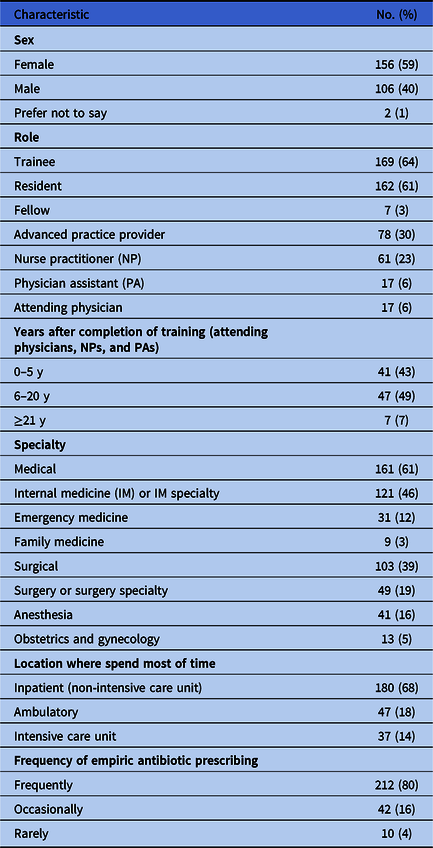
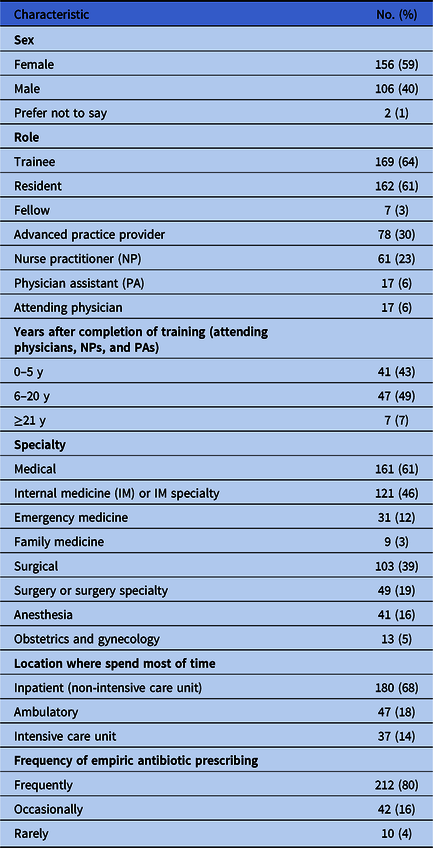
Overall, 264 of 732 (36%) providers responded to the survey (Table 1). Respondent roles included the following: attending (6%), trainee physician (64%), and advance practice provider (APP, 30%). Medical specialties comprised 61% of survey respondents, and surgical specialties comprised 39% of survey respondents. Most of the survey participants spent most of their time in inpatient, non–intensive care unit (ICU) settings (68%), and the remaining participants spent most of their time in ambulatory settings (18%) and ICU settings (14%).
Characteristics of Survey Respondents
Subgroup Analysis of Mean Overall Importance of Clinical Factors for Empiric Antibiotic Prescribing Among All Clinical Scenarios
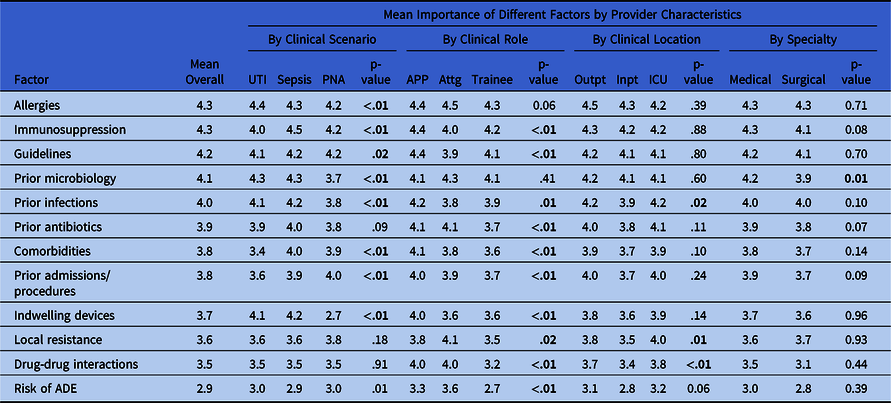
Note. ADE, adverse drug event; APP, advanced practice provider; Attg, attending physician; ICU, intensive care unit; Inpt, inpatient; Outpt, outpatient; UTI, urinary tract infection; PNA, pneumonia.
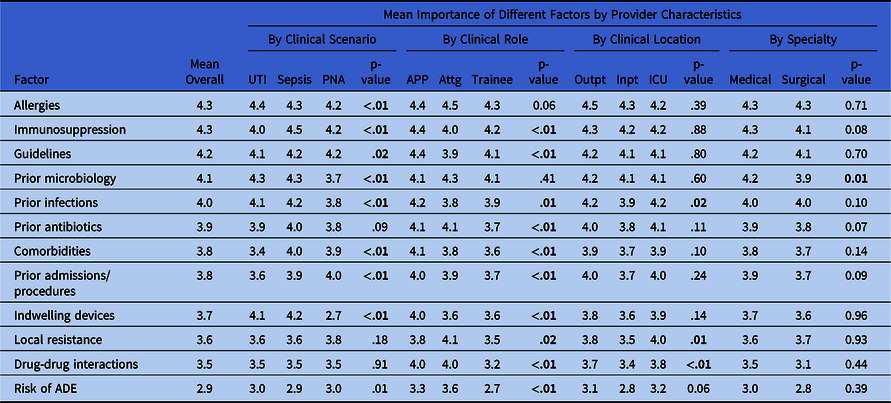
The most important clinical factors across all 3 clinical scenarios were allergies (average Likert score, 4.3), immunosuppression (average Likert score, 4.2), and guidelines (average Likert score, 4.2) (Table 2). The lowest rated clinical factors across the 3 scenarios were risk of adverse drug events (average Likert score, 2.9) and drug–drug interactions (average Likert score, 3.5). The importance of each factor varied significantly among the different clinical scenarios except for local resistance patterns and drug–drug interactions. The greatest absolute mean variation occurred in indwelling devices (absolute Likert-score difference of 1.5 between septic shock and pneumonia; P < .01) and comorbidities (absolute Likert-score difference of 0.6 between septic shock and UTI; P < .01).
Indwelling devices were among the 5 most important factors for septic shock, but the least important factor for pneumonia. Comorbidities were among the 5 most important factors for pneumonia but were the second least important factor for UTI.
Subgroup analysis revealed significant variation in all clinical factors except for prior infection diagnoses and prior microbiology laboratory results based on the type of provider (Table 1). APPs placed greater importance on comorbidities, indwelling devices, and immunosuppression compared to attendings and trainee physicians (P < .01). In contrast, attending physicians placed greater importance on local resistance patterns, risk of adverse drug events, prior admissions and procedures, and drug–drug interactions compared to APPs and trainee physicians (P < .01).
Several factors varied in importance based on where providers spent most of their time. For instance, providers that spent most of their time in the ICU setting placed greater importance on local resistance patterns (P < .01) and drug–drug interactions (P < .01) than did providers that spent most of their time in non-ICU inpatient and ambulatory settings. Medical and surgical providers placed statistically greater importance on only 1 factor: prior microbiology results (P < .01).
Discussion
In this study, we sought to address a gap in knowledge in antibiotic stewardship by providing data on how clinicians prioritize clinical factors when selecting empiric antibiotics. Our findings show that providers vary the importance of clinical factors in empiric antibiotic decisions depending on clinical presentation. Certain factors such as allergies and guidelines remained consistently among the most important factors, whereas factors such as presence of indwelling devices and comorbidities varied among the scenarios. Understanding which factors are most important to prescribers may allow antibiotic stewardship programs to focus on specific areas for education and intervention. For example, allergies may be a key target for provider education. It is consistently important to providers, and β-lactam allergies result in higher rates of broad-spectrum antibiotic use and adverse outcomes. Reference Blumenthal, Lu and Zhang4,Reference Macy and Contreras5 CDSSs have been shown to increase appropriate antibiotic selection and decrease time to appropriate antibiotic therapy, but one challenge in CDSS efficacy has been low adoption rates among prescribers. Reference Chow, Ang and Chow6,Reference Rawson, Moore and Hernandez7 This study, which highlights important clinical factors to prescribers, may improve the presentation of information important to providers, such as prior microbiology or prior antibiotic use in digital CDSS-provider interfaces. Layouts with easily visible, prescriber prioritized information may be more relevant and time saving to clinicians, which has been noted in the literature to improve CDSS adoption. Reference Chow, Ang and Chow6,Reference Rawson, Moore and Hernandez7 The importance of clinical factors in empiric antibiotic decisions varied significantly among providers with different clinical roles. Of all provider types APPs placed the greatest importance on comorbidities, indwelling devices, prior infections, immunosuppression, and guidelines. Attending physicians placed greatest importance on local resistance patterns, risk of adverse drug events, and drug–drug interactions, indicating a potentially more nuanced view of empiric antibiotic selection and risks. Although there is significant variation in the importance APPs, trainees, and attendings place on clinical factors when prescribing empiric antibiotics, remarkably, there is little difference between importance placed by medical and surgical specialties. Differences in attitude and knowledge have been noted between types of clinicians in previous studies, which may contribute to variation in antibiotic prescribing patterns and may also represent targets for education. Reference Salsgiver, Bernstein and Simon8,Reference Sanchez, Hersh, Shapiro, Cawley and Hicks9 The strengths of this study include novel insight into how physicians make empiric antibiotic prescribing decisions, which may be applicable to educational strategies and the design of antibiotic stewardship interventions and CDSS tools.
The limitations of this study include generalizability of results because all responses were from a single university health system. Response bias could not be assessed because no information was collected on nonrespondents. The survey was targeted at the inpatient setting so the results may be less applicable to other settings. Future studies should assess which clinical factors drive broad empiric antibiotic prescription, and how incorporation of important clinical factors into CDSS affects adoption among prescribers.
Supplementary material
To view supplementary material for this article, please visit https://doi.org/10.1017/ice.2020.378
Acknowledgments
None.
Financial support
Drs. Szymczak, Talati, and Hamilton receive support from the CDC Cooperative Agreement FOA#CK16-004-Epicenters for the Prevention of Healthcare Associated Infections. Casey Kim received support from the 2018 IDSA Foundation Medical Scholars Program.
Conflicts of interest
All authors report no conflicts of interest relevant to this article.