There is a lengthy history of explaining presidential greatness through expert surveys. Historian Arthur M. Schlesinger pioneered the practice of surveying academic elites about their attitudes on presidential leadership (Bose Reference Bose, Bose and Landis2003, 5; Schlesinger Reference Schlesinger1948; Reference Schlesinger1962). Schlesinger (Reference Schlesinger1997) updated these elite surveys in Political Science Quarterly. Recent additions to the existing array of explanations for presidential greatness significantly increased our understanding of how scholars rate and rank presidential success in office and after they leave. Presidents and their administrations all confront new challenges and face new technologies. Not surprisingly, presidential ratings and rankings shift over time to reflect those changes. Scholars have taken note of modern developments in the presidency, which reflect new perceptions of presidents, particularly with respect to evolving expectations of presidential leadership of the national economy (Curry and Morris Reference Curry and Morris2010) and progressive policy leadership (Nichols Reference Nichols2012). Mercieca and Vaughn (Reference Mercieca, Vaughn, Vaughn and Mercieca2014, 6) suggested that “the rising preponderance of these polls over time has affected the way that experts and ordinary citizens view presidential greatness as well as our greatest presidents (i.e., great presidents as heroes, not necessarily competent administrators).”
Explanations of presidential greatness are at least as abundant as the number of presidents (Landy and Milkis Reference Landy and Milkis2001). Scholars have suggested that time in office (Felzenberg Reference Felzenberg2008), intellectual brilliance (Simonton Reference Simonton2006), policy performance (Curry and Morris Reference Curry and Morris2010), war or war making (Adler Reference Adler2003), and even physical height (Sommers Reference Sommers2002) are factors that predict presidential greatness. Other presidential characteristics also have been examined, including political experience (Balz Reference Balz2010), but rejected as influential factors; however, time elapsed since being in the White House historically changes the ratings and rankings of presidents in most surveys (Kenney and Rice Reference Kenney and Rice1988; Pfiffner Reference Pfiffner2003). Surprisingly, one factor less explored is the partisanship of the expert raters themselves. Given the influence of partisan polarization, reflections on presidential greatness even among experts may diverge.
Given the influence of partisan polarization, reflections on presidential greatness even among experts may diverge.
This article reports results of a 2018 version of a presidential-greatness survey (referencing presidents up to and including Donald Trump) of political scientists who study the presidency with a focus on the partisan and ideological divides that separate experts.
SURVEY METHODOLOGY
A presidential-greatness survey was conducted online from December 22, 2017, to January 16, 2018. Respondents were current and recent members of the Presidents and Executive Politics Section of the American Political Science Association, the foremost organization of social science experts in presidential politics. A total of 320 respondents were invited to participate and 170 usable responses were received, yielding a response rate of 53%.Footnote 1 The primary purpose of the survey was to create a ranking of presidential greatness covering all presidents from George Washington to Donald Trump. We accomplished this in two ways in the survey instrument. First, we asked respondents to rate each president on overall greatness on a scale from 0 to 100 (0=failure, 50=average, and 100=great). Second, we asked them to indicate the degree of polarization that each president brought to the office.Footnote 2
RESULTS
This section discusses the ratings and rankings of the presidents from top to bottom, introduces the most and least polarizing presidents, and describes the ideological dimensions of these rankings.
Rating and Ranking the Presidents
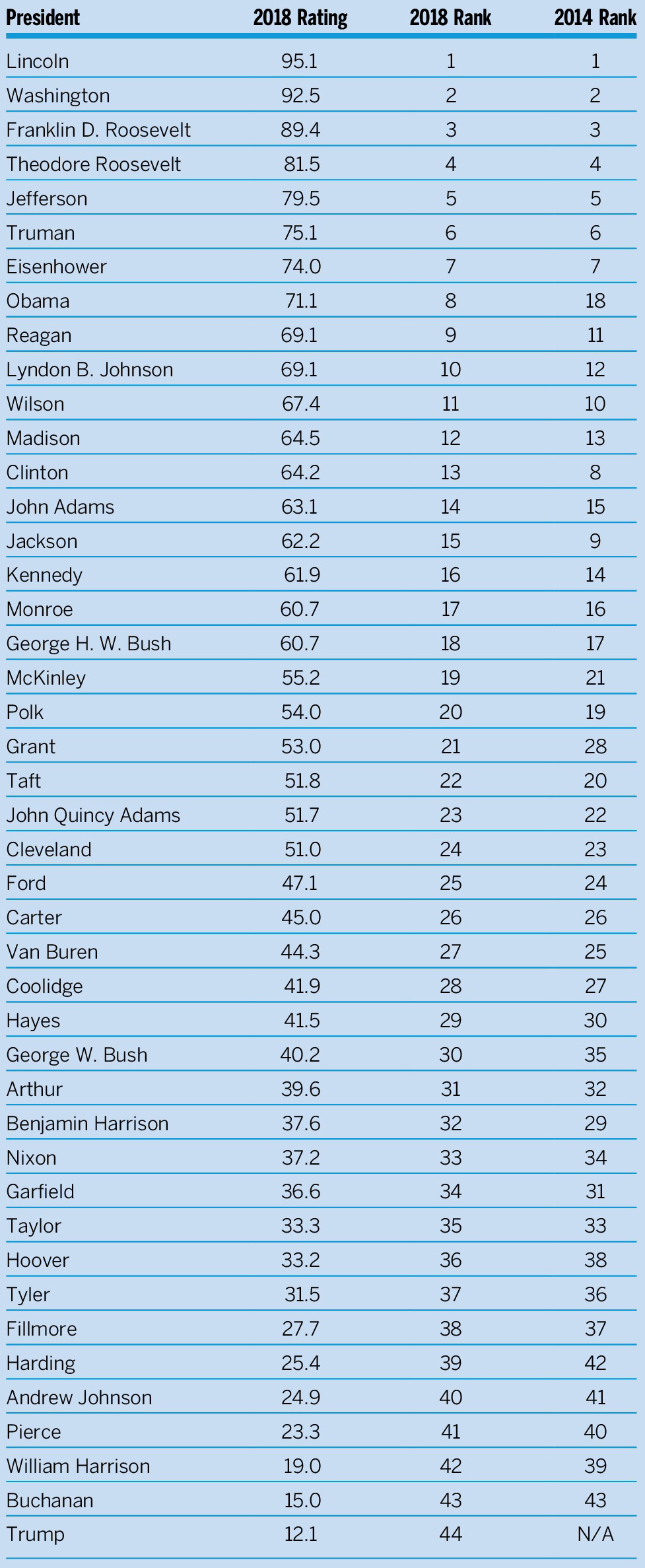
Table 1 presents the average rating of each president, ranked from highest to lowest rating. The top rankings are similar to those from a previous survey (Rottinghaus and Vaughn Reference Rottinghaus and Vaughn2017): Abraham Lincoln again topped the list (μ=95), followed by George Washington (93), Franklin Delano Roosevelt (89), Theodore Roosevelt (81), Thomas Jefferson (80), Harry Truman (75), and Dwight Eisenhower (74). After these first seven places, however, several differences emerge. First, recent evaluations are far more favorable to the presidency of Barack Obama, who is now ranked 8th (71), up 10 places since 2014. He is followed by Ronald Reagan (69), Lyndon Johnson (69), Woodrow Wilson (67), and James Madison (64). Next is Bill Clinton at 14th (64), who dropped five places since the previous survey (Rottinghaus and Vaughn Reference Rottinghaus and Vaughn2017). Clinton is followed by John Adams (63) and Andrew Jackson (62), who dropped six places to 15th.
Overall Presidential Greatness Ratings and Rankings

The middle third of the ranking is generally consistent with results from a 2014 survey (Rottinghaus and Vaughn Reference Rottinghaus and Vaughn2017), although Ulysses S. Grant rose seven places to 18th (μ=53) place. The bottom third is also largely similar to the previous survey’s ranking, with two important exceptions. First, George W. Bush rose five places (40), moving to 30th in the ranking. Second, Donald Trump made his ranking debut at the very bottom of the list. His average rating of 12 is three points lower than that of James Buchanan (15), who occupied the lowest rank in the 2014 survey. William Harrison (19), Franklin Pierce (23), Andrew Johnson (25), Warren Harding (25), and Millard Fillmore (28) also are near the bottom of the ranking.
Partisan and Ideological Differences
The primary purpose of the survey was to examine variation in presidential ratings among experts according to their partisanship and ideological identification. To capture these identities, we asked respondents two questions. First, experts were asked which political party they identified with most often. Among the experts, 57% self-identified as Democrats, 13% as Republicans, 27% as Independents, and 3% as “Other.” Second, we asked whether the respondents considered themselves ideologically liberal (or somewhat liberal), moderate, or conservative (or somewhat conservative). Among the respondents, 58% considered themselves ideologically liberal, 25% moderate, and 17% conservative.
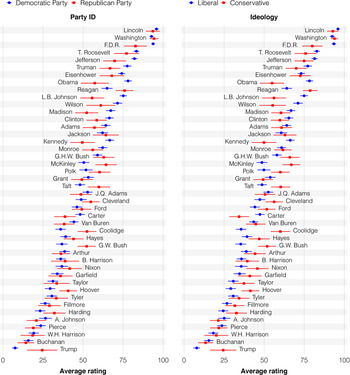
To examine the relationship among partisanship, ideology, and presidential ratings, figure 1 presents the mean rating of each president broken down by the partisan identity and ideology of presidential experts. For simplicity of presentation, results for Independents and ideological moderates are not shown. Appendix B, however, shows that neither of these two groups aligns consistently with either Democrats or Republicans nor liberals or conservatives.
Presidential Greatness Ratings by Expert Partisanship

As demonstrated in figure 1, there are relatively few differences in the overall rankings of presidents by experts who identify as Democrats or Republicans. Furthermore, because presidential experts who identify as Democrats or liberal comprise the largest proportion of the sample, there are relatively few differences between the overall rankings and those given by experts who identify as Democrats or liberal. In fact, there is only one noteworthy difference: both groups ranked Ronald Reagan as 14th compared to his higher overall ranking of 9th. There is somewhat more variation among experts who identify as Independents (details are in appendix B). This group ranked Barack Obama as 13th compared to his overall rating of 8th, and ranked George H. W. Bush as 14th compared to his lower overall ranking of 18th. Independents also ranked Jimmy Carter less favorably than the overall list, placing him 29th, three places lower than his previous standing at 26th.
The rankings by Republicans and conservatives, however, show greater differences from the overall list. Republicans were significantly less favorable toward Barack Obama, rating him 16th, as well as toward Lyndon Johnson (19th), James Madison (22nd), John F. Kennedy (24th), and Jimmy Carter (32nd). Experts who identified as Republicans also appeared considerably more favorable toward other—generally Republican—presidents: William McKinley (9th), George H. W. Bush (11th), James Polk (13th), William Taft (14th), Calvin Coolidge (21st), George W. Bush (23rd), Herbert Hoover (30th), and Martin Van Buren (33rd). Conservatives are largely the same population and thus were generally consistent with the Republican pattern. They nevertheless were especially unfavorably disposed toward Woodrow Wilson, dropping him from 12th place (among Republicans) to 21st, and Ulysses S. Grant (from 25th to 27th), but they were more favorable to James Monroe, moving him up from 18th overall to 12th place. Both groups were somewhat more favorable—although not overwhelmingly so—to Donald Trump, ranking him 40th in each case compared to his overall ranking of 44th.
The Most Polarizing Presidents
Stark partisan polarization is arguably the defining characteristic of our current political era. Although other periods in American history have featured incivility and deep divides, many argue that the current moment has raised polarization to an “unprecedented degree” (Hetherington and Rudolph Reference Hetherington and Rudolph2015; McCarty, Poole, and Rosenthal Reference McCarty, Poole and Rosenthal2006). As some scholars have noted, the current divide between parties has not only encumbered coalition building and policy making but also can influence how ordinary people work and shop (Iyengar and Westwood Reference Iyengar and Westwood2015). Yet, some political figures are more polarizing than others; therefore, in the survey, we sought to gauge not only who the experts felt were the greatest (and least great) presidents but also which presidents were perceived to be the most polarizing while in office. To do so, we asked respondents to identify and rank the five presidents that they believed to be the most polarizing. We then calculated how often a president was identified among the most polarizing and his average ranking.
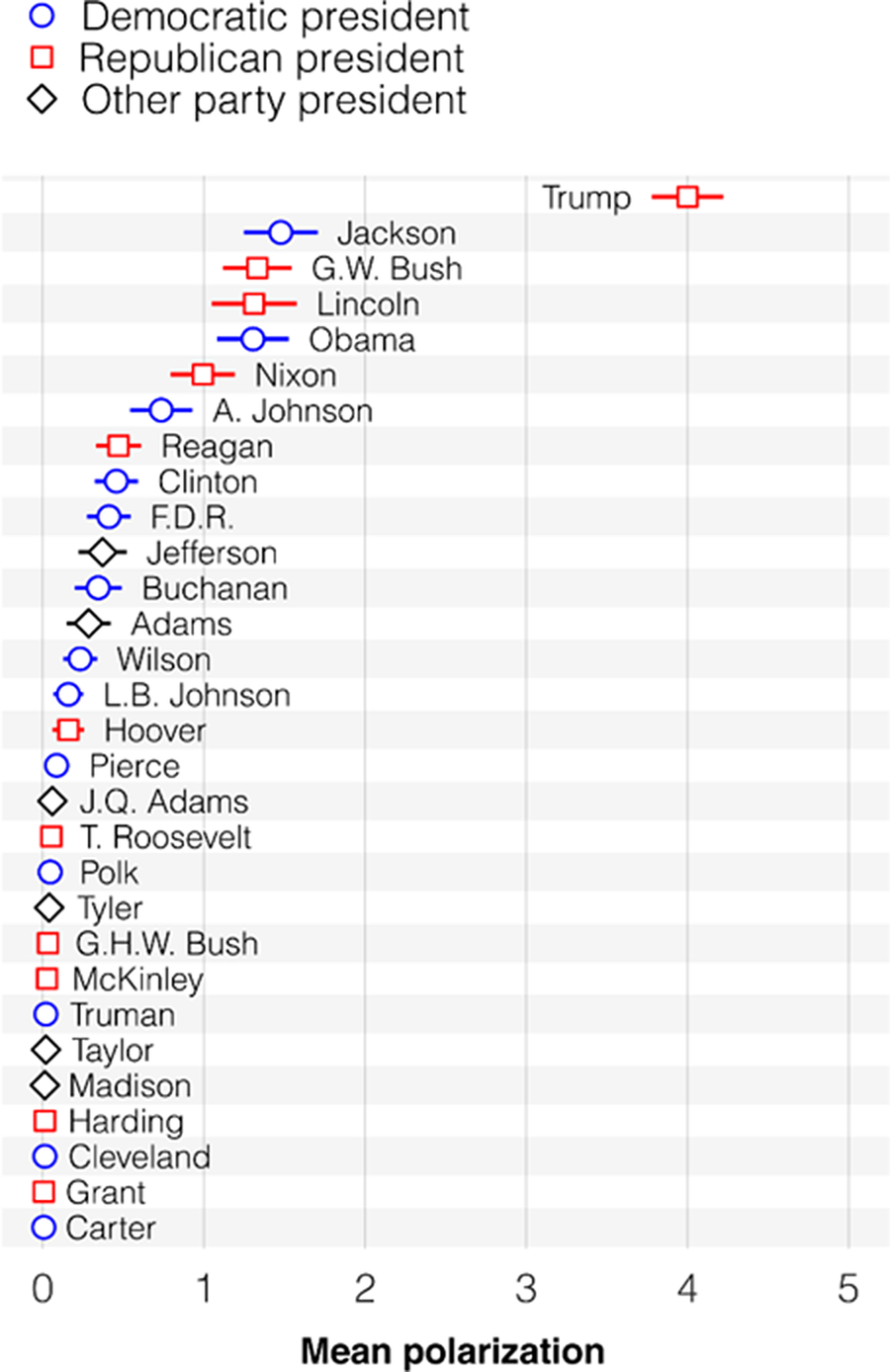
Results are presented in figure 2, which shows the average ranking of each president who was included among the top five most polarizing presidents by at least one expert. As the figure shows, Trump is perceived by a large margin to be the most polarizing president, with an average ranking of 4.0 (i.e., 5 is coded as the “most polarizing”).Footnote 3 Jackson is the second most polarizing president, with an average ranking of 1.5, followed closely by George W. Bush, Lincoln, and Obama, each of whom had an average ranking of 1.3. Trump also stands out as being ranked the “most polarizing” president by the majority of experts: 63% ranked him first. Trump was ranked among the top three polarizing presidents by 75% of experts and among the top five by 83%. At the time of the survey, the Trump White House had pursued fractious policies in seeking to implement a travel ban, dismantling Obamacare, withdrawing from a global climate pact, and agreeing to move the US embassy in Israel to Jerusalem. In comparison to Trump, Jackson—ranked the second most polarizing president on average—was placed as the “most polarizing” by only 7% of experts and in the top three by 27%. George W. Bush was ranked as the most polarizing president by only 2% of experts and in the top three by 27%. Results for Lincoln and Obama are similar, although Lincoln was ranked as the most polarizing president by a relatively substantial 13% of experts. Presidents who were not ranked among the most polarizing by any of the experts include Washington, Garfield, Eisenhower, Kennedy, and Ford.
Differences in Agreement about Presidential Greatness between Democrat and Republican Experts

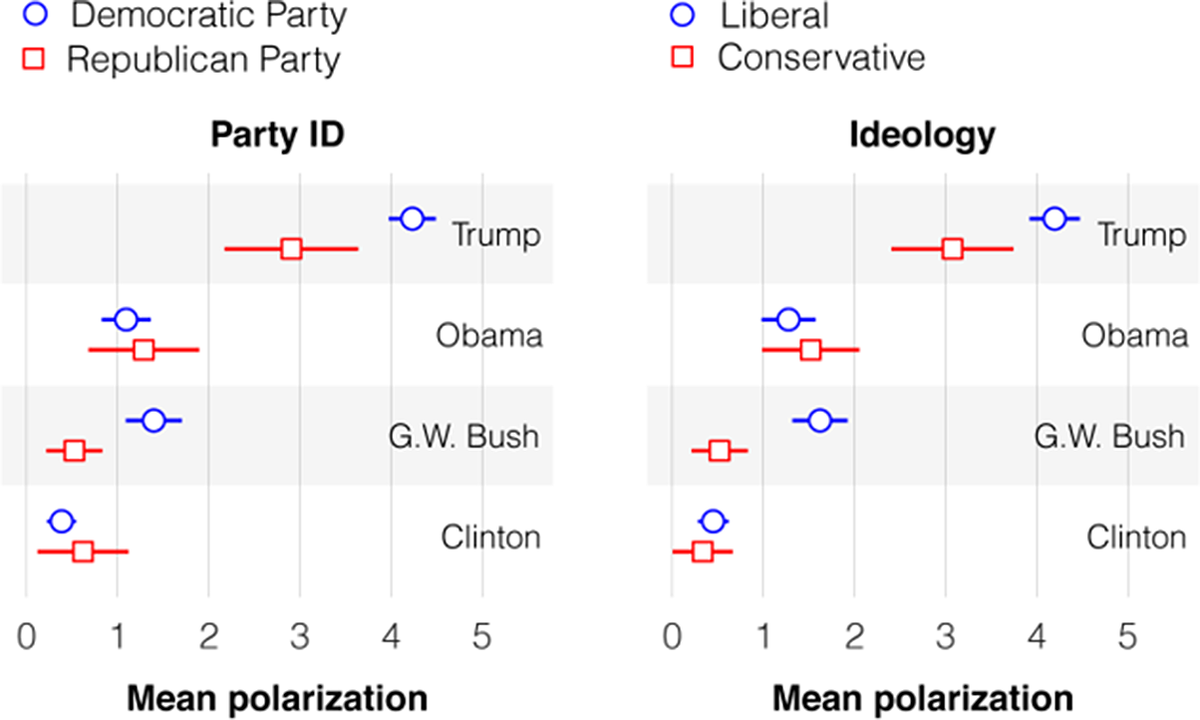
We also examined the average rankings of polarization according to the partisan identity and ideology of the experts. Results for the four most recent presidents are presented in figure 3.
As the figure shows, President Trump is ranked, on average, as the most polarizing president regardless of whether the experts identify as Democrats or Republicans.
Most Polarizing Presidents

As the figure shows, President Trump is ranked, on average, as the most polarizing president regardless of whether the experts identify as Democrats or Republicans. Nevertheless, Republicans rank President Trump as less polarizing on average than Democrats. By contrast, President Obama was ranked as similarly polarizing by both Democratic and Republican experts. It is interesting that Independents (not shown) viewed Obama as more polarizing than those who identified with either of the two major parties. Democrats found President George W. Bush as similarly polarizing as President Obama. For Republican experts, however, George W. Bush was perceived as less polarizing than Obama. The partisan divide on polarizing presidents continued for rankings of President Clinton, with Republicans ranking him as more polarizing on average than either Democrats or Independents. Democrats ranked President Clinton in the middle of the field among the top five most polarizing presidents (3.8), roughly the same as President Obama. Similar to the results by party, experts of every ideological orientation found President Trump to be the most polarizing of all modern presidents. Experts who identified as liberal unsurprisingly ranked President Trump the highest on average as did experts identifying as conservative.
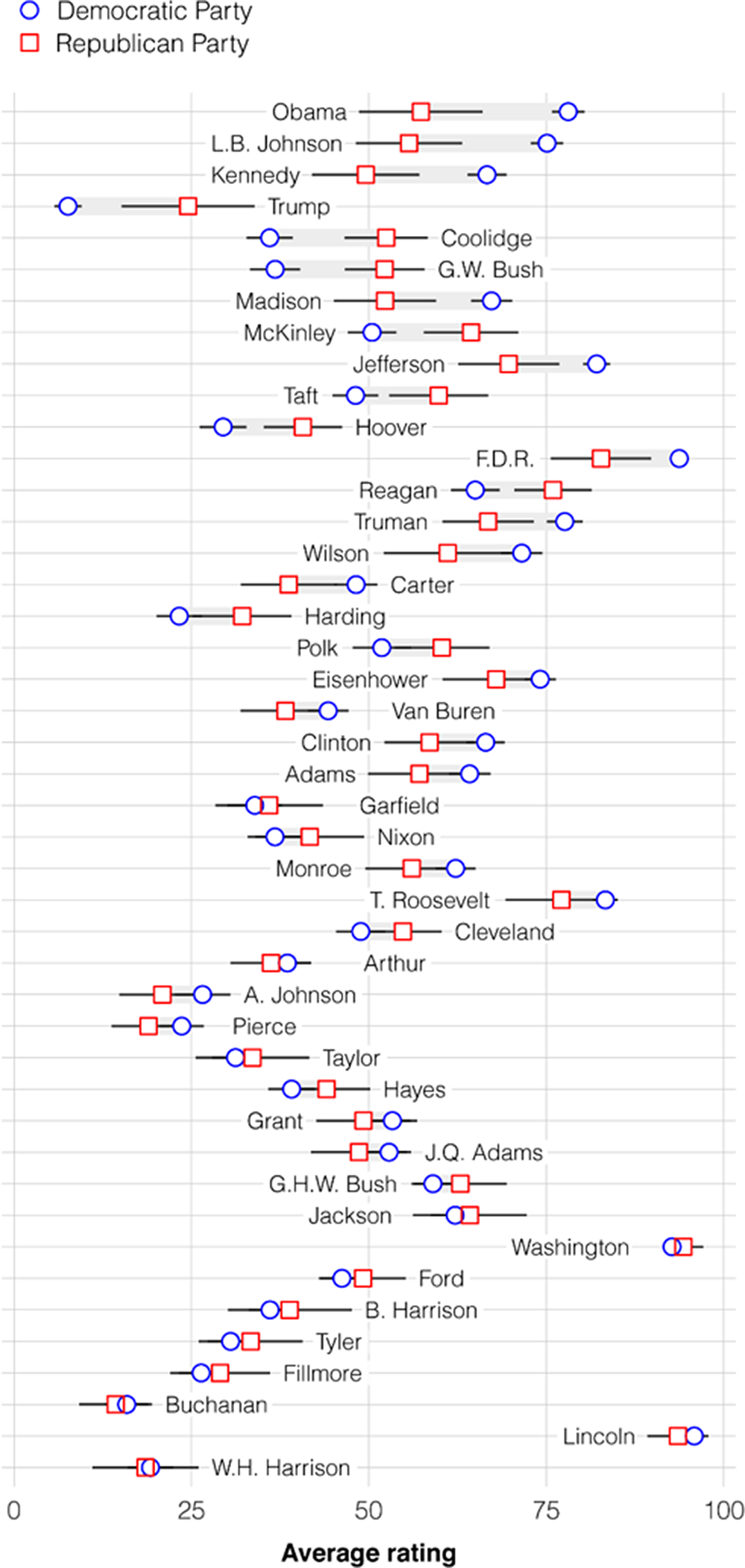
Of course, directly asking about polarization is only one way to determine the role of partisanship in ratings. As in politics more broadly, experts disagree about presidential greatness. The data we collected in our survey allowed us to identify whether the ratings given by these experts were themselves polarized. To examine this, figure 4 displays the average rating of each president ordered by the magnitude of the difference in ratings between experts who identify as Democrats and as Republicans. Clear differences emerged. The difference in ratings between Democratic and Republican experts is most significant for President Obama, followed closely by Presidents Johnson and Kennedy. The expansion of government through Obamacare and the Great Society is the likely partisan staking point and an approach to government on which Democratic and Republican experts fervently disagree. It is interesting that although Trump is rated as the most polarizing president, experts who identified as Democrats and Republicans nevertheless agreed more about how Trump should be rated in terms of presidential greatness than about Obama, Johnson, and Kennedy.
Most Polarizing Presidents, by Partisanship and Ideology of the Expert

To examine these differences in perceptions of presidential ratings and polarization more systematically, we investigated the extent to which variation in expert perceptions is linked to co-partisanship. Despite the benefits of historical perspective, do presidential experts who identify as Republican tend to rate past Republican presidents more favorably than past Democratic presidents? Do experts who identify as Democrats tend to rate past Democratic presidents more favorably?
To test this, we exploited within-expert variation in the ratings of presidents.Footnote 4 We coded a binary variable that indicates, for each expert, whether the president being rated is a co-partisan. We then fit a series of regression models, including control variables from the past literature (see appendix A), to examine whether co-partisanship is associated with (1) higher presidential ratings, and (2) lower—that is, more favorable—rankings of polarization that presidents brought to the office. We fit these models first to the full dataset and second to the subset of the data for modern (i.e., postwar) presidents only. The latter allowed us to examine whether the relationship between co-partisanship and presidential ratings was higher for presidents who governed during the lifetime of many of the experts.
Our results (details are in appendix A) demonstrate that co-partisanship is indeed associated with (1) higher ratings of presidential greatness, and (2) a lower ranking of how polarizing a president is. Furthermore, both of these relationships are stronger for the set of modern presidents. Presidential experts, in other words, perceive the success and polarization of presidents—at least in part—through a partisan lens.
Presidential experts, in other words, perceive the success and polarization of presidents—at least in part—through a partisan lens.
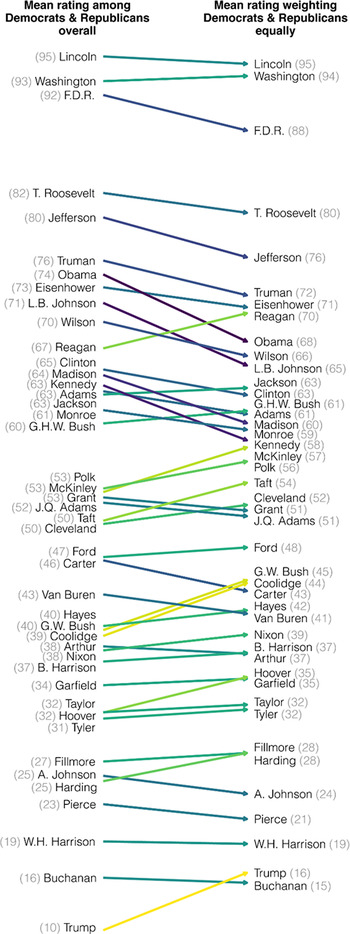
Given these results, and the fact that our sample features many more Democrats than Republicans, we reweighted the sample to give half of the weight to Republicans and half to Democrats. This allowed us to provide a sense of what the results would look like if both partisan groups were equally represented among experts. The results are depicted in figure 5. Weighting the results to be equally partisan yields a substantial increase in the ratings of George W. Bush and Trump, with lesser but noteworthy increases for Harding, Hoover, and Nixon, among others. Meanwhile, the ratings of Democratic presidents Clinton, Kennedy, Johnson, and Obama all decrease, as does the rating for Eisenhower, a Republican.
Ratings of Presidents If Experts Were Equally Democrats and Republicans

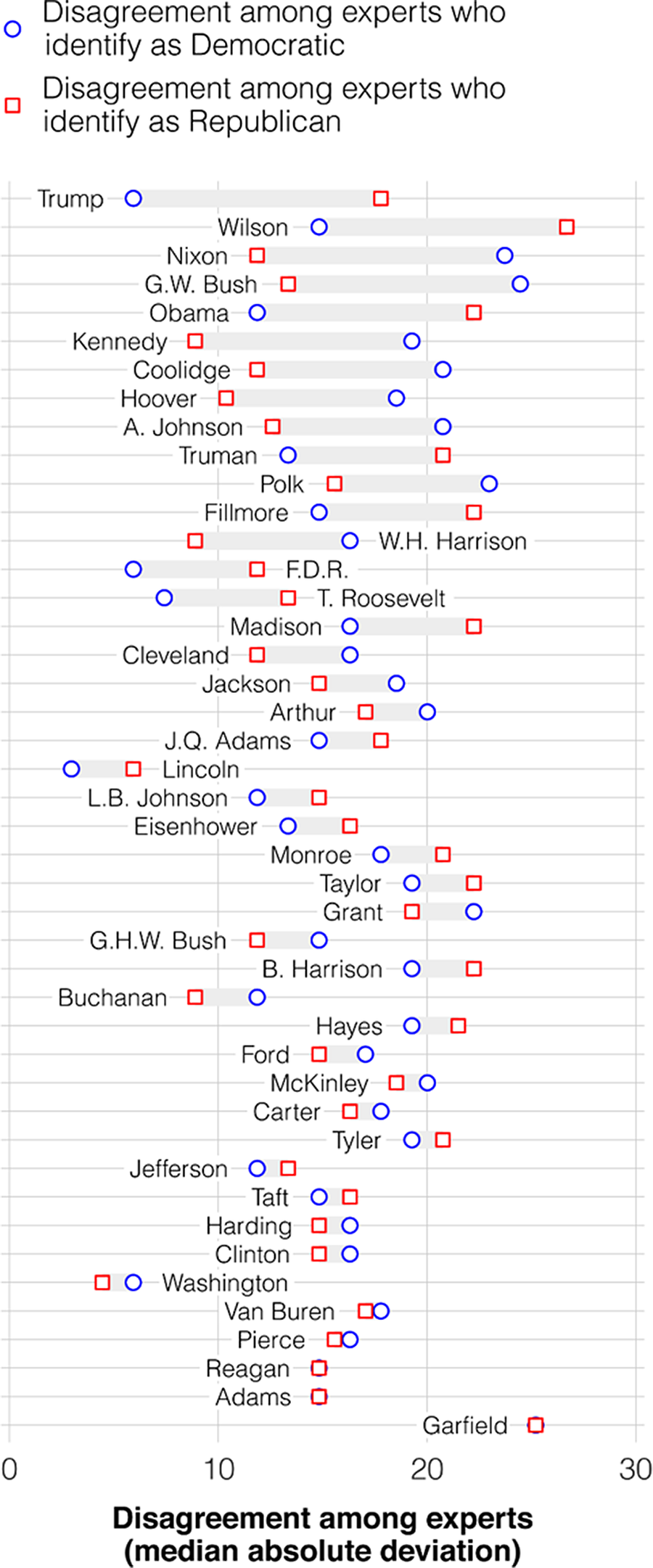
The story, however, is not only about differences across partisan groups but also within them. Experts in both parties agree on some presidents, such as Harrison, Buchanan, and Washington, whose ratings were uniformly low (i.e., Harrison and Buchanan) or high (i.e., Washington). Furthermore, although Presidents Lincoln and Jackson are rated relatively high as polarizing presidents, there is general agreement in their overall ratings among presidential experts of both parties. However, disagreement among experts of the same party also can be compared to disagreement among experts of the other party. Which presidents do experts who identify as Democrats disagree about most? Which presidents do Republicans disagree about most? To investigate these questions, we measured the dispersion of ratings for each president by the median absolute deviation first among experts who identified as Democrats and then among experts who identified as Republicans. The median absolute deviation simply indicates the average distance that a group’s ratings of a president are from the average rating.Footnote 5 A value of 10, for example, indicates that experts gave a president a rating that is 10 points on average from the median rating; a value of 0 indicates that all experts gave a president the same rating. Higher values thus indicate larger disagreement about a president’s rating and lower values, less disagreement.
Figure 6 presents the results. The first line (i.e., Trump) indicates that there is much less disagreement among Democrat experts about the rating of Trump than there is among Republican experts. Experts who are Democrats rated Trump similarly (i.e., low), whereas Republicans’ ratings differed substantially, with some rating him quite high but others very low. In other words, Trump’s polarized presidency has created disagreements between the two major parties as well as within the Republican Party.
Differences in Presidential Ratings Between Democrat and Experts (Sorted by Largest Partisan Difference)

CONCLUSION
The cottage industry spawned by the breathless desire to rate and rank presidents has produced fascinating findings with respect to the predations of presidential success in office and after leaving office. One emergent finding from this most recent survey is that polarized politics does not “stop at the water’s edge” of expert ratings. Meaningful differences emerge when the partisan and ideological affiliations of experts are examined. Republicans and Democrats diverge in rating the top and the bottom presidents and in how polarizing recent presidents have been. This span of differences is greater in evaluating more recent presidents, influencing—and possibly compromising—our attempts to write a first draft of presidential greatness for presidents who have recently left office.
In an era marked by political polarization, it is unsurprising that partisanship affects how experts rate the greatness of presidents, especially recent ones. Yet, as we have shown, experts who identify with the same party nevertheless can disagree about the performance of our country’s recent presidents. Indeed, if partisanship among experts were a unifying force, those who share the same party affiliation might be expected to rate highly a president from their preferred party, with agreement among those who hold the same partisan identity. This does not appear, however, to be the case. As Republican experts’ ratings of Trump and Obama and Democrat experts’ ratings of George W. Bush make clear, opinions about these presidents can vary greatly among experts—even if they share a partisan identity. Thus, although a simple story can be told to highlight the differences between how Republicans and Democrats understand recent presidential history, it also is important to tell the story of a more encouraging divide. Those who share the same party affiliation can nevertheless healthfully disagree about the presidents who represent their own party and the presidents from the party who do not.
Supplementary Materials
To view supplementary material for this article, please visit http://dx.doi.org/10.1017/S1049096520000177.