Introduction
The lichen genus Villophora Søchting et al. (family Teloschistaceae) was described by Arup et al. (Reference Arup, Søchting and Frödén2013) to accommodate the species Caloplaca isidioclada Zahlbr., which was known from South America, Antarctica and a number of subantarctic islands. Based on molecular data, it was known at the time that a number of undescribed species belonged in the genus and their sequences were included in the molecular analysis of Arup et al. (Reference Arup, Søchting and Frödén2013). Subsequently, Villophora microphyllina (Tuck.) S. Y. Kondr. was included in the genus by Kondratyuk et al. (Reference Kondratyuk, Kim, Yu, Jeong, Jang, Kondratiuk, Zarei-Darki and Hur2015).
This paper provides a molecular study of the genus Villophora. Five new species of Villophora (V. darwiniana, V. onas, V. patagonica, V. rimicola and V. wallaceana) are described and one species (V. maulensis) is combined into the genus. The close relationship of the genus Tayloriellina to Villophora (Teloschistoideae) is confirmed, and the new combination Tayloriellina microphyllina is proposed.
Material and Methods
Material
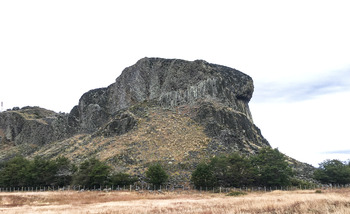
The study is based on collections made mainly by the first and second authors in Patagonia, Antarctica, the Falkland Islands, Crozet and Kerguelen Islands. Collections are located in herbarium C (Copenhagen) unless otherwise indicated. Three of the new species are described from old volcanic rocks in southern Chile, at or close to Morro Chico (Fig. 1), which is also the locus classicus for Catenarina desolata Søchting et al. (Søchting et al. Reference Søchting, Søgaard, Elix, Elvebakk, Sancho and Arup2014).
Old volcanic rocks at Morro Chico, Región de Magallanes y Antártica Chilena, Chile. Three of the newly described species, Villophora darwiniana, V. onas and V. patagonica were found at or near this location. In colour online.

Morphology and anatomy
Macroscopic descriptions are based on observations made with an Olympus SZH dissecting microscope with an Olympus OM-D camera. Sections were made by hand or with a Reichert-Jung Cryostat 2800 Frigocut E microtome and studied with a Leitz Orthoplan microscope. All measurements were made on material mounted in water. Spores were measured outside the asci and measurements are given as the mean ( $\bar{x}) $ and standard deviation (SD) of n measurements with minimum and maximum measurements in parentheses.
Secondary chemistry
Secondary metabolites were identified using HPLC according to Søchting (Reference Søchting1997); thallus and apothecia were analyzed separately. The relative composition of the secondary compounds was calculated based on absorbance at 270 nm according to Søchting (Reference Søchting1997). All species of Villophora and Tayloriellina S. Y. Kondr. et al. have a similar chemosyndrome, namely A of Søchting (Reference Søchting1997), with the following approximate anthraquinone proportions: 1% teloschistin, 2–3% fallacinal, 1–2% parietinic acid, 1–2% emodin, 92–95% parietin. All yellow, orange or reddish-pigmented parts are K+ purple.
Molecular analyses
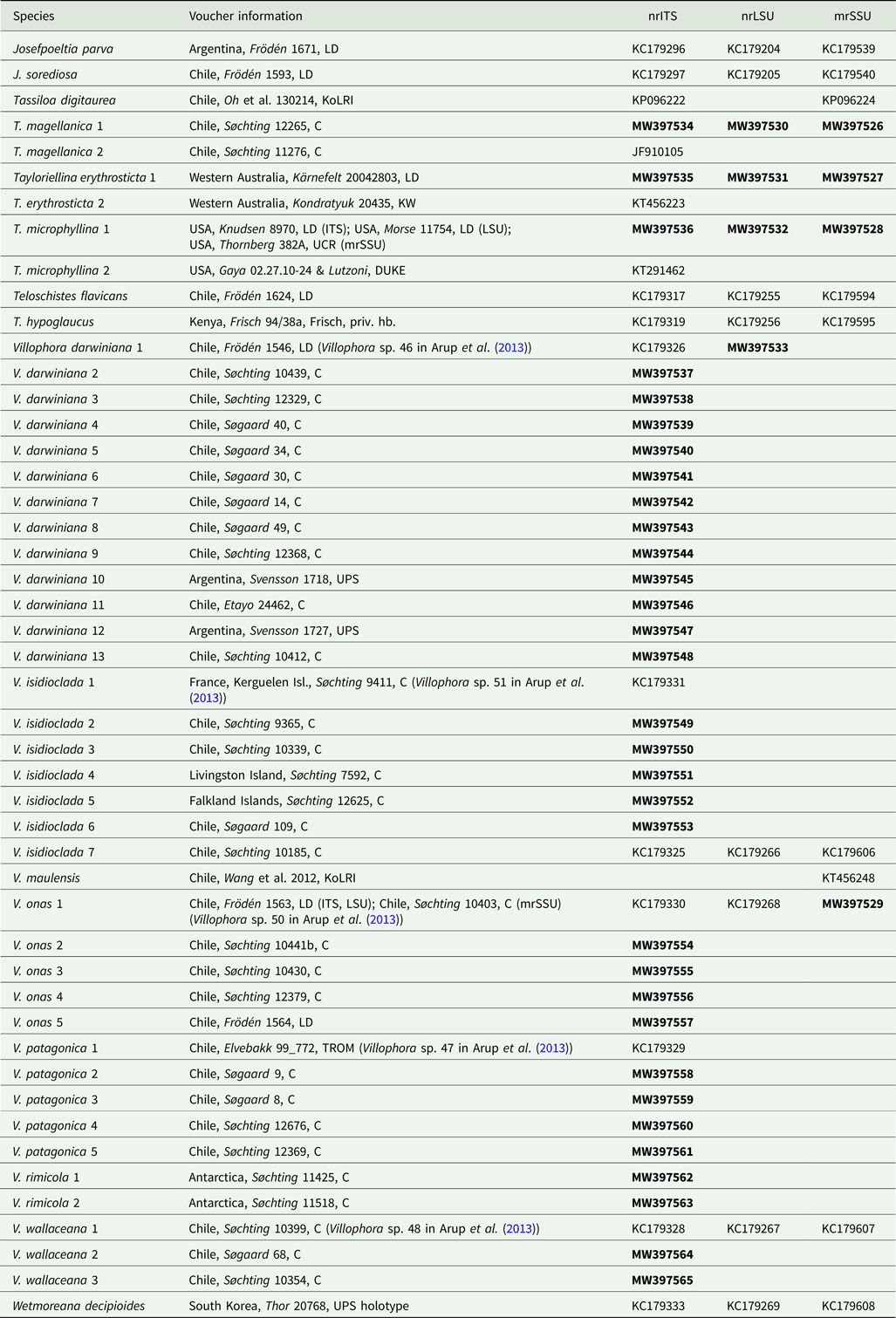
DNA sequences were produced as in Arup et al. (Reference Arup, Søchting and Frödén2013) using direct PCR following Arup et al. (Reference Arup, Vondrák and Halıcı2015). Amplifications were made of the internal transcribed spacer regions (nrITS) and the large subunit (nrLSU) of the nuclear ribosomal RNA genes, and of the small subunit of the mitochondrial ribosomal RNA gene (mrSSU). Primers for amplification were ITS1F (Gardes & Bruns Reference Gardes and Bruns1993), ITS4 (White et al. Reference White, Bruns, Lee, Taylor, Innis, Gelfand, Sninsky and White1990), AL1R (Döring et al. Reference Döring, Clerc, Grube and Wedin2000), LR5 or LR6 (Vilgalys & Hester Reference Vilgalys and Hester1990), mrSSU1 (Zoller et al. Reference Zoller, Scheidegger and Sperisen1999) and mrSSU7 (Zhou & Stanosz Reference Zhou and Stanosz2001). The PCR parameters included an initial hold at 94 °C for 5 min, then denaturing at 94 °C for 1 min, annealing at 50 or 54 °C (mrSSU) or 53–56 °C (nrITS and nrLSU) for 1 min, decreasing by 1 °C per cycle for the first six of the 39 cycles (touchdown), and extension at 72 °C for 3 min. The sequencing was carried out by Macrogen Inc., South Korea using the same primers as for the PCR. The two resulting strands were assembled using CLC Main Workbench 4.1.2 ™ or Geneious 11.1.5. Subsequent alignments were performed in Geneious 11.1.15 using the MAFFT option and adjusted manually. Sequences have been submitted to GenBank as indicated in Table 1.

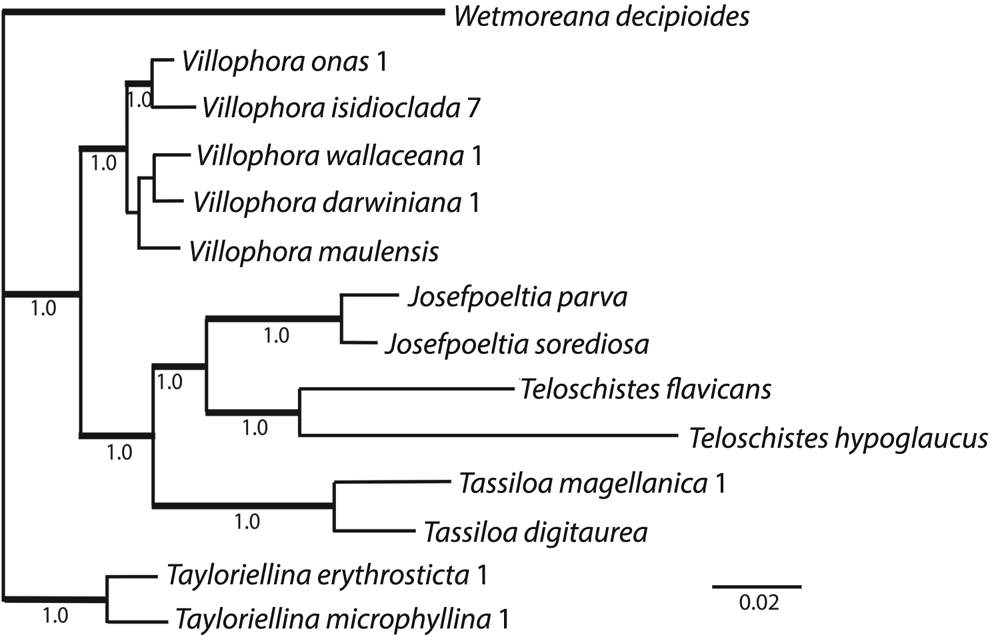
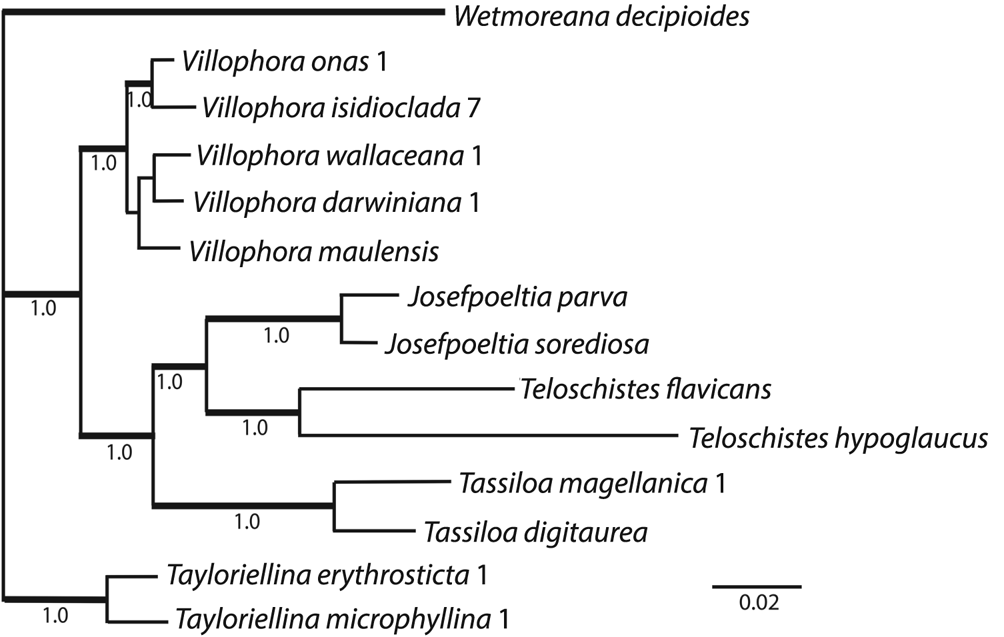
Phylogenetic analysis of Villophora and the closest related genera of the subfamily Teloschistoideae based on three genes: nrITS, nrLSU and mrSSU. Wetmoreana decipioides was used as the outgroup. The mrSSU gene was available only for V. maulensis but it has nevertheless been included in the analysis, and it is clearly not sister to V. onas in this tree.
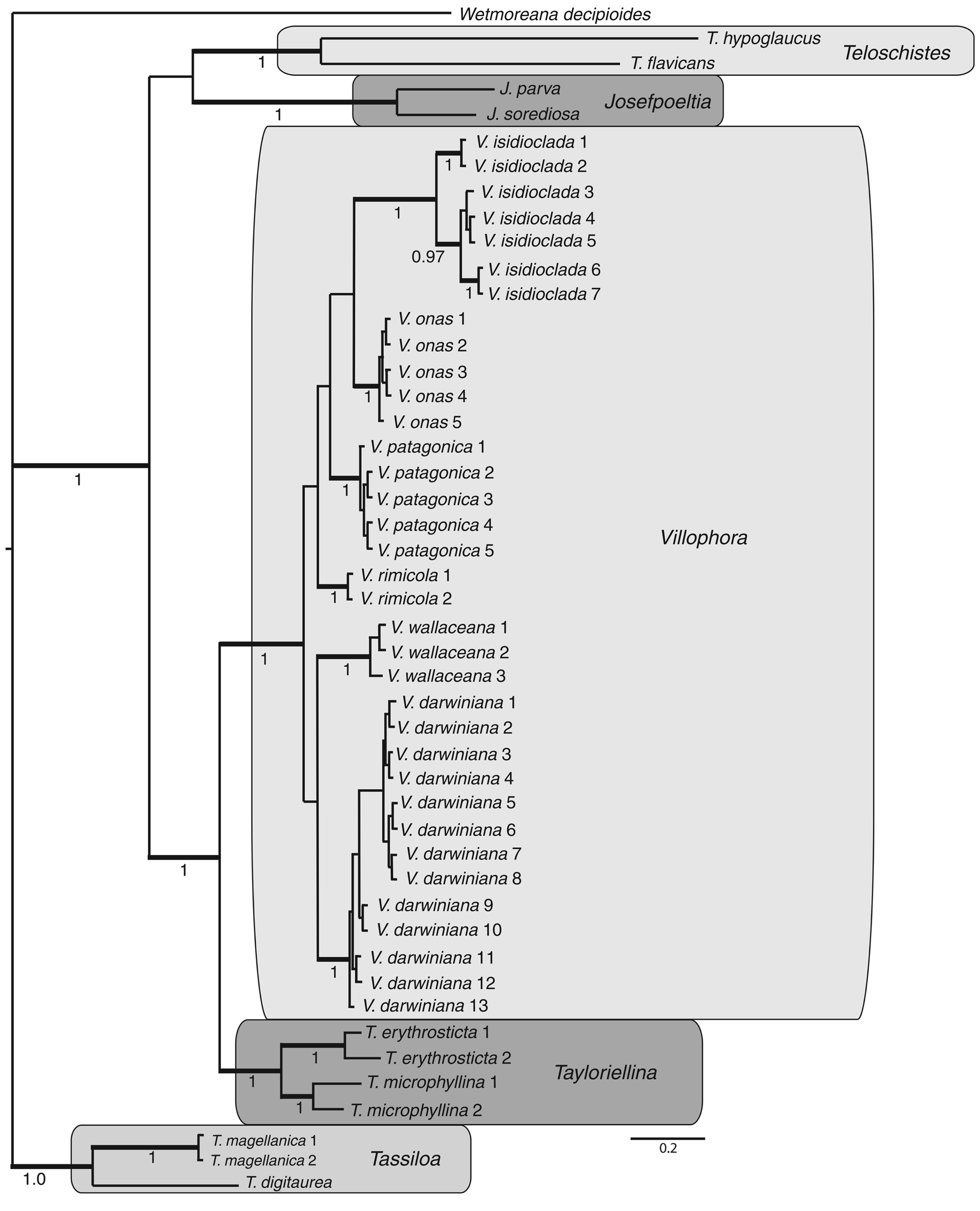
Phylogenetic analysis of Villophora and the closest related genera of the subfamily Teloschistoideae based on nrITS alone. Wetmoreana decipioides was used as the outgroup.

Two alignments were produced, one combined dataset of the nrITS, nrLSU and mrSSU genes and one of nrITS sequences, resulting in 14 terminals in the combined analysis and 47 terminals in the ITS analysis. Both alignments include mainly sequences of Villophora and the closest related genera of the subfamily Teloschistoideae. For both the combined analysis and the ITS alignment, Wetmoreana decipioides (Arup) Arup et al. was used as outgroup. Introns and ambiguous parts were removed from the alignment before analyses.
Phylogenetic analysis
The alignments of the three different genes were first analyzed separately to check for incongruence between genes, but no incongruences were found. A conflict was assumed to be significant if two different relationships were both supported with posterior probabilities ≥ 0.95. A suitable likelihood model for each of the genes was selected, using BIC as implemented in the software jModelTest v.2.1.4 (Guindon & Gascuel Reference Guindon and Gascuel2003; Darriba et al. Reference Darriba, Taboada, Doallo and Posada2012), evaluating only the 24 models available in MrBayes v.3.2 (Ronquist et al. Reference Ronquist, Teslenko, van der Mark, Ayres, Darling, Höhna, Larget, Liu, Suchard and Huelsenbeck2012). For the concatenated data set, the SYM + G model was found to be optimal for the nrITS data set, HLKY + I for the nrLSU data set, and SYM + I + G for the mrSSU data set. An extended ITS alignment was also analyzed separately using MrBayes and the evolutionary model GTR + G + I. The parameters used in the analyses followed those of Arup et al. (Reference Arup, Søchting and Frödén2013) except for the branch length prior that was set to an exponential with mean 1/10. No molecular clock was assumed. Three parallel runs were executed with 2 000 000 generations starting with a random tree and employing six simultaneous chains, five of which were heated in increments of 0.1 °C. Analyses were diagnosed every 1000 generations in the last 50% of the tree sample and automatically halted when convergence was reached. Convergence was defined as a standard deviation of splits (of frequency 0.1) between runs below 0.01. Every 1000th tree was sampled. A majority-rule consensus tree was constructed from the post-burn-in tree samples. The consensus trees were visualized using FigTree v.1.4.4 and redrawn in Adobe Illustrator.
Taxonomy
Villophora Søchting, Frödén & Arup
In Arup et al., Nord. J. Bot. 31(1), 66 (Reference Arup, Søchting and Frödén2013); type: Villophora isidioclada (Zahlbr.) Søchting, Frödén & Arup.
Thallus crustose to microfruticose, consisting of squamules or granules that can be appressed and flattened, but are often more or less vertical, isidioid with blastidia or soredia. Apothecia often rare, zeorine, occasionally with an isidiate thalline margin. All exposed parts are orange due to anthraquinones belonging to chemosyndrome A of Søchting (Reference Søchting1997) and are K+ purple. Asci of Teloschistes-type; ascospores 8 per ascus, polarilocular. Pycnidia not seen. Photobiont chlorococcoid. On rock, dry bark or wood, occasionally lichenicolous, with highest diversity in the Southern Hemisphere. The genus belongs to the subfamily Teloschistoideae (Arup et al. Reference Arup, Søchting and Frödén2013; Bungartz et al. Reference Bungartz, Søchting and Arup2020).
Ecology and distribution
The genus Villophora includes species that are either lichenicolous on saxicolous lichens or grow on rock, wood or tree bark. Six species are currently known from the Southern Hemisphere, five from southern South America and two from Antarctica. Two related genera, Josefpoeltia and Tassiloa, are native to South America, whereas the more closely related species Tayloriellina erythrosticta (Taylor) S. Y. Kondr. et al. is known from Australia and Caloplaca (Tayloriellina) microphyllina (Tuck.) Hasse is known from North America. Records of the latter from Europe have not been validated (Wetmore Reference Wetmore2004; Arup Reference Arup2006).
Generic taxonomy
The initial description of the genus Villophora was based on molecular data (Arup et al. Reference Arup, Søchting and Frödén2013). The five new species described in this paper are closely related to the type species, V. isidioclada, in the well-supported Villophora clade (Fig. 3).
The genus Tayloriellina, hosting the two species T. erythrosticta from Australia and the former V. microphyllina (Tuck.) S. Y. Kondr. from North America, has a sister position to Villophora on the nrITS tree (Fig. 3) but is more distantly located in the three-gene phylogeny, where Tassiloa S. Y. Kondr. et al., Josefpoeltia S. Y. Kondr. & Kärnefelt and Teloschistes appear as closely related genera (Fig. 2).
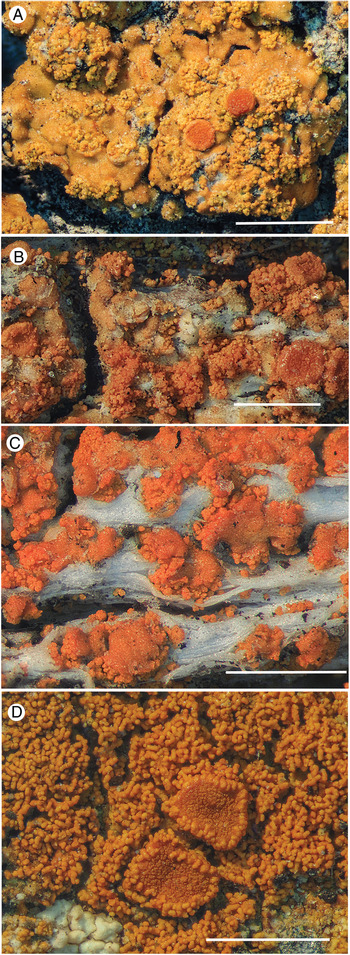
The genus Tayloriella was described by Kondratyuk et al. (Reference Kondratyuk, Kim, Yu, Jeong, Jang, Kondratiuk, Zarei-Darki and Hur2015) to accommodate Caloplaca erythrosticta but since it turned out that the genus name was already in valid use for an algal genus, they subsequently transferred the species to a new genus Tayloriellina (Kondratyuk et al. Reference Kondratyuk, Lõkös, Kim, Kondratiuk, Jeong, Jang, Oh, Wang and Hur2016). From Figs 2 and 3 it is clear that T. erythrosticta and V. microphyllina are sister species that must be hosted in the same genus, either Villophora or Tayloriellina. Based on the three-gene analysis, we combine V. microphyllina into Tayloriellina as T. microphyllina (Tuck.) Søchting & Arup comb. nov. (MycoBank No.: MB 838280. Basionym: Placodium microphyllinum Tuck., N. Amer. Lich. (Boston) 1, 174 (1882)) (Fig. 4A). However, studies based on more than three genes might prove that Tayloriellina is part of Villophora, as was recently proposed by Wilk et al. (Reference Wilk, Pabijan, Saluga, Gaya and Lücking2021).
A, Tayloriellina microphyllina (U. Søchting 9900). B & C, Villophora darwiniana (M. Z. Søgaard 14). B, thallus almost dissolved in soredia, and with apothecia. C, thallus squamules persisting, and with marginal soralia. D, V. isidioclada (M. Z. Søgaard 109). Scales: A & D = 1 mm; B & C = 0.5 mm. In colour online.

A published mrSSU sequence (GenBank number KT456248) of the holotype of Raesaeneniana maulensis (S. Y. Kondr. & Hur) S. Y. Kondr et al. (SK 993) indicates that this species belongs in the genus Villophora, even though the other sequences (nrITS and nrLSU) of the holotype published in Kondratyuk et al. (Reference Kondratyuk, Kim, Yu, Jeong, Jang, Kondratiuk, Zarei-Darki and Hur2015) belong to various remote taxa, including Umbilicaria. Marchantiana maulensis S. Y. Kondr. & Hur, which was later transferred to Raesaeneniana maulensis, was collected in central Chile, and its morphological and anatomical description in Kondratyuk et al. (Reference Kondratyuk, Jeong, Yu, Kärnefelt, Thell, Elix, Kim, Kondratiuk and Hur2014) fits well with Villophora, particularly the species V. onas. Assuming that the mrSSU sequence is correct, we therefore combine it into Villophora as V. maulensis (S. Y. Kondr. & Hur) Søchting comb. nov. (MycoBank No.: MB 838281. Basionym: Marchantiana maulensis S. Y. Kondr. & Hur, Acta Bot. Hung. 56, 108 (2014)) leaving it to extended molecular studies to determine its validity as a species separate from other species in the genus.
Key to Villophora (and allied) species
1 On bark or wood 2
On rock, or lichenicolous on saxicolous lichens 5
2(1) In North America Tayloriellina microphyllina
In Southern Hemisphere 3
3(2) On wood; in Australia Tayloriellina erythrosticta
On dry bark; in South America 4
4(3) Thallus micro-squamulose with mainly marginal soralia, but sometimes soralia/blastidia covering most of the squamules V. darwiniana
Thallus covered by globose granules/isidia V. wallaceana
5(1) Thallus mostly absent or insignificant V. patagonica
Thallus prominent 6
6(5) Thallus well delimited, with crowded, more or less vertical, slim isidia V. isidioclada
Not with vertical, slim isidia 7
7(6) Thallus effuse, with elongated, mostly horizontal areoles; exposed rocks in Patagonia V. onas
Thallus dense cushions of vertical coralloid lobes; in rock crevices in Antarctica V. rimicola
Villophora darwiniana Søchting, Søgaard & Arup sp. nov.
MycoBank No.: MB 838275
Similar to Tayloriellina microphyllina but squamules smaller, 0.1–0.3 mm versus 2 mm, occurring in South America versus North America.
Type: Chile, Región de Magallanes y Antártica Chilena, Morro Chico, 52.0576°S, 71.4221°W, 200 m, dead wood of Nothofagus, 13 February 2018, U. Søchting 12678 (C—holotype).
Thallus indeterminate, 0.5–10 cm, squamulose; squamules flat to concave, vivid orange-yellow to vivid orange, rarely whitish in the centre, irregular, 0.1–0.3 mm wide, entirely sorediate/blastidiate at the edge and underside.
Apothecia rare, few to numerous, when present, zeorine, sessile, dispersed to aggregated, regular, up to 0.8 mm diam.; disc initially slightly concave, later flat, vivid orange; proper margin ±distinct and persistent, level and concolorous with disc; thalline margin sorediate or blastidiate, soon excluded; true exciple prosoplectenchymatous, fan-shaped, 20–50 μm; hymenium 60–70 μm; paraphyses 1.5–2 μm at base, end cells only slightly enlarged, up to 3 μm thick, apically branched; asci with 8 spores; ascospores ellipsoid, (9.8–)11.3 ± 1.0(–13.4) × (4.8–)6.2 ± 0.9(–5.8) μm, length/width ratio 1.9 ± 0.3; septum (2.5–)4.2 ± 0.9(–5.8) μm, length/septum width ratio 2.8 ± 0.6 (n = 15).
Molecular results
The species has very uniform nrITS sequences. It occupies a sister position to V. wallaceana (Figs 2 & 3). The species was included as ‘Villophora sp. 46’ in Arup et al. (Reference Arup, Søchting and Frödén2013).
Etymology
Villophora darwiniana is named in honour of Charles Darwin, who studied the Magellan Archipelago for many months in 1833 during his voyage on HMS Beagle.
Ecology and distribution
Lignicolous or corticolous on rough bark, mainly of Nothofagus spp. at forest edge and in shrub vegetation, 20–620 m alt. Recorded from Province de Santa Cruz, Argentina and Región de Magallanes y de la Antártica Chilena, Chile.
Notes
When squamules are present, V. darwiniana is easily recognized by its lignicolous and corticolous habit combined with its vivid orange soredia/blastidia. When it is totally blastidiate or sorediate and no squamules are visible, it may be difficult to distinguish from V. wallaceana. The latter is more isidiate, with globose isidia of different sizes, while V. darwiniana has soredia/blastidia of ±equal size.
Due to the sorediate squamules and vivid orange colour, it is morphologically rather similar to Tayloriellina (Villophora) microphyllina from North America (Nash et al. Reference Nash, Gries and Bungartz2007). Tayloriellina microphyllina, however, has larger squamules (Fig. 4A), is molecularly distinct, and has not been confirmed as occurring in South America.
Additional specimens examined
Argentina: Province de Río Negro: Bariloche Dept., 1.8 km NNE of Lake Juncos, forest-steppe ecotone, 41.000°S, 71.002°W, 900 m, on decaying bark of Berberis microphylla, 2009, M. Svensson 1727 (UPS); W of Lake Juncos, 41.064°S, 71.016°W, 900 m, on old wooden fence, 2009, M. Svensson 1718 (UPS). Province de Santa Cruz: Rio Turbida at borderpost NE of Puerto Natales, 51.5633°S, 72.3483°W, 620 m, bark of old Nothofagus pumilio, 2005, U. Søchting 10418.—Chile: Región de Magallanes y de la Antártica Chilena, 30 km N of Punta Delgada, Parque Nacíonal Pali Aike, 52.1075°S, 69.7064°W, 186 m, twig on the ground, 2008, M. Z. Søgaard 14; NW of Puerto Natales, 50–100 m from fjord, 51.5411°S, 72.8400°W, 5–50 m, fence pole and base of Nothofagus, 2008, M. Z. Søgaard 30; Parque Nacíonal Torres del Paine, 169 m, 51.0494°S, 72.9367°W, bush, 2008, MZS 34 and 40; walk from Lago Grey, 51.1222°S, 73.1242°W, root of fallen Nothofagus, 2008, M. Z. Søgaard 45, 49; 200 m SW of Hostería Las Torres, 50.983°S, 72.866°W, 100 m, on lignum of Nothofagus antarctica, 1996, A. Elvebakk 96:013 (TROM); Rio Paine valley, 3–4 km SW of Guardería Laguna Amarga, 51.000°S, 72.833°W, 80 m, on Discaria chacaye, 1996, A. Elvebakk 96:690 (TROM); Miradór Lago Nordenskjold, halfway between Laguna Largo and Laguna Mellizas, 51.050°S, 72.916°W, 200 m, on dry, sun-exposed, dead twigs of Discaria chacaye, 1997, A. Elvebakk 97:449 (TROM); Morro Chico, 100 km N of Punta Arenas, 52.0575°S, 71.4212°W, 195 m, bark of Nothofagus antarctica, 2015, U. Søchting 12368, 12367; 52.0576°S, 71.4221°W, 200 m, 2018, U. Søchting 122677; Province Antártica Chilena, Isla Navarino, 6 km SW of Puerto Willliams, dead Nothofagus, 21 m, 54.9325°S, 67.6489°W, 2008, M. Z. Søgaard 70; Isla Navarino, 30 km WNW of Puerto Williams, coastal trail between Wulaia and José, 55.015°S, 68.165°W, 10 m, dead bark of Nothofagus, 2005, U. Søchting 10354; Canal Beagle, Cabo Hyades, Bahia Yendegaia, Puerto Contreras, 54.8605°S, 68.8146°W, 2 m, 2015, U. Søchting 12329.
Villophora isidioclada (Zahlbr.) Søchting, Frödén & Arup
(Fig. 4D)
Thallus crustose to micro-fruticose, vivid orange-yellow to vivid orange, up to 2 cm wide, up to 1 mm thick, rimose-areolate; areoles 0.6–1.4 mm diam., covered by dense coralloid, horizontal, ascending or ±vertical isidia; isidia 20–50 μm thick, slightly moniliform; prothallus rare, very thin, effuse, brighter than thallus. Thallus cortex paraplectenchymatous with globular cells, 3–4 μm diam.
Apothecia very rare, dispersed, regular to angular, up to 0.9 mm diam., zeorine; thalline margin well developed, crenate-isidiate (or smooth at Kerguelen), concolorous with thallus; proper margin thin; disc flat to eventually slightly convex, finely fissured, strong reddish brown, episamma coarse; true exciple prosoplectenchymatous, fan-shaped, 20–100 μm; hymenium 70–80 μm; paraphyses 1.5–2 μm at base, end cells only slightly enlarged, up to 3 μm thick, apically branched; asci with 8 spores; ascospores ellipsoid, (13.4–)15.7 ± 1.4(–18.6) × (6.8–)8.8 ± 0.9(–10.3) μm, length/width ratio 1.8 ± 0.2; septum (4.0–)5.8 ± 1.0(–8.9) μm; length/septum width ratio 2.8 ± 0.6 (n = 21).
Molecular results
ITS sequences of specimens from the Subantarctic Islands, Kerguelen and Crozet form a separate clade deviating from the Patagonian/Antarctic V. isidioclada (V. isidioclada 1 and 2 in Fig. 3). Pending a broader sampling they are included here in V. isidioclada. Deviating molecular characters in the Subantarctic Islands are also seen in the genus Austroplaca (unpublished data) and might indicate a speciation beginning after separation from the parent populations in South America.
The species was included as ‘Villophora sp. 51’ in Arup et al. (Reference Arup, Søchting and Frödén2013).
Ecology and distribution
Maritime rocks and cliffs, normally 2–10 m a.s.l. The species is recorded from Juan Fernandez (type, Zahlbruckner (Reference Zahlbruckner and Skottsberg1924)), southern South America, South Shetland Islands, maritime Antarctica, the Falkland Islands, South Georgia, South Orkney Islands, Crozet Islands and Kerguelen Islands.
Notes
Villophora isidioclada may be somewhat similar to Tassiloa digitaurea (Søgaard et al.) S. Y. Kondr. et al., but V. isidioclada has thinner isidia (30–50 μm) compared to the thicker, more lobulate isidia (60–100 μm thick) of T. digitaurea.
Additional specimens examined
Antarctica: South Shetland Islands: Livingston Island, South Bay, Punta Polaca, 62.666°S, 60.383°W, 20 m, acid, sedimentary bedrock, eutrophicated rock near sea, 1998, U. Søchting 7592; Punta Polaca, 62.6630°S, 60.3939°W, 25 m, 1998 & 2018, U. Søchting 7592, U. Søchting 12745, 12747 & 12759.—Chile: Región de Magallanes y de la Antártica Chilena: Isla Navarino, E of Puerto Navarino, 54.9314°S, 68.3578°W, 4–5 m, E-facing maritime cliff, 2008, M. Z. Søgaard 109; Isla Navarino, 40 km W of Puerto Williams, 54.9183°S, 68.3178°W, 2 m, maritime rocks, 2005, U. Søchting 10165; Isla Navarino, 20 km W of Puerto Williams, Caleta Mejillones, 54.9011°S, 69.1667°W, 10 m, horizontal maritime rocks, 2005, U. Søchting 10185; Isla Navarino, 30 km WNW of Puerto Williams, Wulaia, 55.0356°S, 68.1356°W, 7 m, maritime rocks, 2005, U. Søchting 10339; Canal Beagle, Seno Holandia, 54.9420°S, 69.1545°W, maritime rocks, 2 m from the sea, top of coastal rock, U. Søchting 12296; Seno Espana, 54.7914°S, 69.7569°W, 2 m, W-exposed, maritime rock, 1 m from the sea, 2015, U. Søchting 12304; Isla Martinez, 54.9133°S, 68.2719°W, 3 m, 2015, U. Søchting 12336.—Falkland Islands: East Island: Goose Green E of New Haven, Soladero farm, 51.7239°S, 59.0559°W, 2 m, low mudstone rocks at shore, U. Søchting 12625.—Kerguelen Island: c. 2 km SE of Port aux Francais, 49.3533°S, 70.2283°E, 2 m, 1998, U. Søchting 9411; Peninsule Rallier du Baty, E-most part of Arete Jérémine by W end of Anse du Gros Ventre, 49.7178°S, 68.9181°E, 20 m, wind-exposed horizontal gabbro rocks c. 50 m from sea, 1999, R. S. Poulsen 879; Golfe du Morbihan, Ile Mayes, 49.4700°S, 69.9467°E, coastal rocks, basalt, 1998, U. Søchting 9450, 9455; Presqu’île Ronarch, Cabane Sourcil Noir, 49.6910°S, 70.2700°E, 20 m, sheltered canyon with shaded, vertical sides, basalt, 1998, U. Søchting 9443.—Crozet Island: Base Alfred-Faure at Bay du Marin, 46.433°S, 51.858°E, 123 m, disturbed Azorella-grass vegetation, basalt, 1998, U. Søchting 9365.
Villophora onas Søchting, Søgaard & Arup sp. nov.
MycoBank No.: MB 838276
Thallus lichenicolous or saxicolous, crustose with horizontal or ascending areoles. Similar to the European Flavoplaca coronata but differing in its often lichenicolous habit and longer spore septum. Apothecia numerous, zeorine. Spores polarilocular, 13–17 × 6.5–8 μm.
Type: Chile, Región de Magallanes y de la Antártica Chilena, 100 km SE of Puerto Natales, 15 km NW of Morro Chico, 52.128°S, 71.173°W, 300 m, erratic acid stone, 2 February 2005, U. Søchting 10430a (C—holotype).
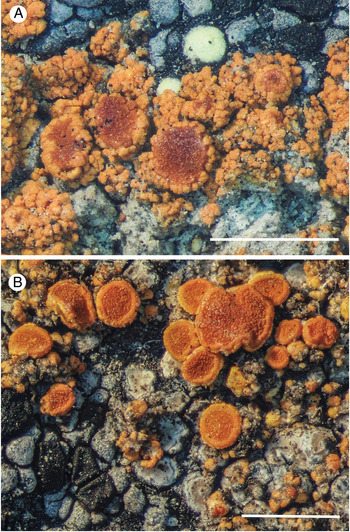
(Fig. 5A)
A, Villophora onas, holotype. B, V. patagonica, holotype. Scale = 1 mm. In colour online.

Thallus crustose, consisting of moniliform to coralloid, spherical to elongated, horizontal or ascending areoles, 0.05–0.15 mm diam., vivid orange-yellow to strongly reddish orange; lichenicolous on crustose lichens and then partly immersed in grey matrix, or epilithic with well-developed thallus.
Apothecia mostly present, numerous, dispersed to aggregated, zeorine, sessile, to 0.8 mm diam., ±regular to angular; margin up to 0.07 mm broad; thalline margin concolorous with the thallus, crenulate and soon excluded; proper margin level with and slightly paler than the disc, smooth; disc flat to eventually slightly convex, episamma fine; thalline exciple with paraplectenchymatous cortex with globular lumina, c. 10 μm diam.; true exciple prosoplectenchymatous, fan-shaped, narrow, 20–30 μm; hymenium 70–80 μm; paraphyses 1.5–2 μm at base, end cells only slightly enlarged, up to 4 μm thick, apically branched; asci with 8 spores; ascospores ellipsoid, (12.8–)14.4 ± 1.4(–18.4) × (6.1–)7.3 ± 0.8(–9.25) μm, length/width ratio 2.0 ± 0.3; septum (4–)5.5 ± 0.9(–7.9) μm, length/septum width ratio 2.7 ± 0.4 (n = 32).
Molecular results
The nrITS-sequences of V. onas are very uniform and make up a sister clade to V. isidioclada.
The species was included as ‘Villophora sp. 50’ in Arup et al. (Reference Arup, Søchting and Frödén2013).
Etymology
The name Villophora onas commemorates the native Onas tribe inhabiting the steppes of Tierra del Fuego prior to the advent of European settlers.
Ecology and distribution
Lichenicolous on crustose, saxicolous lichens, such as Rhizocarpon sp., or saxicolous on stone in steppe, but also among shrubs in alpine heathland, 40–300 m a.s.l. Recorded from Chile, Tierra del Fuego north to 50°S.
Notes
Villophora onas is characterized by an often lichenicolous life habit, combined with the yellow to vivid orange, always granular to isidiate thallus with numerous apothecia. It is similar to the European species Flavoplaca coronata in its granular appearance but differs in not being truly isidiate, in its often lichenicolous habit, having a longer spore septum, and in occurring in South America. Further molecular studies may show it to be closely related to V. maulensis.
Additional specimens examined
Chile: Región de Aisén: along the road Coyhaique-Coyhaique alto, 45.5055°S, 71.7132°W, 700 m, exposed cliffs in open pastureland, 2001, P. Frödén 1563 (LD). Región de Magallanes y de la Antártica Chilena: E end of Lago del Toro, 51.0506°S, 72.5517°W, 40 m, rock, 2005, U. Søchting 10441b; Sierra Baguales, 50.8778°S, 72.3850°W, 2–300 m, rocks in steppe landscape, 1999, A. Elvebakk 99:1140 (TROMS); Sierra Baguales, 50.7917°S, 72.4119°W, c. 300 m, rocks in steppe landscape, 1999, A. Elvebakk 99:1171 (TROMS); Isla Navarino, 25 km W of Puerto Williams, Paso Mladineo, 55.0008°S, 68.0858°W, 580 m, W-exposed basaltic overhang, 2005, U. Søchting 10382; Morro Chico, 100 km N of Punta Arenas, 52.0570°S, 71.4202°W, 228 m, basaltic rock of old volcano in steppe, horizontal rock on soil, 2015, U. Søchting 12379; Tierra del Fuego, along road y-71 c. 22 km W of San Sebastian, 80 m, on siliceous schistose boulder in grass steppe, 2001, U. Arup L01577 (LD).
Villophora patagonica Søchting & Søgaard sp. nov.
MycoBank No.: MB 838277
Similar to Athallia inconnexa in its lichenicolous habit but differing in the generally poorly developed thallus, in not being confined to the genera Acarospora and Aspicilia s. lat., wider spores and in its distribution in Patagonia.
Type: Chile, Región de Magallanes y de la Antártica Chilena, Morro Chico, 52.0576°S, 71.4221°W, 200 m, bedrock basalt, 13 February 2018, U. Søchting 12676 (C—holotype).
(Fig. 5B)
Thallus lichenicolous, insignificant or consisting of minute, pale orange areolae, dispersed around the apothecia, 5–15 mm diam.
Apothecia always present, scattered to crowded, sessile, regular to slightly angular, up to 1 mm diam., deep orange, zeorine; margin 0.04 mm thick; thalline margin thin, soon excluded, orange-yellow; proper margin distinct and persistent, slightly prominent, orange, darker than the thalline margin; disc flat to eventually slightly convex, dark orange, with medium coarse episamma; true exciple prosoplectenchymatous, fan-shaped, 50–60 μm; hymenium 50–70 μm; paraphyses 1.5–2 μm at base, end cells only slightly enlarged, up to 3 μm thick, apically branched; asci with 8 spores; ascospores broadly ellipsoid, (9.4–)12.5 ± 1.3(–16.1) × (5.9–)7.7 ± 0.9(–9.7) μm, length/width ratio 1.6 ± 0.2; septum (3.2–)4.7 ± 0.9(–6.7) μm; length/septum width ratio 2.7 ± 0.3 (n = 35).
Molecular results
Villophora patagonica has very uniform nrITS sequences.
The species was included as ‘Villophora sp. 47’ in Arup et al. (Reference Arup, Søchting and Frödén2013).
Etymology
The name refers to the known distribution in the dry regions of southernmost South America.
Ecology and distribution
Lichenicolous on crustose, saxicolous lichens on siliceous and volcanic rocks, possibly eventually independent of host, on old volcanic rocks in steppe vegetation, 190–360 m. Sometimes with Catenarina desolata Søchting et al. Known from the Región de Magallanes y de la Antártica Chilena, Chile.
Additional specimens examined
Chile: Región de Magallanes y de la Antártica Chilena: 30 km N of Punta Delgada, Parque Nacíonal Pali Aike, 52.1103°S, 69.7008°W, 186 m, on crustose lichens on lava, 2008, M. Z. Søgaard 8, 9; Morro Chico, 52.0500°S, 71.4666°W, 200 m, on rocks in NW-facing boulder slope, 1999, A. Elvebakk 99:772 (TROM).
Villophora rimicola Søchting sp. nov.
MycoBank No.: MB 838278
Similar to Austroplaca erecta in its cushion-like thallus but differing in the bright orange colour versus yellow, in the larger spores with a longer spore septum and in being confined to Antarctica. Thallus saxicolous, forming tight, vertical, anastomosing, pale lobes producing orange areoles on the surface. Apothecia few, zeorine. Ascospores 15–17 × 8.5–9.5 μm, septum 4–5.5 μm.
Type: Antarctica, Loubet Coast, Adelaide Island, Ryder Bay, Lagoon Island, 67.5927°S, 68.2379°W, 30 m, W-exposed scree, on rock between Usnea spp., 20 January 2011, U. Søchting 11518 (C—holotype).
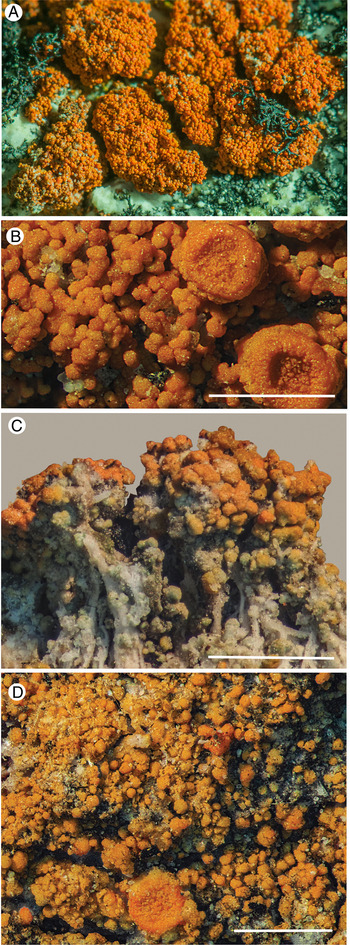
A–C, Villophora rimicola. A, field photograph (U. Søchting 11425b). B, thallus viewed from above (U. Søchting 11447). C, holotype, vertical section through thallus. D, V. wallaceana, holotype. Scales: B & C = 1 mm; D = 0.5 mm. In colour online.

Thallus epilithic, crustose to micro-fruticose, consisting of vertical, terete, coralloid, anastomosing, pale lobes, most often forming tight cushions in rock crevices (Fig. 6C); cushion surface formed by the strongly orange-pigmented lobe ends (Fig. 6B), up to 0.25 mm diam.
Apothecia infrequent, aggregated, zeorine, sessile, to 1 mm diam., ±regular; margin up to 0.04 mm broad; thalline margin concolorous with the thallus, crenulate and soon excluded; proper margin level with and slightly lighter than the disc, smooth; disc flat to eventually slightly convex, episamma fine; true exciple prosoplectenchymatous, fan-shaped, narrow, 20–40 μm; hymenium 70–80 μm; paraphyses 1.5–2 μm at base, end cells only slightly enlarged, up to 3 μm thick, apically branched; asci with 8 spores; ascospores ellipsoid, (14.7–)15.8 ± 1.0(–17.4) × (8.0–)9.0 ± 0.6(–9.4) μm, length/width ratio 1.8 ± 0.2; septum (4.0–)4.6 ± 0.7(–5.4) μm; length/septum width ratio 3.5 ± 0.4 (n = 5, ripe apothecia sparse).
Etymology
The species epithet relates to the growth in crevices. Latin: rima = crack, cleft and colere = to live, to dwell.
Ecology and distribution
Saxicolous in crevices, often eutrophicated by skuas or penguins. From sea level and up to at least 250 m. Recorded from several localities around the British Antarctic Survey base at Rothera Point on Adelaide Island, Antarctica. It is interesting that the species has so far not been recorded from the well-studied maritime Antarctic, such as the South Shetland Islands.
Additional specimens examined
Antarctica: Loubet Coast: Adelaide Island, Ryder Bay, Anchorage Island, 67.6046°S, 68.2163°W, 10 m, coastal rock with bird influence, vertical, NW-exposed rock, 2011, U. Søchting 11425; 67.6016°S, 68.2098°W, 29 m, horizontal pebbles, 2011, U. Søchting 11447; Léonie Island, 67.6018°S, 68.3614°W, 29 m, NE-exposed rocks with skuas, among Usnea spp., 2011, U. Søchting 11384; 67.5939°S, 68.3451°W, 16 m, exposed crevices, 2011, U. Søchting 11414; Rothera Point, Cross Hill, 67.5717°S, 68.1265°W, 20 m, eutrophicated rock crevices, 2011, U. Søchting 11415; Reptile Ridge, 67.5574°S, 68.1528°W, 250 m, S-exposed mountain ridge of granite diorite, exposed horizontal rock, 2011, U. Søchting 11533.
Villophora wallaceana Søchting & Søgaard sp. nov.
MycoBank No.: MB 838279
Similar to Villophora darwiniana but differs in that the thallus consists of globose granules instead of producing squamules with soredia/blastidia on the edge, and in having wider spores with a slightly wider septum.
Type: Chile, Región de Magallanes y de la Antártica Chilena, Isla Navarino, c. 25 km W of Puerto Willliams, 7 km S of Lum, 54.9583°S, 68.0917°W, 370 m, pristine forest of Nothofagus pumilio, dead bark of N. pumilio, 26 January 2005, U. Søchting 10399 (C—holotype).
(Fig. 6D)
Thallus indeterminate, consisting of scattered or crowded, globose, isidioid, corticate granules of uneven size, 0.04–0.08 mm diam., deep orange-yellow to deep orange; thallus partly crustose and almost smooth with flat, adpressed, minute, 75–155 μm broad, slightly brighter coloured areolae associated with the isidia.
Apothecia rare, dispersed to aggregated, sessile, zeorine, regular, 0.2–0.5 mm diam., vivid yellow to vivid orange; disc flat, with medium coarse episamma; proper margin prominent; thalline margin concolorous with thallus, continuous to discontinuous, with occasional isidia; true exciple prosoplectenchymatous, fan-shaped, c. 85 μm; hymenium 60–65 μm; paraphyses 1.5–2 μm at base, apically branched, with only slightly inflated terminal cells, up to 3.5 μm; ascospores ellipsoid, (12.1–)13.7 ± 1.1(–14.7) × (6.7–)7.7 ± 0.6(–8.0) μm, length/width ratio 1.8 ± 0.2; septum (4–)5.4 ± 1.0(–6.7) μm; length/septum width ratio 2.6 ± 0.6 (n = 4).
Molecular results
Villophora wallaceana is sister species to V. darwiniana, which is also the species with the most similar morphology.
The species was included as ‘Villophora sp. 48’ in Arup et al. (Reference Arup, Søchting and Frödén2013).
Etymology
Named after the outstanding biologist and biogeographer Alfred Russel Wallace (1823–1913).
Ecology and distribution. Rough bark of Nothofagus pumilio in pristine forest. It is so far known only from Isla Navarino in Región de Magallanes y de la Antártica Chilena, Chile.
Notes
Villophora wallaceana may be difficult to distinguish from V. darwiniana, but the latter has squamules with soredia/blastidia of ±uniform size from the underside and margins. Villophora wallaceana has globose isidia of uneven size. Villophora wallaceana and V. darwiniana are the only known species of Villophora on bark and lignum in South America.
Additional specimens examined
Chile: Región de Magallanes y de la Antártica Chilena: Isla Navarino, 5 km SW of Puerto Williams, 54.9528°S, 67.6386°W, 171 m, Nothofagus, 2008, M. Z. Søgaard 68; Isla Navarino, 2 km SW of Puerto Williams, Cerro Bandera, 54.9500°S, 67.6417°W, 110 m, on Nothofagus pumilio, 2005, U. Søchting 10251; Isla Navarino, 30 km WNW of Puerto Williams, coastal trail between Wulaia and Caleta José, 55.015°S, 68.165°W, 10 m, dead bark of Nothofagus, 2005, U. Søchting 10354.
Acknowledgements
Lisbeth Knudsen is thanked for technical assistance in the HPLC and molecular laboratories. Arve Elvebakk is thanked for allowing us to study his collections from southern Chile. Peter Convey of the British Antarctic Survey was the mediator of a very stimulating visit to the BAS base at Rothera Point, Antarctica. Fieldwork on Livingston Island and Navarino Island was supported by the Spanish grant CTM2015-64728-C2-1-R (MINECO/FEDER, UE) and the Carlsberg Foundation (2008_01_0645). We are grateful to Jens H. Petersen and Leif Bolding for photographic consultations.
Author ORCID
Ulrik Søchting, 0000-0001-7122-9425.