Introduction
The development of individuals plays an important role in regulating the population of an organism in an agroecosystem. Development varies interspecifically and intraspecifically in response to various abiotic and biotic factors. Interspecific variation includes the slow–fast continuum which elucidates the occurrence of wide variations in sizes of organisms owing to variation in developmental rates (Oli, Reference Oli2004; Bielby et al., Reference Bielby, Mace, Bininda-Emonds, Cardillo, Gittleman and Jones2007). According to this, fast life history is characterized by early reproduction, high fecundity, short generation time, short lifespan, small offspring and adult body size; while a slow life history has the opposite characteristics (Sibly & Brown, Reference Sibly and Brown2007; Jeschke & Kokko, Reference Jeschke and Kokko2009). Intraspecific variation on the other hand, includes the occurrence of individual differences within a population in response to various genetic and environmental factors. Individual development typically exhibits plasticity in response to the prevailing environmental conditions (Pigliucci, Reference Pigliucci2001), especially temperature. Shifts in temperature even minor ones are known to cause changes in developmental and survival responses of most organisms (Joschinski et al., Reference Joschinski, Hovestadt and Krauss2015). This developmental plasticity often involves a strong genetic component (Bergland et al., Reference Bergland, Genissel, Nuzhdin and Tatar2008; Beldade et al., Reference Beldade, Mateus and Keller2011), individual condition and state (Hiyama et al., Reference Hiyama, Taira and Otaki2012), transgenerational effects (Greer et al., Reference Greer, Maures, Ucar, Hauswirth, Mancini, Lim, Benayoun, Shi and Brunet2011) and multifactorial inheritance (Bergland et al., Reference Bergland, Genissel, Nuzhdin and Tatar2008; Maleszka, Reference Maleszka2008). The relationship between development and physiology helps in the translation of genotypes into phenotypes and thus is likely to have major effects on evolutionary outcomes (Stern, Reference Stern2010).
However, what is not understood is the presence of different rates of development in a single cohort under similar abiotic and biotic conditions. Studies on several taxa have revealed the occurrence of two distinct rates of development within a cohort (e.g., Gross, Reference Gross1985; Schönrogge et al., Reference Schönrogge, Wardlaw, Thomas and Elmes2000; Witek et al., Reference Witek, Sliwinska, Skorka, Nowicki, Settele and Woyciechowski2006; Skorping, Reference Skorping2007; Lewis et al., Reference Lewis, Brakefield and Wedell2010). This was investigated and formally reported in the ladybirds, Menochilus sexmaculatus (Fabricius) and Propylea dissecta (Mulsant) (Mishra & Omkar, Reference Mishra and Omkar2012) and chrysomelid, Zygogramma bicolorata Pallister (Pandey et al., Reference Pandey, Mishra and Omkar2013) under constant conditions as well as in the two ladybirds in response to variations in temperature (Singh et al., Reference Singh, Mishra and Omkar2014, Reference Singh, Mishra and Omkar2016). Temperature in particular is one of the main driving forces of development (Jalali et al., Reference Jalali, Mehrnejad and Kontodimas2014; Benelli et al., Reference Benelli, Leather, Francati, Marchetti and Dindo2015) and feeding rates (Sentis et al., Reference Sentis, Hemptinne and Brodeur2012; Sørensen et al., Reference Sørensen, Toft and Kristensen2013) in coccinellids.
Genetic variations in phenotypic plasticity for developmental rates and size in sub-populations have been used to select for faster developing organisms in Drosophila melanogaster Meigen (Partridge & Fowler, Reference Partridge and Fowler1992), lepidopteran, Manduca sexta (L.) (D'Amico et al., Reference D'Amico, Davidowitz and Nijhout2001) and the ladybird, Hippodamia convergens (Guérin-Méneville) (Rodriguez-Saona & Miller, Reference Rodriguez-Saona and Miller1995), but under constant abiotic and biotic conditions. Bimodal (two peaks i.e., slow and fast) distribution has been reported not only in intraspecific body size (Gouws et al., Reference Gouws, Gaston and Chown2011) but also in the developmental rates (Mishra & Omkar, Reference Mishra and Omkar2012; Singh et al., Reference Singh, Mishra and Omkar2014, Reference Singh, Mishra and Omkar2016). The bimodal distribution and the proportion of slow:fast emergence has been found to shift in M. sexmaculatus and P. dissecta, with change in abiotic conditions like temperature and photoperiod (Singh et al., Reference Singh, Mishra and Omkar2014, Reference Singh, Mishra and Omkar2016). The ratio of slow and fast developing individuals also differs with the biotic conditions, such as prey; poor prey species favoured the emergence of more slow developing individuals and vice versa (Singh et al., unpublished data). Such trends in slow:fast ratio have been attributed to selective mortality influenced by the prevailing abiotic and biotic conditions.
Every organism requires a certain amount of energy for growth, development and survival. Favourable conditions with adequate food and energy resources combined with a congenial environment maximize the survival of organisms. Since aphid availability in the agroecosystem frequently fluctuates in space and time, the ladybird predators often face the problem of prey scarcity/deprivation. Prey deprivation severely affects the life attributes of ladybirds (Omkar & Pervez, Reference Omkar and Pervez2003; Schuder et al., Reference Schuder, Hommes and Larink2004; Phoofolo et al., Reference Phoofolo, Giles and Elliott2008; Santos-Cividanes et al., Reference Santos-Cividanes, dos Anjos, Cividanes and Dias2011). Both larval and adult performances of different predatory ladybirds are constrained by the quantity of prey (Lee & Kang, Reference Lee and Kang2004; Santos-Cividanes et al., Reference Santos-Cividanes, dos Anjos, Cividanes and Dias2011). While evaluating the developmental time and survival of Scymnus subvillosus (Goeze) at different prey densities, Atlihan & Guldal (Reference Atlıhan and Guldal2009) found that increased prey density reduced the developmental time and mortality rate. The developmental durations of larval instars of Coccinella septempunctata L. and Coccinella transversalis Fabricius were short when prey was present in abundance and the larvae pupated earlier (Maurice & Kumar, Reference Maurice and Kumar2011). Prey quantity severely affects the reproductive output and fitness of ladybirds (Agarwala et al., Reference Agarwala, Bardhanroy, Yasuda and Takizawa2001; Omkar et al., Reference Omkar, Sahu and Kumar2010). Clutch size and oviposition rate is known to be influenced by the prey quantity available to females at the time of oviposition (Dixon, Reference Dixon2000). Ware et al. (Reference Ware, Yguel and Majerus2008) found the clutch sizes to be maximum when females of Harmonia axyridis (Pallas) and Adalia bipunctata L. were reared on abundant prey. Agarwala et al. (Reference Agarwala, Singh, Lokeshwari and Sharmila2009) reported that females of Harmonia dimidiata (Fabricius) mature earlier and produce more eggs at high prey density. In general, quantity of prey is the key component that affects development, survival and reproduction of insect predators, including ladybirds (Omkar et al., Reference Omkar, Sahu and Kumar2010; Dmitriew & Rowe, Reference Dmitriew and Rowe2011). Therefore, it is logical to hypothesize that the proportion of slow and fast developing individuals will possibly change with change in prey quantity.
Owing to the prominent impact of prey quantity on the development in ladybirds, in the present study we decided to investigate: (i) the effect of scarce and abundant prey supply on the phenomena of slow and fast development in two locally abundant aphidophagous ladybirds, M. sexmaculatus and P. dissecta; (ii) the proportion of slow and fast developing individuals in a cohort with varying prey supply and (iii) the variation in developmental and reproductive attributes of these developmental types. Both these ladybirds co-exist as predators of the numerous species of aphids that infest agricultural crops grown around Lucknow, India. Both ladybirds are polyphagous and potential biocontrol agents. The results of this study are expected to improve our understanding of the specific mechanism involving the slow and fast development in relation to scarce and abundant prey supply.
Materials and methods
Two predaceous ladybirds, M. sexmaculatus and P. dissecta, were selected for the study owing to their: (a) local abundance, (b) wide prey range, (c) fast development, (d) high reproduction and (e) previous studies on related aspects (Mishra & Omkar, Reference Mishra and Omkar2012; Singh et al., Reference Singh, Mishra and Omkar2014, Reference Singh, Mishra and Omkar2016).
Stock maintenance
Adults of M. sexmaculatus and P. dissecta were collected from agricultural fields surrounding Lucknow, India (26°50′N, 80°54′E) and brought to the laboratory. They were paired and kept in transparent plastic Petri dishes (9.0 × 2.0 cm2) containing daily replenished aphids, Aphis craccivora Koch (on host plant Vigna unguiculata (L.) taken from polyhouse cultures; 25 ± 2°C; 65 ± 5% relative humidity (RH)) under standard laboratory conditions (27 ± 1°C; 65 ± 5% RH; 14L:10D) in incubators. Eggs laid were collected every 24 h and incubated under above abiotic conditions until hatching. The larvae were reared until adult emergence in plastic beakers (14.5 × 10.5 cm2; five instars per beaker). The requisite stages were taken from the stock culture for experiments.
Slow and fast development on scarce/abundant prey
During the standardization of prey quantity, it was found that early instars, viz. first, second and third instars of M. sexmaculatus and P. dissecta, consume 6–12 second and third instars of A. craccivora per day, while fourth instars and adult males and females consume 10–20 second and third instars of A. craccivora per day. The treatments of prey-scarce and prey-abundant conditions were selected on this basis.
Ten pairs of 10-day-old unmated adults of the two ladybirds were paired in separate plastic Petri dishes (size as above) and placed under prey scarce (3–5 second and third instars of A. craccivora per day) and prey abundant (25–30 second and third instars of A. craccivora per day) conditions. A total of 260 eggs from the first 5 days of oviposition of each ladybird species on each prey quantity were selected. Hatched instars were reared individually in Petri dishes (size as above) on the prey quantity as provided to their parents till adult emergence. They were observed for survival and moulting with all observations being conducted twice a day. The instars were grouped as slow and fast developing individuals on the basis of their total developmental period following Mishra & Omkar (Reference Mishra and Omkar2012). Mass of emerging adults was taken 6 h after emergence using an electronic balance. Number of immature survival (number surviving out of total number of eggs), proportion of slow:fast emergence (number of slow or fast developing individuals/total number of individuals emerged) and sex ratio in terms of proportion of females in the population, that is number of females in each developmental type (number of females in slow or fast developing individuals/total number of slow or fast developing individuals) was calculated for both ladybird species on each ladybird-prey supply combination.
Effect of slow-fast development on reproductive attributes
The newly emerged adults of each developmental type, i.e., slow and fast developing individuals, were paired in Petri dishes (size as above) and provided with the prey quantity on which they had completed development. Daily oviposition was recorded for the next 20 days and egg viability was recorded in 10 pairs from each type (i.e., slow and fast) under each ladybird-prey supply combination.
Statistical analysis
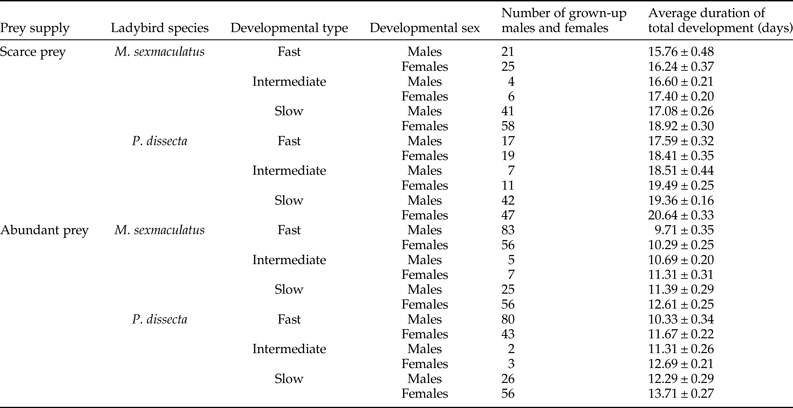
Data on total developmental durations (from day of egg laying to adult emergence) for M. sexmaculatus and P. dissecta on each prey quantity were subjected to Hartigan's dip test for unimodality in statistical software ‘R’ (version 3.0.1; R Development Core Team, 2013) to assess for type of distribution (unimodal, bimodal or multimodal). In case of non-unimodal statistical value being obtained, the interpretation of bimodality was done in combination with graphical representation. The data were also divided into three groups of fast, intermediate and slow developing individuals, with number of grown-up males and females in each group (table 1). Individuals who had an intermediate duration of development were present in negligible numbers hence excluded from the further analysis.
Durations of different life stages of M. sexmaculatus and P. dissecta on scarce and abundant prey supply.

Two-way ANOVA showing the effects of prey supply, ladybird species and their interaction on durations of different life stages.
Values are Mean ± SE. For both ladybird species, upper cases in parentheses represent comparison of means between scarce and abundant prey supply within ladybird species.
Values followed by different alphabets show significant differences (P < 0.05) among means of developmental durations.
Chi-square (χ2) ‘goodness of fit’ analysis was used for the comparison of (i) number of immature survival on scarce and abundant prey supply, (ii) proportion of slow:fast emergence and sex ratio between slow and fast developing individuals on each prey supply and also between scarce and abundant prey supply. When degree of freedom (d.f.) = 1, Yates correction for continuity was employed, while for multiple comparisons, i.e., when d.f. >1, Bonferroni corrections were made using R software. The data were subjected to two way analysis of variance (ANOVA) taking ladybird species, prey supply (scarce and abundant) as independent factors and durations of different life stages of ladybirds as dependent factors followed by Tukey's post hoc comparison of means. Further the data were again subjected to three way ANOVA taking ladybird species, prey supply (scarce and abundant) and developmental type (slow/fast) as independent factors and total developmental duration as dependent factor followed by Tukey's post hoc comparison of means. The data on body mass of males and females taking as dependent factor were subjected to General multivariate analysis of variance (MANOVA) taking ladybird species, prey supply, developmental type and developmental sex as independent factors followed by Tukey's post hoc comparison of means. Insignificant interactions (P > 0.05) were removed.
The data on adult longevity, fecundity and per cent egg viability (dependent factors) were checked for normal distribution prior to subjecting them to three way ANOVA taking prey supply (scarce and abundant), ladybird species, and developmental type (slow/fast) as independent factors. Differences between means were calculated using Tukey's post hoc honest test of significance at 5% levels. All statistical analyses, except χ2 tests, were performed using MINITAB 15.0. Per cent data were arcsine transformed prior to ANOVA followed by Tukey's post hoc comparison of means. Insignificant interactions (P > 0.05) were removed.
Results
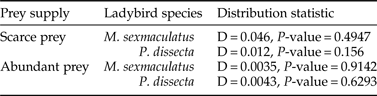
The overall distribution of developmental durations of M. sexmaculatus and P. dissecta was not unimodal (table 2) and revealed a clear bimodal pattern when the frequencies of the developmental durations were graphed (fig. 1).
Frequency distribution of total developmental duration (TDD; in days) of (a) Menochilus sexmaculatus and (b) Propylea dissecta on scarce and abundant prey supply. Bars indicate number of individuals emerging at each development duration.
Results of test for modality of distribution of developmental durations of M. sexmaculatus and P. dissecta on scarce and abundant prey supply.
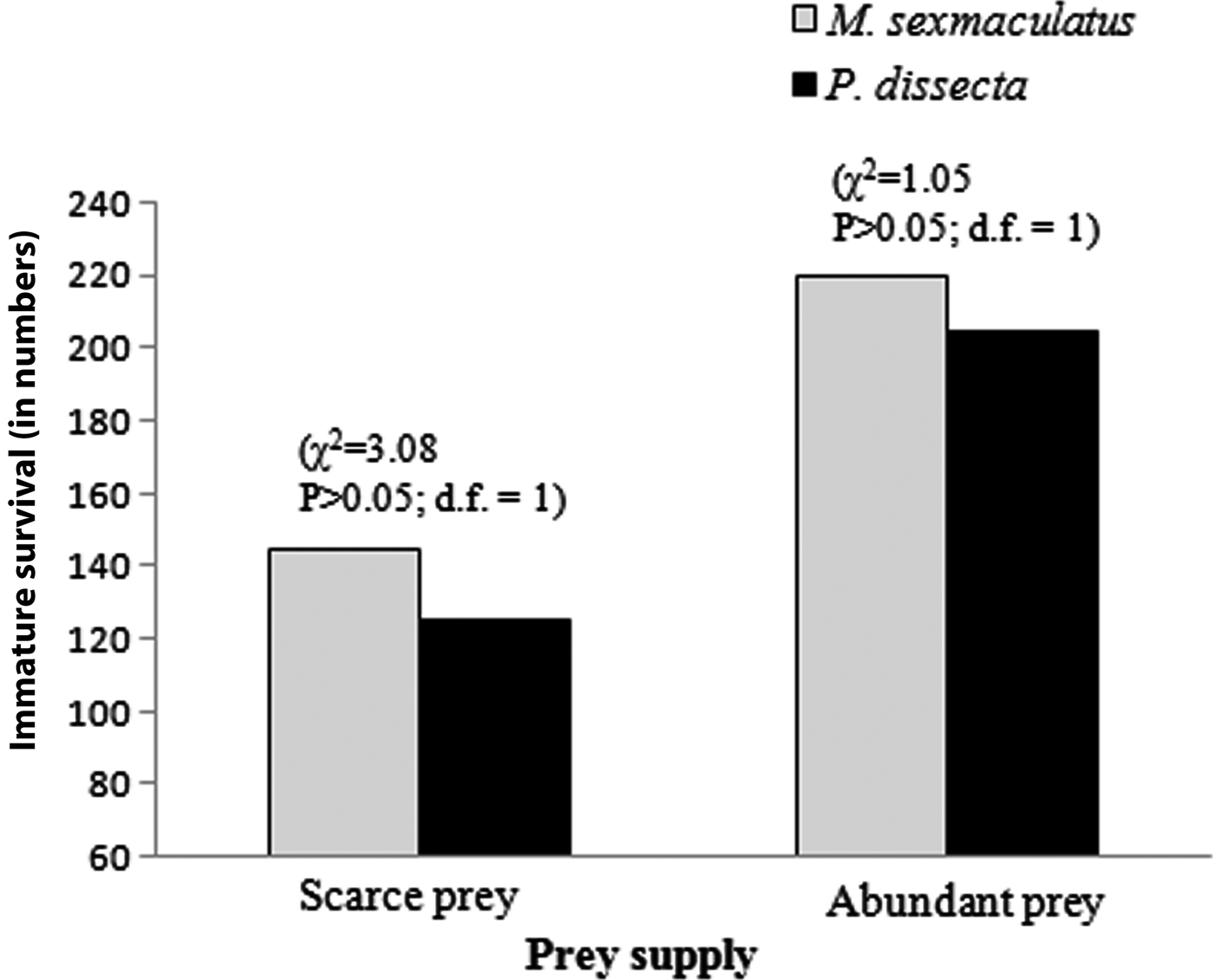
Immature survival of M. sexmaculatus (χ2 = 51.70; P = 0.001; d.f. = 1) and P. dissecta (χ2 = 53.07; P = 0.001; d.f. = 1) differed significantly with the prey quantity, with higher survival under abundant prey supply (fig. 2). However, the difference in immature survival between ladybird species on each prey supply was not significant (fig. 2).
Immature survival (number surviving out of 260 eggs) of Menochilus sexmaculatus and Propylea dissecta on scarce and abundant prey supply. χ2 values present above each set of bars indicate difference between immature survival of each ladybird species on each prey supply.
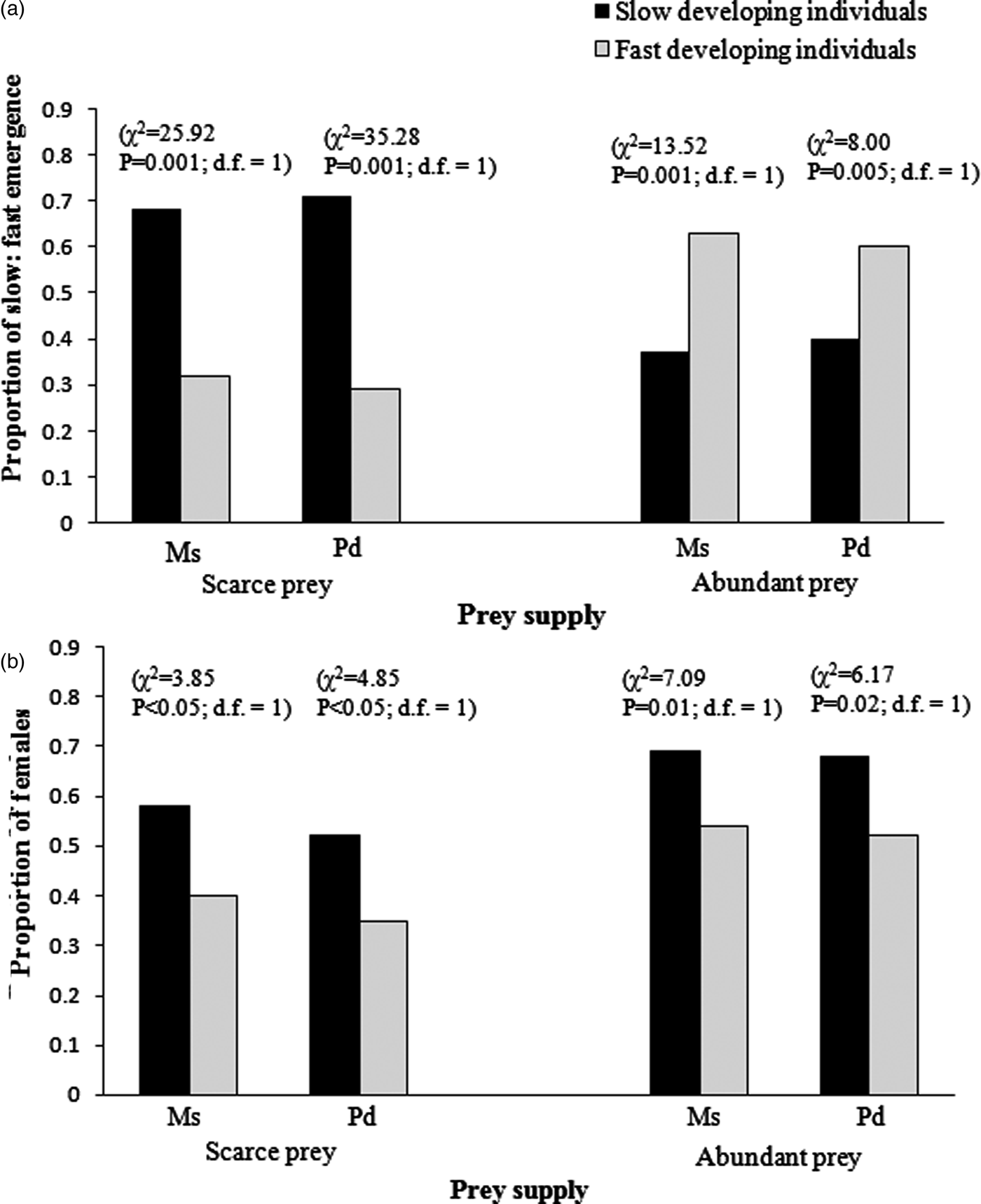
The proportion of slow:fast emergence was significantly different when beetles were fed on scarce and abundant prey supply (fig. 3a). A comparison of slow developing individuals on scarce and abundant prey supply showed significant differences for M. sexmaculatus (χ2 = 19.26; P = 0.001; d.f. = 1) and P. dissecta (χ2 = 19.45; P = 0.001; d.f. = 1). Similar significant differences were recorded for fast developing individuals of M. sexmaculatus and P. dissecta. The number of slow developing individuals was not significantly different between the two ladybirds on scarce (χ2 = 0.12; P > 0.05; d.f. = 1) and abundant (χ2 = 0.23; P > 0.05; d.f. = 1) prey supply. The higher slow developing individuals in both ladybird species were recorded on scarce prey supply and the lower on abundant prey supply (fig. 3a).
(a) Proportion of slow:fast emergence and (b) Sex ratio (proportion of females) of Menochilus sexmaculatus (Ms) and Propylea dissecta (Pd) on scarce and abundant prey supply. χ2 values (significant at P < 0.05) present above each set of bars indicate difference between slow and fast developing individuals of each ladybird species on each prey supply.
The sex ratios of slow and fast developing individuals of M. sexmaculatus and P. dissecta on scarce and abundant prey supply were significantly different (fig. 3b). The sex ratio was female biased in slow developing individuals of both the ladybirds under both prey supply conditions. The number of slow developing females did not differ significantly between scarce and abundant prey supply in M. sexmaculatus (χ2 = 3.93; P > 0.05; d.f. = 1) and P. dissecta (χ2 = 2.61; P > 0.05; d.f. = 1). Insignificant differences were recorded for fast developing females in M. sexmaculatus (χ2 = 5.57; P > 0.05; d.f. = 1) and P. dissecta (χ2 = 5.87; P > 0.05; d.f. = 1). The sex ratio in fast developing individuals of both the species was almost 50:50 on abundant prey supply, but was male biased on scarce prey supply (fig. 3b).
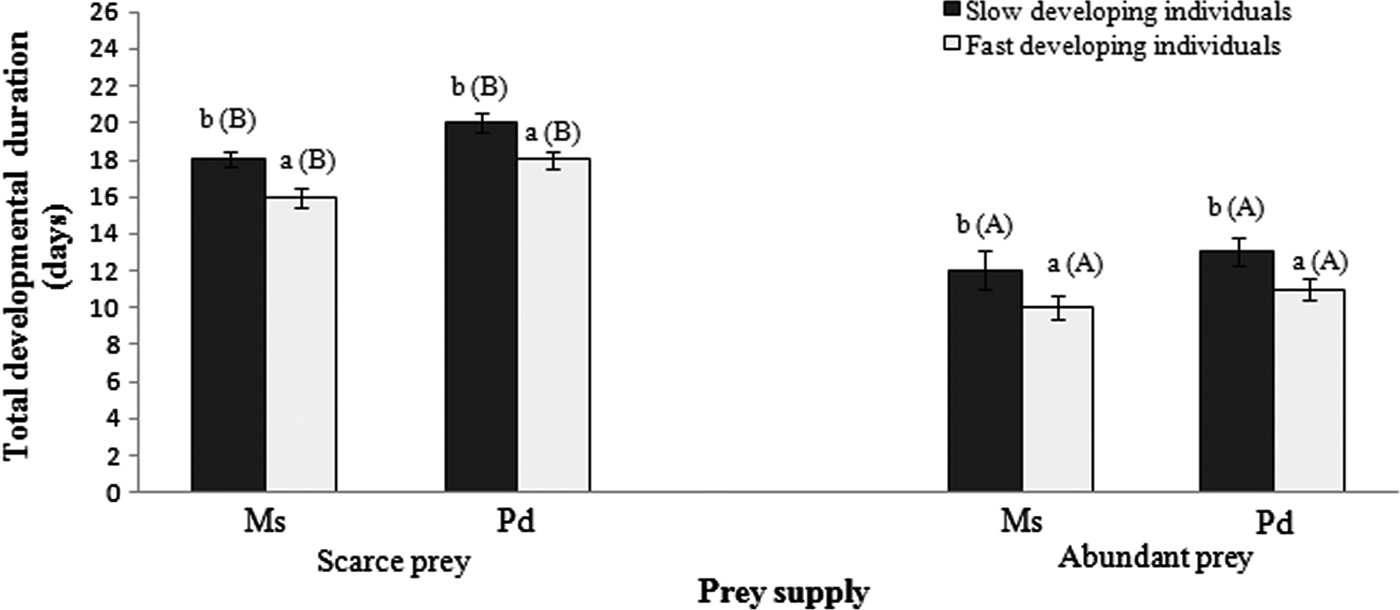
Durations of different life stages of M. sexmaculatus and P. dissecta varied significantly on scarce and abundant prey supply conditions. Post hoc analysis revealed that all the life stages of both the ladybirds took the longest duration to develop on scarce prey supply and shortest on abundant prey supply (table 3). Total developmental duration of slow and fast developing individuals varied significantly between and within prey supply (fig. 4). ANOVA revealed that independent factors, i.e., prey supply (F = 13.93, P = 0.001, d.f. = 1, 156), ladybird species (F = 158.13, P = 0.001, d.f. = 1, 156) and developmental types (F = 58.72, P = 0.001, d.f. = 1, 156) had significant influence on the total developmental duration. The interactions between prey supply and ladybird species (F interaction = 5.85, P = 0.002, d.f. = 1, 156), prey supply and developmental types (F interaction = 5.10, P = 0.025, d.f. = 1, 156), and ladybird species and developmental types (F interaction = 10.51, P = 0.001, d.f. = 1, 156) were significant.
Total developmental duration of Menochilus sexmaculatus (Ms) and Propylea dissecta (Pd) on scarce and abundant prey supply. Values are Mean ± SE. For both ladybird species, lower cases represent comparison of means between slow and fast developing individuals within ladybird species on each prey supply, and upper cases in parentheses represent comparison of means between slow and fast developing individuals within ladybird species on scarce and abundant prey supply. Values followed by different alphabets show significant differences (P < 0.05) among means of slow and fast developing individuals.
Total developmental duration and number of grown-up males and females of fast, intermediate and slow developmental types of M. sexmaculatus and P. dissecta on scarce and abundant prey supply.
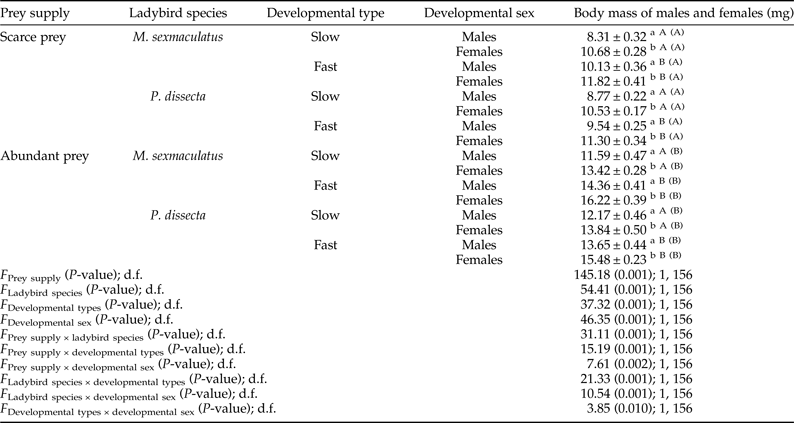
Body mass of slow and fast developing individuals varied significantly between and within prey supply conditions. Males and females of fast developing individuals were heavier on both prey supplies than slow developing individuals (table 4). Such differences were also prominent between the two sexes within each species, with the females always heavier than the males. Post hoc analysis revealed that body mass of males and females of both developmental types was maximum on abundant prey supply and minimum on scarce prey supply. This trend was similar in both species. These results were also supported by ANOVA, which revealed that prey supply, ladybird species, developmental types, developmental sex and their interactions had significant influence on the body mass (table 4).
Body mass of males and females of slow and fast developmental types of M. sexmaculatus and P. dissecta on scarce and abundant prey supply.
General MANOVA showing the effects of prey supply, ladybird species, developmental types, developmental sex and their interactions on body mass of males and females.
Values are Mean ± SE.
For both ladybird species, lower cases represent comparison of means between males and females within slow/fast developing individuals within ladybird species on each prey supply, upper cases represent comparison of means between males of slow and fast developing individuals within ladybird species on each prey supply and females of slow and fast developing individuals within ladybird species on each prey supply, upper cases in parentheses represent comparison of means between males of slow/fast developing individuals within ladybird species on scarce and abundant prey supply and females of slow/fast developing individuals within ladybird species on scarce and abundant prey supply.
Values followed by different alphabets show significant differences (P < 0.05) among means of slow and fast developing individuals.
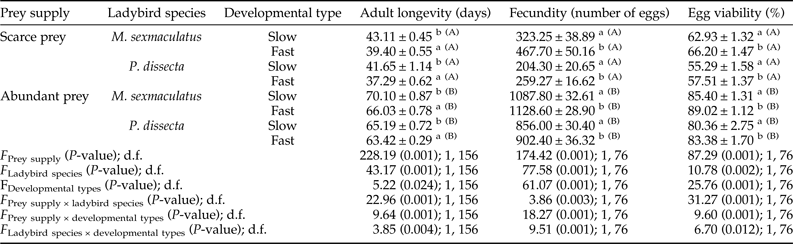
Adult longevity, fecundity and egg viability of slow and fast developing individuals varied significantly between and within prey supply conditions (table 5). Three-way ANOVA revealed that slow developing adults had higher longevities than the fast developing individuals, while significantly higher numbers of eggs were laid by fast developing individuals with higher per cent egg viability than by slow developing individuals. This trend was similar in both species (table 5).
Adult longevity, fecundity and egg viability of slow and fast developmental types of M. sexmaculatus and P. dissecta on scarce and abundant prey supply
Three-way ANOVA showing the effects of prey supply, ladybird species, developmental types and their interactions on adult longevity, fecundity and egg viability.
Values are Mean ± SE.
For both ladybird species, lower cases represent comparison of means between slow and fast developing individuals within ladybird species on each prey supply, and upper cases in parentheses represent comparison of means between slow and fast developing individuals within ladybird species on scarce and abundant prey supply.
Values followed by different alphabets show significant differences (P < 0.05) among means of a slow and fast developing individuals.
Discussion
The results indicate the presence of two developmental rates within a cohort of M. sexmaculatus and P. dissecta, the proportion of which were significantly modified by varying prey quantity. Prey quantity also significantly influenced the developmental duration, survival and reproduction of both the ladybirds. Both developmental types took the longest time to develop under scarce prey conditions and shortest time on abundant prey conditions. Fast developing individuals were heavier than the slow developing ones and their fecundity and egg viability were also highest. Fecundity, egg viability and adult longevity were highest under abundant prey supply.
There exists an inherent variation in developmental rate of M. sexmaculatus and P. dissecta within a cohort provided with same abiotic and biotic conditions. Such an inherent variation in developmental rate has also been reported in salmonid fish (Gross, Reference Gross1985), butterflies, Maculinea rebeli (Hirchke) (Schönrogge et al., Reference Schönrogge, Wardlaw, Thomas and Elmes2000; Witek et al., Reference Witek, Sliwinska, Skorka, Nowicki, Settele and Woyciechowski2006) and Bicyclus anynana (Butler) (Lewis et al., Reference Lewis, Brakefield and Wedell2010), predaceous syrphid, Microdon mutabilis (L.) (Schönrogge et al., Reference Schönrogge, Wardlaw, Thomas and Elmes2000), nematode, Teladorsagia circumcincta (Stadelman) (Skorping, Reference Skorping2007) and other insects (Gouws et al., Reference Gouws, Gaston and Chown2011) including ladybirds (Mishra & Omkar, Reference Mishra and Omkar2012; Singh et al., Reference Singh, Mishra and Omkar2014, Reference Singh, Mishra and Omkar2016; Dixon et al., Reference Dixon, Sato and Kindlmann2015). Though, not commonly assessed, but in ladybirds this inherent variation in developmental rates within the same cohort and population has been observed (Rodriguez-Saona & Miller, Reference Rodriguez-Saona and Miller1995; Dixon, Reference Dixon2000; Mishra & Omkar, Reference Mishra and Omkar2012; Singh et al., Reference Singh, Mishra and Omkar2014, Reference Singh, Mishra and Omkar2016; Dixon et al., Reference Dixon, Sato and Kindlmann2015), albeit their distribution pattern has not been assessed until recently (Mishra & Omkar, Reference Mishra and Omkar2012; Singh et al., Reference Singh, Mishra and Omkar2014, Reference Singh, Mishra and Omkar2016; Dixon et al., Reference Dixon, Sato and Kindlmann2015). The lack of unanimity about bimodality of developmental durations of ladybirds could simply be a result of very few studies on their growth and development attempting to assess the distribution of development rates.
One of the probable reasons behind the provisioning of slow and fast developing eggs by the female in an egg batch could be to minimize local extinction by catastrophic events as suggested by the bet-hedging hypothesis (Hanski, Reference Hanski1988). Other possible rationales behind the variation in developmental rate could be: (a) disparity in maternal investment (Osawa, Reference Osawa2003), (b) asynchronization in hatching (Kawai, Reference Kawai1978; Osawa, Reference Osawa1992), (c) eggs with different metabolic rates due to allelic differences (Sloggett & Lorenz, Reference Sloggett and Lorenz2008; Osawa & Ohashi, Reference Osawa and Ohashi2008), and/ or (d) mother laying eggs with different sizes and nutritional content (Hodek et al., Reference Hodek, Van Emden and Honek2012). High metabolic rate is linked with short developmental period and high fecundity (Marinkovic et al., Reference Marinkovic, Milosevic and Milanovic1986; Hoffmann & Parsons, Reference Hoffmann and Parsons1989) whereas the low metabolic rate is known to increase longevity and stress resistance (Service, Reference Service1987; Hoffmann & Parsons, Reference Hoffmann and Parsons1989). Egg size also affects development success, developmental rate, offspring size and fecundity in insects (Tauber et al., Reference Tauber, Tauber and Tauber1991; Fox & Czesak, Reference Fox and Czesak2000).
The proportion of slow:fast emerged individuals differed notably with varying prey supply. The reduced rates of prey consumption may be a key factor for slow development and high mortality of both larvae and adults (Phoofolo et al., Reference Phoofolo, Giles and Elliott2008). The prey intake, its digestibility and utilization significantly influence the growth, developmental time, body biomass and survival of ladybirds (Rath, Reference Rath2010). It is likely that on abundant prey supply, fast developing individuals were able to develop better and were present in higher numbers, whereas slow developing individuals were found in higher numbers on scarce prey supply possibly owing to decreased availability of nutrients. Such strained nutritive conditions would not be suitable for fast developing individuals, thus causing high mortality and leading to a skewed ratio in favour of slow developing individuals. Also evolutionary theory illustrates that fast development occurs under suitable conditions and slow development occurs under adverse conditions (e.g., Davidowitz & Nijhout, Reference Davidowitz and Nijhout2004; Stillwell et al., Reference Stillwell, Morse and Fox2007, Reference Stillwell, Blanckenhorn, Teder, Davidowitz and Fox2010; Chown & Gaston, Reference Chown and Gaston2010). Additionally, faster-growing individuals are expected to be more sensitive to starvation because of their need for higher metabolic rates. Hence, difference in metabolic rate might also be responsible for this skewed ratio. It has been reported earlier that ectotherm species reared under stressful environments (i.e., food and water stress) have lower metabolic rates than related species from more benign environments (Juliano, Reference Juliano1986). We believe that the differing slow and fast ratio found under differing prey supply indicates the increased mortality of a particular development type as they could not reach the minimum threshold mass for achieving the next developmental stage under each prey supply.
The fecundity of both slow and fast developing individuals of M. sexmaculatus and P. dissecta was low under scarce prey supply, which can be attributed to decreased nutrient resources restricting the development and reproduction of the ladybirds (Moczek, Reference Moczek1998; O'Brien et al., Reference O'Brien, Boggs and Fogel2005; Hodek et al., Reference Hodek, Van Emden and Honek2012). Furthermore, Reznik & Vaghina (Reference Reznik and Vaghina2013) reported that nutrients (quality and quantity of prey) affect the rate of reproductive maturation and fecundity in H. axyridis. Prey scarcity is known to affect fitness of the developing life stages (Agarwala et al., Reference Agarwala, Bardhanroy, Yasuda and Takizawa2001; Stamp, Reference Stamp2001), the development of ovarioles (Hodek et al., Reference Hodek, Van Emden and Honek2012) and even resorption of eggs (Cope & Fox, Reference Cope and Fox2003; Omkar & Pervez, Reference Omkar and Pervez2003).
In cohorts of M. sexmaculatus and P. dissecta, fast developing individuals were large in size and females were more fecund with higher egg viability than slow developing individuals in both prey supply. Dixon et al. (Reference Dixon, Sato and Kindlmann2015) reported that the adult weights of the fast-developing individuals were greater than that of slow-developing individuals when reared on an excess of aphids per day. The variation in fecundity was supported by the differences in body mass (Darwin, Reference Darwin1874). Larger females lay more and bigger eggs (Stearns, Reference Stearns1992; Charnov & Ernest, Reference Charnov and Ernest2006; Davidowitz, Reference Davidowitz2008) and these are considered to facilitate faster development (Garcia-Barros, Reference Garcia-Barros2000; Katvala & Kaitala, Reference Katvala and Kaitala2001; Roff, Reference Roff2002; Omkar & Afaq, Reference Omkar and Afaq2013). Also, the higher fecundity and decreased longevity of fast developing females indicate possible trade-off between reproduction and survival whereas slow developing individuals conserve nutrient reserves for somatic maintenance leading to low energy availability, slower growth, delayed sexual maturation, low gonadal steroid production, small adult body size and low fecundity (Kuzawa, Reference Kuzawa2005, Reference Kuzawa, Trevathan, Smith and McKenna2008; Walker et al., Reference Walker, Gurven, Hill, Migliano, Chagnon and De Souza2006). The higher per cent egg viability in the fast developing individuals may be ascribed to larger size of males that possibly supply higher ejaculate, better quality of genes in addition to accessory gland proteins (Avila et al., Reference Avila, Sirot, LaFlamme, Rubinstein and Wolfner2011; Helinski & Harrington, Reference Helinski and Harrington2011). Lewis et al. (Reference Lewis, Brakefield and Wedell2010) reported that the slow developing males were smaller in size, produced fewer fertile sperm and longer time to mate as compared with fast developing ones.
Besides numerous benefits of fast developing individuals, slow developing individuals were found to be superior when food resources were scarce (Sevenster & Van Alphen, Reference Sevenster and Van Alphen1993). This may also act as a counterbalancing force that preserves the slow developing individuals in the population. Dixon et al. (Reference Dixon, Sato and Kindlmann2015) reported that the optimum growth rate of a predator is positively associated with that of its prey and that plays a crucial role in evolution. The variation in responses with change in prey is similar to that witnessed in these two ladybirds at varying temperatures under ad libitum prey supply (Singh et al., Reference Singh, Mishra and Omkar2014, Reference Singh, Mishra and Omkar2016). Which of the two factors have a stronger influence in determining the slow and fast developers ratio as well as their physiological responses is not yet clear and would be better determined through a nested experimental design. Theoretically, temperature should have a greater influence as even minor shifts are known to cause prominent developmental variations.
The adaptive significance of the existence of slow and fast development in the populations of M. sexmaculatus and P. dissecta could be that in sub-tropical countries like India where almost all seasons are present and aphid availability in ecosystem fluctuates; this developmental rate polymorphism help in maintaining the populations of the individuals even under unsuitable environmental conditions, like prey scarcity.
The present study indicates that: (i) slow and fast developing individuals exist under both scarce and abundant prey supply in M. sexmaculatus and P. dissecta; (ii) slow:fast ratio changes with prey supply and followed a similar trend in both ladybirds; (iii) more fast developing individuals were recorded on abundant prey supply, and less on scarce prey supply; (iv) slow developing individuals showed a female biased sex ratio with increased longevities on both prey supply; (v) fast developing individuals were almost heavier than the slow developing individuals; (vi) selection for faster development leads to higher fitness due to increased fecundity and per cent egg viability. The likely improvement in fecundity of fast developers indicates it to be a genetic trait possibly conserved across ladybird species, which could help in the selection of fast developing lines for their application in biocontrol of insect pests.
Acknowledgements
Neha Singh and Omkar are thankful to the Department of Higher Education, Govt. of U.P., Lucknow, India for providing financial assistance under the Centre of Excellence programme for this work. Geetanjali Mishra is thankful to the Department of Science and Technology, New Delhi, India for financing a project on the topic under the Fast Track Young Scientist Scheme.