


The attitudes of speech communities toward variations that deviate from the perceived “norm” is a systematic process, whether positive or negative. Turner (Reference Turner2015) examined phonetic features of Andalusian Spanish that have historically been associated with negative social perceptions. One such feature was /s/ aspiration, where the /s/ phoneme weakens to [h] or is completely omitted, as in las casas (“the houses”) pronounced as [lah ‘ka.sah] or [la ‘ka.sa] instead of [las ‘ka.sas]. This phonetic feature is often stigmatized and viewed as an indicator of low educational background or rural origins that reinforces negative social stereotypes about Andalusian speakers. This systematic process becomes one of a sociophonetic nature when said speech communities ascribe a certain social value (negative or positive) to speakers of these variations. This ascription of social meaning to different speech communities of Spanish through sociophonetic attitudes is a common practice among first language (L1) users of Spanish (Cestero & Paredes, Reference Cestero and Paredes2018; Montes-Alcalá, Reference Montes-Alcalá2011; Santana Marrero, Reference Santana Marrero2022).
What remains less understood is how this process occurs in second language (L2) learners. Most notably, Stotts (Reference Stotts2014), McDowell (Reference McDowell2020), and Chappell & Kanwit (Reference Chappell and Kanwit2022) revealed that L2 users of Spanish do assign social meaning to different varieties of Spanish in their acquisition. Stotts revealed that participants showed a preference for Peninsular Spanish due to a greater degree of familiarity with Peninsular Spanish. McDowell found that participants in her study rated Mexican Spanish more positively because of their familiarity with Mexican speakers and the dialect’s understandability, while they negatively rated Peninsular and Argentinian Spanish because it was less familiar. Chappell & Kanwit (Reference Chappell and Kanwit2022) likewise investigated the role of sociophonetic variation among L2 learners, focusing on how they constructed social meaning from the realization of coda /s/ as [s] or aspirated [h]. They found that learners with coursework in phonetics were better able to categorize reduced /s/ as characteristic of Caribbean Spanish. Study abroad (SA) experiences in aspiration-prominent regions helped learners recognize the sociophonetic link between coda /s/ reduction and lower socioeconomic status.
Together, these findings demonstrate that increased exposure to Spanish influences L2 learners’ awareness of sociophonetic variation, making it clear that L2 learners’ familiarity and experiences cause a preference for certain Spanish dialects. Also, Chappell and Kanwit’s finding conveys that L2 learners do internalize and acquire specific L1 Spanish sociophonetic attitudes, for example, that aspirated /s/ is associated with lower socioeconomic status. However, much is still left to question regarding how L2 learners acquire existent L1 sociophonetic attitudes and develop their own sociolinguistic attitudes. To address this gap, we asked the following research questions:
RQ1: How do L2 advanced Spanish learners evaluate L1 Spanish speech variation from Mexico, Colombia, Spain, and Argentina across 11 attributes?
RQ2: Do advanced L2 Spanish learners show differences in their ratings depending on the extralinguistic factors of usage, SA, exposure, and age of acquisition (AoA)?
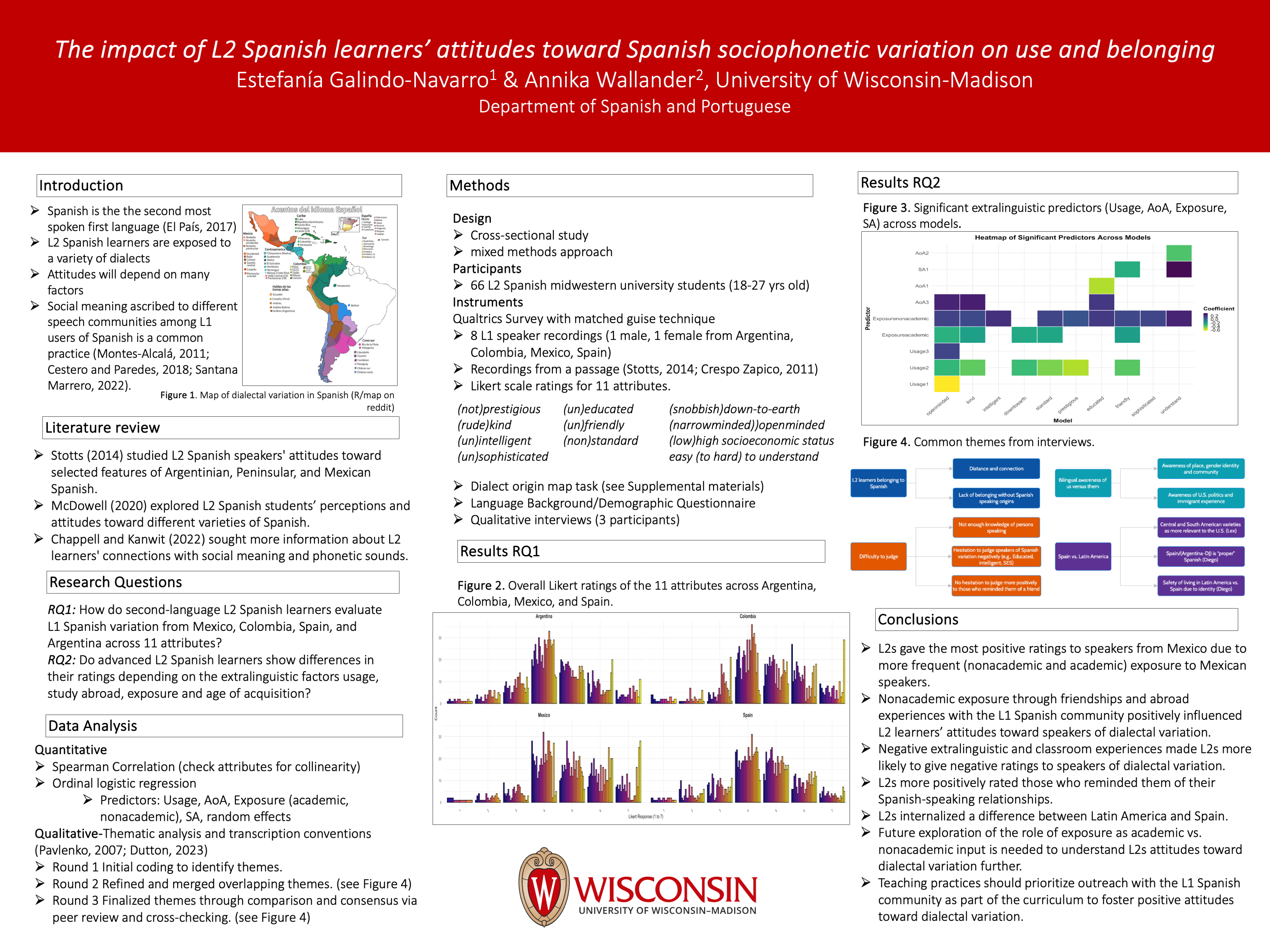
To answer these questions, we employed a mixed methods design to study L2 Spanish learners’ attitudes toward sociophonetic variation in Spanish. Our survey sample consisted of 66 L2 advanced Spanish learners, aged between 18 and 27, from Midwest universities. To collect data from advanced Spanish learners, we recruited participants only from advanced content-focused courses through convenience sampling in the different institutions. We conducted volunteer-based semi-structured interviews with three of these participants. Most participants self-reported their L1 as English (four reported their L1 as Russian, Romanian, or Gujarati).
Participants completed a Qualtrics survey using a matched guise technique adapted from Stotts (Reference Stotts2014), McDowell (Reference McDowell2020), and Chappell & Kanwit (Reference Chappell and Kanwit2022). They listened to recordings from eight speakers (from Argentina, Colombia, Mexico, and Spain) and rated them on a 7-point Likert scale based on the following 11 pairs of sociophonetic attributes representing opposing ends of continua in which the negative attribute was one and the positive one was seven: (snobbish) down-to-earth, (not) prestigious, (un)educated, (rude) kind, (un)friendly, (narrow-minded) open-minded, (un)intelligent, (low) high socioeconomic status, (un)sophisticated, (non)standard, and easy (hard) to understand. A dialect origin task followed, using a labeled map of Spanish-speaking countries. A demographic questionnaire collected data on participants’ language background, exposure, and SA experience.
Quantitative analysis involved descriptive and inferential statistics, including Spearman correlation and ordinal logistic regression (using Helmert coding). Key predictors included academic and nonacademic exposure, age of acquisition (AoA), and study abroad (SA). Exposure was operationalized in two novel ways: academic exposure referred to the number of countries represented in the Spanish spoken by teachers, while nonacademic exposure referred to the number of countries represented in the Spanish of friends and coworkers. Interview data were analyzed through thematic analysis, following the transcription conventions in Pavlenko (Reference Pavlenko2007) and Dutton (Reference Dutton2023). The process occurred in three rounds: initial individual coding, collaborative refinement and merging of themes, and collaborative finalization of themes through consensus and cross-checking. Our use of collaborative peer review at rounds 2 and 3 ensured reliability.
In response to RQ1, our results exhibited noteworthy differences in participants’ ratings of Spanish varieties from Argentina, Colombia, Mexico, and Spain across the 11 sociophonetic dichotomies. Mexican Spanish received the most positive ratings, particularly for friendliness, kindness, and ease of understanding. Colombian Spanish had the second most positive ratings, while Argentinean and Peninsular Spanish displayed more negative ratings; both received comparatively lower ratings for the attributes friendliness and ease of understanding.
For RQ2, extralinguistic factors did make a difference in L2 attitudes toward dialectal variation. Nonacademic exposure was the most significant positive predictor of L2 attitudes across most attribute models. In contrast, academic exposure and early AoA negatively influenced attitudes towards open-mindedness, kindness, down-to-earth, standard, friendliness, and education with only late AoA (post-secondary school) influencing positive attitudes towards dialectal variation in open-mindedness, kindness and education. Frequent daily Spanish usage positively influenced attitudes towards open-mindedness. Interestingly, SA experiences had minimal significant effects, as they only positively influenced ratings of the attribute ease of understanding and negatively friendliness.
To gain richer insight into RQ2, interviews targeted how learners’ attitudes and sense of belonging to Spanish affected their evaluations of dialectal variation. Our three interviewees described their sense of distance or disconnection from Peninsular Spanish and their feelings of a sense of community with Latin American dialects of Spanish (specifically those who discussed their existent relationships with Latin American friends and family friends). Their sense of belonging was affected by their negative judgments toward Peninsular voices and positive judgments toward those who they perceived as Latin American. Nonetheless, they expressed a lack of belonging within the language community because of their lack of Spanish-speaking origins or heritage. They conveyed a bilingual awareness of “us versus them” through their narratives of their experiences, where the topics of place, gender identity, and an awareness of US and Latin American politics and immigrant narratives were at the forefront. All three participants found it difficult to judge speakers of different Spanish varieties because they felt they did not know the speakers personally enough. They expressed a hesitancy to judge speakers negatively, especially speakers’ intelligence, education, or socioeconomic status. However, when a speaker reminded them of someone familiar, like a friend, they assessed the speaker more positively.
Remarkably, each of our interviewees expressed an internalized dichotomy of Spain versus Latin America, with the principal difference being that Peninsular Spanish is more “proper,” while Latin American varieties are more close, friendly, and relevant for L2 learners in the US context. Although L2 learners with connections to an L1 Spanish community more positively judged Latin American dialectal variation, negative associations toward Latin America were expressed in the interviews. One participant expressed concerns about the safety of living in Latin America as someone who identifies as gay, stating that they would prefer, safety-wise, to live in Spain despite viewing Peninsular Spanish as “distant.” Another participant who had positive feelings toward Latin American dialects because of her friends and mentors being from Central America, highlighted having feelings of being ostracized due to her L2 status while celebrating her best friend’s quinceañero (“15th birthday celebration”).
In conclusion, nonacademic exposure through social relationships and experiences with the L1 Spanish community played the most significant role in influencing positive attitudes toward Spanish dialectal variation, similar to the findings in McDowell (Reference McDowell2020) and Chappell and Kanwit (Reference Chappell and Kanwit2022). We ascertain that participants’ informal real-world relationships and everyday interactions with native Spanish speakers foster greater appreciation and acceptance of dialectal variation, specifically from Latin America, meaning informal exposure to Spanish is crucial in fostering positive L2 sociophonetic attitudes. In contrast, academic exposure was linked to lower ratings of dialectal variation, which we interpret as a call for changes to be made to existing curricula due to their clear impact on learners’ negative perceptions and views toward variation. The fact that participants tended to rate more positively those speakers who reminded them of their own Spanish-speaking relationships suggests that personal connections are pivotal in L2 sociophonetic attitude development. Additionally, L2 learners internalized a perceived division between Peninsular Spanish and Latin American varieties, which shows potential for a more comprehensive social dichotomy that L2 learners internalize. Future research should further explore how academic versus nonacademic exposure influences attitudes toward Spanish dialectal variation. Our findings provide implications that language instruction should incorporate outreach with L1 Spanish-speaking communities as part of the curriculum to foster more awareness and inclusive and positive attitudes toward Spanish dialectal diversity.
Supplementary material
The supplementary material for this article can be found at https://doi.org/10.1017/S0261444825000187.