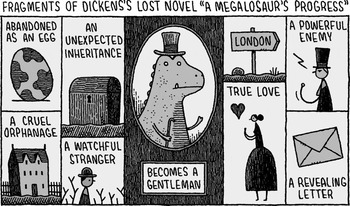
Charles Dickens's novels only occasionally feature images of prehistoric creatures. There is, of course, the famous “elephantine lizard. . .waddling. . .up Holborn Hill” in the opening scenes of Bleak House (1852–53), which, as is brilliantly captured in Tom Gauld's recent cartoon “Fragments of Dickens's Lost Novel ‘A Megalosaur's Progress’” (2011), has become a kind of icon of Dickens's entire fictional oeuvre (Figure 1). But beyond Bleak House’s iconic megalosaurus “forty feet long or so,” Dickens's panoramic representations of urban landscapes, which Adelene Buckland has shown to abound with quasi-geological ruins, are usually populated only by their more diminutive modern inhabitants (1; ch. 1). Even when the changing cityscape of “carcases. . .and fragments” of “giant forms” seems, as in Dombey and Son (1847–48), to suggest the presence of colossal fossilized skeletons thrown up by a “great earthquake,” they remain lifeless and merely augment the pervading atmosphere of urban upheaval (46; ch. 6). Animate extinct animals instead appear more commonly in novels by contemporaries such as William Makepeace Thackeray or, later in the century, Henry James. In their fiction, creatures such as the megatherium, a large edentate from the Pliocene epoch, not only afford apposite metaphors for gargantuan manifestations of industrial modernity, as in the former's Mrs. Perkins's Ball (1846) and the latter's The Bostonians (1885–86). More significantly, they also provide a model for the complex structures of serialized novels, whether commendatory, as in Thackeray's The Newcomes (1853–55), or otherwise, as in the famous epithet “large loose baggy monsters” that James coined in the preface to the New York edition of The Tragic Muse (Reference James1908) (1:x).Footnote 1
Tom Gauld. “Fragments of Dickens's Lost Novel ‘A Megalosaur's Progress.’” Ink on paper, from Guardian, 1 Oct. 2011, Review: 15. Reproduced by kind permission of Tom Gauld.

Although not previously noticed by critics, Dickens, when he did intermittently introduce his own prehistoric analogies, was more likely to have imaginative recourse to the ancient denizens of the sea rather than the land. In Nicholas Nickleby (1838–39) the boisterous Yorkshireman John Brodie resembles, whilst suppressing his laughter beneath bed sheets, “some jovial monster coming to the surface to breathe, and once more dive down” (2: 384; ch. 39). Similarly, the “bar” in the packet dock at Calais in Little Dorrit (1855–57) “with a shallow break of sea over it, looked like a lazy marine monster just risen to the surface, whose form was indistinctly shown as it lay asleep” (493; ch. 20). The overdetermined signifier “monster” was widely employed in the nineteenth century as a convenient synonym for almost all extinct megafauna, and both Brodie's attempts to stifle his laughter and the tidal sandbar at Calais exactly replicate the amphibious habits that, since the mid-1830s, were attributed to the ichthyosaur, a giant marine reptile of the Mesozoic era.Footnote 2 The creature's fossil remains were examined in detail by Richard Owen, the Hunterian Professor of Comparative Anatomy and Physiology at the Royal College of Surgeons, who, in the same year that Nicholas Nickleby reached the end of its serialization, used them to deduce that, while it “presented the general external figure of a huge predatory. . .fish,” the “Ichthyosaurus was. . .an air-breather” whose peculiarly-positioned caudal fin enabled it to move with the “required rapidity and facility to the surface to inspire” before once more diving back into the sea (“Report: I” 88). Another aspect of this amphibious lifestyle, Owen proposed in the year before Little Dorrit began its serialization, was that “Ichthyosaurs occasionally sought the shores, crawled on the strand, and basked in the sunshine,” and “when so visiting the shore. . .for sleep. . .would lie or crawl prostrate” (Geology 27–28).Footnote 3 In both respects, the precise habits inferred by Owen from the ichthyosaurus's petrified and often only fragmentary remains evidently stimulated Dickens's imaginative creativity.
Dickens's droll but nonetheless interested and unskeptical attitude towards the aquatic monster's particular habits in Nicholas Nickleby and Little Dorrit was not shared by all members of the novelistic fraternity. Indeed, Owen, at a meeting of The Literary Club in 1845, had to assure the incredulous poet and novelist George Croly that the ichthyosaur was continually “coming to the surface” and “could not have lived an hour, probably, submerged, without being drowned, because it had lungs and breathed air” (Owen, Life 1: 304). Owen was an enthusiastic participant in metropolitan cultural life, and by the time of his encounter with Croly had already established a close friendship with Dickens, whom he first met in the “green-room” of the Drury Lane Theatre in May 1843 (1: 218). Thereafter the two men regularly visited each other's homes, attended social events together, and read each other's published works with mutual avidity, with Owen eulogizing the “genial humour and touches of exquisite pathos which are yielded by the pages of a Dickens,” and the novelist informing his friend that he had “been reading with unspeakable interest and pleasure, your charming little book on the extent and aims of a National Museum of Natural History” (Royal Literary Fund 24; House 10: 117).Footnote 4 They even planned – albeit unsuccessfully – to jointly give a scientific lecture and a reading of “the Christmas Carol to a Sunday-evening audience” at St. Martin's Hall in support of the anti-Sabbatarian National Sunday League (House 11: 107).Footnote 5 Owen also contributed a number of “familiar papers on natural history” to Household Words, at Dickens's personal behest (7: 780). Despite the relative paucity of actual prehistoric creatures in his own fiction, Dickens must certainly have been aware of his friend's celebrated skills and accomplishments as the foremost paleontologist in Victorian Britain.
Owen was fêted in particular for his ability to infer the size, appearance, and life-habits of animals from just a single part of their anatomy. This enabled him to identify and reconstruct the hitherto unknown denizens of the ancient past even when the only available evidence was a fossilized bone or tooth, or, in some circumstances, just a petrified footprint.Footnote 6 The harmonious organic correspondences that meant that just one part could indicate the configuration of the whole demonstrated that animal bodies, regardless of how peculiar or strange they might appear, were perfectly integrated mechanisms. Owen's celebrated reconstructions of extinct creatures such as the megatherium, the dinornis, a huge struthian bird from New Zealand, and the suborder of gigantic Mesozoic reptiles that Owen, in 1842, named the Dinosauria revealed that, even when their anatomical structures seemed incongruous, awkward, or unwieldy, they were in fact perfectly adapted to the particular environments in which the colossal creatures had lived.Footnote 7 The “Megalosaurs and Iguanodons,” for instance, combined a “complicated and thecodont dentition [i.e., teeth set in sockets] with limbs. . .proportionally large and strong,” and “rejoicing in these undeniably most perfect modifications of the Reptilian type” they had “attained the greatest bulk” in order to facilitate the specific feeding habits necessary “in their respective characters as devourers of animals and feeders upon vegetables” (Owen, “Report: II” 200). Even the seemingly egregious “inferior energy of. . .muscular contractions” exhibited by the “great Dinosaurian reptiles” actually enabled them to “constitute the highest organized species, best adapted to exist under greater atmospheric pressure than operates on the surface of the earth at the present time” (201, 203). Rather than being a defect, their very ponderousness ensured that dinosaurs were perfectly suited to the low levels of oxygen in the air of the Mesozoic period.Footnote 8
Unsurprisingly, Owen's authoritative paleontological deductions were used to bolster the doctrines of natural theology, which, in the writings of the eighteenth-century theologian William Paley and the authors of the eight Bridgewater Treatises (1833–36), maintained that God's existence and wisdom was disclosed not only through scriptural Revelation but could also be inferred from the evidence of design in the natural world, especially the mechanical contrivances of organic structures.Footnote 9 While Owen himself might have been more concerned with the secondary laws by which the Deity worked and was privately formulating an alternative archetypal understanding of vertebrate design, he was willing for his explications of the intricate anatomical structures of extinct creatures to be appropriated for the teleological argument from design that was so essential to his patrons in the scientific and political establishment.Footnote 10 In the second part of the “Report on British Fossil Reptiles” (1842) in which he coined the designation dinosaur, Owen quoted and (seemingly) endorsed the opinion of his mentor, the theologian and geologist William Buckland, that it was impossible to contemplate the “curious piece of animal mechanism” exhibited by the iguanodon's teeth, and especially their “anticipated adaptations to varying conditions,” “without feeling a profound conviction that all this adjustment has resulted from design and high intelligence” (II 124). Dinosaurs such as the iguanodon or Bleak House’s waddling, elephantine megalosaurus were therefore monstrous and ungainly creatures, but nonetheless examples of perfect providential design.
Serial novels were often perceived to lack the harmony, proportion, and sense of design demanded of works of art, and they were regularly represented by antagonistic reviewers in the very same terms used to describe lumbering, unwieldy prehistoric megafauna. The American journalist Champion Bissell, for example, insisted in Sartain's Union Magazine that “no one can gainsay that a serial story. . .is a monstrosity” (278), and his compatriot William Gilmore Simms, writing in the Southern Quarterly Review, derided such works as “incongruous, halting and indefinite” (323). This particular vein of criticism of serial fiction, which was widespread in the nineteenth century despite the failure of almost all modern critics to notice it, culminated in James's now legendary denunciation of mid-Victorian novels as misshapen monstrosities.Footnote 11 Even Dickens, by far the most successful practitioner of serialization, was not immune, as will be seen, from the same strictures.Footnote 12 As such, Owen's capacity to demonstrate that extinct creatures such as the dinosaurs were, no matter how monstrous and cumbersome they might appear, in fact manifestations of perfect, integrated design must have seemed an especially attractive skill to a novelist eager to disclose the underlying design of his own seemingly ill-proportioned serial fiction.
Mr. Venus's Museum
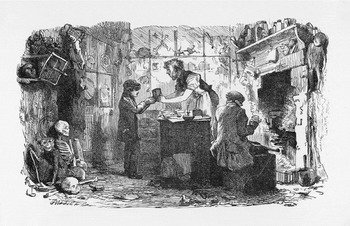
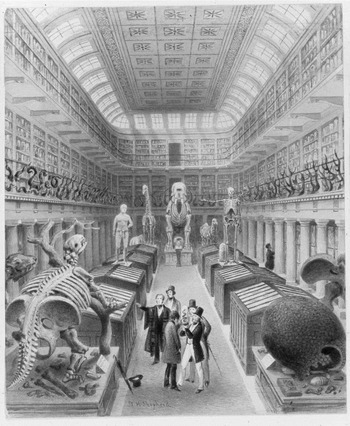
In his last completed serial novel, Our Mutual Friend (1864–65), Dickens alluded directly to the prestigious paleontologist who was by now a longstanding friend. In the first number of the novel, the narrator remarks of Mrs. Podsnap, “fine woman for Professor Owen, quantity of bone, neck and nostrils like a rocking-horse,” while in the seventh installment she is again designated a “‘splendid woman’. . .by elderly osteologists pursuing their studies in dinner society” (1: 8; bk. 1, ch. 2; 1: 193; bk. 2, ch. 4). The latter was most likely a knowing reference to Owen's customary depiction in the popular press, including Dickens's own Household Words, as a “gentleman [with] a remarkable predilection for old bones,” and it is certainly the case that Our Mutual Friend is suffused with many other indirect allusions to Owen and his renowned paleontological reconstructions (Morley 383).Footnote 13 The malevolent amputee Silas Wegg is described as resembling “some extinct bird,” and, as with Owen's celebrated dinornis, the giant flightless bird whose past existence was inferred from just a small fragment of its femur bone, Wegg's whole identity is represented synecdochically by the portion of his leg bone purchased from a hospital porter by Mr. Venus (“Where am I?” and “what did you give for me?,” asks Wegg with existential import) (1: 160; bk. 1, ch. 17; 1: 62; bk. 1, ch. 7). Venus himself is an “Articulator of human bones” who inhabits a gloomy shop crowded with “Bones, warious. Skulls, warious” (Figure 2) that closely resembles the account of Owen's own Hunterian Museum (Figure 3), with its “hundreds of skeletons” and “bony parliament of the natural creation” as well as a Wegg-like “gigantic extinct bird,” published in Household Words in 1850 (1: 62–63; bk. 1, ch. 7; Hunt 278). Tellingly, at the novel's conclusion the narrator even refers to the shop as “Mr. Venus's museum” (2: 276; bk. 4, ch. 14).Footnote 14
Marcus Stone, “Mr. Venus Surrounded by the Trophies of his Art.” Wood engraving by George and Edward Dalziel, from Charles Dickens, Our Mutual Friend, 2 vols. (London: Chapman and Hall, 1864–65), 1: facing 61. © Mary Evans Picture Library.

Thomas Hosmer Shepherd, The Hunterian Museum. Watercolor, c. 1842. Royal College of Surgeons, London. Courtesy of the Hunterian Museum at the Royal College of Surgeons.

Amidst this osseous miscellany, Venus boasts to Wegg “I'm not only first in the trade, but I'm the trade.” Although he then proclaims “I've gone on improving myself in my knowledge of Anatomy till both by sight and by name I'm perfect” when Owen instead endorsed John Hunter's more modest opinion that “Comparative Anatomy. . .is too great a task for any individual to make it in any way perfect,” several critics have identified Venus with the predominant anatomist and paleontologist in nineteenth-century Britain (1: 63; bk. 1, ch. 7; Hunter, Essays 2: 1). Victor Sage has even designated him an “affectionate parody of Owen” (“Negative Homogeneity” 220).Footnote 15 The number plans for Our Mutual Friend show that the character of Venus was in fact only brought into the novel after Dickens had overwritten the second monthly number and needed to postpone a lengthy wedding scene until the subsequent installment, and it is likely that a droll satire of the “boney light” in which his scientific friend examined the natural world would have afforded an expedient solution to one of the perennial contingencies of serial publication (1: 63; bk. 1, ch. 7).Footnote 16
But if Venus represents, at least in part, Owen's renowned capacity, when confronted with a chaotic assortment of fragmentary bones, to “pick ‘em out, and. . .sort ‘em all,” thereby creating order and harmony from disorder and confusion, other critics of Our Mutual Friend have been equally insistent that this anatomical prowess also places Venus in the same position as the actual novelist (1: 63; bk. 1, ch. 7). In his “joining of fragments into skeletons,” according to Albert D. Hunter, Venus becomes a “parody of a godlike creator, he fulfils within the novel the function of the artist, of the novelist himself” (“Dismemberment” 152). Jonathan Smith similarly observes that Venus's “ability to articulate is a creative power.. . . The association of articulation and art suggests Dickens's role as the ‘articulator’ of this narrative. . .as the author who puts its fragmented monthly pieces together” (47). Amalgamating these two critical perspectives on the melancholy articulator it becomes evident that, as well as representing an affectionate caricature of Owen, Venus also afforded a means of relating his celebrated paleontological procedures to Dickens's own practices as a novelist.
Dickens certainly saw suggestive parallels between Owen's particular mode of analyzing petrified fragments and traces and his own attempts to examine and expose the iniquitous social order that came to dominate later novels such as Our Mutual Friend. In a somber travelogue for All the Year Round four years after the completion of that novel, Dickens reflected angrily on the poverty existing in London's squalid streets:
I looked about at the disorderly traces in the mud, and I thought of the drops of rain and the footprints of an extinct creature, hoary ages upon ages old, that geologists have identified on the face of a cliff; and this speculation came over me: – If this mud could petrify at this moment, and could lie concealed here for ten thousand years, I wonder whether the race of men then to be our successors on the earth could, from these or any marks, by the utmost force of the human intellect, unassisted by tradition, deduce such an astounding inference as the existence of a polished state of society that bore with the public savagery of neglected children in the streets of its capital city, and was proud of its power by sea and land, and never used its power to seize and save them! (“On an Amateur Beat” 301)
The sheer force of intellect exhibited by Owen in his astounding inferences regarding the primeval past could, in the far future, similarly recall the gilded hypocrisy and barbarism of the Victorian metropolis in the very same way that Dickens, in his later novels, was himself already exposing it for contemporary readers.
The nineteenth-century capitalist polity is depicted in Our Mutual Friend as a primordial “Dismal Swamp” populated by “amphibious human-creatures” and more voracious “Alligators,” which, like the avian Wegg, will soon become extinct under the ruthless rules of political economy and be preserved, if at all, only by the processes of petrifaction (1: 160; bk. 1, ch. 17; 1: 56; bk. 1, ch. 6). As well as the Dinosauria, Owen, in his 1842 “Report,” had also designated the Crocodilia, comprising prehistoric alligators and gavials, as another of the suborders of fossil reptiles, and in his Monograph on the Fossil Reptilia of the Wealden Formation (1854) he showed that the “vertebræ of the young Iguanodon” had analogous features to those that could be observed in the “naturally articulated vertebral column of a young Alligator” (3). Notably, one of the most conspicuous items in Venus's crowded shop is the articulated skeleton of a “young alligator in the corner,” whose great antiquity, perhaps dating as far back as its dinosaurian brethren in the Mesozoic, is suggested by its “yard or two of smile,” which seems to reflect wryly on the similarities of Victorian London to the “depths of the slime, ages ago” (2: 123, 2: 125; bk. 3, ch. 14).Footnote 17 In evoking the emblematic “slime and ooze” of the nefarious society depicted in Our Mutual Friend (1: 1; bk. 1, ch. 1), Dickens, as he had when portraying the no less symbolic “crust upon crust of mud” traversed by the waddling megalosaurus in Bleak House (1; ch. 1), took inspiration from the reconstructive abilities that Owen shared with Venus.
There is, however, a still more tangible parallel between the particular skills of Owen and Venus and Dickens's own compositional practices. Our Mutual Friend’s serial parts, as Jonathan Smith suggests, had a clear affinity with the osseous fragments articulated with such proficiency by both Owen and Venus, and it is noticeable that, returning to the format of monthly numbers he had pioneered with The Pickwick Papers for the first time in almost a decade, Dickens was especially attentive to the exigencies of this particular form of serialization. This, significantly, seems to have increased following the forced interposition of Venus into the second installment and his subsequent emergence as the novel's symbolic guarantor of order and even meaning. Dickens suggested parallels, at least implicitly, between the synecdochic practices of “readers, pursuing a story in portions from month to month through nineteen months” who attempt to “perceive the relations of its finer threads to the whole pattern” and the “boney” activities of Venus, who, as with “‘that French gentleman’. . .represented. . .by his ribs only,” can construct skeletal wholes from fragmentary parts (2: 307–08; postscript; 1: 63, 1: 61; bk. 1, ch. 7). The discontinuity enforced by Our Mutual Friend’s method of publication, as Juliet McMaster has observed, “makes one think of the novel itself as ‘loose in a bag,’ a fit set of fragments for Mr. Venus's attention” (195). Akin to Owen, Venus exhibits great skill in “piecing little things together,” and it is the “likelihood of small indications leading him on to the discovery of great concealments” that enables him, like a particularly perspicacious serial reader, to comprehend the hidden truths of the various false identities developed over the novel's twenty installments (1: 230–31; bk. 2, ch. 7).
In his review of Robert Hunt's The Poetry of Science for the Examiner in 1848 Dickens had eulogized the “Science. . .[that] has found, and read aloud, the great stone book which is the history of the earth” and “has brought the bones, and pieced together the skeletons, of monsters that would have crushed the noted dragons of the fables at a blow” (787). Nearly two decades later, in his last completed serial novel, Dickens once more suggested a correlation, or at least a clear parallel, between the anatomical and paleontological “piecing. . .together” employed by Owen and Venus and the accurate comprehension of an immense book, distinct from fallacious fables, composed of fragmentary parts (1: 230; bk. 2, ch. 7). Even those readers who were “neither practical chemists nor palæontologists,” Dickens had contended in the Examiner, were still “capable of making. . .geological speculations,” and in Our Mutual Friend such “intelligent men” were offered the opportunity to themselves similarly piece together and speculate on the novel's incrementally developing plot (787).
Owen was not only alluded to in Our Mutual Friend, his methods of paleontological reconstruction were integral to the proper appreciation of the overall structure of a novel whose awkward and anomalous format, appearing simultaneously in monthly installments as well as (after the tenth number) an initial volume, meant that, as Robert L. Patten has noted, “it was one of the more cumbersome. . .novels to sell at railway stalls,” with its by now old-fashioned numbers “too big for the commuter customers” (309).Footnote 18 While Our Mutual Friend, published in the mid-1860s when the popularity of serialized fiction was on the wane, might have seemed particularly unwieldy and ill-proportioned, Dickens had long been anxious, as he put it in the preface to Martin Chuzzlewit, to “resist the temptation of the current Monthly Number, and to keep a steadier eye upon the general purpose and design” of his serial novels (viii; preface). Even in The Pickwick Papers he had envisaged that the “twenty numbers. . .should form one tolerably harmonious whole, each leading to the other,” although he also warned readers that “no artfully interwoven. . .plot can with reason be expected” (1: viii; preface). Hostile early reviewers continued to bemoan his inability to “combine the scattered portions of a tale into one consistent and harmonious whole” ([Lister] 96). It was, however, only with Dombey and Son, which he began writing in June 1846, that Dickens curtailed his previous tendency to impromptu composition and instead drafted detailed number plans – or “mems” as he called them – for the whole novel before a single installment had been started.Footnote 19
Fusing Together
Dombey and Son was meticulously planned in four equal sections, which, according to modern critics, were constructed “architecturally” (Bradbury 157).Footnote 20 The close parallels between architecture and paleontology were frequently noted in the nineteenth century, with, for instance, the Civil Engineer and Architect's Journal reporting, in 1863, that the “organic structure. . .of all good building is so evident from a fragment, that from one stone a piece of architecture can often be put together, in the same way as animal forms may be with certainty built up from a single bone” (“The Royal Institute” 119).Footnote 21 As well as architecture, Dickens, when considering the structural configuration of his later serial fiction, seems also to have drawn upon the procedures and terminology he might have recalled from conversations with Owen, who himself regularly employed architectural analogies such as “osseous masonry” (Memoir 74).
When “publishing. . .in. . .parts,” Dickens told the literary hostess and aspiring novelist Jane Brookfield in February 1866, “notice how patiently and expressly the thing has to be planned for presentation in these fragments, and yet for afterwards fusing together as an uninterrupted whole” [italics mine] (House 11: 160). The term “fragment” was particularly multivalent at this time, signifying both serial numbers and mutilated fossil remains, with Owen, for example, insisting that just a “few fragments” had often “served. . .as the basis of the restoration” of prehistoric creatures (Geology 16, 38–39).Footnote 22 But Dickens's suggestion that the fragments of a serialized story could subsequently be fused together into an integrated whole also corresponds with Owen's account, in his Monograph on the Fossil Reptilia of the London Clay (1850), of the structure of the “skeleton of a Tiger-boa” in which “anchylosis of the 148th to the 149th vertebra has taken place; and the 166th and 167th vertebræ have been more completely. . .fused together, so as to appear like a single vertebra” [italics mine] (61).Footnote 23 It was precisely such “anchylosed joints” that had earlier facilitated William Buckland's initial identification, in 1824, of the size and means of locomotion of the megalosaurus (“Notice” 395), with the “sacral vertebrae,” as Hugh Torrens has written, “fused together, forming a continuous solid piece of bone” (261) that could only have belonged to an unprecedentedly colossal creature such as the “elephantine lizard” that bestrides the opening pages of Bleak House (1; ch. 1). In fact, it was this “large sacrum composed of five anchylosed vertebræ of unusual construction” that Owen, in 1842, assigned as the defining characteristic shared by all members of the Dinosaurian suborder (“Report: II” 102–03).
Alfred Tennyson, whose friendship with Owen was almost as close as that of Dickens, had adopted similar language in expressing his preference for “compact and vertebrate poems” over verse formed limply from “organizable lymph” (Tennyson 2: 506). Tennyson was taking aim at Spasmodic poetry such as Sydney Dobell's Balder (1854) that, indulging in protracted and amorphous monologues, lacked the restraint imposed by a clear, integrated structure. Of course, Tennyson's use of this anatomical language was merely figurative, as indeed was Dickens's own deployment of the terminology he had likely learnt from Owen, but it nevertheless afforded both the poet and the novelist a precise and dexterous – if ultimately only analogical – means of describing their respective compositional practices.Footnote 24 Composed of fragmentary parts that were then fused together into an uninterrupted whole corresponding to vertebrae, the structure of Dickens's serial novels resembled that of the prehistoric megafauna that occasionally appeared within their covers, with Our Mutual Friend itself featuring what the novel's narrator describes as a “very hideous church with four towers at the four corners, generally resembling some petrified monster, frightful and gigantic, on its back with its legs in the air” (1: 167; bk. 2, ch. 1). Being, paradoxically, both unwieldy and yet perfectly adapted (at least to their original Mesozoic environments), such petrified monsters offered Dickens equally apposite analogies for the discordant architecture of London and, at the same time, the harmonious structure of his own serialized fiction.
Yet even when configured along such strict anatomical lines, Dickens's later, more carefully planned novels still remained liable to the “monstrous joining together of. . .anomalous members,” as Sharpe's London Magazine complained of the juxtaposition of sensational and naturalistic registers in Great Expectations (1860–61) (“Great Expectations” 218). This, notably, resembled the fear of inadvertently producing an imaginary composite animal that had long haunted paleontologists piecing together osseous fragments that, when in situ, were often mixed up with the remains of other animals.Footnote 25 The original meaning of the term “monster” was a creature amalgamating discordant parts, with connotations of great size only subsequently being added to its primary meaning, and religious opponents of paleontology's intellectual claims regarding extinction and the vast age of the earth cautioned “let us not be too sure that in putting together the bones of extinct animals and in defining their habits and nature, we are not out of collected fossil remains creating to ourselves a monster” (Best 28–29).Footnote 26 Dickens himself was certainly alert to the perturbing possibility of such paleontological mishaps, reflecting in The Chimes (Reference Simms1844), the Christmas Book he wrote the year after becoming friends with Owen, that in Trotty Veck's disturbed dreams “monsters uncouth and wild, arise in premature, imperfect resurrection; the several parts and shapes of different things are joined and mixed by chance” (93; ch. 3).Footnote 27 As with Sharpe's London Magazine, critics of Dickens's later fiction similarly perceived even his most meticulously planned novels as potentially monstrous amalgams, joining together random and incongruous parts.
What was necessary, in both paleontological reconstructions and the composition of serial fiction, was a flawless design that would preclude the possibility of such egregious conjunctions and instead ensure the harmony and proportion of the perfectly integrated structure. Those “who deny the existence of design in the construction of any part of an organized body,” as Owen avowed, “are not, nor have been, those who have contributed to the real advancement of physiology or palæontology” (Palæontology 301). Similarly, Dickens, only three months after the completion of Our Mutual Friend, insisted to Brookfield regarding serial parts that there “must be a special design, to overcome that specially trying mode of publication” (House 11: 160). Dickens's earlier, more picaresque fiction was frequently condemned precisely for its “absence of design,” as even his friend John Forster complained of Nicholas Nickleby in the Examiner (677). And even when Dickens did try to contrive an intricate murder mystery, critics had been no less censorious. Edgar Allan Poe, in a review of Barnaby Rudge (1840–41) for Graham's Lady's and Gentleman's Magazine, urged that the only way of counteracting the “present absurd fashion of periodical novel-writing” was for the “traces of the design” to be evident “upon every page,” and he complained bitterly that the most egregious “error[s] on the part of Mr. Dickens” had stymied Barnaby Rudge’s putative “design of mystery.” In fact, having claimed to have “fathomed” the plot of Barnaby Rudge by the novel's “seventh page” only to find that his predictions were erroneous, Poe blamed Dickens's improper design and haughtily insisted that “if we did not rightly prophesy, yet, at least, our prophecy should have been right” (126–27). Faced with such stinging censure, the notion of design, in all its manifold senses, was one that became increasingly crucial to the painstaking planning of Dickens's later novels.Footnote 28
He had, after all, pledged to “keep a steadier eye upon the general purpose and design” in Martin Chuzzlewit (viii; preface), and, by the time of Little Dorrit a decade later, could observe archly that what initially appeared a “bad design” might eventually be revealed as a “good and an expressly religious design” by the time of its “climax” (vi; preface). Dickens's conception of religious design, of course, related more to issues such as the providential punishment of Little Dorrit’s corrupt financier Mr. Merdle than to Owen's demonstration of anatomical adaptations so perfect they necessarily indicated the guiding hand of a designer.Footnote 29 Modern critics examining Dickens's potential engagement with Charles Darwin's purposeless evolutionism have nevertheless identified connections between these two strains of divine design. George Levine has contended that Dickens's teleological plotting, although under constant strain from the chaotic multitudinousness of his inventive imagination, finally resulted in a “story much like that told by natural theologians, which makes ‘chance’ part of a larger moral design” (138). Howard W. Fulweiler likewise argues: “It is true of Our Mutual Friend, as it is of all Dickens's novels, that design and teleology are at the core of its fictional intent and thus diametrically opposed to the special vision of Darwin” (73). If, as Gary Colledge suggests, “Dickens embraced the popular natural theology. . .which affirmed both a Scriptural view of God as Creator and the discoveries and evidences of science” (51), and, as Levine proposes, he retained the “confidence of natural theology” in constructing the providential novelistic designs of his later fiction (134), then his method of composition becomes still more analogous to the paleontological procedures of his friend Owen that were so central to the natural theological tradition upheld by Buckland and other influential men of science in the early and mid-nineteenth century. Aesthetic and divine design, the creations of both the serial novelist and the omnipresent author of the natural world, manifest the same skill and artifice, even if the ultimate implication, to avoid raising the artist to a hubristic God-like status, must be that the design of a work of art is directed by divine providence no less than that of an organic structure.Footnote 30
Putting This and That Together
It was in Our Mutual Friend that Dickens, as his ensuing letter to Brookfield suggests, was most concerned with issues of design, not only providential and structural, but also pragmatic and calculating. Within the novel's arena of remorseless amoral competition, numerous characters develop designs in order to take advantage of others, whether the nefarious matchmaking of the “artful and designing woman” Sophronia Lammle, or the only marginally less culpable “thoughts and designs” to “marry money” of the “mercenary plotter” Bella Wilfer (1: 319; bk. 2, ch. 16; 1: 244; bk. 2, ch. 8). To be designing or to have designs in Our Mutual Friend is, almost without exception, a negative attribute. While both Sophronia and Bella at least acknowledge their own designs, the still more manipulative Wegg conceals his plotting, as when he “lightly taps his hands together, to express an undesigning frame of mind,” and instead induces his victims to believe that it is they who are the conniving ones (1: 60; bk. 1, ch. 7). Indeed, the “undesigning Boffin had become so far immeshed by the wily Wegg that his mind misgave him he was a very designing man indeed” (1: 141; bk. 1, ch. 15). Such is the skepticism towards design in the novel that when Eugene Wrayburn is asked by his friend Mortimer Lightwood about his intentions regarding Lizzie Hexam “Do you design to pursue her?,” he replies with uncharacteristic decisiveness: “My dear fellow, I don't design anything. I have no design whatever. I am incapable of designs” (1: 223–24; bk. 2, ch. 6).Footnote 31
Yet despite its apparent distaste for those who pursue designs, Our Mutual Friend is certainly not a novel that is itself without design. In the postscript included in the final double number Dickens elaborated on how keeping the mystery surrounding the identity of John Rokesmith “for a long time unsuspected, yet always working itself out” was the “most interesting and the most difficult part of my design.” This design, as he acknowledged, was one whose “difficulty was much enhanced by the mode of publication,” which precluded all but the most proficient readers of the serial parts from discerning the novel's overall structure “until they have it before them complete.” There nevertheless was a “whole pattern” which, in contrast to the iniquitous and ultimately incoherent designs pursued by characters such as Wegg, had been “always before the eyes of the story-weaver at his loom” throughout the “nineteen months” of the novel's serialization (2: 307–08; postscript).
Dickens, in Our Mutual Friend’s postscript, compared the serial novelist working out the portions of an overall pattern to an artisanal weaver at his pre-industrial loom. Within the novel, however, it is Venus, operating from a no less unadorned and plebeian “working bench,” who similarly articulates skeletal structures according to a larger “pattern,” exemplified – in language inflected with natural theological overtones – by the “bones of a leg and foot, beautifully pure, and put together with exquisite neatness,” with which Wegg's anomalous limb is “compared” but cannot be made to correspond. Even Wegg's prosthetic “timber fiction” lacks any functional correlation to his environment at the Harmon dust mounds, and he concedes the “want of adaptation in a wooden leg to ladders and such like airy perches” (1: 60–62; bk. 1, ch. 7; 1: 231; bk. 2, ch. 7). Although Venus refrains from discoursing explicitly on design, he is adamant that he “keep to nature,” even in his most “miscellaneous working in,” and Wegg's discordant leg, as Venus professes, could only be joined together with other random parts “as a Monstrosity, if you'll excuse me” (1: 60, 1: 62; bk. 1, ch. 7).
This, of course, was precisely how Sharpe's London Magazine had represented Dickens's previous novel Great Expectations and anxieties that even the assiduously planned numbers of Our Mutual Friend might constitute such a composite monster were, at times, expressed in the novel itself. The police inspector who, investigating the apparent murder of John Harmon in the novel's initial monthly part, is in the very same position as serial readers endeavoring to fathom Dickens's mysterious design, is described as “lurking about in boats, putting this and that together. But, according to the success with which you put this and that together, you get a woman and a fish apart, or a Mermaid in combination. And Mr. Inspector could turn out nothing better than a Mermaid, which no Judge and Jury would believe in” (1: 24; bk. 1, ch. 3). In The Newcomes a decade before, Thackeray had used an almost identical phrase to Dickens's “put this and that together” when suggesting that “As Professor Owen. . .takes a fragment of a bone, and builds an enormous forgotten monster out of it, wallowing in primaeval quagmires, tearing down leaves and branches of plants that flourished thousands of years ago, and perhaps may be coal by this time – so the novelist puts this and that together” (2: 81; ch. 47). The serial novelist, for Thackeray, was akin to a paleontologist who produces an unerringly accurate reconstruction of a perfectly designed prehistoric monster from just fragmentary fossil parts. Like Dickens, Thackeray was also a close friend of Owen, and the paleontologist even seems to have sided with the latter in the occasional contretemps between the rival novelists, once remarking that “Dickens has grown so arrogant” (quoted in Adrian 134).Footnote 32 Thackeray, as the above passage from The Newcomes makes clear, was certainly much more explicit than his haughty rival in drawing an analogy between the novelist who “puts this and that together,” while all the time realizing a premeditated design, and Owen's propensity for intuiting the flawless structure of putatively monstrous megafauna. Dickens's own briefer but no less direct allusions to Owen in Our Mutual Friend, as well as the distinctive anatomical terminology evident in that novel and elsewhere in his fiction, journalism, and private correspondence, nevertheless suggest that he too recognized the resemblance between Owen's celebrated paleontological practices and the novelist's “putting this and that together.”Footnote 33
But the same procedure, when in the hands of an indifferent detective (or a negligent author of serial novels) rather than an adept paleontologist, could just as likely result in an incongruous and ersatz conjunction of parts like the mermaid. Other mythical monsters made up from anomalous components such as “Unicorns or Griffins. . .— fables altogether,” Dickens had cautioned novice writers in Household Words in 1853, would be the only literary output of authors who disavowed the strenuous demands of writing serialized fiction, including the “patient separation from the heap of all the fragments that will unite to serve it” (“H. W.” 145). From analogous fragments, as Dickens had noted in his review of Hunt's Poetry of Science, “palæontologists” had “pieced together” perfectly proportioned “monsters that would have crushed the noted dragons of the fables at a blow” (787). A serial novel such as Our Mutual Friend would resemble such a flawlessly integrated monster, rather than an absurdly incongruous monstrosity of unscientific fable, only when its underlying design was recognized by readers following the incrementally developing plot in the same perspicaciously “boney light” as Mr. Venus (1: 63; bk. 1, ch. 7).
Conclusion: Recalled to Life
The longstanding friendship between Dickens and Owen was curtailed only by the novelist's untimely death in April 1870. Owen assuaged his grief by reading The Life of Charles Dickens which John Forster published in three separate volumes between 1871 and 1873. As a friend of Forster as well as of Dickens, Owen was sent presentation copies of each of the volumes, and returned exuberant thanks to their author. Receiving the third volume in April 1874 after having recently returned from a visit to Egypt, he told Forster: “your memorial to your friend. . .will outlast the massive marvels in granite & porphyry which tell of the conquests of the Pharaohs” (Letter to John Forster, 3 April 1874). He had been less hyperbolic in his praise for the second volume, which he received in November 1872, but nonetheless envisaged the “pleasure for many evenings to come that Mrs. O & I shall have at our fire-side, with you & our dear friend, whom you recall to life, completing the circle!” [italics mine] (Letter to John Forster, 14 Nov. 1872). Forster's exhaustive biography, in Owen's perception, not only resembled a kind of archaeological artefact that would endure through the centuries, it also had the capacity to restore the much lamented novelist to life.
Significantly, this was precisely the same power that Owen ascribed to skilled paleontologists, who, by “interpret[ing] the nature of the whole from the observation of a part,” were “enabled to restore and reconstruct many species that have been blotted out of the book of life” (Lectures 3). This, as Dickens had intuited in Our Mutual Friend, directly paralleled the capabilities required by readers of his own serialized novels, although in Owen's letters to Forster it was Dickens, the late progenitor and most successful practitioner of this particular format of fiction, who himself became a kind of extinct creature to be restored to life by the careful attentions of the reader. Owen's regular collaborator William John Broderip – who was also a friend of Dickens and as a police magistrate helped him identify female offenders to be taken in by the reformatory for fallen women at Urania Cottage – had actually employed precisely the same language used in Owen's missive to Forster in an article for Fraser's Magazine, observing of an archaically primitive Australian mammal: “It is impossible for a palæontologist to look at them without fancying that he sees some fossil animal recalled to life” [italics mine] (192).Footnote 34 While not entirely divested of its paleontological associations, Owen's rather knowing use of the very same phrase when writing to Foster was almost certainly also inflected with Dickens's own use of the expression as the central motif of the first book, entitled “Recalled to Life,” of A Tale of Two Cities, which was published in his weekly journal All The Year Round during 1859.
Recalled to Life was in fact Dickens's initial choice as the title of his serialized tale of figurative and anatomical resurrections (the former enacted by the liberated prisoner Alexandre Manette, and the latter practiced by the body snatcher Jerry Cruncher), and Owen's evident recollection of this particular context for an expression that had previously been used by Broderip in an exclusively paleontological sense indicates, once more, the close parallels and regular slippages between the language in which Owen and his deceased friend described their respective activities. Most notably, Owen's distinctive paleontological terminology, as this article has contended, enabled Dickens, in the carefully-planned fiction he produced in the final decades of his life, to demonstrate that his serial novels, no matter how monstrous, incongruous, or unwieldy they might appear to critics, were actually perfectly planned, in precisely the same way as the colossal but providentially designed creatures that Owen had included in his Dinosaurian suborder.