Introduction
Pearl millet (Pennisetum glaucum L. R. Br.) is the staple food crop for the population of the drier parts of Rajasthan (north-west India). Its stover also represents an important source of fodder (Hall et al., Reference Hall, Blumell, Thorpe, Bidinger and Hash2004). Thus, both grain and stover yields are important for the adoption of improved cultivars. Elite cultivars, especially single cross hybrids, have not been widely accepted, despite their large-scale adoption elsewhere (Bhatnagar et al., Reference Bhatnagar, Yadav and Gautam1998; Khairwal and Yadav, Reference Khairwal and Yadav2005), as they have been bred primarily for the more favourable growing areas in India, and so are poorly adapted to the arid environment. Elite cultivars also often do not meet the simultaneous requirement for both grain and stover productivity (Kelley et al., Reference Kelley, Parathasarathy Rao, Weltzien and Purohit1996; Khairwal and Yadav, Reference Khairwal and Yadav2005). Hence, a pearl millet improvement programme targeting environments such as north-west India must focus on the genotypes giving high stover yield, without any sacrifice in grain yield, under the drought conditions typical for this area.
Local landraces are a good source of adaptive genetic variation for tolerance to drought stress (Yadav et al., Reference Yadav, Weltzien-Rattunde and Bidinger2003a), and thus represent suitable breeding material for arid zone environments (Yadav and Weltzien, Reference Yadav and Weltzien1998). They can also be used as parents in a crossing programme aiming to enhance both grain and stover productivity via heterosis, without losing tolerance to drought (Yadav et al., Reference Yadav, Weltzien, Bidinger and Mahalakshmi2000; Bidinger et al., Reference Bidinger, Yadav, Sharma, van Oosterom and Yadav2003). The present investigation was planned both to assess the grain and stover productivity of a landrace collection from Rajasthan for direct use in variety breeding and to estimate the extent of heterosis realistically exploitable in topcross hybrids.
Materials and methods
Genetic material
The material consisted of 169 landraces collected during 1999–2003 from 20 districts in Rajasthan, India. The topcross hybrids were made by pollinating three arid zone-adapted male-sterile seed parents (Bidinger et al., Reference Bidinger, Yadav, Sharma, van Oosterom and Yadav2003) with bulk pollen from six representative arid zone landraces/landrace populations. The landraces included two pure farmer landraces (Nokha and Nagaur village landraces), two landraces in which farmers introgressed some off-farm seed [Bhira Ram 5 and Dhira Ram 25 (vom Brocke et al., Reference vom Brocke, Presterl, Christinck, Weltzien and Geiger2002)] and two populations synthesized from selected landrace accessions representing the Chadi and the Barmer landrace types described by Appa Rao et al. (Reference Appa Rao, Mengesha, Vyas and Rajagopal Reddy1986). Trials included the six pollinator landraces as well as their topcross hybrids on each of the three seed parents.
Field evaluations
The landraces were evaluated under rainfed conditions at the Central Arid Zone Research Institute (CAZRI), Jodhpur in randomized block designs with either two or three replications during the rainy seasons of 2000–2004, except 2002 when the crop season was completely lost because of failure of monsoon rains. The number of landraces included in evaluations was 19 in 2000, 46 in 2001, 45 in 2003, and 59 in the year 2004. Hybrid HHB 67 and composite CZP 923 were included as checks to represent options of two types of cultivars (hybrid vs. composite) available in pearl millet.
The topcross hybrids were evaluated at CAZRI, Jodhpur and the Rajasthan Agricultural University Substation, Nagaur, during the rainy seasons of 2003 and 2004 in five different trials in incomplete block (alpha) designs with either three or four replications. In both sets of trials, plots were either two or four rows of 4 m, with 60 cm spacing between rows and 15 cm between plants within rows. The landrace experiments received 40 kg P2O5/ha and 40 kg N/ha during all 4 years of evaluation. The topcross hybrid trials received 28 kg P2O5/ha and 50 kg N/ha, with the exception of one trial at Nagaur, which received only 28 kg N/ha. The data were recorded on field dry panicle and grain weights on plot basis and were used to calculate total biomass, grain and stover yields in kg/ha and harvest index on a percent basis. The number of downy mildew-infected plants was counted at 30 d after planting and at the dough stage (landraces only). Downy mildew incidence was calculated as percentage of plants infected with downy mildew.
Data analysis
The data were subjected to the analysis of variance according to the trial design. The relationship among grain yield, stover yield, biomass yield and harvest index was examined through correlation analysis. In topcross hybrids, variance for trial entry was partitioned into effects of landraces and topcross hybrids. Heterosis (over the landrace parent) for both individual topcross hybrids and sets of hybrids based on the same seed parent was estimated. Heterosis in individual hybrids was defined as the percentage difference between value of the hybrid and its pollinator parent. Heterosis on a pollinator basis was calculated as the percentage difference between the mean of all hybrids made with that pollinator and the mean of all hybrids in the trial.
Results and discussion
Evaluation of the landraces
Test environment and landrace differences
The four test seasons varied widely for crop growth. The 2001 and 2003 seasons were generally favourable due to seasonal rainfall of more than 320 mm that was well distributed throughout the crop season. As a result, average biomass production was 7534 kg/ha in 2003 and 5361 kg/ha in 2001 (Table 1). In 2000, although moisture was adequate early in the season, the crop was under progressive moisture stress during grain filling, resulting into a lower biomass accumulation (3879 kg/ha) than in 2001 and 2003. The biomass yield was lowest (2819 kg/ha) in 2004 when the total seasonal rainfall was only 169 mm, out of which 138 mm fell within 2 weeks of sowing, subjecting the crop to very severe water stress from the flowering stage onwards.
Mean biomass, grain and stover yields and harvest index and their heritability (h 2) estimates in the landrace trials conducted at Jodhpur during 2000–2004

Though the difference in the biomass productivity among years was twofold during 2000–2003, the variation in its partitioning (harvest index) was small (from 20 to 22%, Table 1). This is consistent with earlier observations that biomass productivity is the major determinant of grain yield in arid zone (Bidinger et al., Reference Bidinger, Yadav and Sharma2002, Reference Bidinger, Yadav, Sharma, van Oosterom and Yadav2003). As a consequence, stover yield varied with the biomass productivity level of each season. In 2004, however, the harvest index was extremely low (10%), as the crop virtually ran out of water during grain filling, resulting in a very low mean grain yield (285 kg/ha), even though stover productivity was average (2051 kg/ha).
The heritability estimates obtained for biomass yield and its component traits and harvest index were moderate to high (Table 1) indicating that the environmental variance did not override genetic variance even in those environments where the productivity level was very low. The analysis of variance indicated significant differences among landraces for biomass, grain and stover yields and harvest index (data not given) in all years, suggesting that a good opportunity existed to identify those landraces with optimum combinations of grain and stover productivity.
Relationship between grain and stover yield of landraces
Both stover yield (r = 0.90–0.97, P < 0.01) and grain yield (r = 0.58–0.77, P < 0.01) were positively and significantly associated with biomass yield in each year. The positive relationship of grain yield with total biomass was not simply a result of autocorrelation, as grain yield was also significantly and positively correlated to stover productivity in 3 out of 4 years (r = 0.48–0.67, P < 0.01). In one year (2000), the relationship between grain yield and stover yield was relatively weak but still positive (r = 0.32, P>0.05).
Harvest index was also positively and highly significantly associated with grain productivity in all sets of landraces in 4 years (0.61–0.84, P < 0.01). The positive correlations of grain yield to both biomass and harvest index indicate that a high accumulation of biomass followed by its efficient partitioning are critical in determining the grain productivity in pearl millet under arid zone environments. It was encouraging to note that biomass and harvest indices were independent of each other in 3 out of 4 years (r = − 0.25 to +0.30, P>0.05), and weakly positively correlated in the other (r = +0.38, P < 0.05). These results indicate that it should be possible to improve grain yield proportionately with the enhancement of biomass productivity, even if same level of harvest index is maintained.
The positive and significant (in 3 out of 4 years) correlations between grain and stover yield clearly demonstrated that grain and stover yields are not separate entities in landraces. Thus, improvement in one trait should not adversely affect the other trait in these materials. These are very critical observations as a trade-off between grain and stover yields has been observed by various workers in conventional pearl millet breeding lines (Virk, Reference Virk1988; Khairwal and Singh, Reference Khairwal, Singh, Khairwal, Rai, Harinarayana and Andrews1999; Yadav et al., Reference Yadav, Weltzien, Bidinger and Mahalakshmi2000). However, in this study stover and grain yields appeared synergistic, as stover productivity explained up to 45% of variation in grain productivity in 3 out of 4 years. Only in 2000 were the two unrelated.
Performance of selected landraces
Several landraces significantly outperformed two checks HHB 67 and CZP 923 (Table 2). A larger proportion of landraces outyielded check CZP 923 than HHB 67. This might be due to the fact that none of the landraces (with flowering time of 44–58 d) could match the earliness of HHB 67 (with 37–42 d to flower). The situation was far more promising for stover yield. More than two-thirds of the landraces produced higher stover yields than both checks. This probably reflects the reason for continuing farmer preference for local landraces over improved cultivars in the mixed crop–livestock farming system in north-western India (Kelley et al., Reference Kelley, Parathasarathy Rao, Weltzien and Purohit1996). Thus, traditional cultivars cater better than improved cultivars to stover needs of arid zone farmers at least partly due to their slightly longer duration than HHB 67 (correlation between days to flowering and stover yield was only between 0.17 and 0.28). However, it should be recognized that the duration of cultivars should not be extended beyond a limit (75 d) as it increases the crop vulnerability to terminal moisture stress (van Oosterom et al., Reference van Oosterom, Whitaker, Weltzien Rattunde, Cooper and Hammer1996).
Number of pearl millet landraces outperforming checks (at least by 10%) HHB 67 (hybrid) and CZP 923 (composite) for both grain yield and stover yield during 2000–2004 at Jodhpur

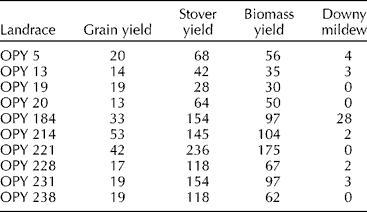
Ten highest yielding landraces had far greater capacity (35–175%) than HHB 67 to accumulate biomass (Table 3). The advantage of the selected landraces with respect to grain yield was also striking, as they produced a 14–53% higher grain yield than HHB 67. The high degree of superiority of these landraces over the improved check implies their much greater adaptation to stress prone environments (Yadav and Weltzien, Reference Yadav and Weltzien2000; Yadav, Reference Yadav2004). Though the mechanism of adaptation to arid zone conditions of pearl millet landraces was beyond the scope of this study, other research (van Oosterom et al., Reference van Oosterom, Bidinger and Weltzien2003) has clearly demonstrated that high-tillering, small-panicled landraces are better adapted to the severe, unpredictable drought stress of the arid zones of north-west India than are low-tillering, large-panicled modern varieties. A small main shoot panicle increases tiller survival under drought and minimizes the delay in flowering under drought. These differences in adaptation are supported by crossover interactions for performance between high-tillering landraces and improved cultivars, grown in severely drought-stressed and more favourable arid zone environments (Bidinger et al., Reference Bidinger, Weltzien, Mahalakshmi, Singh and Rao1994; Yadav and Weltzien, Reference Yadav and Weltzien2000; vom Brocke et al., Reference vom Brocke, Christinck, Presterl, Weltzien and Geiger2003).
Magnitude (%) of superiority of selected pearl millet landraces for grain, stover and biomass yields over popular hybrid check HHB 67, plus their downy mildew incidence (% plants infected) from field evaluations

Heterosis in landrace-based topcross hybrids
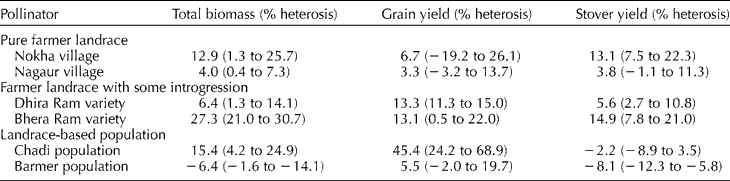
The mean heterosis for total biomass and grain and stover yields was highly variable for individual traits and pollinators (Table 4). The pollinator mean heterosis for biomass ranged from − 6% for the Barmer population to +27% for the Bhera Ram farmer variety, and for grain yield from 3% for the Nagaur village variety to 45% for the Chadi population. There were similar trends in the seed parents, among which much higher levels of heterosis were found with ICMA 93333 than with ICMA 91444 (13.7% vs. 6.1% for mean biomass, and 23.7% vs. − 0.7% for grain yield – data not presented). The high degree of heterosis with the Bhera Ram farmer variety and the insignificant heterosis in the Nagaur Village pollinator for all variables suggest that there are significant differences in general combining ability (GCA) among the individual landraces and seed parents. Therefore, it should be possible to explore the general potential of individual landraces as parents for hybrids through combining ability trials. However, there was also a considerable range in the percentage of heterosis in topcross hybrids on different seed parents within the same pollinator (Table 4), as well as among different landraces on the same seed parent (data not presented); hence, it is likely that specific as well as GCA differences existed among parents. For example, biomass increased by 30% for the ICMA 91444 × Bhera Ram and the 841A × Bhera Ram topcross populations, whereas grain yield increased >40% for the 841A × Chadi and the ICMA 93333 × Chadi topcross population.
Mean (range) heterosis (% superiority over landrace pollinator) of topcross hybrids made on three selected inbred male-sterile seed parents, for a set of six landrace pollinators

Data are means of five test environments at CAZRI, Jodhpur and RAU, Nagaur in 2003 and 2004. See Materials and Methods for the description of the landrace pollinators.
Use of landraces in cultivar breeding
Landrace-based composite varieties
The most direct use of arid zone landraces is as parents in the breeding of open-pollinated varieties for the arid zone, or by making population crosses among superior landraces (or with existing open-pollinated varieties) with a similar phenotype (e.g. maturity, height, panicle type, etc.). These would usually need to be followed by selection for sufficient uniformity to be able to describe the unique characteristics of the variety for registration, seed production, etc. The other option is to make broad-based populations by randomly mating larger numbers of superior landraces, and then producing varieties from phenotypically similar progenies derived from the population (Witcombe, Reference Witcombe, Khairwal, Rai, Harinarayana and Andrews1999).
The selected landraces from this study would form good sources for improving grain yield in arid zone breeding programs, without adversely affecting stover yield. Downy mildew (Sclerospora graminicola) susceptibility of pearl millet landraces might be a restraining factor in their utilization in breeding. The field downy mildew incidence in the selected landraces was between 0 and 28% in the present investigation. It would be wise to screen these landraces under high downy mildew pressure to assess their genetic resistance before they are extensively used in breeding programmes. If necessary, however, downy mildew resistance can be significantly improved by recurrent selection (Weltzien and King, Reference Weltzien and King1995) or by molecular marker-assisted selection (Hash and Witcombe, Reference Hash, Witcombe and Leslie2002).
A good example of the use of landraces in cultivar breeding is the composite variety CZP 9802, bred from the landrace-based Early Rajasthan Population (Yadav and Weltzien, Reference Yadav and Weltzien2000). This population was synthesized from four early maturing Rajasthan landraces and underwent a number of cycles of recurrent selection for both adaptation to arid zone conditions and for downy mildew resistance under glasshouse conditions (Yadav and Weltzien, Reference Yadav and Weltzien1998). In the Indian national testing system for new cultivars, CZP 9802 produced 25–56% higher grain yield and 20–58% higher stover yield than two national checks in drought environments. Under near-optimum growth conditions, its stover yield exceeded to that of checks by 16–47%, without compromising grain yield (Yadav and Bidinger, Reference Yadav and Bidinger2007). Thus, CZP 9802 combines adaptation to drought stress with a yield potential under improved conditions, which is as high as that of the national checks. As a result, millet variety CZP 9802 was released for cultivation in drought-affected millet growing areas in the states of Rajasthan, Gujarat and Haryana (Yadav, Reference Yadav2004). This variety is already being grown over 20,000 ha in western Rajasthan.
Use of landraces in topcross hybrids
The other option for the use of landraces is as pollinators in the breeding of topcross hybrids (male-sterile seed parents × open-pollinated restorers). This approach seeks to combine the adaptation and productivity of a superior landrace pollinator with heterosis from the combination with a genetically different (but still adapted) seed parent (Yadav et al., Reference Yadav, Weltzien, Bidinger and Mahalakshmi2000). The key to achieving increased grain and stover yields by this route seems to be the identification of seed parents with a positive GCA for total biomass under arid zone conditions (Bidinger et al., Reference Bidinger, Yadav, Sharma, van Oosterom and Yadav2003). This is particularly true in the case of seed parents, as most available seed parents are not well adapted to arid zone conditions (Yadav et al., Reference Yadav, Bidinger and Sharma2003b)
A knowledge of the GCA of both landrace and seed parent would certainly be useful in designing experimental topcross hybrids that are likely to give significant levels of heterosis for one or more traits. An earlier study indicated that the general combining abilities of seed parents and pollinator populations was able to predict 35–62% of grain yield heterosis and 76–92% stover yield heterosis in topcross hybrids (Bidinger et al., Reference Bidinger, Yadav, Sharma, van Oosterom and Yadav2003). Whether it is worth investing resources in estimating the GCAs of potential landrace pollinators before making testcrosses, as opposed to simply making experimental testcrosses to a set of seed parent with known combining ability in arid zone environments, is debatable. This study certainly indicated that it was possible to identify good levels of heterosis for grain or stover yield in a relatively small set of testcrosses, made without any prior knowledge of the combining ability of the landraces. Operationally, it is very easy to make a large number of testcrosses with a single landrace pollinator by planting the pollinator and a large set of male-sterile seed parents in a single isolation. Therefore, it may be simpler to make larger sets of testcrosses, with the best of the available landraces, and reduce these to a smaller number by an initial visual evaluation (in comparison to the pollinator itself), before replicated yield testing is initiated.
Acknowledgements
The landrace collection and evaluation work was done under ICAR-funded NATP Project on the Sustainable Management of Biodiversity. The generosity of farmers to contribute the sample of their landrace produce is greatly appreciated and thankfully acknowledged.