Introduction
In this paper, we describe the new mineral popugaevaite (Cyrillic: попугаеваит), the first natural borate with both F and Cl as species-defining constituents. It was found at the Internatsional’nyi diamond mine operated on the Internatsional’naya kimberlite pipe in Sakha (Yakutia) Republic, Russia. This kimberlite pipe, a well-known, actively operating diamond deposit, is the type locality of two recently discovered crichtonite-group minerals, botuobinskite SrFe2+Mg2(Cr3+6Ti4+12)[O36(OH)2] and mirnyite SrZr4+Mg2(Cr3+6Ti4+12)O38 (Rezvukhin et al., Reference Rezvukhin, Rashchenko, Sharygin, Malkovets, Alifirova, Pautov, Nigmatulina and Seryotkin2023).
Popugaevaite was found in a single (holotype) specimen of a core of a prospecting borehole drilled from an underground working. It is named in honour of the Russian geologist Dr. Larisa Anatol’evna Popugaeva (1923–1977), one of the principal discoverers of diamondiferous kimberlite pipes in Yakutia. Both the new mineral and its name have been approved by the Commission on New Minerals, Nomenclature and Classification of the International Mineralogical Association, (IMA2019–115, Pekov et al., Reference Pekov, Zubkova, Chaikovskiy, Chukanov, Belakovskiy, Yapaskurt, Bychkova, Ksenofontov, Chirkova, Britvin and Pushcharovsky2020, symbol Pgv). The type specimen (part of the holotype) is deposited in the systematic collection of the Fersman Mineralogical Museum of the Russian Academy of Sciences, Moscow with the catalogue number 97010.
Occurrence and general appearance
The new mineral was found in only a single specimen, a fragment of the core of a prospecting borehole drilled at the Internatsional’nyi (International) underground diamond mine, Internatsional’naya kimberlite pipe, Irelyakh river basin, 10 km SW of the city of Mirnyi, Sakha (Yakutia) Republic, Siberia, Russia.
The Internatsional’naya pipe breaks through the Early Cambrian sedimentary strata mainly consisting of terrigenous-carbonate, carbonate and evaporitic rocks. This sedimentary strata contains layers of halite rocks, from 1.5 m to 30 m thick, with accessory dolomite, anhydrite, celestine and the borate mineral kurgantaite CaSr[B5O9]Cl·H2O. Numerous xenoliths of halite rocks up to several metres in size, as well as veins of recrystallised halite and breccias with halite cement, are typical for the Internatsional’naya pipe, and in some other Yakutian kimberlite pipes (Kopylova et al., Reference Kopylova, Kostrovitsky and Egorov2013; Agashev et al., Reference Agashev, Nakai, Serov, Tolstov, Garanin and Kovalchuk2018 and references therein). An interesting geochemical and mineralogical feature of the Internatsional’naya pipe is the presence of a rich borate mineralisation of the low-temperature hydrothermal origin in the contact zone between kimberlite and halite xenoliths and in halite veins. The major borate mineral here is ekaterinite Ca2(B4O7)(Cl,OH)2·2H2O which forms numerous nodules and veins up to 4.5 cm thick, sometimes together with serpentine (Nikulin and Eremeev, Reference Nikulin and Eremeev2011). In ekaterinite aggregates, halite and an unusually Fe2+-enriched variety of szaibélyite (up to 28.5 wt.% FeO) form thin veinlets (Zubkova et al., Reference Zubkova, Pekov, Chukanov, Chaikovskiy, Yapaskurt and Pushcharovsky2020).
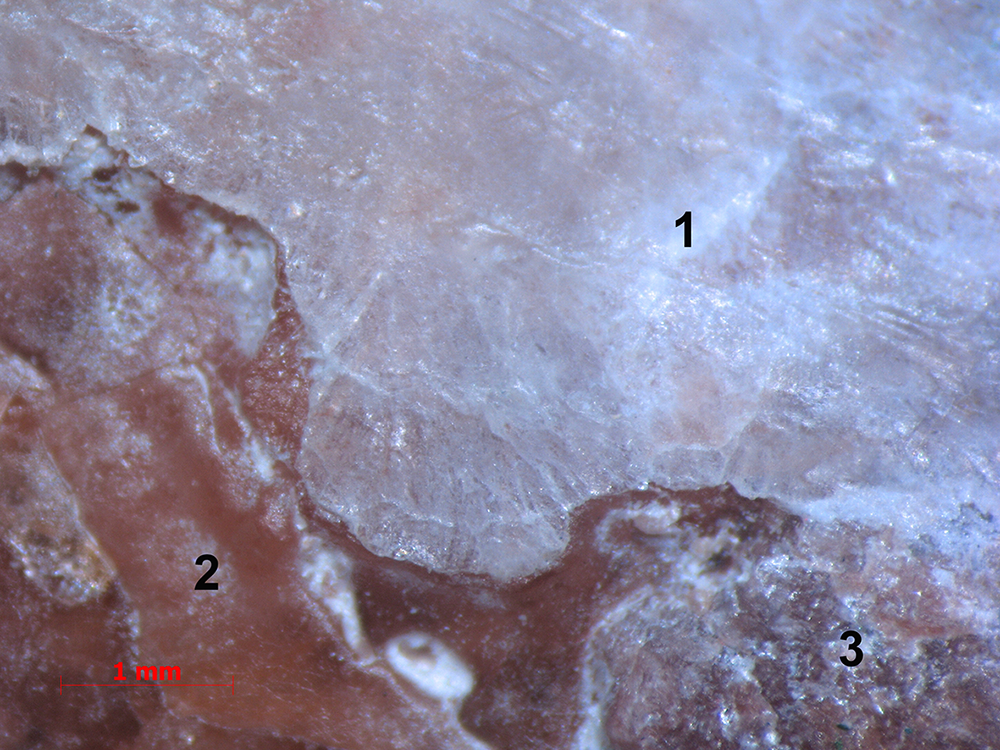
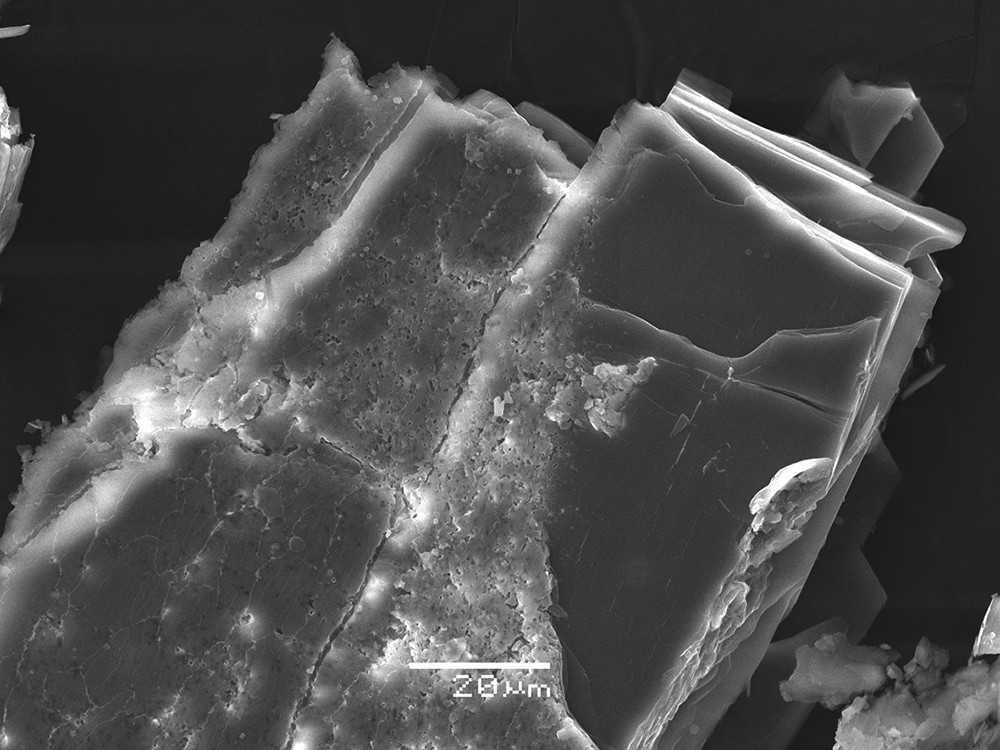
Popugaevaite occurs as veinlets in massive, fine-grained aggregates of reddish-pink ekaterinite and crusts on ekaterinite nodules (Fig. 1) embedded in halite. Other associated minerals include Fe-enriched szaibélyite, serpentine, dolomite, pyrrhotite and chalcopyrite. The veinlets and crusts of popugaevaite are typically 0.2–0.3 mm, rarely up to 0.7 mm in thickness and up to 1 cm × 4 cm in area. They consist of coarse prismatic, sometimes lath-shaped, typically split individuals (crude crystals: Fig. 2) up to 0.3 mm × 1 mm. Aggregates of the new mineral contain numerous inclusions of halite and Fe-bearing szaibélyite.
Colourless crust of popugaevaite (1) with halite (2) on ekaterinite (3). Field of view width: 9.5 mm, holotype sample.

Coarse crystal of popugaevaite. Scanning electron microscopy (SE) image.

Physical properties and optical data
Popugaevaite is transparent, colourless, with a white streak and vitreous lustre. It is non-fluorescent under both ultraviolet rays and an electron beam. Popugaevaite is brittle. Cleavage is perfect on {010}, and the fracture is stepped. The Mohs’ hardness (determined using a scratch test) is ca 3. The density could not be measured because of the paucity of pure material and presence of inclusions of halite and szaibélyite. The density calculated using the empirical formula and unit-cell volume obtained from single-crystal X-ray diffraction data is 1.933 g cm–3.
Popugaevaite is optically biaxial (–), α = 1.502(2), β = 1.523(2), γ = 1.530(2) (589 nm). 2Vmeas = 50(10)° and 2Vcalc = 59°. Dispersion of optical axes was not observed. In plane polarised light the mineral is colourless and non-pleochroic.
Infrared spectroscopy
In order to obtain an infrared (IR) absorption spectrum, popugaevaite powder was mixed with anhydrous KBr, pelletised, and analysed using an ALPHA FTIR spectrometer (Bruker Optics) at a resolution of 4 cm–1. 16 scans were collected. The IR spectrum of an analogous pellet of pure KBr was used as a reference.
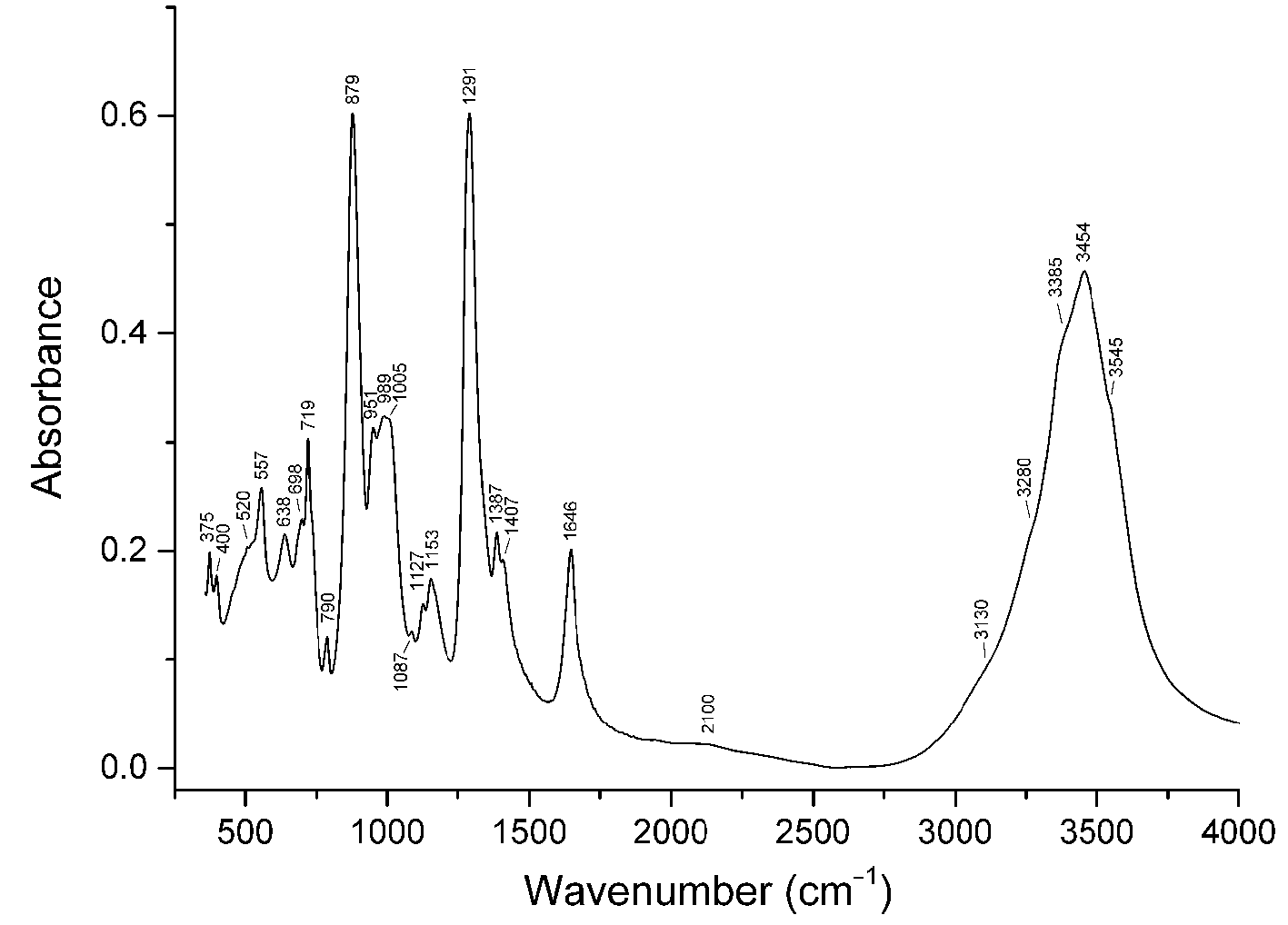
The IR spectrum of popugaevaite (Fig. 3) contains bands in the region from 3130 to 3550 cm–1 (O–H-stretching vibrations of OH groups and H2O molecules), at 1646 cm–1 (bending vibrations of H2O molecules), in the range 1290–1410 cm–1 (mixed modes involving asymmetric stretching vibrations of BO3 triangles and B–O–H bending vibrations), 870–1160 cm–1 (stretching vibrations of BO4 tetrahedra), in the regions from 690 to 800 cm–1 (O–B–O bending vibrations of BO3 triangles) and from 500 to 640 cm–1 (mixed O–B–O and B–O–B bending modes combined with librational modes of H2O molecules). Bands below 500 cm–1 are due to lattice modes. The weak band at 2100 cm–1 corresponds to a combination mode. The band assignment was made based on IR spectra of orthoborates and compounds containing [B(OH)4]– anion (Chukanov, Reference Chukanov2014; Chukanov and Chervonnyi, Reference Chukanov and Chervonnyi2016).
Infrared absorption spectrum of popugaevaite.

The IR spectrum of popugaevaite is in general close to that of brianroulstonite (Grice et al., Reference Grice, Gault and van Velthuizen1997). The main differences are as follows: (1) In the IR spectrum of brianroulstonite, the maximum of the strong absorption in the range of O–H-stretching vibrations is observed at 3363 cm–1 and is significantly shifted in comparison with the band of O–H-stretching vibrations with the absorption maximum at 3454 cm–1 in the IR spectrum of popugaevaite. (2) In the IR spectrum of brianroulstonite, additional absorption maximum is observed at 971 cm–1 which may correspond to Ca···O–H bending vibrations.
Both these facts confirm the presence of the isolated (non-bound with B) OH– anion in brianroulstonite and the absence of this anion in popugaevaite in which the OH– group non-bound with B is replaced by F–.
Chemical composition
The determination of Ca, F and Cl in popugaevaite was carried out using a Jeol JSM-6480LV scanning electron microscope equipped with an INCA-Wave 500 wavelength-dispersive spectrometer (Laboratory of Analytical Techniques of High Spatial Resolution, Dept. of Petrology, Moscow State University), with an acceleration voltage of 20 kV and a beam current of 20 nA. The electron beam was rastered to the 5 × 5 μm area. The following standards were used: diopside (Ca); MgF2 (F); and NaCl (Cl). The contents of other elements with atomic numbers > 6, except oxygen, are below detection limits.
The presence of a significant amount of chlorine in popugaevaite prevents the quantitative determination of boron by electron microprobe due to the overlap of X-ray emission lines of the K series of B with L lines of Cl. The boron content was determined using inductively coupled plasma mass spectrometry (ICP-MS). The measurements were carried out with the Element-2 (Thermo Fisher Scientific) instrument which has a high resolution (that avoids interference between components) and sensitivity. Several crystals of the mineral were dissolved in 10 cm3 of 3% HNO3 solution (Merck, Suprapur®) in deionised water (EasyPure). As the mass of the mineral was too small for accurate weighing, we have determined contents of B and Ca in relative units and further, we have used the averaged Ca content, obtained by electron microprobe, for calculation of the B content. The obtained value is in good agreement with the boron content determined from the crystal structure data (see below).
Special attention was paid to the correctness of fluorine determination in popugaevaite. In particular, we carried out an electron microprobe study, under the same conditions, of hilgardite Ca2B5O9Cl·H2O, as a standard of a mineral with stable stoichiometry and with the same constituents as in popugaevaite, except for F. This study showed the Ca:Cl ratio very close to 2:1 and the absence (i.e. the content below detection limit) of F.
The paucity of pure material of popugaevaite meant that H2O was not analysed. Instead the H (H2O) content was calculated, based on the structure data (see below) and taking into account the charge balance requirement, by stoichiometry: for (OH)6(H2O)8 = 22 H atoms per formula unit (apfu).
The average (for six spot electron-microprobe analyses for Ca, F and Cl) chemical composition of popugaevaite (wt.%, ranges are in parentheses) is: CaO 28.54 (28.34–28.75), B2O3 28.62, F 3.19 (2.97–3.31), Cl 11.50 (11.32–11.60), H2Ocalc 32.83, O=(F,Cl) –3.94, total 100.74.
The analytical total is close to 100 wt.% that demonstrates a good agreement between the electron microprobe data for Ca, F and Cl, ICP-MS data for B and the calculated value for H (H2O). The correctness of the obtained chemical data is also confirmed by the excellent value of the Gladstone–Dale compatibility index (Mandarino, Reference Mandarino1981): 1 – (Kp/Kc) = –0.026.
The empirical formula, calculated on the basis of 23 O+F+Cl apfu with 22 H apfu, is: Ca3.07B4.96O6.03(OH)6F1.01Cl1.96·8H2O. The idealised formula is Ca3B5O6(OH)6FCl2·8H2O, which requires CaO 27.74, B2O3 28.70, H2O 32.70, F 3.13, Cl 11.69, O = (F,Cl) –3.96, total 100 wt.%.
Popugaevaite is insoluble in water and slowly dissolves in cold dilute HCl aqueous solution without effervescence. The obtained solution shows a characteristic colour reaction with quinalizarin clearly indicating the presence of boron.
X-ray crystallography and crystal structure determination details
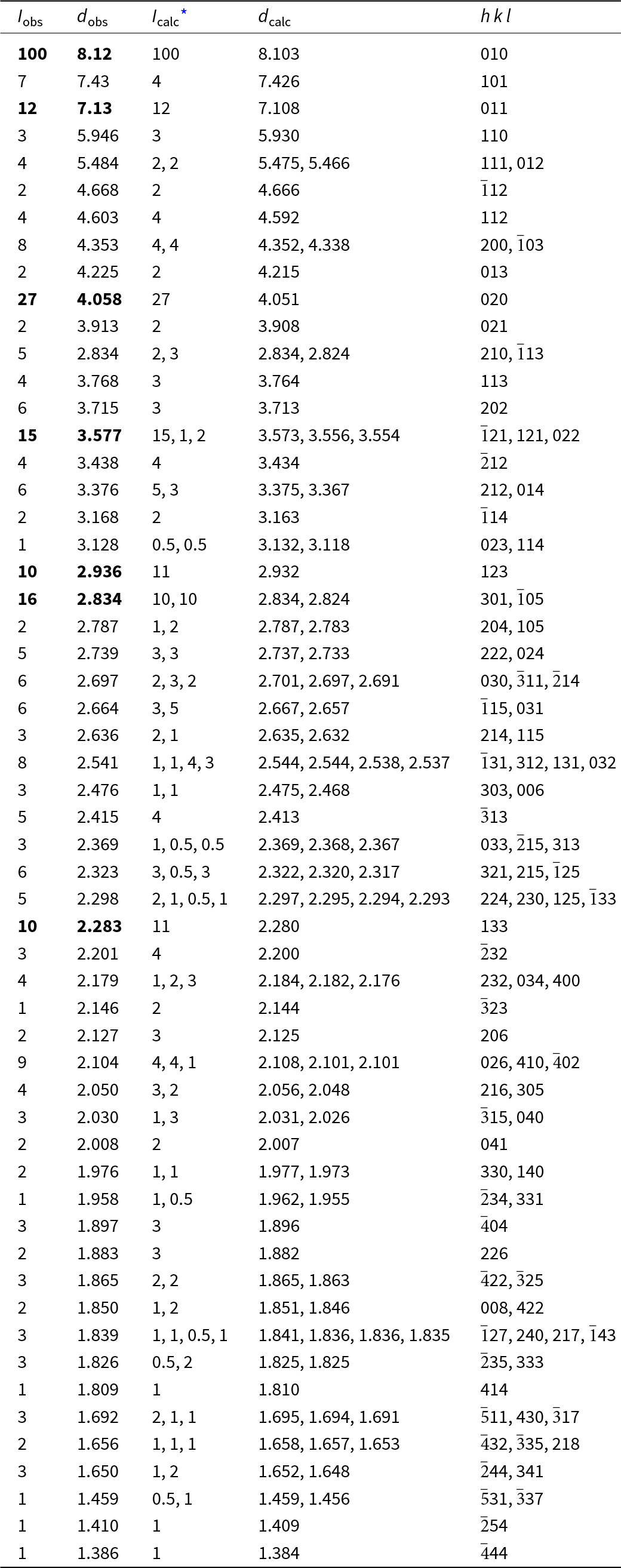
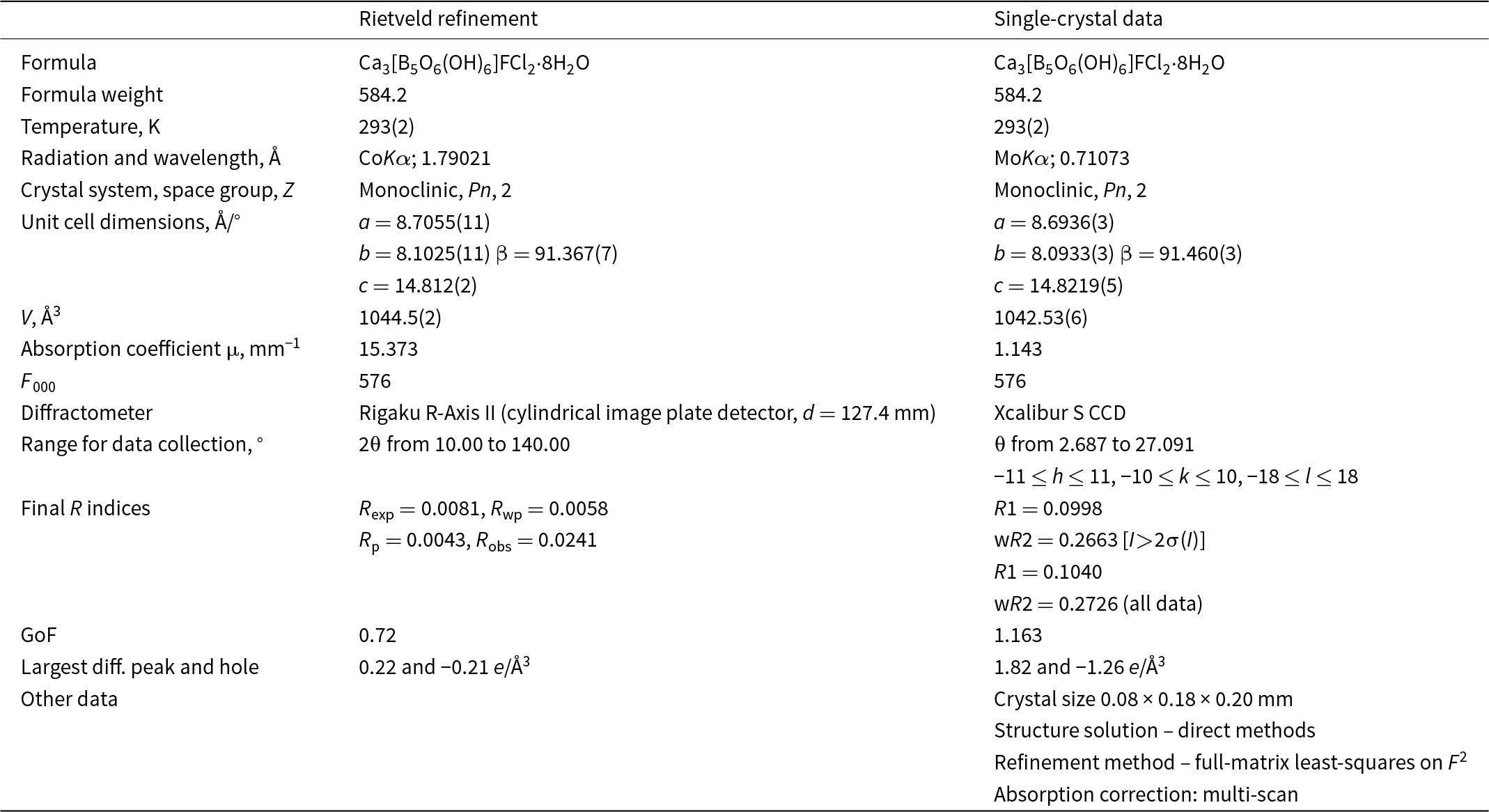
Single-crystal X-ray diffraction (XRD) studies of popugaevaite were carried out using an Xcalibur S diffractometer equipped with a CCD detector. Data reduction was performed using CrysAlisPro, version 1.171.37.34 (Agilent Technologies, 2014). The data were corrected for Lorentz factor and polarisation effects. The crystal structure was solved by direct methods and refined in the space group Pn using the SHELX software package (Sheldrick, Reference Sheldrick2015). Unfortunately, because of the moderate quality of the crystal studied and consequently of the experimental data, this did not give a good agreement between observed and calculated F2 values: final R hkl = 0.0998 for 4255 reflections with I>2σ(I). However, reasonable values of interatomic distances, as well as good agreement between the measured and calculated powder XRD patterns (Table 1) showed that the obtained structure model is correct. Further refinement of the structure was performed by the Rietveld method using this model in order to check whether other possible popugaevaite polytypes exist in the sample and to obtain more precise powder diffraction data.
Powder X-ray diffraction data (d in Å) of popugaevaite

* For the calculated pattern, only reflections with intensities ≥0.5 are given. The strongest reflections are marked in boldtype. The powder pattern was calculated using Diamond, Version 3.2k.
Powder XRD data of popugaevaite (Table 1) were collected with a Rigaku R-AXIS Rapid II diffractometer equipped with a cylindrical image plate detector (radius 127.4 mm) using Debye-Scherrer geometry, CoKα radiation (rotating anode with VariMAX microfocus optics), 40 kV, 15 mA and an exposure time of 15 min. The angular resolution of the detector is 0.045°2θ (pixel size 0.1 mm). The data were integrated using the software package Osc2Tab (Britvin et al., Reference Britvin, Dolivo-Dobrovolsky and Krzhizhanovskaya2017).
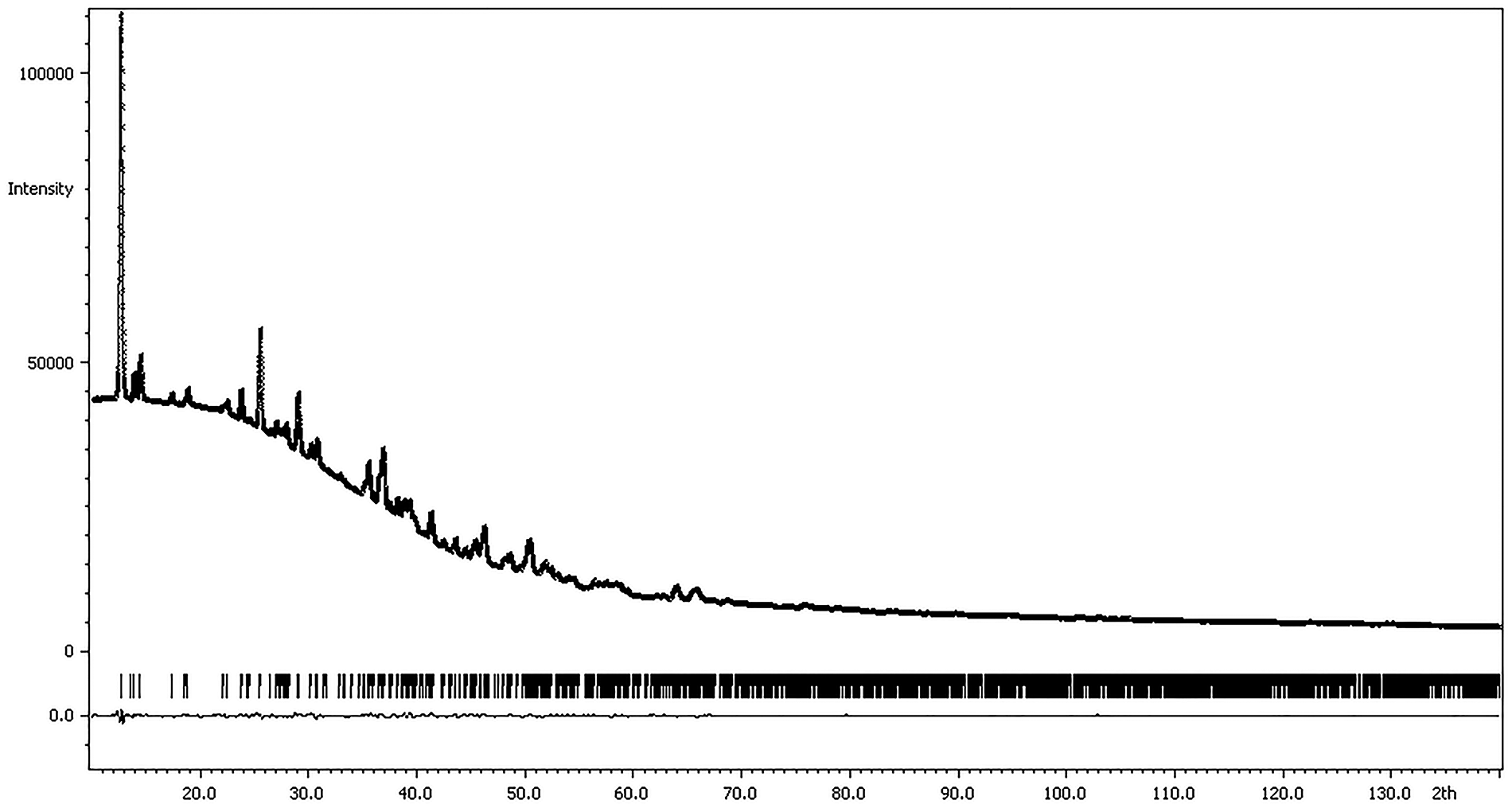
Data treatment and the Rietveld structure analysis were carried out using the JANA2006 program package (Petříček et al., Reference Petříček, Dušek and Palatinus2006). The profiles were modelled using a pseudo-Voigt function. The structure was refined in isotropic approximation of atomic displacements. The U iso values for all boron atoms were restricted to be equal. In addition, the restriction of equal U iso values was applied to the totality of all O and F atoms. The cation–anion interatomic distances for B-centred tetrahedra and triangles, as well as Ca–F and Cl–O distances, were softly restricted to be close to the values obtained for the single-crystal model. Final agreement factors are: R wp = 0.0058, R p = 0.0043 and R obs = 0.0241. The observed and calculated powder XRD diagrams demonstrate a very good compatibility (Fig. 4).
Observed and calculated powder X-ray diffraction patterns of popugaevaite. The solid line corresponds to calculated data, the crosses correspond to the observed pattern, vertical bars mark all possible Bragg reflections. The difference between the observed and calculated patterns is shown by the lower pattern.

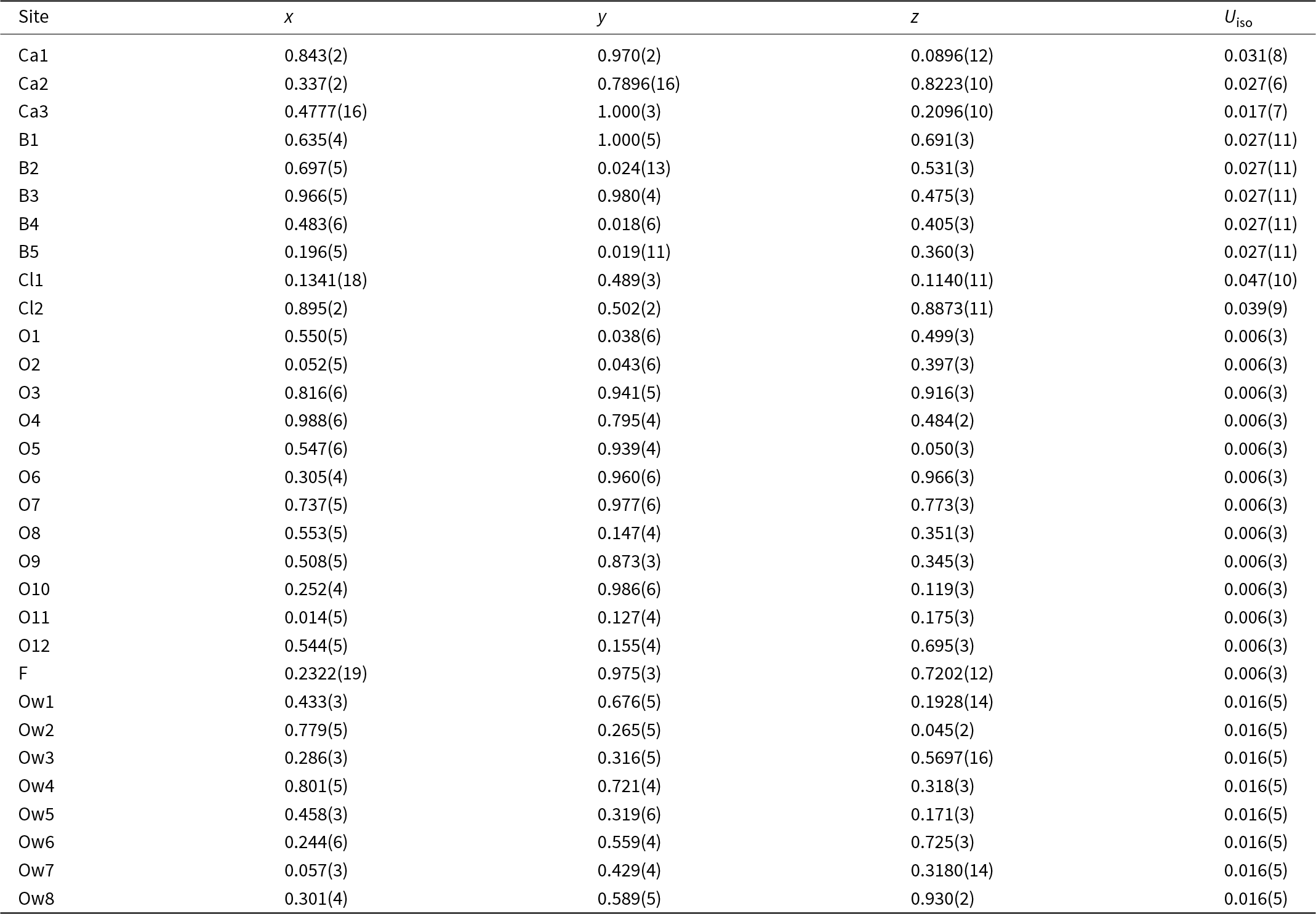
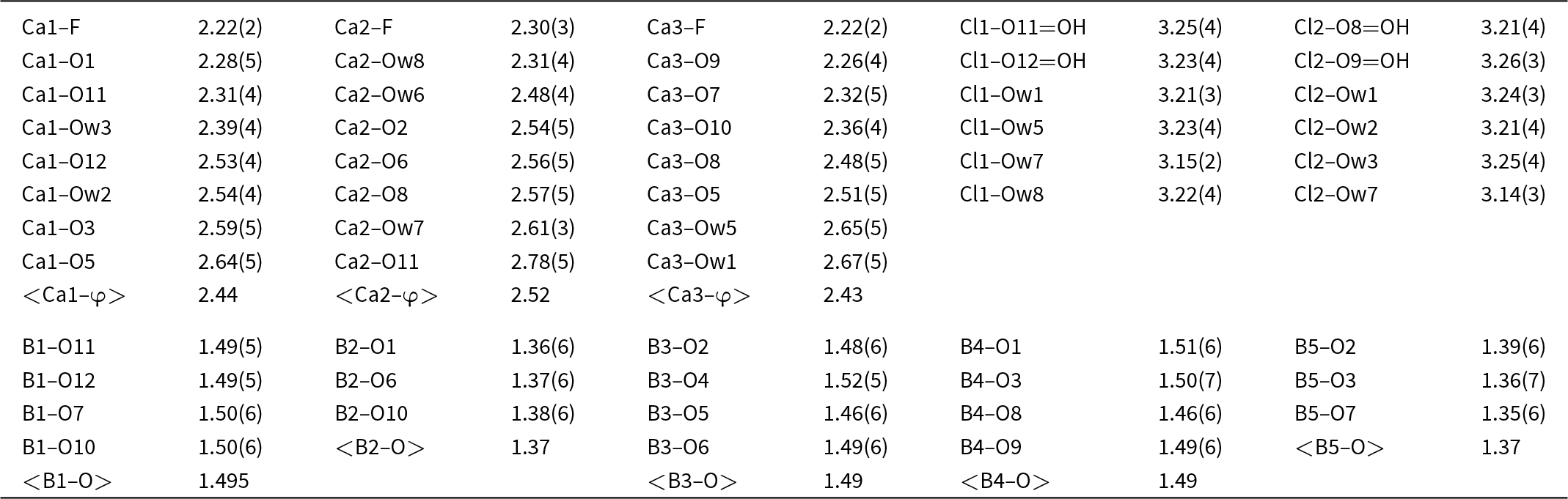
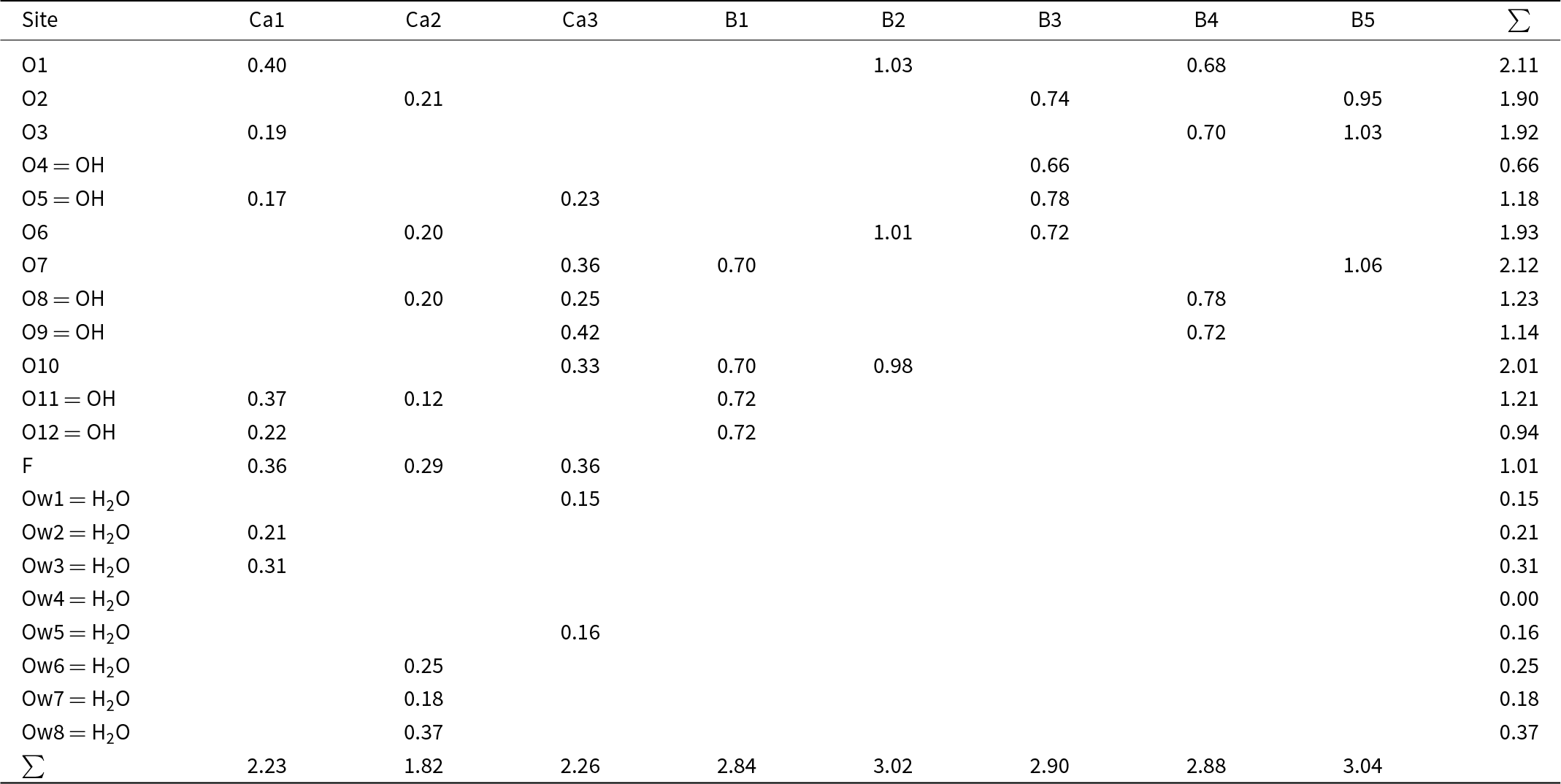
Crystal data, data collection information and structure refinement details for both single-crystal and powder XRD studies of popugaevaite are given in Table 2, coordinates and thermal displacement parameters of atoms in Table 3, selected interatomic distances in Table 4 and bond valence calculations in Table 5. The crystallographic information file has been deposited with the Principal Editor of Mineralogical Magazine and is available as Supplementary material (see below).
Crystal data, data collection information and structure refinement details for popugaevaite

Coordinates and isotropic displacement parameters (U iso, in Å2) of atoms for popugaevaite (after Rietveld refinement)

Selected interatomic distances (Å) in the structure of popugaevaite (after Rietveld refinement)

Bond valence calculations for popugaevaite

Bond-valence parameters for B–O, Ca–O are taken from Gagné and Hawthorne (Reference Gagné and F.C2015) and for Ca–F from Brese and O’Keeffe (Reference Brese and O‘Keeffe1991).
Discussion
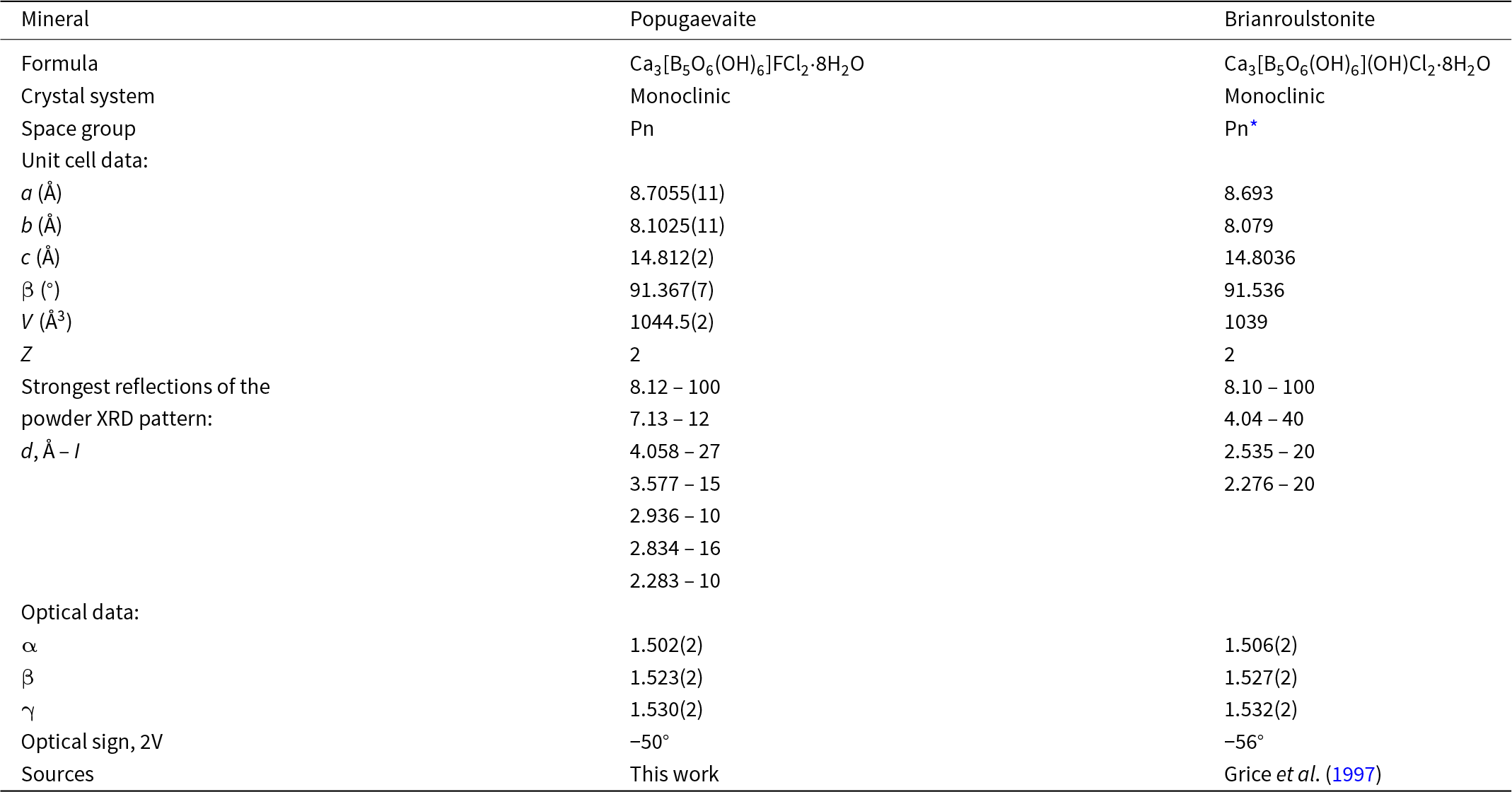
Popugaevaite Ca3[B5O6(OH)6]FCl2·8H2O is an isostructural analogue of brianroulstonite Ca3[B5O6(OH)6](OH)Cl2·8H2O (Grice et al., Reference Grice, Gault and van Velthuizen1997, Reference Grice, Gault and Van Velthuizen2005) with F– instead of the OH– group non-bound with boronFootnote 1. The transformation matrix from the unit cell of brianroulstonite [space group Pa, a = 17.367(4), b = 8.079(2), c = 8.693(2) Å, β = 121.56(2)° and V = 1039.3(6) Å3: Grice et al., Reference Grice, Gault and van Velthuizen1997] to the conventional unit cell chosen by us for popugaevaite is as follows: 0 0 1/0  $\bar 1$ 0/1 0 1. This results in the unit-cell parameters of brianroulstonite a = 8.693, b = 8.079, c = 14.8036 Å and β = 91.536° close to those of popugaevaite (Table 6).
Comparative data for popugaevaite and brianroulstonite

* Brianroulstonite was originally described with space group Pa and the following unit-cell parameters: a = 17.367(4), b = 8.079(2), c = 8.693(2) Å, β = 121.56(2)° and V = 1039.3(6) Å3 (Grice et al., Reference Grice, Gault and van Velthuizen1997); the transformation matrix from this unit cell to the conventional unit cell chosen by us for popugaevaite is as follows: 0 0 1/0  $\bar 1$ 0/1 0 1 (see text).
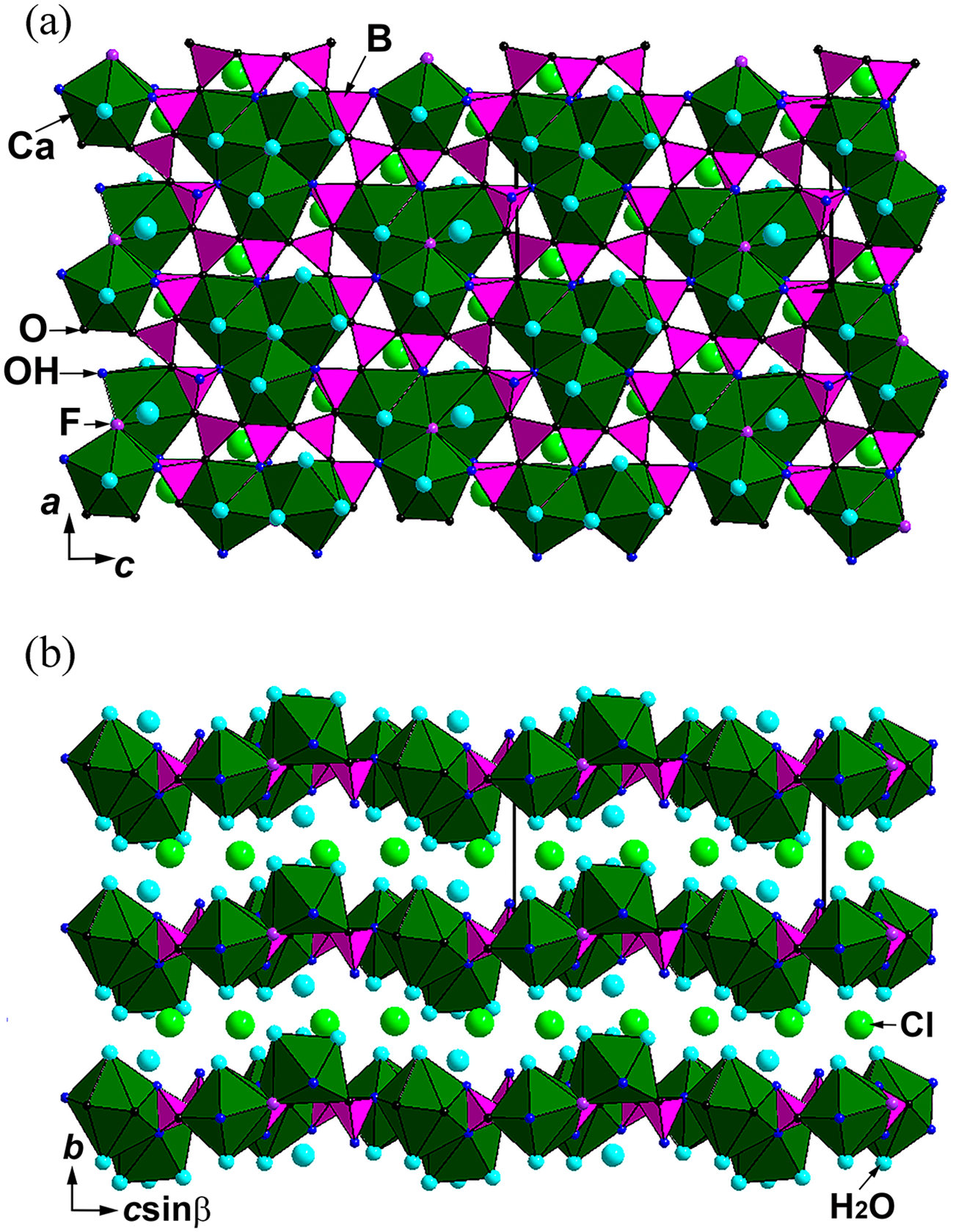
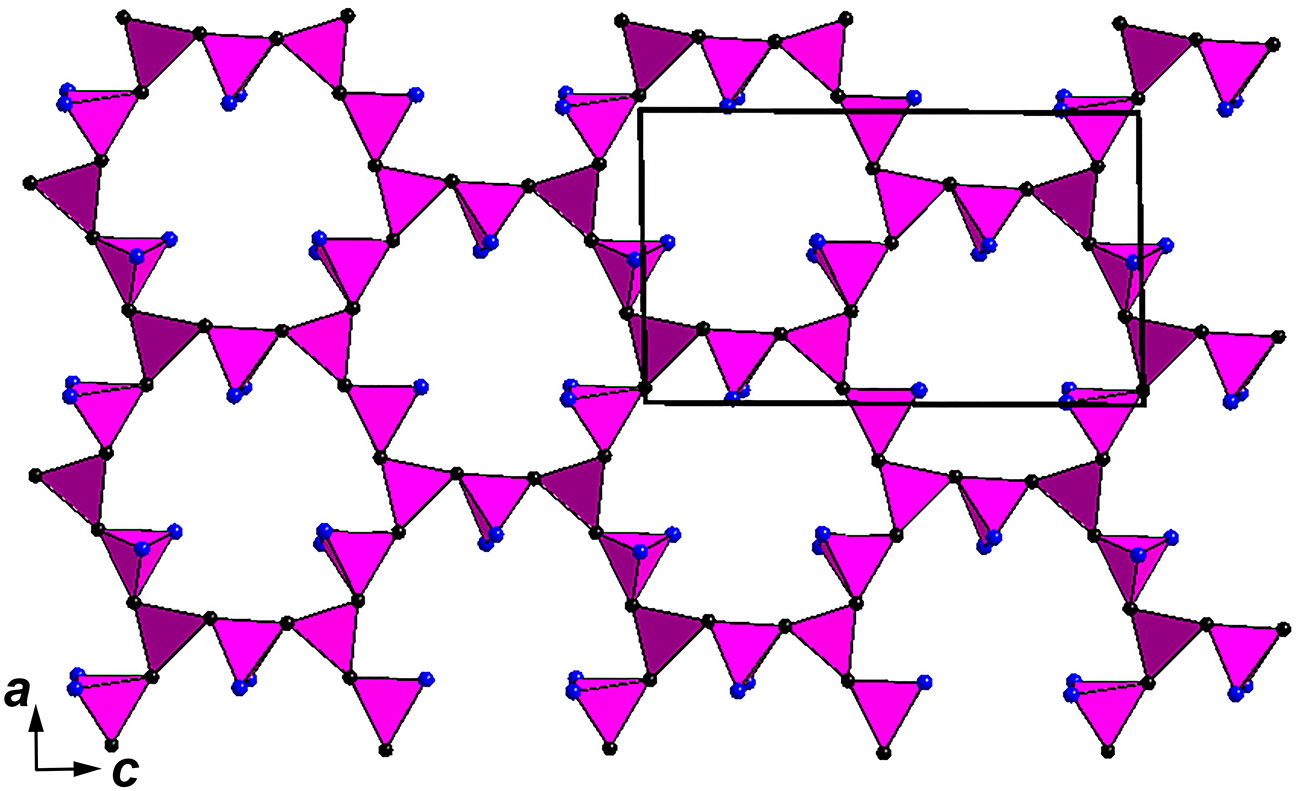
The crystal structure of popugaevaite (Fig. 5), as well as that of brianroulstonite, is based on the layers of twelve-membered rings of alternating B-centred polyhedra: BO3 triangles and BO2(OH)2 tetrahedra (Fig. 6). Each ring consists of six triangles and six tetrahedra and shares three borate polyhedra with adjacent rings. Within the rings of the borate sheets three crystallographically non-equivalent Ca sites are located. All Ca cations have eight-fold coordination CaO2F(OH)3(H2O)2 for Ca1 and Ca3 and CaO2F(OH)2(H2O)3 for Ca2. Ca-centred polyhedra share F–(OH) edges to form triads with a common F vertex. All H2O molecules participate in Ca coordination except Ow4 which is only hydrogen-bonded within the structure. The Cl atoms are located between the calcium-borate slabs and cross-linked to them through the complex system of H bonds in which Cl atoms play the role of the only acceptors of H-bonds with the OH–Cl distances in the range from 3.15 to 3.25 for Cl1 and 3.14–3.26 Å for Cl2 (Table 4).
The crystal structure of popugaevaite projected along the b (a) and a (b) axes. The unit cell is outlined. Drawn using Diamond, version 3.2k (Crystal Impact, 2014)

Borate layer in the structure of popugaevaite. The unit cell is outlined.

The fundamental building block (FBB) in the structures of brianroulstonite and popugaevaite, according to the classification of FBB in borates (Burns et al., Reference Burns, Grice and Hawthorne1995; Grice et al., Reference Grice, Burns and Hawthorne1999), can be presented as 6Δ6□:<Δ□Δ□Δ□Δ□Δ□Δ□>. Among minerals, twelve-membered borate rings were also reported in pringleite and ruitenbergite, two polymorphs of Ca9[B26O34(OH)24]Cl4·13H2O (Grice et al., Reference Grice, Burns and Hawthorne1994), and in penobsquisite, Ca2Fe[B9O13(OH)6]Cl·4H2O (Grice et al., Reference Grice, Gault and Van Velthuizen1996), where the sheets of dodecaborate rings are linked to form frameworks. Isolated twelve-membered rings with alternating boron tetrahedra and triangles have been reported for satimolite, KNa2(Al5Mg2)[B12O18(OH)12](OH)6Cl4·4H2O (Pekov et al., Reference Pekov, Zubkova, Ksenofontov, Chukanov, Yapaskurt, Korotchenkova, Chaikovskiy, Bocharov, Britvin and Pushcharovsky2018).
The borate layers [B5O6(OH)6] formed by twelve-membered rings in popugaevaite are topologically close to the silicate tetrahedral nets in zeophyllite Ca13(F,OH)10[Si5O14]2·6H2O and britvinite [Pb7(OH)3F(BO3)2(CO3)][Mg4.5(OH)3(Si5O14)] (Yakubovich et al., Reference Yakubovich, Massa and Chukanov2008). The main difference is that in popugaevaite both triangles and tetrahedra participate in the fundamental building blocks whereas in both aforementioned silicates the layers are formed exceptionally by tetrahedra. As a result, borate and silicate layers are characterised by different formulae: [B5O6(OH)6] vs [Si5O14].
Supplementary material
The supplementary material for this article can be found at https://doi.org/10.1180/mgm.2024.79.
Acknowledgements
We thank three anonymous referees for their valuable comments. The works were performed in accordance with the State Tasks of the Russian Federation: mineralogical and crystal chemical studies – no. 121061600049-4, IR spectroscopy – no. 124013100858-3, single-crystal XRD – no. АААА-А16-116033010121-7, powder XRD study – no. AAAA-A19-119091190094.
Competing interests
The authors declare none.