Introduction
In Failing at Fairness, Sadker and Sadker
(1994) provide extensive evidence that America's school
system has systematically discriminated against girls and women. In
areas that boys are encouraged to excel, girls are denied opportunities.
They are taught to speak quietly, to defer to boys, to avoid math and
science, and to value neatness over innovation and appearance over
intelligence (Sadker and Sadker 1994, 13).
Girls consistently outperform boys in elementary school but lag behind
them by the time they graduate. Sadker and Sadker show that
discrimination does not end with high school graduation, but follows
female students through their college careers.
How are political science departments doing? Though roughly half of
political science majors are women, are they systematically
discriminated against? Two comprehensive reports on women in political
science have documented gender discrimination in graduate schools and in
the hiring and promotion of women faculty (Committee
on the Status of Women in the Profession 2001; Committee on the Status of Women 1992). However,
these reports only briefly address issues of gender discrimination in
the undergraduate classroom.
We are surprised by the relative lack of attention paid to issues of
gender discrimination in undergraduate teaching because our jobs, our
departments, and our universities exist to teach undergraduates.
Potential gender discrimination in undergraduate teaching is an
especially important issue at our university where our political science
major attracts more men than women, raising the question of whether
gender discrimination contributes to this pattern.1
BYU is part of a category of the “Protestant Schools”
that in general have more men expressing interest in majoring in
political science than women (Mann
1996). At BYU approximately 38% of political science
majors are women, in contrast to the national average of about
50% women.
Thus, we hope to contribute to a discussion
of gender discrimination in undergraduate teaching by identifying
obstacles women face in political science today and testing for the
presence of those obstacles in an undergraduate classroom setting.
We find evidence to support claims that the content of political science
courses, specifically statistics, may create barriers for women. We also
find support for the claim that women teaching assistants effectively
motivate women students. Surprisingly, however, we find that the gender
match between a teaching assistant and a student appears largely
irrelevant for student performance. Women seem to be more motivated to
complete a course when their teaching assistant is a woman, but we find
no consistent evidence that women perform better on course assignments
when they are taught by a woman.
Hypotheses
It would be difficult to make a comprehensive list of all the potential
obstacles female political science students face. We have condensed the
extensive literature on gender discrimination to three distinct
hypotheses that were testable and seemed appropriate for a study of
gender discrimination in undergraduate political science courses.
Our first hypothesis concerns role model effects, the primary concern of
the report on gender and the profession. Female instructors may inspire
female students to perform better. Ehrenberg (1997) and his associates
carried out the most prominent research project in this area. Using data
from the National Educational Longitudinal Study of 1988, they concluded
that student performance had little association with the match between
the students' race, gender, and ethnicity, and that of the teacher's.
Although the Ehrenberg study concluded that a gender match of the
instructor and student did not affect student performance, we have
decided to test this hypothesis for several reasons. First, there has
not been any follow-up research on their findings. Second, the Ehrenberg
study looked at students in high school, not college. Third, we can
obtain information about students taking courses that was not available
to Ehrenberg and his colleagues, allowing us to control for different
factors. Finally, we have the advantage of looking at students'
performance on a variety of course assignments. We expect that the role
model effect would be greatest on assignments that require a close
interaction between a student and a teaching assistant and weakest on
assignments in which the interaction with the teaching assistant was
less important. Thus, a multiple choice exam in a large lecture class
should be less influenced by the role model effect of the gender of the
teaching assistant while an intense writing and research assignment that
required multiple interactions with a teaching assistant should exhibit
a greater role model effect.
A second hypothesis comes out of studies about the relationship between
gender and course content. Recent studies suggest that in math young
girls perform as well as boys do; however, over time fewer girls
continue in advanced math courses because of a lack of encouragement and
tracking practices (Leahey and Guo 2001; Weber 2001, 147–48). By the time students enter
college, women have developed adverse attitudes toward math, affecting
their performance in math-related areas (Nosek et. al
2002). In contrast, Fox and Ronkowski
(1997) show a gender advantage for women in tasks that are
spelled out with clarity. We expect that political science classes that
use extensive math or statistics might exhibit a gender disadvantage for
women students.
A final hypothesis is derived from descriptions of a “chilly learning
environment.” Men volunteer comments more than women; men are called on
more than women; instructors learn the names of men faster than they
learn the names of women (Banks 1988).
Similarly, topics typically chosen by men and styles of argumentation
used by men are favored in political science and other disciplines
(Andersen and Miller 1997; Taber et. al. 1988; Banks
1988, 138). Though one female teaching assistant could not
correct for all of these biases, we expect that a female teaching
assistant is less likely to contribute to this type of a biased learning
environment, somewhat counteracting the effects of the discipline, the
content of the course, and the male gender of the professors teaching
the course.
Data
We saw an excellent opportunity to examine these hypotheses by collecting
data on the performance of more than 600 students who took the course
“Political Inquiry” over a three-year period. This course is a required,
introductory course that emphasizes writing, library research, research
designs, and statistics. The course meets three times a week; two of
those meetings are lectures by the professor and the third is an
hour-long lab taught by an undergraduate teaching assistant. The lecture
class has from 120 to 160 students; the labs have from 10 to 20 students
with each teaching assistant teaching two labs during a semester.
Students write weekly papers including an essay on a theory and a review
of an article; several research designs; and exercises on grammar,
style, library research, statistics, and citation style. The teaching
assistants' main responsibility during labs is to explain the writing
assignments. They also grade these assignments, administer quizzes,
review the week's lectures, answer questions, and handle all complaints
about grading.
The unusually prominent role of teaching assistants in this course
provided an excellent test case to assess gender discrimination. The
best course in which to test the effect of the gender of an instructor
would be a nearly identical course taught by a variety of instructors.
For example, different sections of a calculus course that used the same
textbook and same exam would create an excellent test of the effect of
the gender of the instructor because differences in the course structure
and evaluations are minimized. Unfortunately, there are very few, if
any, political science courses that are taught in such a nearly
identical manner. Typically, political science courses with the same
course title will vary in the amount and type of reading, assignments,
and exam formats.
Thus, our study of teaching assistants seems appropriate for an analysis
of the gender effects of an instructor. All students take the same
identical course with identical readings, exams, and writing
assignments. Only the gender of the teaching assistant varies from one
lab to the next. Furthermore, the role of teaching assistants in our
course is more like that of an instructor than a typical teaching
assistant. The teaching assistants explain the writing assignments, work
closely with students on those assignments, grade the assignments, and
handle student complaints about grading, making the teaching assistants
nearly equivalent to instructors in the course.
A wide range of factors have been linked to discrimination, oppression,
and barriers in society and the classroom. Weber
(2001) examines factors thought to contribute to
discrimination based on race, class, gender, and sexuality. In our
course, societal norms, university practices, assigned texts, the
discipline of political science, and the white, male, upper middle class
characteristics of the two professors of the course could all
potentially contribute to the presence of discriminatory practices and
attitudes.2
A cursory analysis of
teaching evaluations suggests the overt discriminatory impact of
professors is negligible. The overall evaluation of the
professor by women students was slightly higher than the
evaluation given by male students (6.0 vs. 5.9 on a 7.0 point
scale). In addition, student responses to the question “Does the
instructor respond respectfully to student questions and
viewpoints?” were identical for both male and female students
(6.1).
Nevertheless, in our study we attempt to hold
these factors constant by selecting a course in which these factors do
not vary. In our results we recognize the constant effect of these other
factors while simultaneously drawing conclusions about the impact of
gender matching between students and teaching assistants.
In addition, the nature of the class controls for self-selection.
“Political Inquiry” is a required course for the political science
major; very few students choose to take the course as an elective. More
importantly, students can not choose their teaching assistant. Because
they register for a lab section without knowing who their teaching
assistant will be, student lab assignments are made regardless of any
preference the students might have concerning the gender of their
instructors. We checked for the random nature of the gender of the
teaching assistant by running a cross-tabulation on the gender of the
student against that of the teaching assistant. The chi-square value was
0.3889 with a probability significance level of .53. This is strong
evidence that gender did not play a role in deciding which lab students
registered for.
There are three other advantages to using this course for our analysis.
First, in most of the semesters studied in the course teaching
assistants used a blind-grading system. The anony-mity of students was
protected through the use of code names, preventing overt bias in
grading for or against individual students or groups of students.
Second, the course has a reputation among students as being the most
rigorous of the courses in the major.3
A
reflection of BYU's religious nature and the reputation of the
course is a recent student evaluation suggesting that the course
be renumbered as Political Science 666.
If women are
discouraged from being political science majors, a likely place for that
discouragement to occur is in this course. Finally, our course data has
both objective and subjective measures of student performance. The
course grade is based primarily on the writing assignments (subjective)
and a multiple-choice final exam (objective). In our analysis we regress
both of these measures on the same set of independent variables. The
different nature of these two measures allows us to test between several
different hypotheses of gender discrimination.
The role model effect could be manifest as either a general or a specific
influence. Generally, women students with female teaching assistants
would be more enthusiastic about the overall course. They would be more
likely to complete the course and more likely to do better on all course
assignments. Specifically, the role model effect might appear more
strongly on writing assignments for which students work closely with
their teaching assistants. In contrast, having a female teaching
assistant should be less relevant for performance on the final exam
which covers material from class lectures and is only tangentially
related to the teaching assistant led lab sections.
The course content suggests that women will do worse in the class,
regardless of the gender of the professor or teaching assistant, but the
exam is more heavily weighted toward statistics and the assignments are
more heavily weighted toward writing and specific task-oriented
activities, leading to the conclusion that women should do better
(regardless of the gender of their TA) on the assignments and worse on
the final.
Unfortunately, hypotheses derived from observations about a “chilly”
learning environment mirror those of the role model hypothesis. Women
students should do better on all course work if their teaching assistant
is female because there will be less of a “chilly” learning environment
for those students. This advantage should be greatest for the writing
assignments where the interaction with the teaching assistants is
extensive, and least for the exam where the interaction with the
teaching assistants is much less important.
Model
Our first analysis is of students who fail to complete the course. We
define this term broadly as any student who failed to take the final
exam or received less than a total of 40% on their combined writing
assignments. We analyze in a logistic regression the dependent variable
“complete the course” which is coded as 1 for all students who met the
minimal requirements for course completion and 0 for those who did
not.
Our most important independent variable was the gender match between a
student and his or her teaching assistant. We divided students into four
categories: male students with a male teaching assistant, male students
with a female teaching assistant, female students with a male teaching
assistant, and female students with a female teaching assistant. To
avoid problems of multicollinearity, we excluded the category of male
students with male teaching assistants from this and subsequent
regressions. We also included several other control variables, including
the student's prior GPA, year in school, age, credit hours currently
enrolled in, marital status, and U.S. citizenship.4
Age and year in school are both controlled for because
of the unique situation at BYU where most male students take two
years out of their university education for church service at
the age of 19.
We included GPA since performance in past classes is a measure of both
innate ability and work ethic.5
We also
had a measure of ACT scores, but it performed worse than GPA,
suggesting that for this course, GPA rather than ACT scores is a
better predictor of class performance. In addition, using ACT
scores did not change the results for class performance compared
to the gender match between student and teaching
assistant.
Students who have done well in previous classes
should perform well in their current classes. We included the number of
credit hours a student took because the course requires many time
consuming writing assignments. Students with fewer credits have more
time to study, extremely important for rewriting and revising their
writing assignments. Similarly, we included a variable for marital
status because we believed that married students, on average, would be
more serious about their course work than unmarried students. We also
expected year in school to be correlated with class performance; more
advanced students should do better in the class, with the possible
exception of seniors who may have delayed taking this introductory class
until their final year of school for reasons that might be correlated
with a poorer performance in the class. Finally, we included a dummy
variable to capture whether or not the student was a citizen of a
country where English is the native language. Citizenship is a surrogate
measure for being a native speaker of English. We expect native speakers
to do better in the course, especially on writing assignments.
During the five semesters that the data set covers, two different
professors took turns teaching the course and 15 teaching assistants
taught various lab sections. With both of the professors and each of the
teaching assistants there are certain unobserved characteristics
associated with him or her that affect the performance of his or her
students. To control for this unobserved heterogeneity, we included
dummy variables for one of the professors and for 14 of the 15 teaching
assistants. The dummy variable for the professors proved to be
significant, as were several of the dummy variables for the teaching
assistants. To minimize visual confusion and to keep the tables from
becoming too cluttered we do not include the dummy variables for the
professor and teaching assistants in our regression results.
Initially there were 669 observations; however, two students never signed
up for a lab section, so the working data set has 667 observations. Of
these 667 students, 82 or 12.3% failed to complete the course.
Descriptive Statistics
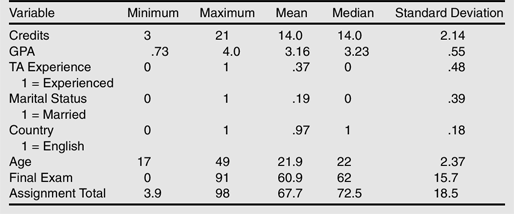
Of the 669 students, 64.9% were male, and 73% took the class from a male
teaching assistant. Most of the students were single (81.1%) and were
U.S. citizens (96.7%). While students from each stage of their college
careers were represented in the sample, juniors were the largest group
(38.7%). Prior to taking the course, the average GPA for the students
was a 3.16. On average, a student in the course was enrolled in 14
credits during the semester. Finally, the average score on the final
exam was 60.9%, and the average score on their combined written
assignments was 67.7%.6
The average scores
for the final and the assignments include the students who
failed to complete the course. For students who took the course
during their first semester at BYU, prior GPA is measured as
their GPA during that first semester.
Regression Results
In a logistic regression of 30 independent variables on the dependent
variable of whether or not a student completed the course, only two
variables achieved levels of statistical significance: the GPA of the
student and a dummy variable for female students in labs with male
teaching assistants.7
The 30 independent
variables include 14 dummy variables for specific teaching
assistants, three dummy variables for years in school, and four
for age groupings. There are three dummy variables for student
gender-teaching assistant gender combinations, and single dummy
variables for the professor, marital status, country of origin,
and teaching assistant experience. There are also two variables
for student GPA and credit hours taken.
To facilitate
interpretation of the coefficients in this regression, we calculated
predicted values for four observations which had the median value for
each of the independent variables but varied the four possible matches
of student and teaching assistant gender.
8 For dummy variables we used the mean value rather than the
median value. However, using the mean value produces nearly
identical results. Females in male labs have a predicted
completion rate of 86.2% and females in female labs have a
predicted rate of 95.5%.
The percent predicted to
complete the class for each group are as follows:
Women in labs
with male 88.3%
teaching assistants:
Women in labs
with female 96.3%
teaching assistants:
Men in labs
with male 95.2%
teaching assistants:
Men in labs
with female 94.5%
teaching assistants:
These findings support other studies that have found that the gender of
the instructor matters to students. Rothenstein
(1995) found that increasing numbers of female faculty
members was related to the increased likelihood that female students
will get an advanced degree. Neumark and Gardecki
(1998) found that female Ph.D. students with female advisors
did not enjoy any improved job placement when compared with female Ph.D.
students who had male advisors. At the same time, they found that female
Ph.D. students with female advisors were able to finish their
dissertations much more quickly. Rothenstein, Nuemark, and Gardecki and
others have all found that female students with female instructors are
more motivated to study.
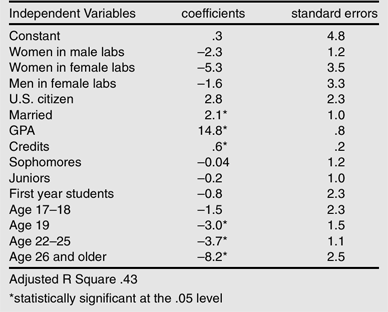
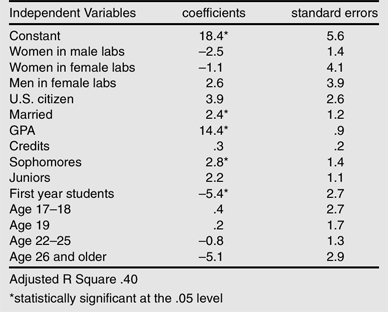
We continued our analysis of the effect of instructor gender by assessing
student performance for the 585 students who completed the course. We
analyzed separately two dependent variables: the students' final exam
scores and their combined scores on all of their written assignments.
The final exam score is a percent correct on a 100-question, multiple
choice exam. The maximum possible on all of the writing assignments
combined was 650 points. To facilitate interpretation of the regression
results and comparison between them, we divided the point total on the
assignments for each student by 6.5, measuring both variables as a score
out of 100 points possible. We included the same battery of independent
variables.
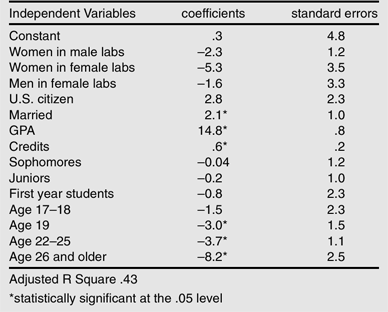
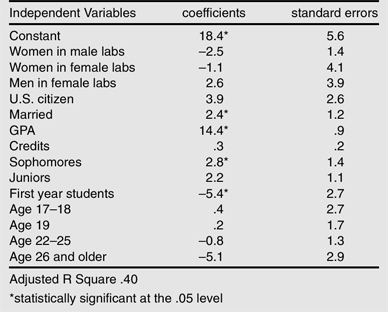
After controlling for fixed effects by including dummy variables for the
teaching assistants and the professor, most of the results came out as
expected. The number of credit hours was the only variable with a
different coefficient value than we had initially expected. Students
taking more credits actually did better on course assignments. Perhaps
credit hours operates as a surrogate measure for the number of hours
employed. Students who take fewer credits may work more hours, and those
taking more credits may work few hours or not at all. In addition,
students with higher GPAs do better, as do married students. U.S.
citizens also have the strongest advantage on writing assignments as we
predicted. First year students consistently earn the lowest grades, and
sophomores and juniors outperform seniors on written assignments with
all three grades earning similar exam scores. Students age 20–21
generally outperform students in other age cohorts.
The values of the coefficients regarding the gender match are
interesting. On both assignments and finals men do better than women and
the gap between men and women does not narrow for writing assignments,
contrary to the course content hypothesis. In addition, the gender of
the teaching assistant does not produce a clear effect on student
performance. For example, men do 2.3% better than women on the final
exam for students that have male teaching assistants, but for students
who have female teaching assistants, the male advantage increases to
3.7%. We found similar results when we analyzed assignments. In labs
with male teaching assistants, men on average earn grades that are 2.5%
better than women in those same labs, but in labs with female teaching
assistants men on average earn scores 3.7% better than women. These
findings do not show an advantage for women with female teaching
assistants, and this lack of advantage is nearly identical for both
exams and writing assignments.
In both regressions, men with male teaching assistants served as the
baseline. On assignments, it was true that women with female teaching
assistants earned higher grades (1.4%) than women with male teaching
assistants. However, men with female teaching assistants also earned
higher grades (2.6%) than men in labs taught by male teaching
assistants. On final exams women on average did 3% better if they had a
male teaching assistant, but men also did 1.6% better if they had a male
teaching assistant. Students with female teaching assistants did better
on assignments, regardless of their gender, and students with male
teaching assistants did better on the final, regardless of their gender.
In all cases, however, average scores for men were consistently higher
than the scores for women in the same categories of labs.
These results, however, rarely reached levels of statistical significance
for matching the gender of the student with the teaching assistant,
raising questions about the robustness of our findings.9
For the category of women in labs with male
teaching assistants, the level of statistical significance was
between a probability of .05 and .10 for both
regressions.
Further analysis of separate regressions run
for each individual teaching assistant underscores this concern. In
these 15 separate regressions there are no consistent differences
between the gender of the teaching assistant and the performance of
students of the same gender. For example, six of the nine male teaching
assistants had men outperforming women on writing assignments, and three
of six women teaching assistants showed a similar male advantage. On the
final, men did better for five of the nine male teaching assistants and
for four of the six female teaching assistants. Similarly, women did
relatively better on assignments than on the final (in comparison to the
average male performance) for two of the six female teaching assistants
but also for four of the nine male teaching assistants.
Finally, for most of the teaching assistants there was not a large
differential between the average performance of women relative to men on
the objectively graded final compared with the subjectively graded
writing assignments. The four largest differentials occurred in two male
and two female teaching assistants' results. However, one male and one
female both had women doing better than men on assignments but men doing
better than women on the exam. The other male teaching assistant had men
doing better on assignments with women doing better on exams. The
remaining female teaching assistant had men doing better on both
assignments and exams with a much larger male advantage on assignments.
These inconsistent results suggest that the gender of the instructor may
not be a significant factor in student performance.
Though our results support the more general claims of the role model
hypothesis (women with female teaching assistants are more likely to
finish the course), the specific claims of the role model hypothesis and
the “chilly learning environment” hypothesis are not supported. The
actual performance of students is not consistently or significantly
affected by the gender of the students' teaching assistant. As mentioned
above, the Ehrenberg (1997) study found similar results; being the same
gender is not related to improved performance.
Our study also provides strong support to the claim that the nature of
the course and its content create a bias that favors male students. We
were puzzled, however, that the male advantage persisted even in writing
assignments and detailed task specific assignments that the literature
suggests women excel in. Perhaps the combination of both types of
assignments in the same course makes it difficult to compartmentalize
the assignments, causing a greater similarity between the types of
assignments than would be found if the assignments were given separately
in different courses.
Conclusion
We have articulated some of the obstacles that women political science
students still face. Barriers to women in courses that rely heavily on
math or statistics can not easily be eliminated by changes in only one
college course. Though the main work needs to be done when students are
younger, it is still important that college instructors encourage
students, especially women, to pursue statistics and mathematics. Along
with encouraging women to study statistics, instructors can try to
follow Fox and Ronkowski's (1999) advice to use methods that will better
reach female students.
While our findings seem to suggest that women with female teaching
assistants (and by implication instructors) do not necessarily learn the
material better, they also suggest a strong motivational component of
female instructors acting as role models. Female students with female
teaching assistants were more likely to finish the course. As women
continue to play an increasingly important role in politics, political
science faculty should redouble their efforts to eliminate teaching
practices that advantage one gender over the other. Faculties with
increased numbers of female faculty will be more effective at motivating
their female students to finish their programs and play a meaningful
role in the world.