This 2015 Supplement to Cardiology in the Young is entitled: “Proceedings of the 2015 International Pediatric Heart Failure Summit of Johns Hopkins All Children’s Heart Institute”. The International Pediatric Heart Failure Summit of Johns Hopkins All Children’s Heart Institute was held on 4 and 5 February, 2015. The 2015 International Pediatric Heart Failure Summit of Johns Hopkins All Children’s Heart Institute was funded through the Andrews/Daicoff Cardiovascular Program Endowment, a philanthropic collaboration between All Children’s Hospital and the Morsani College of Medicine at the University of South Florida (USF). Sponsored by All Children’s Hospital Andrews/Daicoff Cardiovascular Program, the International Pediatric Heart Failure Summit assembled leaders in clinical and scientific disciplines related to paediatric heart failure and created a multi-disciplinary “think-tank” in order to accomplish the following objectives:
-
∙ Understand the “state of the art” in 2015 with respect to medical and surgical treatment of cardiac failure in children and in adults with congenital heart disease and explore potential future advances in the care of these patients.
-
∙ Identify the frontiers of research for the next 20 years in the domain of paediatric cardiac failure.
-
∙ Educate future physicians in the science and humanity of paediatric cardiac failure.
-
∙ Explore opportunities related to advocacy for these patients and the institutions caring for them.
Thus, the goals of the 2015 International Pediatric Heart Failure Summit of Johns Hopkins All Children’s Heart Institute are to advance the state of the art of paediatric heart failure in the domains of patient care, research, education, and advocacy.
The 2015 International Pediatric Heart Failure Summit of Johns Hopkins All Children’s Heart Institute was sponsored by All Children’s Hospital Andrews/Daicoff Cardiovascular Program. Information about George R. Daicoff, MD, and Ed and Sarainne Andrews is provided in this introductory manuscript to the 2015 Supplement to Cardiology in the Young entitled: “Proceedings of the 2015 International Pediatric Heart Failure Summit of Johns Hopkins All Children’s Heart Institute”. Dr Daicoff founded the All Children’s Hospital Pediatric Heart Surgery programme and directed this programme for over two decades. Sarainne Andrews made her generous bequest to All Children’s Hospital in honour of her husband Ed and his friendship with Dr Daicoff in order to support cardiovascular surgery research efforts.
George R. Daicoff, MD
George R. Daicoff, MD, is the founder of the cardiac programme now known as Johns Hopkins All Children’s Heart Institute. Dr Daicoff was the founding Chief of Cardiovascular Surgery at All Children’s Hospital. In 1977, Dr Daicoff moved from the University of Florida in Gainesville to All Children’s Hospital in Saint Petersburg. Dr Daicoff retired in 1998 after having served as Chief of Cardiovascular Surgery at All Children’s Hospital for 21 years from 1977 to 1998.
George was born on November 10, 1930 in Granite City, Illinois. He received his A.B. degree in 1953 from Indiana University and his MD degree in 1956, also from Indiana University. George then spent 1956 through 1963 training in General Surgery and Thoracic and Cardiovascular Surgery at University of Chicago:
-
∙ 1956–1957, Internship, University of Chicago
-
∙ 1957–1958, Junior Assistant Resident in Surgery, University of Chicago
-
∙ 1958–1959, Senior Assistant Resident in Surgery, University of Chicago
-
∙ 1959–1960, Resident in Surgery, University of Chicago
-
∙ 1960–1962, Senior Resident in Surgery, University of Chicago
-
∙ 1962, Chief Resident in General Surgery, University of Chicago
-
∙ 1963, Chief Resident in Thoracic and Cardiovascular Surgery, University of Chicago
George was appointed as Instructor in Surgery at University of Chicago from 1960–1963. He was then Assistant Professor of Thoracic and Cardiovascular Surgery at University of Chicago from 1963–1967.
In 1965, George was a Visiting Colleague in London, England, at Postgraduate Medical School of London. In 1966, George was a Fellow in Cardiovascular Surgery at Mayo Clinic in Rochester, Minnesota in the tutelage of John Kirklin.
In 1967, George joined the faculty at University of Florida in Gainesville, and he remained at University of Florida from 1967 to 1977. He was Associate Professor of Thoracic and Cardiovascular Surgery at University of Florida from 1967 to 1970 and Professor of Thoracic and Cardiovascular Surgery at University of Florida from 1970 to 1977. He served as Division Chief of Thoracic and Cardiovascular Surgery at University of Florida from 1972 to 1977.
In 1977, George relocated to Saint Petersburg, Florida and founded the cardiac surgery programme at All Children’s Hospital. He served as Chief of Cardiovascular Surgery at All Children’s Hospital from 1977 to 1998. He was appointed Clinical Professor of Surgery at University of South Florida in 1982. In 1999, George was also appointed Adjunct Clinical Professor of Thoracic and Cardiovascular Surgery at University of Florida.
George has had multiple hospital appointments throughout his career:
-
∙ 1956–1957, Billings Hospital, University of Chicago
-
∙ 1967–1977, Shands Teaching Hospital, University of Florida
-
∙ 1977–1998, All Children’s Hospital, Saint Petersburg, Florida
-
∙ 1977–1998, Bayfront Medical Center, Saint Petersburg, Florida
-
∙ 1995–1998, Northside Hospital, Saint Petersburg, Florida
-
∙ 1999, Gainesville Veterans Medical Center, Gainesville, Florida
-
∙ 2002, Bay Pines Medical Center, Saint Petersburg, Florida
George has won multiple academic awards including:
-
∙ 1963–1966, Schweppe Foundation Research Fellowship
-
∙ 1968–1972, John Hartford Foundation
-
∙ 1992, Andrews Foundation
George received certification from the America Board of Surgery (certificate number 10944) in 1962, and he received certification from the America Board of Thoracic Surgery (certificate number 01286) in 1964, the year I was born!!! He received medical licenses in Indiana (1956), Illinois (1958), and Florida (1968, ME0013566).
George was a member of multiple professional societies and other organizations:
-
∙ 1952, Alpha Epilson Delta
-
∙ 1958, Sigma Xi
-
∙ 1963, Illinois Society for Medical Research
-
∙ 1965, American College of Surgeons
-
∙ 1965, Chicago Surgical Society
-
∙ 1967, American College of Cardiology
-
∙ 1967, American Association for Thoracic Surgery
-
∙ 1967, The International Cardiovascular Society
-
∙ 1968, American Heart Association
-
∙ 1969, Society of Thoracic Surgeons
-
∙ 1969, Florida Medical Society
-
∙ 1969, Southern Thoracic Surgical Association
-
∙ 1970, Association for the Advancement of Medical Instrumentation
-
∙ 1971, Florida Heart Association
-
∙ 1972, Congenital Heart Surgeons’ Society
-
∙ 1974, American College of Chest Physicians
-
∙ American Thoracic Society
-
∙ Florida Society of Thoracic and Cardiovascular Surgeons
-
∙ Pinellas County Medical Association
-
∙ American Medical Association
-
∙ West Coast Academy of Cardiology
-
∙ Cardiac Advisory Committee, Children’s Medical Services, HRS, State of Florida
-
∙ Chief, Department of Cardiac Services, All Children’s Hospital, Saint Petersburg, Florida
-
∙ Medical Executive Committee, All Children’s Hospital, Saint Petersburg, Florida
-
∙ Ethics Committee, All Children’s Hospital, Saint Petersburg, Florida
-
∙ Intensive Care Committee, All Children’s Hospital, Saint Petersburg, Florida
-
∙ Operating Room Committee, All Children’s Hospital, Saint Petersburg, Florida
-
∙ Standards Committee, All Children’s Hospital, Saint Petersburg, Florida
-
∙ Research Committee, Suncoast Chapter, American Heart Association
-
∙ Professional Education Committee, Suncoast Chapter, American Heart Association
-
∙ Board of Directors, Rogers Heart Foundation
-
∙ Medical Proficiency Committee, Bayfront Medical Center, Saint Petersburg, Florida
-
∙ Critical Care Unit Committee, Bayfront Medical Center, Saint Petersburg, Florida
-
∙ Sponsor of Andrews/Daicoff Chair in Cardiac Research, University of South Florida
George has always been an active leader in our profession and has been recognized in many local, national, and international domains. This recognition is exemplified by the relationship that George Daicoff has had with the Southern Thoracic Surgical Association, one of George’s favorite professional organizations. Since 1964, the President’s Award of the Southern Thoracic Surgical Association has recognized the best scientific paper delivered at the previous Annual Meeting of the Southern Thoracic Surgical Association. George Daicoff won this award in 1970. In 2008, this award was named the Clifford Van Meter President’s Award. In 2013, the Clifford Van Meter President’s Award was augmented to recognize specifically the best adult cardiac surgery paper delivered at the Annual Meeting. Also, in 2013, the Carolyn Reed President’s Award was established to recognize the best general thoracic surgery paper delivered at the Annual Meeting, and the Congenital Heart Surgery President’s Award was established to recognize the best congenital heart surgery paper delivered at the Annual Meeting. In 2015, the Congenital Heart Surgery President’s Award was named the George Daicoff President’s Award, recognizing the best congenital heart surgery paper delivered at the Annual Meeting. Naming the Congenital Heart Surgery President’s Award after George Daicoff is a fitting tribute to George because he devoted his career to pediatric and congenital cardiac surgery and has always been an active and involved member of the Southern Thoracic Surgical Association. In fact, in 1996, twenty-six years after winning the President’s Award for the best scientific paper at the Southern Thoracic Surgical Association, George won the Osler Abbot Award of the Southern Thoracic Surgical Association! (The Osler Abbot Award is given annually to the member of the Southern Thoracic Surgical Association who excels in the art of discussionmanship.)
In 1988, George recruited Jim Quintessenza to All Children’s Hospital in Saint Petersburg, Florida. Under the tutelage of George, Jim Quintessenza had the opportunity to participate in 5 MINI – SABBATICALS to complete his training in pediatric and congenital cardiac surgery:
1. Neonatal Cardiac Surgery – Arterial Switch Procedure
Dr. Aldo Castaneda
Boston Children’s Hospital
Boston, Massachusetts
June 20, 1989 – July 2, 1989
2. Neonatal Cardiac Surgery – Neonatal Techniques and Perfusion
Dr. Claude Planche
Hospital Marie-Lanelonge
Paris, France
June 25, 1990 – July 7, 1990
3. Neonatal Cardiac Surgery – Myocardial Preservation
Dr. Hillel Laks
UCLA Medical Center
Los Angeles, California
October 24, 1991 – October 31, 1991
4. Neonatal Cardiac Surgery / HLHS
Dr. Vaughn Starnes
USC Medical Center
November 3, 1993 – November 5, 1993
5. Neonatal / Infant Heart Transplantation
Dr. Len Bailey
Loma Linda Medical Center
March 10, 1993 – March 12, 1993
Jim Quintessenza then followed George Daicoff as Chief of Cardiovascular Surgery from 1998 to 2015. George and Jim recruited me to join All Children’s Hospital, and I joined the Division of Cardiovascular Surgery at All Children’s Hospital in 1998.
We have a great cardiac programme at Johns Hopkins All Children’s Heart Institute thanks to the vision and leadership of George Daicoff, and our programme is a fitting legacy to George. On a personal note, my family and I have an AWESOME life, and we are massively thankful to George Daicoff and Jim Quintessenza for giving us the opportunity!!!
A Medline search of “Daicoff-G” reveals 51 publications dating back to 1958!Reference Siderius, Brunnen, Daicoff, Lancaster and Moulder 1 , Reference Daicoff, Lancaster, Stewart, Siderius and Moulder 2 George published many important papers over the course of his career, including important contributions in the early 1970s related to congestive heart failure in infancy treated by early repair of ventricular septal defectReference Daicoff and Miller 3 and the intra-operative evaluation of surgical systemic-to-pulmonary artery shunts.Reference Daicoff 4 Additional contributions included studies of cardiac valvar surgery in central Florida,Reference Daicoff 5 and allograft replacement of the aortic valve versus the miniroot and valve.Reference Daicoff, Botero and Quintessenza 6 Of notable relevance to this Pediatric Heart Failure Supplement to Cardiology in the Young, George is a co-author on recent publications about paediatric cardiac transplantation from the team at All Children’s Hospital.Reference Jacobs, Quintessenza and Boucek 7 , Reference Jacobs, Asante-Korang and O’Brien 8
The Congenital Heart Surgeons’ Society (CHSS) is considered by many to be the most prestigious association of congenital heart surgeons in North America. 9 , Reference Jacobs, Ungerleider and Tchervenkov 10 George R. Daicoff, MD, is a founding member of the CHSS.
The CHSS meets annually to discuss problems of mutual interest in patient management. The CHSS was formed in 1972 on the suggestion of Eoin Aberdeen, then at Children’s Hospital of Philadelphia, to include surgeons of compatible character with a special interest in paediatric cardiac surgery. It was to be a small group of surgeons patterned after the European Cardiac Surgeon’s Club, with an initial maximum membership set at 16. The initial invitation letter was sent by Eoin Aberdeen to Phil Ashmore, Doug Behrendt, Aldo Castaneda, George Daicoff, Anthony Dobell, Henry Edmunds, John W. Kirklin, James Malm, Dwight McGoon, Robert Replogle, Albert Starr, and George Trusler. These surgeons were to meet to relate their pioneering operative experiences with complex congenital heart disease in a friendly, uninhibited atmosphere; 10 surgeons attended the first meeting, which took place on 7 September, 1973, at the Sonesta Beach Hotel near Miami. The name of this club was discussed and George Daicoff suggested “Small Heart Club” and Eoin Aberdeen suggested “Pediatric Cardiovascular Surgery Club”. The group, however, opted for “Congenital Heart Surgeons’ Society”. George remained active in CHSS throughout the remainder of his career, and he is senior author on important CHSS publications.Reference Jacobs, Ungerleider and Tchervenkov 10 , Reference Jonas, Quaegebeur, Kirklin, Blackstone and Daicoff 11
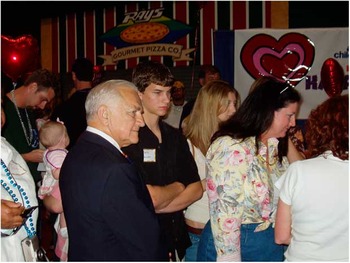
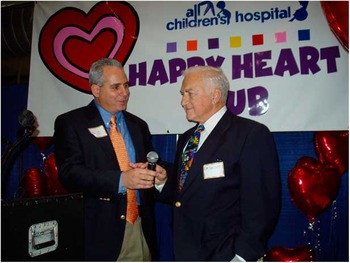
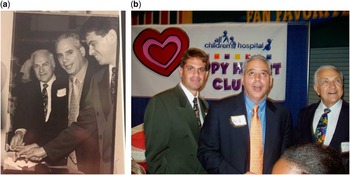
George Daicoff recruited Jim Quintessenza to All Children’s Hospital and then George and Jim recruited me. For this opportunity, my family and I are eternally thankful (Figs 1–4).
The 2004 Happy Heart Party hosted by All Children’s Hospital featured a huge cake in the shape of a heart and allowed for cardiac patients to visit with their doctors and nurses.

George R. Daicoff, MD, surrounded by many of his former patients at the 2004 Happy Heart Party hosted by All Children’s Hospital.

James A. Quintessenza, MD, introducing George R. Daicoff, MD, at the 2004 Happy Heart Party hosted by All Children’s Hospital.

George R. Daicoff, MD, James A. Quintessenza, and Jeffrey P. Jacobs, MD, at the 2004 Happy Heart Party hosted by All Children’s Hospital, cutting the cake ( a ), and watching balloons fall ( b ).

Ed and Sarainne Andrews
Sarainne Andrews and her husband Ed were long-time friends of Dr George R. Daicoff. Ed was an inventor and entrepreneur who befriended a young George R. Daicoff while he was still at the University of Chicago Medical School (1956 through 1963). Mr Andrews quickly became a supporter of Dr Daicoff and his work. After Dr Daicoff moved to Saint Petersburg, Sarainne Andrews, Mr Andrews’ widow, provided annual support to research and educational programmes at All Children Hospital. Her bequest of 1 million US dollars upon her death for the cardiovascular programme at All Children Hospital eventually led to the creation of the All Children’s Hospital Andrews/Daicoff Cardiovascular Program.
Dr Daicoff stated that “I am pretty sure she wanted to memorialize Ed in his inventive and altruistic ways. I took it as a personal goal to add to that gift in order to develop a laboratory for cardiovascular research at All Children’s Hospital”.
The 2015 International Pediatric Heart Failure Summit of Johns Hopkins All Children’s Heart Institute
In the United States of America alone, ~14,000 children are hospitalised annually with acute heart failure. The science and art of caring for these patients continues to evolve.
Congenital cardiac malformations are the most common types of birth defects. Congenital heart disease is present in ~10 out of every 1000 live births in the United States of America. 12 Before the introduction of current diagnostic modalities including echocardiography, incidence figures ranged from 5 to 8/1000 live births. With improved diagnostic modalities, many more patients with milder forms of congenital heart disease can now be identified, so that contemporary estimates range from 8 to 12/1000 live births.Reference Hoffman and Kaplan 13 – Reference Hoffman 15 About 25% of babies with a congenital heart disease undergo surgery or catheter-directed intervention in their 1st year of life. 12 In the United States of America, 96–97% of all the patients undergoing surgery for paediatric and congenital heart disease survive to discharge from the hospital,Reference Jacobs, Jacobs, Mavroudis, Tchervenkov and Pasquali 16 although survival to discharge is lower in neonates (9.6% operative mortality) and infants (3.0% operative mortality).Reference Jacobs, Jacobs, Mavroudis, Tchervenkov and Pasquali 16 Unfortunately, a subset of surviving patients will ultimately develop life-threatening heart failure, and additional children who are born with structurally normal hearts will also develop cardiac failure.
Definitions of heart failure include the following:
Heart failure is a complex clinical syndrome of symptoms and signs that suggest impairment of the heart as a pump supporting physiological circulation. It is caused by structural or functional abnormalities of the heart. The demonstration of objective evidence of these cardiac abnormalities is necessary for the diagnosis of heart failure to be made. 17
Heart failure is a clinical syndrome characterized by systemic perfusion inadequate to meet the body’s metabolic demands as a result of impaired cardiac pump function. This may be further subdivided into systolic or diastolic heart failure. In systolic heart failure, there is reduced cardiac contractility, whereas in diastolic heart failure there is impaired cardiac relaxation and abnormal ventricular filling. 18
The Supplement that you are about to read has the following objectives:
-
∙ summarise the lessons learnt at the International Pediatric Heart Failure Summit of Johns Hopkins All Children’s Heart Institute,
-
∙ describe the “state of the art” of the treatment of paediatric cardiac failure, and
-
∙ discuss future directions for research in the domain of paediatric cardiac failure.
The goals of this Supplement to Cardiology in the Young and the International Pediatric Heart Failure Summit of Johns Hopkins All Children’s Heart Institute are certainly congruent with the goals of George R. Daicoff, MD, Ed and Sarainne Andrews, and the Andrews/Daicoff Cardiovascular Program of Johns Hopkins All Children’s Heart Institute.
Acknowledgement
The 2015 International Pediatric Heart Failure Summit of Johns Hopkins All Children’s Heart Institute was funded through the Andrews/Daicoff Cardiovascular Program Endowment, a philanthropic collaboration between All Children’s Hospital and the Morsani College of Medicine at the University of South Florida (USF). The Andrews/Daicoff Endowment was established by Sarianne and Ed Andrews in honor of George Daicoff M.D., their longtime friend. Being an entrepreneur and inventor, Mr. Andrews, along with his wife, bequeathed a significant gift to All Children’s in support of Dr. Daicoff, founding Chief of Cardiovascular Surgery at All Children’s Hospital (ACH) and heart surgery program director for over 20 years. The generous bequest provided through the Andrews’ estate was gifted by ACH to USF for a 1:1 match by the State of Florida eminent scholars program. Each year income from this fund supports the enhancement and growth of cardiovascular research under Dr. Jeff Jacobs, director of the Andrews/Daicoff Cardiovascular Program at All Children’s Hospital Johns Hopkins Medicine.