Introduction
As the aging segment of United States population increases due to medical breakthroughs and lifestyle changes, older adults will live longer with chronic conditions and many will experience life-limiting illnesses that necessitate advance care planning (ACP), (Bonner et al., Reference Bonner, Wang and Wilkie2014; Lum et al., Reference Lum, Sudore and Bekelman2015). It is projected that by the year 2030, 21% of the US populations will be 65 years and older and be more racially and ethnically diverse (Bureau, Reference Bureau2020). ACP is a process whereby a patient, in consultation with clinicians, family members, and close others, makes decisions about his or her future health care, should he or she become incapable of participating in medical treatment decisions (Singer et al., Reference Singer, Robertson and Roy1996; Detering et al., Reference Detering, Hancock and Reade2010). ACP also involves designating an alternate surrogate decision-maker or decision partner (Sudore et al., Reference Sudore, Lum and You2017; Gray et al., Reference Gray, Nolan and Clayman2019). ACP is a critical component of palliative care and end-of-life care (EOLC) to promote quality of care and treatment satisfaction, as well as goal-concordant care (Ferrell et al., Reference Ferrell, Sun and Hurria2015; Sanders et al., Reference Sanders, Curtis and Tulsky2018).
While ACP rates are low overall, African Americans are less likely to engage in ACP or have documentation about their EOL preferences compared to Whites (Reese et al., Reference Reese, Ahern and Nair1999; Gerst and Burr, Reference Gerst and Burr2008; Sanders et al., Reference Sanders, Robinson and Block2016). Reasons for these disparities are multifaceted, i.e., the influence of cultural beliefs about death and dying, high-cost, poor communication with providers, receipt of care not consistent with preferences, and spiritual beliefs about EOLC, to name a few (Born et al., Reference Born, Greiner and Sylvia2004; Ejem et al., Reference Ejem, Barrett and Rhodes2019). One major barrier is medical mistrust in the health care system among African Americans, which is often associated with increased emergency room visits, poor uptake of preventive services, such as ACP, delayed health-seeking behaviors, and knowledge of past injustices in research, such as the Tuskegee study that did not end until 1972 (Johnson et al., Reference Johnson, Kuchibhatla and Tulsky2008; Smith et al., Reference Smith, McCarthy and Paulk2008; LaVeist et al., Reference LaVeist, Isaac and Williams2009; Bullock, Reference Bullock2011). Although strategies to promote ACP in communities exist (Bullock, Reference Bullock2006, Reference Bullock2011; Banerjee et al., Reference Banerjee, Kin and Strachan2015), there continues to be a lack of uptake due in part to structural barriers beyond race disparities (Degenholtz et al., Reference Degenholtz, Arnold and Meisel2002; Meghani and Hinds, Reference Meghani and Hinds2015).
Research is needed to understand facilitators of ACP in African Americans, particularly the role of religion in decision-making and acceptability (Garrido et al., Reference Garrido, Idler and Leventhal2013; Elk, Reference Elk2016; Sanders et al., Reference Sanders, Robinson and Block2016). Religious coping involves using religious faith to adjust to challenging and stressful events (Pargament et al., Reference Pargament, Koenig and Tarakeshwar2004). The integration of a patient's religious preferences and/or spirituality, their values, beliefs, and behaviors may best be understood using social identity theory (Hogg et al., Reference Hogg, Abrams and Otten2004). Social Identity theory suggests a person seeking self-improvement applies methods that are normal to the social group in which the person self-identifies (Hogg et al., Reference Hogg, Abrams and Otten2004). Consequently, African Americans whose church plays a substantial role in their self-identity can learn new concepts more readily when those concepts are endorsed by their church. The role of the African American church is, therefore, important to understand as it relates to facilitating ACP and EOLC.
More than two-thirds of older African American adults report monthly church attendance (Taylor et al., Reference Taylor, Chatters and Jackson2007). The African American church often also serves as a linkage to services and support for families who may not attend worship services or hold membership within a particular church but who live in communities surrounding the church (Sahgal and Smith, Reference Sahgal and Smith2009; Krause and Hayward, Reference Krause and Hayward2014). The pastor (or pastoral team) is considered the faith leader and responsible for the provision of spiritual support for illness, particularly at end-of-life (Trusts, Reference Trusts2017). The purpose of this study is to explore the perceptions of church leaders and parishioners on the role of the church in ACP and EOLC. Disparities in ACP outcomes are well documented. Research is needed to explore the role of the African American church in ACP.
Methods
Ethics statement
Our study was approved by the Johns Hopkins Bloomberg School of Public Health Institutional Review Board.
Setting
The study included two Baptist churches in Maryland. Both congregations were 99% African American and each church reported having approximately 3,000 members on record. Enrollment occurred from November 2016 to September 2017.
Study design
We conducted a descriptive qualitative study with African American church leaders, (e.g., minister, deacons, ministry leaders) and parishioners to gain a better understanding of the church's role in implementing ACP and EOLC interventions. The study was informed by earlier work examining parishioners’ experiences with being a caregiver, as well as their interest in PC and EOLC (Hendricks Sloan et al., Reference Hendricks Sloan, Peters and Johnson2016). The results of this previous study showed that African American parishioners desire to learn more about ACP and EOLC. To extend our examination, we adopted the socio-ecological model (Campbell et al., Reference Campbell, Hudson and Resnicow2007; Waller et al., Reference Waller, Sanson-Fisher and Ries2018) as a means to determine how church-based health promotion partnerships can impact multiple levels of positive transformation. The socio-ecological model directs attention to both individual behavior and environmental determinants. From this prospective, the behavior is affected by and affecting the social environment (McLeroy et al., Reference McLeroy, Bibeau and Steckler1988); the African American church, therefore, can affect multi-level change.
Recruitment process
We engaged church Pastors to guide this study in the recruitment process. A formal announcement about the study was made by the church pastor before or after the service, totaling three announcement in the two churches. Potential participants were eligible if they were >18 years of age, self-identified as African American, and a member of one of the two study churches.
Parishioners self-enrolled into the study by responding to a flyer that included an overview of the study and investigator's contact information. Participants that agreed to join the study signed a written consent form and a copy of the form was made available to them. All participants that responded to the study flyer met the eligibility requirement for enrollment into the study. The interviews were conducted privately in the church or participant's home. Participants engaged in one-on-one semi-structured interviews examining beliefs and about experiences with illness, death, and dying, and how the church can be a means of support. Participants were provided with a $20.00 gift card to a local retail establishment. Recruitment continued until theoretical saturation of data.
Data collection
Literature review and input from content experts and church leader stakeholders guided the development of a semi-structured questionnaire and interview guide for parishioners and church leaders. All interviews were conducted by members of the research team that represented multiple disciplines e.g., public health scientist, physician, nurse, social worker, and clergy. Interviews lasted an average of 45 min. Parishioner participants (n = 15) were asked about their perspectives on ACP and EOLC, as well as their personal and caregiving experiences. Church leaders (n = 10) were asked about their personal experiences with church parishioners, and perceptions they have about other church leaders’ interaction with parishioners on the topic of advance care planning (ACP). Leaders were also asked about ACP discussions with families in the church and themes of conversations that took place.
Questions included: “Have you had ACP or EOLC discussion with parishioners or others? If so, describe your approach to type of discussions with parishioners who were ill or at end-of-life; “What do you see as the EOLC needs for parishioners?”; “What is your perception of how other church leaders discuss ACP and EOLC with parishioners?” Non-church leaders (parishioners whose role did not include ministry director, deacon, or minister within the church) (n = 15) were asked about their individual experiences related to ACP, their perceptions about the role of the church, and their attitudes and beliefs about ACP and EOLC. Interviews continued until saturation was reached and no new codes were added.
Data analysis
Thematic data were determined by an interdisciplinary team of study investigators consisting of scientists, church stakeholder, physician, nurse, social worker, and a non-denominational pastor. Initially, the in-depth, semi-structured interviews were audio recorded, professionally transcribed verbatim, and reviewed for accuracy and quality by one researcher (D.S.). Three researchers (D.S., T.G., and D.H.) individually reviewed transcripts to become familiar with data and to gain initial impressions. Coding entailed a directed content analysis approach (Hsieh and Shannon, Reference Hsieh and Shannon2005). Coding discrepancies were discussed and resolved by a research team member and expert in qualitative data analysis (J.B.). We also explored similarities and differences between the views of church leaders and parishioners, which are described in the results section. Members of the research team met multiple times to ensure consensus coding and consistency. After the coding scheme was finalized, the full set of transcripts was coded using ATLAS.ti 8 (ATLAS.ti Version 8. 2015. Berlin: Scientific Software Development).
Results
Participants demographics
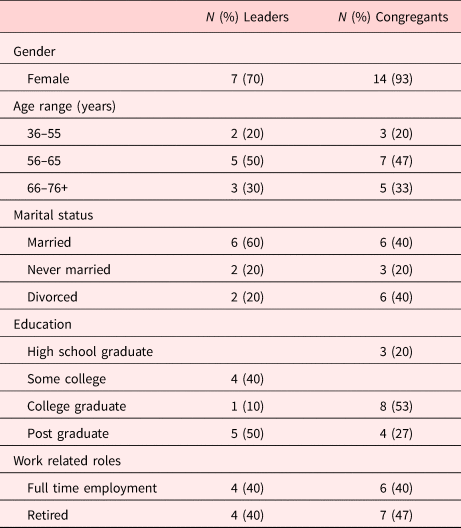
We consented and enrolled a final sample of 15 African American church parishioners (n = 15) and 10 parishioner leaders (n = 10) (Table 1). Forty-four per cent of the sample was between ages 56 and 65, 28% were between ages 66 and 75, and 84% of the overall sample identified was female. The overall sample was highly educated with 72% having a college or postgraduate degree, and 56% were retired.
Participant demographics

Thematic findings: church role in ACP
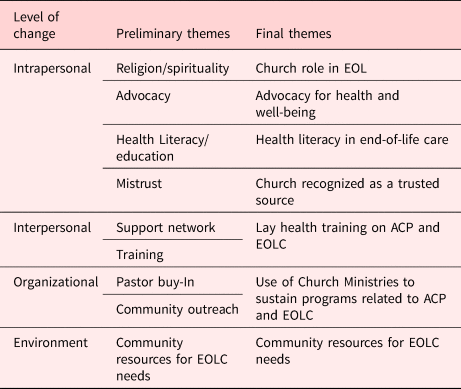
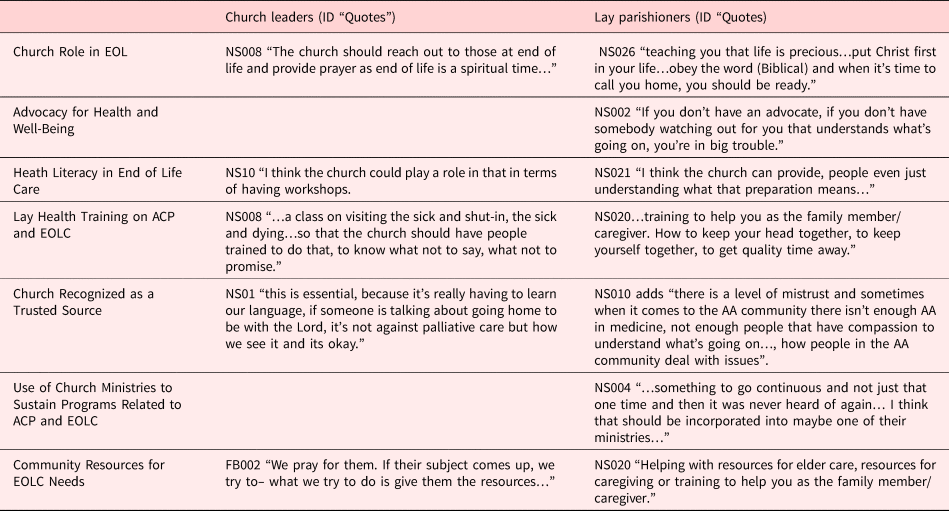
Seven identified themes emerged within the socio-ecological level of change across four strata: intrapersonal, interpersonal, organizational, and environment. The results are subdivided into preliminary themes and final themes (see Table 2), with specific quotes stratified by group (see Table 3). An overarching theme of religion and spirituality was present throughout most participant responses. Several main factors surfaced from narratives describing participants’ perception of church involvement in ACP and EOLC. Both church leaders and parishioners suggested the church should be a provider of training, education, and resources for ACP and EOLC. Church leaders specifically spoke about support networks, where parishioners suggested the church as an advocate.
Thematic findings across levels

Church role in advance care planning: quotations illustrating themes by group

Church role in EOL
The theme of the church role at end of life is depicted through the focus of religion and spiritual support in both church leader and parishioner responses to church involvement in ACP and EOLC. For instance, participant NS08 said “the church should reach out to those at end-of-life and provide prayer as end-of-life is a spiritual time…by someone who has the religiosity as well as the training, who is aware of and respects where you came from, where you are, and the Holy Ghost.” Where that participant refers to prayer, participant NS026 feels that the church should prepare you spiritually through “teaching you that life is precious…put Christ first in your life…obey the word (Biblical) and when it's time to call you home, you should be ready.” This sentiment of spiritual preparation pertaining to EOL was a repeated sentiment.
Advocacy for health and well-being
Parishioners, not leaders, emphasized the importance of having someone advocate for you to help you gain the best understanding of information when interacting with the medical system and to enhance the patient clinician relationship. Participant NS002 emphasized “there are all kinds of personalities to interact with in the medical system and not everybody is going to like everybody's personality. You have to understand medicine a little bit better, to understand your choices.”
Health literacy in EOLC
Leader and parishioner responses were congruent with regard to the importance of the church's role of providing education about ACP and EOLC for its parishioners. They felt that increasing knowledge and understanding about the importance of ACP and EOLC through workshops, seminars, and classes have the potential to increase the participation in ACP and EOLC but more importantly increase confidence in decision-making. Specifically, participant NS10 states “the church could play a role in terms of having workshops”, and participant NS021 adds the example that the “church can provide…..understanding of what preparation means because the church is very much involved at the end-of-life where people have to go through the planning and all that for funerals and things.” This participant goes on to suggest that the church is a part of the community, not just for bible study but should inform the people of what EOLC is and provide resources.
Lay health training on ACP and EOLC
The necessity of the church being a place where lay health training on topics of ACP and EOLC take place was strongly emphasized. Training should include how to communicate during visits outside the church (community outreach) with those experiencing medical crisis and/or dying. Participant NS020 adds “…training to help you as the family member/caregiver. How to keep your head together, to keep yourself together, to get quality time away.”
Church recognized as a trusted source
Parishioner NS01 describes the desired role for the church to act as a broker with the medical system by saying, “you know, able to bridge the gap between trust and respect”. The church fosters a community of trust and support for parishioners as they think about EOLC and ACP. Parishioners who may have experienced poor quality of care struggle with issues of trust as in NS009 who states “I am concerned, the medical community really failed her (speaking about her mother) they failed her insofar as medical care and I think that points of respect, points of respect.” NS010 adds “there is a level of mistrust and sometimes when it comes to the African American community there isn't enough African American in medicine, not enough people that have compassion to understand what's going on…, how people in the AA community deal with issues”. Participants have noted that the church provides support that consists of parishioners who are like-minded and spiritual minded, and can help inform them of their EOLC options so they can make decisions based on their needs and preferences. Additionally, NS01 feels “this is essential, because it's really having to learn our language, if someone is talking about going home to be with the Lord, it's not against palliative care but how we see it and its okay.”
Use of church ministries to sustain programs related to ACP and EOLC
Many participants expressed the relative importance of having a sustainable program within the African American church that informs and supports parishioners as they make decisions related to ACP and EOLC. A suggestion from one of the participants included developing and implementing a program that involves the church ministry would be one way to assure that parishioners remain informed and supported when making decisions about ACP and EOLC. The existence of a nurse or wellness ministry is customary in African American churches and ideal to house this resource.
Community resources for EOLC needs
Most participants expressed the importance of having community resources in the African American community with the church as a place that parishioners and the larger community can learn about resources that exist for EOLC needs. Examples of such resources include information about caregiving, homecare and respite services, and community palliative care programs.
Discussion
This initial study examined the role of the African American church involvement in ACP and EOLC and is possibly the first to focus on perceptions of what the church can contribute. We found that many parishioners and church leaders shared their viewpoints as caregivers or as those for whom ACP is a concern due to an immediate circumstance. There was an agreement between lay parishioners and church leaders that the church is a place to foster a community of trust and to obtain education, training, and resources for ACP and EOLC. However, it is interesting that church leaders did not mention the church as an advocate with the medical system or as a place for parishioners to seek comfort in crisis situations. In terms of comfort care, it is important to determine whether the clergy is prepared and comfortable with being present during end-of-life situations for its parishioners. Moreover, it is important to examine the ways in which EOLC is integrated into education and training within seminary programs. Clinical Pastor Education (CPE) is a separate elective program, often with the additional cost that many clergies have not taken (Miller-McLemore, Reference Miller-McLemore2008).
Overall, participants expressed the value of the African American church and how the church is a central part of life from an early age, as stated by participant NS011, “I've always been involved in church even as a little girl, personally, it keeps me grounded… it keeps me uplifted and it keeps me upbeat because if I did not have it, I don't know how I would get from day to day, I have to be honest.” Another respondent NS004 says that “church is my coping mechanism, that sense of belonging to a body of believers is what gets me through most of those difficult times.” This quote is consistent with how most African Americans view the church.
This information will enable insights in the delivery ACP education and interventions in the African American community.
Implications
The African American Church is an institution rooted in the uplifting of African Americans (Mitchell, Reference Mitchell1990), and for many, it is a mainstay. Faith in a God who is able to miraculously overcome enslavement and oppression is the means through which this uplifting is believed to be achieved (Lincoln and Mamiya, Reference Lincoln and Mamiya2005). This aspect of faith within the African American church is embedded in biblical stories, particularly the bondage of Israel (Lincoln and Mamiya, Reference Lincoln and Mamiya2005). The African American church worships a God who delivers, who sets free, and who does the impossible (Cone, Reference Cone1984). The impossible works of God include overcoming physical ailments, which is antithetical to death, and thus preparation for death is not inherently logical.
These religious concepts are aspects of the social identity of African American church goers and those who ascribe to the religious beliefs of the African American church. One's social identity defines the social categories to which one self-ascribes, and the associated behavioral norms. Because the African American church is not an institution where ACP or EOLC has been readily practiced, ACP and EOLC is not something readily embraced by its members. Furthermore, the association between ACP and EOLC with a failure to overcome increases the resistance of planning for end-of-life.
The social identity of the African American church as overcomer has many virtues. One of the shortcomings is that ACP is neglected, and end-of-life can become a crisis moment because families are unprepared. If, under the leadership of African American church clergy, the understanding of death could be expounded to include preparation, then asking church members to plan would no longer create a cognitive dissonance between preparing for death and their faith and the attached social identity.
Another critical factor in ACP and EOLC acceptance among African Americans is the African American disparity in health care access and delivery. If regular access to a physician is a stretch of the imagination, creating a plan with particular options for one's physician to exercise in the future is beyond the realm of possibility. ACP and EOLC are an addition to regular health care. They are best understood after fundamental health care needs are addressed.
Limitations of the study
There are potential biases in the data in that those who participated in the interviews were limited to parishioners of one of the two churches located in the mid-Atlantic region of the United States. Churches within this study are of the same denominations, very large with parishioners who are highly educated. Findings may be different for individuals with less education who live in other geographic regions, attend smaller churches, and report other religious affiliations. Participants who consented had a desire or willingness to participate in the interviews, which may potentially lead to biases in the data compared to individuals who chose not to participate. Unfortunately, we were not able to gain further insight into why some people chose not to participate in the study. Moreover, the results are not generalizable to all African American parishioners and church leaders, nor are the results representative of parishioners who may identify as other than African American. There is also a potential for social desirability bias, where participants may have answered questions in a manner that will be viewed favorably by researchers.
Strengths of the study
Despite these limitations, this research study has numerous strengths. First, thematic data were determined by an interdisciplinary team of study investigators consisting of a church stakeholder, physician, nurse, social worker, and a non-denominational pastor, giving a well-rounded perspective during the analysis phase and development of final themes. This study is one of few that examines ACP and the role of the church in the African American community. Reaching thematic saturation at 25 interviews, the study not only reports parishioners’ thoughts of whether the church should participate in ACP and EOLC, but the findings also inform church leaders regarding intervention development to bridge the gap between African Americans and ACP and thereby reduce disparities at end-of-life. There is a need for health care providers to make efforts to better understand the history of mistrust among African Americans when they interact with the health care system and work to find ways to improve these relationships (Witt et al., Reference Witt, Brawer and Plumb2002).
Future directions in research
Results of this study offer some important insight into expanding our understanding of the role of the church in the implementation of a church-based ACP intervention and its sustainability. Our findings suggest that culturally sensitive interventions and community-based interventions are critically needed to address the influence of religion and spirituality in ACP and perceptions of death and dying. Collaborative partnerships are needed to help African Americans, particularly those with serious illness, understand their prognosis and the important role that ACP can play in EOLC preferences. Understanding the church's role in health care decision-making and the promotion of health behavior is one of the key ways to advancing ACP congregational-oriented programs and discussions, as well as conversations between patients and providers. Our study also suggests the need for parishioners to work together with church leaders, health care systems, and their clinicians to better identify and express their EOLC preferences in the context in which religion influences their decision-making. In addition, studies that focus on the variety of resources addressing African American cultural issues and their relationship to health-seeking behavior is important, particularly with the inherent mistrust of traditional medical care often found in this population (Witt et al., Reference Witt, Brawer and Plumb2002). Our study findings may potentially inform future studies that not only focus on EOLC preferences and ACP to increase ACP uptake and positive health outcomes among African American communities through the African American church.
Acknowledgments
R. A., J. B., A. B., T. P., and D. S. planned the study and designed the methodology; D. S., T. P., J. B., and D. H. completed qualitative interviews; R. A., and J. B. supervised the data analysis; and D. S., T. G., D. H., performed data analyses. All authors contributed to the preparation of the manuscript.
Funding
This work was sponsored by the Johns Hopkins University, Office of the Provost Discovery Award #1603010095 (Principal Investigators Aslakson & Bowie).
Conflict of interest
The authors declare that they have no conflict of interest.