1. Introduction
Ediacaran soft-bodied and skeletal fossils are well known from almost all continents, but Gaojiashania and similar problematic fossils have only been found to date in China, where they mostly occur in the upper Ediacaran strata of the Yangtze Platform. Although this interesting form has been known for over 20 years, its affinities have been never discussed in the context of general observations of the Ediacaran fauna (e.g. Schopf & Klein, Reference Schopf and Klein1992; Jensen, Reference Jensen2003; Seilacher, Grazhdankin & Legouta, Reference Seilacher, Grazhdankin and Legouta2003; Fedonkin et al. Reference Fedonkin, Gehling, Grey, Narbonne and Vickers-Rich2007). Here we report the first finds of Gaojiashania from upper Ediacaran strata of the Siberian Platform, and we also re-describe it as a trace fossil.
2. The Ediacaran–Cambrian transition on the Siberian Platform
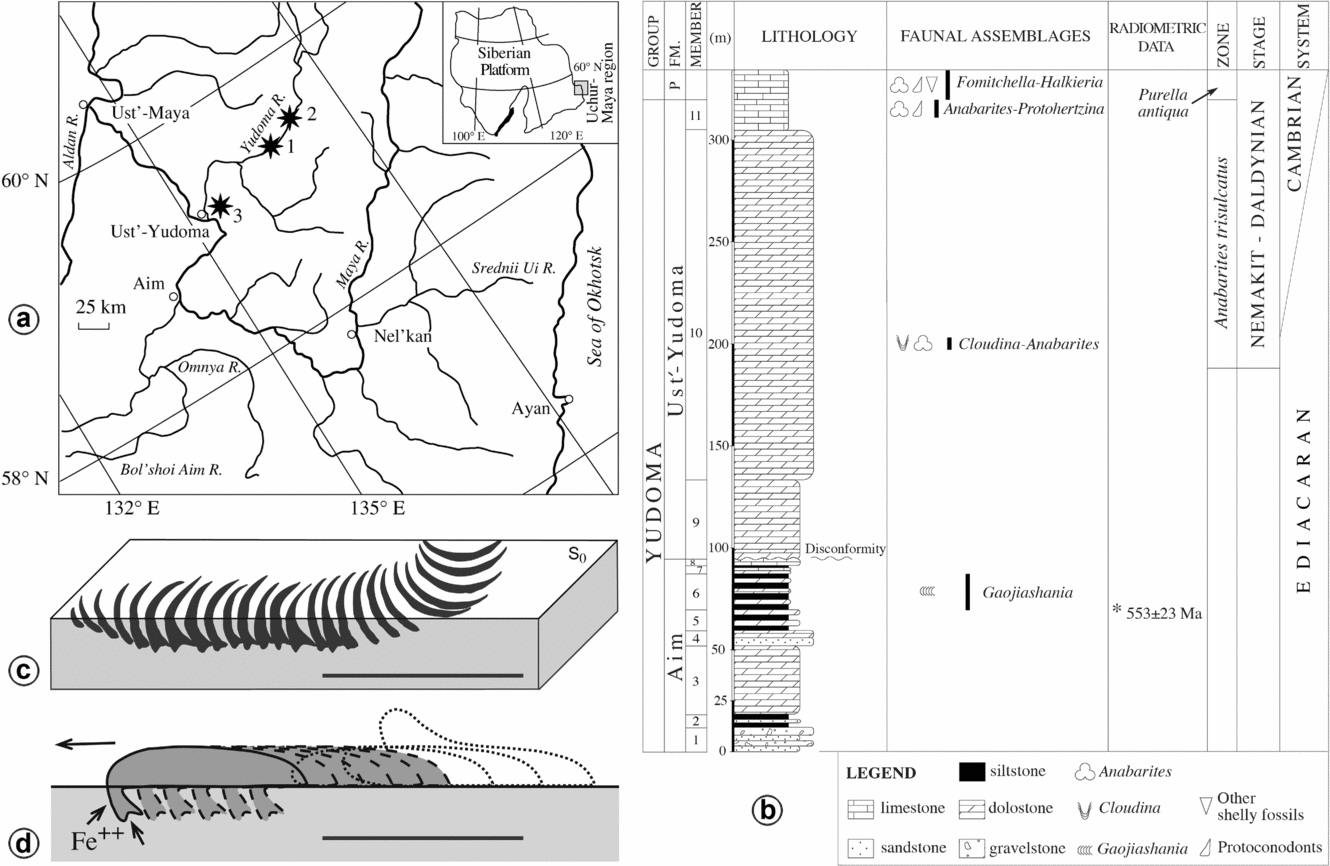
The Yudoma River transects the Uchur-Maya region forming the southeastern margin of the Siberian Platform (Fig. 1a). A key section of the Yudoma Group crops out in cliffs on the right Yudoma River bank near Nuuchchalakh Valley. Here the Yudoma Group has been subdivided into Members 1 to 11 by Semikhatov, Komar & Serebryakov (Reference Semikhatov, Komar and Serebryakov1970) (Fig. 1b). Finds of Gaojiashania are restricted to the 18 m thick Member 6, which occurs 70 m above the base of the Yudoma Group and is represented by an alternation of dark-grey thin-bedded siltstone and bluish-grey wavy-bedded dolomitic mudstone; the bedding planes of the latter are teeming with fossil remains.
(a) Map of the Uchur-Maya region showing reference sections on the Yudoma River: 1 – Nuuchchalakh, 2 – Kyyry-Ytyga, 3 – Ust'-Yudoma. The inset map indicates the position of the region within the Siberian Platform. (b) Lithostratigraphic column of the Nuuchchalakh section. Pb–Pb radiometric data (Semikhatov et al. Reference Semikhatov, Ovchinnikova, Gorokhov, Kuznetsov, Kaurova and Petrov2003) and occurrences of shelly fossil assemblages are extrapolated from the Kyyry-Ytyga section. P – Pestrotsvet Formation. (c) 3D reconstruction of the trace fossil Gaojiashania. S0 – bedding plane. Scale bar, 10 mm. (d) Interpretation of the trace (vertical section) made by a stem-group social amoebozoan feeding selectively on reduced iron-rich mud. Arrow indicates a direction of motion. Scale bar, 10 mm.
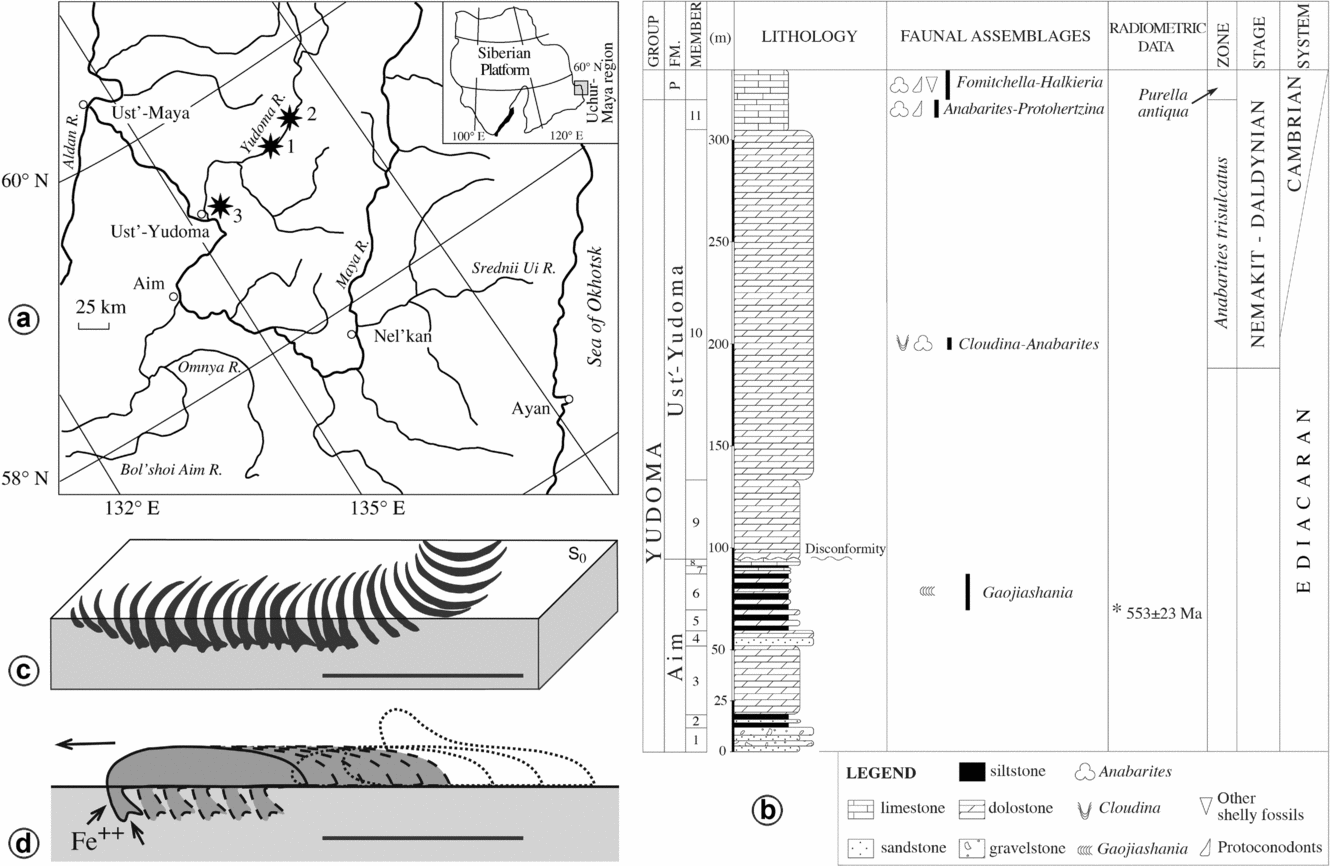
The age of strata containing Gaojiashania is early late Ediacaran because an undisputed Nemakit-Daldynian skeletal assemblage appears in the uppermost 8 m of the Yudoma Group. Such an assemblage is found in the coeval Kyyry-Ytyga section that occurs upstream in the Yudoma River (Fig. 1a). The assemblage includes protoconodonts Protohertzina unguliformis as well as various anabaritids of the Anabarites trisulcatus Zone. In the overlying basal Pestrotsvet Formation, other protoconodonts, hyolithelminths, halkieriids, and chancelloriids are present which are indicative of the Purella antiqua Zone. Moreover, in the same section 108 m below the top of the Yudoma Group (coeval with Member 10 of the Nuuchchalakh section) several anabaritid species co-occur with an upper Ediacaran skeletal fossil Cloudina ex gr. C. riemkeae. By correlation of the Nuuchchalakh and Kyyry-Ytyga sections, the Gaojiashania beds are underlain by strata of 553 ± 23 (2σ) Ma as defined by Semikhatov et al. (Reference Semikhatov, Ovchinnikova, Gorokhov, Kuznetsov, Kaurova and Petrov2003) who applied Pb–Pb radiometric analysis to the less altered limestones from the lower Kyyry-Ytyga section.
A similar sequence of fossils is observed in South China where the Gaojiashania assemblage (middle Dengying Formation) is followed by the Cloudina–Sinotubulites assemblage (upper Dengying Formation) which in turn is replaced by the lowermost Meishucunian (= upper Nemakit-Daldynian) Anabarites trisulcatus–Protohertzina anabarica assemblage with coeval trace fossils of Cambrian aspect (Kuanchuanpu Formation) (Hua et al. Reference Hua, Zhang, Zhang and Wang2000; Weber, Steiner & Zhu, Reference Weber, Steiner and Zhu2007).
3. Systematic palaeontology
Ichnogenus Gaojiashania Yin, Zhang & Lin in Zhang, Reference Zhang1986
Type ichnospecies. Gaojiashania cyclus Yin, Zhang & Lin in Zhang, Reference Zhang1986 from the upper Ediacaran Gaojiashan Member of the Dengyin Formation, Ningquiang County, Shaanxi Province, South China.
Diagnosis (emended). A vermiform fossil consisting of a long chain of depressed meniscus-like segments densely stacked in irregular sinuous horizontal series with no distinct preferred direction; segments possess slightly flaring margins.
Occurrence. Ichnospecies of Gaojiashania are restricted to the upper Ediacaran strata (< 552– > 544 Ma) of the Yangtze (South China) (Zhang, Reference Zhang1986; Lin, Zhang & Zhang, Reference Lin, Zhang and Zhang1986; Ding et al. Reference Ding, Zhang, Li and Dong1992; Hua et al. Reference Hua, Zhang, Zhang and Wang2000; Chen, Sun & Hua, Reference Chen, Sun and Hua2002; Hua, Chen & Zhang, Reference Hua, Chen and Zhang2004), North China (Shen et al. Reference Shen, Xiao, Dong, Zhou and Liu2007) and Siberian platforms.
Gaojiashania annulucosta Zhang, Li & Dong in Ding et al. Reference Ding, Zhang, Li and Dong1992
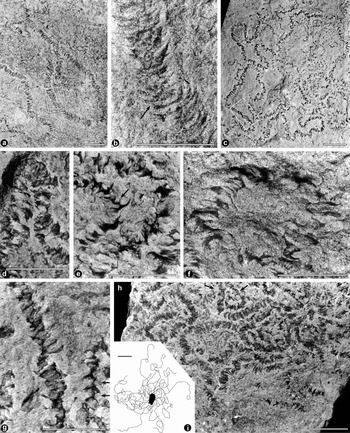
Gaojiashania annulucosta Zhang, Li & Dong in Ding, Zhang & Dong, 1992 on a dolomitic mudstone surface, Nuuchchalakh section, Yudoma River, Yudoma Group, upper Ediacaran Series. (a) PIN 4349/4001, possible phobotaxis; (b) detail of (a), mottled texture (arrowed); (c, g) PIN 4349/4002, axial crest (arrowed); (d) PIN 4349/4006, graded texture; (e) PIN 4349/4003, axial crest (arrowed); (f) PIN 4349/4004, loop; (h) PIN 4349/4005, coiling (arrowed) and phobotaxis; (i) trail pattern of Dictyostelium discoideum slugs with fruiting bodies (redrawn after photograph in Wallraff & Wallraff, Reference Wallraff and Wallraff1997). All scale bars measure 10 mm.

1992 Gaojiashania annulucosta Zhang, Li & Dong in Ding et al., p. 101, pl. 13, figs 1, 6a.
2004 Shaanxilithes; Hua, Chen & Zhang, p. 266, pl. 1, figs 1–6.
2007 Helanoichnus helanensis; Shen et al., p. 1399, fig. 4.6–4.8.
?2007 Horodyskia moniliformis?; Shen et al., p. 1401, fig. 4.9–4.12.
2007 Palaeopascichnus minimus Shen et al., p. 1404, fig. 8.1–8.5.
2007 Palaeopascichnus meniscatus Shen et al., p. 1404, fig. 8.6–8.7.
2007 Shaanxilithes cf. ningqiangensis; Shen et al., p. 1406, fig. 8.8–8.12.
2008 Palaeopascichnus minimus; Dong et al., fig. 6b.
Material and repository. Seven slabs with several dozens of specimens from the Nuuchchalakh locality, Yudoma River, Yakutia–Sakha Republic, Russia; Yudoma Group, upper Ediacaran Series. The specimens are housed in the Palaeontological Museum of the Russian Academy of Sciences, Moscow (PIN, collection 4349).
Description. Each specimen consists of a long set of meniscus-like (crescent) segments, slightly depressed into the matrix, stacked in irregular series. The length of the fossils is not constrained, and can extend to over 100 mm. The segment width is not consistent and varies significantly (from 1 to 4 mm) although it is constant within a single series. The segment density varies from 12 to 16 segments per 10 mm of the fossil length, independently of specimen width, so that wider specimens show a more dense segmentation. Slightly eroded specimens reveal the segments to be funnel-shaped (Fig. 2g). Segments are eccentrically nested and probably possess a longitudinal crest which is visible in some sites of specimens as a continuous dark axial string (Fig. 2e, g). The vertical dimension is roughly estimated to be between 0.5 to 2 mm depending on the segment width.
In some specimens, a possible juxtaposition of two separate fossils cannot be excluded (Fig. 2h). In other instances, loop and radiating patterns are observed but the latter might be coincidental (Fig. 2f, h). Features of self-avoiding behaviour (phobotaxis) and coiling are detected (Fig. 2a, c, h).
Fossils are easily detected on weathered rock surfaces, appearing bluish-grey on a yellowish-green background, but are almost unrecognizable on freshly split surfaces. In polished thin sections, the fossils are transparent. SEM-Link system analysis of these sections coated with gold reveals a mainly siliceous composition for segments but a dolomitic matrix composition. The silicification is probably secondary, as no traces of recrystallization are observed.
Discussion. Siberian specimens do not differ significantly from the type material of Gaojiashania annulucosta Zhang, Li & Dong in Ding, Zhang & Dong (1992) from South China either in size range (1–4 mm in width against 1–6 mm) or in overall morphology (Ding, Zhang & Dong, 1992; Shaanxilithes in Hua, Chen & Zhang, Reference Hua, Chen and Zhang2004). Originally Gaojiashania was described as a tubicolous body fossil but Hua, Chen & Zhang (Reference Hua, Chen and Zhang2004) suggested a calcified algal affinity.
Shaanxilithes Xing, Yue & Zhang in Xing et al. (Reference Xing, Ding, Luo, He and Wang1984) from coeval strata of South China (Xing et al. Reference Xing, Ding, Luo, He and Wang1984; Lin, Zhang & Zhang, Reference Lin, Zhang and Zhang1986; Ding, Zhang & Dong, 1992; Hua et al. Reference Hua, Zhang, Zhang and Wang2000; Weber, Steiner & Zhu, Reference Weber, Steiner and Zhu2007) shares a similar ‘endless’ segmented morphology; indeed some specimens of Gaojiashania have been wrongly ascribed to Shaanxilithes (Hua, Chen & Zhang, Reference Hua, Chen and Zhang2004). The finds of pyritized Gaojiashania in its type locality reveal an open segmentation which may cause segments to be separated during burial (Chen, Sun & Hua, Reference Chen, Sun and Hua2002). The segments themselves are tore-like and bear a pronounced central opening. It is difficult to exclude the possibility that these fossils represent different preservational types of the same organism, although typical Shaanxilithes is mostly preserved as ribbon-shaped flattened structures with faint transverse striations (Weber, Steiner & Zhu, Reference Weber, Steiner and Zhu2007).
Gaojiashania annulucosta was described by Shen et al. (Reference Shen, Xiao, Dong, Zhou and Liu2007) as Palaeopascichnus minimus and P. meniscatus, from the upper Zhengmuguan Formation of North China. Both of these species consist of crescent-shaped segments rather than chambers. More-poorly-preserved specimens were attributed by the same authors to Helanoichnus helanensis Yang in Yang & Zhang, Reference Yang and Zhang1985 and to Shaanxilithes cf. S. ningquiangensis Xing et al. Reference Xing, Ding, Luo, He and Wang1984. All these fossils possess a similar size range (1–6 mm in width, 19–39 segments per 10 mm length) and basic ribbon-like morphology including irregular flaring margins and some radiating structures (cf. Shen et al. Reference Shen, Xiao, Dong, Zhou and Liu2007, fig. 4.4 and Fig. 2h herein). Shen et al. (Reference Shen, Xiao, Dong, Zhou and Liu2007) emphasized that none of these fossils were related to ichnofossils and rather represented remains of tubicolous animals. Another possible morphological deviation from the same sampling set is Horodyskia moniliformis? (Shen et al. Reference Shen, Xiao, Dong, Zhou and Liu2007, fig. 4.9–4.12). This fossil consists of uniserially-arranged spheres which form straight or curved sequences of centimetric length. Again, this shares the same range of sizes found in Palaeopascichnus, Helanoichnus, and Shaanxilithes from the same locality and in some cases is arranged in continuous transitional series with Helanoichnus.
4. Origin of Gaojiashania and relationship to similar Ediacaran fossils
The difficulty of recognition of both Siberian and Chinese (e.g. Shen et al. Reference Shen, Xiao, Dong, Zhou and Liu2007) fossils on freshly-revealed bedding surfaces in contrast to their clear visibility on weathered rock surfaces, hints to the possibility that the ichnofossil-producer either fed selectively on reduced iron-rich mud or grew within it. This style of preservation favours a trace fossil interpretation if a foraging behaviour is invoked, since weathering would preferentially stain iron-bearing sediment but not the iron-depleted areas processed by the producer (Fig. 1d). The mottled and graded textures visible within Gaojiashania but not in the matrix further support the proposition that this is a trace fossil rather than a body fossil (Figs 1c, 2b, d). Similarly, the indeterminate ‘growth’ without a maximum size constraint and self-avoiding behaviour also point to a trace fossil assignment for Gaojiashania (Fig. 2c, h). However, Gaojiashania displays several distinct chain sizes within the same sampling set, and does not show any regularity in sinuosity but does display some coiling and curious loop-like structures (Fig. 2f, h). The apparent fragmentation of individual specimens that suggest a tubicolous nature is observed in Chinese (Chen, Sun & Hua, Reference Chen, Sun and Hua2002) but not Siberian material.
Haines (Reference Haines2000, fig. 7C) described an upper Ediacaran fossil (the upper Wonoka Formation, the Adelaide ‘Geosyncline’, South Australia) consisting of meniscus-like segments and compared it with the problematic Ediacaran trace fossils Palaeopascichnus sinuosus and P. delicatus as well as with the modern brown alga Padina; however he preferred an encrusting algal affinity for this unnamed organism. He noted that interpretation of Palaeopascichnus itself as a meandering trace fossil was not well grounded. Similar to Siberian fossils, the Australian examples are superimposed in places, but they show a clear branching pattern and their segments are definitely convex in shape and widen gradually. However, all these forms spread horizontally across soft substrates and probably penetrated slightly beneath the surface (Fig. 2c, h). Such a pattern is hardly consistent with an encrusting algal model. Jensen (Reference Jensen2003) suggested that interpretation of such Ediacaran forms as Palaeopascichnus, Yelovichnus and Neonereites as trace fossils and Orbisiana as a metaphyte should be abandoned due to their chambered rather than meandering structure. Yelovichnus resembles strikingly the ‘Wonoka fossil’ (Fedonkin, Reference Fedonkin, Sokolov and Ivanovskiy1985, pl. 27, fig. 2) while Palaeopascichnus figured by Jensen (Reference Jensen2003, fig. 5b) and by Shen et al. (Reference Shen, Xiao, Dong, Zhou and Liu2007) possesses some tore-like segments and displays branching. Seilacher, Grazhdankin & Legouta (Reference Seilacher, Grazhdankin and Legouta2003) reinterpreted these fossils as chambered agglutinated tests of giant symplasmic xenophyophorean protists (a highly specialized group of deep-sea foraminifers). Such an affinity, although interesting, does not account for the fact that living xenophyophoreans of a similar habit are erect and contain a pronounced amount of barite.
It is possible that Gaojiashania, Shaanxilithes and Palaeopascichnus-group fossils including the ‘Wonoka fossil’ are related. All of them are represented by segmented, elongated structures of indeterminate growth, sometimes with branching. Such forms appeared in Early Mesoproterozoic time and are represented by Horodyskia moniliformis Yochelson & Fedonkin, Reference Yochelson and Fedonkin2000. Horodyskia has been compared to either macroalgae, or tissue-grade colonial eukaryotes with linearly arranged beads connected by a mudground stolon, or with chains of giant bacterial cells like the modern sulphide-oxidizing Thiomargarita (Fedonkin & Yochelson, Reference Fedonkin and Yochelson2002; Grey et al. Reference Grey, Williams, Martin, Fedonkin and Gehling2002). Noteworthy is that similar to Gaojiashania, Horodyskia moniliformis consists of several discrete size ranges of chains within which all the beads are equal in dimensions. Finds of transitional Gaojiashania–Horodyskia specimens by Shen et al. (Reference Shen, Xiao, Dong, Zhou and Liu2007) support the close relation of these fossils. Also, Dong et al. (Reference Dong, Xiao, Shen and Zhou2008) described Horodyskia and Gaojiashania specimens, named as Palaeopascichnus jiumenensis, of the same size from the Ediacaran Liuchapo Formation (Guizhou Province, South China). These authors described both Horodyskia minor spheres and P. jiumenensis segments as connected by an organic filament, but no organic matter was detected. A similar ‘filament’ is observed in the Siberian material. It is a longitudinal section of individual segment crests (Fig. 2e, g). Although Dong et al. (Reference Dong, Xiao, Shen and Zhou2008) interpreted their fossils as agglutinated tests noting a similarity with agglutinating foraminifers, those fossils neither bear any kind of aperture, nor display an increase in chamber size with individual growth. The terminal spherical chamber observed by Dong et al. (2008, fig. 7i–l) in some specimens of P. jiumenensis is here re-interpreted as a transverse section of a segment rather than a distinct structure.
The only probable trace fossil that predates Horodyskia is Myxomitodes Bengtson, Rasmussen & Krapez (Reference Bengtson, Rasmussen and Krapez2007) found in the Palaeoproterozoic Stirling Range Formation (c. 1.7 Ga) of Western Australia. These authors characterized Myxomitodes as smooth paired ridges cast in positive hyporelief along bedding planes. They noted loops connecting paired ridges as well as some apparent crosscuts which would be expected if both ridges were produced by the same agent one after another but not at the same time. They further suggested that similar features could be produced by slime moulds (Mycetozoa) but were very cautious about this idea due to the known terrestrial adaptation of modern representatives and the difficulties of aggregation into a moving slug in an unlimited aqueous environment.
Myxomitodes has more in common, in both size and morphology, with the presumed feeding trails of a modern giant deep-water gromiid protist, which can reach up to 3 cm in diameter (Matz et al. Reference Matz, Frank, Marshall, Widder and Johnsen2008). These modern trails are short, slightly sinuous grooves bordered by two low lateral ridges with an axial crest, but are much simpler (non-segmented and almost straight) than Gaojiashania-like structures.
Thus, a ‘slime mould behaviour model’ seems to be more plausible for the affinity of Gaojiashania. Gaojiashania shows similarity to both the individual slime moulds’ slug footprints in the form of repeating unidirectional semicircular folds and also to the multiple slug trails which demonstrate an extremely irregular looping pattern (Wallraff & Wallraff, Reference Wallraff and Wallraff1997; Sternfeld & O'Mara, Reference Sternfeld and O'Mara2005). These differ, however, in size (Fig. 2i). The width of a modern slug and its slime trail is approximately 0.1 mm, which is an order of magnitude narrower than the smallest Siberian Gaojiashania specimen. However, Palaeopascichnus jiumenensis shows a similar size to modern forms, being 0.1 to 0.7 mm in width (Dong et al. Reference Dong, Xiao, Shen and Zhou2008).
Slime moulds also produce fruiting bodies which form some patterns similar to the ‘Wonoka fossil’ as well as to Horodyskia (Gross, Reference Gross1994, fig. 2). In both the Zhengmuguan and Liuchapo formations, the Horodyskia morphotypes resemble fruiting bodies and the Palaeopascichnus–Shaanxilithes morphotypes represent traces that not only co-occur but are continuous one into another (Shen et al. Reference Shen, Xiao, Dong, Zhou and Liu2007, fig. 4.9, 4.10; Dong et al. Reference Dong, Xiao, Shen and Zhou2008, fig. 7i–l).
In the Holocene Epoch, mycetozoans are represented by terrestrial semiaquatic species. They show advanced molecular signal transductors and activators, including several families of G-protein-coupled receptors, protein kinases, and ATP-binding cassette transporters which are crucial for multicellular development and which had been thought to be specific to animals (e.g. Kay, Reference Kay1997; Eichinger et al. Reference Eichinger2005). They also possess homeobox genes that regulate anterior–posterior patterning (Han & Firtel, Reference Han and Firtel1998). This suggests that mycetozoans diverged after the plant–animal split, but before the divergence of fungi (Nikolaev et al. Reference Nikolaev, Berney, Fahrni, Bolivar, Polet, Mylnikov, Aleshin, Petrov and Pawlowski2004). Thus, slime moulds must have had marine predecessors.
5. Conclusions
Although slime moulds may have obtained multicellularity independently of metazoans, they present an attractive model of motile stem-group multicellular organisms which can be inferred to have inhabited Proterozoic sea-bottoms. Kuzdzal-Fick et al. (Reference Kuzdzal-Fick, Foster, Queller and Strassmann2007) in studying the ecology of the slime mould Dictyostelium discoideum discovered that its multicellular slug easily crosses certain physical barriers which its individual amoeboid cells were unable to pass through. This would allow it to gain an important selective benefit in exploiting new food sources and so extending its distribution. The acquisition of multicellularity might therefore perform a crucial role in the progressive opening up of new environments by Proterozoic life forms.
Gaojiashania and related Ediacaran and pre-Ediacaran fossils may represent a wide array of genuine trace fossils produced by a variety of multicellular, but not necessary metazoan, organisms as well as some giant protists. For this reason it seems premature to deny the presence of any complex trace fossils in Ediacaran and earlier strata.
Acknowledgements
We thank Alex Page (University of Cambridge), an anonymous referee, and Rachel Wood (University of Edinburgh) for interesting and constructive criticism and Isabel Pérez-Urresti (Universidad de Zaragoza) for the preparation of figures. This is a contribution to the projects: Consolíder CGL2006–12975/BTE (‘MURERO’; Ministerio de Educación y Ciencia-FEDER–EU, Spain), Multidisciplinar PM067/2006 (Gobierno de Aragón), Grupo Consolidado E–17 (‘Patrimonio y Museo Paleontológico’; Gobierno de Aragón), and IGCP 493 (‘The Rise and Fall of the Vendian Biota’). AZ benefited from the grants MI042/2006, Departamento de Ciencia, Tecnología y Universidad (Gobierno de Aragón) and CB 3/08 Programa Europa XXI de Estancias de Investigación (CAI–CONAI+D) 2008.