Implications
Production diseases of commercial pigs adversely affect farm profitability and reduce consumer acceptability by inducing losses of performance, increasing mortality and morbidity and, by insulting animal welfare. The choice of assessment criteria to detect diseases provides a challenge for farmers, veterinarians and researchers. This systematic review evidences a large variety of traits and highlights the absence of a common core of traits across diseases and studies. It quantifies the impact of the major production diseases on several traits that could serve as potential indicators for prognosis and identification of production diseases and for assessment of the efficacy of preventive or corrective practices.
Introduction
Management practices applied in intensive production systems in association with genetic selection of pigs for high production efficiency are often associated with a high risk for developing behavioural, physiological and immunological disorders (Rauw et al., Reference Rauw, Kanis, Noordhuizen-Stassen and Grommers1998; Fraser et al., Reference Fraser, Duncan, Edwards, Grandin, Gregory, Guyonnet, Hemsworth, Huertas, Huzzey, Mellor, Mench, Spinka and Whay2013). These disorders, collectively called production diseases, are defined as diseases with a multifactorial aetiology, which may be influenced by environmental conditions and negatively affect animal productivity (adapted from Martineau and Morvan, Reference Martineau and Morvan2010) as well as animal welfare. Production diseases have a great impact on the profitability of animal production systems, as they induce loss of performance, associated with reduced growth and feed efficiency, and increased mortality and morbidity. They show diversity with regards to the productive stage in which they are observed, the physiological system affected and their causal factors. A comprehensive summary of production diseases occurring in pigs as well as dissecting their impact on animal traits has not been attempted so far.
The overall aim of this study was to systematically map the published literature on production diseases affecting the pigs at various productive stages. The specific objectives were (1) to carry out a systematic literature review in order to classify all traits that have been measured and which are associated with the occurrence of production diseases across productive stages of pigs; and (2) to conduct a meta-analysis on the effects of productive diseases on animal based traits. In addition, factors such as animal age, breeding conditions and method for analysis that may explain heterogeneity in the data were explored to better understand the variability in responses.
Material and methods
Definitions
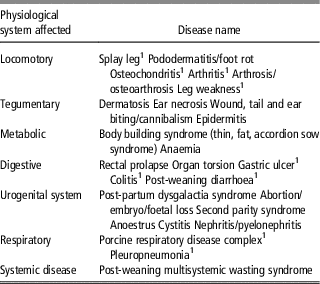
Production diseases were defined as having a complex aetiology including genetic factors, management, nutrition and the existence of opportunistic pathogens. A list of production diseases was established according to the physiological system they affect and according to Martineau and Morvan (Reference Martineau and Morvan2010) and Zimmerman et al. (Reference Zimmerman, Karriker, Ramirez, Schwartz and Stevenson2012) (Table 1). Diseases with a compulsory infectious agent were generally not taken into consideration, except for the respiratory system, where the most widespread diseases have a multifactorial pathogenesis and always include one or more infectious agents. Generally, authors may list pleuropneumonia, caused by Actinobacillus pleuropneumonia, as part of the respiratory disease complex, a term that was used to describe pneumonia of multiple aetiology and causing clinical disease (Brockmeier et al., Reference Brockmeier, Halbur and Thacker2002). However, in the present analysis, pleuropneumonia was considered as a separate condition to the respiratory disease complex for two reasons. First, the literature research using the keywords ‘porcine respiratory disease complex’ (PRDC) did not permit to obtain publications on A. pleuropneumoniae. Second, due to greater severity of disease course (Brockmeier et al., Reference Brockmeier, Halbur and Thacker2002; Zimmerman et al., Reference Zimmerman, Karriker, Ramirez, Schwartz and Stevenson2012), a greater impact on health and welfare traits was expected for pleuropneumonia compared with respiratory disease complex. Diseases primarily caused by nutrient deficiencies or mycotoxins were not considered due to their single-factor aetiology (feed management failure). Finally, the present study focussed on production diseases affecting the locomotory, digestive and respiratory systems as these are the main disorders for which antibiotics are still widely used in Europe (EMA Committee for Medicinal Products for Veterinary Use and EFSA Panel on Biological Hazards, 2017).
General list of production diseases affecting pigs

1 Diseases considered in the present work.
All productive stages and all breeds were considered. Animals were considered as piglets from birth to weaning; weaners from weaning to 30 to 35 kg of BW and grower-finishers thereafter and up to slaughter at 120 kg of BW.
Traits were defined according to the Animal Trait Ontology for Livestock (Le Bail et al., Reference Le Bail, Bugeon, Dameron, Fatet, Hurtaud, Hue, Joret, Salaün, Nédellec, Reichstadt and Vernet2012), as any measurable or observable characteristic of a livestock animal. A categorisation of different types of traits was performed in relation to the general nature of the trait, the specific name of the trait, whether the trait was measured in dead or alive animals and the biological sample in which the trait was measured (Supplementary Table S1). The general trait categories identified were productive traits (growth or production or reproductive performance), entire or whole animal traits (measurement of physiological or anatomical characteristics in living animals) biochemical traits, behavioural traits, carcass traits (composition or dimension or size traits) and molecular traits to measure DNA, RNA and protein expression.
Literature search: search strategy and inclusion criteria
Searches were carried out between April 2014 and May 2015 using Web of Science Core Collection as bibliographic databases. The search terms are presented in Supplementary Material S1. In order to reduce publication bias, additional studies of key authors in the field were searched for in the Web of Science’s Core collection and Google scholar. Furthermore, the reference lists of included studies were assessed in order to ensure that references which may have not returned from the data base searches were included. Searches included documents published in peer-reviewed journals in English and French between 1976 and 2015.
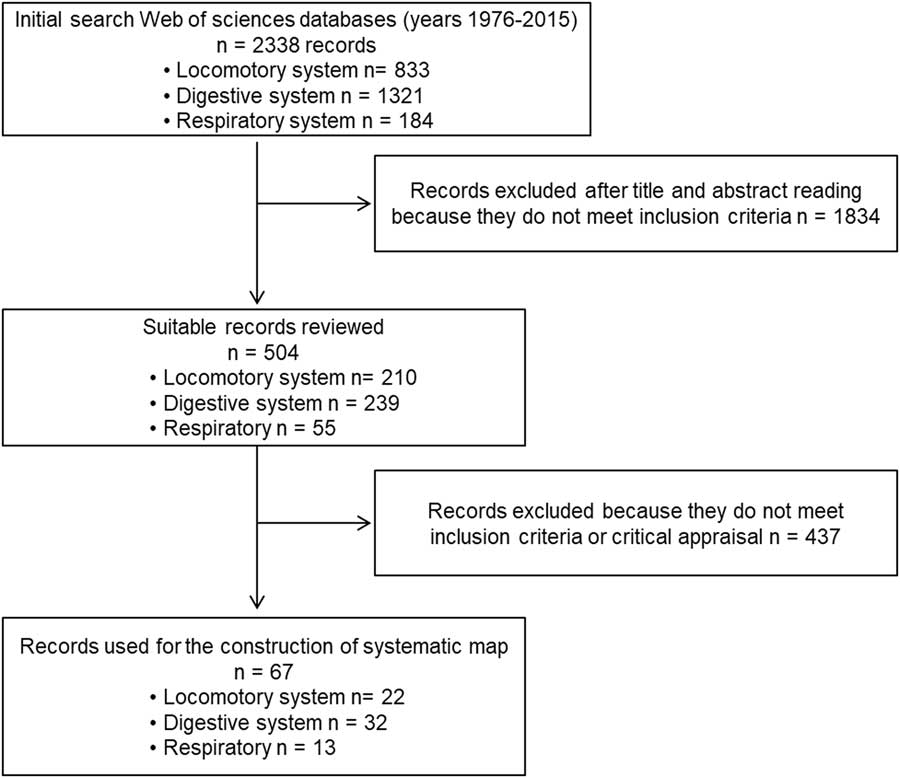
The literature search retrieved a total of 2338 records that were filtered in a two-stage process (Figure 1). The retrieved articles were first scanned for title and abstract and 504 of them were deemed as relevant. Then the 437 retained articles were imported into EndNote® software and were afterwards assessed for full text.
Screening process of articles on production diseases published in pigs.

Studies selected for data extraction met all the following criteria for inclusion:
1. Study was an original research work reporting the numerical mean of the traits.
2. Research provided the results for at least one group affected by the disease and one healthy control group matched by age and/or BW. Affected groups corresponded to populations in which all subjects were affected, as well as populations, which were representative of a population affected by the disease even if not all individuals were explicitly reported as affected. This choice was supported by our objective to work on animal-based indicators (animal level or animal-centred) rather than indicators measured at group level.
3. The publication appropriately described the method used for the diagnosis of the disease.
4. Research described the statistical analysis performed and reported whether response traits statistically differ between the affected and the control groups.
5. Research provided animals with nutrients above the National Research Council (2012) recommendations levels, except for studies in which specific nutrient deficiencies or feed restriction was applied on the affected group in order to favour the production disease.
Studies presenting results from animals affected by naturally occurring diseases were classified as ‘field studies’, whilst studies where diseases were experimentally induced were classified as ‘intervention studies’. Field studies were defined as studies which take place in commercial farms or in experimental facilities, where the effect of production diseases on traits is monitored in naturally affected populations and is then compared to unaffected-control populations. The intervention studies were performed in experimental facilities. In this case, a production disease is either introduced in a population by a specific intervention and is then compared to an unaffected-control population, or is applied to all animals and then comparisons are drawn between groups of affected and non-affected animals. Their inclusion to our data set significantly increased the number of assessed studies. In addition, they expanded upon the measurement of traits which are often not possible to collect under field conditions (invasive collection of biological sample). The types of intervention applied in studies were related to management or practices, nutrition, administration of pathogens, toxins, adjuvants or other compounds (See Supplementary Material S2 for more details).
Data extraction
Data were extracted from 67 articles in excel spreadsheets by a single reviewer. The information indicating the sex of the animals, their genetic background, the housing and dietary composition specifics over the majority of their lifetime and the type of feed (dry or liquid) and feeding system (collective electronic feeding system, collective trough or individual though), and the type of interventions were recorded. When the disease was experimentally induced, the nature and duration of the intervention and the age at which it was applied were recorded. The effect size of the traits was calculated as the difference, expressed in %, of the mean value of the trait between the affected and the control group. Therefore, a positive effect size indicates that the parameter observed is greater in the affected group than the control group, and vice versa. The effect size was coded as 1 when the difference was between 0% and 5%, 2 when it was between 5% and 15% and 3 when it was greater than 15%. This stratification of effect size was implemented on the assumption that a difference between 0% and 5% in any given production trait is of low detectability, a difference of 5% to 15% is suitable for the detection of a production disease, whereas a difference of more than 15% is clearly detectable. When the traits were reported at different time-series points, or multiple groups, subjected to the same intervention and affected to a different degree by a production disease, the magnitude of the effect size was estimated by calculating the average difference between the control and the affected population over time or across affected groups. The sample size for each measurable trait was recorded. It consisted of the sum of animals used in the control and affected population for which comparisons are drawn. In the database, one line corresponded to a group of animals subjected to the same treatment during a given period within an experiment. When several independent experiments were reported within an article, they were considered as separate studies.
Meta-analysis
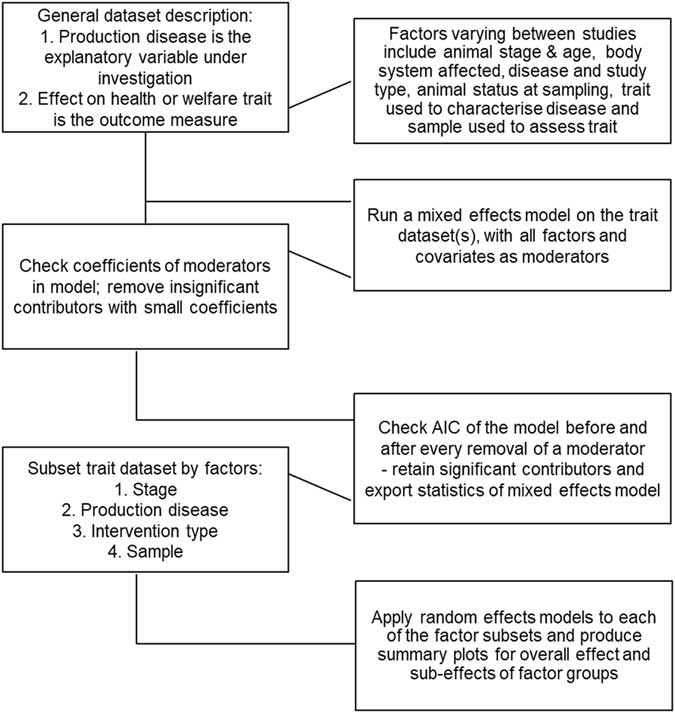
Mixed and random effect models were fitted to the data with a restricted maximum-likelihood estimator using the open source package Metafor (Viechtbauer, Reference Viechtbauer2010) within the R software environment (R Core Team, 2013); significance level was set at 0.05. The detailed procedure and information regarding explanatory and outcome variables in are outlined in Figure 2. The meta-analysis permits to analyse which traits were most affected (outcomes) and which diseases (explanatory variables) had biggest impact on assessed traits. This is so because the effect size of traits is always the difference between affected and unaffected animals so any ‘production disease’ is underlying the effect size value. Variances were imputed using a resampling procedure based on effect and sample size of each study, since variances were often unreported in relation to the effects of interest within publications. Since there was a minimal level at which meaningful comparisons across studies based on magnitude and direction of effects size could be made, meta-analysis were conducted only on traits assessed at least five times across all included studies. A subset-analysis of significant factor groups was performed for each trait and typically comprised ‘stage of the animal’, ‘type of disease’ and ‘type of intervention’ as a grouping factor (additional explanatory variables). When other factors were significant, subgroups were created accordingly. Estimates of amount of heterogeneity exhibited between studies beyond chance (I2) were used to determine uniformity of response (Higgins et al., Reference Higgins, Thompson, Deeks and Altman2003). Homogeneity is considered when I2<25%. Sensitivity analysis was undertaken to ascertain the impact of study weighting. Funnel plot asymmetry was examined to assess the potential for publication bias using Egger’s regression tests with P-value <0.05 indicating funnel plot asymmetry. Posthoc comparisons of the summary effect sizes for each analysed trait were performed in order to reveal which were most responsive to production diseases and could therefore be used as diagnostic factors for their occurrence. This was done by examining any overlap of confidence intervals (CI) around each trait’s summary effect size in a summary plot including all traits. Such comparisons across production diseases were also made by plotting CI around trait effects within disease to determine which diseases had greater impact overall and on which traits.
Flowchart describing statistical approach using package metafor (Viechtbauer, Reference Viechtbauer2010) in R software to analyse animal-based traits in pigs. AIC=Akaike’s information criterion.

Results
Study selection, profile of included studies and reporting quality
On the basis of our assessment, 67 articles out of a total of 2338 retrieved records matched our inclusion criteria, consisting of 77 distinct experiments in which comparisons were drawn between 89 groups of animals affected by production diseases and 77 control groups. This represents a low inclusion rate (2.9%, Figure 1 and Supplementary Table S2). The list of articles included in the database can be found in Supplementary Material S3.
Many studies were excluded on the basis of their statistical methodology, or the absence of statistical assessment, mainly because their target was the characterisation of the effects of the diseases from a qualitative perspective, such as on the level of histological, histopathological alterations, etc. In numerous studies, particularly those of the respiratory system, no negative control group was available for comparison. A large number of full-text assessed intervention studies were excluded because they were comparing treatment groups with differing levels of the production disease as a result of various implemented interventions without comparing groups consisting of only affected individuals with control disease-free populations.
The papers published on each production disease varied greatly (Supplementary Table S2 and Figure 1), with a maximal number of studies available for disease conditions such as ulcer, colitis and arthritis (more than 500 articles). Few studies were published on rectal prolapse and organ torsion (less than 25 articles) and even less so on pododermatitis. Due to their limited representation in the literature, foot rot (two studies) and pododermatitis (three studies) were not included in the database because these studies did not meet the criteria of inclusion in the database. In four studies, the disease was identified as leg weakness or lameness, but no indication allowed characterisation of the type of disease. These experiments were included in the database as leg weakness disease.
Information provided by the studies such as the genotype and sex of the pigs, the type of the floor, the ambient temperature, the system of feeding and type of feed were recorded as markers of reporting quality, but they were not used as part of our inclusion criteria. It is worthwhile mentioning that the reporting quality of the included articles judged by the provision of such information was weak. Animal genetics was the most frequently available descriptor and was specified in 55 of 77 experiments; 36 experiments used commercial cross-breeds and 19 experiments used pure breed pigs. The sex of the pigs was reported in 32 of 77 experiments with 18 of them using both male and female pigs, eight males only (two entire, one castrated and five not precise) and six experiments using only females. Housing conditions were scarcely recorded with only 10 experiments providing the type of floor. Housing temperature was not indicated, except in two instances. With respect to feeding, only nine experiments provided information on type of feed and/or feeding system.
Amongst the experiments included in the database 78% were classified as intervention studies. This proportion of interventions largely differed between affected system and diseases: 39 of 40 experiments studying digestive diseases, 9 of 22 for the locomotory system and 12 of 13 for respiratory system. The nature of the intervention applied for the induction of production diseases in included studies varied within and across production diseases. In a few experiments, affected groups were not subjected to an intervention but the control groups were given a protective intervention.
The age of the animals varied according to the physiological stage during which the respective diseases occur. Sows were poorly represented in the database with only three experiments investigating occurrence of peptic ulcer, lameness and leg weakness. Pigs studied towards splay leg disease were newborn (0 to 8 h old), whereas animals affected by post-weaning diseases were weaned pigs (average of age 28 days at the beginning of the study). Colitis was studied across all stages; interventions to induce colitis were applied at various stages with 10 experiments comprising young piglets (intervention starting from day 6 after birth), and four and five studies comprising weaner and grower pigs, respectively. Ulcers were mostly studied in growing pigs (12 of 15 experiments). Ulcer-inducing interventions started on average at 70 days of age or an average BW of 38 kg. Out of six experiments modelling arthritis, induction was conducted on growing pigs and started on average at 78 days of age. Osteochondrosis was studied in growing pigs or at multiple stages from 45 days (6 kg) and until slaughtered at 110 kg of BW. Respiratory diseases were studied in weaner or growing pigs, at an average intervention start age of 48 days.
Traits used to characterise affected pigs
A total of 524 unique traits were measured and were categorised into carcass, molecular, productive, biochemical and entire animal traits (Supplementary Table S1). An analysis of the frequency of specific traits across the three considered body systems can be found in Supplementary Tables S3 and S4. Diseases affecting the digestive system were studied by means of traits falling under all categories, with the most prevalent traits being productive, biochemical and carcass traits, depending, nonetheless, on the disease. Generally, locomotor diseases were studied mainly by biochemical, carcass and molecular traits. Molecular and biochemical traits were used to describe splayleg, arthritis and osteochondrosis. For leg weakness, measured traits were mainly related to carcass characteristics. Respiratory disease was studied by productive, biochemical and molecular traits only. Entire animal traits occurred only a few times in association with locomotor diseases. No behavioural traits were recorded overall from the included experiments.
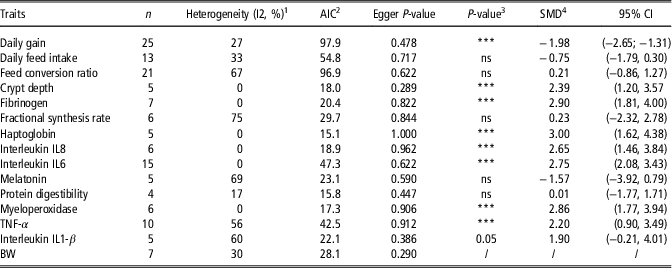
The number of times a trait was repeated across experiments varied from 1 to 31 times. Only 14 traits were measured in more than five experiments (Table 2). Traits were measured in either alive or dead animals and in a variety of sample material as indicated. The majority of traits in live animals were measured at the level of the animal, or via blood sampling, while in dead animals the majority of the measurements were carried out in organs. Traits were measured in a variety of sampling material including blood, muscle, articular cartilage, bone or at the level of the animal for productive traits.
Statistical parameters of random effects models (REMs) for each trait measured in pigs

TNF=tumour necrosis factor; CI=confidence interval.
1 I2=measure of heterogeneity.
2 Akaike’s information criterion (AIC) – measure of model overfitting.
3 P-value for the effect size. ***P<0.001, ns=not significant.
4 Standardised mean difference (SMD) – measure of the summary effect size.
Meta-analysis of the effect of diseases on traits
Detailed statistical analyses was performed for the 14 traits measured more than five times as well as for the trait ‘protein digestibility’ measured four times since there was relative homogeneity with respect to factors which varied across studies. No forest plot was included for the trait ‘BW’, since the overall summary effect and sub-group effects were all non-significant. However, this trait was included in the overall posthoc summaries, as it had been assessed by more than five studies (N=7, Table 2). Forest plots and subgroup summary effect sizes are presented in Figure 3 and Figures S1 to S14.
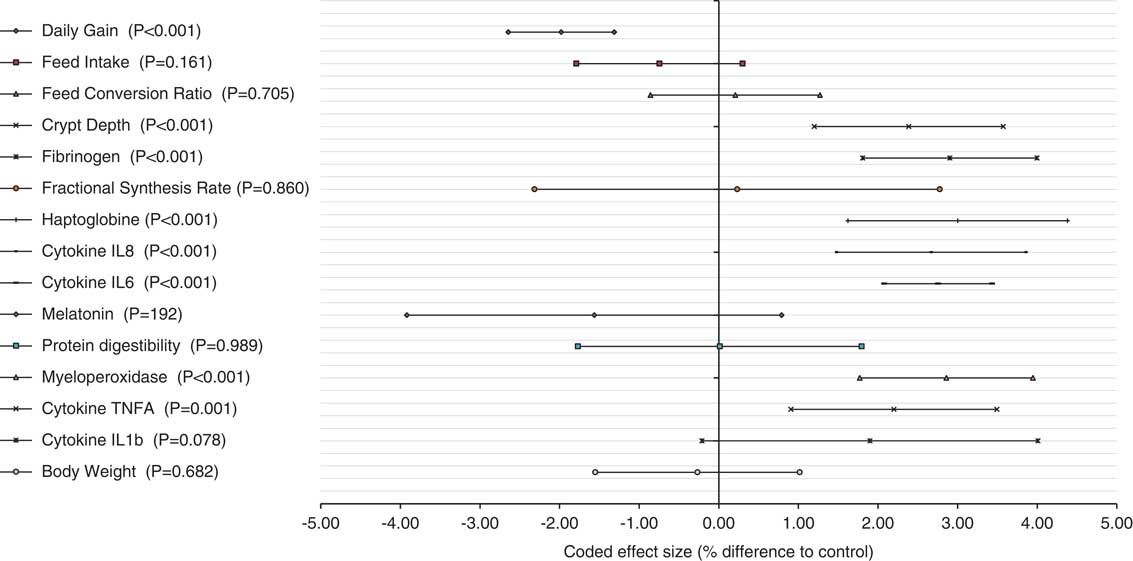
Comparison of summary effect sizes and confidence intervals across all traits measured in pigs and considered in the meta-analysis. The effect size was coded as 1 when the difference between control and affected group was between 0% and 5%, 2 when it was between 5% and 15% and 3 when it was greater than 15%. Sign of the effect size indicates if the analysed parameter is higher (+) or lower (−) in infected pigs. IL=interleukin; TNFA=tumour necrosis factor-α.

Overall, heterogeneity (I2) ranged from low to high, that is, from 0% to 75% between studies that assessed the same trait (Table 2). Generally, traits with large effect sizes that differed significantly from controls showed the least heterogeneity across different studies which assessed the trait. When factors that differed between studies were included in the model (mixed effect models), heterogeneity between studies was lower and ranged from 0% to 67% overall. Akaike’s information criterion values were generally very low, indicating that models were fitted appropriately. With one exception, Egger test results were non-significant across all models, indicating absence of publications bias. The exception concerned studies assessing average daily gain in response to a nutrition intervention, showing a significant deviation from symmetry in the funnel plot (P=0.014).
A detailed trait-by-trait analysis is presented in Supplementary Figures S1 to S14. Overall, the most affected traits were molecular and biochemical traits, specifically the inflammatory biomarkers ‘haptoglobin’ and ‘fibrinogen’ with summary effect sizes of 3.0 (CI 1.62 to 4.38) and 2.9 (CI 1.81 to 4.0) and cytokines, such as interleukin (IL) 6 and IL8, with effect sizes of 2.65 (CI 1.46 to 3.84) and 2.75 (CI 2.08 to 3.43), respectively (Table 2). ‘Average daily weight gain’ showed a summary effect size of −1.98 (CI −2.65 to −1.31) across studies and along with cytokine IL-6, these two traits showed the least variability between studies, as supported by narrow CI around their summary effect size. Traits differed significantly between each other which was demonstrated by non-overlapping CI (Figure 3); however, this was mainly due to the direction in which the trait was affected and not the magnitude of its effect size. Nonetheless, traits experiencing an increase in affected animals, such as ‘fibrinogen’, ‘haptoglobin’, the cytokine ‘IL6’ and the enzyme ‘myeloperoxidase’ were significantly more affected compared to traits, such as the feed conversion ratio. Interestingly, the overall effect of production diseases on feed intake, the feed conversion ratio, protein digestibility and BW was non-significant compared to controls, since 0 was included within the CI. Yet, average daily gain was significantly lower overall in animals affected by production diseases and this trait was one of the most frequently assessed traits across included studies.
The magnitude of response of average daily gain differed amongst growth stage, production disease and intervention methods (Table 3 and Supplementary Figures S1 to S3). Indeed, the observed decrease of average daily gain in unhealthy groups was most important for piglets and weaners (−3 and −2.62, P<0.001) for colitis and PRDC (−2.98 and −2.78, P<0.001) and when the disease was experimentally induced using pathogens (−2.80, P<0.001). Conversely, the magnitude of the increase of immune traits was globally independent of growth stage, production disease and intervention method (Table 4 and Supplementary Figures S7 to S9; S13 to S14). As an exception, tumour necrosis factor (TNF)-α, and IL1-β did not significantly increase in production diseases affecting weaners and piglets, respectively.
Summary of the meta-analysis for productive traits measured in pigs

CI=confidence interval; PRDC=porcine respiratory disease complex.
1 Mean effect size calculated according to random effect model.
***P<0.001; **P<0.01; *P<0.05; ns=not significant.
Summary of the meta-analysis for immunological traits measured in pigs

CI=confidence interval; PRDC=porcine respiratory disease complex; TNF=tumour necrosis factor.
1 Mean effect size calculated according to random effect model.
***P<0.001; **P<0.01; *P<0.05; #0.05⩾P⩽0.10; ns=not significant.
Discussion
For the first time, this study has permitted a global assessment of traits used in the published literature to study production diseases on various stages in pigs. The main outcomes are as follows: (1) the great variety of traits that were measured across diseases; (2) the lack of studies on some diseases (mainly pododermatitis) and traits (mainly behavioural characteristics); and (3) the quantification of the impact of diseases and additional factors on several traits most of them relative to performance characteristics or immune response of pigs. These outcomes and methodological limitations are discussed below.
Our study revealed a total of 524 unique traits with only 14 measured in more than five experiments. Such diversity is explained by several factors. First, some traits are specific for a physiological system (as an example bone characteristics for locomotory system) or are disease specific (as an example Escherichia coli for Post Weaning Disease) and so not used across experiments. Second, diseases are studied by several scientific communities (e.g. immunologists, physiologist, animal scientists), that preferably use traits directly linked to their discipline and organisational levels (cell, organ, entire animal). Integrative studies, combining different levels and disciplines are scarce. More pragmatically, some traits are more laborious or expensive to assess than others (molecular traits v. performance as an example), or require animals to be euthanised, which restricts their use and as a result their inclusion in the data base. Our work evidenced an absence of a common core of measurements within the scientific literature. As the first step in a procedure of indicator development is to select a variable that is prominent in the monitoring throughout the end-users community (World Health Organization, 2015), adoption of a common core of measurements based on standardised methods and a more trans-disciplinary and integrative approach is required.
The representation of certain diseases such as rectal prolapse, organ torsion and pododermatitis was limited due to under-publication in contrast to a maximal number of studies for ulcer, colitis and arthritis. Such discrepancies in assessed diseases are attributed to the economic importance of the disease, to its prevalence in pig populations reared commercially or by the existence or not of methods to reproduce them in intervention studies. Regarding the affected system studied, publication output and inclusion in the database were the greatest for digestive, the lowest for locomotor and intermediate for respiratory diseases. This order is not consistent with the reported economic impact of respiratory diseases with an estimated cost amounting to between 4 and 7 € per pig v. 3 to 5 € for enteric diseases (Niemi et al., Reference Niemi, Jones, Tranter and Heinola2016).
Gaps evidenced in this work can also be directly linked to our methodological approach. Indeed, we included articles which fulfilled certain strict criteria, therefore limiting the number of studies that were included in the data set to 2.9% of the total publications which characterise production diseases in pigs. The most significant factor for study exclusion was the partial presence of production diseases in the affected and control groups. As we were primarily interested in the absolute effect of production diseases on production traits, studies that did not clearly separate into affected and healthy control animals were excluded. These studies compared treatment groups with a different incidence of occurrence of the production disease, typically as a result of various implemented interventions (management practices, vaccination v. none). Further work could be carried out to incorporate these studies, assigning different weight to their impact in the meta-analysis according to the percentage of the population which is affected by the production disease.
Another important gap identified by our work was the absence of behavioural traits as indicators of production diseases. This is, at first sight, surprising because behavioural traits are largely used to characterise animal welfare that is in close relation with health (Fraser et al., Reference Fraser, Weary, Pajor and Milligan1997; World Organisation for Animal Health, 2017). Behavioural changes often precede or accompany subclinical and clinical signs of disease or injury and might have diagnostic value (Kyriazakis and Tolkamp, Reference Kyriazakis and Tolkamp2010). Quantification of behaviour can be time consuming, subjective, and impractical, particularly on large scale farms, which might explain the absence of utilisation of this trait to characterise disease. The current development of automation and sensor capable of measuring behaviour will probably lead to the use of behavioural traits for automatic detection and quantification of health and welfare compromises in the near future (Matthews et al., Reference Matthews, Miller, Clapp, Plötz and Kyriazakis2016). Development of behavioural and thus non-invasive indicators will permit to better objectivise the level of animal stress during experiments as well as in commercial pig farm. This is particularly relevant in the current context where citizen and consumer concern regarding animal welfare is increasing (Clark et al., Reference Clark, Stewart, Panzone, Kyriazakis and Frewer2016).
Traits within biochemical, molecular and productive trait groups are reported most frequently in the published literature and the most affected by production diseases, among these some cytokines (IL1-β, IL6, IL8 and TNF-α), acute phase protein (haptoglobin) and daily weight gain. These traits were significantly affected by different diseases with pleuropneumonia and arthritis being the two diseases having the greatest impact on animal health traits in this analysis, followed by the PRDC and colitis. Consequently, these traits could be potential indicators to measure for prognosis, detection or study of these diseases as well as to test the effect of preventive or corrective practices. On a practical aspect, animal performance traits such as daily gain are quite easy to measure and have the advantage to be non-invasive, by contrast to immunological parameters that need blood collection.
Cytokines and haptoglobin are key mediators associated with systemic inflammation (Eckersall et al., Reference Eckersall, PK. Saini and McComb1996). Inflammation and the accompanying acute phase response is the first response of animals facing environmental, psychological, chemical or microbial stresses. This response is not specific to the type of disease, but monitoring their concentration can help to test the health status of an animal and to evaluate their ability to recover. Inflammatory states decrease feed consumption (Konsman and Dantzer, Reference Konsman and Dantzer2001) due to sickness-induced anorexia (Pastorelli et al., Reference Pastorelli, van Milgen, Lovatto and Montagne2012; Kyriazakis, Reference Kyriazakis2014). Immune activation leads to additional nutritional requirements to cover a greater protein synthesis in immune and hepatic compartments (Klasing and Iseri, Reference Klasing and Iseri2013) and energy expenditure for fever and oxidative responses (Benhariz et al., Reference Benhariz, Goulet, Salas, Colomb and Ricour1997), both of them responsible for a change of nutrients allocation with decrease of nutrient available for growth (Spurlock, Reference Spurlock1997; Le Floc’h et al., Reference Le Floc’h, Melchior and Obled2004). Association of performance and immune traits is also relevant with regard to the concept of robustness, defined as the ability to combine expression of production potential with resilience to stressors (Knap, Reference Knap2005). This appears to be particularly relevant in case of production diseases (Gunnarsson, Reference Gunnarsson2006).
Development of indicators also implies the selection of reference values (Girardin et al., Reference Girardin, Bockstaller and van der Werf1999). Although we had a quantitative approach in this work, our methodological approach is not accurate enough to establish references for several reasons. First, a major source of bias is the approach used to identify studies. Published studies are strongly subject to publication bias. There is a potential likelihood that studies that failed to show an effect have a decreased opportunity to be published. Therefore, the source of papers may represent a biased subset of papers and, if this is the case, may provide a best-case scenario difference. In addition, due to the heterogeneity and amount of recorded data as all traits were indiscriminately considered, effect sizes were extracted via a simplified protocol. This resulted in an underestimation of effects on traits which are severely affected by production diseases; traits affected by anything more than 15% in the affected as compared to the control population were assigned a score of 3.
To conclude, this systematic literature review evidenced a great diversity of traits used to characterise production diseases, and gaps for some diseases (mainly pododermatitis) and traits (mainly behavioural characteristics). Traits relating to animal growth rate or immune response of pigs are the most present and can be considered as good candidates for indicator design. Indicators will help to better prognose and identify production diseases or to test practice limiting the disease.
Acknowledgements
This project has received funding from the European Union Seventh Framework Programme for research, technological development and demonstration under Grant Agreement No. 613574 (PROHEALTH).
Preliminary results of this work have been published in Loisel F, Stravakakis S, Sakkas P, Kyriazakis I, Stewart G, Le Floc’h N, and Montagne L 2016. Identification of animal-based traits as indicators of production diseases in pigs. Proceedings of the XVIth International Conference on Production Diseases in Farm Animals (ICPD), Wageningen, Netherlands, Wageningen Academics Publishers. p 152 (poster).
Declaration of interest
No conflicts of interest.
Ethics statement
Not relevant.
Software and data repository resources
None of the data were deposited in an official repository.
Supplementary material
To view supplementary material for this article, please visit https://doi.org/10.1017/S1751731118002719