The battle over lesbian and gay rights has gained increased prominence in the political arena. Discrimination against homosexuals may have been widely accepted in the past, but today such discrimination is strongly debated. In 2004, the presidential candidates as well as members of Congress squared off on whether to enshrine a ban on gay marriage into the Constitution. Analyzing the 106th–108th Congresses reveals that member and district characteristics greatly influence the level of support for gay and lesbian rights. Democrats are far more supportive of pro-gay and -lesbian initiatives than Republicans. Region similarly plays a key role. Southerners are more tepid in their support for gay and lesbian rights than their northern colleagues. At the same time, New England representatives are even more liberal than other northerners. Despite strong opposition to gay marriage within the churches of their communities, African-American and Latino representatives are especially likely to support gay and lesbian rights. Church membership also guides representative behavior, though not always as conventional wisdom might indicate. Catholic representatives are not more hostile to gay and lesbian rights than other representatives. Moreover, the influence of religious affiliation on congressional voting behavior is declining. Constituency characteristics, such as urbanicity and education, also shape representative behavior but play a secondary role.
Measuring and Modeling Support for Gay and Lesbian Rights
The Human Rights Campaign (HRC), the most prominent lobby in Washington on gay and lesbian issues, rated all Members of Congress from 0 to 100 based primarily on support for the organization's position on key votes in the 106th–108th Congresses. For example, opposition to an amendment barring gay and lesbian couples from adopting a child in the District of Columbia raised HRC scores of members in the 106th Congress. HRC's scores were not based solely on roll-call votes. In each Congress, HRC gave higher ratings to members who co-sponsored the Employment Non-Discrimination Act and the Hate Crimes Prevention Act, and who adopted a written non-discrimination office policy. Measures related to the question of gay marriage were prominent in the 108th Congress; three of the eight measures related to marriage rights.
Rather than using the actual HRC rating, the dependent variable in models presented here is a count of the number of pro-HRC positions taken during a Congress. Since HRC double counts votes on the Marriage Protection Amendment in its ratings for the 108th Congress, I do the same. The total number of items is 10 in the 106th Congress and nine in the 107th and 108th Congresses.1
HRC does not count missed votes against the score of a member. Following HRC's lead, when a member missed votes, I recorded the member as having voted with HRC on the whole number of votes that when divided by the number all votes scored in a Congress and multiplied by 100 is closest to the member's actual score from HRC. The count for the 107th Congress includes three items “noted but not scored” by HRC in order to increase the number of items included in the count from six to nine.
An extended beta-binomial model, appropriate for grouped binary data like the dependent variable, is used to fit the data for each Congress (see Palmquist
1998). Probit is used to separately model support for the Marriage Protection Amendment.
Partisanship
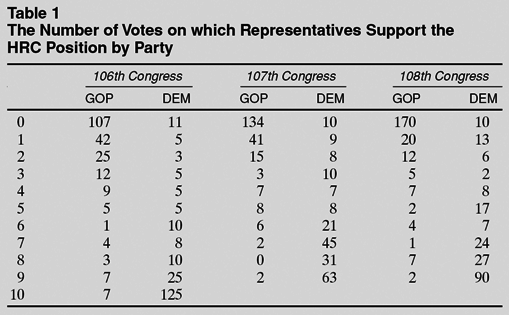
Models of support for gay and lesbian rights in Congress have usually included measures reflecting both the characteristics of the representatives and their constituencies. Party has been perceived as a crucial factor with Democrats being the more liberal party. The ideological differences in the behavior of members of the two major parties rose markedly during the 1990s (Bond and Fleisher 2000; Jacobson 2001). Examination of HRC scores from the 106th–108th Congresses suggests that this polarization extends to issues related to sexual orientation. Table 1 indicates that Democrats were far more likely to support issues championed by HRC. In the 106th Congress, 125 Democrats and 7 Republicans received perfect scores from HRC while 107 Republicans and 11 Democrats opposed HRC on every issue. Polarization appears to have increased over time. In the 108th Congress, 170 Republicans but only 10 Democrats consistently opposed HRC. However, 141 Democrats but only 10 Republicans supported HRC on seven or more issues in the Congress.
Race
Bivariate analysis of the voting behavior of African-American and Latino members suggests that they are unusually supportive of gay rights. Limiting the comparison to Democrats as most black and Latino representatives are Democrats, the average African American supported HRC on 9.6 out of 10 votes in the 106th Congress. The average Latino supported HRC on 9.1 votes but the average white supported HRC on only 7.8 votes. Black and Latino representatives' high support for HRC extended to more recent Congresses. The average white Democrat voted with HRC on 6.2 and 6.6 votes, respectively, out of 9 in the 107th and 108th Congresses but the average African American voted with HRC on 7.5 and 7.3 votes, respectively. The average Latino Democrat similarly voted with HRC on 7.5 out of 9 votes in both Congresses.
Most African-American and Latino representatives win election from majorityminority districts, so this liberalism might reflect greater support for homosexual rights among blacks and Latinos. Wilcox and Wolpert (2000) find that whites are cooler toward gay and lesbian equality than either blacks or Latinos. However, other studies suggest that greater religiosity leads blacks and Latinos to oppose gay and lesbian rights (Nicholson and Segura 2001). Nevertheless, due to past experience with discrimination, members of these groups may not be so quick to condemn their representatives for supporting lesbian and gay rights. Representatives can justify votes in favor of gay and lesbian rights by placing these votes in the context of broader support for minority rights.
Religion
Consistent with Lewis and Edelson (2000), support for gay rights should vary by religion of representative as religions differ greatly in their support for homosexual rights. Representatives of any particular religion are more likely to hail from constituencies with voters who share their faith, so it is difficult to assess whether the beliefs of a representative or their constituents drive the representative's actions. However, religion may remain a potent force regardless of whether the pressure toward action stems from internal religious or external constituent beliefs. All religion variables were coded to include only white representatives as black and Latino representatives are expected to be relatively liberal regardless of religion.
Members of liberal churches should support gay and lesbian rights to a greater extent than members of conservative churches. Liberal Protestant representatives, defined as Episcopalians or Unitarians, are expected to vote more often in favor of gay and lesbian rights than representatives of other religions. Unitarians hold tolerance as one of their core beliefs and ordain gay and lesbian ministers. The average liberal Protestant member supported HRC on around 0.5 votes more than other white members in the 106th and 108th Congresses but there was no difference in the 107th Congress. Jewish beliefs on homosexuality and other issues vary substantially. Orthodox Jews are more likely to hold conservative views than non-practicing Jews or members of Reform or Conservative synagogues. As most Jews adhere to the more liberal religious traditions within Judaism, Jewish representatives are expected to take relatively liberal positions. In all three Congresses, the average Jewish Democrat supported HRC on approximately two more votes than the average non-Jewish Democrat.2
Only one Jewish representative sat in the House as a Republican.
Conservative churches are highly critical of efforts to expand legal protections for homosexuals. Many of their members believe that homosexual behavior is sinful and that legal protection for gays and lesbians would only serve to promote behavior which ought to be condemned. The Mormon Church is critical of homosexuality, so Mormon representatives may oppose gay rights more often. The average Mormon Republican opposed HRC on 1.6 more votes in the 106th Congress and on 0.9 more votes in the 107th and 108th Congresses than other Republican representatives.3
Ten out of 12 Mormon representatives were Republicans in the 106th Congress; eight out of 11 were Republicans in the 107th and 108th Congresses.
leaders, such as Jerry Falwell, and organizations, such as the Southern Baptist Convention, have been leaders in combating legal protections for gay and lesbian rights. In the 108th Congress, the average white Baptist Democrat opposed HRC on 1.7 more votes than other white Democrats (as compared to a difference of 0.9 votes among Republicans). Black Baptists often agree that homosexuality is sinful and provide little support for homosexual rights or gays and lesbians within the African-American community (Cohen
1999). However, black Baptist leaders have provided little support for anti-gay crusades, perhaps fearing that the promotion of intolerance against gays and lesbians might encourage intolerance more generally.
Prominent Roman Catholic prelates have publicly condemned homosexuality and the Roman Catholic Church is officially opposed to the expansion of homosexual rights. The Roman Catholic Church nevertheless has had decidedly mixed success in promoting its conservative views on social issues among its adherents. Roman Catholic representatives may thus fail to demonstrate higher levels of conservatism on gay and lesbian issues. In the 106th Congress, for example, the average white Catholic representative voted with HRC on 0.9 more votes than the average white non-Catholic representative of the same party.
Gender
Past studies have suggested that women may be more liberal than other representatives, especially on social issues. Of course, this relative liberalism may reflect that more progressive districts are more likely to elect women, rather than that liberalism is a trait inherent in women. In any case, the average female Democrat voted with HRC on 1.9 votes more than the average male Democrat in the 108th Congress. Female Republicans voted with HRC on an average of 0.9 more votes than male Republicans.
Region
Region likely explains deviations by Democrats and Republicans from the dominant positions within their parties. The South has long been a social conservative heartland (Rozell and Wilcox 1997; Lublin 2004), so representatives from the South should accordingly provide lower levels of support on lesbian and gay issues than other representatives. New England representatives, on the other hand, should likely provide greater support for gay rights. Speel (1998) documented how the growing social conservatism of the Republicans on the national level alienated New England Republicans. Historically, New England Republicans took liberal positions on racial and social issues even as they supported economic conservatism. In order to survive electorally, New England Republicans may still deviate from the dominant social conservatism of their party and minimize distinctions with Democrats.
Urbanism and Education
Urban areas have more heterogeneous populations than rural areas and are known for being more tolerant of differences among people, though Wolpert and Wilcox (2000) found no evidence of significant differences between urban and rural support for gay rights. The gay population is also usually more visible and organized in urban areas. Moreover, Lewis and Edelson (2000) found that opposition to the Defense of Marriage Act (DOMA) and support for the Employment Non-Discrimination Act (ENDA) rose with the population density of congressional districts, so congressional support for gay rights should rise as the proportion urban of their districts increases. Scholars have repeatedly demonstrated that tolerance toward members of other groups usually rises with education.4
However, Wilcox and Wolpert (2000) found no significant relationship between education and support for gay and lesbian rights. Lewis and Edelson (2000) did not examine education in their analysis of opposition to DOMA and support for ENDA.
Members who represent districts with a greater
proportion of college graduates should accordingly support gay and lesbian rights at a higher rate.
Results and Discussion
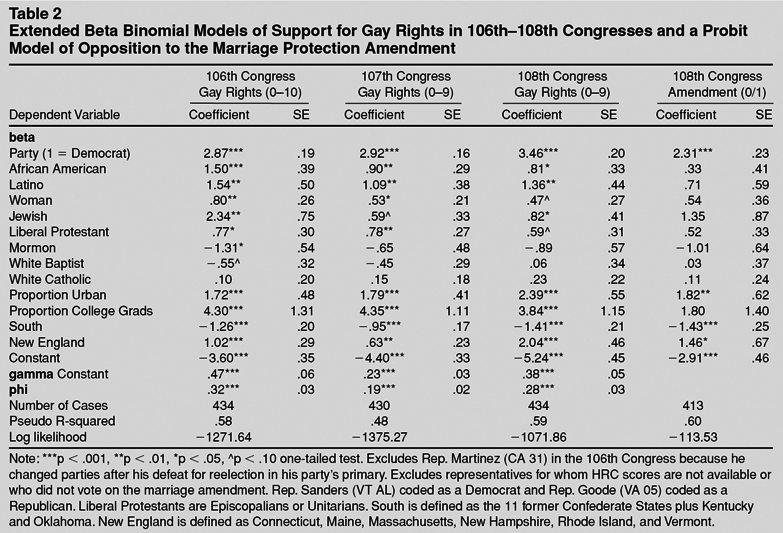
Table 2 presents extended betabinomial models of support for gay and lesbian rights in the 106th–108th Congresses as well as a probit model of opposition to the Marriage Protection Amendment in the 108th Congress. For the model for the 106th Congress, the coefficients on all variables are in the directions predicted and z-tests (equivalent to standard t-tests) indicate that all are statistically significant at p .05 (one-tailed test) except for the coefficients on white Baptist and white Catholic representative.
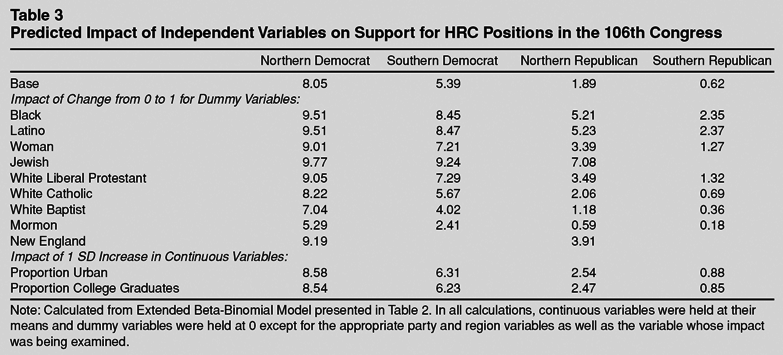
Table 3 shows the predicted impact of the different factors on support for HRC positions in the 106th Congress. Party affiliation clearly had the greatest influence on the level of support for gay rights. Northern Democrats were far more likely to vote with HRC than northern Republicans. Among northern representatives, the model predicted that a northern Democrat would support HRC on at least eight out of 10 votes while a northern Republican would oppose HRC on just over eight out of 10 votes. The partisan differences among southern representatives were smaller but still large. While southern Republicans were expected to oppose HRC on at least nine votes, southern Democrats were predicted to support HRC on at least five occasions.
Regional differences within the parties were also strong, though weaker than the gap between the parties. Southern Democrats were predicted to vote with HRC on 2.7 fewer votes than other Democrats while New England Republicans were predicted to vote with HRC on 2.0 more votes than other northern Republicans. New England Democrats were also unusually liberal and southern Republicans unusually conservative compared to other members of their parties, but the intra-party differences amounted to around only one vote in each case.
African-American and Latino representatives from the North were predicted to support HRC on nearly every occasion, while their southern counterparts were expected to vote with HRC on over eight of 10 votes, higher than the rate of support among northern white Democrats. Women representatives were also more sympathetic to gay and lesbian rights though the effect was not as strong as that of race or region. Gender had the strongest impact among southern Democrats, with women voting in favor of gay and lesbian rights on 1.8 more votes than their male counterparts.
Religious convictions influence the voting behavior of members on gay rights but the impact varies greatly by faith. Jewish Democrats took the most strongly pro-HRC positions of any group of representatives in either the North or the South in the 106th Congress. As Table 3 shows, white liberal Protestants (Episcopalians and Unitarians) were also expected to be more supportive of gay rights, though not as supportive as Jews. Contrary to what one would expect based on Catholic doctrine, white Catholic representatives appear marginally more supportive of gay rights than other members, though the effect is not statistically significant. Mormons and white Baptists were noticeably more conservative than other members, especially among Democrats, in the 106th Congress. Mormon Democrats opposed HRC on approximately two more votes than other Democrats. White Baptist Democrats cast around one more vote against the HRC position than other Democrats.
The impact of the two demographic variables, proportion urban and proportion college graduates, is small. Southern Democrats from districts that are 97% urban provide support for HRC on 0.9 more issues than Democrats from the South who hail from 75% urban districts (a difference of one SD). Similarly, southern Democrats who represent districts where 28% completed college provide support on 0.8 more issues than their peers who represent districts where only 20% are college graduates (a one SD difference). Changes for members from other parties and regions are smaller.
The results presented in Table 2 suggest that the importance of religion has declined over time. By the 108th Congress, only Jewish representatives demonstrated statistically significant different levels of support (at p .05). And the impact of religion dropped dramatically even among Jewish members; Jewish representatives were not significantly more likely to support or to oppose the Marriage Protection Amendment (see the last two columns of Table 2).
At the same time that religion has declined, party has grown in importance from the 106th to 108th Congress. Partisanship is also one of the few factors, along with region and urbanism, to influence voting on the Marriage Protection Amendment. Northern Democrats had a 90% probability of voting against the Amendment compared to a 15% probability for northern Republicans. Among southerners, the probability of opposition was only 1% for Republicans and 44% for Democrats. In contrast, New England Democrats were virtually assured of voting against the Amendment as were two in three New England Republicans. These results reflect that 80% of Democrats who voted for the Amendment were southerners and 93% of Republicans who voted against it were non-southerners.
The most important congressional vote on gay and lesbian rights in recent memory was a heavily partisan vote with regional defections. The outcome on this vote closely reflects the rising importance of party and declining importance of religion in voting on gay and lesbian issues. Unless the Republicans make major gains in the U.S. House, the chance of passing anti-gay constitutional amendments is quite low. On the other hand, the probability of passing legislation favorable to lesbians and gays should remain low unless Democrats can retake the House. In short, the statusquo on gay and lesbian rights should maintain itself unless the balance of the House alters substantially from its post-1994 makeup.