Introduction
The ENT emergency clinic at the Leicester Royal Infirmary provides an important patient service. It is run daily and is conducted by senior house officers (SHOs) and foundation year doctors. Within our department, written documentation was filed in the patient's notes, but often no formal correspondence was sent to the patient's general practitioner. This was clearly unacceptable practice and had to be addressed. With current financial restraints within the National Health Service and an existing backlog of consultant clinic dictations, relying on overstretched secretarial staff to generate clinic letters was not a viable option. Instead, we needed to explore other, more cost-effective methods of providing general practitioner correspondence.
A published audit conducted within another hospital had previously demonstrated improvements in record-keeping following introduction of a computer template, for patients attending the ENT emergency clinic, although no feedback had been sought from general practitioners.Reference Hobson, Khemani and Singh1
We therefore conducted a general practitioner questionnaire audit, to assess the suitability and effectiveness of a standardised, computerised clinic letter template in providing correspondence to general practitioners, regarding patients attending our ENT emergency clinic.
Standards
In accordance with the good medical practice principles published by the General Medical Council (GMC), general practitioners should be fully informed about their patients' care.2 One hundred per cent of patients seen in the ENT emergency clinic should therefore have a summary letter sent to their general practitioner.
Methods
A standardised, computerised clinic letter template was designed using Microsoft Word® software (see Appendix 1), based on guidelines published by the Royal College of Surgeons of England.3 The template filled one A4 sheet of paper and contained relevant patient details (name, date of birth and hospital number), the clinic appointment date and the referral source. Four boxes allowed the clinic doctor to fill in particulars regarding history and examination findings, diagnosis, investigations, management, and outcome. The clinic doctor's name, grade and pager number were also documented. All these details were inserted into the Microsoft Word template during the clinic visit. Two copies were printed and signed; one copy was filed in the patient's notes, and the other sent in the internal post to the patient's general practitioner.
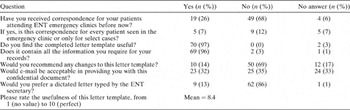
In order to audit the effectiveness of this computerised letter template, a general practitioner questionnaire and self-addressed envelope were enclosed along with the letter, inviting the recipient general practitioner to provide feedback. The questionnaire consisted of two parts. The first part retrospectively questioned whether the general practitioner had previously received correspondence regarding their patient's attendance at the ENT emergency clinic, and whether such correspondence had been received for every relevant patient or only for select cases. The second part of the survey sought feedback on the usefulness of the computerised letter template; the questions posed are shown in Table I.
Results of regional GP questionnaire*

* n = 72.
One hundred questionnaires were enclosed with the first 100 computerised letters sent to patients' general practitioners, over a four-week period in January 2007. Following this, the audit was discontinued and the template letter alone was posted. Data from the feedback questionnaires returned to the department were entered into a Microsoft Excel® database and analysed.
Results
Seventy-two of the 100 general practitioner questionnaires were completed and returned, a response rate of 72 per cent. The questionnaire results are shown in Table I.
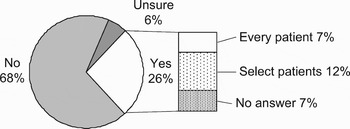
Of the 72 general practitioners who responded, only 19 (26 per cent) stated that they had received previous ENT emergency clinic letters, of whom only five (7 per cent) stated that such correspondence had been received for every patient attending this clinic (Figure 1). Seventy (97 per cent) of the general practitioners found the letter template useful, and 69 (96 per cent) stated that the letter contained all the information required for their records. Only 23 (32 per cent) stated that receiving the computerised letter via e-mail would be acceptable, and 62 (86 per cent) stated that they would not prefer to receive a typed, dictated letter instead.
Percentage of general practitioners who received ENT emergency clinic correspondence prior to the introduction of the computerised letter template.

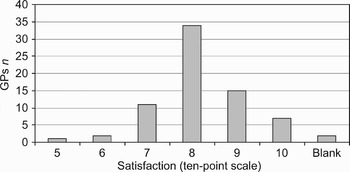
General practitioners were asked to score the usefulness of our template letter on 10-point satisfaction scale (in which one indicated no value and 10 indicated perfection). The mean satisfaction score of the 72 respondents was 8.4 (Figure 2).
General practitioners' (GPs) satisfaction with the computerised clinic letter template, scored on a 10-point scale. Mean = 8.4.

Discussion
Good communication between secondary and primary care givers is essential for effective patient management. This is stipulated in the good medical practice guidelines published by the GMC.2 In addition, studies have shown that general practitioners are highly appreciative of correspondence informing them of their patients' care.Reference Van den Brink, Moorman, de Boer and Kerrebijn4 Computerised clinic template letters provide a succinct method of formally documenting out-patient consultations. Their effectiveness has been well documented in the medical literature, with one study demonstrating that general practitioners prefer structured, computerised template letters to unstructured, dictated letters.Reference Ray, Archbold, Preston, Ranjadayalan, Suliman and Timmis5
Before the introduction of our clinic letter template, only 7 per cent of the general practitioners surveyed claimed that they had received correspondence for all their patients attending the ENT emergency clinic. Since emergency clinic summaries had not been routinely posted to the general practitioner prior to the introduction of our letter template, such correspondence would have comprised dictated letters regarding complex patients or patients listed for theatre within the emergency clinic. Similar poor notification of general practitioners by ENT emergency clinics has been documented in another hospital.Reference Hobson, Khemani and Singh1 As an ENT department serving our regional general practitioners, we had been aware of this problem before conducting this audit; answers to the retrospective part of the questionnaire confirmed the problem. The computerised clinic template letter was devised as a fast, succinct and cost-effective solution which would not overburden our already overstretched secretarial staff. Its introduction served as the implementation of change, and the second part of the questionnaire sought feedback to enable fine-tuning of the template, according to the general practitioner's wishes.
Following the commencement of this audit, 100 per cent of patients seen in the ENT emergency clinic had a computerised letter template completed, with a signed copy sent to their general practitioner via internal post. Although we could not be sure that every letter sent was received, the response rate to our questionnaire audit suggests that at least 72 per cent of general practitioners were now receiving correspondence for each patient attending the ENT emergency clinic. This prospective component of the audit completed the audit cycle, with the standard achieved.
Our computerised letter template was well received, with 97 per cent of the general practitioners surveyed stating it to be useful, and collectively awarding a mean satisfaction score of 8.4 on a 10-point scale. Ninety-six per cent of general practitioners stated that the template contained sufficient information for their records.
However, 14 per cent of respondents recommended changes. These referred to specific incidences in which certain details had been omitted and poorly legible, hand written template letters had been used (when the clinic printer temporarily failed). Both of these issues were subsequently addressed and resolved.
• Often, no general practitioner correspondence is sent regarding patients seen in the ENT emergency clinic
• A standardised, computerised clinic letter template was designed and implemented as a solution
• A regional general practitioner questionnaire audit confirmed that this mode of correspondence was a success, being delivered faster and structured better than dictated letters
• The authors recommend that all ENT emergency clinics adopt computerised templates as a means of generating general practitioner letters
We asked general practitioners whether they would prefer letters sent via e-mail, or a dictated letter. Only 32 per cent stated that e-mail would be an acceptable method of transmission. Some were opposed, stating that they did not have a work-based e-mail address, or did not check e-mails on a regular basis; others raised valid questions regarding the security of transmitting confidential documents on-line. Four of the 72 respondents (6 per cent) stated they would prefer letters transmitted by facsimile. With regards to dictated letters, surprisingly, 86 per cent stated that they would not prefer such a letter. Respondents commented that a standardised template letter was more concise, structured and readable than a dictated letter and arrived at their practice faster; this reflects the findings of other, similar studies.Reference Ray, Archbold, Preston, Ranjadayalan, Suliman and Timmis5, Reference Farquhar, Barclay, Earl, Grande, Emery and Crawford6
On the strength of this constructive general practitioner feedback, we decided to continue to use our clinic letter template, with only minor alterations, and to continue delivery via internal post. We intend to re-audit the effectiveness of this system in the future, in order to implement any required modifications.
Conclusion
The provision of general practitioner correspondence regarding patients attending the ENT emergency clinic is essential for good patient management and ensures effective continuity of care. This general practitioner questionnaire audit demonstrated the effectiveness of a simple, standardised, computerised clinic letter template in providing patients' general practitioners with fast, succinct, readable and affordable correspondence. We therefore encourage all ENT departments to adopt such a template when providing general practitioners with correspondence regarding their patients' attendance at the ENT emergency clinic.