



This article presents a preliminary theoretical model for the potential harms of compensatory exercise among those seeking weight loss, regardless of the presence of other eating disorder symptoms. Second, we outline key steps in a research pathway that will ultimately inform the development and testing of interventions that can promote both physically and psychologically healthy exercise engagement.
Compensatory exercise and associated risk for disordered eating behaviours
Individuals with eating disorders are known to engage in compensatory exercise, which can be defined as exercise undertaken to influence one’s body shape and/or weight and is designed to ‘make up for’ calories consumed during binge eating episodes. Reference Schaumberg, Pictor and Frank1 Individuals with eating disorders also report excessive exercise engagement (i.e. exercising when one otherwise would not, or exercising longer or more vigorously than one otherwise would), feeling driven and/or compelled to exercise and exercise dependence (i.e. needing more exercise to achieve positive psychological effects over time (tolerance), and experiencing intense negative affect when unable to exercise (withdrawal)). Reference Schaumberg, Pictor and Frank1 It is well established in the eating disorder literature that compensatory exercise engagement perpetuates other disordered eating symptoms. Reference Schaumberg, Pictor and Frank1 For example, compensatory exercise is thought to negatively reinforce binge eating and other forms of disinhibited eating by alleviating post-binge sequelae (aversive stimulus), which often present as heightened distress and fear of weight gain, intense feelings of guilt and shame and intrusive thoughts regarding body image. Reference Schaumberg, Pictor and Frank1–Reference Martin, Schell, Srivastav and Racine3 Exercising produces physiological and cognitive/affective changes, thus reducing post-binge symptoms and increasing the likelihood that the behaviour is repeated in the future. Reference Schaumberg, Pictor and Frank1 Importantly, the relationship between eating episodes and exercise becomes disordered through this reinforcement learning pathway. Exercise itself is not a ‘risk’ behaviour: rather, it is the context in which the exercise is being undertaken (i.e. compensatorily) that poses risk for perpetuation of disordered eating.
Potential for compensatory exercise among individuals pursuing weight loss
Individuals seeking treatment for obesity are often encouraged to increase their exercise engagement as a health-promoting behaviour alongside dietary changes. Reference Annesi4 Unfortunately, exercise is often connected directly to caloric intake within the context of behavioural obesity treatment. In fact, many evidence-based behavioural weight loss interventions promote increased exercise engagement as a ‘calorie budgeting’ method, Reference Flack, Hays, Moreland and Long5 largely without direct guidance for clinicians on how to avoid promoting compensatory exercise engagement. In concert with widespread sociocultural messaging about exercise as a potentially effective method of losing weight, and the pervasive notion that ‘calories in = calories out’, it is likely that individuals seeking weight loss are engaging in some level of compensatory exercise with the intent of controlling their weight and counteracting caloric intake even in the absence of other disordered eating symptoms. Although there are no published studies of compensatory exercise prevalence among individuals seeking weight loss, one study found that 21% of individuals with binge eating disorder (an eating disorder diagnosis characterised by lack of compensatory behaviours and often associated with excess weight gain) who were enrolled in a behavioural weight loss intervention reported compensatory exercise. Reference Wons, Michael, Lin and Juarascio6 Larger prevalence studies have estimated that 11% of individuals with binge eating disorder report current compensatory exercise irrespective of weight loss status, Reference Campbell, Greig, Griffiths, Hashman, Sottile and Isobe7 and that up to 40% of individuals with binge eating spectrum eating disorders report engaging in compensatory and/or compulsive exercise patterns. Reference Watson, Schaumberg, Thornton, Kennedy, Ong and Roche8
Potential risks of compensatory exercise in weight loss-seeking populations
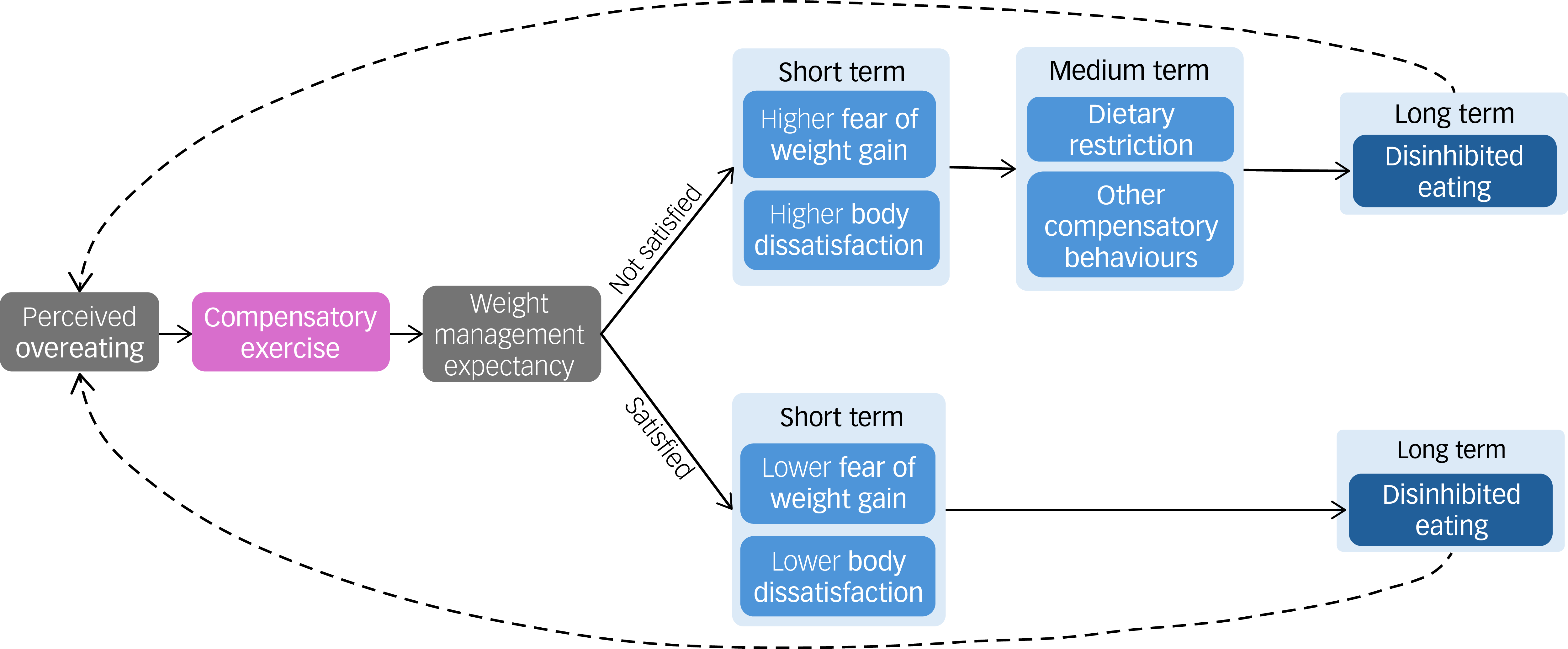
Although increasing exercise may support weight loss by burning more energy, connecting the energy burned from one exercise episode to a single perceived overeating episode forms the same negative reinforcement loop observed among individuals with eating disorders. For example, an individual may eat past the point of comfortable fullness at lunch and feel guilty that they ate more calories than intended, or worry that this eating episode could jeopardise their weight loss. They may then exercise for longer than usual that afternoon to make up for the extra calories eaten at lunch, thus reducing their guilt and increasing the likelihood that the overeating behaviour is repeated in the future. Whereas excessive and/or compulsive exercise patterns more probably indicate already active underlying eating pathology, compensatory exercise adopted by individuals pursuing weight loss could put them at undue risk for new development of disordered eating pathology and, ultimately, undermine their physical health and/or weight management efforts. Consistent with research in eating disorder populations, compensatory exercise engagement among individuals seeking weight loss could contribute to disinhibited eating, elevated fears of weight gain and onset of other compensatory behaviours (e.g. inappropriate dietary restriction), and ultimately increase the risk of meeting diagnostic criteria for an eating disorder (Fig. 1 Reference Schaumberg, Pictor and Frank1–Reference Martin, Schell, Srivastav and Racine3 ).
Maintenance model of compensatory exercise among individuals pursuing weight loss. For example, when an individual feels that they have eaten too much, they may engage in exercise to compensate for these calories with the goal of managing their weight either by avoiding future weight gain or by contributing directly to weight loss. If this individual is satisfied with the effect of that exercise episode on their weight (e.g. the number on the scale stays the same or reduces, depending on their goal), they experience reductions in fears of weight gain and body dissatisfaction, which negatively reinforce disinhibited eating in the long term. If the individual is not satisfied with the effect of that exercise episode on their weight (e.g. the number on the scale stays the same or rises, depending on their goal), they experience increased fear of weight gain and body dissatisfaction, which contribute to increased risk for inappropriate dietary restriction and other compensatory behaviours, and ultimately increase risk for disinhibited eating in the long term.

Fig. 1 Long description
The diagram begins with perceived overeating, which leads to compensatory exercise. This exercise influences weight management expectancy, which can either be satisfied or not satisfied. If not satisfied, it results in higher fear of weight gain and higher body dissatisfaction in the short term. This leads to dietary restriction and other compensatory behaviors in the medium term, ultimately resulting in disinhibited eating in the long term. If satisfied, it results in lower fear of weight gain and lower body dissatisfaction in the short term, leading directly to disinhibited eating in the long term.
Gaps in existing knowledge
Despite the potential for compensatory exercise to be problematic among individuals pursuing weight loss, no research has empirically examined compensatory exercise engagement in this population. As such, its prevalence, phenomenology and associated risks remain unknown. Without a nuanced understanding of risk and maintaining factors for compensatory exercise engagement among individuals seeking weight loss, there is little information on which to base intervention development aimed at promoting non-compensatory forms of activity. Additionally, without knowing the prevalence of compensatory exercise engagement and potential severity of associated risks among individuals seeking weight loss, there is little ground on which care providers can base decision-making around intervention resource allocation. A detailed and empirically based understanding of compensatory exercise in the context of obesity treatment would support intervention development efforts, and also serve the long-term goal of preventing comorbid eating disorder onset among individuals seeking weight loss.
Directions for future research
Given the high likelihood of compensatory exercise engagement and potential severity of associated risks among individuals pursuing weight loss, a more nuanced understanding of this phenomenon is urgently needed. Below, we lay out several key steps in a research pathway based on the National Institutes of Health stage model for behavioural intervention development. Progress across these phases of development will be used to inform both prevention efforts and clinical interventions. Although future directions for each phase of translation are discussed, this paper focuses primarily on research within stage 0 (basic research) given the formative work needed to inform specific intervention development, testing and implementation. The ultimate goal of future work should be to create interventions that effectively promote non-compensatory forms of activity (i.e. exercise as a complement to dietary changes, but not undertaken to directly make up for perceived overeating).
Stage 0: basic behavioural research
Establishing prevalence
Given the lack of foundational research in this area, establishing the prevalence of compensatory exercise among individuals pursuing weight loss represents a critical first step. Future research should seek to quantify the proportion of individuals seeking weight loss who report engaging in compensatory exercise across various settings (e.g. medical clinics, self-guided diets) and in weight management approaches (e.g. surgical versus medication-based interventions).
Empirically based understanding of risks and clinical outcomes
To better aid decision-making around resource allocation for intervention developers and care providers, future research should seek to quantify the risks and clinical outcomes associated with compensatory exercise among individuals seeking weight loss. As noted above, such risks might include the elevated probability of experiencing other eating disorder symptoms (e.g. binge eating, dietary restriction, elevated shape/weight concern, other compensatory behaviours). However, associated risks could also relate to weight management outcomes, such as higher likelihood of engagement in other forms of disinhibited eating (e.g. emotional eating, overeating without loss of control) and differences in patterns of weight change (e.g. weight cycling, weight loss/gain over time). Based on the maintenance model described in Fig. 1, engagement in compensatory exercise could jeopardise weight management outcomes and contribute to weight cycling among individuals seeking weight loss, via an increased propensity for disinhibited eating. As such, future research should examine the influence of compensatory exercise engagement on both eating disorder symptoms and diagnostic status (because many individuals seeking weight loss also report clinically significant eating disorder symptoms that often go undiagnosed Reference Bianciardi, Fabbricatore, Di Lorenzo, Innamorati, Tomassini and Gentileschi9 ), in addition to weight change. Finally, it is also possible that compensatory exercise confers additional risk for other psychopathologies such as depression or anxiety, which are highly comorbid with other eating disorder symptoms often shared by individuals seeking weight loss (e.g. poor body image).
Understanding the phenomenology
Complementary qualitative approaches could also be leveraged at this stage to understand the phenomenology of compensatory exercise engagement among individuals seeking weight loss. Such qualitative work would facilitate deeper understanding of individuals’ motivations and behavioural presentations, as well as greater context for how compensatory exercise is associated with other behavioural and psychological phenomena (e.g. other eating disorder behaviours, overeating, body image, depression, anxiety) in this population. These data could play a key role in identifying potentially relevant risk and maintenance factors (stage 0), as well as informing intervention targeting and tailoring efforts (stage I).
Identification of key risk and maintenance factors
A key ingredient for the development of effective interventions is accurate target specification. Thus, future research should leverage relevant theory to guide future work aimed at isolating specific risk and maintenance factors for compensatory exercise (e.g. perceived overeating, poor body image, elevated negative affect, social comparison making). Importantly, to inform a range of potential prevention and intervention approaches, future research should examine these risk and maintenance factors across different timescales. These timescales could range from developmental trajectories of behaviour measured over several years to inform prevention efforts, to information about within-day risk to promote timely intervention and prevent engagement in compensatory exercise among individuals already exhibiting the behaviour.
Stages I and II: intervention development and assessment of ‘pure’ efficacy
Findings from basic research will inform the development of new, and/or adaptations of existing, evidence-based intervention techniques to target relevant risk and maintenance factors for compensatory exercise. Research at this stage should take a multi-pronged approach to focus on both prevention and treatment, because there is a need for empirical understanding of how to prevent the development of compensatory exercise at the start of individuals’ weight loss journeys, as well as how to intervene once compensatory exercise is already present. Work within this stage should also define clinically meaningful changes in compensatory exercise engagement to inform future treatment efficacy testing. These interventions need to be tested for proof of concept, and simultaneously evaluated for feasibility and acceptability before advancing to the fully powered randomised controlled trial (RCT) efficacy testing stage. Finally, work within this stage should further aim to determine appropriate control conditions (e.g. current standard of care) for use within stage III RCTs to determine intervention efficacy.
Stages III–V: intervention effectiveness and implementation
Once promising interventions to either prevent or reduce engagement in compensatory exercise have been designed and preliminarily tested, research in stages III–V can focus on evaluation of real-world efficacy (III), effectiveness (IV) and implementation (V). It will be important to consider end-goals for implementation within real-world settings. Although most people undertake self-management of weight loss, those wanting added support most often present in medical settings (e.g. for medication or bariatric surgery). Thus, future interventions should be able to be readily integrated within large healthcare systems. Many individuals also attempt to lose weight on their own, often using a smartphone application for calorie tracking. Considering these two points of presentation, digital interventions could represent a promising avenue for compensatory exercise intervention among individuals seeking weight loss, given the scalability, potential for personalisation and readily self-guided nature of digital applications (rather than requiring more costly, clinician-mediated delivery). Additionally, informed by phase II research findings, digital interventions can be applied across many different timescales, thereby enabling delivery across multiple contexts and increasing efficacy.
At this stage, it will also be important to examine the impact of reductions in compensatory exercise on additional health outcomes. For example, in addition to evaluating the effect of interventions on exercise frequency, eating disorder symptoms and weight management outcomes, trials at this stage may also evaluate the effect of reducing compensatory exercise engagement on more distal physical (e.g. inflammatory response) and psychological (e.g. depression) outcomes.
Compensatory exercise engagement may put individuals pursuing weight loss at increased risk for disinhibited eating, poor body image, increased fears of weight gain, onset of other compensatory behaviours, increased risk for development of a full-threshold eating disorder, weight cycling and weight gain over time. Research in this area will enable the development and testing of interventions that can promote non-compensatory forms of exercise and ultimately improve weight management outcomes.
Data availability
Not applicable.
Author contributions
E.W.L.: conceptualisation, writing – original draft, review and editing. K.B.-R.: writing – review and editing. E.H.: writing – review and editing. C.S.: writing – review and editing, supervision.
Funding
This research received no specific grant from any funding agency, commercial or not-for-profit sectors.
Declaration of interest
None.



eLetters
No eLetters have been published for this article.