

Relationship efficacy beliefs are self-perceptions of one's ability to successfully initiate, develop, and maintain romantic relationships and are shaped by direct relationship experiences (e.g., Weiser & Weigel, Reference Weiser and Weigel2016). Such beliefs are important predictors of relationship quality (Lopez Morua, & Rice, Reference Lopez, Morua and Rice2007; Riggio et al., Reference Riggio, Weiser, Valenzuela, Lui, Montes and Heuer2011, Reference Riggio, Weiser, Valenzuela, Lui, Montes and Heuer2013; Weiser & Weigel, Reference Weiser and Weigel2016). From an attachment-theoretical perspective, beliefs about the self are, in part, shaped by attachment-related experiences (Bowlby, Reference Bowlby1973/1998; Collins, Guichard, Ford, & Feeney, Reference Collins, Guichard, Ford, Feeney, Rholes and Simpson2004). Individuals with attachment insecurities are thought to be particularly vulnerable to deficits in self-appraisals of social competence (Mallinckrodt & Wei, Reference Mallinckrodt and Wei2005; Wei, Russell, & Zakalik, Reference Wei, Russell and Zakalik2005) and report fewer efficacious romantic relationship beliefs, specifically (Lopez et al., Reference Lopez, Morua and Rice2007; Weisskirch, Reference Weisskirch2017). It is well documented that relative to their more secure counterparts, avoidant and anxious individuals are more likely to experience less satisfying romantic relationships (e.g., Hadden, Smith, & Webster, Reference Hadden, Smith and Webster2014).
Although research has reported relationships between attachment styles and relationship efficacy beliefs (e.g., Lopez et al., Reference Lopez, Morua and Rice2007), attachment styles and relationship quality (e.g., Hadden et al., Reference Hadden, Smith and Webster2014), and relationship efficacy beliefs and relationship quality (e.g., Lopez et al., Reference Lopez, Morua and Rice2007; Weiser & Weigel, Reference Weiser and Weigel2016; Riggio et al., Reference Riggio, Weiser, Valenzuela, Lui, Montes and Heuer2011), to our knowledge research has not examined whether attachment insecurity is related to lower relationship satisfaction in part because of individuals’ beliefs of their own relational incompetence. The present study extends previous research by investigating whether relationship efficacy beliefs mediate the relationship between attachment style and relationship satisfaction. A secondary aim was to further investigate the role of direct, romantic experience on relationship efficacy beliefs. Whereas greater experience is related to more efficacious beliefs in other domains (e.g., Tschannen-Moran & Hoy, Reference Tschannen-Moran and Hoy2007; Wilfong, Reference Wilfong2006), findings are mixed in the relationship domain (e.g., Cui, Fincham, & Pasley, Reference Cui, Fincham and Pasley2008; Cohen, Reference Cohen2018; Riggio et al., Reference Riggio, Weiser, Valenzuela, Lui, Montes and Heuer2011, Reference Riggio, Weiser, Valenzuela, Lui, Montes and Heuer2013).
We addressed these aims in a sample of emerging adults. For emerging adults (i.e., 18- to 25-year-olds) in the West, exploring love and intimacy becomes more serious and could be considered a normative developmental task (Arnett, Reference Arnett2000). While not all young people engage in romantic relationships, for those who do, these early romantic experiences might play an important role in shaping beliefs and expectations about the self and others and developing interpersonal skills for relationships later in the lifespan. As such, it is important to examine the characteristics and processes underlying these cognitions during this key period of identity development.
Attachment, Efficacy Beliefs, and Relationship Satisfaction
For our first aim we tested the model depicted in Figure 1: Attachment style shapes beliefs about one's ability to initiate, develop, and maintain successful romantic relationships (Path a) and, in turn, relationship efficacy beliefs predict greater relationship satisfaction (Path b).
Proposed indirect effect of attachment style on relationship satisfaction through relationship efficacy beliefs.

Attachment styles reflect systematic differences in mental representations of individuals’ attachment histories (Bowlby, 1973/Reference Bowlby1998; Collins & Allard, Reference Collins, Allard, Fletcher and Clark2002), which include beliefs about relationship partners and the self, such as self-worth and efficacy, and are used to organise and shape affect, behaviour and cognitions in close relationships (Collins & Allard, Reference Collins, Allard, Fletcher and Clark2002). Secure attachment histories reflect consistent patterns of positive experiences and receiving sensitive, responsive care, fostering positive views of self (e.g., as competent of gaining protection or support when needed) and others (e.g., as available and trustworthy). In contrast, insecure attachment histories reflect less optimal experiences involving unreliable or neglectful attachment figures and a lack of consistent sensitive and responsive care. Such attachment histories are proposed to foster dysfunctions in self-representations (Mikulincer & Shaver, Reference Mikulincer and Shaver2016).
Attachment insecurity is commonly assessed along two dimensions — attachment anxiety and avoidance — with low scores on both dimensions indicative of attachment security. Attachment anxiety reflects hyperactivation of the attachment system, shown in tendencies to experience negative emotions and persistent concerns of and hypervigilance to signs of relational threat (Mikulincer & Shaver, Reference Mikulincer and Shaver2016). Individuals high in attachment anxiety are concerned about being abandoned, rejected, and not being loved by their attachment figures (Brennan, Clark, & Shaver, Reference Brennan, Clark, Shaver, Simpson and Rholes1998; Rholes & Simpson, Reference Rholes, Simpson, Rholes and Simpson2004). Attachment avoidance reflects deactivation of the attachment system and is characterised by the tendency to avoid one's own and others’ negative emotions, and an inability to regulate negative emotions effectively (see Mikulincer & Shaver, Reference Mikulincer and Shaver2016). Individuals high in attachment avoidance desire independence and are uncomfortable with closeness in their relationships (Brennan et al., Reference Brennan, Clark, Shaver, Simpson and Rholes1998; Rholes & Simpson, Reference Rholes, Simpson, Rholes and Simpson2004). Anxiously attached individuals tend to have negative self-views (e.g., low self-esteem, unworthy of protection) and ambivalent views of others — they strongly desire others’ attention and love, but also perceive others as unavailable or unreliable. In contrast, avoidantly attached individuals tend to report positive self-views in some domains (e.g., high explicit self-esteem); however, these views are thought to be due to defensive processing and are less stable than the positive views of secure individuals (Mikulincer & Shaver, Reference Mikulincer and Shaver2016). Avoidant individuals hold negative views of others and also some negative views of self (e.g., in interpersonal domains; Mikulincer & Shaver, Reference Mikulincer and Shaver2016).
Attachment and relationship satisfaction
The association between attachment security and relationship satisfaction is well documented (e.g., see the meta-analysis by Hadden et al., Reference Hadden, Smith and Webster2014; see also Li & Chan, Reference Li and Chan2012). Securely attached individuals tend to report cognitions that promote relationship satisfaction (e.g., cognitive openness; Mikulincer & Arad, Reference Mikulincer and Arad1999), whereas those who are insecurely attached tend to report cognitions that diminish relationship quality (e.g., negative attributions to ambiguous relational events; Collins, Ford, Guichard, & Allard, Reference Collins, Ford, Guichard and Allard2006). Individuals with attachment insecurities also report and have been observed to provide less optimal caregiving (e.g., see Collins, Ford, Guichard, Kane & Feeney, Reference Collins, Ford, Guichard, Kane, Feeney, Mikulincer and Shaver2010). Perceptions of partner's care (Kane et al., Reference Kane, Jaremka, Guichard, Ford, Collins and Feeney2007) and own caregiving (Reizer, Ein-Dor, & Shaver, Reference Reizer, Ein-Dor and Shaver2014) predict relationship satisfaction.
Nevertheless, the association between attachment style and relationship satisfaction is not simply direct but is mediated. Insecure attachment is associated with less adaptive social-cognitive (e.g., negative partner attributions; Sumer & Cozzarelli, Reference Sümer and Cozzarelli2004), emotional (e.g., negative affectivity; Davila, Bradbury, & Fincham, Reference Davila, Bradbury and Fincham1998), and relational skills (e.g., conflict resolution behaviours; Marchand, Reference Marchand2004), which in turn are linked to negative evaluations of the relationship. We propose that another social-cognitive factor, efficacy beliefs, will also mediate the association between attachment and relationship satisfaction.
Attachment and self-efficacy beliefs
As might be expected, given the variation in their self-views, individuals with different attachment styles vary in their efficacy beliefs across a number of domains (e.g., see Mikulincer & Shaver, Reference Mikulincer and Shaver2016); in particular, their social and romantic relationships (Figure 1, Path a). For example, Mallinckrodt and Wei (Reference Mallinckrodt and Wei2005) and Wei et al. (Reference Wei, Russell and Zakalik2005) confirmed in undergraduate samples that individuals high in attachment anxiety were particularly vulnerable to deficits in social self-efficacy due to their negative attachment histories, and their negative model of self. Anxious individuals’ reliance on others also impedes the development of their self-efficacy (Mikulincer & Shaver, Reference Mikulincer and Shaver2016). Although avoidant individuals might hold a positive or negative model of self (Bartholomew, Reference Bartholomew1990), they also have less positive attachment histories. Like attachment anxiety, attachment avoidance is associated with lower confidence in social situations (e.g., Collins & Read, Reference Collins and Read1990) and lower social self-efficacy (Mallinckrodt & Wei, Reference Mallinckrodt and Wei2005; Wei et al., Reference Wei, Russell and Zakalik2005). Caregiving history and characteristics of their self-knowledge likely also account for the negative associations reported between relationship self-efficacy and attachment anxiety and avoidance (Lopez et al., Reference Lopez, Morua and Rice2007; Weisskirch, Reference Weisskirch2017).
Self-efficacy beliefs and relationship quality
Those individuals who believe they are capable of enacting relationship-promoting behaviours do so and, as a consequence, experience more satisfactory relationships (Weiser & Weigel, Reference Weiser and Weigel2016) and greater commitment, satisfaction and investment (Riggio et al., Reference Riggio, Weiser, Valenzuela, Lui, Montes and Heuer2013; Figure 1, Path b). Relationship-relevant efficacy beliefs can be assessed at multiple levels. For example, social self-efficacy, a relatively broad set of beliefs across different social interactions (e.g., with strangers, friends, partners), was found to partly explain the association between married adults’ attachment avoidance and conflict resolution styles (Corcoran & Mallinckrodt, Reference Corcoran and Mallinckrodt2000). Self-efficacy in romantic relationships, reflects beliefs about one's abilities as a relationship partner, developed across different relationships and not tied to a specific partner (i.e., domain-specific; Riggio et al., Reference Riggio, Weiser, Valenzuela, Lui, Montes and Heuer2011, Reference Riggio, Weiser, Valenzuela, Lui, Montes and Heuer2013). Further, efficacy with specific relationship behaviours has also been examined. For example, Ciu, Fincham, and Pasley (Reference Cui, Fincham and Pasley2008) found that efficacy beliefs focused on resolving conflict were significantly correlated with undergraduate students’ relationship quality and conflict. Lopez et al. (Reference Lopez, Morua and Rice2007, p. 92) examined relationship self-efficacy at the level of confidence in one's ability to enact specific relationship maintenance behaviours: ‘to give and receive care and support’ (Mutuality); ‘to constructively manage unpleasant personal affect associated with potentially frustrating partner behaviours or relationship events’ (Emotional Control); and ‘to assert personal needs and maintain clear interpersonal boundaries with one's partner’ (Differentiation). All three efficacy beliefs were negatively correlated with attachment avoidance and anxiety, reflecting the general pattern of insecure individuals’ tendency to make negative self-appraisals in social competence domains, and with relationship satisfaction. Lopez et al. found that after controlling for relationship satisfaction at time 1, emotional control beliefs (and attachment anxiety) significantly predicted undergraduate students’ relationship satisfaction approximately three months later. Individuals who reported greater confidence in their ability to effectively manage their emotions in the face of arguments, disagreement or criticism with their partner reported higher relationship satisfaction over time.
Taken together, more insecure individuals might report lower relationship satisfaction in part because of beliefs of their own social and relational incompetence. To our knowledge, previous research has not directly examined whether the three relationship efficacy beliefs — mutuality, emotional control, and differentiation — mediate the association between attachment style and relationship satisfaction. By examining multiple efficacy beliefs, we can identify whether certain behaviours are more important, in general, or for individuals with different attachment styles, specifically, in predicting relationship satisfaction. For example, given that caregiving is a significant predictor of relationship satisfaction (e.g., Reizer et al., Reference Reizer, Ein-Dor and Shaver2014), mutuality beliefs may play an important role in predicting levels of satisfaction. Despite engaging in a relationship, attachment avoidant individuals, for whom self-reliance and maintaining emotional and cognitive distance are paramount, might believe they are not able to achieve or maintain relationship boundaries, which in turn might undermine their experience of relationship satisfaction. Emotional control beliefs might be important for both attachment-avoidant and -anxious individuals, for whom perceived incompetence in their ability to effectively regulate negative emotions might have an adverse impact on their relationship satisfaction.
Romantic Relationship Experience and Efficacy Beliefs
Another aim of the study was to examine the role of romantic relationship experience in relationship efficacy beliefs. According to social cognitive theory, self-efficacy beliefs develop over time and are shaped by four sources: mastery experiences, verbal persuasion, vicarious experiences, and physiological and affective states (Bandura, Reference Bandura1997). Of these sources, direct mastery experiences are the most important. Direct experiences of success or failure provide information about one's capabilities, which then contributes to self-appraisal in that domain. Performance on a task affects confidence in performing similar tasks in the future, with successful outcomes enhancing efficacy beliefs (Bandura, Reference Bandura1977). Little is known about the relationship between direct, romantic experience and relationship efficacy beliefs, specifically.
In other domains, experience has been linked to efficacy beliefs. For example, teacher efficacy beliefs were lower among novice versus experienced teachers (Tschannen-Moran & Hoy, Reference Tschannen-Moran and Hoy2007). Wilfong (Reference Wilfong2006) found that computing experience was positively correlated with computing efficacy beliefs. In a relationship context, those in their first relationship might have fewer direct experiences of being romantically involved and, therefore, less information about their ability to enact behaviours to maintain a satisfying relationship. Such individuals might be less confident in their relational abilities compared to individuals who have experienced multiple dating or romantic relationships. Indeed, relationship commitment, which in part reflects experience of relational interdependence, is related to relationship efficacy beliefs: Participants in committed relationships reported higher mutuality and emotional concern efficacy beliefs compared to those in less committed relationships (Lopez et al., Reference Lopez, Morua and Rice2007).
Research has examined differences in self-efficacy in romantic relationships in terms of current relationship status (e.g., Cohen, Reference Cohen2018; Riggio et al., Reference Riggio, Weiser, Valenzuela, Lui, Montes and Heuer2011). For example, Cohen (Reference Cohen2018) reported that adults currently in a romantic relationship reported higher romantic efficacy beliefs than did those who were currently single. Across three undergraduate samples, Riggio and colleagues (Reference Riggio, Weiser, Valenzuela, Lui, Montes and Heuer2013) found no significant association between efficacy beliefs and relationship status when status was defined as currently romantically involved (vs. not), married (vs. single), or ranged from married to dating several people. Yet, to our knowledge, only one study has examined variation in relationship efficacy beliefs based on previous relationship experience. Riggio et al. (Reference Riggio, Weiser, Valenzuela, Lui, Montes and Heuer2013) correlated number of previous relationships with domain-specific efficacy belief scores and found no significant relationship: Those with more partners (albeit the average number of partners was low), did not report greater relationship competence. To explore this issue further, we examined whether differences might be evident in the three specific relationship efficacy beliefs among individuals in their first ever romantic relationship and those who have had more partners.
The Present Study
We are contributing to the extant literature on attachment styles, efficacy beliefs and relationship outcomes in two ways. First, we examined whether relationship efficacy beliefs explain, in part, insecure individuals’ experiences of less satisfying romantic relationships (Figure 1, Path c’ and c respectively). We hypothesised that participants with higher avoidance and anxiety would report lower relationship efficacy beliefs (mutuality, differentiation, and emotional control) (Figure 1, Path a; Hypothesis 1a) and that those with lower efficacy beliefs would, in turn, report lower relationship satisfaction (Figure 1, Path b; Hypothesis 1b). Second, we examined romantic experience and how it relates to efficacy beliefs. Although previous research has not found a significant association between relationship experience and efficacy beliefs assessed at the domain-specific level, we speculated whether those individuals with less romantic experience (i.e., those in their first romantic relationship) would report fewer efficacious beliefs in terms of mutuality, differentiation, and emotional control in their current relationship, than those individuals with more experience (Hypothesis 2).
Method
Procedure and Participants
The project was approved by the University's ethics committee. The survey was hosted online in the School of Psychology's research participation system. Eligible participants were emerging adults involved in a romantic relationship of at least 3 months’ duration. Volunteers (N = 273) were recruited from the School's programs and received research credits as compensation. After giving informed consent, participants completed the measures described below, which were presented in a computer-generated random order, with demographic information always presented last. Additional measures (see authors [manuscript in preparation]) were included as part of a project on the development of relationship skills in emerging adulthood. All participants were debriefed online.
Data were excluded if participants were not currently in a relationship (n = 22), were deemed to show insufficient effort responding (i.e., 2 seconds or less per item; n = 4; Huang, Curran, Keeney, Poposki, & DeShon, Reference Huang, Curran, Keeney, Poposki and DeShon2012), or were male (n = 24).Footnote 1 Because the measure of relationship efficacy was specific to a partner, we also excluded those participants who described their relationship status as ‘dating several people casually’ (n = 8) or ‘other’ and did not report their status (n = 6).
The final sample consisted of 216 emerging adult women (median age = 19 years, M = 19.2, SD = 1.03), the majority of whom were British (85%) and heterosexual (89%). Eighty-two percent stated they were dating one person seriously, 14% were dating one person casually, and, 3.2% were cohabiting.
Measures
Relationship-specific attachment style
Because of the age and likely range of romantic experience of the sample, we measured attachment to current partner because domain-specific measures (i.e., romantic attachment style) capture thoughts, feelings, and behaviours across different romantic partners.Footnote 2 We used the partner items from Fraley, Heffernan, Vicary, and Brumbaugh's (Reference Fraley, Heffernan, Vicary and Brumbaugh2011) Experiences in Close Relationships — Relationship Structures measure to assess attachment avoidance (six items; e.g., ‘I don't feel comfortable opening up to this person’) and anxiety (three items; e.g., ‘I'm afraid that this person may abandon me’). Participants rated their agreement with each item on a 7-point scale (1 = strongly disagree to 7 = strongly agree). Fraley et al. (Reference Fraley, Heffernan, Vicary and Brumbaugh2011) found the measure to be valid and reliable in samples of dating and married adults.
Relationship self-efficacy
The Relationship Self-Efficacy Scale (Lopez et al., Reference Lopez, Morua and Rice2007) was originally developed on an undergraduate student sample. The measure assesses confidence in performing relationship-maintenance behaviours within a specific relationship using 35 statements that fall into three subscales: mutuality (e.g. ‘Let your partner take care of you when you are ill’; ‘Comfort your partner when he or she is angry or upset with someone else’), emotional control (e.g., ‘Stay calm when you and your partner are having a serious argument’; ‘Accept criticism from your partner without attacking/challenging him or her’) and differentiation (e.g. ‘Tell your partner when you would prefer to be alone’; ‘Accept your partner's desire to spend time with other people’). Participants rated their confidence for each behaviour along a 9-point scale (1 = not at all sure to 9 = completely sure). Participants were instructed to consider their current partner when completing the items.
Each subscale has shown good internal consistency, moderate-to-high test–retest reliability over 3 months, and predictive validity, with the scores associated with relationship satisfaction over 3 months after controlling for attachment style and time 1 satisfaction (Lopez et al., Reference Lopez, Morua and Rice2007). Penzel (Reference Penzel2017) reported that the scores positively correlated with a measure of romantic competence (knowledge about the effectiveness of behavioural responses in a romantic context).
Relationship satisfaction
The seven-item Relationship Assessment Scale (Hendrick, Reference Hendrick1988) scale was used to assess relationship satisfaction (e.g., ‘How well does your partner meet your needs?’). Participants indicated their agreement with each item using a 5-point scale (anchors varied). Although the measure was originally used to assess marital satisfaction (Hendrick, Reference Hendrick1981), Hendrick, Dicke, and Hendrick (Reference Hendrick, Dicke and Hendrick1998) modified and tested it on a sample of undergraduate students. The measure showed good internal consistency and test–retest reliability over 6–7 weeks in an undergraduate sample (Hendrick et al., Reference Hendrick, Dicke and Hendrick1998). Hall and Fincham (Reference Hall and Fincham2009) found its scores to correlate meaningfully with other measures of relationship satisfaction in undergraduate samples.
Social self-efficacy
Given that previous research has found social self-efficacy to correlate with measures of relationship self-efficacy (e.g., Riggio et al., Reference Riggio, Weiser, Valenzuela, Lui, Montes and Heuer2011) and to mediate the association between attachment and relationship outcomes (Corcoran & Mallinckrodt, Reference Corcoran and Mallinckrodt2000), we included a measure of social self-efficacy to rule out this alternative explanation for the hypothesised mediated association. The Perceived Social Self-Efficacy scale (Smith & Betz, Reference Smith and Betz2000) assesses self-efficacy across a range of social behaviours. Participants indicated their confidence in carrying out 25 social activities (e.g., ‘Get invited to a party that is being given by a prominent or popular individual’) using a 5-point scale (1 = no confidence to 5 = complete confidence). Smith and Betz developed the measure on a sample of undergraduate students, and found it to have high internal consistency, test–retest reliability over 3 weeks, and demonstrated its construct and discriminant validity.
Demographic information and romantic experience
Participants reported gender, age, ethnicity, and sexual orientation. To assess romantic experience, participants indicated current relationship status (dating several people casually, dating one person casually, dating one person seriously, cohabiting, married, other) and length and whether their current relationship was their first romantic relationship. Participants who answered ‘no’ to this last question, were asked to indicate how many previous romantic relationships they had had and the length of each. Due to a computing problem, relationship length was not recorded for current or previous relationships.
Results
Table 1 displays the descriptive statistics, reliability coefficients, and correlations for the attachment, satisfaction, and efficacy scores. Consistent with Lopez et al. (Reference Lopez, Morua and Rice2007), the three relationship efficacy belief scores were negatively correlated with attachment avoidance, anxiety, and satisfaction. There was no evidence of multicollinearity among the attachment and self-efficacy variables (rs all < .70; Tabachnick & Fidell, Reference Tabachnick and Fidell2013).
Descriptive Statistics and Zero-Order Correlations (N = 216)

Mediation Analysis
Given that the three beliefs were correlated with each other and with relationship satisfaction we tested Hypotheses 1a and 1b with Hayes’ (Reference Hayes2013) PROCESS multiple mediation model (model 4, with bias-corrected [BC] 95% CIs, 5,000 bootstrap samples). If simple mediation tests are used in such contexts, a significant mediating effect could be because of the mediator's correlation with other non-included mediator(s) and the outcome variable (Hayes, Reference Hayes2013). As such, we entered all efficacy beliefs as mediators to examine the unique mediating effect of each belief while controlling for the other beliefs.Footnote 3 The predictor variable was attachment avoidance (with anxiety as a covariate; and vice versa); the mediators were mutuality, emotional control, and differentiation scores and social self-efficacy; and the criterion was relationship satisfaction. Both models accounted for 53% of the variance in relationship satisfaction.
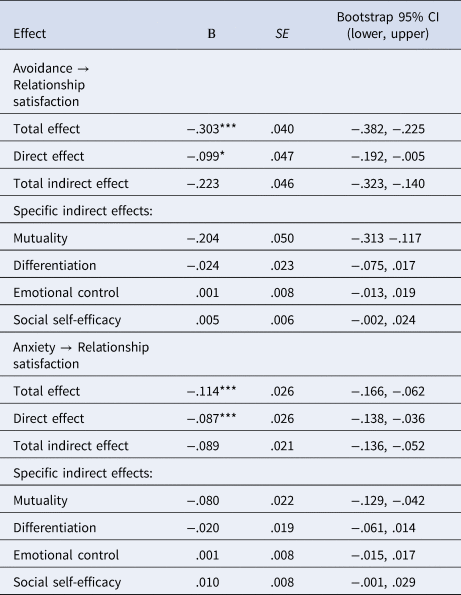
With attachment avoidance as the predictor, its total and direct effects on relationship satisfaction were statistically significant (see Table 2 and Figure 2). Addressing Hypothesis 1a, avoidance was negatively associated with mutuality, differentiation, and emotional control, but was not significantly associated with social self-efficacy. Mutuality beliefs were significantly related to satisfaction, whereas differentiation, emotional control, and social self-efficacy beliefs were not. The total indirect effect was statistically significant, indicating that the set of efficacy belief scores mediated the association between avoidance and satisfaction, providing support for Hypothesis 1b. Only the specific indirect effect of mutuality beliefs was significant, controlling for differentiation and emotional control and social self-efficacy.
Coefficients and BC 95% CI of the Direct and Indirect Effects

Note: N = 216. Both models: Total R 2 = .531. F of model (6, 209) = 39.9***
***p < .001. **p < .01.
Indirect effect of attachment style on relationship satisfaction through social and relationship efficacy beliefs

With attachment anxiety as the predictor, its total and direct effects on relationship satisfaction were also significant. In support of Hypothesis 1a, anxiety was negatively related to mutuality (β = −.284, p < .001), differentiation (β = −.377, p < .001), emotional control (β = −.248, p < .001), and social self-efficacy beliefs (β = −.111, p < .001). Mutuality beliefs were significant predictors of satisfaction, but differentiation, emotional control and social self-efficacy were not. Addressing Hypothesis 1b, as for avoidance, the total indirect effect was significant, but only the specific indirect effect for mutuality beliefs was significant, controlling for differentiation and emotional control and social self-efficacy.
Alternative models
Due to the study's cross-sectional design, we tested two alternative explanations for the association between attachment, efficacy beliefs and satisfaction with a focus on mutuality beliefs, as these were the only ones to significantly mediate the association. First, we tested and found a significant effect of satisfaction as a mediator of the association between attachment avoidance (indirect effect: β = −.276, bootstrap SE = .061, BC 95% CI [−.410, −.171]) and anxiety (indirect effect: β = −.149, bootstrap SE = .033, BC 95% CI [−.222, −.091]) and mutuality beliefs. Second, we examined whether attachment style mediated the effect of mutuality beliefs on satisfaction. Both attachment avoidance (indirect effect: β = −.061, bootstrap SE = .031, BC 95% CI [.006, .123]) and anxiety (indirect effect: β = .049, bootstrap SE = .017, BC 95% CI [.021, .085]) were significant mediators.
Romantic Experience and Efficacy Beliefs
Romantic relationship experience was operationalised as the number of previous romantic relationships. On average, participants had had 1.14 romantic relationships (SD = 1.27, range: 0–6), although for the majority of participants (40%) this was their first romantic relationship. As shown in Table 1, romantic experience was significantly and positively correlated with attachment avoidance, r(216) = .159, p = .02, and social self-efficacy (r = .162, p = .017), but did not correlate significantly with any of the relationship self-efficacy scores (rs < .019, ps > .089) or relationship satisfaction (r = −.11, p = .10).
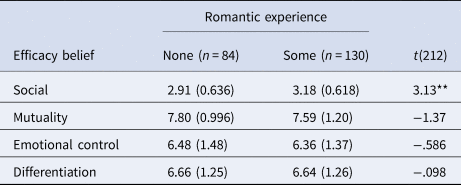
Table 3 presents the mean efficacy scores for each level of romantic experience (first romantic relationship vs. experience of at least one previous romantic relationship). Addressing Hypothesis 2, independent samples t tests revealed no significant differences in relationship self-efficacy scores as a function of romantic experience (ps ≥ .172); however, there was a significant difference in social self-efficacy scores. Participants in their first romantic relationship had significantly lower social self-efficacy scores than those who had experience of more than one romantic relationship.
Social and Relationship Efficacy Mean Scores (SD) by Level of Romantic Experience

Note: None – current partner is participants’ first romantic partner; Some – current partner is at least the participants’ second romantic partner
**p < .01.
Discussion
The present study examined whether the association between attachment security and relationship satisfaction is, in part, mediated by three relationship efficacy beliefs — mutuality, differentiation, and emotional control — in a sample of emerging adult women. Adding to the extant literature, which has previously examined only social self-efficacy as a mediator in a married adult sample (Corcoran & Mallinckrodt, Reference Corcoran and Mallinckrodt2000), we found that mutuality beliefs were an important mediator of the attachment-satisfaction relationship. Further, given the importance of direct experience in shaping efficacy beliefs, we examined whether the three efficacy beliefs differed as a function of romantic experience. Consistent with previous research that has found no such differences in domain-specific relationship self-efficacy (e.g., Riggio et al., Reference Riggio, Weiser, Valenzuela, Lui, Montes and Heuer2013), and contrary to our hypothesis, mutuality, differentiation and emotional control beliefs did not differ as a function of romantic experience, operationalised as the number of previous romantic partners.
The Mediating Effect of Relationship Self-Efficacy Beliefs
Consistent with Hypothesis 1, mutuality beliefs mediated the attachment-satisfaction relationship. Individuals who reported more attachment insecurity (higher attachment avoidance or anxiety) also reported lower confidence in their ability to act as, and use their current partner as, a secure base (i.e., mutuality beliefs) and, in turn, reported lower relationship satisfaction. Insecurely attached individuals are less effective at providing and seeking care in their romantic relationships (Feeney & Collins, Reference Feeney and Collins2003, Reference Feeney, Collins, Rholes and Simpson2004; see also Mikulincer & Shaver, Reference Mikulincer and Shaver2009). Difficulties in caregiving and careseeking, as assessed in terms of perceived support provided and received (Kane et al., Reference Kane, Jaremka, Guichard, Ford, Collins and Feeney2007) and activation of the caregiving system (Reizer et al., Reference Reizer, Ein-Dor and Shaver2014), can have a detrimental effect on relationship satisfaction. Adding to this literature, our findings show that inefficacious beliefs about one's caregiving and careseeking abilities also predict lower relationship satisfaction. Further, the mediating effect was present while accounting for social self-efficacy, indicating that beliefs about the ability to enact specific relationship behaviours, rather than the relatively broader set of beliefs about social competence, is important in understanding this relationship outcome in this sample.
Notably, differentiation and emotional control beliefs did not mediate the attachment-satisfaction relationship or significantly predict relationship satisfaction. Yet, consistent with Lopez et al. (Reference Lopez, Morua and Rice2007), both beliefs (along with mutuality) were significantly correlated with relationship satisfaction. We might have failed to find significant indirect effects of these two efficacy beliefs because such effects are attenuated in multiple mediator models when mediators are correlated (Preacher & Hayes, Reference Preacher and Hayes2008; see also Endnote 3).
Although we found some support for Hypothesis 1, we also found evidence for two alternative models, suggesting that there is greater complexity in the concurrent associations between attachment, mutuality beliefs, and satisfaction. Lower avoidance and anxiety scores predicted greater satisfaction, which in turn predicted higher mutuality scores. While efficacy beliefs have been found to predict relationship satisfaction over time (Lopez et al., Reference Lopez, Morua and Rice2007), Weiser and Weigel (Reference Weiser and Weigel2016) reported that satisfaction had a direct effect on (domain-level) relationship efficacy beliefs when both were assessed concurrently. Consistent with the latter findings, our findings also show satisfaction predicted a relationship-specific efficacy belief, mutuality. These findings can be interpreted within social-cognitive theory regarding how self-efficacy emerges. Developing a resilient sense of self-efficacy comes from experiencing success and persevering in the face of difficulties (Bandura, Reference Bandura1997). Positive experiences, here in the form of a satisfying relationship, in part contribute to relationship self-efficacy beliefs (Weiser & Weigel, Reference Weiser and Weigel2016).
Further, more efficacious beliefs predicted lower avoidance and anxiety, which both in turn predicted greater satisfaction. Given that these relationship-specific attachment styles and efficacy beliefs would have developed from the same direct experiences with the current partner, a high degree of convergence would be expected between them. Indeed, this was confirmed by the moderate in magnitude correlations between mutuality beliefs and the attachment dimensions. These findings raise questions about how relationship-specific efficacy beliefs and attachment styles might develop. The attachment theoretical account proposes that negative models of self, derived from less optimal attachment histories, bias appraisals of one's competence. Yet, when both representations — attachment and efficacy beliefs — are new and developing simultaneously, it is not clear, as the present findings suggest, whether attachment shapes efficacy beliefs or vice versa, or whether there is a bidirectional influence. Given the concurrent assessment of attachment and efficacy in our study, it is not possible to draw any conclusions in this regard. Future research might adopt a cross-lagged, over-time design in order to tease apart how newly forming attachment representations and other social-cognitive constructs shape each other.
Romantic Experience and Efficacy Beliefs
Direct experience is an important determinant of efficacy beliefs (Bandura, Reference Bandura1977). Our second hypothesis addressed differences in efficacy beliefs as a function of direct, romantic experience, operationalised as the number of previous romantic partners. On average, individuals reported a high sense of relationship efficacy in their current relationship, regardless of romantic experience. This finding is consistent with that reported by Riggio et al. (Reference Riggio, Weiser, Valenzuela, Lui, Montes and Heuer2013), who found that the number of previous relationships did not correlate significantly with domain-level relationship self-efficacy beliefs. Together, these findings could reflect the idea that the very act of being in a relationship, regardless of one's relationship history, gives individuals the sense that they are capable of enacting pro-relationship behaviours. Such an idea would also provide an explanation for why previous studies have shown that efficacy beliefs are not related to relationship status when all participants are currently involved (e.g., Riggio et al., Reference Riggio, Weiser, Valenzuela, Lui, Montes and Heuer2013), but are related when comparing those currently involved to those participants that are single (e.g., Cohen, Reference Cohen2018; Riggio et al., Reference Riggio, Weiser, Valenzuela, Lui, Montes and Heuer2011). Alternatively, number of previous relationships is a relatively crude measure of direct relationship experience, one that does not capture the impact that each relationship has had on individuals’ understanding and appraisal of the self.
Yet, individuals with more romantic experience did report higher social self-efficacy than those with less experience. This pattern is consistent with evidence that suggests those adolescents who believe they are socially capable experience more romantic involvement over time (Neeman, Hubbard, & Masten, Reference Neemann, Hubbard and Masten1995; Zimmer-Gembeck, Siebenbruner, & Collins, Reference Zimmer-Gembeck, Siebenbruner and Collins2001). Speculatively, over time, social competence beliefs might shape the relationship efficacy of those with more romantic experience indirectly through increased romantic involvement. Nevertheless, the cross-sectional design limits our ability to comment on the developmental links between social competence beliefs and beliefs about one's competence within a specific relationship.
Study Limitations and Future Research Directions
Our study has a number of limitations. First, participants were female university students, and consistent with our intentions were all emerging adults. We would not expect these findings to generalise to older adults or those with significantly greater romantic experience. Relative to older adults, our sample may experience relationships of shorter duration or have fewer constraints to maintain the relationship (e.g., shared property, financial dependence, children). Future research might examine more diverse samples. For example, more romantic involvement has been linked to negative outcomes in high-risk samples (Madsen & Collins, Reference Madsen and Collins2011). Second, due to the small number of men recruited in the initial sample, it was not possible to examine gender differences. Because gender differences have been reported in romantic involvement (e.g., Monteoliva, García-Martínez, Miguel, Calvo-Salguero, & Aguilar-Luzón, Reference Monteoliva, García-Martínez, Miguel, Calvo-Salguero and Aguilar-Luzón2012) and relationship efficacy beilefs (Lopez et al., Reference Lopez, Morua and Rice2007; see also Endnote 1), there might be a role for gender of self and partner in the interrelationships between attachment, efficacy beliefs, and relationship satisfaction. Third, our assessment of romantic experience was limited without relationship length (e.g., the ability to capture greater experience both in number and duration). Future research might also assess the impact of each relationship on the individual and previous relationship quality to fully capture the nature and extent of experience (e.g., how beliefs differ based on the valence of previous experiences). Fourth, as we only assessed individual reports, future research could collect couple data to examine dyadic effects of relationship self-efficacy beliefs. For example, partner feedback on the success (or failure) of attempts at enacting relationship promoting behaviours might contribute to self-appraisals of own relationship competence. Finally, while the predictive and convergent validity of the relationship efficacy measure has been examined (Lopez et al., Reference Lopez, Morua and Rice2007; Penzel, Reference Penzel2017), the extent to which the measure maps on to actual behaviour is unknown. Relatedly, because all variables were relationship-specific it is important to consider the degree of convergence between them (e.g., whether efficacy scores are a proxy for satisfaction; Johnson & Anderson, Reference Johnson and Anderson2015). Following recommended cut-offs for convergent validity (e.g., r > .70; Carlson & Herdman, Reference Carlson and Herdman2012), all correlations were lower, indicating that the efficacy beliefs (particularly, differentiation and emotional control) were not simply proxies for attachment style or satisfaction. Nevertheless, clearly, further validity testing of the self-efficacy measure is required.
Conclusions
Taken together, our findings add to the extant literature on the psychological mechanisms underlying the well-documented association between attachment insecurity and relationship dissatisfaction. Insecurely attached adults experience lower relationship satisfaction, in part because of deficits in their beliefs about their ability to engage in relationship-enhancing behaviours. Attachment insecurity is a vulnerability for holding less efficacious beliefs about caregiving and careseeking abilities, which contributes to reporting less satisfying romantic experience. Yet, further research is required to better understand how attachment insecurity and efficacy beliefs develop simultaneously.
Authors’ note
This work is based on a thesis by K. Harman, (KH) under the supervision of F. Julal Cnossen (FJC), in partial fulfilment for the degree of BSc (Hons) Psychology. FJC and KH share first authorship. All authors contributed to conceptualisation and methodology. Writing (thesis): KH. Writing (manuscript, reviewing, and editing): FJC. Formal analysis: FJC. Methodology: FJC, KH, RB.
Acknowledgments
We would like to thank Adenike Adesanya and Hannah Murphy for their assistance with data collection and the anonymous reviews for their constructive feedback on previous versions of this paper.
Financial support
This research received no specific grant from any funding agency, commercial or not-for-profit sectors.
Conflict of interest
None.
Ethical standards
The authors assert that all procedures contributing to this work comply with the ethical standards of the relevant national and institutional committees on human experimentation and with the Helsinki Declaration of 1975, as revised in 2008.