I am the Good Shepherd. The Good Shepherd lays down His life for the sheep. A hireling – that is, one who is not a shepherd and who does not own the sheep – leaves the sheep and flees when he sees the wolf coming, and the wolf pounces down on the sheep and scatters them. The reason why the hireling flees is that he is a hireling, and does not care for the sheep.
The Gospel of John 10:11–13INTRODUCTION
In the last four decades, there has been a shift in livestock ownership within African pastoral societies (Bassett Reference Bassett1994; Bonfiglioli Reference Bonfiglioli1985; Homewood Reference Homewood2008; Little Reference Little1985). During droughts the wealthy were able to profit from poor pastoralists who had to sell their cattle at very low prices (Fratkin & Roth Reference Fratkin and Roth1990; Hogg Reference Hogg1986; Loftsdóttir Reference Loftsdóttir2001). The result has been a major redistribution of cattle within pastoral societies as well as to owners outside pastoral societies. These so-called absentee owners contract hired herders to take care of their animals – often the impoverished pastoralists who lost all their animals. This process has been described as an increasing proletarisation of pastoral labour (Bovin Reference Bovin, Manger and Bovin1990; Fratkin Reference Fratkin1997; Ingold Reference Ingold1980). Inequality has always existed in pastoral societies (Salzman Reference Salzman1999), but herding contracts have been considered emblematic of the new inequality in pastoral societies (Hogg Reference Hogg1986). The shift in livestock ownership and the increase in herding contracts have been held responsible for major changes in African pastoral societies, because the assumption is that these contracts are exploitative and negatively affect herd and rangeland management (Bassett Reference Bassett1994; Bonfiglioli Reference Bonfiglioli1985; Toulmin Reference Toulmin1992). However, until now there have been few systematic studies of herding contracts and hired herder livelihoods in Africa (but see Turner Reference Turner1999).
We conducted an ethnographic study of a mobile pastoral system in the Far North Region of Cameroon to determine whether herding contracts are exploitative, by examining whether they provide sustainable livelihoods and allow herders to rebuild their herds. In addition, we examined what motivates herders to engage in herding contracts. We found considerable variation in herding contracts and no indications of a negative impact on herd and rangeland management. We argue that the social organisation of labour in this mobile pastoral system may explain why herder contracts have no such negative impact. Previous studies of herding contracts have focused narrowly on the economics of ownership rather than the social organisation of labour, and we argue for a holistic approach that considers the socio-cultural context of herding.
A better understanding of herding contracts in the African context is important because the number of herds managed by hired herders is increasing and will continue to increase. Simultaneously population growth and economic development are fuelling a growing demand for livestock products in the developing world. This demand will drive major changes in livestock systems and has been referred to as the ‘livestock revolution’ (Delgado et al. Reference Delgado, Rosegrant, Steinfeld, Ehui and Courbois1999). This revolution will probably involve greater investment by absentee owners using contract labour. The shift in livestock ownership means that more and more animals will be managed by pastoralists who do not own them, and that the organisation of labour in African pastoral systems is increasingly shaped by herding contracts. This may have important consequences for the viability of pastoral societies in Africa. Bonfiglioli (Reference Bonfiglioli1985) argues, for example, that WoDaaBe society could no longer be reproduced socially because impoverished pastoralists who worked as hired herders were unable to participate in the livestock exchanges that are a critical part of the social system. The end result, according to Bonfiglioli, is that WoDaaBe society is no longer viable.
BACKGROUND
Herding contracts are arrangements between an owner and a herder who cares for the herd, and who is usually compensated with a wage and/or livestock. Although there is considerable variation in herding contracts, one can distinguish two main types of contracts in West Africa: hired herding and entrustment. Hired herding is a labour contract in which an owner pays a herder a monthly wage and provides him with herding equipment (shoes, clothes, stick). Entrustment is a leasing contract in which an owner entrusts animals to a herder who has usufruct rights over milk but is not paid a wage, although there may be other forms of compensation, including cash (Moritz Reference Moritz and van Santen2008; Turner Reference Turner1999). In this article we focus on hired herding rather than entrustment, although these complex patterns of ownership and management arrangements do overlap. For example, hired herders may take care of only a few animals, while entire herds may be entrusted, and vice versa.
Herding contracts are not a new phenomenon in Africa. Pastoralists have always had to balance the needs of herd and household. The herd must provide subsistence to the household while the household has to provide care for the herd (Dahl & Hjort Reference Dahl and Hjort1976). Households frequently go through periods in which there is an imbalance between herd and household, which can be resolved through different mechanisms, including adoption, livestock loans or herding contracts (Stenning Reference Stenning and Goody1958).
Although herding contracts are not new, they have drastically changed in the last decades, including a shift from payment in animals to wages, and a shift from contracts between kin to contracts between non-kin. These changes are part of a larger process of commoditisation of land, labour and livestock in African pastoral systems, partially due to various pressures on pastoral systems, including the loss of grazing land and accessible water resulting from conservation, development interventions and climate change (Fratkin Reference Fratkin1997; Galvin Reference Galvin2009; Homewood Reference Homewood2008; Little et al. Reference Little, McPeak, Barrett and Kristjanson2008). The result of this transformation is a greater proletarisation of impoverished pastoralists (Anderson & Broch-Due Reference Anderson and Broch-Due1999; Hogg Reference Hogg1986), many of whom work as hired herders for absentee owners.
The shift in livestock ownership and the increase in herding contracts have been held responsible for negative effects on herd and rangeland management (Bassett Reference Bassett1994; Bonfiglioli Reference Bonfiglioli1985; Homewood Reference Homewood2008; Homewood & Lewis Reference Homewood and Lewis1987; Little Reference Little1985). However, there is little or no evidence to support these claims. For example, there is no good data to support the claim that hired herders cause more crop damage than independent herders, or that owner-managed cattle are in better condition than cattle managed by hired herders. Homewood and Lewis (Reference Homewood and Lewis1987) argue that owner-managed cattle did better in drought than cattle managed by hired herders in Baringo, Kenya. They write: ‘Transhumant animals are either entrusted to kinsmen or stock friends, or placed with a hired herder. The two options differ in that, when stock are entrusted, the herder has a personal interest in their welfare, this is not the case for stock placed with a hired herder. Such transfers affect results … potentially, through differences in performance between owner-herded and placed animals’ (ibid.: 618). They argue that livestock losses are higher in one of the areas, which reportedly has more animals that are entrusted to kinsmen and stock associates or placed with hired herders. They also suggest that animals placed with hired herders suffer greater mortality (ibid.). However, no evidence is presented that would support this claim. Nevertheless this paper is widely cited as evidence that hired herding has a negative impact on herd and grazing land management.
Different explanations for why and how herding contracts affect herd and rangeland management have been put forward:
1. Ownership and investment in the herd. Bonfiglioli (Reference Bonfiglioli1985) argues that hired herders have neither the authority nor the motivation to improve herd productivity because they do not own the animals.
2. Poverty and herd management. Toulmin (Reference Toulmin1992) argues that hired herders privilege the needs of the household over those of the calves when they allocate milk because they are not invested in herd growth.
3. Working conditions. Bassett (Reference Bassett1994) argues that poor working conditions and low incomes lead to careless herding and more crop damage as a form of protest by hired herders.
4. Herd mobility. Little (Reference Little1985) argues that owners prefer to have control over the herder and therefore keep the herd close to his home. This reduces herd mobility and herd production and leads to rangeland degradation.
Central to a number of these explanations is the economic condition of hired herders. There is little systematic data on herding contracts and hired herder livelihoods in Africa to evaluate these explanations, but there are numerous studies of herding contracts and herder livelihoods in Near Eastern pastoral systems, where owners and herders are two ubiquitous classes (Black Reference Black1972; Bradburd Reference Bradburd1990). Bradburd (Reference Bradburd1980, Reference Bradburd1982, Reference Bradburd1989) has examined the causes of inequality and explained the variation across pastoral societies in the Near East in several papers. He found that the volatility in animal wealth does not lead to radical shifts in socio-economic status (Bradburd Reference Bradburd1982). Random variation in herd size tends to lead to greater economic differentiation and is not the great equaliser it was once thought to be (Barth Reference Barth1961). Herds among the Komachi do decrease dramatically in size, but only increase gradually in size. Despite the lack of socio-economic mobility, there is a persistent notion among pastoralists that upward mobility is possible (e.g. Black Reference Black1972; Bradburd Reference Bradburd1980). The Qashqa'i, for example, believe that hard-working pastoralists become wealthy, even though many herders are frustrated because they recognise their inability to be economically mobile (Beck Reference Beck1980). Pastoralists recognise that pastoralism is a risky business and explain the variation in outcomes as ‘fate’ (Black Reference Black1972: 629; Bradburd Reference Bradburd1982:102).
Herding contracts are an important mechanism for the maintenance of class divisions. There are related factors that determine whether a herding contract will allow for socio-economic mobility and whether the contracts are exploitative: the type of commodities produced for external markets, the terms of the contract, and the labour relations between owner and herder. Bradburd (Reference Bradburd1989) compared the Basseri, Komachi and Yomut, and found that the commodities that pastoralists produce for external markets have an impact on extra-household labour requirements and herding contracts. Among the Basseri there were few herding contracts because the commodities were lambskins and therefore owners had no large herds or need for extra-household labour. Impoverished shepherds were forced to leave the pastoral system (Barth Reference Barth1961). The Komachi, on the other hand, intensified the production of sheep and cashmere wool in response to market demand. Male animals were the greatest producers of wool, and because male and female animals were herded separately there was a high demand for extra-household labour. The commodities produced have a direct effect on the demand for herding labour and thus the terms of the herding contracts. The supply and demand for herding labour and the formation of classes is also affected by alternative livelihood options outside the pastoral sector. Bradburd (Reference Bradburd1980: 605) has argued, for example, that Komachi hired herders are ‘trapped’ in the pastoral sector because there are few opportunities outside the pastoral economy. In general, the higher the demand for herding labour, the better the terms of the contracts. As a result, the herding contracts were more generous among the Yomut (Irons Reference Irons, Chang and Koster1994) and the Baluch (Salzman Reference Salzman2004) than among the Komachi, and this allowed for much greater socio-economic mobility among the former than the latter, because it gave herders access to breeding animals (Bradburd Reference Bradburd1989; Irons Reference Irons, Chang and Koster1994; Salzman Reference Salzman1999).
Labour relations between owner and herder also play a role in determining whether hired herding is exploitative, or whether socio-economic mobility is possible. For example, Bradburd (Reference Bradburd1990) has argued that the practice of komak, a form of neighbourly help among the Komachi, actually makes herding relations exploitative because hired herders and their wives are more often asked to provide help to owners than vice versa. In addition, the practice of class endogamy reduces the chances for poor herders to marry their way up among the Lur (Black Reference Black1972), while the absence of class endogamy is one reason why there is much more socio-economic mobility among the Yomut (Irons Reference Irons, Chang and Koster1994).
The general finding from studies of Near East pastoral societies is that herding contracts are exploitative. However, Fernández-Giménez (Reference Fernández-Giménez1999) argues that in Mongolia relations between owners and herders are often best described as mutually beneficial, and that there is no indication that the high rates of absentee ownership have detrimental ecological effects. Fernández-Giménez offers several explanations for why the contracts are considered mutually beneficial in Mongolia: animals are primarily kept for subsistence, the owners and herders are kin, the herders are still able to keep their own animals and build their herds, and there is reciprocity between owners and herders, which usually replaces a wage. The owner provides transport animals, boarding for school children in town, and market goods. Fernández-Giménez argues that this system is not exploitative because the herders still have access to the means of production: breeding animals, land and water. They are also treated fairly because they are kin or friends of the owners, and their children have more opportunities than most pastoral children since the owners provide the means of sending them to school.
The research on herding contracts in pastoral societies in the Near East and Mongolia suggests that access to the means of production is critical for socio-economic mobility, but also that the social context of herding contract determines whether hired herders are considered to be exploited or not.
METHODOLOGY
Most of our data on hired herders, absentee owners and herding contracts discussed was collected in two different research projects, but the article builds on research among different pastoral communities across the Far North Region of Cameroon that has been on-going since 1993. The first project was a comparative study of three pastoral communities – peri-urban, agro-pastoral and nomadic – in the region from September 2000 to August 2001 (Moritz Reference Moritz2003). Multiple household surveys were conducted throughout the year to collect demographic, agricultural and consumption data for individual households. We also collected data on herd management and production costs, as well as on ownership, exchanges and entrustment of animals. The second project was a cross-sectional study of twenty-three hired herders, twenty-five independent herders, six independent herders with entrusted herds, and fourteen absentee owners. The interviews were conducted with help from local research assistants in the Logone floodplain, the location of the herds in the dry season, from January to March 2009. Structured and semi-structured interviews were used to collect information about the terms of the herding contracts, herder livelihoods, socio-economic mobility, and livelihood preferences.
STUDY AREA AND POPULATION
The Far North Region of Cameroon has a semi-arid climate with one rainy season and one dry season. During the eight-month dry season, cattle lose considerable weight and become more susceptible to diseases. The primary goal of pastoralists is to overcome the difficulties of the dry season when animal losses are the highest. This is achieved through a focus on animal nutrition, in particular increasing weight in the rainy season, so that animals have enough reserves to survive the long dry season, and preventing weight loss in the dry season (see Schareika Reference Schareika2003). Mobile pastoralists limit weight loss of their animals through transhumance, taking the animals to the rangelands with the highest quality and quantity of forage.
Two phytogeographic zones characterise the region: Sudanian in the southern grades and Sahelian in the Logone floodplain. Although the Sahelian zone is characterised by lower rainfall, the seasonal flooding of the Logone floodplain makes this zone one of the most important dry-season grazing lands in the Chad Basin. Pastoralists from Cameroon and neighbouring Chad, Niger and Nigeria trek each November to the Logone floodplain, when the water retreats, to exploit the excellent quantity and quality of the grasslands (Scholte et al. Reference Scholte, Kari, Moritz and Prins2006). At the start of the rainy season, pastoralists return to the higher elevated dunes of the Diamaré or to their respective countries. The Diamaré plains and the Logone floodplain form complementary resources for mobile pastoralists in the Far North; the former provide pastures in the rainy season, the latter in the dry season.
There are different pastoral systems in the Far North Region of Cameroon, including agro-pastoral and peri-urban systems (see Moritz Reference Moritz2003; Seignobos & Iyébi-Mandjek Reference Seignobos and Iyébi-Mandjek2000). In this article we focus on herding contracts and hired herder livelihoods in a mobile pastoral system, rather than sedentary agro-pastoral systems. We studied herders who are permanently on transhumance and use the Logone floodplain during the dry season. This group of approximately 1,500 mobile pastoralists includes Arab and FulBe, in which the latter can be further sub-divided into Jamaare'en, Woila'en, Alijam'en, Adanko'en, Anagamba'en and Uuda'en. The precise number of hired herders in this population is unknown because they are often embedded in camps of independent herders, but we estimate that about 25% of the herds are under contract.
HERDING CONTRACTS IN THE FAR NORTH REGION OF CAMEROON
In their simplest form, herding contracts involve an owner and a herder, but we distinguish four different roles: absentee owner, hired herder, independent herder and intermediary. Absentee owners may have a few animals or multiple herds that are either entrusted to independent pastoralists and/or managed by hired herders, in which case an intermediary may or may not supervise the herder. The typical image of an absentee owner in the literature is a businessman or government official based in an urban centre, but this does not reflect the reality in the Far North Region. There is great variation in wealth, livestock ownership, ethnicity, location (rural/urban) and occupation. Some absentee owners are Musgum fishermen who have entrusted a few animals to an independent pastoralist. Others are FulBe agro-pastoralists who have entrusted one or more herds to hired herders. Some absentee owners are local government officials based in the Logone floodplain, while others are traditional chiefs based in the Diamaré. Most absentee owners were previously involved with and/or continue to be actively involved in the mobile pastoral system. For example, in recent years, a number of mobile pastoralists have settled but their herds continue to go on transhumance with hired herders.
Independent pastoralists subsist from their own herds. In addition to these herds, they may take care of a few animals or an entire herd from absentee owners. They may also employ hired herders to herd their own subsistence herd or absentee-owned herd, in which case they are respectively employers or intermediaries. The typical image of an independent herder is someone who subsists off his own herd and is not affected by the commoditisation of herding labour in pastoral systems. Again, this does not reflect the reality in the Far North Region of Cameroon. There are independent herders who are not involved in herding contracts in one way or another, but these are few and far between. Some independent herders are quite wealthy and use hired herders to take care of their herds. Others are relatively poor and have a few entrusted animals in their herd or have one of their sons take care of an absentee-owned herd, or else are intermediaries who entrust an absentee-owned herd to a hired herder in their camp.
Hired herders are employed by independent pastoralists or absentee owners and are paid a monthly wage. They may have a few animals of their own but not enough for subsistence. The typical image of a hired herder as an impoverished pastoralist does reflect the reality in the Far North Region, although there is quite a lot of variation here, too. The main distinction that pastoralists make is that between hired herders with and without family, i.e., bee saare ‘with house/wife’ or bee sawru ‘with stick’. Most herders with sticks are on short-term contracts. They may come from sedentary non-pastoral communities. Or they may come from mobile pastoral communities but did not inherit enough animals to establish an independent herd and household. Most hired herders are FulBe, but there are also Tupuri herders. The ages of hired herders range from early twenties to sixties. Hired herders with families may own their own animals and take care of entrusted animals, or they may not own any animals at all and take care of an absentee-owned herd. Some hired herders camp together with other hired herders who take care of herds from the same village in the Diamaré. Others live with and/or work for independent pastoralists, who may be intermediaries for absentee owners or owners of the herds.
Intermediaries (kaliifa) are responsible for supervising the herd and hired herder and act as intermediary between the absentee owner and the hired herder. Most animals entrusted to mobile pastoralists are initially entrusted to an intermediary, who is usually the camp leader. The intermediary in turn entrusts the animals to hired herders, generally his sons or other resident kin. The intermediary has ultimate responsibility for the herd and is held accountable by the absentee owners. The hired herders have usufruct rights over the animals and receive a monthly wage. But apart from some small gifts, there are no direct material benefits for the intermediary, except that he has more followers in his camp.
Overall, we found that there are long-standing relations between absentee owners, hired herders and independent pastoralists in the Logone floodplain. Most of the absentee owners are agro-pastoralists themselves, and they or their fathers went on transhumance to the floodplain thirty to forty years ago. We met hired herders who have worked for the same owner for over thirty years, and others who have worked for different owners in the same village for over twenty years. Herders and owners are part of an extensive, integrated social network that makes up the mobile pastoral system in the Far North Region.
Sustainable livelihoods
We examined whether contracts provide herders with sustainable livelihoods and allow them to rebuild their herds and become independent herders. Scoones (Reference Scoones1998: 5) defines sustainable livelihoods as follows: ‘A livelihood comprises the capabilities, assets (including both material and social resources) and activities required for a means of living. A livelihood is sustainable when it can cope with and recover from stresses and shocks, maintain or enhance its capabilities and assets, while not undermining the natural resource base.’ This approach includes an assessment of sustainability by analysing livelihood resources, such as natural, physical, financial, human and social capital, and examining how households use these resources to cope with and recover from stresses and shocks. We used two indicators to evaluate whether herding contracts provided sustainable livelihoods. First, we examined whether the contracts covered the minimal subsistence needs of herder households. Second, we examined how hired herders coped with stresses and shocks.
Terms of contracts
There is considerable variation in the terms of contracts in the Far North Region of Cameroon. Most herders were paid wages and received clothes and shoes from the owners. A few herders mentioned that they had the option to be paid in animals instead of cash, but few were actually paid in kind. Wages ranged from FCFA 5,000 to 10,000 (or US$10 to 20) per month, with an average wage of FCFA 7,500 (US$15) per month, which is usually paid every three months. A few herders were not paid a wage, but instead could sell animals to cover their household needs. These herders were living off the herd as if they were independent herders, even though they did not own the animals. This practice is similar to what Ensminger (Reference Ensminger and Cook2001) describes for Orma hired herders who over time were adopted by owners as fictive sons. Ensminger argues that adoption reduces the transaction costs of monitoring herders, as the Orma think that it is better to use family labour than hired labour.
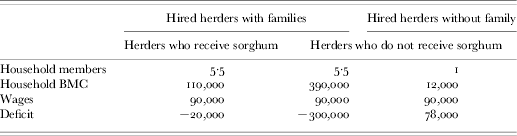
We examined whether the herding contracts covered the minimal subsistence needs using household survey data. We found that the wages alone do not cover the basic maintenance costs (BMC) of hired herders, except in the case of herders without families (see Table 1). Herders without families have meals with neighbours and in return give the woman who is preparing their meals the usufruct rights over the milk from their herd. In our analysis we distinguished between households that did or did not receive sorghum from the owners, because this accounts for the greatest variation in BMC. Fewer than half of the herders (nine out of twenty-four) and half of the owners (seven out of fourteen) mentioned that they respectively received or provided sorghum. Households that receive sorghum have an estimated annual BMC deficit of FCFA 20,000, which they can easily cover with milk sales.
Annual basic maintenance costs (BMC) and wages of hired herders
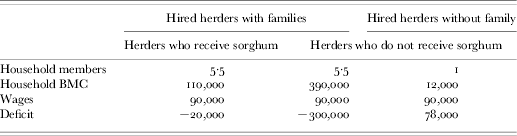
Note: These annual basic maintenance costs are estimates based on data from household budget surveys in 2000–1 and surveys in 2009. The numbers represent average expenditures per household in FCFA (FCFA 500 is approximately US$1).
Households that do not receive sorghum have an annual BMC deficit of more than FCFA 300,000, which is more difficult to cover with milk sales only. But we found that hired herders regularly sell animals with or without the owner's permission, to cover herd expenses like salt, vaccinations, transhumance taxes or compensation for crop damages. They may use the remainder of the sales revenues to cover their own household expenses. This explains how hired herders who are not provided with sorghum are able to make ends meet. Because these sales often happen without permission, we do not have good data on their number and frequency. However, the estimates of the basic maintenance costs suggest that hired herders have to sell two to three animals a year to cover the deficit. We were told that most sales happen during the transhumance, when there is a greater risk of damage to crops or fish canals. This is also the period when exhausted animals that can no longer move have to be sold along the transhumance route for much lower prices than when they are sold at the markets, because the herders have to continue moving and cannot take the animal to market. It is also more difficult for owners to visit their herds, and hired herders may thus have to make independent decisions to sell animals. Normally, herders have to notify the owners and ask for permission, but during the transhumance it may take up to two weeks before they hear back or are given money to cover the expenses. Unauthorised sales of animals are often a source of conflict between owners and herders, and may lead to the termination of the contract.
Coping with stresses and shocks
Another dimension of sustainable livelihoods is the ability of a household to cope with stresses and shocks. Scoones (Reference Scoones1998) defines stress as a common occurrence that adds extra expenses to the household; a shock is a far more devastating, uncommon and unexpected event. For our study we examined how people were able to cope with the stress of having an illness within the household, which is a common occurrence and locally meaningful measurement of stress.
We asked both hired and independent herders how they would cover the expenses of bringing a sick household member to hospital. There are health centres in the Logone floodplain, but these are operated by nurses or nurse assistants and are not well stocked. Depending on the location in the floodplain, it can take half a day or a day to get to a doctor or hospital. Asking herders about how they dealt with serious illness is thus a good indicator of household stress.
Independent herders reportedly had no problem coping with the stress of a serious illness. They all said that they had the means to transport the sick to the hospital and pay for medicines. However, only 40% of the hired herders said that they owned the means to do so. The other 60% said that they did not have the means, and would have to sell one of the owner's animals or borrow money from others. In contrast to independent herders who can rely on their livestock as assets, most hired herders are only able to cope with stresses by relying on their social networks, which include the absentee owners. One herder whom we interviewed was involved in a terrible car accident that kept him bed-ridden for more than six months. During that time, he lived in the compound of the absentee owner and was cared for by the latter's family, while his close kin managed the absentee-owned herd.
Labour relations
The case above shows that herding contracts are not simple labour contracts; they are better described as patron–client relationships in which the owner has responsibility for the herder and his family. In fact, owners are called jaagordo or patron in Fulfulde. Herders and owners have long-standing relations. Although many contracts end within one year, most of the herders we interviewed had been working as hired herders for over five years (the average was twelve years). Thirteen had been working as hired herders over ten years, five over twenty years and one of them for forty-seven years. In some cases, herders had been working for the same owner for over thirty years.
Most absentee owners kept their herds not for profit, but mainly for security and subsistence. They were independent agro-pastoralists in villages and towns in the Diamaré, and kept one herd in the village for milk and immediate needs, and one bush herd for less urgent needs that was entrusted to hired herders. Most owners would sell a number of cattle from their bush herd once a year to cover major expenses; they were not selling them to maximise profits. In some sense, they were managing the herd in similar ways as independent pastoralists, except that they were not involved in day-to-day decision-making and had additional sources of income from other economic activities.
Some pastoralists said that ‘herds were primarily for the herders’, implying that the herds were less important for the owners. The herds of course provided an important source of income and security for their owners, but these would not be devastated if they lost their herd since most of them also owned a village herd and had other sources of income. However, the absentee-owned herds were extremely important for hired herders, because they provided their main livelihood. Absentee owners who ended the contract and took away the herd would instantly impoverish a hired herder and his family. Not only did hired herders then lose their income, they would also lose their source of subsistence (milk and millet), security (sale of cattle) and community, as they would be forced to settle and leave the pastoral system. Decisions to end contracts were not taken lightly, and generally they were only ended if the herder was seriously negligent and/or lost too many animals. Pastoralists did not speak well of owners who suddenly terminated contracts or sold an entire herd, leaving the hired herder and his family with nothing.
To examine whether hired herders felt exploited, we asked if they were satisfied with the terms of their contracts and why. The majority were satisfied with the terms of their contract (68%), especially when they were paid in kind. But their explanations did not suggest that they were very content. Some said that ‘it's a contract’, ‘it is the same as everyone else's contract’, or ‘I'm eating’. The 32% who were not satisfied said that they were ‘struggling’, but had ‘no other options’. A few mentioned that the contracts did not allow them to save anything, or that they had to pay for their own food (however, some hired herders who were provided with sorghum were not satisfied with their contracts either). Thus, even though the majority of the herders answered that they were satisfied, the discussions with them do not show much contentment.
Socio-economic mobility
One of the reasons for herder discontentment is their limited socio-economic mobility, or ability to become independent herders. All pastoralists mentioned that building herds was easier in the past when expenses were lower, herders were paid in breeding stock, there was less supervision, and herders could more easily steal from the owners. Today it is almost impossible to start as a hired herder and become an independent one.
Pastoralists told us that if a herder owns some small stock or cattle prior to beginning hired herding, he is more likely to be able to become independent. Starting with small stock, which reproduce quickly, a herder can sell these, buy cattle at the market, and so over time build his herd. This works only if the herder does not have to sell his own animals to provide for his family, and the owner covers most of his expenses. Most hired herders (fifteen out of twenty-three) owned some livestock. Seven of these fifteen saw their number of livestock increase since they started working as hired herders (six saw no change and two saw their numbers decrease). Even though none saw any significant growth in livestock numbers, some herders think that hired herding helps them progress towards economic independence. In particular, younger herders who have only been herding for about five years see themselves becoming independent in the next five years, while older herders who have been herding for more than ten years no longer see themselves becoming independent.
Although many hired herders realise that they may not achieve economic independence, there is still a widespread belief that it is possible. Most pastoralists know people who started as hired herders with a few animals and are now wealthy herd owners. However, their number is relatively small. The pastoralists who succeeded owned a few animals when they began as herders, worked hard, were paid in kind, lived extremely modestly, and managed their money responsibly. In addition, their wives were hard-working and economical. Wives' milk revenues covered all the household expenses, so that no animals had to be sold and herds could grow quickly. Such wives, rewBe jamBe, were compared to the poles that hold up the straw mats that cover the houses: without them, everything would fall apart. Finally, we were told over and over again that in order to achieve independence, herders must not drink, smoke, or spend any money on prostitutes. Because socio-economic mobility is so rare, the belief may be considered similar to the false notion of socio-economic mobility and equality that has been described in Near East pastoral societies (Black Reference Black1972; Bradburd Reference Bradburd1990).
With limited socio-economic mobility among hired herders, one would expect the development of permanent economic classes of owners and hired herders as in the Near East (Black Reference Black1972; Bradburd Reference Bradburd1990). Some of the hired herders in our sample mentioned that their fathers were also hired herders. It is easy to see how a class of hired herders is reproduced. Since they have few animals of their own, their sons will not inherit any, and they will likely be hired herders as well. Although inequality is reproduced over time, there are no distinct economic classes. Apart from livestock ownership, there are no major differences between hired and independent herders in terms of material wealth. In addition, within one extended household, one finds herds owned by household members and outsiders. There is also no class endogamy; within each family, lineage and clan one finds hired and independent herders. Finally, hired herders with adolescent sons no longer have to work themselves, and can live the leisurely life of older independent herders. They can travel to villages and markets during the day to socialise with other independent herders. Thus, to some extent the life cycle of hired herders is similar to that of independent ones. However, despite similar lifestyles and integration in pastoral society, hired herders and poorer independent herders have lower social status than herders who own their herd.
Alternative livelihoods
When herding contracts provide minimal subsistence and limited socio-economic mobility, the question is why hired herders continue to pursue this work. We know many pastoralists who have pursued other lines of works as livestock traders, cattle drivers between markets, retailers, or as migrant workers on plantations in coastal West Africa. We asked hired herders if they saw other livelihood options for themselves or whether they preferred herding to all other options. The only alternative livelihoods that herders mentioned were farming and trading. When asked about obtaining work in urban areas, most herders said they did not know anything about working in a city, nor did they know anyone who could provide them with a job.
When we asked herders to rank the different options, most ranked herding as the preferred livelihood (nine), followed by trading (five) and farming (two). Trading, especially livestock trading, is considered a high-status occupation. However, the two hired herders we interviewed who had tried cattle trading had to stop because they lost money. Slightly fewer than half of the hired herders we interviewed had tried farming; five of these were still farming in the wet season and combined it with herding in the dry season. However, the consensus is that farming provides subsistence but no monetary income, which is why they continue to herd. Others argued that neither farming nor herding are reliable and/or sufficient, and that one must engage in both to have a more secure subsistence base.
However, herding is not just a way to make a living; it is also a way of life. Thirty percent of the herders said nothing else exists besides herding, and did not list any other livelihood options. The majority of the people we interviewed preferred herding because it is inherited or because it is all they know. One man told us, ‘herding is inherited and you cannot walk away from what is inherited’. There is a strong cultural commitment to the herding lifestyle: seeing large herds of cattle on open pastures gave hired herders a sense of contentment, pride and purpose.
THE SOCIAL ORGANISATION OF HERDING LABOUR
Hired herders in the Far North Region do not only have a cultural commitment to the husbandry of animals, but are also drawn to the social life of herding, which has features in common with crew cultures that have been associated with extractive economies of logging, mining and fishing. Wilk (Reference Wilk, Brewer and Trentmann2006) has described how crew culture develops as all-male crews work in remote and isolated locations. Long-distance sailors, whalers, loggers, cowboys, oil-drillers and fishermen often have long and sometimes indefinite contracts, which involve physically strenuous and dangerous jobs that require skill and self-discipline, and put crews in a high degree of physical and social isolation. In these contexts workers not only develop strong social male bonds and a masculine culture, but also a strong commitment to the job.
The work of hired herders is strenuous and dangerous. Every day, they wake up before sunrise to milk their cows, have a quick meal, and then spend the whole day, from about 7:00 to 18:00, in the bush taking their animals to pasture and water. On their return, they milk their cows, have a meal, and socialise with other herders, before they have to follow their herd to pasture for night grazing from 21:00 to 24:00. Each night they have to be vigilant against predators (lions and hyenas), and cattle thieves who do not hesitate to kill.
Some herders are isolated from their families and communities if they left their family in the village, but others have their families in the camp and are less isolated. Nevertheless, during the day herders are away in the bush, and even though they work independently and not as a crew, they spend much time together in all-male groups. They take pride in their herding knowledge and skills (ngaynaaka) and they are competitive. When the herds return from pasture in the evening, everyone can see which animals and herds are well fed (hari), and which are not. FulBe pastoralists do not hesitate to shame the herder whose animals are not well fed.
Despite the relative isolation, there is also a strong social life in the Logone floodplain. By day in the bush and at night in the camp, young herders spend much time together. In addition, they go the weekly markets in the towns and villages near the grazing areas. The Saturday Mazera market is the most important market during the dry season in the Logone floodplain. Some pastoralists call it Makka WaynaaBe, a Mecca for herders. It is the hub of social life for all mobile pastoralists in the Logone floodplain, including hired herders who are regularly given the day off to go to the market.
Every Saturday the entire village of Mazera is overtaken with market activities. Pastoralists and their families will come to the market to buy sorghum, vegetables, new clothes and medicines, but also to socialise with other pastoralists. They meet at the livestock market or in one of the restaurants. There, they sit in the shade and order a plate of grilled meat and tea, which is one of the most gratifying rewards after a week of hard work. As the day draws to an end and the vendors begin to break down their booths, the restaurants become entertainment venues. Cold beer in the bottle and hard liquor, which is sold in small plastic bags, is served while local celebrated musicians (wambaaBe) play and sing. The unmarried or free women (azabaajo) who work in the restaurants begin to dance, casually at first but as the night goes on, this turns into a sort of game. The men bet on the girls who are dancing and the girls will only continue to dance if the men continue to bet. They can bet anything from kola nuts to cash. The dancing, drinking and betting will go on and on for hours until the sun comes up. The man who placed the highest bet on a certain girl ‘wins’ that girl for the night, which does not necessarily mean he has sex with her. The girl gets whatever the man bet on her, which she splits with the madam, a woman whose nickname is Baaleri Faasiki Jemma (‘the black woman of the night who can't be trusted’). Herders return to the camp and work only after they have recovered from their hangover the next day. This cycle of strenuous work and binge release is not unique to pastoralists in the Logone floodplain. It is also common in the crew cultures that Wilk (Reference Wilk, Brewer and Trentmann2006) describes.
Wilk (ibid.:134) argues that bingeing is a means of survival, a way to stay sane in certain economic conditions. It sets herders apart from the sedentary societies as well as from their pastoral communities. They engage in behaviour like drinking, smoking and gambling that is not indicative of being a good Muslim. Although this creates a social stigma, it simultaneously strengthens the bonds between herders and reinforces their commitment to the crew culture and the herding work, making it more difficult for hired herders to leave this way of life.
HERD AND RANGELAND MANAGEMENT
Our study focused on herding contracts and livelihoods of hired herders, not on the ecology of pastoral societies. Although we have no direct evidence and cannot draw any definitive conclusions that herding contracts have no negative effects on herd and rangeland management, we have a number of indirect lines of evidence that all suggest that there is no difference between independent and hired herders in the mobile pastoral system in the Far North Region of Cameroon.
Hired herders are highly dedicated to their work, for cultural as well as social reasons. They have to maintain a reputation of a good herder. Most herders knew each other and were constantly evaluating each others' herds. It is a form of competition that one also finds in other crew cultures and that explains their investment in the work of herding. Even though they do not own animals in the herd, their investment in the work results in no obvious negative impacts on herd management and production.
When we asked if independent herders provided better care to their animals than hired ones, pastoralists answered unanimously that there was no difference and that it depended on the individual herder: some herders have a strong heart (bernde tiinde) and take good care of animals, while others have a dead heart (bernde waande) and do not. Knowing whether someone is a hired herder does not tell you anything about the care for and condition of the animals, according to mobile pastoralists. It is important to remember that, in most cases, it is not the independent herders themselves who take their animals to pasture but their children, who may or may not be dedicated to the work.
To find out more about the hired herders' herd management practices, we interviewed absentee herd owners to gain their perspectives. Most of the owners (82%) were satisfied with the care their herders were giving to the livestock. The consensus was that the herders use the best available pasture, and that if the owners were not satisfied then they would find another herder. The few owners who were not satisfied said this was due to high livestock losses due to theft, for which they blamed the herder.
During the interviews with both independent and hired herders, we asked whether hired herders have access to the same grazing resources as independent herders. Repeatedly, we were told that in principle it does not matter if one is an independent or hired herder, because everyone had free access to the same camp zones, pastures and watering places. They often said, ‘it is not about people, it is about cattle’, the implication being that cattle do not compete over resources. This ethos of open access was widely shared across independent herders, hired herders and absentee owners.
One indicator of rangeland management by hired herders is herd mobility (Little Reference Little1985; Turner Reference Turner1999). Research on African rangelands has underscored the importance of the distribution and mobility of livestock for maintaining productivity of rangelands in arid and semi-arid areas and avoiding overgrazing (Behnke et al. Reference Behnke, Scoones and Kerven1993). Some studies have found that owners wish to keep their herds close to the village, which leads to over-exploitation of land surrounding the village (Little Reference Little1985; Toulmin Reference Toulmin1992). However, in our study of herding contracts in a mobile pastoral system, we found no major differences in mobility patterns between hired and independent herders. Camps consisting mostly of hired herders cover similar distances to camps consisting of mostly independent herders, but move less frequently within seasons. Because hired herders have similar mobility patterns to independent herders, who are highly adaptive in response to seasonal variations in resource availability, there is no indication that herding contracts in this mobile pastoral system have a more negative impact on rangeland management than independent herding.
* * *
The widely held assumption is that herding contracts are exploitative and lead to poor herd and rangeland management. We found that hired herders are barely making ends meet, and that socio-economic mobility is rare. Moreover, one could argue that the livelihoods of hired herders are inherently unstable and unsustainable because owners can take the herd away at any time. However, we also found that this does not necessarily lead to poor herd and rangeland management. We briefly review the four assumptions about herding contracts and herd and rangeland management, and whether these assumptions are supported by our findings.
Bonfiglioli (Reference Bonfiglioli1985) has argued that hired herders do not have the motivation to improve herd productivity because they do not own the animals. However, we found that hired herders may not own the animals, but they are committed to the work of herding (ngaynaaka). Hired herders are motivated to perform because of the cultural commitment to herding, because their families are dependent on the herds for milk and for their salary, and because of competition with other herders. Herds and herders are constantly evaluated by fellow herders. Every evening when the herds return from pasture, everyone can see for themselves which animals are well fed, their bellies bloated, and which ones are not. Herders whose animals are not well fed are immediately ridiculed. Because the nutritional effects of grazing are cumulative, bad herd management can be viewed directly by comparing the condition of the animals in different herds. Pastoralists argued that there was no difference in cattle condition between hired and independent herders.
Toulmin (Reference Toulmin1992) has argued that herders privilege the needs of the household over those of the calves when they milk cows, because they are not invested in the herd. In mobile pastoral systems in which the herders are always on the move and the owner is absent, there are no conflicts over milk claims between owners and herders. All hired herders have full usufruct rights over the milk from the herd, while many owners have another milk herd in the village. Calves in herds managed by hired herders could be receiving less milk, but we found no evidence to suggest that this is the case.
Bassett (Reference Bassett1994) has argued that poor working conditions and low wages lead to careless herding and more crop damage by hired herders. The majority of the herders in our study were satisfied with their contracts and compensation. Also, the work is hard, but herders are not isolated, they are part of a ‘crew’. We did not observe the patterns that Bassett (Reference Bassett1986, Reference Bassett1994) describes of hired herders purposefully causing damage to tarnish the reputation of the absentee owners. Some pastoralists suggested that hired herders might cause more crop damage so that they could pocket the difference from the cattle sales when paying for the damages, but we found no evidence to support this claim.
Little (Reference Little1985) has argued that owners want to have control over the herder and therefore keep the herd close to home. This reduces herd mobility and herd production. We did not find conflicts over herd mobility and management between owners and herders. Hired herders had mobility patterns similar to independent herders, especially when they are embedded in the camps of independent herders.
Although our findings suggest that herding contracts do not have negative effects on herd and rangeland management in a mobile pastoral system, this may not necessarily be the case in sedentary agro-pastoral systems in which herds do not go on transhumance. In these systems hired herders are in frequent contact with the owner and socially isolated from other herders. This means that they have little autonomy with regard to herd management, and are often in conflict with the owners. More importantly, in sedentary agro-pastoral systems, hired herders do not enjoy the benefits of being part of a larger community of other (hired) herders: the crew culture of mobile pastoralists. The negative impacts of herding contracts in sedentary agro-pastoral system may result not from exploitative herding contracts, but from the lack of herder autonomy and from social isolation from other herders. The social organisation of labour – herder autonomy and commitment to herding in a crew culture – may be the critical difference here.
Our study suggests that the continuing shift in livestock ownership to absentee owners who hire herders to manage their animals may not have disastrous consequences for herd and rangeland management, provided that hired herders are embedded in the social organisation of mobile pastoral systems. In these contexts, hired herders will continue their commitment to pastoral values, which are not only about owning livestock but also about herding them well.