Introduction
Cutaneous T-cell lymphoma is a heterogeneous group of T-cell neoplasms involving the skin. Reference Hristov, Tejasvi and Wilcox1 Mycosis fungoides (MF) is the most common subtype, with an annual incidence of 5·6 per 1·000·000 people. Reference Korgavkar, Xiong and Weinstock2 Most patients present with early-stage disease, Reference Arulogun, Prince and Ng3 classically with discrete and indolent skin lesions that resemble eczema or widespread erythema. Some patients, eventually, progress to an advanced stage, where they may present with fungating tumours, erythroderma, and involvement of lymph nodes and viscera. Reference Larocca and Kupper4 Treatment is dependent on the stage and extent of the disease. For early stage, the treatment concept relies on skin-directed therapies (topical therapies, phototherapy and radiotherapy [RT]), while in advanced stage, systemic therapy is used alone or combined with skin-directed therapies. Reference Trautinger, Eder and Assaf5
For unifocal small extensions of disease, local RT provides effective palliative remission. But when a significant amount of body surface is involved such that the entire skin surface requires irradiation, total skin electron beam therapy (TSEBT) is employed. TSEBT provides a relatively homogenous RT dose to almost the entire skin (dose uniformity ± 15 Reference Anacak, Arican, Bar-Deroma, Tamir and Kuten6 to 25% Reference Fahimi Monzari, Geraily, Aghili and Toolee7,Reference Weaver, Gerbi and Dusenbery8 ). The Stanford technique is the most commonly TSEBT method used, which relies on a large electron 6-field technique (anterior, posterior and four opposed oblique fields). Here, patients stand in an upright position on a static base during irradiation. Reference Chowdhary, Chhabra, Kharod and Marwaha9 However, this positioning makes certain areas of the body to be ‘shadowed’, including the top of the scalp, perineum, upper inner thighs and soles of the feet (up to 40% underdosage). Reference Weaver, Gerbi and Dusenbery8 For patients presenting lesions in these underdosed regions, TBSET becomes ineffective, requiring alternatives. Various types of localised RT techniques for skin irradiation are available, such as electrons, kilo and megavoltage photons with tissue compensation. Reference Pashazadeh, Boese and Friebe10 Although electron beams are well suited to the treatment of these superficial targets, for regions with highly irregular surfaces, electron field setup can prove challenging with inadequate tumour coverage and excess dose variance. Photon irradiation with tissue compensation can be an option.
Materials used as bolus vary from commercial to handmade, as plasticine, natural rubber, paraffin wax, Play-Doh®, propylene glycol, water-soaked gauze sponges, aquaplast, gels, and polypropylene. Reference Aras, TANZER and İkizceli11–Reference Endarko, Aisyah, Carina, Nazara, Sekartaji and Nainggolan13 No strong evidence exists regarding the best bolus, so the choice is determined by institutional preferences, availability and the characteristics of the area to be irradiated. In our institution, for irregular surfaces whose RT treatment requires bolus, we use paraffin gauze. We present the case of extensive involvement of MF treated with photon beam RT and paraffin gauze compensator.
Case Presentation
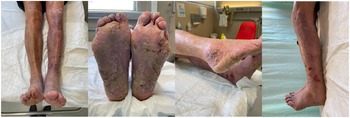
An 87-year-old man was referred to our department in October 2021. The patient was diagnosed with MF in 2003, with a long history of multiple relapses and therapies. Three months prior, he experienced clinical worsening and thus was referred to our department for RT. The patient showed plaques across the thigh and left leg, and across the right leg, both feet and soles, including the interdigital folds (Figure 1). Due to the locations of the skin lesions and the need of using custom-made bolus, a single fraction treatment was chosen.
Patient photographs at initial presentation.

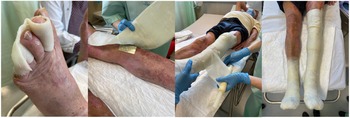
Long sheets of paraffin gauze dressings were used to create a 0·5-cm thick bolus in the affected areas. The sheets of gauze were overlapped as evenly as possible, with particular attention to remove any air bubbles between the gauze and the skin (Figure 2). In addition, in vivo dose measurement of the surface dose was performed using the methodology commonly used in the hospital for similar cases (for further details, see Dias et al, 2019 Reference Dias, Pinto and Borges14 and Santos et al, 2021 Reference Santos, Silva and Sarmento15 ).
Clinical setup of the paraffin gauze dressing and radiochromic films for in vivo dosimetry.

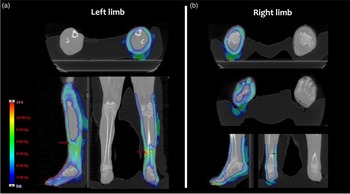
A computer tomography (CT) scan was performed for planning purposes. The clinical target volume was created by applying an isotropic expansion of 3 mm inside the body (none of the MF lesions revealed deep infiltration; thus, 3 mm encompasses the entire disease and skin). For the planning target volume (PTV), an additional 2-mm isotropic margin was added to the outer CTV (this allowed for the optimisation of the dose on the skin), resulting in a 5-mm-thick rim. A computerised dosimetric plan was generated using intensity-modulated radiation therapy (IMRT) with 6 MV photons (Figure 3), and 8 Gy to the PTV mean was prescribed.
PTV (red contour) dose coverage shown in colour wash for the left (a) and right (b) lower limbs.

Results
The mean calculated dose to the skin of both legs was 8,1 Gy (Dmin = 2,9 Gy, Dmax = 10,5 Gy). The results of in vivo dosimetry, using EBT3™ (Ashland Inc., Wayne, NJ, USA) with the local protocol for film analysis, had the mean measured value of 7,8 Gy (Dmin = 6,6 Gy, Dmax = 9,3 Gy). This difference is justified by the location of the films on the skin surface which does not reflect the dose on the whole skin volume (a skin thickness of 3 mm was considered). The value of the mass density of the paraffin gauze was estimated from the Hounsfield Units of the CT images carried out in prior institutional studies, with this estimated value being 0·92 g/cm3.
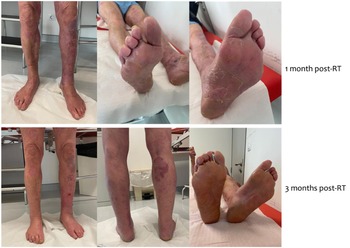
Five weeks after irradiation, the patient presented at our office referring complete resolution of the local pain and pruritus and presented with only vestigial plaques in a healing phase (Figure 4). Three months post-RT, the patient presented without any skin lesions. No acute or late toxicity was reported. Eleven months after receiving the treatment, the patient remains without any lesion on the treatment fields and asymptomatic, consistent with a complete response.
Photos of the patient 1 and 3 months after the RT showing a partial and complete response, respectively.

Discussion
Though irradiation of superficial lesions is challenging, due to the dose build-up effect from megavoltage X-ray, Reference Dipasquale, Poirier, Sprunger, Uiterwijk and Miralbell16 the surface dose can be increased by adding a tissue equivalent material.
From our knowledge, this is the first report on the use of paraffin gauze as a tissue compensator, which limits the comparison of our results. A few other clinical reports using handmade bolus with different materials exist (using peroxide-soaked gauze Reference Adachi, Oike, Tamura, Ota and Ohno17 and rice Reference Majithia, Rong and Siddiqui18 ), and all refer complete remissions of the lesions. Furthermore, paraffin gauze is not included in any of the existent studies regarding the dosimetric properties of handmade bolus. Reference Aras, TANZER and İkizceli11–Reference Endarko, Aisyah, Carina, Nazara, Sekartaji and Nainggolan13,Reference Walker, Cohen and Menchaca19–Reference Banaee, Nedaie, Nosrati, Nabavi and Naderi22
Paraffin gauze bolus proved to be an inexpensive, convenient and effective method for superficial cancer therapies when uneven body contours are involved. This material also possesses the main features that are intended for a bolus. Reference Carina, Sekartaji, Aisyah, Nazara and Nainggolan12,Reference Endarko, Aisyah, Carina, Nazara, Sekartaji and Nainggolan13 Unwanted dose heterogeneity Reference Butson, Cheung, Yu and Metcalfe23,Reference Dias, Gonçalves and Monteiro24 owing to the presence of an air gap between the bolus and the patient’s skin was satisfactorily accomplished by the paraffin gauze, due to the flexibility and capacity of the paraffin to infiltrate into all the folds of the patient’s skin. It has, however, some limitations as it is a time-consuming method that may be too laboured-intensive to be applied for fractionated radiation schemes.
Conclusion
Single-fraction IMRT using a paraffin gauze bolus for skin dose coverage was, in this case, effective for the treatment of MF lesions of the lower limbs, feet soles and interdigital folds. Care should be taken to the selection of bolus material in patients referred to irradiate superficial lesions. Considering the physical properties of the paraffin gauze, such as its availability, flexibility and ease of application to irregular surfaces, this material proved to be a suitable option to provide conformance to irregular contours. Further research is warranted to develop superior alternatives in scenarios like we stated in our case.
Acknowledgements
Ethics approval and consent to participate. Written informed consent for the publication of clinical details and photographs was obtained from the patient. Per our institutional demands, no ethical approval is required for the publication of a clinical case.