Introduction
Food intake is a central biological process in animals, as it determines the quantity of energy and nutrients available for the physiological and behavioural processes, which ultimately determine fitness (growth, reproduction and survival; Stephens and Krebs, Reference Stephens and Krebs1986). The amount of food eaten by herbivores is affected by many factors, including the characteristics of the resources (chemical composition and digestibility), the animals (breed, sex, live weight (LW), reproductive state, etc.) and of their environments (weather, management, housing, etc.). The abundance and structure of plant resources, which vary strongly in time and space, play a particularly important role in free-ranging animals (Crawley, Reference Crawley1983).
The influence of plant quality on intake in ruminants is well documented: as the fibre content of forages increases with age of the plants, the undegradable fraction of the cell walls increases and the rate of digestion of the degradable fraction declines (Grenet and Demarquilly, Reference Grenet and Demarquilly1987). Therefore the time required to reduce the large ingested forage particles to small-sized particles of sufficient density to escape from the rumen is increased (Baumont et al., Reference Baumont, Prache, Meuret and Morand-Fehr2000 for a review). Since it takes longer for the food to pass through the digestive tract, voluntary intake declines because the rumen has a limited capacity (Reid et al., Reference Reid, Jung and Thayne1988; Jarrige et al., Reference Jarrige, Dulphy, Faverdin, Baumont and Demarquilly1995). For ruminants, therefore, there is a definite cut-off point in the percentage of fibre in the diet that they can tolerate: beyond this they are unable to extract energy at a fast enough rate to maintain their nutrient absorption (Janis, Reference Janis1976; Pérez-Barbería et al., Reference Pérez-Barbería, Elston, Gordon and Illius2004).
Equids are grazing herbivores that are believed to be better adapted for the consumption of high-fibre low-quality forages (Duncan et al., Reference Duncan, Foose, Gordon, Gakahu and Lloyd1990). Compared with ruminants, these hindgut fermenters are not limited by the need to reduce the particle size of food for passage out of the digestive tract, and thus their food intake should be less affected by declines in forage quality, and they may even be able to increase their intake to maintain rates of energy and nutrient absorption (Janis, Reference Janis1976).
It is well known that digestibility in horses declines with forage quality (e.g. Duncan et al., Reference Duncan, Foose, Gordon, Gakahu and Lloyd1990). For intake, however, most studies have found no significant relationship with forage quality (Martin-Rosset and Doreau, Reference Martin-Rosset and Doreau1984; Cymbaluk, Reference Cymbaluk1990; Duncan, Reference Duncan1992). More recently, it has been suggested that horses may respond to declining forage quality (increasing fibre content or decreasing crude protein (CP) content) as in ruminants, and decrease their intake (Dulphy et al., Reference Dulphy, Martin-Rosset, Dubroeucq, Ballet, Detour and Jailler1997a; Mesochina, Reference Mesochina2000). In a review of the results of several studies of the literature, a negative relationship between dry matter intake (DMI) and forage fibre content (neutral detergent fibre, NDF) has been found in horses (Mesochina, Reference Mesochina2000): this relationship was weak though the fibre range was wide, including straws, grass and alfalfa hays (DMI in g DM/kg LW0.75 per day = 150.18 − 0.09 × NDF (%), R 2 = 0.23, n = 55 forages, 30% < NDF < 83%). A similar pattern was found by Dulphy et al. (Reference Dulphy, Martin-Rosset, Dubroeucq, Ballet, Detour and Jailler1997a) on a narrower fibre range (DMI in g/kg LW per day = 53 − 0.05 × NDF (%), R 2 = 0.63, n = 12 forages, 53% < NDF < 83%).
The CP content of forages has been found to have a weak, positive effect (low slope) on intake in horses (Dulphy et al., Reference Dulphy, Martin-Rosset, Dubroeucq, Ballet, Detour and Jailler1997a: DMI in g/kg LW = 11 + 0.08 × CP (%), R 2 = 0.63, n = 12 forages, 30% < CP < 47%; see also Chenost and Martin-Rosset, Reference Chenost and Martin-Rosset1985; Mesochina, Reference Mesochina2000). However, this relationship disappeared in reviews covering a large number of forages (79 fresh and dry forages, Dulphy et al., Reference Dulphy, Martin-Rosset, Dubroeucq and Jailler1997b; see also Martin-Rosset and Doreau, Reference Martin-Rosset and Doreau1984; Duncan, Reference Duncan1992). But it can be concluded from the study of Vernet et al. (Reference Vernet, Vermorel and Martin-Rosset1995) that intake of straws in horse is lower than that of hays, and intake of legume hays is higher than that of grass hays. The influence of forage quality (digestibility, fibre content, CP) on intake of horses is still an open question today.
A weakness of the reviews cited above is that they combined data from different studies in meta-analyses without controlling for the differences between individual horses, diets and experimental procedures. In contrast to ruminants, which have been selected principally for their production (Koenen et al., Reference Koenen, Aldridge and Philipsson2004), horses (specially saddle horses) have been selected essentially on the basis of other criteria, e.g. athletic performances. It is a common observation that individual horses differ greatly in their ability to consume forages, which may be a consequence of artificial selection. In this study, we analyse a large dataset on intake and digestibility in horses fed with different forages of contrasting quality, measured by the INRA to set up tables of chemical composition and nutritive value of forages for horses (Martin-Rosset et al., Reference Martin-Rosset, Vermorel, Doreau, Tisserand and Andrieu1994), using standardised techniques. To allow comparison with the literature, we analyse the data at the level of groups of horses, using mean values of intake and digestibility of the group of individuals tested on each forage. We also analysed the data at the individual level, with statistical models allowing individual variability to be taken into account. Inter-individual differences, commonly considered as random noise, may on the contrary represent biological relevant variation that is worthy of being pointed out. The aim of this study was to determine to what extent forage quality and digestibility influence the intake of fresh and dry forages by horses. This will ultimately help to improve prediction models of intake by horses, in relation to forage characteristics.
Material and methods
Experimental design
The experiments were conducted in the INRA Centre de Clermont-Ferrand/Theix between 1980 and 1988 and between 1992 and 1994 (Chenost and Martin-Rosset, Reference Chenost and Martin-Rosset1985; Dulphy et al., Reference Dulphy, Martin-Rosset, Dubroeucq, Ballet, Detour and Jailler1997a and Reference Dulphy, Martin-Rosset, Dubroeucq and Jailler1997b). As the results of the analyses of the effect of forage quality on DMI were not different between the two periods, all these data were combined for the meta-analysis.
Animals and their management
Twenty-one saddle horses (standardbred geldings, between 3 and 16 years old at the time of the experiments and which had reached their adult weight), weighing between 400 and 600 kg (mean ± s.e. = 490 ± 35 kg), were used in the experiments. The horses were in normal body condition (according to the body condition score (BCS) method of INRA-HN-IE, 1997: 2.5 < BCS < 3.5 using a scale of 0 to 5), with no thin or very fat individuals. They were stabled in a closed, unheated building and kept in boxes during the adaptation period and tethered in stalls during the measurement period. Keeping horses in stalls had no effect on their voluntary intake (Dulphy et al., Reference Dulphy, Martin-Rosset, Dubroeucq and Jailler1997b). The horses were led outside 3 times a week for 1 h in a nearby sandy paddock.
Feed
Over the course of the study, the horses were fed 45 different forages: 40 grass and 5 alfalfa hays. Of the 40 grass forages, 33 were grass hays (natural grasslands, see Dulphy et al., Reference Dulphy, Martin-Rosset, Dubroeucq, Ballet, Detour and Jailler1997a and Reference Dulphy, Martin-Rosset, Dubroeucq and Jailler1997b); 7 fresh forages (from natural grasslands), harvested on the morning of the experiment, were used in 1981 only (see Chenost and Martin-Rosset, Reference Chenost and Martin-Rosset1985). The hays were given unchopped; some fresh forages were chopped (5 cm long).
Protocol
The main experiments were conducted between 1980 and 1988, when between five and six individuals (not always the same ones) were tested on 39 forages. The animals were fed the forages for one week for adaptation to the new diets, and to avoid carry-over effects, before testing them on the same forage in the following week. Between 1992 and 1994, six forages were tested in a latin-square design with six animals (some of these animals had already been tested between 1980 and 1988) and six longer periods (2 weeks for adaptation and 2 weeks for measurements).
The hays were offered ad libitum (10% to 15% refusal) at 0800 and 1600 h. Fresh forages were distributed in three meals, at 0800, 1200 and 1600 h (ad libitum, with 10% to 15% refusal).
Measurements
The LWs of the individuals were known (the mean of the weights at the beginning and at the end of each experiment). Samples of forage were taken every day (100 to 200 g), first to determine their dry matter (DM) contents, and then their chemical composition from bulked samples from each week of measurement. Ash contents were determined after incineration at 550°C, CP (in % DM) was estimated using the Kjeldahl method (N × 6.25, Association of Official Analytical Chemists, 1980), crude fibre (CF in % DM) using the Weende method (Henneberg and Stohmann, Reference Henneberg and Stohmann1859) and NDF (in % DM, cell walls) with the Van Soest method (Goering and Van Soest, Reference Goering and Van Soest1970). Measures of individual dry matter digestibility (DMDi in %) were performed every day of the measurement week on each forage for each individual.
Voluntary daily DMI of each individual were calculated as the difference between quantities offered and refused. Individual dry matter intakes (DMIi) were expressed in g/kg of LW (g DM/kg LW per day) as the main determinant of intake is body size. In this study, 21 horses were fed 45 forages of different quality (not all horses tested on all forages), involving 229 measures of individual daily intake and digestibility.
Forage quality was expressed as NDF (range: 47.7% to 73.7% of DM in this study) and CP (range: 5.5% to 21.4% of DM in this study) as they are the most accurate predictors of intake and digestibility in herbivores (Van Soest, Reference Van Soest1994b).
Statistical analyses
Relationships between voluntary DMI and DMD, between DMD and forage quality (NDF or CP) and between DMI and forage quality were investigated with two different approaches:
• First, we used General Linear Models (GLM) for the groups of horses, on the mean values of intake and digestibility for the 5 or 6 individuals tested on each forage (n = 45);
• Second, we analysed the dataset for the measures on the 17 individual horses (of the 21) for which we had more than 5 measures (n =210).
We used the Residual Maximum Likelihood algorithm in General Linear Mixed Models (GLMM) generally more accurate for meta-analyses of repeated measures from the same individuals (Pinheiro and Bates, Reference Pinheiro and Bates2000), incorporating random effects. This analysis allows the specific effects of covariates and factors (fixed variables) to be tested while accounting for the variance explained by potentially confounding variables, which are included as ‘random variables’. This prevents the variance due to these random variables being erroneously incorporated in the error term of the analysis. Appetite, and consequently food intake, in herbivores is known to show seasonal variations (Iason et al., Reference Iason, Sim and Gordon2000) partly under the control of endogenous cycles of hormonal secretions linked with the photoperiod, via melatonin, which exhibits a strong rhythmicity in horses (Piccione et al., Reference Piccione, Caola and Refinetti2005). Unfortunately, in the present dataset, the diets fed to the horses were not balanced among seasons and adding this factor in the model did not explain a significant part of the variance in intake levels. The only random variable integrated here was the ‘individual’ as we analysed individual repeated measures. In this last approach, we examine the individual variations by performing GLM for each of the 15 individuals tested more than 5 times on one diet type (two of them were tested at least 6 times on two different diet types). For each model (GLM and GLMM), the factor diet (grass hay, alfalfa hay or fresh grass forage) was considered to be a treatment and was incorporated as a three-level factor (fixed effect in the case of GLMM).
The variables were log-transformed when necessary to normalise their distribution (Kolmogorov–Smirnov tests). Model selection was performed with analyses of variance and AIC values (Akaike’s Information Criterion, Akaike, Reference Akaike1973): the best models were considered as those with AIC values smaller than the others by 2 units (Burnham and Anderson, Reference Burnham and Anderson1998).
All the statistical analyses were performed with the R2.4.1 free software (http://cran.r-project.org/, Ihaka and Gentleman, Reference Ihaka and Gentleman1996), with the functions ‘lm’ (Linear Models, package ‘base’) and ‘lme’ (Linear Mixed Effect models, package ‘nlme’).
Results
Digestibility and intake by the groups of horses
Forage characteristics, digestibility and intake levels for each diet by the groups of horses are presented in Table 1. The average DMD declined significantly with declining forage quality (DMD = 102.76 − 0.81 × NDF, R 2 = 0.71, P < 0.001, n = 45; DMD = 36.05 + 1.31 × CP, R 2 = 0.63, P < 0.001, n = 45), but there was no effect of the diet. These two models explained about two-thirds of the variance in DMD.
Forage quality (NDF for the fibre content and CP for the protein content), dry matter digestibility (DMD) and dry matter intake (DMI) levels for each diet by the group of horses (mean ± s.e.)

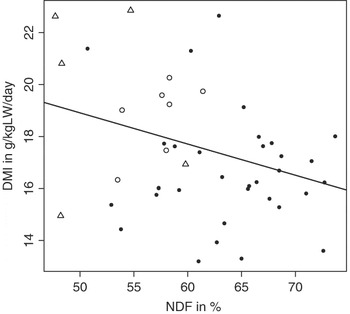
There was no significant relationship between DMI (expressed in g DM/kg LW per day) and DMD (in %) (P > 0.05), whatever the diet. The CP content had no effect on DMI either (P > 0.05), though the intercepts differed significantly between diets (Intercepts = 19.2 g DM/kgLW per day for fresh grass forages and for alfalfa hays, 17.0 g DM/kg LW per day for grass hays, P < 0.05). In contrast, DMI declined significantly as the fibre content increased (DMI = 24.91 − 0.12 × NDF, R 2 = 0.10, P < 0.05, n = 45); there was no effect of diet or of the interaction, and this model explained only 10% of the variance in DMI (Figure 1).
Average dry matter intake of forages by the groups of horses in relation to their fibre content for the three diets (grass hays ●, fresh grass forages ○ and alfalfa hays ▵), the — line represents the relation for the three diets together (DMI = 24.91 − 0.12 × NDF, R 2 = 0.10, P < 0.05).

Digestibility and intake, controlling for the differences among individual horses
As in the previous analysis, individual DMD declined significantly with fibre content of the forage (NDF, AIC = −822.49, P < 0.001, n = 210), and increased significantly with the CP content (AIC = −761.92, P < 0.001, n = 210). The intercepts differed significantly among the three diets for NDF, being highest for fresh forages and lowest for alfalfa hays (log10DMDi = 3.55 − 1.02 × log10NDF for fresh forages, log10DMDi = 3.50 − 1.02 × log10NDF for alfalfa hays and log10DMDi = 3.53 − 1.02 × log10NDF for grass hays; P < 0.001, n = 210). For CP there were differences of intercept between grass hays and the two other diets, which did not differ among themselves and had a higher intercept (log10DMDi = 1.41 + 0.30 × log10CP for fresh forages and alfalfa hays, log10DMDi = 1.39 + 0.30 × log10CP for grass hays; P < 0.05, n = 210). NDF was a better predictor of DMDi than CP (the AIC of the NDF model was much smaller, see above).
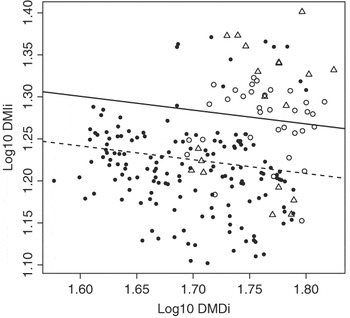
When the differences among individual horses were controlled for, individual DMI increased significantly as individual DMD declined (AIC = −606.58; P < 0.05, n = 210). The intake level of grass hays was lower than those of the two other diets (P < 0.001); the difference between the last two was not significant (Figure 2).
Individual dry matter intake in relation to individual dry matter digestibility (both log-transformed) for the three diets (grass hays ●, fresh grass forages ○ and alfalfa hays ▵); — fresh forages and alfalfa hays: log10DMIi = 1.563 − 0.164 × log10DMDi; - - - - grass hays: log10DMIi = 1.504 − 0.164 × log10DMDi.

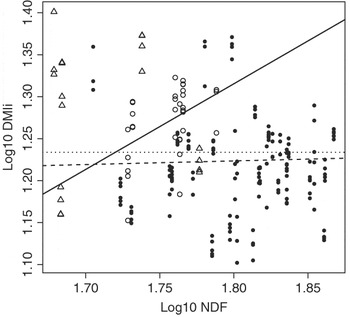
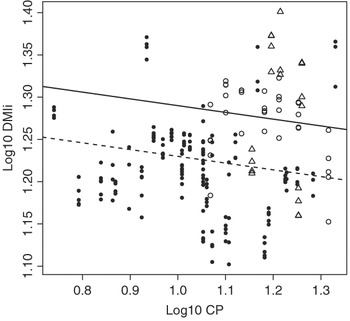
The DMIi increased as forage fibre content increased (AIC = −603.08; NDF: t-value = 2.28, P < 0.05, n = 210) with significant differences of intercepts and slopes between forages (Figure 3). This relation was strong for fresh forages (P < 0.05), weak but significant for grass hays (P < 0.05) and not significant for alfalfa hays. There was a significant negative relation between DMI and CP content (AIC = −606.90; CP: t-value = −2.73, P < 0.01, n = 210) with differences of intercepts between grass hays and the two other diets (P < 0.001, no significant difference between the other two diets; Figure 4). DMDi and CP (with AICs of −607) were slightly better predictors of DMIi than NDF (AIC = −603).
Individual dry matter intake in relation to fibre content (NDF, both log-transformed) for the three diets (grass hays ●, fresh grass forages ○ and alfalfa hays ▵), — fresh forages (log10DMIi = −0.52 + 1.02 × log10NDF); …. alfalfa hays (log10DMIi = 1.23 + 0 × log10NDF); - - - - grass hays (log10DMIi = 1.146 + 0.04 × log10NDF).

Individual dry matter intake in relation to crude protein content (CP, both log-transformed) for the three diets (grass hays ●, fresh grass forages ○ and alfalfa hays ▵); — fresh forages and alfalfa hays (log10DMIi = 1.37 − 0.08 × log10CP); - - - - grass hays (log10DMIi = 1.31 − 0.08 × log10CP).

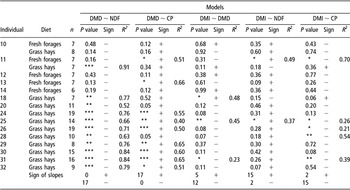
For the 15 individuals where there were adequate data (tested more than 5 times on one diet, two of them tested on two different diet types), digestibility clearly declined with declining forage quality: all the individuals showed a negative effect (Table 2; 11 of which were significant for NDF, 0.52 < R 2 < 0.91, nine for CP, 0.40 < R 2 < 0.66). The majority of horses tended to eat more as digestibility declined (12/17, two of which were significant, 0.23 < R 2 < 0.45); however, one animal significantly increased its intake as digestibility increased (no. 18), and four others tended to do so. This effect was stronger in the models of intake on plant-based measures of forage quality: the great majority of horses increased their intake as forage quality declined (Table 2; 15/17 for both NDF and CP, two of which were significant for NDF, 0.37 < R 2 < 0.49, and five for CP, 0.21 < R 2 < 0.70).
Intake and digestibility of forages by individual horses (P values, sign of the slopes; R 2 values are given when the models are significant)

DMD = dry matter digestibility; DMI = dry matter intake.
*P < 0.05; **P < 0.01; ***P < 0.00.
Discussion
As expected, the digestibility of forages in these horses declined consistently with forage quality (fibre and CP content) according to both the mean and individually based analyses. Further, the fibre content of the forages was a better predictor of DMD than CP; this regression for fibre content (DMD (%) = 102.8 − 0.81 × NDF, P < 0.05, R 2 = 0.71, n = 45) is close to the one obtained from the review by Duncan et al. (Reference Duncan, Foose, Gordon, Gakahu and Lloyd1990), (DMD (%) = 93.3 − 0.64 × NDF (%), P < 0.001, R 2 = 0.87, n = 25) on the same fibre range (40% to 80%), though our intercept and slope are higher. This difference could be due to the forages used, which were hays in Duncan et al. (Reference Duncan, Foose, Gordon, Gakahu and Lloyd1990), whereas we also included fresh forages, which were more digestible. If we consider only hays in our study, the regression becomes DMD (%) = 100.3 − 0.78 × NDF (P < 0.05, R 2 = 0.71, n = 38), which is even closer to the regression obtained by Duncan et al. (Reference Duncan, Foose, Gordon, Gakahu and Lloyd1990). The relation between DMD and NDF in ruminants is also negative, but cattle digest fibrous forages better than do horses, so the slope of the regression for cattle is shallower over the same range of forage quality, DMD (%) = 86.6 − 0.49 × NDF (%) (P < 0.001, R 2 = 0.36, n = 54, Duncan et al., Reference Duncan, Foose, Gordon, Gakahu and Lloyd1990).
There was no suggestion that the average intake of groups of horses was affected by the DMD or CP content, but intake did appear to decline slightly as the fibre content increased (DMI = 24.91 − 0.12 × NDF, P < 0.05, R 2 = 0.10, n = 45). A similar pattern, but with a lower slope, was found by Mesochina (Reference Mesochina2000), who used a wider range of diets, including straws (see Introduction). However, when mixed models, which take into account differences between individuals, were used to analyse the effects of DMD on intake, a very different picture emerged. As digestibility declined there was a significant increase in intake, and the analysis of the data on individual horses shows that 12/17 increased their intake (or tended to do so); five did not, with one animal decreasing its intake significantly (Table 2). The results for the plant-based measures of quality show that as the CP declined, so DMI increased (Figure 4), and this was true for 15/17 individuals feeding on grass forages (fresh and hays; Table 2). For NDF there was a strong effect in fresh forages, but the range of fibre (53% to 61%) and the number of tests (34) were small. In grass hays the effect was in the same direction (Figure 3). Of the 17 individual regressions, 15 showed an increase of intake of grasses, or tended to do so, as NDF content increased (Table 2). The effect was non-existent in alfalfa (Figure 3). We conclude that most horses respond to declining quality in grass forages by increasing their intake. The net energy content of the feed, predicted from forage characteristics (fibres and proteins), was comprised between 1 and 1.5 Mcal/kg DM as recommended by the INRA tables for adult horses at rest (Martin-Rosset et al., Reference Martin-Rosset, Doreau, Boulot and Miraglia1990). In ruminants, the amount of DM consumed increases with increasing concentration of the digestible energy in the ration until it reaches a plateau on high caloric density diets (concentrate feeds). However, this plateau does not express on pure forage diets (Van Soest, Reference Van Soest1994b). In horses, we did not find such an effect (see also Mesochina, Reference Mesochina2000 for a review) with, on the contrary, a tendency to observe a decline in intake as the net energy content of the forage, highly correlated with DMD, increases. These results are consistent with the experimental demonstration that ponies respond to a dilution of their (concentrate) diet with an indigestible element (hardwood sawdust) by increasing their intake (Laut et al., Reference Laut, Houpt, Hintz and Houpt1985). When dilution was slight, compensation was complete and the horses maintained their digestible energy intake, but at a higher dilution, the slight increase in intake was not sufficient to maintain the energy intake constant (Laut et al., Reference Laut, Houpt, Hintz and Houpt1985). This conclusion is very consistent as well with DMI determined in feeding trials using young horses (1 or/and 2 years old) fed during the winter period at trough either with hay-based diet fed ad libitum and supplemented with 1 or 3 kg concentrate or with hay and straw diet fed ad libitum supplemented with 1 or 3 kg concentrate. Horses fed with a low amount of concentrate attempted to compensate the DMI of forage to meet the same total energy intake and their energy requirements. But the compensation on DM basis was only partial (Martin-Rosset and Doreau, Reference Martin-Rosset and Doreau1984). Horses are therefore capable of increasing DMI to some extent when the quality of forage decreases, because time spent eating and the rate of intake (g DM/min) can be increased (Vernet et al., Reference Vernet, Vermorel and Martin-Rosset1995).
The higher intake of alfalfa hays, compared to grass hays, even at the same digestibility, is consistent with other studies of horses (Vernet et al., Reference Vernet, Vermorel and Martin-Rosset1995; Bastian et al., 2005), and is also true for ruminants (Baumont et al., Reference Baumont, Jailler and Dulphy1997). Alfalfa usually has less cell wall, and a higher rate of digesta passage (LaCasha et al., Reference LaCasha, Brady, Allen, Richardson and Pond1999), and lignification affects more of the digestible matter in grasses than in alfalfas, resulting in a lower intake relative to digestibility (Van Soest, Reference Van Soest1994a). Sensorial properties can also affect intake: for ruminants, low intake of silage is often attributed to low palatability since digestibility is only slightly different from that of green forages (Baumont et al., Reference Baumont, Prache, Meuret and Morand-Fehr2000). At the same level of digestibility, eating alfalfa involves higher digestion and passage rate and thus lower fill effect in the ruminant rumen compared to grass hays. If horses are sensitive to this phenomenon, palatability may explain why fresh forages and alfalfa are eaten more readily by horses than grass hays, for equal levels of digestibility. However, it is known from other studies that horses reduce their DMI on straws, which are very lignified forages, compared to grass (Vernet et al., Reference Vernet, Vermorel and Martin-Rosset1995; Dulphy et al., Reference Dulphy, Martin-Rosset, Dubroeucq, Ballet, Detour and Jailler1997a). Low intake of straws may be due to low palatability (i.e. the characteristics of the forage that determine its rate of intake via its smell, its taste and its texture, Dulphy et al., Reference Dulphy, Martin-Rosset, Dubroeucq, Ballet, Detour and Jailler1997a). Very fibrous forages like straws also involve costs and time to manipulate (more mastication to reduce in small particles), which could compete with intake itself. It seems therefore that horses are able to increase their intake on fibrous forages, but only until a threshold.
For ruminants, the NDF content of forages is the feed component most consistently related to intake. Animals require time to eat and time to ruminate, both of which are related to net NDF consumption (Van Soest, Reference Van Soest1994b). The negative relation between fibre and intake on coarse forages has usually been interpreted as a fill effect. Short-term control of feeding behaviour is partly linked to satiety processes, and gastric distension is perhaps the essential factor involved in satiation, acting as a post-ingestive signal to prevent excess feeding (Faverdin et al., Reference Faverdin, Baumont and Ingvartsen1995). Another possibility is that low-quality diets may be deficient in nitrogen or some other nutrient, which could limit intake by slowing rates of digestion. Nutrient deficiency is, however, not an alternative explanation, since retarding digestion will increase rumen fill (Van Soest, Reference Van Soest1994b). Overall, intake declines with forage maturation, and toughness acts as a physical constraint on intake in ruminants (Weston, Reference Weston1996). All large herbivores are thus ultimately limited in their intake by gut fill: the difference between horses and ruminants appears to be that the passage rate of ruminants is slow and decrease even more on high-fibre diet, whereas the food flow rate is more rapid in the tract of horses that are consequently less limited by their gut capacity.
Our analysis at the group level is consistent with previous reviews and suggests that forage quality explains little of the variance in food intake in horses, so the intake of groups of horses is not predicable from the chemical composition of forages. For the first time, using mixed models, we show that the variable ‘individual’ clarifies the picture, as the horses showed different responses to a decrease in forage quality. This study demonstrates what is well known to horse owners: some animals are ‘good eaters’ and others are not. In our study, these differences (coefficients of variation for intake were quite high: 9% for fresh forages, 13% for grass hays and 17% for alfalfa hays) did not result from differences in age, body mass or reproductive state, and we were not able to determine their cause. The consequence of these differences among individuals is that, with an unbalanced experimental design, it is possible to get the opposite result from the real one. This may explain why previous analyses have suggested that horses may, like ruminants, eat less as food quality declines (Dulphy et al., Reference Dulphy, Martin-Rosset, Dubroeucq, Ballet, Detour and Jailler1997a; Mesochina, Reference Mesochina2000).
For many years, there has been a tendency to regard individual variation as an obstacle to understanding basic principles. Intra- and inter-individual variations were considered to be only noise, reducing the capacity of statistical tests to detect differences between groups. Berteaux et al. (Reference Berteaux, Thomas, Bergeron and Lapierre1996) however showed that inter-individual differences, in physiological characteristics for example, may represent biological relevant variation rather than random noise and that inter-individual variability is the raw material upon which natural selection acts. Selection (natural or artificial) can favour the coexistence of different types of behaviour patterns, referred to as ‘strategies’ within a population (Jensen, Reference Jensen1995). More attention needs to be paid to this, in domestic as well as in wild animals. The differences observed between individual horses in this study may result from artificial selection over millennia, which never focused on parameters linked with productivity as in other farm animals. The value of individuals in most livestock species like cattle is determined by the production of milk or meat, which depends directly on the animals’ ability to extract energy and nutrients from plants. Individual variability in intake by ruminants is similar to that observed in this study of horses (e.g. 9% to 15% of variation for sheep intake of conserved forages excluding straw and silage; Baumont et al., Reference Baumont, Chenost and Demarquilly2004); however, this variability can largely be explained by parameters like age, physiological status, breed or genetic ascendance (Jarrige et al., Reference Jarrige, Dulphy, Faverdin, Baumont and Demarquilly1995). In saddle horses, on the other hand, traits linked to performance in competition and/or conformation scores are the main criteria for selection. Estimates of cardiovascular, metabolic, muscular and locomotor parameters are even being used for selection today, since there are relationships between these traits and success in competition (Rivero and Barrey, Reference Rivero and Barrey2001). As a result, horses were and are selected on traits that are not linked with feeding, and this could lead to variability in their ability to ingest and digest their feed.
For the two individuals that increased their DMI significantly as digestibility declined (nos. 25 and 31, see Table 2), the increase was enough to allow them, even on the worst-quality forages, to reach their requirements of digestible energy and protein according to the INRA standards for adult horses at rest (see Martin-Rosset et al., Reference Martin-Rosset, Vermorel, Doreau, Tisserand and Andrieu1994). For the other individuals that tended to eat more as digestibility declined, their intake of digestible energy and protein was always above or close to requirements. For the three individuals that ate less on low-quality forages, the decrease was not enough to cause any deficit in their energy and protein supplies. For alfalfa hays, as their quality was moderate (digestible CP content was between 8.5% and 11.5%), the horses were also eating well above their requirements of energy and protein on all the hays without having to increase their DMI. In general therefore, these horses were able to compensate for declining quality by eating more, as suggested by Janis (Reference Janis1976), when it was necessary to reach the levels of digestible energy and protein for maintenance.
It would clearly be of interest to repeat this study on other types of horses, like ponies or draught horses that have not been selected primarily for their athletic performance, to test whether these breeds show less variability in their intake strategy when faced with low-quality forages. Similarly, horses with higher requirements, like pregnant or lactating mares, might show stronger responses to variable forage quality, as even digestibility seems to be affected by level of requirements: DMD is lower in pregnant than in lactating mares, and both are lower than in dry ones (Martin-Rosset et al., Reference Martin-Rosset, Doreau, Boulot and Miraglia1990).
Conclusion
This study shows, for the first time, that individual horses can increase their intake as forage quality and digestibility decline, but not all individuals respond in the same way on all forages. On grass forages, most individuals compensate, at least partially, for a decline in forage digestibility by an increase in their voluntary intake. This response is different from that of cattle, in which intake declines on poor-quality forages. This analysis highlights the importance of taking individual differences into account in the analysis of determinants of levels of intake in large herbivores; it may well be that individual horses are more variable than individual cattle, and perhaps other ruminants because of the selection on the latter has been for production purposes. These results should be tested on other types of horses to attempt and design a predictive model of intake and digestibility for different types of diets in horses using criteria linked to forage quality.
Acknowledgments
The authors would like to thank Dr D. Berteaux and two anonymous referees for their useful comments on the manuscript.