INTRODUCTION
As a result of life-history strategies, some groups of marine amphipods have specialized as facultative ecto-parasites of fish, living freely on the bottom or in the water column (Bousfield, Reference Bousfield and Parker1982; Vader & Romppainen, Reference Vader and Romppainen1985). Some species of lysianassoidean, pardaliscoidean, lafystiidean and trischizostomatidean groups are known as ‘hitch-hikers’, attaching temporarily to the body surface or gills of the fish hosts by means of clamp-like gnathopods (Bousfield, Reference Bousfield1987).
The family Trischizostomatidae Lilljeborg, 1865 contains one genus, Trischizostoma Boeck, 1861, with 17 species of pelagic or bathypelagic amphipods inhabiting depths from 22 to 3655 m as hyperbenthic components or ecto-parasites of fish and are widespread worldwide (Freire & Serejo, Reference Freire and Serejo2004). Bousfield (Reference Bousfield1987) considered the trischizostomatid amphipods to be relatively host-specific, sometimes occurring in juvenile stages on benthic invertebrates and, as adults, on a narrow range of fish hosts.
Species of the genus Trischizostoma Boeck, 1861 are characterized by their mouthparts, including their styliform upper lip, mandibles and maxillae, the absence of a molar process, the reduction of coxa 1, which is partially covered by coxa 2, the strongly subchelate and robust gnathopod 1, with propodus inverted in the adult stage, palm with stout setae, dactylus large, and a small telson, which is either entire or cleft (Barnard & Karaman, Reference Barnard and Karaman1991). Prior to this study, 17 nominal species of Trischizostoma have been described worldwide (Horton, Reference Horton, Horton, Lowry, De Broyer, Bellan-Santini, Coleman, Daneliya, Dauvin, Fišer, Gasca, Grabowski, Guerra-García, Hendrycks, Holsinger, Hughes, Jazdzewski, Just, Kamaltynov, Kim, King, Krapp-Schickel, LeCroy, Lörz, Senna, Serejo, Sket, Thomas, Thurston, Vader, Väinölä, Vonk, White and Zeidler2015).
Based on the structure of the rostrum, mouthparts and telson, Barnard (Reference Barnard1961) organized the Trischizostoma genus in two groups: one with a large rostrum, strongly styliform mouthparts, and an entire telson, and another group with a smaller rostrum, less styliform mouthparts, and a notched telson. According with Freire & Serejo (Reference Freire and Serejo2004), Tomikawa & Komatsu (Reference Tomikawa and Komatsu2009), and the present study, all species of Trischizostoma belonging to the entire telson group have been documented from the North-east and South-west Atlantic Ocean, the North-west and North-east Pacific Ocean, and the Indo-Pacific. The notched telson group occurs in the South-east Atlantic and South-west Indian Ocean.
During a long-term survey focused on deep-water benthic communities inhabiting below the Oxygen Minimum Zone in western Mexico (the TALUD project), a specimen of Trischizostoma was collected. It represents a new species, which is described herein and increases to 18 the number of species of Trischizostoma documented worldwide. A global geographic distribution pattern of the genus Trischizostoma is also provided.
MATERIALS AND METHODS
The material on which this study is based was collected by the RV ‘El Puma’ of the Universidad Nacional Autónoma de México (UNAM). The specimen of Trischizostoma was captured during a sampling cruise off the west coast of Mexico (TALUD XII, March–April 2008) with a benthic sledge (2.35 m wide, 0.9 m high) equipped with a modified shrimp net (~5.5 cm stretched mesh size) with a ~2.0 cm (3/4″) internal lining net. Depth was measured with a SIMRAD digital recorder.
Temperature, salinity and oxygen were measured close to the sea bottom with a Seabird 19 CTD. Rosette-mounted 10 L Niskin bottles were also deployed and dissolved oxygen concentration was estimated with the Winkler method (Strickland & Parsons, Reference Strickland and Parsons1972). Sediment was sampled with a modified USNEL box core and organic carbon content was determined by oxidation following Loring & Rantala (Reference Loring and Rantala1992).
The specimen of Trischizostoma was examined, dissected and illustrated in detail using a MOTIC SMZ–168 dissecting microscope equipped with a camera lucida. Mouthparts and small appendages were illustrated using a MOTIC BA–210 compound-microscope, also equipped with a camera lucida. Illustrations were completed using the Corel Draw V.12 program. All measurements of the holotype were made with the Motic Images Plus V.2 program. The terminology used for the body structures, setae, spines, the description, remarks and the morphological comparison were based on Lowry & Stoddart (Reference Lowry, Stoddart and Crosnier1993, Reference Lowry, Stoddart and Crosnier1994) and Tomikawa & Komatsu (Reference Tomikawa and Komatsu2009). The type material of this new species of Trischizostoma amphipod is deposited in the Regional Collection of Marine Invertebrates (ICML-EMU) at UNAM in Mazatlán, Mexico.
RESULTS
SYSTEMATICS
Order AMPHIPODA Latreille, 1816
Suborder GAMMARIDEA Latreille, 1802
Superfamily LYSIANASSOIDEA Dana, 1849
Family TRISCHIZOSTOMATIDAE Lilljeborg, 1865
Genus Trischizostoma Boeck, 1861
Trischizostoma unam sp. nov. (Figures 1–6)
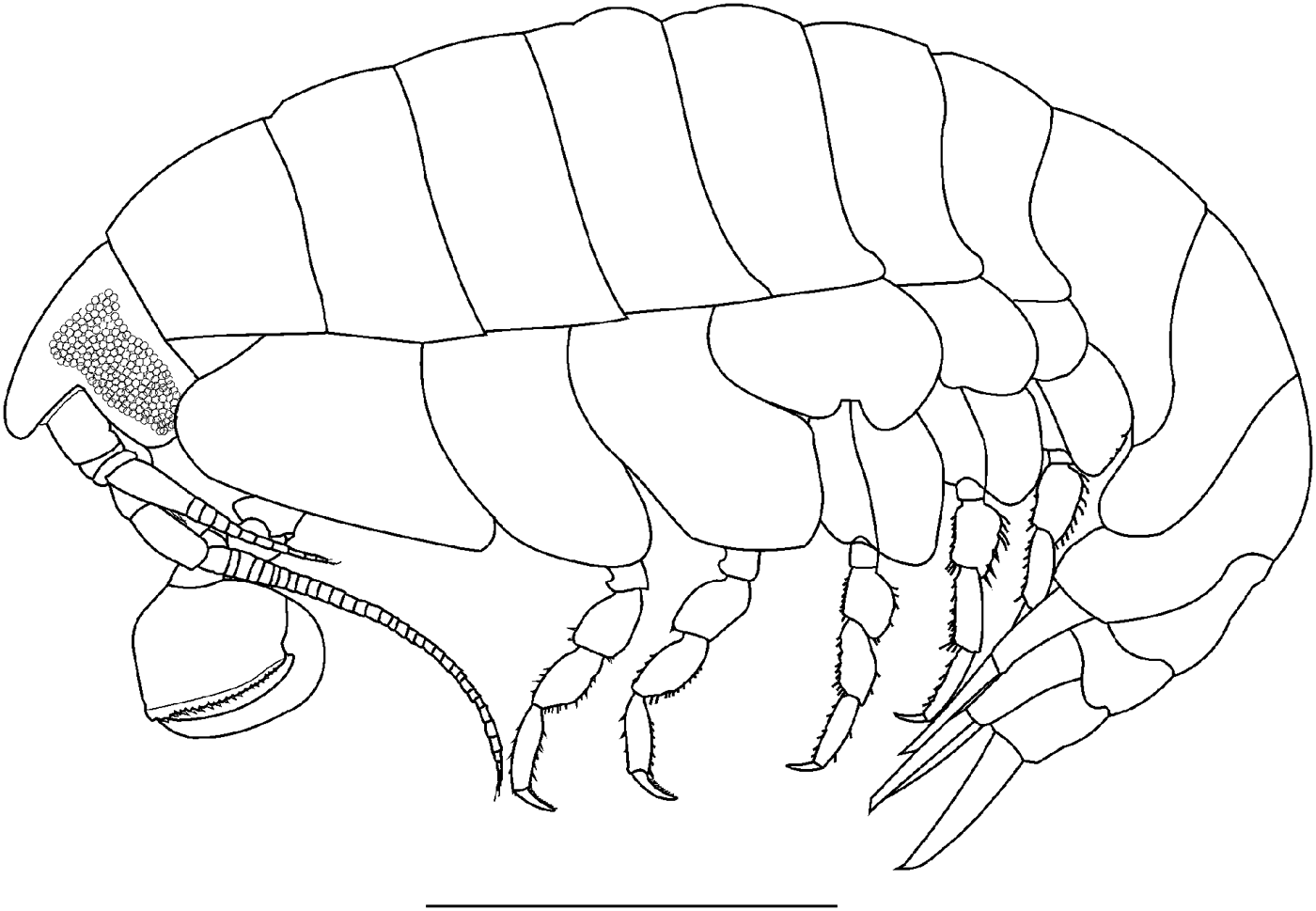
Trischizostoma unam sp. nov., holotype female (38 mm): habitus. Scale bar: 10 mm.

Trischizostoma unam sp. nov., holotype female (38 mm): (A) head; (B) antennae 1; (C) antennae 2. Scale bars: B, 2.0 mm; C, 3.5 mm.

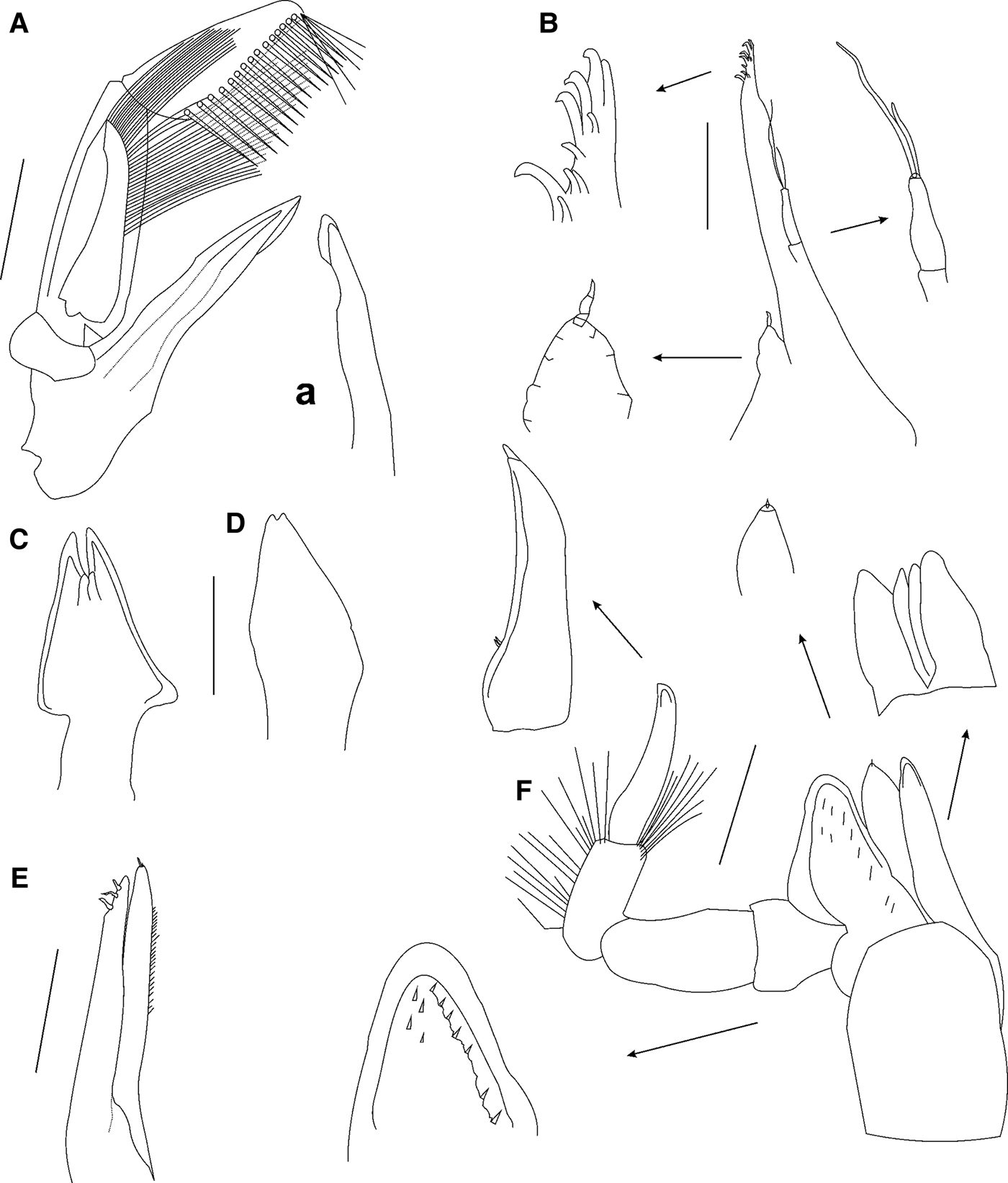
Trischizostoma unam sp. nov., holotype female (38 mm): (A) mandible left; a, mandible right distal part; (B) maxilla 1; (C) lower lip; (D) upper lip; (E) maxilla 2; (F) maxilliped. Scale bars: A and F, 0.5 mm; B–E, 0.2 mm.

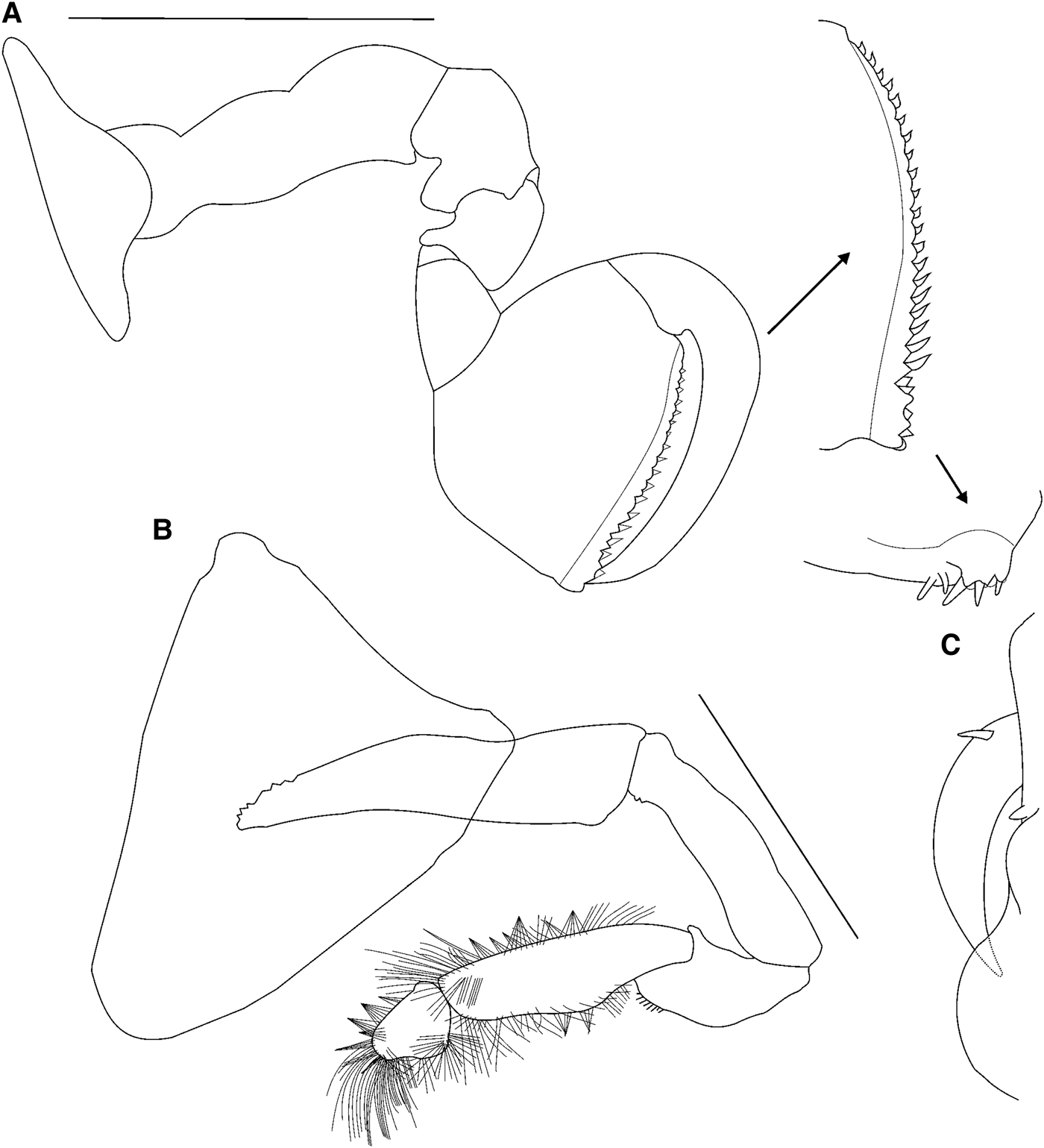
Trischizostoma unam sp. nov., holotype female (38 mm): (A) gnathopod 1; (B) gnathopod 2; (C) detail of gnathopod 2 palm margin. Scale bars: A, 4.0 mm; B, 1.0 mm.

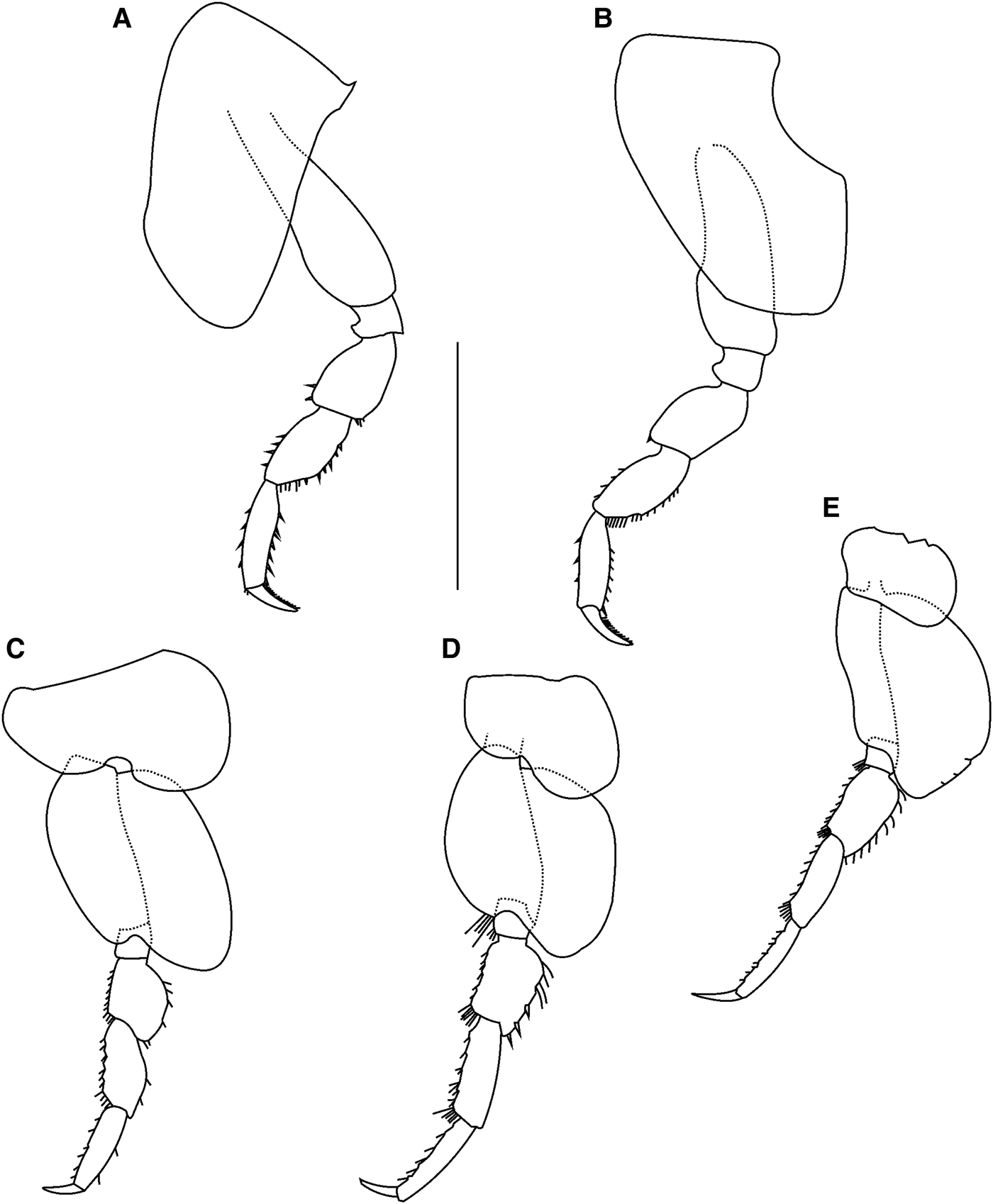
Trischizostoma unam sp. nov., holotype female (38 mm): (A) pereopod 3; (B) pereopod 4; (C) pereopod 5; (D) pereopod 6; (E) pereopod 7. Scale bar: A–E, 5.0 mm.

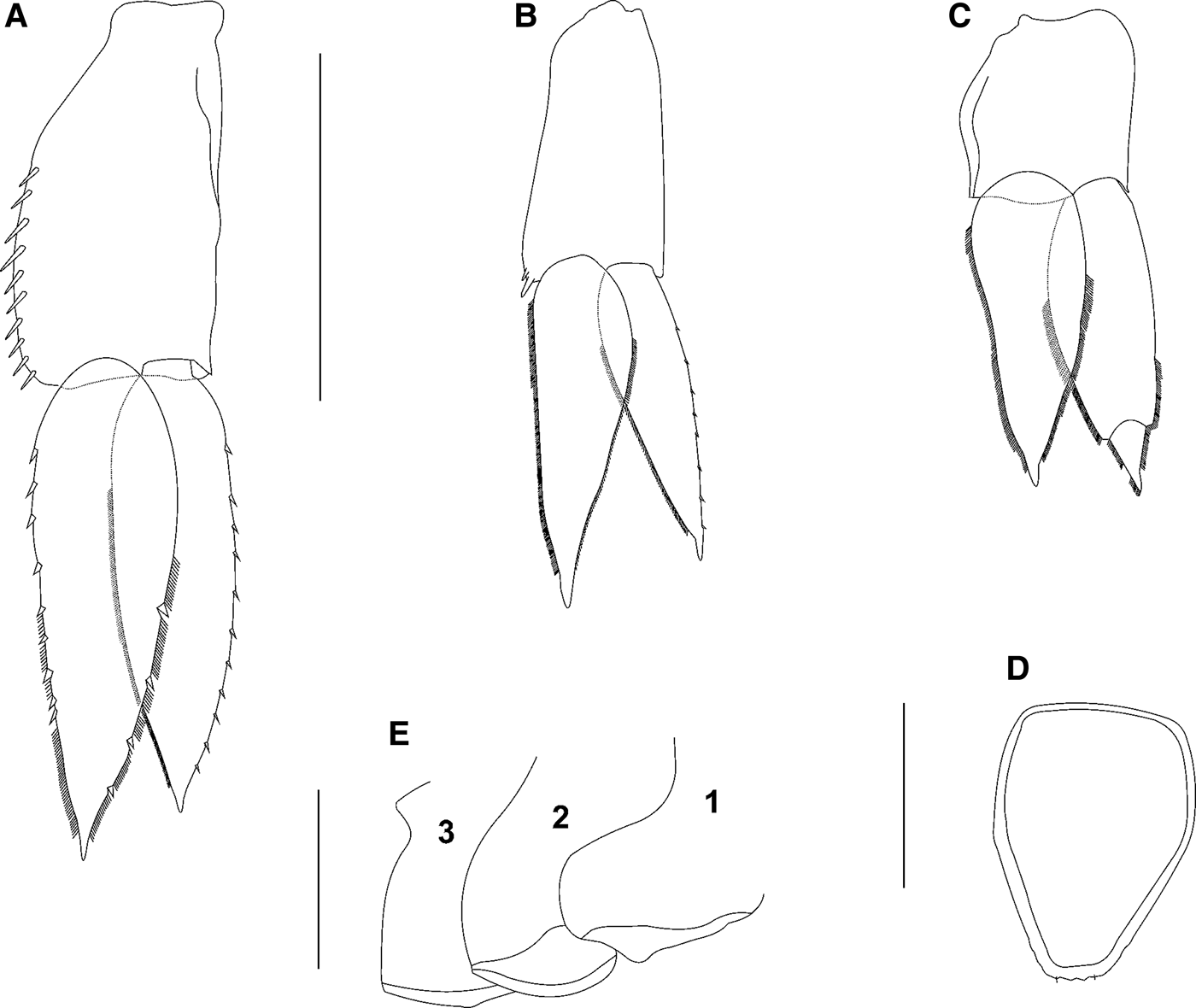
Trischizostoma unam sp. nov., holotype female (38 mm): (A) uropod 1; (B) uropod 2; (C) uropod 3; (D) telson; (E) epimeral plates. Scale bars: A–C, 2.5 mm; D, 0.5 mm; E, 4.5 mm.

TYPE MATERIAL
Holotype: one ovigerous female, 38 mm total length, carrying 14 eggs, RV ‘El Puma', 29 March 2008 (ICML-EMU-10990).
TYPE LOCALITY
Western Mexico, NE Pacific Ocean, TALUD XII cruise station 9 (17°10′26″N 101°37′37″W), benthic sledge, 1392–1420 m.
ETYMOLOGY
The species is named after the Universidad Nacional Autónoma de México, a name used here as an acronym (UNAM).
DIAGNOSIS
Head slightly longer than deep, rostrum large, eyes covering most of head; urosomite 1 unnotched anterodorsally; antenna 1 shorter than antenna 2; antenna 2 flagellum 34-articulate; maxilla 1 outer plate narrow, large with 10 spine-teeth in modified 4/6 arrangement distally, palp narrow, large, 0.4× outer plate length, 1-articulate; maxilla 2 inner plate with row of minute, marginal setae; gnathopod 1 propodus subtriangular, palmar margin with 20 robust setae, anterodistal corner with 5 robust setae; gnathopod 2 minutely subchelate, coxa large, subconical, palm minute, a robust seta and small protuberance near base of dactylus; telson longer than broad, entire, apically truncate, with 2 minute simple setae and 2 minute crenulations distally.
DESCRIPTION
Based on holotype female, 38 mm total length; male unknown. Head (Figures 1 & 2A) slightly longer than deep; lateral cephalic lobe absent; rostrum large; eyes covering most of head, expanded dorsally and narrowing ventrally. Dorsal margins of pereonites 1–7 and pleonites 1–3 smooth (Figure 1), pereonite 4 with a small hump. Urosomites 1–3 dorsally smooth, urosomite 1 unnotched.
Antenna 1 (Figure 2B) short, almost 0.5× length of antenna 2, 0.22× body length; peduncular article 1 short, length 1.2× breadth, without tooth on distomedial margin, distoventral margin with plumose setae; peduncular articles 2–3 shortest, ventral margin of article 3 setose; accessory flagellum medium, subequal in length to article 1 of primary flagellum, 4-articulate, article 1 longest; primary flagellum 11-articulate, article 1 longest, articles 3 and 5 each with long seta (seta on article 5 broken), callynophore strong, one-field of dorsomedial brushes.
Antenna 2 (Figure 2C) about 2× length of antenna 1; peduncular article 3 short, length 0.33× article 4; peduncular article 4 with ventromarginal plumose setae and dorsomarginal simple setae; peduncular article 5 with dorsomarginal simple setae; flagellum 34-articulate.
Mounthpart bundle conical. Epistome and upper lip fused (Figure 3D), upper lip truncated distally; lower lip (Figure 3C) subtriangular, inner lobes present, outer lobes acute, mandibular process subtriangular. Mandibles (Figure 3A) with incisors symmetrical, small and sub-linguiform at tip of styliform projection; lacinia mobilis, accessory setal row, and molar absent. Mandibular palp attached proximally; article 1 shorter than 2 and 3, length 0.55× width; article 2 broad, length 1.2× article 3, with 34–35 A2-setae; article 3 falcate, with 15 D3-robust setae along posterior margin, with 5 apical E3-setae. Maxilla 1 (Figure 3B) inner plate short with a simple apical seta; outer plate narrow, large with 10 spine-teeth in modified 4/6 arrangement, outer row with ST1 to ST3 large, with cusp distally, ST4 large and distal to ST1–ST3, ST5–ST7 absent, inner row with STA large, displaced from STB-STF, without cusps, STB-STF short, without cusps; palp narrow and large, 0.4× outer plate length, 1-articulate, with 2 large apical setae, distomesial margin smooth. Maxilla 2 (Figure 3E) inner and outer plates narrow, inner with a row of minute setae marginally, one small and one minute apical setae, outer plate slightly larger than inner, with 3 robust setae subapically. Maxilliped (Figure 3F) inner plate narrow, subequal in length to outer plate, substyliform, with one apical minute seta; outer plate subovate, submarginal setae vestigial; palp large, 4-articulate, styliform, geniculate between articles 2 and 3; article 3 with marginal setae; dactylus longer than articles 1–3, slender, lanceolate, anterior margin smooth, unguis present.
Gnathopod 1 (Figure 4A) subchelate, coxa vestigial, triangular, margins smooth; basis long, slender, margins smooth; ischium short; merus and carpus rotated; propodus and dactylus inverted in adult, margins without setae; carpus subtriangular, compressed; propodus massive, subtriangular, palmar margin with 20 robust setae, anterodistal corner with 5 robust setae.
Gnathopod 2 (Figure 4B) minutely subchelate, coxa large, subconical, margins smooth; basis large, slender, posteroproximal corner serrate; ischium long, slender; merus subtriangular, posterodistal corner with minute simple setae; carpus long, slender, anterior and posterior margins covered with setae, including short distofacial row of setae; propodus subtriangular, with numerous setae; palmar margin with minute robust seta and small protuberance; dactylus short, with minute anteroproximal robust seta.
Peraeopod 3 (Figure 5A) coxa large, anterodistal margin weakly concave, and posterodistal concave, margins smooth, posteroproximal corner with spine-process; merus with robust setae distally; carpus with marginal robust setae; propodus slender with marginal robust setae; posterior margin of dactylus lined with minute simple setae. Peraeopod 4 (Figure 5B) coxa large, deeper than wide, with posterior lobe, posterodistal corner almost quadrate, anterior margin convex, margins smooth; merus with marginal robust setae, propodus slender, with marginal robust setae; posterior margin of dactylus lined with minute simple setae. Peraeopod 5 (Figure 5C) coxa bilobed, marginally smooth, posterior lobe deeper than anterior; basis expanded, posterior lobe deeper than anterior; merus expanded, posterior margin rounded, with several marginal setae; carpus and propodus with marginal setae; dactylus short, slender. Peraeopod 6 (Figure 5D) coxa small, lobate posteriorly; basis expanded with broad posteroventral lobe, anterodistal corner with simple setae; merus expanded proximally, with marginal simple and robust setae; anterior margin of carpus and propodus with simple setae; dactylus short, slender. Peraeopod 7 (Figure 5E) coxa smallest, not lobate posteriorly; basis expanded posteriorly, posterior margin slightly rounded, minutely crenate; merus with marginal simple setae; anterior margin of carpus and propodus with simple setae; dactylus short, slender.
Oostegites from gnathopod 2 to peraeopod 5. Gills from gnathopod 2 to peraeopod 7.
Epimeral plates (Figure 6E). Anteroventral margin of epimeron 1 rounded, midventral margin pointed, posteroventral corner subquadrate; ventral margin of epimeron 2 rounded, posteroventral corner subquadrate; epimeron 3 minutely pointed midventrally, posteroventral corner subquadrate.
Uropod 1 (Figure 6A), peduncle with 10 dorsomedial robust setae; outer ramus slightly shorter than inner ramus, outer ramus with 11 minute, robust setae along outer margin, lined with minute, simple setae along inner margin; inner ramus with 4 robust setae on outer margin and 9 on inner margin, both margins lined with simple setae distally. Uropod 2 (Figure 6B) peduncle with 2 distal robust setae, outer ramus slightly shorter than inner ramus, outer ramus with 8 minute robust setae along outer margin, several minute simple setae on inner margin; inner ramus with both margins setose. Uropod 3 (Figure 6E) peduncle as wide as long, dorsolateral flange, rami subequal in length; outer ramus 2-articulate, article 2 short, rami without robust setae; several minute, simple marginal seta on both rami.
Telson (Figure 6D) longer than broad, entire, dorsally smooth, apically truncate, 2 minute simple setae and 2 minute crenulations distally.
ECOLOGY
The only specimen available was collected in the following environmental conditions (measured at the bottom): salinity, 34.58 ppm; temperature, 3.29°C; dissolved oxygen 0.75 ml L−1; organic carbon in muddy sediments, 1.70%. Although species of Trischizostoma are known as occasional ectoparasities on fish, there is no information on the possible host of T. unam sp. nov.
TAXONOMIC REMARKS
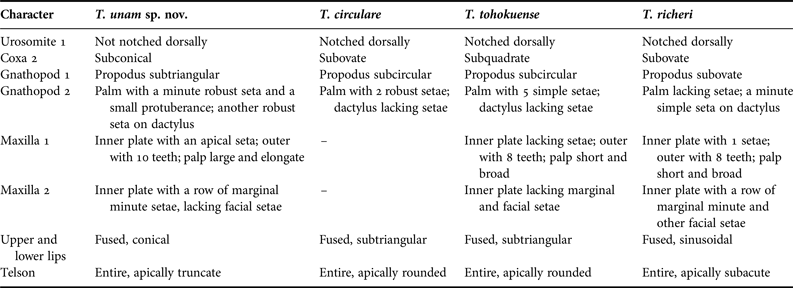
Female of Trischizostoma unam sp. nov., is morphologically most similar to females of T. circulare Barnard, Reference Barnard1961, T. tohokuense Tomikawa & Komatsu, Reference Tomikawa and Komatsu2009 and T. richeri Lowry & Stoddart, Reference Lowry, Stoddart and Crosnier1994. These species all share a large rostrum, expanded eyes, an entire telson, and margins of carpus and propodus covered with numerous simple setae. The female of Trischizostoma unam sp. nov., however, can be easily distinguished from those three species by the following characters: (1) in T. unam sp. nov. urosomite 1 is not notched anterodorsally vs notched in the other three species; (2) in T. unam sp. nov. coxa 2 is subconical vs suboval or subquadrate; (3) the propodus of gnathopod 1 is subtriangular in T. unam sp. nov. vs subcircular or subovate; (4) the palm of gnathopod 2 has one minute seta and one protuberance in T. unam sp. nov. vs no setae or 2 to 5 setae; (5) there are 10 spine-teeth at the outer plate of maxilla 1 and the palp is large in T. unam sp. nov. vs the outer plate with 8 teeth and a short palp; (6) the telson is apically truncate in T. unam sp. nov. vs rounded or subacute in the other three species. The main morphological differences are summarized in Table 1.
The more significant morphological characters used to distinguish females of Trischizostoma unam sp. nov. from those of the closely related species: T. circulare, T. tohokuense and T. richeri.

DISCUSSION
As in other groups of deep-water crustaceans, there is a significant lack of information on Amphipoda, although the number of species described over time has regularly increased to a figure close to 9700 species, all habitats considered (Coleman, Reference Coleman2015). While some regions have been intensively sampled (e.g. the Mediterranean Sea and the Antarctic) (e.g. Brandt, Reference Brandt1997; Cartes & Sorbe, Reference Cartes and Sorbe1999), others have partly been explored. Altogether, our knowledge of deep-water amphipod communities is particularly limited, although some areas have received much more attention. In the Mediterranean Sea, for example, of the 415 known species of Amphipoda on record 154 (37.1%) are from the deep water (>150 m), but only 11.3% inhabit below 1000 m (Bellan-Santini, Reference Bellan-Santini1990). In the Antarctic, 496 species had been registered in 2003 (Clarke & Johnston, Reference Clarke and Johnston2003), but this number increases constantly due to a large sampling effort performed by several institutions. A recent census put the number of species of amphipods in the southern Ocean close to 650 (De Broyer et al., Reference De Broyer, Guerra-Garcia, Takeuchi, Robert and Meerhaeghe2004, Reference De Broyer, Lowry, Jazdzewski and Robert2007; Zeidler & De Broyer, Reference Zeidler, De Broyer and De Broyer2009). An estimated 1000 species from the Antarctic and sub-Antarctic region are awaiting description (d'Udekem d'Acoz, personal communication, January 2016). An analysis of bathymetric distribution of Antarctic amphipods performed by Brandt (Reference Brandt1997) and based on three surveys, indicated a strong component of eurybathic genera (~40%), with depth range of 1000 m or more.
The matter of estimating richness of deep-water amphipods is further complicated by the existence of presumably cosmopolitan species that probably comprise multiple cryptic species. As in the case of species covering very large geographic ranges, species reported for wide depth-range might also represent a species complex (Havermans et al., Reference Havermans, Sonet, d'Udekem d'Acoz, Nagy, Martin, Brix, Riehl, Agrawal and Held2013). Further sampling in the deep-water with adequate gear will certainly increase the number of known species exclusive to deep-water habitats. The use of baited traps, for example, has proved very effective in collecting large amounts of deep-water scavenging amphipods (e.g. France, Reference France1994). Similar results have also been obtained using suprabenthic samplers (e.g. Lörz & Brandt, Reference Lörz and Brandt2003).
In the eastern tropical Pacific, 494 species of amphipods have been recorded, of which 107 (21.7%) are restricted to deep water (>200 m), but a large number of species (183 or 37% of total) feature a rather undefined bathymetric range, with published records including very shallow (~ 0 m) and very deep water (>3700 m) (García-Madrigal, Reference García-Madrigal and Hendrickx2007). However, to our knowledge baited traps and suprabenthic sledges aimed at collecting deep-water Peracarida have not been regularly deployed in the region. Use of these gear would certainly improve our knowledge on amphipods in Pacific Mexico and elsewhere, for example in the Gulf of Mexico where box cores have often been used to study this fauna (e.g. Escobar-Briones & Winfield, Reference Escobar-Briones and Winfield2003; Winfield et al., Reference Winfield, Escobar-Briones and Morrone2006).
With the addition of the new species, the genus Trischizostoma, established by Boeck (1861), now includes 18 nominal species: T. nicaeense (Costa, 1851); T. raschi Boeck, 1861; T. remipes Stebbing, 1908; T. paucispinosum K. H. Barnard, 1916; T. longirostre Chevreux, 1919; T. serratum K.H. Barnard, 1926; T. circulare; T. denticulatum Ledoyer, 1978; T. barnardi Vinogradov, 1990; T. cristochelata Vinogradov, 1990; T. macrochela Vinogradov, 1990; T. nascaensis Vinogradov, 1990; T. tanjae Vinogradov, 1991; T. crosnieri Lowry & Stoddart, Reference Lowry, Stoddart and Crosnier1993; T. richeri; T. costai Freire & Serejo, Reference Freire and Serejo2004, T. tohokuense and T. unam sp. nov.
As far as we know, the global geographic distribution of the genus Trischizostoma is concentrated in the southern hemisphere (15 species), compared with the northern hemisphere (seven species) (Figure 7). Trischizostoma unam sp. nov. is the first species of the genus recorded for the NE Pacific. Distribution related to the oceans indicates that six species (T. costai, T. denticulatum, T. longirostre, T. nicaeense, T. raschi and T. richeri) have been documented for the Atlantic Ocean, eight species (T. barnardi, T. cristochelata, T. macrochela, T. nascaensis, T. tohokuense, T. crosnieri, T. richeri and T. unam sp. nov.) for the Pacific Ocean, and five (T. circulare, T. denticulatum, T. remipes, T. serratum and T. tanjae) for the Indian Ocean.
Current global distribution of all species of genus Trischizostoma. Numbers refer to known species as listed (1–18), and correspond to the localities where these have been reported: (1) T. barnardi, (2) T. christochelatum, (3) T. circulare, (4) T. costai, (5) T. crosnieri, (6) T. denticulatum, (7) T. longirostre, (8) T. macrochela, (9) T. nascaense, (10) T. nicaeense, (11) T. paucispinosum, (12) T. raschi, (13) T. remipes, (14) T. richeri, (15) T. serratum, (16) T. tanjae, (17) T. tohokuense and (18) T. unam sp. nov.

ACKNOWLEDGEMENTS
The authors would like to thank all scientists, students and crew members who helped with the sampling operations aboard the RV ‘El Puma’ during the TALUD XII cruise. Ship time of the research cruises TALUD XII carried out aboard the RV ‘El Puma’ was funded by the Universidad Nacional Autónoma de México. We also thank Cris Serejo and an anonymous reviewer for their comments and suggestions to improve this manuscript, and Cédric d'Udekem d'Acoz for his comment on amphipods diversity and for providing pertinent literature.