Introduction
Since 1979 the right to unemployment benefit has become contingent upon more and more conditions (Novak, Reference Novak1997; Dwyer, Reference Dwyer2004), and this trend looks set to continue. Labour proposed that those who have received Jobseeker's Allowance (JSA) continuously for two years or more must work for their benefit (Wintour, Reference Wintour2008). The Conservatives intend to make this condition apply to those who have been on JSA for at least two of the last three years (Conservative Party, 2008) and have pledged that those ‘who refuse to accept reasonable job offers could forfeit their benefits for up to three years’ (Conservative Party 2010: 16). The Conservatives' coalition agreement with the Liberal Democrats simply asserted that unemployed people's receipt of benefits will be ‘conditional on their willingness to work’ (HM Government, 2010: 23).
Both Labour and Conservative Parties consider their approach fair, and feel justified in insisting that ‘those who can work should work’.Footnote 1 David Cameron (Reference Cameron2008) has said that moving people ‘off benefits and into work’ is consistent with promoting ‘a compassionate society that believes in social justice’. Likewise, Labour minister John Hutton (Reference Hutton2006) said it was ‘unfair’ to ask ‘hard working families to pay for the unwillingness of some to take responsibility to engage in the labour market’.
Yet this talk of fairness comes at a time when the distribution of income and wealth in the UK is much more unequal than in past decades. The gini-coefficient score for income inequality, which stayed at around 0.25 in the post-war period, increased to around 0.35 between the late 1970s and the late 1980s, and remains at approximately that level (Sefton and Sutherland, Reference Sefton, Sutherland, Hills and Stewart2005; OECD, 2008). The figure for the distribution of wealth rose to around 0.70 in the early 2000s after being in the mid 0.60s for the previous two decades (Hills, Reference Hills2004; Dixon and Paxton, Reference Dixon, Paxton, Pearce and Paxton2005). Furthermore, research repeatedly demonstrates the existence of a wide gap between the life chances of babies born into households at the top and bottom of the income distribution (Bamfield and Brooks, Reference Bamfield and Brooks2006).
This article revisits the issue of whether or not welfare conditionality can be justified in such an unequal society. The first part discusses Stuart White's The Civic Minimum (Reference White2003), the most notable recent exposition of the view that conditionality is only acceptable in a much more equal society than the UK is at present. I argue that politicians’ claims that conditionality is ‘fair’ rely upon the empirically unsubstantiated assumption that equal (or almost equal) opportunities are possible in a society of radically unequal outcomes. The second part presents findings from a study which investigated the impact of values upon labour market choices. The study provided a unique in-depth examination of a diverse sample's views around equality and welfare conditionality. Views about equality were found to be important in determining views on conditionality and what was considered morally acceptable labour market behaviour. Most notably, the study explored the values, atttitudes and behaviour of a group of ‘alternative’ JSA claimants who, echoing White, rejected the suggestion that they ‘should work’ in a very unequal society. The article concludes by considering the implications of the empirical findings for welfare policy.
Stuart White's ‘justice as fair reciprocity’
White is an egalitarian liberal who starts from the premise that the ‘good society’ is one of mutual concern and respect or, more precisely, one in which individuals exhibit ‘democratic mutual regard’ (2003: 27). White sets out a philosophy of economic citizenship appropriate for such a society, whereby citizens who ‘claim the high minimum share of the social product necessarily available to them . . . have an obligation to make a decent productive contribution, proportional to ability, to the community in return’ (2003: 17–18).
This ‘justice as fair reciprocity’, in its ‘ideal’ form, demands a ‘comprehensively egalitarian society’ (2003: 77) that not only eliminates discrimination on the grounds of ‘race’, gender etc., but also fully corrects for brute luck disadvantages – which consist mainly of disadvantageous endowments of external wealth, marketable talent and educational opportunities. White acknowledges the lack of support for this in the UK and so, to avoid being ‘unhelpfully utopian’, proposes a ‘non-ideal form of fair reciprocity’ (p. 78), which guarantees the following egalitarian outcomes: freedom from poverty, discrimination and exploitation; the opportunity for rewarding and challenging work; access to external wealth; and minimised educational inequalities (see White, Reference White2003: 90–1).
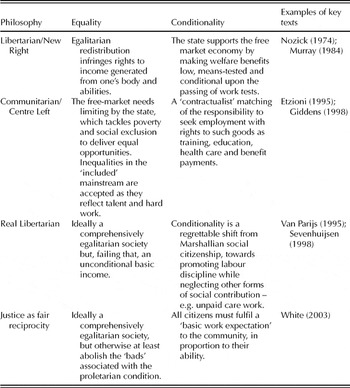
White contrasts his position with three others (see Table 1, page 5). The ‘New Right/Libertarian’ philosophy is evident in the Conservatives’ belief that ‘the free market economy is the fairest way of rewarding people for their efforts’ (Osbourne, Reference Osbourne2008). New Labour literature neatly fits the ‘Centre Left/Communitarian’ philosophy (see Lister, Reference Lister1998; Powell Reference Powell and Powell1999; Deacon, Reference Deacon2002; Levitas, Reference Levitas2005; Driver and Martell, Reference Driver and Martell2006). However, the Parties’ policies do not precisely match the philosophies; Cameron's Conservatives have declared support for Centre Left ideas like equal opportunities (Cameron, Reference Cameron2008) and tackling child poverty (Letwin, Reference Letwin2006), while New Labour's use of low, means-tested benefits fits the New Right/Libertarian position. White explains that his own approach is similar to the Centre-Left/Communitarians in its ‘emphasis on the responsibilities that accompany citizens’ social rights’ and is similar to Real Libertarians in its belief in ‘economic egalitarianism’ (2003: 17).
Stuart White's four philosophies of economic citizenship

Source: White (Reference White2003, chapter 1).
White (Reference White2003: 137–9) defends his stance on conditionality against the Real Libertarians, explaining that the ‘work test’ – which he sees as essential to his favoured mutually responsible society – is not opposed by leading advocates of social justice like Marshall (Reference Marshall1950) and Rawls (Reference Rawls1999), and that Left literature has often equated the voluntarily unemployed with the idle, share owning capitalist.Footnote 2
He also defends his ‘non-ideal’ version of ‘justice as fair reciprocity’ against the possible accusation that it is no more egalitarian than New Labour. White explains that he, unlike New Labour, agrees with Rawls that talent should go unrewarded as it is ‘arbitrary from a moral perspective’ (Rawls, Reference Rawls1999: 64, quoted in White, Reference White2003: 13), and that he wishes ‘to achieve equality of opportunity (not just a basic level of opportunity)’ (2003: 98).
While White's stance on the reward of talent clearly separates him philosophically from both Labour and Conservatives, his dispute with them over equality of opportunity is an empirical matter. Equality of opportunity is usually taken to mean an equal ability to fulfil one's potential with a given amount of talent and effort (Miller, Reference Miller, Pearce and Paxton2005), and it is well established that this is not possible in a society of unequal outcomes (Hirsch, Reference Hirsch1977; Barry, Reference Barry2005). Richer parents can buy their children the educational advantage that is so important in determining their future income. Furthermore, area-based, class-based, gendered and ethnic cultures are found to strongly influence educational outcomes (Ball, Reference Ball2003; Reay et al., Reference Reay, David and Ball2005), with children severely educationally disadvantaged before they are old enough to make their own choices (Barry, Reference Barry2005; Bamfield and Brook, Reference Bamfield and Brooks2006). While some welfare capitalist societies – a notable example being Sweden – have successfully minimised these inequalities through redistribution and universal day care provision for younger children (Esping-Andersen, Reference Esping-Andersen, Giddens and Diamond2005), such policies are not advocated by New Labour or the Conservatives. Hence, White's view that genuine equality of opportunity cannot exist under present policy arrangements, and instead requires more radical measures such as the ‘heavy’ taxation of wealth (2003: 199), carries considerable empirical support.
The study
The research presented here explored in-depth the values, and views about economic citizenship, of 30 unemployed and 20 employed people. Groups with differing values (as well as other relevant characteristics) were purposively sampled in order to gain a deeper understanding of contrasting values and attitudes around work and welfare, and the relationship between these contrasting values/attitudes and behaviour in the labour market. This focus on diversity is rare in studies of welfare claimants, and it is widely acknowledged that UK social policy literature has, until recently, tended to downplay or neglect individual agency (Williams et al., eds., Reference Williams, Popay and Oakley1999; Deacon, Reference Deacon2002; Lister, Reference Lister2004). Indeed, when UK unemployment was last high enough to make it a major topic of political debate and social research, even those authors who lamented the treatment of the unemployed as an homogeneous group (examples include McLaughlin et al., Reference McLaughlin, Millar and Cooke1989; White, Reference White1991) went on to recommend examining different categories such as age and gender – not differences in values or preferred lifestyles. Moreover, qualitative studies of the unemployed understandably took place in culturally homogeneous, working-class neighbourhoods (McLaughlin et al., Reference McLaughlin, Millar and Cooke1989; Jordan et al., Reference Jordan, James, Kay and Redley1992). Hence, while lone parents’ culturally diverse ‘gendered moral rationalities’ have been mapped (Duncan and Edwards Reference Duncan and Edwards1999; Duncan and Irwin, Reference Duncan and Irwin2004), such work is hitherto absent from UK literature on the unemployed. This is not the case elsewhere. In the Netherlands, Engbersen et al. (Reference Engbersen, Schuyt, Timmer and Van Waarden1993) identified some unemployed people with a ‘traditional’ strong work ethic who diligently sought employment, and others with an ‘alternative’ work ethic who often preferred to live on the benefits provided by the relatively permissive and generous Dutch welfare system of the time.
The following groups were chosen:
Employed with a strong commitment to the ‘work ethic’ (Strong Work Ethic)
Employed, with weak commitment to the ‘work ethic’ (Weak Work Ethic)
Unemployed, with low employability (Low Employability)
Unemployed, with mainstream values and lifestyles (Mainstream Unemployed)
Unemployed, with alternative values and lifestyles (Alternative Unemployed)
The Alternative unemployed were chosen for their rejection of Protestant Work Ethic values (see Furnham, Reference Furnham1990) and low interest in material possessions, which, it was hypothesised, would make them more likely to be voluntarily unemployed. The Mainstream Unemployed were included because they neither held the Alternative respondents’ values nor chronically lacked employability as did the Low Employability group, who usually had low or no qualifications and were homeless or had a criminal record. The Strong and Weak Work Ethic groups were categorised based on the strength of their moral preference for paid work over claiming JSA, as moral judgment about paid work was not usually made without reference to benefit receipt (this was a key finding which is discussed below).
Respondents were assigned to the five groups after initial questioning or, if it was unclear which category respondents fitted, after the interviews had taken place. Apart from their defining characteristics, the five groups were chosen randomly. It was possible that someone could fit both the Low Employability and Alternative unemployed groups, but this did not happen. The unemployed groups included both short- and long-term unemployed. All 30 unemployed were entitled to claim JSA, and 29 did so at the time of interview. The employed groups included part-time and full-time workers. The sample was overwhelmingly white, and the 19 women and 31 men, and those of various ages, were evenly distributed between the five groups.
Thirty-five semi-structured interviews took place in Canterbury, chosen because it was an affluent city in south-east England at a time of low unemployment (2001–2), and the rest in the larger and more industrial cities of Bradford, Leeds and York. Questions covered values and attitudes concerning work, materialism, welfare and social justice; respondents’ education, household roles and past labour market experiences and decision-making. Respondents were accessed via street canvassing, outside Canterbury job centre, via a homeless charity (for some of the ‘Low Employability’ respondents) and, in the case of some of the ‘Alternative’ respondents, through contacts made during an earlier project.
Findings
The ‘Wealth Ethic’
When respondents moralised in favour of work, they rarely did so without mentioning the claiming of state benefits – one's moral duty to the rest of society was to avoid being a burden on it:
It would be a matter of pride to provide my own money from my labours rather than going to the dole office. (Strong Work Ethic, Male, 57, Council Worker)
It's not about laziness, it's about paying your own way. (Strong Work Ethic, Female, 52, Cleaner)
When respondents were asked whether or not they believed that people with no financial need either for paid work or for claiming JSA should have to work, a typical response was ‘I think they should have a choice’ (Strong Work Ethic, Female, 23, Retail Manager). Most said that they would choose to work in this circumstance, yet none spoke of a possible moral obligation to do so:
I would go back to work for my own benefit but I can choose the job that I want to do and the hours. (Mainstream Unemployed, Male, 58)
This morality around work and claiming unemployment benefits is consistent with what Kelvin and Jarrett (Reference Kelvin and Jarrett1985: 104) call the ‘wealth ethic’ – ‘to make or have sufficient wealth not to have to depend on others’. As they explain, ‘provided one has enough money to be independent, there is certainly no moral obligation to work’ (1985: 104). It also matches Mead's (Reference Mead, Mead and Beem2005: 192) description of US public opinion:
Americans seem to combine a communitarian ethic for the poor with a Lockean attitude above that level . . . they insist that the dependant display recognised civilities such as working . . . But above the welfare level, individuals . . . need only obey the law.
Twenty-nine respondents supported the Wealth Ethic (all 10 Strong Work Ethic, 6 Weak Work Ethic, 7 Low Employability, 6 Mainstream Unemployed, and no Alternative Unemployed). The 12 who opposed it on egalitarian grounds consisted of all the Alternative respondents and two of the Weak Work Ethic group. Of the remaining nine, some held views which were unclear or fitted neither category, while others were unfamiliar with moral debates around work and welfare.
All 50 respondents had done paid work, while 44 had experienced unemployment. Their labour market decisions reflected their unique circumstances and individual preferences about jobs, including the emphasis they placed on the importance of money. However, their views regarding the Wealth Ethic dictated the parameters of what they considered morally acceptable labour market behaviour. Claiming JSA without seeking employment was morally unacceptable to the 29 who supported the Wealth Ethic, whereas it was morally acceptable to the 12 who opposed the Wealth Ethic on egalitarian grounds (although the Wealth Ethic supporters occasionally reported failing to live up to their expressed morality, and the Alternatives sometimes hinted that they felt ashamed of their unemployment). The two categories of respondent are discussed in turn, in order to explain why their views regarding the wealth ethic (and hence what they considered acceptable labour market behaviour) differed.
The Wealth Ethic supporters
In order to explain why Wealth Ethic supporters did not, like White and the Alternatives, insist upon greater equality as a prerequisite of their support for welfare conditionality, we require knowledge of whether or not they considered contemporary UK society fair, and how this in turn related to their commitment to the Wealth Ethic.
The Wealth Ethic supporters all said it was fair that hard work and talent should be rewarded. They agreed that the unemployed should be entitled to state benefits and help finding jobs. They expressed much dismay at the unfairness of what academics refer to as the ‘unemployment trap’ (see Gebauer and Vobruba, Reference Gebauer and Vobruba2003), whereby unemployed people are unable to increase their incomes by taking attainable jobs. Only the most vehement Wealth Ethic supporters condemned those who chose to remain on benefits when in the ‘unemployment trap’. Most, like Strong Work Ethic, Female, 19, Shop Assistant, who said she would choose to work due to ‘the boredom factor and just because I feel that I should work’ did not condemn others for not doing so ‘as long as they're actively seeking work’.
Respondents considered the distribution of income and wealth in the UK to be at least tolerably fair. Hard work, talent and luck were the most popular reasons given for people reaching the top of the income distribution. Talk of social injustice was largely confined to discussion of breaches of existing anti-discrimination legislation and to the very rich being ‘born with a silver spoon’ (Strong Work Ethic, Female, 35, Recruitment Officer). Reference to educational inequalities was confined to occasional mentions of the funding gap between private and state schools. Moreover, respondents downplayed the relationship between educational attainment and subsequent earnings, often citing business acumen as the main route to a higher income (like Lewis and White's (Reference Lewis, White, Paxton, White and Maxwell2006) respondents, they often named Richard Branson as an example of someone who had reached the top through effort and talent). Thus, consistent with findings elsewhere (Sefton, Reference Sefton, Park, Curtice, Thomson, Bromley, Phillips and Johnson2005; Taylor-Gooby, Reference Taylor-Gooby, Pearce and Paxton2005), while a majority believed the UK to be too unequal (owing to their resentment towards a privileged minority at the top), support for redistribution was limited, largely due to fears that it rewards the undeserving.
Older, working-class, and less educated respondents tended to be the Wealth Ethic's most vehement advocates. Six in particular, divided equally between the Low Employability and Strong Work Ethic groups, asserted views on welfare and gendered work roles in a basic, unelaborated way, with which it was assumed all right-thinking people would agree (this is consistent with past research on working-class communities – examples include Turner et al., Reference Turner, Bostyn, Wight, Roberts, Finnegan and Gallie1985; Wight, Reference Wight1993). They often said the Wealth Ethic had been ‘instilled’ in them (Strong Work Ethic, Female, 52, Cleaner). Their intransigence about social standards contrasted with younger respondents who typically defended the right of individuals and groups to lead an alternative lifestyle, providing they did not breach the Wealth Ethic.
Given their lack of education, the traditionalist respondents were at considerable risk of unemployment, and spoke with sadness about past experiences of joblessness. One said he was ‘willing to take almost anything [he] was capable of’ when unemployed, and contrasted this approach with that of the voluntarily unemployed, of whom he said ‘our taxes are higher because they won't work’ (Strong Work Ethic, Male, 64, Cleaner). While his willingness to take ‘almost anything’ is questionable (his account suggested he followed traditional gendered norms), the fiercest supporters of the Wealth Ethic were nevertheless those who reported taking the most drastic steps to avoid claimant unemployment.
The same respondent described himself as an ‘out and out socialist’ – thus exemplifying a recurring finding, that egalitarianism did not necessarily temper respondents’ support for the Wealth Ethic. This appeared to be because they saw the Wealth Ethic as a cast-iron social rule, whereas the issue of distributive justice was considered debatable. It might also have been because resentment at paying taxes to fund the voluntarily unemployed stemmed from the same sense of economic injustice that led them to become socialists. Perhaps it also stemmed from their stated belief that opportunities (if not outcomes) were at least tolerably equal, which in turn appeared to be attributable to their failure to grasp the true extent of social inequality, owing to relying upon lived experiences when forming perceptions of social reality. This has been found elsewhere (Runciman, Reference Runciman1966; Golding and Middleton, Reference Golding and Middleton1982), and was a view expressed by one of a sub-group of five highly educated and more questioning respondents (three were in the Weak Work Ethic group and two in the Mainstream Unemployed group), who were the Wealth Ethic's least vehement supporters:
The world of the very rich is located in a very different space to the world of the poor, and most people don't even quite recognise what is going on. (Mainstream Unemployed, Male, 48)
The five were accustomed to higher incomes and jobs they enjoyed, and therefore viewed unemployed people as unfortunate victims who typically lived in ‘poverty’ (see also Golding and Middleton, Reference Golding and Middleton1982; Hills and Lelkes, Reference Hills, Lelkes, Jowell, Curtice, Park, Thomson, Jarvis, Bromley and Stratford1999). These ‘liberal’ attitudes to poverty, popular among middle-class professionals (Park et al., Reference Park, Phillips and Robinson2007), lessened the shame this sub-group reported feeling when unemployed.
The Alternatives
The Alternative respondents rejected the Wealth Ethic because they strongly believed that UK society is unjust. They had often been employed, either when they needed the money or found work they considered interesting. Of the 12, two had jobs at the time of interview. A further three held regular voluntary work positions. However, their morality and related lifestyle preferences led them to be much likelier than the Wealth Ethic supporters to choose to claim JSA instead of doing paid work. While five had fairly normal expenditure patterns, none could be called consumerist, and none indicated that they were likely to be enticed into low-paid jobs by small economic incentives. Their generally higher levels of educational attainment (six Alternatives had degrees, compared with just nine of the other 38 respondents) meant that they tended to find low-status jobs uninteresting. However, their career paths were interrupted by periods of unemployment, so their academic qualifications did not translate well into employability. With one exception (Male, 42, Unemployed), none had dependants, and this meant they did not have to think of the material needs of others when making labour market decisions.
Most of the Alternatives’ complaints about inequality focused upon wages and conditions in low-status jobs. For example, a man who had been unemployed for over a year, who said ‘I don't really mind [being unemployed]’, explained why he would only seek employment ‘if there was a real job’:
I can go out and do an honest day's work for somebody who appreciates what I'm doing and its quite enjoyable, if I am doing something for somebody I do it well and I like it if I am appreciated . . . My mate got a job as a cleaner to get the dole off his back, and hated it, and the people looked down on him and he's thinking ‘the bastards, they're making so much money out of my labour and paying me nothing’ . . . If somebody is being paid minimum wage somebody is being ripped off. I'd rather not have any money. (Male, 42, Unemployed)
Another explained why he had felt exploited in employment and comfortable about claiming JSA:
People owning land and companies at the expense of others, I think it's disgraceful. You're only lining somebody else's pocket, the work that you do you don't get sufficient rewards for it . . . the friends and acquaintances I had were claiming benefits and the feeling towards it was you should claim and you should get everything out of the government. (Male, 23, Waiter)
They often directly opposed New Labour's argument that citizens have a moral obligation to contribute through work:
If the community itself is running on immoral principle and it says to you that you should join their morality, to assist them in an immoral act, then no it doesn't work. If it was really moral, and really to the benefit of other people, then yes I'd say that I agree with that. (Male, 47, Unemployed).
Similarly, another argued that the ‘draught proofing’ she had done as part of an employment training course was a positive contribution, whereas her earlier work for a company involved in ‘selling coal’ was not:
The attitude that if you're not in paid work anything you do doesn't count, that's what gets me . . . you could be in a job that is socially or ecologically destructive. (Female, 33, Unemployed)
She was one of ten who agreed that welfare conditionality would be acceptable in an equal society (one of the remaining two was suspicious of conditionality per se, while the other's view was unclear). Only one Alternative respondent focused critical attention upon unequal opportunities rather than unequal outcomes. She bemoaned the fact that it was ‘women’ who had ‘got to do’ cleaning jobs, and suggested that politicians believed that equal opportunities existed because they ‘don't come from a working-class housing estate, where there's no money going, there's no prospects, there's no education’ (Female, 28, Unemployed).
The Alternative respondents’ accounts of their voluntary work shed light on their moralities and preferences, and hence offered insights into why economic enticements and moral persuasion have been ineffective in mobilising them into jobs. Some echoed feminist concerns about society undervaluing unpaid caring work (see Sevenhuijsen, Reference Sevenhuijsen1998; Lister, Reference Lister2001; Williams, Reference Williams2001):
When I'm doing [voluntary work] some people would define as idle, but I actually counsel women and I'm not getting paid for it. What some people might do paid – stand on a till, which is more important? . . . what I'm doing is far more important . . . I love it, I can never imagine not working there . . . I would rather work at [voluntary organisation] underpaid than work in a factory for forty pound an hour. (Female, 28, Unemployed)
Another was asked if she thought she could find a paid job:
I certainly could, I know that . . . If something I fancy comes along I am fit and able to work and at the moment I don't want to. I've got no dependents. Obviously I couldn't wander down to, let's say, Debenhams, pick out what I like, but . . . I'm not materialistic . . . If somebody said to me em ‘look, you get exactly the same, your standard of living won't change etc etc but you would be required to work in the dogs home or animal sanctuary’ or something like that I would do it willingly. In fact I do do it willingly for nothing. (Female, 39, Unemployed)
This combination of low materialism and an unwillingness to devote time and energy to uninteresting full-time work was shared by the other voluntary worker, who had been unemployed since leaving University a year earlier. He spoke of ‘dull’ low-status jobs, and said ‘I don't like a forty hour week, I can live on less money than that’ (Male, 26, Unemployed). He worked voluntarily in a charity book shop, which he considered ‘helpful’ to others.
Conclusion
The 50 interviews offered a unique in-depth examination of a diverse sample's values and views on equality and welfare conditionality, and how this in turn impacted on their labour market choices. Respondents’ views on equality were crucial in determining the parameters of what they considered morally acceptable labour market behaviour. While the ‘Alternative’ respondents rejected the suggestion they ‘should work’ and were most disposed to voluntary unemployment, they were willing to undertake voluntary work, and said they would support work obligations if society was equal. Yet, ironically, the non-alternative respondents, who broadly supported New Labour's policies and communitarian slogans, endorsed Wealth Ethic beliefs which echoed the individualism communitarianism opposes – their understanding of obligation by the community stopped at not being a burden on it. Therefore, while New Labour's ‘rights and responsibilities’ rhetoric, in ‘sound bite’ form, appeals to all but those at the political extremes, support for the philosophy that underpins it appears to be much more limited.
While the diversity of values and related motivations among unemployed people found here has been hitherto overlooked or downplayed, lone mothers’ diverse ‘gendered moral rationalities’ have been identified, and this has led to New Labour's ‘welfare to work’ policies being accused of containing ‘rationality’ and ‘morality’ mistakes (see Barlow et al., Reference Barlow, Duncan, James, Carling, Duncan and Edwards2002). The ‘rationality mistake’ refers to policy-makers’ misplaced assumption that economic considerations are paramount in lone parents’ choices between caring and paid work (research on the unemployed has also found that small economic incentives have negligible employment status effects – e.g. McLaughlin et al., Reference McLaughlin, Millar and Cooke1989). The ‘morality mistake’ is made after economic incentives and child care provision fails to entice some lone mothers into employment, and policy-makers initially wrongly assume that this is due to their lack of awareness of policy. When lone mothers still fail to respond in the intended way after being told of policy, they are then wrongly assumed to be irresponsible, when in fact they are making a moral choice to stay at home to look after their children. Something similar to the rationality and morality mistakes might be happening in the case of unemployed Alternative respondents, as they have failed to respond in the anticipated way to New Labour's moral persuasion and to its ‘make work pay’ policies such as the minimum wage. In this case, policy-makers might wrongly assume that Alternatives are unwilling to contribute to the good of the community.
Research here and elsewhere indicates that the radical redistribution White and the Alternative respondents want is highly unlikely in the near future. However, existing policy could be reformed by providing ‘alternatives’ with what they would consider meaningful work. The voluntary sector and environmental New Deal options were welcome in this connection, although they were criticised as second rate, temporary alternatives to proper employment (Millar, Reference Millar2000). Perhaps by allowing the ‘alternatives’ to declare their moral position in Job Centre interviews, and giving policies like the voluntary and environmental options permanence and better pay, ‘alternatives’ could be allowed to increase their incomes while making a contribution to society consistent with their values (this is not far removed from current policy debates, as the creation of ‘green’ jobs has been mooted by Gordon Brown as a way of tackling recessional unemployment). Such a reform is potentially popular – as the Alternative respondents’ right to lead their chosen lifestyle was respected by many other respondents, providing they were not voluntarily unemployed, and it would not be viewed as a ‘soft option’ if it was made unattractive to those who do not share the Alternative respondents’ organisational commitment and modest material standards.
Acknowledgements
I am grateful to Alan Deacon, Simon Duncan and three anonymous referees for their helpful comments on earlier drafts of this paper.