Half a decade into a new global economic crisis, most policymakers, pundits, and scholars discuss the situation in nongendered ways, carting out long-standing criticisms of bloated states or of neoliberalism, despite powerful feminist critiques. At the same time, feminist scholars, particularly those within feminist political science (FPS) studying advanced democracies, have been struggling with a “central paradox . … The widespread formal adoption and development of … gender equality … initiatives … [but] their partial and variable institutionalization in terms of impact on institutional practices, norms, and outcomes” (Mackay, Monro, and Waylen Reference Mackay, Monro and Waylen2009, 254–55). In this article, we make a case for a feminist theory of political corruption that can help explain both the economic crisis and this paradox of “strong equality policy, weak practice.”
Much as feminist political scientists have done with other important concepts, such as democracy and development, we reconceptualize political corruption to “better account for the realities of gender as a complex process” based on the guidelines developed by Goertz and Mazur (Reference Goertz and Mazur2008, 1, chapter 2). We begin with Underkuffler's (Reference Underkuffler and Rothberg2009) concept of corruption—not just as the prevailing definition as bribery or embezzlement—but as immoral acts by those public authorities whom citizens have trusted. Asserting that the “political project” of neoliberalism (Harvey Reference Harvey2005) must be understood institutionally and that corruption and neoliberalism must be understood as analytically distinct, we argue that analysis that focuses only on one element of corruption—even the more systemic notions such as clientelism—misses the overall subversion of legitimate governance. Like others who are beginning to see the connection between inequality and corruption (Underkuffler Reference Underkuffler and Rothberg2009, 32–33) and drawing upon feminist political economy (e.g., Peterson Reference Peterson2003), we then investigate the gendered ideologies rationalizing corruption and its intersectional impact. For FPS, we offer a model for explaining political corruption drawing upon postcommunist theories, arguing that “flex nets” (Wedel Reference Wedel2009) are the agents who may construct the ultimate corrupt system, a “prerogative regime” that parallels “the constitutional state.” The former is a more critical take on what public policy studies might call “policy networks,” the latter a rethinking of critiques of the patriarchal state (e.g., Connell Reference Connell1987; Pateman Reference Pateman1988) based on a model used to explain hybrid regimes (Fraenkel Reference Fraenkel1969; Sakwa Reference Sakwa2010; Reference Sakwa2011).
The paradox of “strong equality policy, weak practice” is variously understood and theorized within FPS. To explain male dominance, political scientists have considered levels of women's participation in formal politics, strategies such as quotas and women's parties to foster participation and women's policy agencies, as well as structural factors, such as economic development. They have found that none has proven unquestionably successful at establishing gender equality (e.g., Krook Reference Krook2009; McBride, Mazur, and Lovenduski Reference McBride, Mazur and Lovenduski2010; Weldon Reference Weldon2002). Banaszak, Beckwith, and Rucht's (Reference Banaszak, Beckwith and Rucht2003) study of women's movements facing the state reconfigured by neoliberalism suggests a bait and switch: just as women's movements gained access and/or power, power shifted locations, and while some institutions became more available to some women, these power shifts reinscribed, or even worsened, some intersectional inequalities. For the feminist new institutionalists, the paradox is explained through the concept of “decoupling”—the disconnect between various systems and institutions (Mackay, Monro, and Waylen Reference Mackay, Monro and Waylen2009, 254–55)—and the gendered “informal ‘rules of the game’” are often blamed (Krook and Mackay Reference Krook and Mackay2011, 1). Banaszak and Weldon (Reference Banaszak and Weldon2011) suggest evaluating substantive equality based on a matrix of informal institutions and formal institutions. These concepts of decoupling and informal institutions—the “socially shared rules, usually unwritten, that are created, communicated, and enforced outside of officially sanctioned channels” (Helmke and Levitsky Reference Helmke and Levitsky2004, 727)—begin to raise questions about what might be called corruption.
But none of these approaches takes corruption head on, even as scholars of developing and postcommunist countries find it important (Goetz Reference Goetz2007; Tripp Reference Tripp2001; Wedel Reference Wedel2009), and as nonfeminist political scientists have begun to connect concepts such as clientelism to related questions of democratic governance and interest representation (Roniger Reference Roniger2004, 353). Further, recent events—protests against the fallout of the continuing global financial crisis and the Arab Spring—have demonstrated widespread citizen outrage at corruption. From 2005 through 2011, Politics & Gender published only twenty articles that mention “corruption,” five others referencing “patronage” (three mentioned both), two mentioning “rent-seeking,” and none referencing “patrimonialism” or “clientelism.” In almost all articles, the references are in passing, typically pointing out that women in politics are perceived as less corrupt.Footnote 1 Of the two pieces that examine evidence related to corruption, one finds mixed ethnographic evidence regarding women's involvement in corruption in Rwanda (Burnet Reference Burnet2011, 325–27), and another suggests that there is little relationship between oil-rich countries, often marred by corruption and rent seeking, and patriarchy (Norris Reference Norris2009, 553). Two others offer hypotheses about the gender equality paradox that implicitly point to the possible causal relationships between corruption and the gender equality paradox: that feminist policies may be passed to foster patronage networks in nondemocracies (Tripp Reference Tripp2006, 260) and that “[p]atronage practices within political parties also manifest pervasive gender bias” (Hawkesworth Reference Hawkesworth2005, 150). Our goal is to convince FPS that political corruption is a problem worth exploring, instead of just assuming it marginal to democracies.
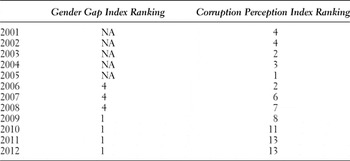
To develop our framework, we conduct a case study of Iceland in the years leading up to, during, and following its almost economic collapse in 2008. While a small—or even a micro—state, “Iceland's boom and bust replicate in miniature the causes, development and trajectory of the absolutely larger but proportionately similar American boom and bust” (Schwartz Reference Schwartz2011, 293; see also Wade and Sigurgeirsdóttir Reference Wade and Sigurgeirsdóttir2012). Despite much gender inequality in practice—most notably low female influence in economic life and the persisting gender wage gap (the biggest in Europe)—Iceland recently leapfrogged to the top of the World Economic Forum's Global Gender Gap Index, which estimates gender differences regardless of development, and into the top ten of the United Nation's newly created Gender Inequality Index (Hausmann, Tyson, and Zahidi Reference Hausmann, Tyson and Zahidi2012; Hlödversdóttir Reference Hlöðversdóttir2007; Mósesdóttir et al. Reference Mósesdóttir, Dofradóttir, Einarsdóttir, Blöndal, Þórðarson and Ásgeirsdóttir2006; Niskanen et al. Reference Niskanen2011; Special Investigation Commission [SIC] 2010; United Nations Development Programme 2011) (see Table 1). In this way, this case exemplifies the gender equality paradox. Highlighting the problems with the prevailing measures of corruption, as the country was heading toward collapse in 2001 to 2006, Transparency International (TI) consistently ranked Iceland as one of the least corrupt countries in the world. The original data for this case study are based on fieldwork conducted in 2010 to 2011 by Johnson and a gender review of the official report on the crisis by Einarsdóttir and Pétursdóttir (Reference Einarsdóttir and Pétursdóttir2010). In the following, we narrate Icelandic activists' push toward gender equality, the pushback of Iceland's corrupt liberalization, and the ostensible feminist revolution, developing our feminist conceptualization of corruption along the way. Our claims are necessarily provisional, given the recentness of the events and the remarkably limited scholarship on Iceland's corruption.Footnote 2
Indicators of Iceland's gender equality and corruption

Sources: Hausmann, Tyson, and Zahidi Reference Hausmann, Tyson and Zahidi2012; Transparency International, online at http://www.transparency.org/ (accessed June 28, 2012).
UNDERSTANDING THE GENDER EQUALITY PARADOX: THE PROMISE OF GENDER EQUALITY IN ICELAND
To understand Iceland's strong equality rankings—the “equality policy” piece of the gender equality paradox—we begin with the history of women's and feminist mobilization in Iceland. Despite its seeming isolation as an island in the North Atlantic, Iceland experienced its recent wave of feminism simultaneous to the explosion of the second-wave women's movement around the world. As a result of the advocacy of the Icelandic Women's Rights Association (IWRA), founded in 1907, women in Iceland gained suffrage fairly early: local rights in 1908, national rights for women over the age of 40 in 1915, and universal adult national rights in 1920 (Erlendsdóttir Reference Erlendsdóttir1993). Through the use of women's lists, as was common across the Nordic countries, Icelandic women were elected quickly, even to the national parliament in 1922, but then faced a half century of harsh resistance (Matthíasdóttir Reference Matthíasdóttir2004; Styrkársdóttir Reference Styrkársdóttir and Bergqvist1999).
The major push for women's full status was jumpstarted in the 1970s, as part of the country's postindependence move to develop its economy and model itself on its Nordic counterparts (Gústafsdóttir, Matthíasdóttir, and Einarsdóttir Reference Gústafsdóttir, Matthíasdóttir, Einarsdóttir and Ómarsdóttir2010, 2). Following two other important women's organizations—the IWRA and the Federation of Icelandic Women's Associations—a women's liberation group, the Redstockings, announced their formation during the 1970 trade union May Day parade, hanging a female effigy with the slogan, “A human being—not a commodity” (Sigurðardóttir Reference Sigurðardóttir, Agnarsdóttir, Halldórsdóttir, Gísladóttir, Matthíasdóttir and Þorgrímsdóttir2001, 479). In meetings held in Reykjavik in conjunction with the UN International Women's Year in 1975, activists planned the trailblazing “Women's Day Off,” in which women stopped what they were doing, in the home or at work, and came out for the largest outdoor gathering in Iceland's history (Gudnadóttir Reference Guðnadóttir1985). Bringing Iceland to a standstill, women demonstrated their collective power to organize and that women's labor was essential to the functioning of Icelandic society. This second-wave mobilization resulted in a number of reforms, including the Equal Pay Act in 1973. Like their counterparts in Europe and the United States, Icelandic feminists fought for and won legalized abortion in 1975. In 1976, the first Gender Equality Act—prohibiting sex-based discrimination and requiring equal opportunities for education and employment—was debated and passed (Gudnadóttir Reference Guðnadóttir1985). What we now might call a “women's policy agency,” the Gender Equality Council was founded and was charged with implementing the law. In the early to mid-1980s, maternity benefits were strengthened, and the Convention on the Elimination of All Forms of Discrimination against Women (CEDAW) was signed and ratified (Gudnadóttir Reference Guðnadóttir1985).
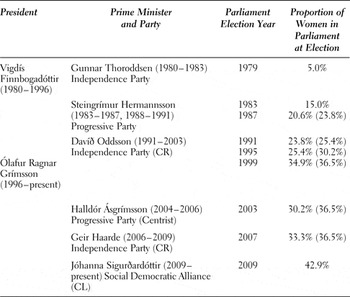
Icelandic women's activists focused their attention not only on claim making, but also on pressure on formal politics and institutions (Styrkársdóttir Reference Styrkársdóttir and Dahlerup1986, 143). In 1980, women's groups, including individual women from the Redstockings, supported the election of Vigdís Finnbogadóttir, the first female president for Iceland and for the world, albeit in a largely ceremonial role (148) (see Table 2). Although she did not emphasize feminist issues in her four four-year terms, Finnbogadóttir saw herself as inspired by the 1975 walkout and served as an important ally, fostering the collaboration of many women's groups (Bragadóttir Reference Bragadóttir2000, 155). In 1981, in response to feminists' frustration with the slow progress and the low number of women in government, activists relaunched the women's list, a tactic not being undertaken by activists in other Nordic countries at the time. The list was transformed into the Women's Alliance, a political party “of women for women, run on egalitarian feminist lines” with an agenda of “eliminating gender oppression and transforming gender relations” to foster “collective, caring values” (Dominelli and Jonsdóttir Reference Dominelli and Jonsdóttir1988). In addition to calling political parties to task for being run by “power-hungry men,” their manifesto was pro-environment and pro-peace (Styrkársdóttir Reference Styrkársdóttir and Dahlerup1986, 150). The creation of the party was a ploy designed for Iceland's unique primary system, which seemed to disadvantage women and minorities (153).Footnote 3
Women in politics in Iceland

Source: Alþingi, online at http://www.althingi.is/vefur/upplens.html (accessed June 15, 2012).
Note: The percent in parentheses is the proportion of women right before the next election. The change is a result of resignations and replacement of MPs.
Women from the lists were elected in local elections in 1982. A year later, the Women's Alliance secured 5.5% of the vote and, in 1987, 10.1% in national parliamentary elections (Styrkársdóttir Reference Styrkársdóttir and Bergqvist1999, 90). By 1985, although the municipal and national executive and legislative leadership remained overwhelmingly male, there were shifts throughout politics (Gudnadóttir Reference Guðnadóttir1985). There were some additional policy successes as well, such as changing laws on sexual violence (Gunnlaugsdóttir Reference Gunnlaugsdóttir2005) and opening the first hospital-based rape crisis center (Agnarsdóttir Reference Agnarsdóttir1994). In response to this pressure, the parties on the left and center of the political spectrum introduced “soft quotas”—quotas within parties often adopted informally (Einarsdóttir and Hjartardóttir Reference Einarsdóttir and Hjartardóttir2009).
By the late 1980s, Icelandic women were well-placed to achieve gender equality according to the prevailing approaches to understanding the paradox of “strong equality policy, weak practice.” The women's movement was one of the most vibrant in the Global North with insider allies and the radical core, which, together, seem essential to keep up the challenge (Htun and Weldon Reference Htun and Weldon2012; Weldon Reference Weldon2002). Iceland's women's policy agency was one of the most powerful in the world, and while women's policy agencies have not always been crucial, they have more often than not been helpful in fostering the goals of women's movements (McBride, Mazur, and Lovenduski Reference McBride, Mazur and Lovenduski2010). In a proportional representation electoral system, the percent of women in the parliament was increasing toward what is often seen as “a critical mass.” The soft quotas and the Women's Alliance were tools that could even “fast track” women's representation (Dahlerup and Freidenvall Reference Dahlerup and Freidenvall2005). While norms about gendered attitudes regarding motherhood and housework remained pervasive, Icelandic women were highly educated, and four out of five were in the workforce, a huge leap from two decades earlier (Einarsdóttir Reference Einarsdóttir, Billson and Fluehr-Lobban2005, 189). This suggested that the key socioeconomic and cultural barriers to women's representation were coming down, and Iceland appeared to be on the path toward gender equality.
CHALLENGING CONVENTIONAL NOTIONS OF CORRUPTION: ICELAND MOVES FROM CLIENTELISM TO SOMETHING ELSE
At the same time that the second wave of Iceland's women's movement was thriving, observers suggest that Iceland's liberal democracy became more corrupted (SIC 2010), setting up the gender equality paradox. More so than its Nordic neighbors, Iceland already had some nondemocratic elements. Modeled on earlier colonial constitutions, Iceland's first constitution since full independence from Denmark in 1944 had established “a rather messy and complicated political arrangement,” something akin to a semipresidential system that, in practice, looked parliamentary but, in reality, was clientelistic (Kristinsson Reference Kristinsson, Kopecký, Mair and Spirova2012; Kristjánsson Reference Kristjánsson2004, 153, 163). Politics was dominated by one political party: the center-right Independence Party. Iceland's relatively poor economy was seen as controlled by a few groups of families, colloquially referred to as “the Octopus,” which dominated the leading economic sectors (Árnason Reference Árnason1991; Baldvinsdóttir Reference Baldvinsdóttir1998; Hlödversdóttir Reference Hlöðversdóttir2007).Footnote 4 With influence through the political parties, these families exerted influence on top officials in the civil service, police, and judiciary up through the late 1970s (Árnason Reference Árnason1991; Wade and Sigurgeirsdóttir Reference Wade and Sigurgeirsdóttir2010a). As a result, they were able to reap and distribute enormous benefits, as well as institutionalize patron-client relationships. The mix between politics and the economy was secured through the Independence Party, which essentially controlled the National Bank, and its frequent coalition partner, the Centre Party, which controlled the Agricultural Bank: “Market transactions became political and personal, as credit and jobs were allocated by calculation of mutual advantage. Power networks became tangled webs of bullying, sycophancy and distrust …” (Wade and Sigurgeirsdóttir Reference Wade and Sigurgeirsdóttir2010a).
In these ways, most sectors of Iceland's society—foreign trade, banking, literature, housing, retail trade, and jobs in government, and, partly, the press—were shaped by clientelism, dating as far back as the 1920s (and perhaps even to the beginning of home rule in 1904). Party patronage was common, as the Independence Party, the party of “officialdom and the establishment in Iceland,” established local party machines that competed for access to services, licenses, and other favors on behalf of the business community and made partisan appointments to public-sector jobs (Kristinsson Reference Kristinsson, Kopecký, Mair and Spirova2012, 189). There were, however, some limits common to other Scandinavian contexts: party support also came from “class interests and/or ideological conviction,” and welfare policies were impartial (Kristinsson Reference Kristinsson, Kopecký, Mair and Spirova2012, 189; Roniger Reference Roniger2004, 361–62). Institutional trust was relatively high compared to the low institutional trust typical of patrimonial systems (354). Dissatisfied, Iceland's citizens challenged both this party patronage and the systemwide clientelism in the 1960s and 1970s, leading to new practices and regulation in the 1980s and 1990s, and old-school patronage began to decline (Kristinsson Reference Kristinsson, Kopecký, Mair and Spirova2012).
Into this context of apparent democratization of the clientelistic system, the “Locomotive Group” launched its radical liberalization campaign in a journal called The Locomotive (in 1973) and infiltrated the Independence Party (Gissurarson Reference Gissurarson2006). After a contentious and divisive power struggle (Jóhannesson Reference Jóhannesson2010, 378), Davíð Oddsson—one of the Locomotive Group leaders—seized the reins of the Independence Party in 1991 and became prime minister, one of the most powerful prime ministers since independence (Kristjánsson Reference Kristjánsson2004, 160). In 2005, he stepped into the role of chair of the Central Bank (2005–2009) while Halldór Ásgrímsson, who had been foreign minister, became prime minister. His successor, Geir Haarde, was minister of finance from 1998 to 2005 and then prime minister from 2006 to 2009 (see Appendix 1 for a summary of the key figures in the crisis).
Not just a turning point for the neoliberal turn in Iceland's economy (Gissurarson Reference Gissurarson2006, 7), Oddsson's ascension in 1991 also marked the beginning of a new type of corrupted institutions, despite the strong ratings by TI. Between 1991 and 2003, “Iceland's economy quickly went from being one of the most regulated and state-controlled economies in Europe to being one of the most liberalized in the world” through the dramatic rent seeking of a small network of insiders (Skaar Viken Reference Skaar Viken2011, 316). Most significantly, from 1998 to 2003, the small, mostly publicly owned banking sector was privatized, primarily into the hands of the Independence and Centre Parties and their supporters (e.g., Skaar Viken Reference Skaar Viken2011; Tranøy Reference Tranøy2011; Wade and Sigurgeirsdóttir Reference Wade and Sigurgeirsdóttir2010a). Oddson's government then removed the boundaries between investment and the government-backed commercial banking, allowing the banks to “self-regulate,” backed by government protection for failure. These reforms, in the middle of the globalizing finance economy, constructed a Ponzi scheme of consumer and bank loans and then of more complicated financial vehicles, such as collateralized debt obligations. All of this was justified in a widespread propaganda campaign illustrating that Iceland was the neoliberal success story, a new financial capital fortuitously positioned on the continental divide between Europe and North America (SIC 2010, vol. 1, 212; vol. 8, 192).
As Kristinsson (Reference Kristinsson, Kopecký, Mair and Spirova2012, 195) notes, this privatization “would have created problems for the parties had they not already abandoned mass clientelism to a significant degree.” Instead, it was a kind of insider privatization similar to Russia's post-Soviet liberalization, in which the leaders' well-placed friends reaped rewards through flawed and nontransparent means, and the spoils were not jobs, but privatized banks and natural resources (SIC 2010, vol. 1, 268; vol. 8, 30; Skaar Viken Reference Skaar Viken2011; Wade and Sigurgeirsdóttir Reference Wade and Sigurgeirsdóttir2010a). Clientelism often “assumes an addendum-like character, ancillary to democratic institutions, and only seldom does it become a major organizational mechanism” (Roniger Reference Roniger2004, 356), but in Iceland, government policy was now intentionally set to privilege certain sets of elites.
As Iceland's economy began its downslide in 2007, the government failed to act, and the new rules of the game—looting and lax regulation (Skaar Viken Reference Skaar Viken2011)—became more evident. As no procedures had been formulated for recording meetings, information was exchanged informally, and no minutes were taken during official meetings (SIC 2010, vol. 7, 113). These cadre leaders also held frequent meetings with the CEOs of the banks, without informing the minister for business affairs, who was by 2007 a member of the Center-Left Social Democratic Alliance. As a result, in the careful language of the SIC report diagnosing Iceland's economic crisis, “[t]he discharge of official duties by the Board of Governors of the CBI [Central Bank of Iceland] was … . not as thorough as might have been expected,” and the government “focused too much on the image crisis facing the financial institutions rather than the obvious problem[s]” (SIC 2010, vol. 2, 9, English version). In the assessment of less restrained observers, “as the collapse gathered speed, Oddsson, as Central Bank governor, moved to peg the krona at close to the precrisis rate, a crazy move by all economic counts, but it might have allowed cronies in the know to spirit their krona into safer currencies in the few hours that the rate lasted” (Wade and Sigurgeirsdóttir Reference Wade and Sigurgeirsdóttir2010b). He consulted only Prime Minister Haarde. Even the Central Bank's chief economist was kept in the dark, or in his own words, everything “was completely out of control … I was informed about the decision five minutes before it was announced on the web … I didn't know whether to laugh or cry…” (SIC 2010, vol. 1, 162).
RECONCEPTUALIZING CORRUPTION: ICELAND'S MOVE TOWARD A PREROGATIVE REGIME THROUGH FLEX NETWORKING
TI's strong rankings for Iceland as the crisis was building were based on the dominant definition of corruption also used by the World Bank and Global Integrity: “the abuse of public office for private gain,” such as bribery, embezzlement, kickbacks, and extortion (Rotberg Reference Rotberg2009, 4).Footnote 5 There has been much criticism and revision in TI's perception-based methodology (see Rotberg Reference Rotberg2009), but we want to launch a larger critique here that the Iceland case suggests that political scientists need a fundamentally different way of thinking about corruption in order to make sense of both the financial crisis and the gender paradox.
In her review of the mainstream literature, Underkuffler (Reference Underkuffler and Rothberg2009) argues that the common conceptualizations of corruption—including more scholarly ones that theorize corruption as the violation of law, breach of duty, inefficiency, or even the subverted public interest—miss what many citizens in protest mean. For most people, corruption evokes immoral acts by those public authorities whom we have trusted:
Corruption, in this view, is not simply an official's poor choice or bad act; it is a threatening exhibition of the actor's self-involvement, self-indulgence, and disregard for the restraint of societal bonds … It substitutes personal self-seeking, family or clan loyalties, or other parochial goals and loyalties for larger societal identification and societal goals. (38–39)
Corruption, from this viewpoint, is described as a “virus,” “cancer,” or “infestation,” suggesting not an “individual transgression … [but] a vital threat to the larger societal fabric” (37–38). These are the kinds of moral and systemic notions of corruption that were expressed in the mass media and in protestors' chants as Iceland's government and economy were thrown into crisis (Mbl.is 2009a; 2009b), and taking people's lived experiences seriously is important for most feminist theorists.
While TI mostly measures individual misdeeds, this morality-based understanding of corruption suggests that other forms of corruption may be more problematic in the era of radical liberalization. Observing postcommunist liberalization, Rasma Karklins (Reference Karklins2002, 24) suggested that there were three types of corruption: “low-level administrative corruption” (type 1) that is at the fore of the prevailing definition of corruption; “self-serving asset stripping by officials” (type 2); and “‘state capture’ by corrupt networks” (type 3). As she points out, a few rogue individuals approaching officials and getting some of them to bend rules in response to bribes or a few rogue officials using licensing and inspection discretion for extortion (type 1) is less morally suspect and less politically damaging than the organized extortion by officials or the looting institutionalized into some privatization schemes. Most damaging is type 3, where there is the de facto takeover of institutions by collusive networks that then undermine elections through illicit campaign financing and manipulate the legislative process through systemic vote-buying schemes or debasement of judicial justice so that the powerful are not prosecuted while opponents are targeted. This fuller definition of corruption returns to the seminal work by Scott (Reference Scott1972), who argued that corruption is often a hidden political agenda with potentially long-term consequences for distorting the political system: “administrative, legislative, and judicial malpractice leads to the squandering of political capital through the loss of judicial security, public accountability, and international prestige” (see Karklins Reference Karklins2002, 23).
Even in the most problematic postcommunist regimes such as Russia, however, state capture connotes too marked of a takeover; instead, most such regimes are some kind of hybrid. Building upon insights about similar tensions in Nazi Germany and Putin's Russia from 2005 to 2008 (Fraenkel Reference Fraenkel1969; Sakwa Reference Sakwa2010; Reference Sakwa2011),Footnote 6 we suggest that type 3 corruption results in what is best conceptualized as a dual state in which “shadowy arbitrary arrangements”—what we call the prerogative regime—challenge the constitutional state. In dual states, legitimacy is rooted in constitutionalism while important decisions are arranged through a parallel Byzantine parapolitics of factions and informal groups. Analysis that focuses only on one element of corruption—such as bribery, embezzlement, or even patronage or rent seeking—misses the seismic shift in governance.
Using this conceptualization of corruption reveals how Iceland may have had little of type 1 corruption during liberalization, but much like postcommunist regimes where corruption flourished because of systemic features such as monopoly over decision making and nomenklatura networks (Karklins Reference Karklins2002), the clientelism that marked preliberalization Iceland proved fertile for the other two forms of corruption. While there is much debate over the causes of Iceland's crisis and much of the politics remains obscured, the more credible studies (e.g., SIC 2010; Skaar Viken Reference Skaar Viken2011; Wade and Sigurgeirsdóttir Reference Wade and Sigurgeirsdóttir2010a; Reference Wade and Sigurgeirsdóttir2012) suggest that the liberalization period was not just marked by “self-serving asset stripping by officials” (type 2 corruption), but also by some institutionalization of a prerogative regime. Most markedly, Iceland's constitutionally muddled executive-parliamentary relations were manipulated by a powerful leader and his cadre, and the important decisions were made outside of democratic institutions and procedures, such as by the two party leaders in coalition rather than the relevant ministers (Einarsdóttir and Pétursdóttir Reference Einarsdóttir and Pétursdóttir2010, 4.1).
To assemble this prerogative regime, the new power elite used what Wedel (Reference Wedel2009, 20) identifies as the four typical “flex-net” tactics typical of such elites (see also Wade and Sigurgeirsdóttir Reference Wade and Sigurgeirsdóttir2010a). First, the would-be elites created “an intricate spine” of individuals, originating from the Locomotive Group, working across government and the economy, privileging loyalty over merit, connected by their shared personal histories. Second, claiming unique specialized knowledge to justify not sharing information, they espoused a coherent ideology, the glory of the free market, while securing their own control (and profit making) of the process and outcome. Third, they juggled multiple, overlapping roles in government, business, and the media—facilitated by new public-private partnerships recommended by neoliberalism, explaining why the media were unwilling to hold the government accountable (SIC 2010, vol. 9). Fourth, these tactics allowed them to transform the rules to suit their collective goals—in other words, to formalize many of the informal rules of the game and to eschew traditional politics within legislative and judicial branches.
This reconceptualization of corruption raises questions about the way we think about political agency. “Flex nets are … more amorphous and less transparent than conventional lobbies and interest groups, yet more coherent and less accountable” (Wedel Reference Wedel2009, 20). They most resemble “policy networks”—the linkages between a set of actors with varying levels of interest in and influence on a particular policymaking process—that have become an important framework for public policy studies, especially in Europe (e.g., Mahon, Andrew, and Johnson Reference Mahon, Andrew, Johnson, Orsini and Smith2009, 48; Peterson Reference Peterson, Wiener and Diez2009). But even the policy networks approach tends to downplay the ways in which official processes are subverted and accountability mechanisms are sabotaged by these clusters of actors from government, business, media, and nongovernmental organizations. Those who use the metaphor of policy networks have also tended to be less critical of these networks, seeing them as a less hierarchical form of policy making and downplaying the questions about how people are excluded, even as feminist scholars raise questions about the role of “technical expertise” as potentially exclusionary (e.g., Banaszak, Beckwith, and Rucht Reference Banaszak, Beckwith and Rucht2003, 7; Connell Reference Connell, Zinn, Hondagneu-Sotelo and Messner2005; Peterson Reference Peterson, Wiener and Diez2009).
Our conceptualization of corruption also raises questions about concepts central to political science, such as neoliberalism, as well as the private-public and formal-informal distinctions. Those who championed neoliberalism in Iceland subverted the power of the market, privileging private interests in their privatization schemes (see also Wedel Reference Wedel2009). As feminist theorists have criticized the public-private distinction, the simultaneous roles of elites in government, business, media, and as consultants belies the notions of public-private that undergirds the conventional definition of corruption by public officials. The ways in which financial and political elites colluded to make laws that suit their purpose suggest how arbitrary the distinction between formal and informal is and downplays the “the mutual constitutive relationship between” the formal constitutional state and the “parallel reality” (Sakwa Reference Sakwa2011, 106).
GENDERING CORRUPTION: THE GENDER CAPTURE AND GENDERED IDEOLOGY OF ICELAND'S PREROGATIVE REGIME
Reconceptualizing corruption in this way begins to gender corruption by making it institutional rather than individualistic, a weakness that contributed to banal discussions as to whether women were more or less likely to be corrupt. The second step is to take into full account the ways in which gender is complicit in Iceland's corruption, something that even regular Icelandic citizens tended to notice as they decried “the men who stole all our money” (Chartier Reference Chartier2010, 129–33; Johnson Reference Johnson2011). The most obvious is that there was gender capture of the leading positions in the prerogative regime: the Locomotive Group was virtually all men (Gissurarson Reference Gissurarson2006, 8), as were others in leading positions. Those elites, the men who reaped the most spoils of newly private banks and access to natural resources, looked out for each other, rewarding themselves with the loot and protecting each other with unsound loans (Einarsdóttir and Pétursdóttir Reference Einarsdóttir and Pétursdóttir2010). Much like the transnational business masculinity emerging globally, especially among multinational corporations and global finance (Connell Reference Connell, Zinn, Hondagneu-Sotelo and Messner2005), complicit business elites paraded their plunder: hosting extravagant festivities, delighting in nightclub excursions, yachting, and flaunting their luxury cars and housing (Bowers Reference Bowers2011; Jóhannesson Reference Jóhannesson2009).
The gender capture and performance were justified by calling upon nation-centric masculinity ideals, holding that only (some) men had what it took to embrace the risks required in business and government (Einarsdóttir and Pétursdóttir Reference Einarsdóttir and Pétursdóttir2010). Iceland's once left-leaning president, Ólafur Ragnar Grímsson—in his Reference Grímsson2005 speech, “How to Succeed in Modern Business: Lessons from the Icelandic Voyage”—explained that Iceland's Viking heritage made Icelandic entrepreneurs into unique “risk takers … . daring and aggressive.” (Vikings, as Grímsson surely knew, were men who kidnapped, raped, and forcibly married women from across Northern Europe on their way to Iceland.) Those who did not fit the new masculine ideal were undermined (such as the one woman in power during privatization, the minister of industry and commerce, from 1999 to 2006) or derided (such as the center-left minister for business affairs from 2007 to 2009, who was depicted as irresponsible and talkative through a discourse of unmanliness) (Einarsdóttir and Pétursdóttir Reference Einarsdóttir and Pétursdóttir2010). A heteronormative, ethnocentric, neomasculinity was, in the language of the analysis here, the cerebrospinal fluid of the various networks of elites who formed the intricate spine. This ideological framing is unsurprising considering the power elite's political project was couched in neoliberalism with its gendered ideological foundations (Einarsdóttir Reference Einarsdóttir and Stefánsson2010; Peterson Reference Peterson2003). Both political leaders and leading bankers claimed that Icelandic male tycoons had astute intuition and business acumen that made neoliberalism the right path for Iceland, despite the growing concerns being raised by observers This prevailing social discourse about the unique success of the [male] Icelandic bankers contributed to the crises (Einarsdóttir and Pétursdóttir Reference Einarsdóttir and Pétursdóttir2010). That they were Vikings justified the enormous wages and profit accruing to a small set of individuals, such as by Bjarni Ármannsson, head of Glitnir Bank, whose wages increased fivefold in three years (SIC 2010, vol. 3, 44).
Femininity was also reconstructed to complement the neoliberal neomasculinity (Connell Reference Connell, Zinn, Hondagneu-Sotelo and Messner2005). To reposition Iceland in the new globalizing era, young Icelandic women were sexualized, becoming the symbol of Iceland's openness to the world (Alessio and Jóhannsdóttir Reference Alessio and Jóhannsdóttir2011; Gústafsdóttir, Matthíasdóttir, and Einarsdóttir Reference Gústafsdóttir, Matthíasdóttir, Einarsdóttir and Ómarsdóttir2010). Tourism was promoted, becoming the country's second biggest industry, with images of stunning Icelandic women ready and willing to “party” for visiting American and European men (Alessio and Jóhannsdóttir Reference Alessio and Jóhannsdóttir2011, 36–37). Women's beauty contests, disrupted in the 1970s as a result of women's organizing, had been brought back in the 1980s, and two Icelandic women won the Miss World competition (Gústafsdóttir, Matthíasdóttir, and Einarsdóttir Reference Gústafsdóttir, Matthíasdóttir, Einarsdóttir and Ómarsdóttir2010, 5). While once cast as the “Iceland ambassadress of pure femininity,” such women were recast as erotic and sexually available. This was made concrete in that wives became a trophy for the new elites, similar to the Porsches that bankers were buying and brandishing (SIC 2010, vol. 8, 43). The new image of Icelandic women, the sexually available Nordic beauty, placed women as the helpmates to the neoliberal project (Einarsdóttir and Pétursdóttir Reference Einarsdóttir and Pétursdóttir2010). Policies that privileged men at the expense of women—such as promoting heavy industry and lowering taxes—could be excused, although they fostered polarized gender regimes, both ideologically and in practice. Just as “the masculinized identity of breadwinner and head-of-household depends on the feminized identity of housewife, care-giver, and helpmate,” so does the “overvalorized pay for elites depend on undervalorized pay—or no pay—for denigrated (feminized) labor” (Peterson Reference Peterson2003, 81).
Most important for the argument here, the new gender ideology was used to justify the corruption of democracy and the establishment of the prerogative regime. That the power elite were “chums” rationalized the replacement of formal meetings and minute-taking with personal networking across the divide between the state and private interests. According to Sigurjón Þ. Árnason, the former CEO of Landsbanki, Iceland's former “national bank,” whose privatization, embrace of risky financial instruments, and collapse in 2008 is the emblem of the crisis,
[t]he system worked such that Davíð [Oddsson, then head of the Central Bank] spoke to Halldór [then cohead of Landsbanki], Sturla [Pálsson, head of the Central Bank's International and Market Department] spoke to Jón Þorsteinn [Oddleifsson, manager in Landsbanki] or to me. Sturla and I are friends, we were classmates in college.Footnote 7 (SIC 2010, vol. 6, 279)
Instead of holding formal meetings when danger signs emerged, leaders called former classmates, friends, or even neighbors. Geir Haarde explains that, while serving as prime minister in March of 2008,
I asked him [Sigurjón Árnason] to come over to my house three times in March [2008], both to discuss the Icesave accounts [Landsbanki's savings account in the Netherlands and the UK], which I was already having great concerns about … and the situation with the European Central Bank which was becoming a problem. Sigurjón is a great mathematician, and he drew up some boxes for me, I didn't understand half of it, how, with some arrows and darts, money could be obtained from the Central Bank of Europe. It all involved making some instruments, some kind of papers which the bank would accept as collateral for Euros. (SIC 2010, vol. 8, 147)
This chumminess also led to unjustified trust in each other's expertise, regardless of evidence to the contrary.
As political power shifted from the constitutional state to the prerogative regime centered in the confluence of finance and governance, the new Zeitgeist sidelined Iceland's powerful women's movement and made the increasing number of women in parliament and the state less influential (Einarsdóttir Reference Einarsdóttir and Stefánsson2010), a bait and switch that weakened both gender equality policy and practice. For example, when the Center for Gender Equality was recreated in 2000, the minister of social affairs moved it to the city of Akureyri on Iceland's northern coast. While an important second city, Akureyri is a five-hour drive from the Reykjavik metropolitan area where two-thirds of Iceland's population lives, and most of the Center's staff quit, and women's activists were outraged. Thinly justified as a democratic move to distribute Iceland's administration more evenly across the country, the move weakened the Center's policymaking capacity, its ability to oversee the government, and its links with the women's movement,Footnote 8 central elements of a women's policy agency's authority (McBride, Mazur, and Lovenduski Reference McBride, Mazur and Lovenduski2010). While other government offices may have branches in Akureyri, no other major office is far from the Reykjavik metropolitan area, except for those, such as regional development and conservation, that have specific geographic ties. Women's issues were literally marginalized in ways completely new to Icelandic politics.
Thus, the building blocks for Iceland's gender equality paradox were laid: the constitutional foundations for gender equality destabilized by the stronghold of male dominance of the prerogative regime. More than two decades ago, Pateman (Reference Pateman1988) argued that liberal democracy entailed a preceding sexual contract of men over women, ensuring gender inequality. The gender equality paradox reflects the reality that feminist activism inside and outside the state has rewritten the contract, leading to remarkable reforms to respond to violence against women in many places around the world (Htun and Weldon Reference Htun and Weldon2012; Weldon Reference Weldon2002). In Iceland, however, and probably in other ostensible democracies, the constitutional contract has been undermined by the shady agreements among elite men and privileging a particular masculinity.
THE GENDER EQUALITY PARADOX EXPLAINED: ICELAND'S FEMINIST REVOLUTION?
As the crisis mounted, steeped in masculinist nationalism, Icelandic voters reacted in gendered ways, leading to Iceland's high gender equality rankings and Iceland's pronounced gender equality paradox. In 2009, when Iceland's government became the first government in the world to collapse under the weight of the financial crisis, Icelanders chose a female prime minister and the parties on the Left that were the successors to the Women's Alliance. The Women's Alliance had formally dispersed in 1999 into the Social Democratic Alliance, while some members joined the Left-Green Movement. The Left-Green Movement has gender quotas for its party lists and all elected bodies within the party, while the Social Democratic Alliance has soft quotas (Einarsdóttir and Hjartardóttir Reference Einarsdóttir and Hjartardóttir2009). As a result, there was also near gender parity in the new government, and the parliament was more than 40% female for the first time in Iceland's history, a shift that the foreign media has portrayed as a kind of feminist revolution (Chartier Reference Chartier2010, 129–33).
The new government then passed a package of gender equality policies. The most symbolically important policy states that by September of 2013, publicly owned companies, as well as joint-stock companies with more than 50 employees, will be required to have at least 40% of both sexes on their boards (Act on Corporations 2010). Medium and large companies must also report the gender balance in employment in general and in management. These requirements apply to the newly nationalized banks as well as the medium businesses that went bankrupt. Other policies—which Icelandic feminists see as progressive, even if globally there is a prominent feminist disagreement—include a 2009 law, modeled on one in Sweden, that criminalizes the buying of sex while protecting female prostitutes from prosecution, and laws that ban strip clubs and lap dancing (Act on Criminality 2009). Legislation in 2010 legalized same-sex marriage and allowed access to donor egg and sperm for single women and lesbian couples (Act on Marriage 2010).
Unlike in most Western societies, Icelandic feminism has kept active in the streets. The Women's Day Off was repeated in 2005 and then in 2010 with most Icelandic women and their supporters assembling in Iceland's major cities to protest the gendered wage gap and the failure of the government to address male violence against women. Thousands of Icelandic women participated in the Slutwalk in July of 2011, a transnational response to a Toronto cop's comment about avoiding rape by not dressing like a slut, an echo of a similar comment by the head of Iceland's sex crime unit in the preceding year (Kjartansdóttir Reference Kjartansdóttir2010). And the Center-Left government was relatively responsive to the claims of feminist organizations, such as the Icelandic Feminist Association, founded in 2003, with the goal of fostering “critical and feminist discussions in all areas of Icelandic society.” Its former spokesperson, Katrin Anna Gudmundsdóttir, in 2010 was at the finance ministry in charge of starting gender budgeting in Iceland. Gender budgeting was part of the coalition platform of the Social Democratic Alliance and Left-Green Movement that requires the assessment of all budgets and programs for their likely impact on women and gender equality. According to Gudmundsdóttir, after the 2009 election, a steering committee on gender budgeting recommended implementing pilot projects across all ministries, and all were funded in the 2011 budget (Johnson Reference Johnson2011). For Gudmundsdóttir, “The difference is political will and the decision to start implementing gender budgeting in Iceland.”
There remains, however, a large gap between laws against gender violence and Iceland's justice system's response. The United Nations CEDAW Committee (2008) expressed concerns about the light penalties for crimes of sexual violence, despite a relatively forceful framework. Despite the ban, lap dancing is still operating, and it remains to be seen how successful the pilot projects will be. Although there have been certain signs of improvement in gender relations in the constitutional state and the public sphere, the situation is precarious in social institutions, the labor market, and the private sphere with a real risk of backlash regarding women (Árnadóttir and Bjarnadóttir Reference Árnadóttir and Bjarnadóttir2011; Jóhannsdóttir Reference Jóhannsdóttir2010).
As this article goes to press, Iceland awaits another parliamentary election (on April 27, 2013), the results of which will give some indication as to whether gender equality and anticorruption efforts will be furthered or reversed. As Tripp (Reference Tripp2001) suggests about the women's movement in Africa launching effective challenges to clientelism, we consider here whether Iceland's women's movement, with its allies inside and outside the state, has advanced a contrasting gender ideology and undercut the prerogative regime in meaningful ways. Our approach suggests using a gendered version of Wedel's (Reference Wedel2009) four categories of flex nets to begin to answer these questions.
(1) Has the intricate spine of men working across government and the economy, privileging loyalty over merit, connected by their shared personal histories, been broken?
When the Independence Party lost its dominance in 2009, it was a major blow to those who espoused neoliberalism. After the election, when it replaced Haarde in 2009, the party even acknowledged that certain mistakes were made in the privatization of banks, suggesting fissures within the party. The mistakes, however, were mostly explained by flaws in the key players' characters (i.e., the irresponsible tycoons who could not handle the freedom they were granted), not the policy or the values of the Independence Party (Egilsson Reference Egilsson2009). Because of the legacy of patronage, the flex nets are probably more entrenched in the bureaucracy. Further, even the competence, credibility, and loyalty of the center-left administration is open to doubt because many members played a role in the turn of events leading to the crises (SIC 2010). Although remarkable financial regulatory reforms have been passed, a reform of the administration toward an impartial and meritocratic bureaucracy has only just started, leaving the legacy of clientelism in place and the Independence Party likely to be back in power before the prosecutions are completed (Kristinsson Reference Kristinsson, Kopecký, Mair and Spirova2012; Wade and Sigurgeirsdóttir Reference Wade and Sigurgeirsdóttir2012, 142). There are also signs of persisting male privilege. The Equality Complaints Committee ruled that Prime Minister Sigurðardóttir and her minister of the interior, Ögmundur Jónasson, had violated the law on gender equality by hiring men instead of more-qualified women (Iceland Review Online 2012a; 2012b).
(2) Has the neoliberal ideology, with its Viking neomasculinity and its complementary sexualized Nordic beauty, been fundamentally undermined at least to the degree that it cannot be used to justify the lack of transparency?
Neoliberalism, in its unfettered and virtual finance form, has been threatened by new regulations and the nationalization of banks. Unlike in the United States, some financiers are being held accountable for paying back some public losses (Iceland Review Online 2011). These changes have been marked by the Economic Freedom Index, constructed by The Heritage Foundation and the Wall Street Journal (2012): in 2011, Iceland scored as “moderately free” at 68.2, down from its all-time high score of 76.6 (“mostly free”) in 2006. In February 2012, former secretary at the Ministry of Finance, Baldur Gudlaugsson, was sentenced by the Supreme Court of Iceland to two years for insider dealing and crimes in public employment (Icenews 2012a). Only a few days later, four former top executives at Kaupthing Bank were charged by the special prosecutor (Icenews 2012b). Since then several charges have been brought by the special prosecutor against Icelandic bankers, and a handful of them have been found guilty, although too few according to the special prosecutor, who sees this as “meager returns” (Higgins Reference Higgins2013). There has been a shift, at least a symbolic one, in gendered imagery with the electoral success of a prime minister who married her female partner after enacting a same-sex marriage law. But there is also masculinist resistance, the most visible of which was the 2012 reelection of Grímsson as president of Iceland.
(3) Have the male-dominated elites lost their ability to juggle multiple roles in government, business, and the media that had been facilitated by new public-private partnerships recommended by neoliberalism?
After the crisis, Oddsson secured a position editing Iceland's leading newspaper, Morgunblaðið. Iceland's newspapers have long been tied to political parties—Morgunblaðið to the Independence Party—and these ties have been obstacles to competitive elections and to the inclusion of women (Styrkársdóttir Reference Styrkársdóttir and Dahlerup1986, 143). While the leader and parliamentary group of the Independence Party have supported the government's negotiated deal over the money Icesave owes to investors from Britain and the Netherlands, Oddsson has used his position as a pulpit to undermine the deal and the government. Ásgrímsson, who resigned from the prime ministry in 2006, became secretary general of Nordic Council of Ministers in 2007. Haarde was prosecuted by a special Icelandic court, the Landsdómur, and found guilty of one form of negligence: failing to hold emergency cabinet meetings in the run up to the crisis. He was not, however, sentenced to any jail time.
(4) Have constitutional politics, especially within the legislative and judicial branches, as well as the women's policy agency, been strengthened so that rules cannot be changed to suit the collective goals of elites?
While the trust in Alþingi has never been lower (Nikolov Reference Nikolov2010), the constitutional state appears somewhat stronger. In October of 2012, the government asked for popular input, with a consultative referendum, on a new constitution altering church-state relations, separation of powers, transparency, and rights to natural resources. Many see a new constitution as a necessary response to the financial crisis and to the messiness of the constitution that retains much of its colonial predecessor. Illustrating more democratic urges, the draft constitution was posted for comment on Facebook. More controversially, since 2008, the president has twice used his veto power, a power suggested in the constitution but never used by any previous president. One could see these moves, which vetoed two Icesave deals and sent them to a national referendum (where the prime minister lost and the president won), as a populist response to limit Iceland's citizens' financial responsibilities for the crisis and/or as a manipulation of the constitution.
On the whole, this evidence is mixed, suggesting that observers should be cautious, but not dismissive, in the assessment of the feminist successes of Iceland's 2009–2013 government in terms of gender inclusiveness and women-friendly policy. Iceland's constitutional state has promised more gender equality, but there is insufficient evidence that the prerogative regime has been dismantled.
WHAT STUDYING TINY ICELAND CAN TEACH FEMINIST POLITICAL SCIENCE: BRINGING IN THE PREROGATIVE REGIME
At the 2011 meeting of the European Consortium for Political Research in Reykjavik, Iceland's President Grímsson, a political scientist, argued that its virtual collapse should radically challenge political science's embrace of markets as the best organizer of society. Not alone in this claim about political science's failure (e.g., Tranøy Reference Tranøy2011), the president's speech, referring only to nonfeminist, white, male political scientists, revealed once again the male dominance of canonical political science, as well as the consequences of its ignoring feminist and other critical theorizing. Feminist political economy has long been critical of neoliberalism, even its modern financial form (e.g., Einarsdóttir Reference Einarsdóttir and Stefánsson2010; Peterson Reference Peterson2003).
In this article, we argue that feminist political science should also take seriously the institutionalized corruption that helps explain the politics of the global financial crisis and the paradox of strong gender equality policy, weak practice. This Icelandic case suggests that it is not just that elements of corruption, such as party patronage, may be gendered (Hawkesworth Reference Hawkesworth2005, 150), but also the corruption of democracy broadly construed. It is not that women are less likely to be corrupt, as the development industry has claimed, but that gender ideology can justify corruption and that institutionalized corruption is one more way to maintain male dominance even as new gender equality measures are taken within diverse institutions. Here, we have suggested looking, with a gendered lens, at the tension between the constitutional state and the prerogative regime and at the role of flex-net tactics as a way of specifying informal institutions and practices. In these ways, corruption becomes the process—built upon chummy networks and relying upon neoliberal/gender ideologies—through which typically male-dominated elites transgress proclaimed values of accountability, transparency, and equality. In Iceland, it is the tension between the prerogative regime and the constitutional state that best explains this central paradox of feminist political science. As feminist neoinstitutionalists argue, political institutions profoundly shape opportunities for activists; we argue that corruption can be an important component of these institutions.
Political economists might counter that what we are calling corruption might simply be the institutionalization of neoliberalism. We argue that political economists who recognize the political project in neoliberalism, such as the installation of new elites (e.g., Harvey Reference Harvey2005), say too little about the resulting political institutions and processes. Further, while this Icelandic case suggests that “economic liberalization” as practiced may encourage corruption—countering economic theories that more markets may decrease corruption (Underkuffler Reference Underkuffler and Rothberg2009, 34–35)—such corruption may not be solely caused by liberalization. Similar types of corruption exist in many places around the world, including Iran and Russia, which do not embrace neoliberalism.
We do not want to discount the enormous efforts being made by women and their allies to get more women in legislative and executive power, or by the researchers who study descriptive representation. Indeed, it is possible that reforms, such as quotas for corporate boards, will increase gender equality in the new global finance economy. But we wonder if women's successes in entering politics, such as in Iceland, have something to do with the fact that power has shifted elsewhere. In this era of globalization, where goods and virtual financial instruments move much more freely than people, and where governments have little authority to hold elites accountable, we wonder if the increased representation of women in constitutional politics is at least partially a result of constitutional politics not mattering so much anymore.
APPENDIX
Key figures in Iceland's crisis