Introduction
Obsessive–compulsive disorder (OCD) and tic disorder (TD) are highly disabling, often comorbid, chronic, and challenging conditions that affect adults and children and are responsible for a significant socioeconomic burden for affected individuals, related families, caregivers, and communities.Reference Grabe, Ruhrmann and Ettelt 1 , Reference Dell’Osso, Benatti and Hollander 2
Comorbidity between OCD and TD is frequent,Reference Gomes de Alvarenga, de Mathis and Dominguez Alves 3 , Reference Ferrao and Alvarenga 4 and thus, it has been hypothesized that these disorders and their dimensions of symptoms may be closely interrelated, representing a specific subtype of illness, ie, obsessive–compulsive tic disorder (OCTD) with a peculiar presentation, course, and treatment response.Reference Yu, Mathews and Scharf 5 , Reference Stein, Kogan and Atmaca 6 In the fifth edition of the Diagnostic and Statistical Manual of Mental Disorders (DSM), 7 OCD has been included in the new category of “OC and related disorders” and the new “tic-related” specifier was introduced. The definition of this specifier has encouraged new investigation of the epidemiology, clinical presentation, disability, and therapeutic response of patients with OCTD.Reference Leckman, Grice and Barr 8 -Reference Briguglio, Dell’Osso and Galentino 11 Moreover, some studies demonstrated that OCTD and OCD presentations could differ in many aspects, such as age at onset, gender prevalence, presence of sensory phenomena and specific obsessions, comorbidity with attention-deficit/hyperactivity disorder and positive family history for OCD and/or TD.Reference Yu, Mathews and Scharf 5 , Reference Kloft, Steinel and Kathmann 12 -Reference Pinto, Monzani and Leckman 14 The presence of early onset, comorbidity, and chronic course in OCTD are thought to delineate a more severe illness compared to OCD without TD, although studies assessing severity of illness in OCTD have shown mixed results, with multiple concerns raised toward the definition of response/refractoriness in clinical practice.Reference Macerollo, Martino and Cavanna 15 However, no study has focused on how the presence of tics can influence response to treatments in patients with OCTD vs OCD.
In terms of treatment response, up to 60% of the patients with OCD do not respond or only partially respond to first-line pharmacological and psychotherapeutic treatments and some of them do not achieve a satisfactory response even with second-line treatment, ie, augmentation with atypical antipsychotic or with behavioral therapy.Reference Skapinakis, Caldwell and Hollingworth 16 -Reference Albert, Barbaro and Aguglia 19
Several factors contribute to treatment resistance in patients with OCD, including disease severity, medical or psychiatric comorbidities, and exposure to chronic stressors.Reference Macerollo, Martino and Cavanna 15 , Reference Pallanti and Quercioli 20 In order to assess treatment response, the use of validated qualitative and quantitative scales is well established. The Yale–Brown Obsessive Compulsive Scale (Y-BOCS) is the most widely used instrument for measuring the severity of OCD symptoms.Reference Goodman, Price and Rasmussen 21 An operational definition of the response can be identified by a Y-BOCS scores reduction of at least 35% after an adequate trial of a selective serotonin reuptake inhibitor (SSRI), while a reduction between 35% and 25% defines a partial response and a reduction of less than 25% defines a non-response.Reference Pallanti and Quercioli 20 , Reference Mataix-Cols, Fernández de la Cruz and Nordsletten 22 The definition of clinical remission applies to individuals who no longer meet the diagnostic criteria for OCD, showing a Y-BOCS score ≤ 12 and a Clinical Global Impression-Severity (CGI-S) rating 1 (“normal, not at all ill”) or 2 (“borderline mentally ill”), lasting for at least 1 week, even if additional follow-up to assess whether response/remission status has been maintained over longer periods are recommended.Reference Mataix-Cols, Fernández de la Cruz and Nordsletten 22 Operational definitions of response for TD have not been established yet. The Yale Global Tic Severity Scale (YGTSS) is a helpful tool for the assessment of tic severity.Reference Leckman, Riddle and Hardin 23 Although a reduction of more than 35% from the baseline YGTSS score can be considered an indication of treatment response, no consensus on the use of this scale alone has been reached.Reference Storch, De Nadai and Lewin 24
In order to further investigate the epidemiology, presentation, and clinical course of OCTD, in 2020, a task force of Italian experts in the field of OCD and TD was created, including 10 tertiary clinics across 8 cities and 7 regions in Italy. As previously published studies, generated by the analysis of a collaborative sample of patients with OCD vs OCTD, have supported the notion of a more clinically severe phenotype for patients with TD and OCTD, the aim of our multicenter study was to investigate clinical and sociodemographic features of OCD patients with or without tics, comparing subsamples of responders, partial responders, remitters, and treatment-resistant patients. Moreover, we further focused on potential predictors of remission, response, and treatment resistance, being these categories the most relevant for future research. We hypothesized that, in line with previous studies in the field, specific sociodemographic and clinical factors could predict a worse profile in relation to treatment response.
Methods
Three hundred and ninety-eight patients with a DSM-5 diagnosis of OCD with and without comorbid TD (in this case meeting, the criteria for the DSM-5 tic-related specifier) of whatever age and gender were recruited from 10 different psychiatric departments across Italy. All participating departments agreed sharing patients anonymized data for the purpose of the study. Diagnoses were obtained through the administration of a clinical structured interview based on DSM-5 criteria. 7 After obtaining written informed consent for using anonymized patients’ information for research, patients were assessed using a previously shared questionnaire composed of 35 questions investigating the following dimensions: (a) main sociodemographic features (ie, age, gender, occupation, and marital status); (b) presence of TD; (c) clinical history (ie, ages at OCD onset and TD onset, presence of other psychiatric comorbidities and age at comorbidity onset, psychiatric family history, and psychiatric poly-comorbidity [ie, the co-occurrence of at least two comorbid psychiatric conditions other than OCD]), presence and type of current psychopharmacological treatment, presence of current psychotherapeutic treatment (every approach of psychotherapy was considered), and (d) perceived quality of life, family involvement, type of treatment response, presence of lifetime suicidal ideation, or suicide attempts. All patients recruited were receiving antidepressant (either SSRIs or clomipramine) and/or antipsychotic treatment, according to major guidelines recommendations, for at least 3 months.Reference Del Casale, Sorice and Padovano 25 -Reference Fineberg, Hollander and Pallanti 27
Sociodemographic and clinical variables were collected for the whole sample and subsequently compared for treatment-outcome subgroups, defined as follows: remission, treatment-resistance, response and partial/no response after antidepressant, and antipsychotic treatment lasting for at least 3 months. More specifically, response was defined as a Y-BOCS scores reduction of at least 35% after an adequate trial of an SSRIs; partial response was defined as a Y-BOCS scores reduction between 35% and 25% and nonresponse was defined as a reduction of less than 25%; treatment resistance was defined as no change/worsening in Y-BOCS scores after 12 weeks of at least two treatment trials: either two trials of SSRI or one trial of SSRI and one trial of clomipramine.Reference Pallanti and Quercioli 20 , Reference Mataix-Cols, Fernández de la Cruz and Nordsletten 22 Lastly, clinical remission definition was applied to patients no longer meeting OCD diagnostic criteria and showing a Y-BOCS score ≤ 12.Reference Mataix-Cols, Fernández de la Cruz and Nordsletten 22
Statistical analyses were performed with Pearson’s chi-squared test for categorical variables and ANOVA test for continuous variables. Multivariate logistic regressions were performed to analyze possible factors associated with remission, treatment-resistance, and responder conditions. All analyses were performed using Statistical Package for the Social Sciences (SPSS) 26.0 software for Windows (SPSS Inc, Chicago, IL). Statistical significance was set at P < .05.
Results
The sample included 398 patients with a diagnosis of OCD with and without comorbid TD, distributed as follows: 43 (10.8%) from Luigi Sacco University Hospital, Milan; 50 (12.6%) from IRCCS Orthopedic Institute Galeazzi, Milan; 16 (4%) from San Paolo Hospital, Milan; 60 (15.1%) from Istituto di Psicopatologia, Rome; 63 (15.8%) from Rita Levi Montalcini Department of Neuroscience, Turin and the Department of Biomedical Sciences of Alma Mater Studiorum University of Bologna; 24 (6%) from Institute of Neuroscience, Florence; 19 (4.8%) from the Department of Clinical and Experimental Medicine of Pisa; 38 (9.5%) from Teramo Hospital; and 85 (21.4%) from IRCCS Ospedale Policlinico San Martino, Genova.
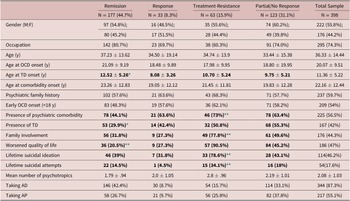
Main sociodemographic and clinical variables of the whole sample are reported in Table 1. The whole sample showed a 55.8% male rate and a mean age of 36.33 ± 14.44 years. The mean age at OCD onset was 19.78 ± 10.16 years and mean age at comorbidity onset was 20.7 ± 9.51 years. The sample consisted of 231 (58%) patients with OCD but without TD and 167 (42%) patients with OCTD with a mean age at TD onset of 11.36 ± 5.22 years. Regarding pharmacological treatment, 87.3% of the whole sample was taking antidepressant and 55.1% antipsychotic with a mean number of psychotropics of 2.08 ± 1.03. Moreover, 60.5% of the whole sample was treated with psychotherapy. As regards treatment response, 44.7% of the total sample was in a condition of remission, 8.3% of response, 31.1% of partial/no response, and 15.9% were treatment-resistant patients.
Comparison of Sociodemographic and Clinical Variables between Treatment Outcome Subgroups

Values for categorical and continuous variables are expressed in percentages and mean ± SD, respectively. Reported variables had a percentage of missing data ranging from 1% to 10%. Boldface indicates parameters with statistically significant differences between the two subgroups.
Abbreviations: AD, antidepressants; AP, antipsychotic; OCD, obsessive–compulsive disorder; TD, tic disorder.
** P < .005.
* P < .05.
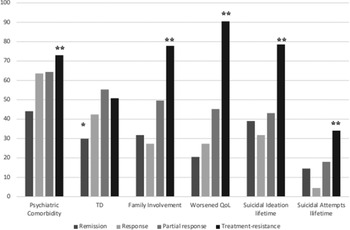
For the purpose of the study, the whole sample was divided in four subgroups based on treatment-outcome profiles: response, partial/no response, treatment-resistance, and remission (see Table 1 and Figure 1). First, the remission group showed a significantly higher age at TD onset (12.52 ± 5.26 vs 8.08 ± 3.26 vs 10.7 ± 5.24 vs 9.75 ± 5.21 years; P < .05) and higher age at OCD onset (21.09 ± 9.19 vs 18.48 ± 9.89 vs 17.98 ± 9.95 vs 18.80 ± 19.95 years; P = .058) with a borderline statistical significance compared to the other groups.
Comparison of clinical variables between treatment outcome subgroups. QoL, quality of life; TD, tic disorder. Boldface indicates parameters with statistically significant differences between the two subgroups; **P < .005; *P < .05.

A significantly higher rate of psychiatric comorbidities (73% vs 44.1% vs 63.6% vs 63.4%; P < .005), TD in particular (50.8% vs 29.9% vs 42.4% vs 55.3%; P < .05), emerged in the treatment-resistant group compared to remission, response groups and partial/no response. Significantly higher rates of family involvement and perceived worsened quality of life were found in treatment-resistant group (77.8% vs 31.8% vs 27.3% vs 49.6% and 90.5% vs 20.5% vs 27.3% vs 45.2%; P < .005). Finally, the treatment-resistant group showed higher rates of lifetime suicidal ideation (78.6% vs 39.0% vs 31.8% vs 43.1%; P < .005) and lifetime suicidal attempts (34.1% vs 14.5% vs 4.5% vs 18%; P < .005) compared to the other groups. No differences emerged in terms of gender, positive psychiatric family history, age and age at comorbidity onset, psychopharmacological, and psychotherapeutic treatment correlates between groups (see Table 1).
We tested the predictor variables for multicollinearity before regression analysis. In our study, the lowest tolerance value was 0.954 and the highest Variance Inflation Factor (VIF) was 1.711. Accordingly, multicollinearity did not affect our regression model.
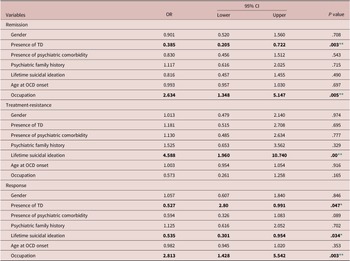
In the logistic regression model, the condition of remission was positively associated with having an occupation (odds ratio [OR] 2.634; P < .005) and negatively associated with comorbid TD (ie, OCTD: OR 0.385; P < .005; see Table 2). Concerning treatment-resistance condition, the logistic regression model showed a significant positive association with the presence of lifetime suicidal ideation (OR 4.588; P < .005; see Table 2). Finally, the condition of responder was negatively associated with comorbid TD (OR 0.527; P < .05), lifetime suicidal ideation (OR 0.535; P < .05), and other psychiatric comorbidities (OR 0.594; P = .089) although not reaching statistical significance. Moreover, a significant positive association with having an occupation emerged (OR 2.813; P < .005; see Table 2).
Multivariate Logistic Regression of Factors Associated with Treatment-Outcome Subgroups

Hosmer and Lemeshow test 0.342; 0.497; 0.582. Boldface indicates parameters with statistically significant differences between the two subgroups.
Abbreviations: CI, confidence interval; OCD, obsessive–compulsive disorder; OR, odd ratio; TD, tic disorder.
** P < .005.
* P < .05.
Discussion
In the present study, we sought to examine three different profiles of treatment response in patients OCD with and without TD. To the best of our knowledge, this is the first study that analyzes these specific variables in a multicentric sample of adult outpatients with OCD and OCTD.
Consistently with previously reported findings, OCTD patients showed an earlier age at onset, as compared to OCD patients without tics.Reference Dell’Osso, Benatti and Hollander 2 , Reference Diniz, Rosario-Campos and Hounie 28 Regarding treatment response, our total sample showed higher rates of remission compared to the lower rates of responder conditions and treatment-resistant patients, in line with the current literature.Reference Pallanti and Quercioli 20 Furthermore, considering responders and remitter subjects together, 53% of the patients with OCD responded to an appropriate treatment, whereas 47% of the sample did not respond to first-line or augmentation therapies. These results are consistent with previous research.Reference Skapinakis, Caldwell and Hollingworth 16 -Reference Albert, Barbaro and Aguglia 19 More in detail, our remission rates were 44.7% and response rates were 8.3%. The imbalance of the remission group compared to the responder group could be due to the long-term assessment of the present study in a tertiary setting.
When the different subgroups, divided on the basis of their longitudinal treatment outcome, were compared, significantly later ages at OCD and TD onset were observed in the remission group compared to both responder and treatment-resistant groups. Previous research has already acknowledged that early age of onset can be associated to higher overall OCD severity scores and lower remission rates.Reference Dell’Osso, Benatti and Hollander 13 , Reference Diniz, Rosario-Campos and Hounie 28 -Reference Visser, van Oppen and van Megen 31
Moreover, in the remission group a lower rate of psychiatric comorbidities and TD emerged, showing a significant negative association with the presence of tic. Consistently, significantly higher rates of psychiatric comorbidities and TD were observed in treatment-resistant patients compared to the other subgroups. This finding is consistent with previous studies that identified higher rates of psychiatric comorbidities and an earlier OCD onset as negative predictors of treatment efficacy.Reference Dell’Osso, Benatti and Buoli 32 , Reference Albert, Barbaro and Bramante 33 In addition, previous studies showed a correlation between the number of comorbid disorders, OCD severity and duration of illness.Reference Fineberg, Reghunandanan and Brown 34 Therefore, the presence of comorbidities predicted greater rates of treatment-resistance.Reference Stewart, Geller and Jenike 35 , Reference Fineberg, Pampaloni and Pallanti 36 Of note, Shetti et alReference Shetti, Reddy and Kandavel 37 have previously reported that the lack of therapeutic response was related to comorbid disorders, poor insight and the presence of sexual obsessions, washing, and multiple obsessions. In addition, the presence of TD was significantly associated with a worst treatment outcome. Furthermore, we observed that the condition of remission was positively associated with having an occupation. Present finding is consistent with previous research, showing that OCD patients with higher severity and worse treatment outcomes suffer from a relevant disability, leading to impaired family and daily life activities, including professional and interpersonal relationships.Reference Macerollo, Martino and Cavanna 15 , Reference Remmerswaal, Batelaan and Hoogendoorn 38
Lastly, significantly higher rates of lifetime suicide ideation and lifetime suicide attempts emerged in treatment-resistant patients, showing a significant association with perceived worsened quality of life and higher family involvement compared to other groups. Consistently, previous ICOCS studies on suicide attempts in OCD patients showed higher rates of suicide attempts in patients with psychiatric and medical comorbidities, who presented TD as one of the most frequent comorbid conditions.Reference Shetti, Reddy and Kandavel 39 -Reference Dell’Osso, Nicolini and Lanzagorta 41 This result may be related to the latent impulsiveness characterizing patients affected by OCTD. Patients with OCTD often experience anger, frustration, and externalizing behaviors that could emerge in a sudden and disruptive way and may end with suicide attempts.Reference Roessner, Becker and Banaschewski 10 A study by Storch et alReference Storch, Hanks and Mink 42 reported that, in patients with TD and TS, higher frequencies of suicidal thoughts and behaviors were frequently associated with comorbid disorders such as depression, OCD, and anxiety disorders. Albert et alReference Fernández de la Cruz, Rydell and Runeson 43 found that the most significant predictors of greater suicidality were the severity of OCD and comorbid depressive and anxiety symptoms. Moreover, more recently, Fernández de la Cruz et al,Reference Olatunji, Rosenfield and Tart 44 in a sample of patients with chronic TD and TS, reported that 78.13% of the individuals who died by suicide in the TS/TD cohort had other recorded psychiatric comorbidities compared to the population-matched control group.Reference Fernández de la Cruz, Rydell and Runeson 43 , Reference Albert, De Ronchi and Maina 45
No differences emerged in terms of gender, positive psychiatric family history, age, and age at comorbidity onset between subgroups. These results are consistent with other studies, which found no such associations.Reference Shetti, Reddy and Kandavel 37 , Reference Olatunji, Rosenfield and Tart 44
Conclusions
Specific clinical factors such as the presence of psychiatric comorbidities and TD comorbidity, in particular, could predict a worse treatment response, thus determining a significant impairment of the quality of life for both OCD patients and their caregivers. Conversely, later ages at OCD and TD onset, lower rates of psychiatric comorbidities and TD may predict higher rates of remission, with a minor negative impact on quality of life and family involvement. An earlier, more personalized and multidisciplinary treatment seems a priority in patients with OCD and OCTD, given their early onset and the severe and chronic course of the disorder. Ultimately, the presence of TD in patients with OCD—ie, patients with OCTD—was found to be more frequently associated with less favorable profiles of response.
The abovementioned results should be interpreted in light of some methodological limitations. First, the cross-sectional nature of the study allowed only a one-time assessment. Moreover, some variables such as psychiatric family history and age at psychiatric comorbidity onset were obtained retrospectively, being susceptible to recall bias. Furthermore, the following variables were not collected: dosage and total duration of current/previous pharmacological treatment, ongoing psychotherapy’s approaches. Lastly, as regards sample analysis, we chose to not analyze the total sample differentiating patients with OCD vs OCTD a priori to avoid bias of selection, however our results showed a different course and treatment response between those groups, in line with the current literature.
Further follow-up studies are needed to better characterize long-term course of OCD patients with and without comorbid TD, focusing on the response to treatment.
Author Contributions
Conceptualization: B.D., M.P., D.S., and B.B.; Data curation: B.D., A. Amerio, and R.G.; Supervision: B.D., D.M., M.B., D.D.B., S.P., M.A., A. Amerio, A. Aguglia, B.D.M., C.A.V., F.M., G.G., M.P., R.N., O.G., A.P., D.S., A.T., U.A., and B.B.; Validation: B.D., D.M., M.B., D.D.B., S.P., M.A., A. Amerio, A. Aguglia, C.A.V., F.M., G.G., M.P., R.N., O.G., R.G., A.P., D.S., S.R., A.T., U.A., and B.B.; Visualization: B.D., D.M., M.B., M.A., A. Amerio, A. Aguglia, G.M., M.P., R.N., O.G., D.P., R.G., A.P., D.S., S.R., A.T., and B.B.; Investigation: B.D.M., M.P., O.G., and D.P.; Resources: B.D.M., R.B., S.R., and U.A.; Software: B.D.M. and G.G.; Formal analysis: N.G.; Writing – original draft: B.D., D.D.B., D.C., G.M., M.P., N.G., R.C., and B.B.; Writing – review & editing: B.D., D.M., M.B., D.D.B., S.P., M.A., A. Aguglia, C.A.V., F.M., G.G., G.M., M.P., O.G., D.P., R.G., A.P., D.S., A.T., U.A., and B.B.
Disclosures
Prof. Dell’Osso has received lecture honoraria from Angelini, Jansen, Lundbeck, Livanova, Arcapharma, and Neuraxpharm. Benatti Beatrice has received a consultant fee from Lundbeck. Viganò Caterina Adele has received speaker fees from Lundbeck and Angelini. Nicolaja Girone, Dario Conti, Rita Cafaro, Caterina Viganò, Matteo Briguglio, Donatella Marazziti, Federico Mucci, Orsola Gambini, Benedetta De Martini, Antonio Tundo, Roberta Necci, Domenico De Berardis, Roberta Galentino, Sara De Michele, Roberta Balestrino, Umberto Albert, Sylvia Rigardetto, Giuseppe Maina, Giacomo Grassi, Stefano Pallanti, Andrea Amerio, Andrea Aguglia, Davide Prestia, Mario Amore, Alberto Priori, and Domenico Servello, Mauro Porta declare no conflict of interest.
Funding
This research received no specific grant from any funding agency, commercial or not for profit sectors. The study was partially funded by CRC Aldo Ravelli.