

GROOVED WARE MATERIAL & SETTLEMENT IN ORKNEY: CONTEXT & WIDER SIGNIFICANCE
Grooved Ware pottery has a remarkably wide distribution in Britain (Piggott Reference Piggott1936) and Ireland (Grogan and Roche Reference Grogan and Roche2010), and recent and current excavations in Orkney and elsewhere are shedding new light on the social relations that accompanied its use. The connections which the distribution represents are more extensive than seen in the ceramic traditions which immediately precede it, and Grooved Ware pottery is found in a variety of contexts ranging from passage tombs, henges, and circles of timber and stone (Wainwright & Longworth Reference Wainwright and Longworth1971; Cleal & MacSween Reference Cleal and MacSween1999) to settlements and pits (Cleal & MacSween Reference Cleal and MacSween1999). Significant social change has been inferred from its appearance and widespread adoption (Wainwright & Longworth Reference Wainwright and Longworth1971; Renfrew Reference Renfrew1979; Thomas Reference Thomas2010; Parker Pearson Reference Parker Pearson2012; Sheridan Reference Sheridan2004; Richards Reference Richards2013). Despite the amount of Grooved Ware which has been discovered, however, including that found since the last major synthesis (Cleal & MacSween Reference Cleal and MacSween1999), key questions remain about its dating. When – and where and why – did this ceramic tradition emerge? How long did it last, and was its demise sudden and simultaneous? What is the chronological significance of its observed stylistic variability, at various scales, from site to site and within and between regions (Wainwright & Longworth Reference Wainwright and Longworth1971; Cleal & MacSween Reference Cleal and MacSween1999; Brindley Reference Brindley1999; Garwood Reference Garwood1999)? Given the widespread distribution of this ceramic tradition, was there constant or just episodic interaction between its users over the half millennium or more of its currency? And how did it relate to other ceramic traditions that were current in the late 4th and 3rd millennia cal bc?
Orkney plays a particularly important role in the story of Grooved Ware, because it is widely believed that this is where the ceramic tradition emerged (Ashmore Reference Ashmore1998; Reference Ashmore2005; MacSween Reference MacSween1992; Sheridan Reference Sheridan2004; Schulting et al. Reference Schulting, Sheridan, Crozier and Murphy2010), and because it has produced by far the largest amount of Grooved Ware pottery from across Britain and Ireland. There has been a long-running debate about the relationship between the users of Grooved Ware and the users of Unstan Bowls and other round-based pottery in Orkney (Clarke Reference Clarke1983; Renfrew Reference Renfrew1985; Kinnes Reference Kinnes1985; MacSween Reference MacSween2007b; Hunter & MacSween Reference Hunter and MacSween1991; Hunter Reference Hunter2000). And it is now clear, from the investigation of a series of multi-phase sites, that Wainwright and Longworth’s (Reference Wainwright and Longworth1971) previous fourfold classification of Grooved Ware into sub-styles is inadequate to characterise the variability of the tradition, either geographically or chronologically, and this applies to Orkney as much as to elsewhere in Britain and Ireland; there is an important ongoing task of description and typochronology to be addressed.
The emergence of Grooved Ware probably related to the competitive social dynamics of late 4th millennium cal bc Orkney, in which certain individuals and groups set out to differentiate themselves from their neighbours in various ways (MacSween Reference MacSween1995; Schulting et al. Reference Schulting, Sheridan, Crozier and Murphy2010, 30–41; Sheridan & Brophy Reference Sheridan and Brophy2012; Sheridan Reference Sheridan2014; Richards Reference Richards2013). The invention of a new style of pottery, different from the round-based repertoire, was one aspect of this creation of a new identity. The building of larger and more elaborate passage tombs (Audrey Henshall’s (Reference Henshall1972) ‘Maes Howe type’), employing design ideas and practices from the Boyne Valley in eastern Ireland, was arguably another. The appearance of the Orkney Vole, an introduction from somewhere in continental Europe, hints at even longer-distance sea travel (Cucchi et al. Reference Cucchi, Barnett, Martínkova, Renaud, Renvoisé, Evin, Sheridan, Mainland, Wickham-Jones, Tougard, Quéré, Pascal, Pascal, Heckel, O'Higgins, Searle and Dobney2014). Innovation in ceremonial practice included the stone circle, with enclosing ditch and bank, at the Stones of Stenness (Ritchie Reference Ritchie1976; Schulting et al. Reference Schulting, Sheridan, Crozier and Murphy2010, illus. 23). Over time a process of competitive conspicuous consumption may have led to the emergence of the area around the Loch of Stenness as a major focus for ceremony and ritual, in which Ness of Brodgar played a key role (Card Reference Card2013). Maceheads (Simpson & Ransom Reference Simpson and Ransom1992), carved stone balls and other carved stone objects could well have served as symbols of authority and identity (cf. Clarke et al. Reference Clarke, Cowie and Foxon1985) for a putative emergent elite or community leadership of some kind (Sheridan & Brophy Reference Sheridan and Brophy2012; Sheridan Reference Sheridan2014). There were other changes, in settlement architecture and organisation, with the Skara Brae ‘village’ illustrating a process of agglomeration (Clarke Reference Clarke1976; Reference Clarke2012). There are also hints that agricultural production may have intensified over these centuries, as suggested by the evidence for manuring (Sharples Reference Sharples1985; Reference Sharples1992; Dockrill & Bond Reference Dockrill and Bond2009). This, in turn, is reflected in the elevated nitrogen isotope levels in human remains (Lawrence Reference Lawrence2012).
In this context, the site of Pool (Hunter Reference Hunter2000; Reference Hunter2007; Hunter & MacSween Reference Hunter and MacSween1991) is particularly significant, because it provided the first well stratified assemblage which encompassed a specific site-based transition from round-based to Grooved Ware pottery (MacSween Reference MacSween1992), and the stratigraphy of the site allowed clear phasing of settlement activity. In turn, this enables a close investigation of ceramic development, and of the progression of not only stylistic dimensions but also technical aspects of the pottery, particularly the selection of materials used to open the clay (Hunter & MacSween Reference Hunter and MacSween1991; MacSween Reference MacSween2007a). So far, however, the detailed chronology of this important site has remained frustratingly unclear (Hunter Reference Hunter2000, 123–4; Reference Hunter2007, 60–3; Schulting et al. Reference Schulting, Sheridan, Crozier and Murphy2010, 36, illus. 24).
THE SITE OF POOL
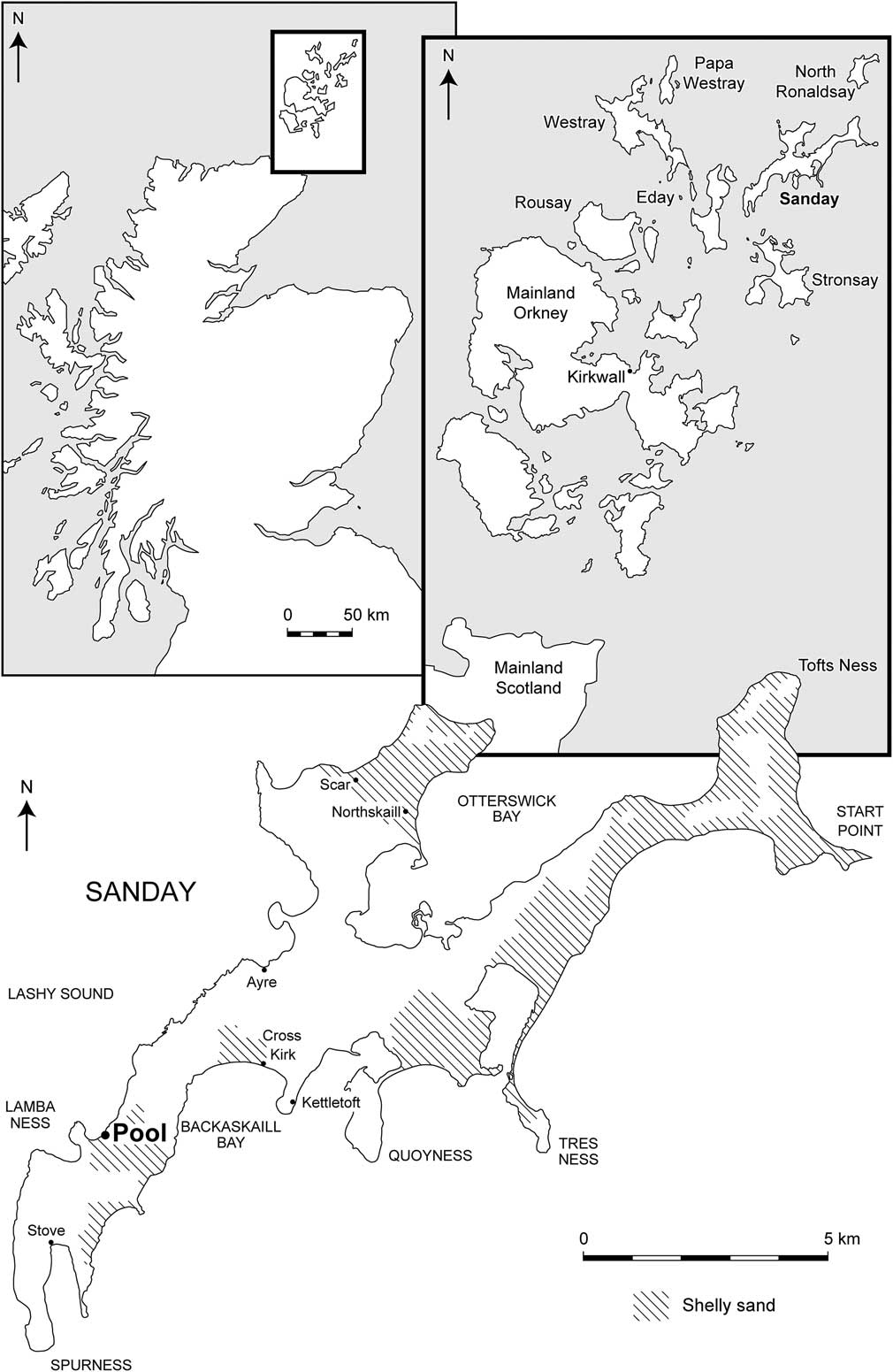
Pool lies on the coast of the low-lying but historically fertile island of Sanday (Peterkin Reference Peterkin1820, 87–97; Figs 1–2). The island is dominated by coastal dunes, particularly at the north, and wide shell-sand beaches; its highest point is little more than 30 m OD. Its solid geology is Middle Old Red Sandstone which produces, in most parts of the island, laminar Rousay Flags well suited to building. Sanday has a rich archaeological record; survey of the island undertaken by Raymond Lamb identified almost 200 sites ranging in date from prehistoric to industrial, many being prone to coastal erosion (Lamb Reference Lamb1980).
Map showing location of site

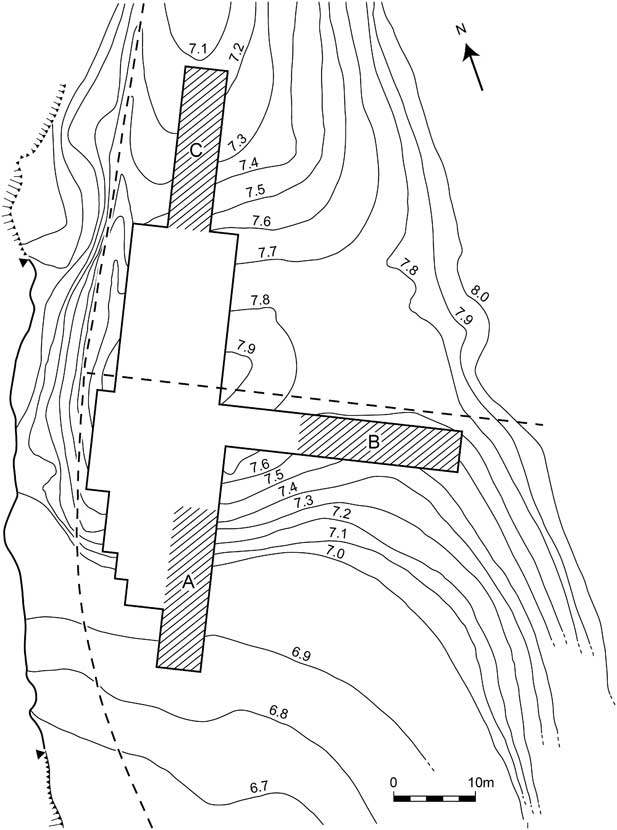
Plan of trenches in the area of eroding mound excavated

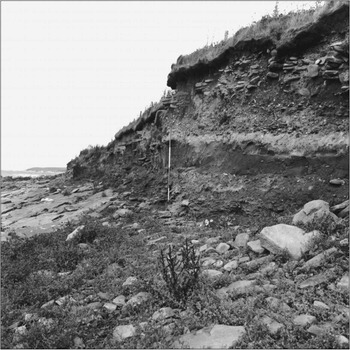
One of the key sites of Lamb’s survey was the eroding cliff section at Pool. This was c. 65 m in length, and in places up to 3 m in high, with walls, midden, and flagged flooring openly exposed to the sea (Hunter Reference Hunter2007). The cliff face sporadically collapsed leaving fragments of pottery and other objects on the shore, many being identified as of Iron Age and later Norse origin (Fig. 3). Subsequent surveys showed that the eroded section belonged to a large settlement mound of which a substantial portion still remained, and a large-scale excavation was funded by Historic Scotland. This was undertaken between 1984 and 1989. The Neolithic deposits were investigated over an area of approximately 750 m2 (Hunter Reference Hunter2007, chap. 3).
The eroding cliff face at Pool from the south, with structural remains visible

The mound was multi-period, in two main stratigraphic bands: a lower midden-based sandy band which contained structures associated with both round-based and Grooved Ware pottery, followed by an upper, blacker band containing a complex of Iron Age buildings (Hunter Reference Hunter2007). These buildings subsequently became adapted as part of a Viking and later Norse settlement.
THE NEOLITHIC SEQUENCE AND FEATURES
The remains of 14 Neolithic structures were found at Pool. The site formation was both concentrated and deep. Three main phases were identified (Phases 1–3), defined according to the stark differences in the colour of the occupation deposits, which is believed to relate to the use of differing fuel types (Hunter Reference Hunter2007, 22–3). Phase 2 was also subdivided by two sand horizons, relating to episodes or phases of sand blow-in that covered much of the settlement (Hunter Reference Hunter2000, 119).
The primary levels (Phase 1), within a band of dark organic soils, contained sherds of round-based pottery associated with the single-coursed outlines of three small, irregularly arranged stone buildings or huts, probably with turf backing. The bioarchaeological evidence shows cultivation and herding of domesticates (Bond Reference Bond2007). Dark midden deposits were used as a structural component; this took the form of bulk tipping deposits comprising a mixture of sand and burnt organic material incorporated in wall fills and between casing walls.
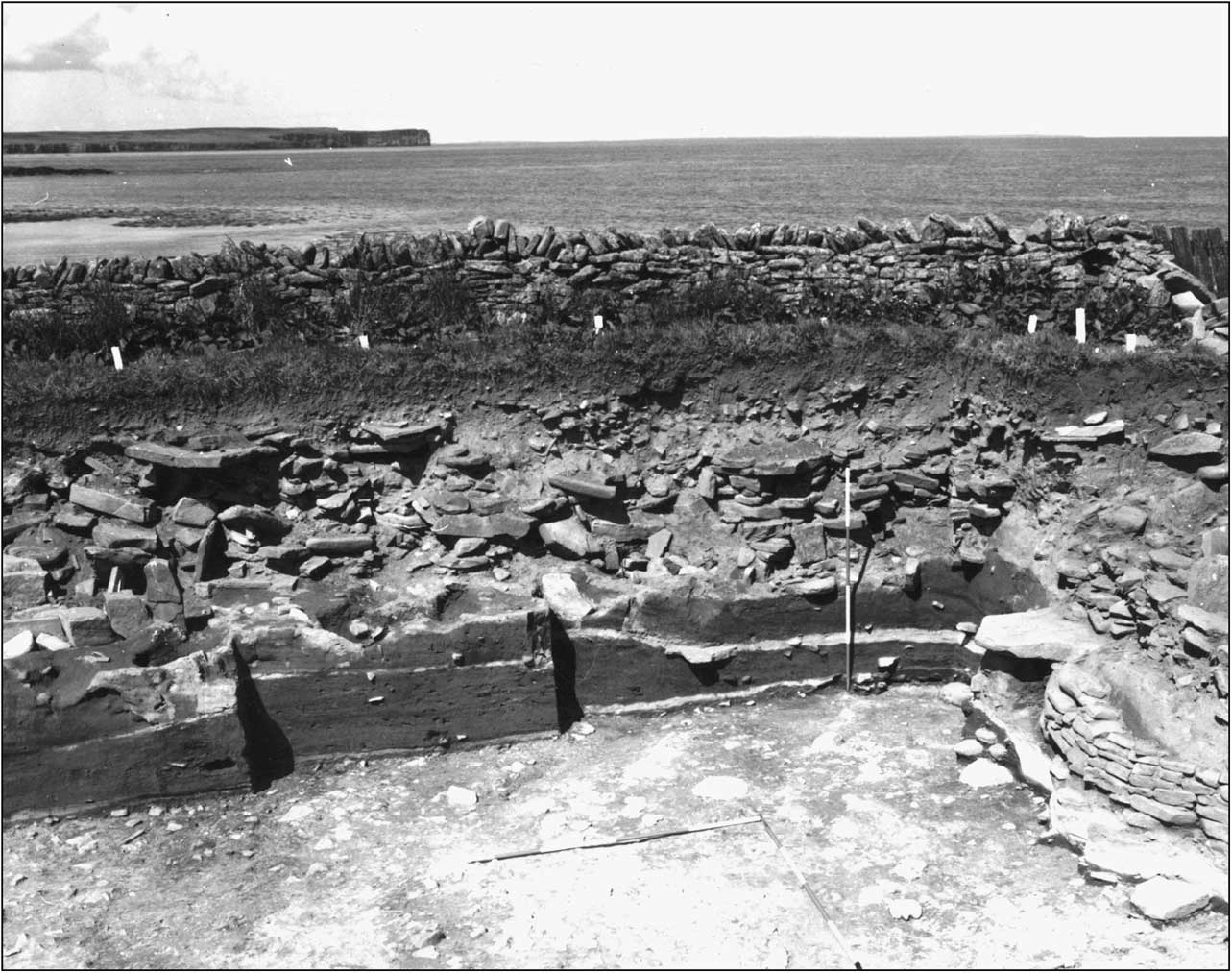
The Phase 1 deposits were overlain by light sandier deposits, red in colour, and with a slight shift in geographical focus (Phase 2.1), but without observable interface. They were interpreted as ash deriving from hearths, the fuel probably being a peat-substitute derived from the deposits of a dried-up loch nearby. No structures other than stone spreads and pits were identified in the areas excavated. This may have been a short-lived occupation as the site became sealed by aeolian sand, then subsequently by further red midden layers (Phase 2.2), again without definable structural associations in the area excavated. These were then covered by a further aeolian sand layer. Both sand layers presumably relate to sandstorms as a result of which the site may have ceased to be occupied (Fig. 4).
View of excavated section from the east with the Calf of Eday in the background. The lower (darker) part of the section represents the Neolithic deposits in which the two sand horizons can clearly be seen. Visible in the section to the right is the curved walling of a Neolithic Structure from Phase 2.3

After the second sand horizon, the focus of settlement shifted once more and three structures were built, within red midden deposits, using more substantial stones than in Phase 1 (Phase 2.3). Two of these were excavated in full and were mushroom-shaped, one being focused on a clay-luted tank; the third was not fully excavated but exhibited a casing or outer wall, infilled with midden in a manner similar to those identified by Childe at Skara Brae (Childe Reference Childe1931, 9). This phase yielded environmental data which suggested changes in crop species, from naked to hulled barley, as well as an increasing and widening exploitation of the landscape.
The final Neolithic phase (Phase 3) contained eight further structures but in a darker organic midden matrix, possibly representing the use of a different fuel source from that exploited previously (Hunter Reference Hunter2007, 73). The phase demonstrated building forms ranging from large structures with focal hearths and casing walls, to small single-faced ‘sheds’ of undefined function. Hearth midden continued to dominate the matrix; it was used not only as infill for casing wall construction (to which artefacts appear to have been deliberately added), but also as an external surface on which butchering activities, possibly of a ritual nature, took place.
THE NEOLITHIC POTTERY ASSEMBLAGE FROM POOL
The Neolithic pottery assemblage from Pool comprises 10,000 sherds (MacSween Reference MacSween1990; Reference MacSween2007a) (Figs 5–7). A morphological/technological approach to its investigation was taken, combining typological study with recording of the technology of pottery manufacture and analysis of the clays and temper used.
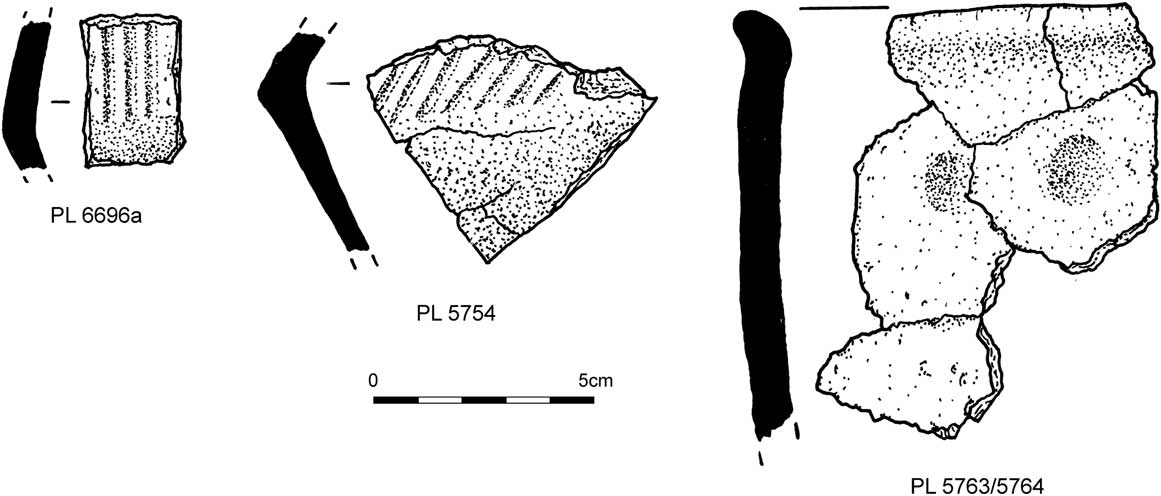
Summary of Pool pottery, redrawn from MacSween (Reference MacSween2007a); sherd numbering as in that publication: (left) Phase 1.1; (middle & right) Phase 1.2

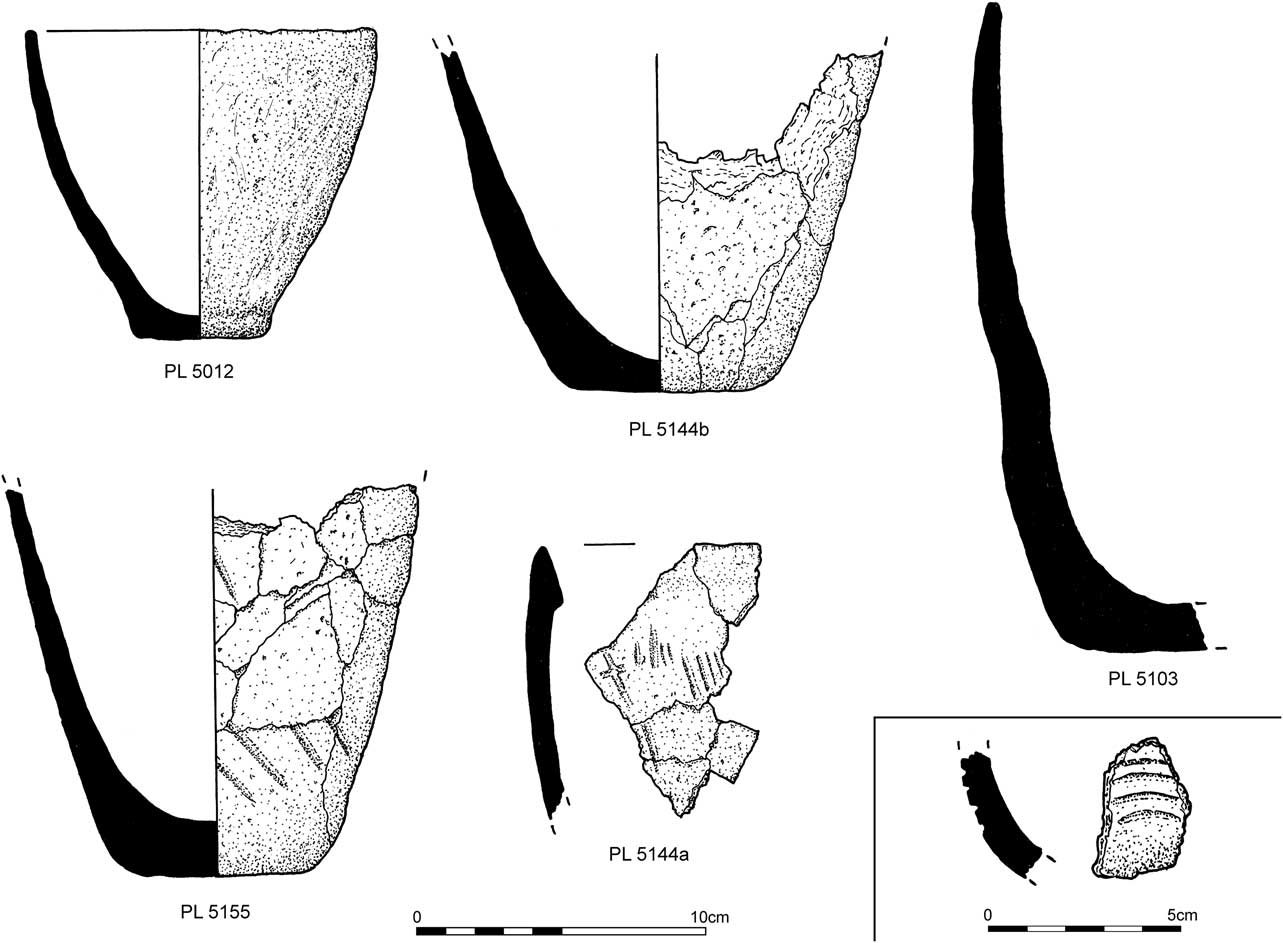
Summary of Pool pottery, redrawn from MacSween (Reference MacSween2007a); sherd numbering as in that publication: Phase 2.2

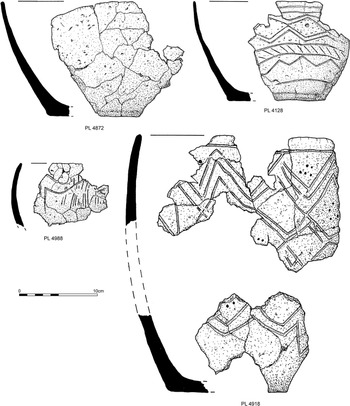
Summary of Pool pottery, redrawn from MacSween (Reference MacSween2007a); sherd numbering as in that publication: Phase 2.3

Phase 1.1 (Fig. 5, left)
Only a small part of the earliest archaeological deposits, the black tips above the subsoil, was excavated. Fifty sherds were recovered, including seven rims. Four sherds are from three round-based bowls, decorated above the carination with lines of either cord impressions or incisions (MacSween Reference MacSween2007a, 289, illus. 8.1.1). There were also some small rim sherds with plain, flat or slightly everted lips. The assemblage is abraded and the sherds are small, but the most common fabric is a fine micaceous clay with rock or shell temper.
Phase 1.2 (Fig. 5, centre & right)
The assemblage from Phase 1.2, the structures on the black tips, is very similar overall to the assemblage from Phase 1.1. The assemblage of 225 sherds representing 97 vessels included one sherd which was identifiable as from a round-based bowl. From the profile of the other rim sherds in the assemblage, most could have been from round-based bowls. One of the bowls is decorated with a row of finger tip impressions just below the lip of the vessel (MacSween Reference MacSween2007a, 290, illus. 8.1.2). Sandy clays were used more than in Phase 1.1.
Although the assemblages from the two sub-phases of Phase 1 are not identical, the number of sherds is small and overall there are more similarities than differences.
Phase 2.1
The assemblage from Phase 2.1, the red tips above the black tips of Phase 1.2, was again small, comprising only 214 sherds representing 37 vessels. Shell was identified as temper in 46% of the vessels recorded. From the thickness of some sherds, some of the vessels were substantial. Fine clays were used in 72% of the vessels. One sherd is decorated with incised parallel lines, and one flat base was found. Technologically, the assemblage is similar to the earlier material of Phase 1.2, but the one flat base hints at morphological change.
Phase 2.2 (Fig. 6)
Phase 2.2 represents the red tips above the sand horizon covering the Phase 2.1 deposits. A total of 1241 sherds representing 210 vessels was recovered, ranging from a small thumb pot to large vessels with slightly angled sides. Wide-mouthed ‘baggy’ vessels with a plain rim and a very distinctive small base are included. From two complete profiles these vessels were 100–150 mm in height and 120–130 mm at the rim, narrowing to 50–60 mm at the base. Small vessels with a larger basal diameter were also recovered. Decoration was by incision and there are eight examples including chevrons and straight parallel lines. 67% of the vessels are shell-tempered and the rest are untempered. The bases and decoration in particular suggest continuing change compared to Phase 2.1. There are elements here which are recognisable in later Grooved Ware assemblages.
Phase 2.3 (Fig. 7)
Phase 2.3, the largest grouping of red tips and structural deposits, produced 4750 sherds representing 630 vessels. Shell-tempered fine clays are the most common fabric type. A similar range of vessels to Phase 2.2 is represented, from small vessels to baggy vessels and larger, thicker-walled vessels. Decoration on these vessels was by incision from apparently random lines to zoned decoration incorporating chevrons, lozenges, and bands of incised lines. Curving lines and dots are also included. Rock tempering was noted in 13% of the vessels concentrated in a few contexts: 0905, 0979, 1130, 2478 and 2831. Forms, decorative motifs, and techniques are widely paralleled in other Grooved Ware assemblages.
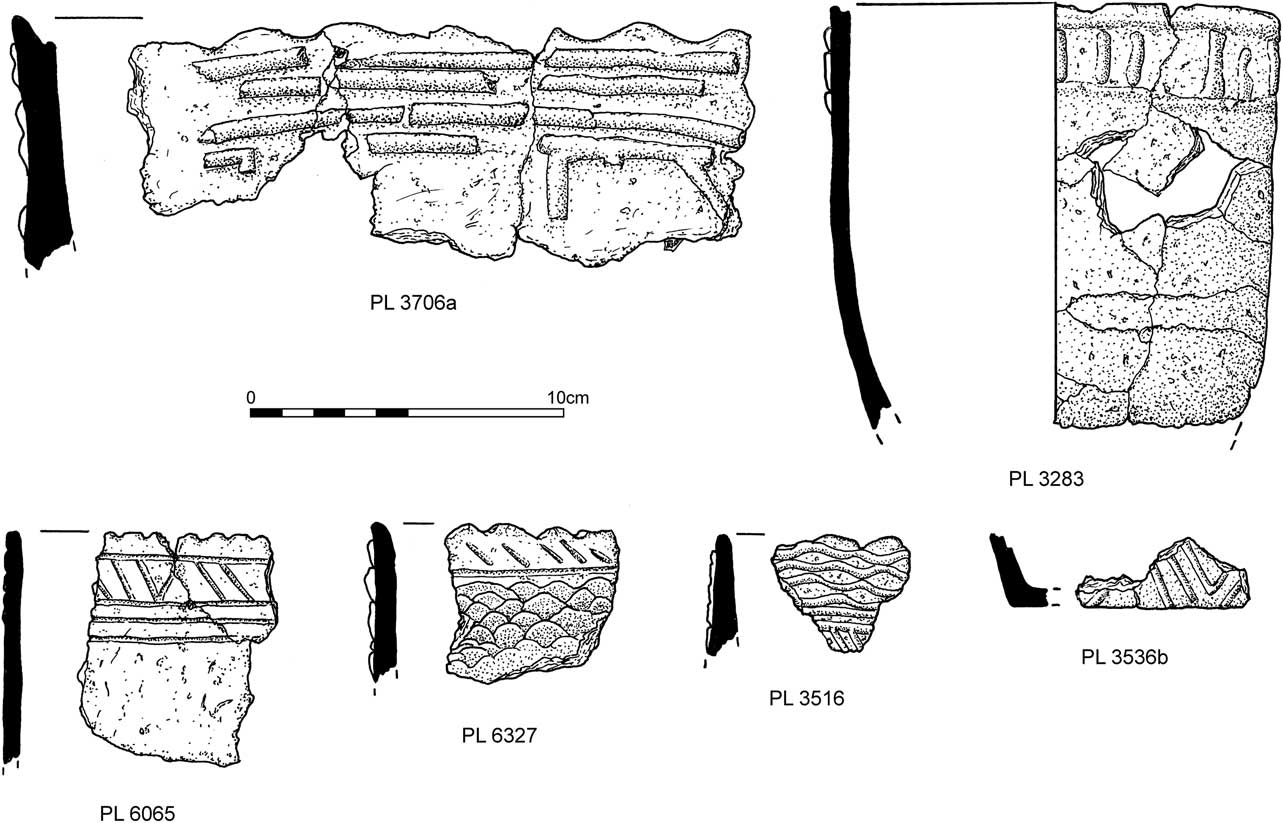
Phase 3 (Fig. 8)
An assemblage of 3260 sherds representing 840 vessels was recovered from contexts in Phase 3.1, the major structural sequence including the black tipping, and a further 400 sherds representing 80 vessels were found in Phase 3.2, the structures cut into the black tips. There did not seem to be significant difference between the pottery from these two phases, but the Phase 3 pottery contrasts markedly – in morphology, technology, decorative technique, and motifs – from the earlier assemblage. Taken together, 75% of these vessels from Phase 3 are rock-tempered, 20% are untempered, and 5% are shell-tempered. The most common vessel type in Phase 3 is a flat-based, bucket-shaped vessel or a flat-based vessel with more splayed sides. Decorated rims are represented; scalloped ones are most common but there are also examples of notched rims. The commonest decoration is a band around the upper part of the vessel, featuring either incisions into a thick slip or a band of overlapping parallel strips. Other forms of applied decoration are branching lines, ladders, trellis, lattice, and fish-scale.
Summary of Pool pottery, redrawn from MacSween (Reference MacSween2007a); sherd numbering as in that publication: Phase 3

AIMS OF THE DATING PROJECT AT POOL
The Neolithic sequence at Pool was selected for inclusion in a dating project: The Times of Their Lives (ToTL), because it offered the prospect of integrating a well defined and fairly deep stratigraphic sequence with a series of radiocarbon dates spanning much, if not most, of the currency of Grooved Ware. In Phase 2.1 flat-based pottery begins to be produced within the technological approach to ceramic manufacture identified in Phase 1, and is developed in Phases 2.2 and 2.3. Phase 3 is characterised by flat-based Grooved Ware pottery with heavy applied decoration in a distinctly new fabric type.
It was hoped both to inform the debate surrounding the origins of Grooved Ware on Orkney and also to provide dates for the two types of Grooved Ware at Pool, which could then be used as reference points for dating other assemblages in Orkney (cf. Schulting et al. Reference Schulting, Sheridan, Crozier and Murphy2010). It has previously been suggested that Orcadian Grooved Ware is the earliest in Britain as a whole (among others by MacSween Reference MacSween2007b; Thomas Reference Thomas2010; Schulting et al. Reference Schulting, Sheridan, Crozier and Murphy2010) but this is based on a limited number of radiocarbon dates of varying quality and it is important that further data are obtained to examine this issue in more detail. So we start here with Pool, and the project is also helping to re-examine the chronology of other Grooved Ware sites on Orkney, including Barnhouse (Richards Reference Richards2005), the Links of Noltland (Sheridan Reference Sheridan1999; Moore & Wilson Reference Moore and Wilson2011), Ness of Brodgar (Card Reference Card2013), and Skara Brae (cf. Sheridan et al. Reference Sheridan, Clarke and Shepherd2012a).
RADIOCARBON DATING AND CHRONOLOGICAL MODELLING
From the outset the new radiocarbon dating programme for Pool was conceived within the framework of Bayesian chronological modelling (Buck et al. Reference Buck, Cavanagh and Litton1996). This allows the combination of calibrated radiocarbon dates with archaeological prior information using a formal statistical methodology. At Pool the deep stratigraphic sequence, with apparently clear marker horizons provided by the blown sand deposits, could potentially provide highly informative prior information to produce a refined chronology for the site.
A limited number of radiocarbon dates had been obtained from selected Neolithic phases as part of the original post-excavation analysis, and a larger suite of thermoluminescence (TL) measurements had been produced on the feldspar component of a range of sherds from the entire Neolithic sequence (Hunter Reference Hunter2007, appx 2; Spencer & Sanderson Reference Spencer and Sanderson2012). From the evidence for settlement before and after the two major sand blows, Hunter suggested that these events produced no major effect on settlement continuity, and that Neolithic activity appeared to have gone on at the site for ‘slightly less than two millennia’. Removing clear outliers in the TL data, Hunter (Reference Hunter2007, 61) suggested that Neolithic occupation continued from the early/mid-4th millennium to the end of the 3rd millennium bc. He suggested that activity associated with Grooved Ware (Phase 2.1) began in 3710±165bc, although he noted that this interpretation placed the emergence of Grooved Ware in Orkney significantly earlier than in other calculations (e.g. Ashmore Reference Ashmore2004, 130). Subsequent research in TL dating has demonstrated the presence of anomalous fading in feldspars (Duller Reference Duller2008, 7–8), which can bias some luminescence measurements on feldspars to younger ages.
Sampling
The stratigraphic discussion of the Neolithic deposits provided by Hunter (Reference Hunter2007, chap. 3) is an interpretative narrative rather than a blow-by-blow account of each deposit recorded. We therefore consulted the primary archive held by the Royal Commission for the Ancient and Historical Monuments of Scotland (RCAHMS). Unfortunately, the overall site matrix could not be located. The stratigraphic relationships employed in this paper were therefore reconstructed from the individual record cards, plans, sections, and site notebooks held in the RCAHMS, in consultation with the excavator. In all cases, it was only possible to reconstruct partial stratigraphic sequences that had to be combined using the overall phasing scheme provided by Hunter (Reference Hunter2007). We continued on this basis because we felt that the overall stratigraphic narrative was robust enough to provide reliable prior information for the model. The nature of the archaeological deposits, with blown sand marker horizons and very distinctive tipping deposits, provided clear and comparatively unequivocal stratification.
Identifying samples suitable for dating within the collections of the Orkney Museum was challenging. The Neolithic bone finds, which had the consistency of cream cheese when excavated (Hunter Reference Hunter2007, 207), had either not survived excavation or had been heavily consolidated with PVA. No unburnt bone was therefore suitable for radiocarbon dating. Calcined bone survived from a number of contexts in Phases 2.2–3.2. Pool was extensively sampled for charred plant remains. Unfortunately, the majority of bulk samples had been processed using polypropylene glycol and paraffin as additives and subsequently stored in industrial methylated spirits (IMS). This rendered them unsuitable for radiocarbon dating. A small number of sediment samples from the Neolithic phases had been specifically processed to provide material suitable for radiocarbon dating. These were processed by hand using water, and not stored in IMS. Only some of this material could be located in the environmental archive at Bradford University.
That left the possibility of finding suitable organic residues on pottery sherds, although these were rare. The depositional environment on site was such that many of the pottery sherds were very soft when recovered and had lost their surfaces or had been treated with PVA. This limited the number of charred food residues available for radiocarbon dating.
No samples at all could be identified from the earliest phase (Phase 1) and that which contained the first evidence of Grooved Ware (Phase 2.1). Organic residues of sufficient size for dating were available on 20 sherds (from Phases 2.2, 2.3, 3.1, and 3.2) and two samples of uncontaminated charred plant remains were available (both from Phase 3.1). The surviving calcined bone did not add to the temporal or spatial range of these samples. Because of the limited availability of suitable organic material, many of the original objectives of the dating programme could not be achieved. Specifically, we would not be able to produce a chronology for the earliest Grooved Ware on the site. We decided to go ahead with a dating programme nonetheless, because the chronological development in Grooved Ware form and fabric at Pool is intrinsically relevant to the wider research aims of the Grooved Ware component of The Times of Their Lives. The sampling strategy at Pool was, however, severely constrained by the availability of organic material suitable for dating.
Results
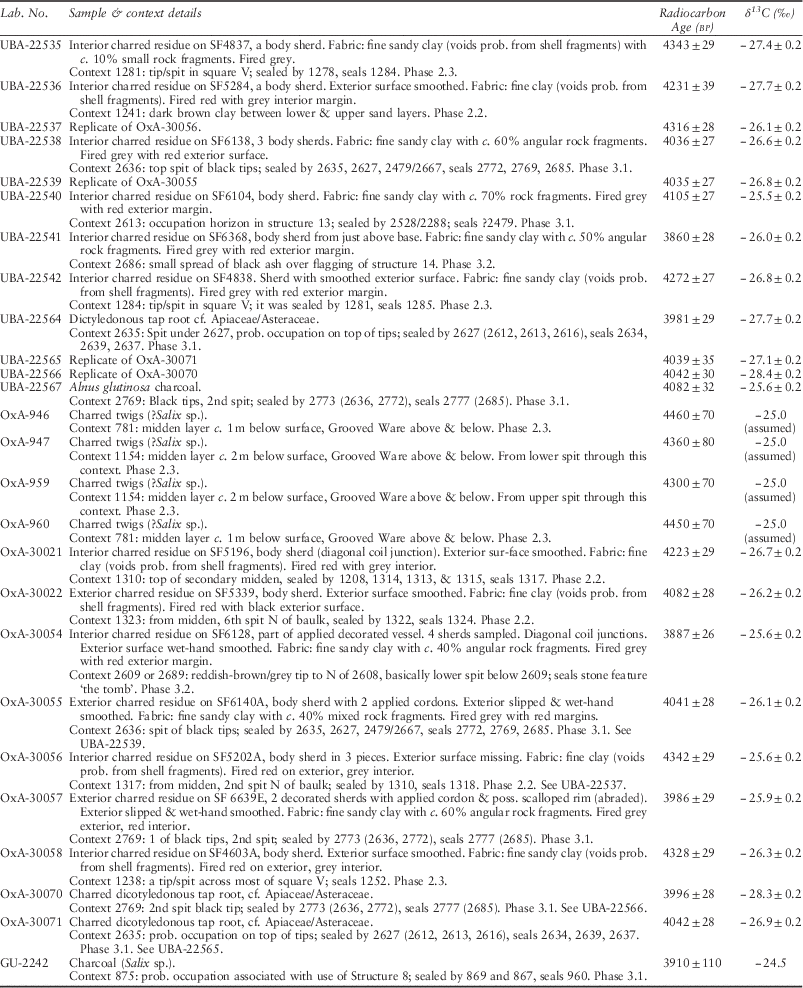
A total of 26 radiocarbon measurements are now available from Pool, all but five of which were undertaken on behalf of the ToTL project (Table 1). All are conventional radiocarbon ages (Stuiver & Polach Reference Stuiver and Polach1977).
Radiocarbon measurements and associated δ13c values from pool

Radiocarbon samples of charred plant remains dated as part of the original post-excavation programme were measured by AMS at the Oxford Radiocarbon Accelerator Unit using methods outlined in Gillespie et al. (Reference Gillespie, Gowlett, Hall, Hedges and Perry1985) and Hedges (Reference Hedges1981). Samples of charred plant remains measured in Oxford for this project were pretreated using acid-base-acid and residues on pottery were pretreated using a series of acid washes (Brock et al. Reference Brock, Higham, Ditchfield and Bronk Ramsey2010). Samples were combusted and graphitised (Brock et al. Reference Brock, Higham, Ditchfield and Bronk Ramsey2010; Dee & Bronk Ramsey Reference Dee and Bronk Ramsey2000), and dated by AMS (Bronk Ramsey et al. Reference Bronk Ramsey, Higham and Leach2004).
Samples measured by AMS at the 14CHRONO Centre, Queen’s University Belfast were pretreated using an acid wash, with the exception of UBA-22567 which was subjected to an acid-base-acid pretreatment protocol. Pretreatment, combustion and graphitisation, and measurement protocols are given in Reimer et al. (Reference Reimer, Hoper, MacDonald, Reimer and Thompson2015). All graphite reduction was undertaken using a zinc catalyst.
Bulk willow charcoal (GU-2242) was measured by Liquid Scintillation Spectrometry at the Scottish Universities Research and Reactor Centre as part of the original post-excavation programme. This sample was processed using methods outlined in Stenhouse and Baxter (Reference Stenhouse and Baxter1983), and dated as described by Noakes et al. (Reference Noakes, Kim and Stipp1965).
Three sets of true replicate measurements (repeat determinations on the same sample) were produced. OxA-30055 and UBA-22539 on exterior residue on small find sherd 6140 are statistically consistent (T’=0.0; T’(5%)=3.8; df=1; Ward and Wilson Reference Ward and Wilson1978), as are OxA-30070 and UBA-22566 on a charred dicotyledonous tap root (T’=1.3; T’(5%)=3.8; df=1), and OxA-30071 and UBA-22565, also on a charred dicotyledonous tap root (T’=0.0; T’(5%)=3.8; df=1). The replicate measurements have been combined by taking a weighted mean before calibration and inclusion in the chronological models.
Bayesian modelling
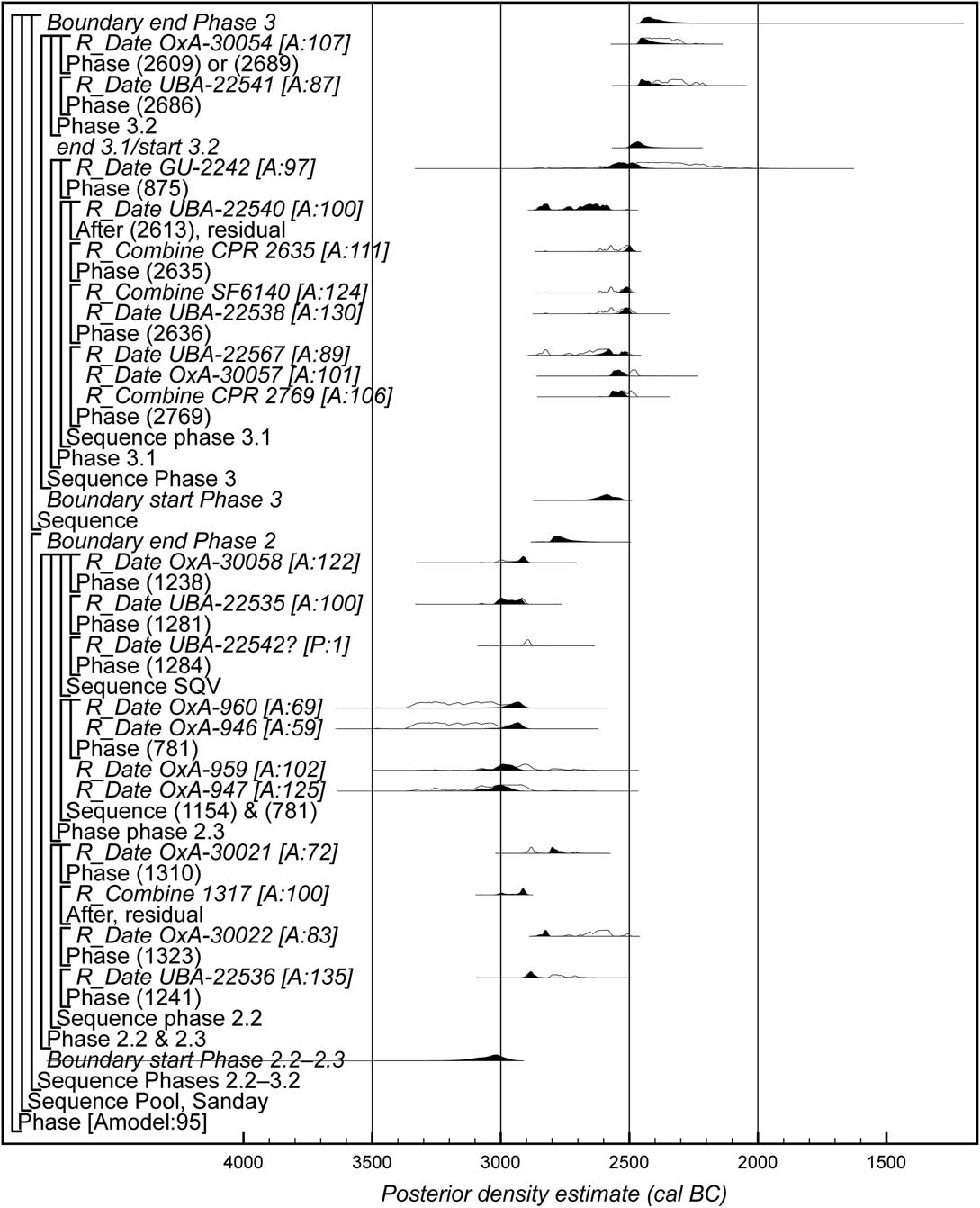
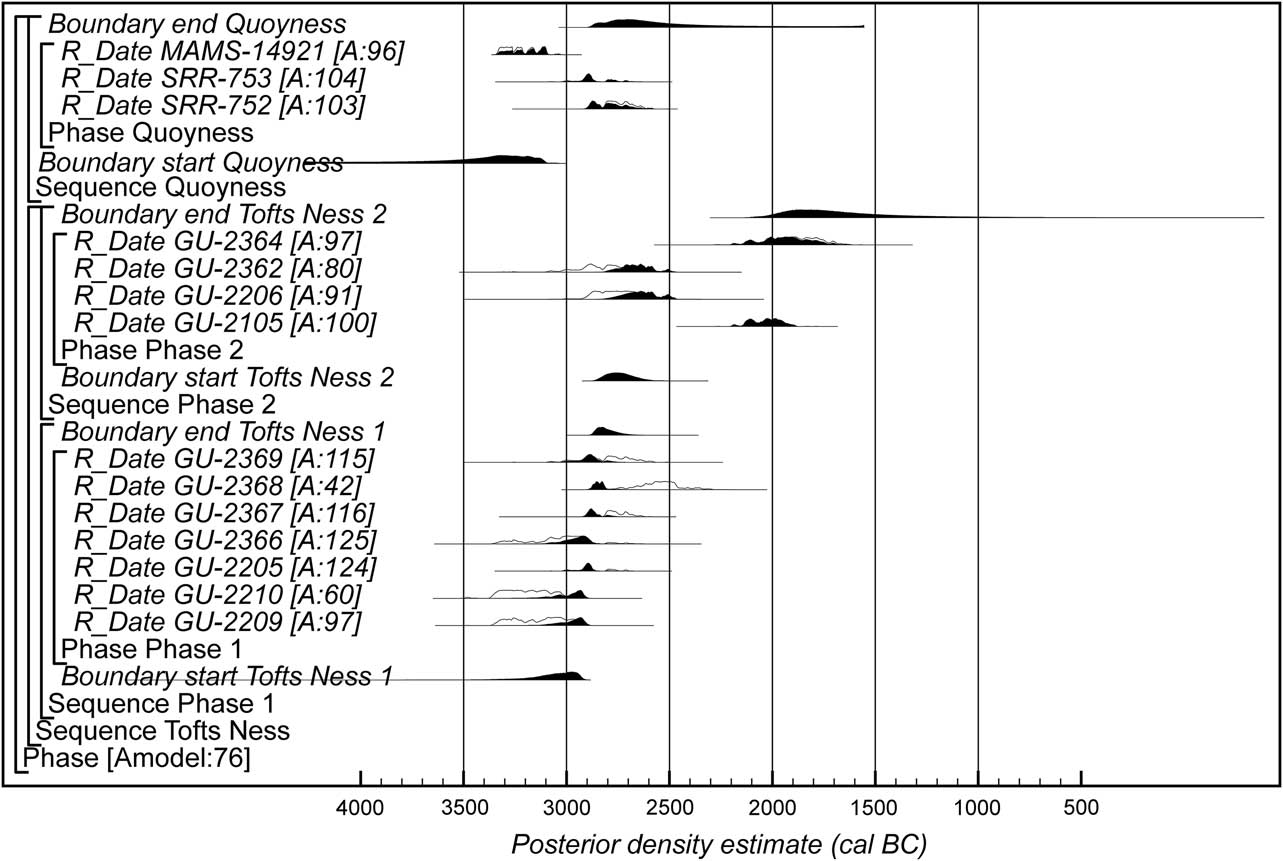
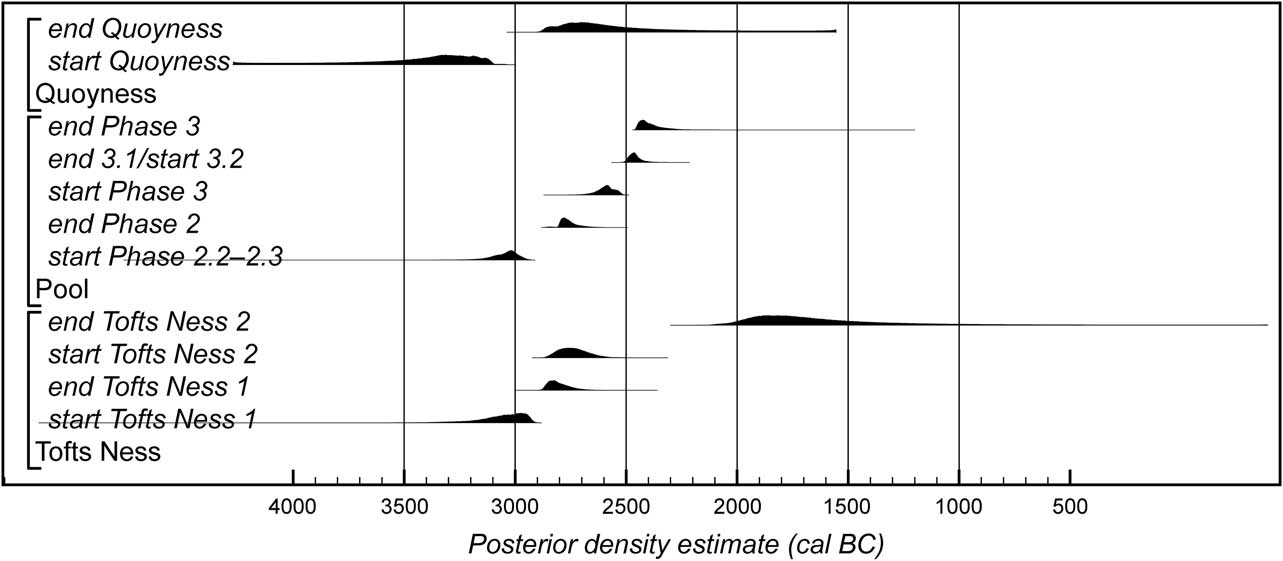
The chronological modelling described in this section has been undertaken using OxCal 4.2 (Bronk Ramsey Reference Bronk Ramsey1995; Reference Bronk Ramsey2009), and the internationally agreed calibration curve of the northern hemisphere (IntCal13; Reimer et al. Reference Reimer, Bard, Bayliss, Beck, Blackwell, Bronk Ramsey, Buck, Cheng, Edwards, Friedrich, Grootes, Guilderson, Haflidason, Hajdas, Hatté, Heaton, Hoffmann, Hogg, Hughen, Kaiser, Kromer, Manning, Niu, Reimer, Richards, Scott, Southon, Staff, Turney and van der Plicht2013). The models are defined by the OxCal CQL2 keywords and by the brackets on the left-hand side of Figures 9–10 and 12–14. In the diagrams, calibrated radiocarbon dates are shown in outline and the posterior density estimates produced by the chronological modelling are shown in solid black. The Highest Posterior Density intervals which describe the posterior distributions are given in italics.
Probability distributions of radiocarbon dates from Pool. Each distribution represents the relative probability that an event occurs at a particular time. For each of the dates two distributions have been plotted: one in outline, which is the result of simple radiocarbon calibration, and a solid one, based on the chronological model used. Distributions other than those relating to particular samples correspond to aspects of the model. For example, the distribution ‘start Phase 3’ is the estimated date when activity in Phase 3 began. Measurements followed by a question mark and shown in outline have been excluded from the model for reasons explained in the text, and are simple calibrated dates (Stuiver & Reimer Reference Stuiver and Reimer1993). The large square brackets down the left-hand side along with the OxCal keywords define the overall model exactly

Durations of dated phases of activity and for the interval between phases 2 and 3 at Pool, derived from the model defined in Fig. 9

We constructed the chronological model for Pool in stages. First, we combined the individual stratigraphic sequences for the dated samples with the radiocarbon dates in a single continuous phase of activity. The calibrated radiocarbon dates of three samples have extremely poor agreement with their positions in their relevant stratigraphic sequences (see Bronk Ramsey Reference Bronk Ramsey1995, 429 & 2009, 356–7 for details of the agreement indices employed by OxCal). SF5202 (OxA-30056 and UBA-22537 from context 1317; A: 0) and SF6140 (UB-22540 from context 2613; A: 9) must be redeposited pottery sherds in the contexts from which they were recovered. UBA-22542 is on an encrusted residue from a sherd from context (1284) that is clearly stratified within the ash tips sequence in Square V. This result is slightly too recent for its stratigraphic (A: 14) position. On balance, we think that it is more likely that a small proportion of younger contamination has survived the acid wash pretreatment than that this sherd was intrusive or that both the samples from the overlying contexts were residual. Either way, this measurement has been excluded from the model and those from SF5202 and SF6140 modelled as termini post quos for their contexts. When this is done, the model has good overall agreement (Amodel: 63; model not shown). This means that 23 of the 27 radiocarbon dates from Pool are compatible with the recorded stratigraphy.
The next stage in the modelling process is to incorporate the sequential phasing presented by Hunter (Reference Hunter2007). The radiocarbon dates have extremely poor agreement with this interpretation (Amodel: 0; model not shown). Examination of the individual indices of agreement for each radiocarbon date demonstrates that it is the sequence between Phases 2.2 and 2.3 which conflicts with the radiocarbon data. All the samples from Phase 2.3 have poor agreement being later than those from Phase 2.2 (A: 4, A: 0, A: 0, A: 12, and A: 40). The two results from context 781, one of the lowest deposits attributed to Phase 3.1, also have very poor individual agreement with this position in the stratigraphic sequence (A: 0 and A: 0).
Two alternative explanations of this discrepancy are possible. In the first scenario, Phase 2.3 is indeed later than Phase 2.2, and everywhere across the site they are separated by the upper sand horizon. In this reading all the samples that we have dated from Phase 2.3 are reworked from earlier deposits. The second scenario is that the ages of the radiocarbon samples from Phases 2.2 and 2.3 reflect the timing of the formation of the parent deposits. In this reading, the red tip deposits of Phases 2.2 and 2.3 relate to a continuous period of activity, and are not everywhere on the site clearly separated by the distinctive layer of the upper sand.
We find the first scenario implausible for two reasons. The first is that four of the five radiocarbon dates from Phase 2.3 are compatible with the individual stratigraphic sequences of tips within the phase. If all the material had been redeposited then such coherence would not be expected. The second is the character of the tipped deposits themselves, which show individual lenses of material that we interpret as the result of discrete disposal events of primary refuse. In favour of this interpretation are the care with which the excavation was undertaken and the distinctive nature of the sand-blown horizons.
The second scenario is also not unproblematic. It would mean that the distinctive ‘upper sand horizon’ would have been misidentified or conflated with the ‘lower sand horizon’ (or indeed other, less extensive, episodes of blown sand) when the two stratigraphic sequences dated from Phase 2.3 were recorded and excavated. The sequence of deposits in Square V, which contained contexts (1284), (1281) and (1238), is explicitly recorded as lying above the ‘upper sand’. Similarly, the long sequence of contexts which contains (1154) and, at a higher level, (781) is also recorded in archive as starting above the ‘upper sand’. The radiocarbon dates from Phase 2.3 clearly conflict with this record. Since the ‘lower sand horizon’ is recorded at the base of the stratigraphic sequence that contains the dated samples from Phase 2.2, and this sequence ends with the ‘upper sand horizon’, it seems less likely that the samples from this lower horizon have been incorrectly phased.
The incompatibility between the published phasing scheme and the dates from context (781) is perhaps less problematic. This context lay directly beneath Iron Age deposits and appears in the stratigraphic sequence that includes context (1154) and starts on the ‘upper sand deposit’. Elsewhere, however, it occurs at the top of a stratigraphic sequence that includes only two earlier deposits before the ‘lower sand deposit’. Unlike the division between Phases 2.2 and 2.3, the division between Phases 2.3 and 3.1 is not marked by a distinctive sand blow and (781) is consistently assigned to phase 2.3 in the archive.Footnote 1 Given two statistically consistent radiocarbon measurements on short-lived material from the deposit (OxA-946 and OxA-960; T’=0.0; T’(5%)=3.8; df=1) which are compatible with two other radiocarbon dates that are directly stratigraphically related (OxA-947 and OxA-959), the allocation of this context to Phase 2.3 seems to be correct.
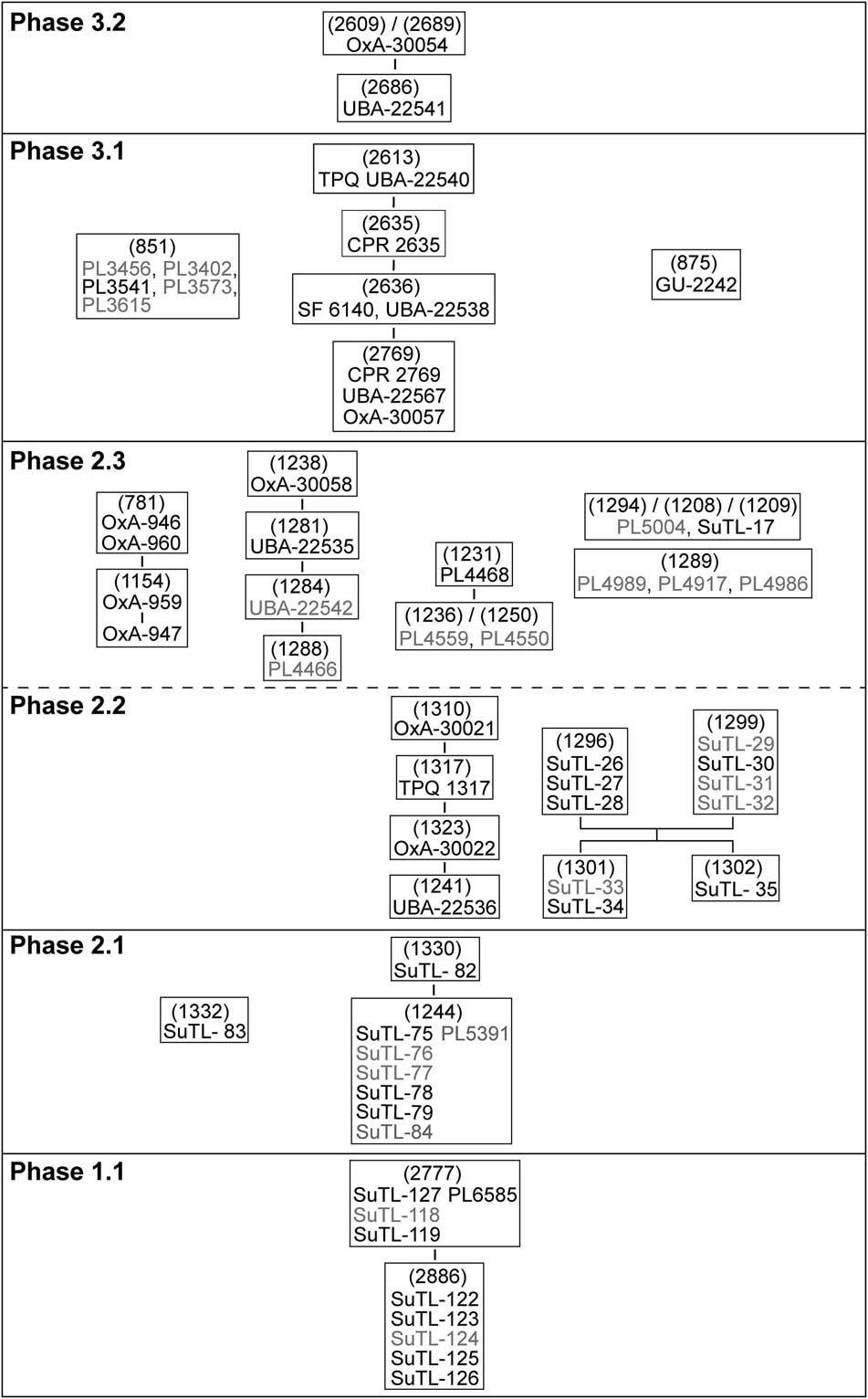
The chronological model shown in Figure 9 thus combines Phases 2.2 and 2.3 and follows the archive in allocating context (781) to Phase 2.3. The radiocarbon dates also show a clear break between the period of occupation of the site in Phase 2 and the period of occupation in Phase 3. This is compatible with the distinct change from shell-tempering to rock-tempering in the pottery fabrics used, and also to the stylistic changes observed in the vessels. The activity in Phases 2 and 3 is thus modelled in terms of separate, but successive, periods of continuous occupation with an interval of unknown duration between them. The stratigraphic and phasing information incorporated in this model (Fig. 9), and the subsequent sensitivity analysis which incorporates the luminescence ages obtained in the 1980s, are summarised in Figure 11.
Stratigraphic matrix of dated samples from Pool (thermoluminescence dates shown in grey are those excluded from the model defined in Fig. 12)

This model has good overall agreement (Amodel: 95). It suggests that Phase 2.2/2.3 began in 3210–2935 cal bc (95% probability; start Phase 2.2–2.3; Fig. 9), probably in 3100–2980 cal bc (68% probability). Phase 2 ended in 2860–2830 cal bc (2% probability) or 2815–2650 cal bc (93% probability; end Phase 2; Fig. 9), probably in 2805–2735 cal bc (68% probability). Phase 3 began in 2680–2515 cal bc (95% probability; start Phase 3; Fig. 9), probably in 2625–2545 cal bc (68% probability). Phase 3.1 ended and Phase 3.2 began in 2510–2395 cal bc (95% probability; end 3.1/start 3.2; Fig. 9), probably in 2495–2445 cal bc (68% probability). Phase 3, and Neolithic occupation at Pool, ended in 2460–2280 cal bc (95% probability; end Phase 3; Fig. 9), probably in 2455–2370 cal bc (68% probability).
Phase 2.2–2.3 lasted for a period of 135–515 years (95% probability; duration Phase 2.2 & 2.3; Fig. 10), probably for a period of 195–350 years (68% probability). Period 3 also endured, lasting for a period of 70–365 years (95% probability; duration Phase 3; Fig. 10), probably for a period of 105–250 years (68% probability). The gap between phases 2 and 3 lasted a period of 35–270 years (95% probability; Phase 2–3 interval; Fig. 10), probably for 115–235 years (68% probability).
At this point we added the luminescence ages to the Bayesian model, also including the stratigraphic sequences of deposits from which the dated pottery sherds derived. Eleven groups of replicate luminescence ages are available from Neolithic pottery sherds from Pool (Spencer & Sanderson Reference Spencer and Sanderson2012, table A1). Of these, seven are statistically consistent, although those on PL4986 (phase 2.3), PL3456, and PL3573 (both from Phase 3.1) are not. Three of four measurements on PL4559 (Phase 2.3) are statistically consistent, although the fourth (SUTL-53b) is much earlier. We have omitted from the analysis the three statistically inconsistent groups of measurements, and SUTL-53b. We have also omitted SUTL-84 (390±250bc) from Phase 2.1 and PL3615 (SUTL-40a, ad830±100 and SUTL-40b, ad740±150) from Phase 3.1, judgmentally, as clearly they are anomalously late. In total 37 luminescence ages (eight of which are weighted means from statistically consistent replicate groups) were included in the first iteration of the TL model.
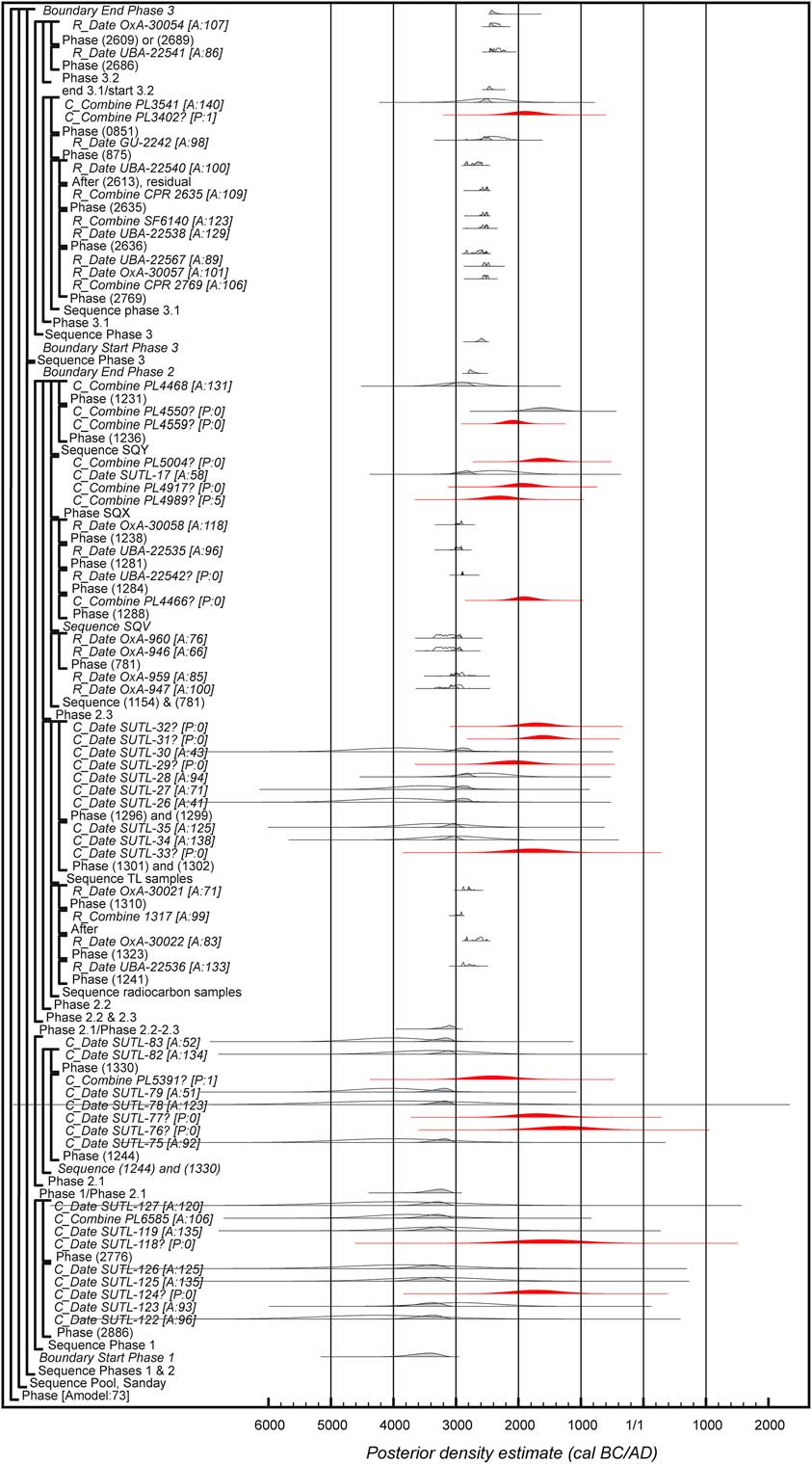
The model combining the radiocarbon and luminescence dates and with the stratigraphic sequences from which the samples were recovered, and the reading of this described above, has extremely poor overall agreement (Amodel: 0). A proportion of the luminescence ages have very low individual indices of agreement (A<10) and are clearly anomalously recent (SUTL-124 and SUTL-118 in Phase 1; SUTL-76 and -77 in Phase 2.1; SUTL-31, -32, and -33 in Phase 2.2; PL4466, PL4917, PL5004, PL4559, and PL4550 in Phase 2.3; and PL3402 in Phase 3.1), and are presumably subject to anomalous fading. If these ages are removed as inaccurate misfits, the remaining model still has poor overall agreement (Amodel: 27; model not shown), with three further samples having poor individual agreement and appearing to be anomalously recent (PL5391 in Phase 2.1 and SUTL-29 and PL4989 in Phase 2.2). If these ages are also removed as inaccurate misfits, the model has good overall agreement (Amodel: 73; Fig. 12).
Probability distributions of radiocarbon and thermoluminescence dates from Pool. The format is identical to that of Fig. 9. Measurements followed by a question mark and shown in grey (red online) have been excluded from the model for reasons explained in the text. The large square brackets down the left-hand side along with the OxCal keywords define the overall model exactly

We doubt whether this model provides a more reliable chronology than the model including only the radiocarbon dates presented above (Fig. 9). In a situation where over half of quoted ages are clearly inaccurate (for technical reasons that were poorly understood at the time when they were measured), it is difficult to accept that the remaining results have no bias. Are these simply those samples where the anomalous fading was less severe? It is possible that the results on the earlier pottery are more reliable. All four of the luminescence ages from Phase 3.1 (100%) have been excluded as misfits from the model shown in Figure 12, seven of nine (78%) from Phase 2.3, four of ten (40%) from Phase 2.2, four of nine (44%) from Phase 2.1, and two of nine (22%) from Phase 1. This may support the suggestion of higher firing temperatures for these earlier ceramics derived from high-temperature thermoluminescence archaeothermometry (Spencer & Sanderson Reference Spencer and Sanderson2012, 3546). We also note that the posterior density estimates for the boundaries of Phase 2.1 (during which the first flat-based pottery occurs at Pool) from the model shown in Figure 12 are compatible with an emergence of this pottery tradition in the last centuries of the 4th millennium cal bc (Phase 1/Phase 2.1 and Phase 2.1/Phase 2.2-2.3; Fig. 12). This fits with the other evidence currently available for this transition.
Given the uncertainties surrounding the accuracy of the thermoluminescence ages from Pool, however, we regard the model shown in Figure 9 as providing the most accurate estimate of the chronology of Pool currently available.
DISCUSSION
Dating Grooved Ware emergence and development at Pool
The results presented above have allowed us to draw two significant conclusions about Grooved Ware pottery at Pool. First, the transition at Pool from the use of round-based pottery to that of incised Grooved Ware had occurred by 3210–2935calbc (95% probability; start Phase 2.2–2.3; Fig. 9), probably by 3100–2980 cal bc (68% probability). Secondly, there was a hiatus in the occupation, after which a significantly different kind of Grooved Ware was in use, in Phase 3.
Regarding the emergence of Grooved Ware, there is a degree of technological and stylistic continuity at Pool between the round-based vessels of Phase 1 and the baggy vessels of Phase 2. Quite what the timing and tempo of the switch to flat-based forms and incised decoration at Pool were is unclear. The two main episodes of sand blow-in in Phase 2 could have led to short-term interruption of occupation, but the pattern of ceramic development does not suggest a hiatus of the kind now established between Phases 2.3 and 3.
It also remains to be established, with reference to other sites currently being dated, whether the tempo and nature of change at Pool were the same as elsewhere in Orkney or whether ceramic development in individual sites, communities or islands within the archipelago proceeded at individual rates, and not necessarily concurrently. Though the results from Pool do not include a reliable date estimate for Phase 2.1, or for Phase 1, they confirm that Grooved Ware was being made on Sanday by c. 3000 cal bc. The question of the date of the start of Grooved Ware in Orkney as a whole will be returned to in other papers.
As for the second major conclusion referred to above, it appears that after the break in occupation at the end of Phase 2.3, the site was reoccupied in Phase 3 by a community using a pottery assemblage which was different in every way — technologically, morphologically and decoratively — from that which had been used by the previous inhabitants represented by the Phase 2.3 settlement. The time represented by this break in occupation is in the order of four to nine generations.
Settlement development at Pool
It does not seem to be a coincidence or simply an accident of survival that the number, variety, formality and robustness of structures revealed within Pool (Hunter Reference Hunter2007, 63–7) increase through time, such that by Phase 3 there was what the excavator called ‘a more monumental type of architecture’, accompanied by ‘increasing importance attached to processes of discard’ (Hunter Reference Hunter2007, 67). The style of construction in Phase 3 at Pool appears to reflect what has been suggested as a broader trend towards increasingly monumentalised (non-funerary) architecture in Orkney. Large and elaborate buildings have been revealed at the top of the sequence at Ness of Brodgar, for example, even though their precise dates have not yet been established (Card Reference Card2013), and more remains to be discovered about the structures in earlier levels there.
Other evidence from Sanday
One of the main results from the dating and modelling project at Pool has been the identification of a significant hiatus in the occupation between Phases 2.3 and 3.1. What are the local implications? Sanday is only 18km long and barely 4km across at its widest point (though the coastline is very irregular). Stephen Dockrill (Reference Dockrill2007, 395; Dockrill & Bond Reference Dockrill and Bond2009) has stressed what he sees as the long-term continuity of occupation of the island, while John Hunter (Reference Hunter2007, 515) has emphasised the fragility of island life. Obviously, there is no total inventory of Grooved Ware settlements on Sanday; other sites have doubtless been lost to coastal erosion or sea-level rise, or remain otherwise undetected. Where detailed survey work has been carried out, on the Tofts Ness peninsula, for example, a series of banks, enclosures, and large mounds and over 300 smaller mounds and cairns have been revealed, suggesting burial and settlement evidence spanning the prehistoric period (Dockrill Reference Dockrill2007, 4–7; cf. Lamb Reference Lamb1980); other indications of settlement are to be found at Spur Ness and Elsness (Bond et al. Reference Bond, Braby, Dockrill, Downes and Richards1995, 127). More specifically, there is what appears to be an impressively large Grooved Ware site at the Bay of Stove at the south-west end of the island, not far from Pool (Bond et al. Reference Bond, Braby, Dockrill, Downes and Richards1995; Richards Reference Richards2005, 7, fig. 2.1). This was first recorded by Lamb (Reference Lamb1980, 16) as an area of eroding cliff section. In 1992, structures including standing walls, house floors, hearth deposits, and midden with ash, pottery, and bone, were visible along 50 m of low cliff face (Gibson & Bradford Reference Gibson and Bradford2008, 85–6). A test pit 25 m inland of the coastline, positioned to gauge the extent of the site, produced a significant quantity of flint and Grooved Ware pottery (Bond et al. Reference Bond, Braby, Dockrill, Downes and Richards1995, 127).
The other main settlement evidence comes from Tofts Ness at the other end of the island to Pool (Dockrill Reference Dockrill2007). Here the primary structure (Structure 1) and the contemporary tips, and the tips which infill it, have been ascribed a Neolithic date. Structure 1 was a sub-circular building 4m in diameter which is represented by the fragmentary remains of a stone wall with an earth core. The tips are layered ash and midden with similarities to the tips at Pool, with the bulk of the material derived from fuel debris (Dockrill Reference Dockrill2007, 23). The pottery is an assemblage of 2000 sherds representing a maximum 600 vessels. The vessels are flat-based with slightly angled walls and there are no sherds which represent round-based vessels. The fabrics are mainly untempered (66%) with some rock-tempered (16%). There is no decorated pottery which is comparable to the pottery from Pool but there are parallels in terms of overall form (MacSween Reference MacSween2007c, 259–60).
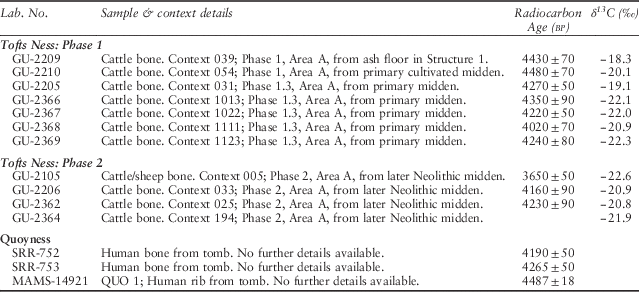
A suite of 11 radiocarbon dates are available from Tofts Ness (Table 2). All are on short-life material, but it is not clear whether these samples represent bulk samples of more than one bone (although we suspect that GU-2105 may have been) and whether the bones were disarticulated and so have the potential for being reworked. The results from Phase 1 form a coherent group which suggests that this activity dates to between 3330–2910calbc (95% probability; start Toft Ness 1; Fig. 13), probably 3115–2930calbc (68% probability), and 2880–2695calbc (95% probability; end Toft Ness 1; Fig. 13), probably 2865–2775calbc (68% probability). Phase 1 at Tofts Ness and Phase 2.2/2.3 at Pool are clearly at least partially contemporary (100% probable; Fig. 14), although the lack of dates for Phases 1 and 2.1 at Pool probably means that activity here started earlier, and Phase 2 at Pool probably ended after Phase 1 at Tofts Ness (77% probable). Very limited radiocarbon dating is also available for the chambered cairn at Quoyness (Table 2; Fig. 13), which suggests that its use was contemporary with that of Phases 1 and 2 at Pool and Phase 1 at Tofts Ness.
Probability distributions of radiocarbon dates from Tofts Ness and Quoyness, Sanday. The format is identical to that of Fig. 9. The large square brackets down the left-hand side along with the OxCal keywords define the overall model exactly


Radiocarbon measurements and δ13c values from the settlement at tofts ness (mound 11, phases 1–2Footnote 1 ) & the maes howe-type chambered cairn at quoyness, sandayFootnote 2

1 Dockrill Reference Dockrill2007; Dockrill and Bond 2007
2 Davidson and Henshall Reference Davidson and Henshall1989; Sheridan et al. Reference Sheridan, Goldberg, Blackwell, Mahler, Richards, Duffy, Gibson, Macniven and Caldwell2012b
The existing radiocarbon dates from Phase 2 at Tofts Ness are problematic (Table 2; Fig. 13). They do not form a coherent group and it is thus difficult to tell whether this activity ran through from the second quarter of the 3rd millennium cal bc to the end of that millennium, or whether it was a much shorter period of occupation around 2000 cal bc. In the latter case, a component of reworked bone from Phase 1 must have been incorporated in the samples for GU-2206 and GU-2362. Only further radiocarbon measurements on samples of secure taphonomic association with this later period of activity will resolve this issue. At present, however, there remains the possibility of a mid-third millennium break in occupation at Tofts Ness too. It remains to be seen whether the hiatus at Pool was covered by continuity of occupation elsewhere, but this is strongly suspected to have been the case. Hunter (Reference Hunter2007, 518) has noted that there was no specific evidence for decline or catastrophe in relation to the abandonment of Pool, and the hiatus too may just have to be explained by comings and goings in settlement life (Dockrill 2007, 31; cf. Whittle Reference Whittle1997).
One stalled cairn (Tres Ness: ORK 50) and possibly three Maes Howe-type monuments (Quoyness: ORK 44; Mount Maesry: ORK 38; and perhaps Tofts Ness: ORK 77) have been recorded on Sanday (Davidson & Henshall Reference Davidson and Henshall1989, figs 5–6); it has also been suggested that Structure 14 at Pool, the latest Neolithic building there, was in fact a chamber tomb (Hunter Reference Hunter2007, 518). All are placed on what are now (at current sea levels) small peninsulas or promontories, perhaps deliberately distanced from the main mass of the island. The best investigated is the Maes Howe-type monument at Quoyness (Childe Reference Childe1952; Davidson & Henshall Reference Davidson and Henshall1989, 154–8). This lies roughly halfway between Pool and Tofts Ness.
The architecturally comparable monument of Quanterness has been modelled with a start date in the later 4th millennium cal bc, with the main phase of burial activity ending between the mid-29th and very early 28th centuries cal bc (Schulting et al. Reference Schulting, Sheridan, Crozier and Murphy2010, illus. 18). It has been argued that the design of Maes Howe-type monuments in Orkney was influenced by the major cruciform-chambered passage tombs of the Boyne Valley in Ireland, whose date falls towards the end of the 4th millennium (Cooney et al. Reference Cooney, Bayliss, Healy, Whittle, Danaher, Cagney, Mallory, Smyth, Kador and O’Sullivan2011; Bayliss & O’Sullivan Reference Bayliss and O’Sullivan2013; Sheridan Reference Sheridan2014; Schulting et al. Reference Schulting, Sheridan, Crozier and Murphy2010; Reference Schulting, Bronk Ramsey, Reimer, Eogan, Cleary, Cooney and Sheridanforthcoming). The Maes Howe-type cairn at Pierowall, Westray, also appears to have been used in the earlier 3rd millennium (Sharples Reference Sharples1984; Schulting et al. Reference Schulting, Sheridan, Crozier and Murphy2010, illus. 19). Niall Sharples (Reference Sharples1984, 84–7, 117–19) has argued that the stone platforms there and at Quoyness were secondary additions and radiocarbon dates for this phase at Pierowall fall in the later 3rd millennium cal bc (Sharples Reference Sharples1984, 86). If Quoyness were to have had a parallel chronology to Quanterness and Pierowall, its main use could belong to the period represented by Phase 2 at Pool, rather than by Phase 3, whereas its remodelling with the stone platform could overlap or follow Phase 3 at Pool. This deserves further investigation.
First implications for the wider context
The results presented here have added significant new information about the emergence and development of Grooved Ware at one location in Orkney. The question of overlap with round-based pottery (cf. Kinnes Reference Kinnes1985, 23; Renfrew Reference Renfrew1985, 7) will be pursued in other papers, as will the wider Grooved Ware sequence, once other models have been completed. It is already worth noting briefly, however, that comparanda for the use of incised decoration arranged in zig-zag lines or as nested lozenges — design elements that echo motifs in the passage tomb ‘art’ of the Boyne Valley — can be found not only in Orkney (at the Stones of Stenness, Barnhouse, and Quanterness: Ritchie Reference Ritchie1976; Jones Reference Jones2005; Renfrew Reference Renfrew1979) but much farther afield, in western Scotland, Ireland, and as far as southern England, in what Wainwright and Longworth (Reference Wainwright and Longworth1971) would have described as Woodlands sub-style Grooved Ware (Sheridan Reference Sheridan2004, 34, fig. 5.1; cf. Cowie et al. Reference Cowie, Barnett and MacSween1999; Cleal & MacSween Reference Cleal and MacSween1999). The radiocarbon dates from Stenness fall in the early 3rd millennium cal bc (Schulting et al. Reference Schulting, Sheridan, Crozier and Murphy2010, illus. 23). These results are certainly compatible with the notion that Grooved Ware emerged in Orkney, and Pool remains one of the best single sites where the process of ceramic change involved in the transition from the use of round-based pottery to the use of Grooved Ware can be traced in detail. Other individual sites or local clusters of sites investigated since the Pool excavations, including Crossiecrown, Stonehall, and Muckquoy on Mainland, have produced both round-based and Grooved Ware pottery (Colin Richards, pers. comm.), and the relationships between the two types of pottery at these other sites will be reported in detail elsewhere (Richards & Reference Richards and JonesJones in press). Furthermore, as far as trajectories of continuing development are concerned, the sequence of ‘incised shell-tempered ware followed by applied stone-tempered ware’ noted at Pool is echoed at Rinyo and Skara Brae (MacSween Reference MacSween1992; Clarke Reference Clarke1983).
The Phase 3 Grooved Ware from Pool also finds a series of comparanda in Orkney and further afield. In Orkney, assemblages from the Links of Noltland, Skara Brae and Ness of Brodgar (Moore & Wilson Reference Moore and Wilson2011; Clarke Reference Clarke1976; Reference Clarke1983; Card Reference Card2013) spring to mind, all showing applied and elaborated decoration in a range of variations. Comparable material can be found as far as the south of England: witness the pots with complex applied lattice motifs (MacSween Reference MacSween1992, motif 12) found not only in Orkney but at Barrow Hills, Radley, and Cassington, Oxfordshire (Cleal Reference Cleal1999, 1), in what Wainwright and Longworth (Reference Wainwright and Longworth1971) would have called the Rinyo sub-style. There are also clear elements of their Durrington Walls sub-style in this pottery.
The results from Pool have also contributed to questions of the nature and trajectory of settlement history on a small island within the Orkney archipelago. As discussed above, a denser pattern of Grooved Ware settlement can be predicted on Sanday than is represented by Pool, Tofts Ness, and Bay of Stove alone. There are hints of coming and going, of which the hiatus now established at Pool may be only one example, as well as the trend seen between Phases 2 and 3 at Pool towards more elaborate and formalised domestic architecture. It is also valuable to note the presence of up to three Maes Howe-type monuments on Sanday, presumably post-dating the construction of the single stalled cairn on the island. We do not know the size of community represented at individual sites such as Pool or Tofts Ness, though it has been suggested that the latter could have been the home of ‘an extended family group’ (Dockrill Reference Dockrill2007, 381), far less the size of the Sanday population as a whole, but we might reckon with an island-wide constituency of people, to be numbered in at least the hundreds, who could have been involved in the construction of Maes Howe-type monuments. We do not, however, exclude the possibility of other people coming in from elsewhere to take part in such construction projects.
The closer one examines particular sites and locales, not least in settings like Sanday which risk being treated as peripheral to an assumed core of activity on Mainland Orkney, the more complicated the story of change, development and connection becomes. The new narrative that may now come out of fresh dating and ongoing excavations in Orkney could turn out to differ significantly from that advocated just a relatively short time ago. Issues of materiality, architecture and monumentality relate to major questions of identity, community, social relations and connectivity, which probably played out in complicated fashion at a whole series of scales, from the local to the far-flung (MacSween Reference MacSween1995; Richards Reference Richards2013; Sheridan Reference Sheridan2004; Reference Sheridan2014). The re-investigation of the chronology of Pool shows what can be achieved at a single site on a small island.
Acknowledgements
Grateful thanks are due to: Sheila Garson and Janette Park at Kirkwall Museum; Alison Turner-Rugg, Ingrid Mainland, & Peter Marshall, for help with sampling in the museum; The Royal Commission on the Ancient and Historical Monuments for Scotland; National Museums Scotland; and Ian Dennis and Kirsty Harding for help with the figures. The Times of Their Lives (www.totl.eu) is funded by the European Research Council (Advanced Investigator Grant: 295412), and led by Alasdair Whittle and Alex Bayliss.