Bread was a vital staple in Roman Britain that called for the extensive cultivation or importation of wheat and the ubiquitous milling of grain into flour. Three main kinds of mill were in use in the Roman world:Footnote 78 rotary querns turned by hand (hand-mills), water-mills driven by sufficiently active and reliable water-flow, and Pompeiian-style (hour-glass/donkey) mills powered by animals (cattle/donkeys/horses) or, as the biblical, blinded Samson found in Gaza,Footnote 79 by slaves. Hand-mills of various designs largely for domestic useFootnote 80 are known from even the humblest settlements in Roman Britain, and at some sites occur in considerable numbers, e.g. at Usk, London, Silchester, Strageath and Vindolanda, among many others.Footnote 81 Milling on a large or commercial scale, however, mainly at military sites and bakeries in towns, was done using either water-mills or, more usually, Pompeiian-style mills, as at Pompeii itself.Footnote 82 Both kinds are seemingly very rare and, until very recently, only three Pompeiian or similar mills were known from the whole of Roman Britain — at the Roman port of Hamworthy on the south-east Dorset coast, at Corfe Mullen on a Roman road 6 km inland to the north of Hamworthy, and at Princes Street, London.Footnote 83 This tally has now more than doubled as the result of excavations at a Roman site at 1 Poultry in the City of London (near Bank Station), from which five potential Pompeiian-style mills have been recorded from Flavian levels, in addition to hundreds of fragmentary hand-mills.Footnote 84 Another important find is of an almost complete mill, reputedly of sandstone, from a pre-Flavian military site at Clyro (Hay-on-Wye) in the Welsh Marches.Footnote 85 A tenth mill of the Pompeiian sort can now be added to this rapidly growing total, in this case from another inland location, the long-lived Romano-British town at Silchester (Hants.), known since Victorian times to be rich in hand-mills.Footnote 86 Like the mills from 1 Poultry, all the evidence, as described below, points to a Rhenish origin for the Silchester device.
CONTEXT AND MATERIALS
The fragmentary mill described below is known from two distinct contexts in the Romano-British town of Silchester (Calleva Atrebatum). The earliest is the infill of a post-hole (9084) from a short series along the edge of a north-west–south-east street dated to Period 1 (pre-Flavian) within Insula IX. It yielded one substantial fragment (1667 g) — relatively insignificant in relation to the original mill as a whole — and one small scrap. The second is the packing of a post-hole (9892) structurally integral to early Roman timber Building 8, dated to Period 2 (late first/early second century a.d.) to the south within the same insula. From it came three significant fragments (2100 g, 1540 g, 172 g) and also scraps. This district is being excavated as part of the Silchester Insula IX ‘Town Life’ Project,Footnote 87 which aims to throw light on the development of Calleva from the Late Iron Age to post-Roman times.Footnote 88 None of the fragments are joining, but they themselves present no evidence to suggest that more than one mill is represented. Their modest size and the contexts suggest that the mill had been broken up for hardcore or packing after it had become worn, damaged or abandoned.
FORM
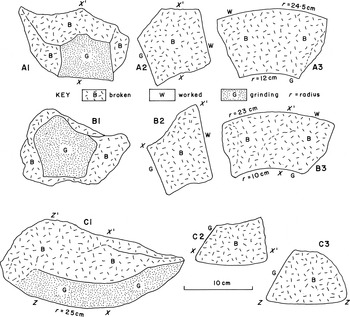
fig. 9 illustrates the three principal fragments of the Silchester mill and the three kinds of surface they are considered to display. The broken and weathered surfaces are irregular, but with projecting features, including many edges and corners, that are slightly rounded and softened. The worked surfaces are regularly curved, comparatively smooth and with local traces of the pecking technique used to finally shape the mill. The parts interpreted as grinding surfaces are also regularly curved but the smoothest of all.
The form of the Silchester mill. A – Upper stone, context 9892: 1, internal view showing grinding surface; 2, radiaxial section (presumed top upward); 3, transverse section viewed from above. B – Upper stone, context 9084: 1, internal view showing grinding surface; 2, radiaxial section (presumed top upward); 3, transverse section viewed from above. C – Lower stone, context 9892: 1, axial view looking downward; 2 and 3, radiaxial sections (top upward).

What is interpreted as the upper stone (catillus) of the mill is represented by two similar fragments, one from each context ( fig. 9.A1–3, B1–3); the smaller fragment from context 9892 is not illustrated but, like the larger ones, displays a small area of grinding surface. An overall diameter of not less than c. 500 mm is indicated by the curvature of the surviving worked surfaces, but the fragments are too small to suggest the precise form of the upper stone. The radiaxial sections ( fig. 9.A2, B2) are plausibly oriented in the illustration as if they came from a broadly hourglass-shaped catillus, the commonest Roman form, with a conical or bell-shaped lower part that tapered in thickness downwards and outwards over the stationary and more massive lower stone.
The later context 9892 also yielded a fragment thought to be from the lower stone (meta). This shows a narrow portion of a grinding surface with a maximum diameter of c. 500 mm, suggesting that it came from the lower part of this element of the mill ( fig. 9.C1–3). Except for the under surface, it is more weathered than the other fragments. The under surface, however, is smoothly convex and fresh-looking, as if the lump, positioned upside-down, had been used secondarily for rubbing or sharpening.
PETROGRAPHY
The Silchester mill was manufactured from a rock that can be assigned to the broad class of alkali-rich basic igneous rocks, which range in texture from fine to very coarse grained. These differ from the normal calc-alkaline basic rocks, which include the common basalts and gabbros, not in terms of their silica content, but in being relatively rich in the alkalis sodium and potassium. Mineralogically, they are made up of feldspathoids as well as feldspars (aluminosilicates), together with combinations of the ferromagnesian pyroxenes (commonly soda-rich) and olivine. In any bulk, these alkali-rich basic rocks are associated with regions where the Earth's crust has experienced significant, deep, tensional rupture on a large scale, such as the Rhineland Graben, the Massif Central, and the great African Rift Valley. Volcanicity is strongly expressed in all these regions and the alkali-rich basic rocks found typically are fine-grained lavas, as is the case with the Silchester mill.
The fragments from the mill are indistinguishable in hand-specimen and under the hand-lens. They are mid- to dark grey, tough, highly vesicular, flow-textured lavas with a scattering of visible, large, well-shaped crystals (phenocrysts), mainly of pyroxene. A thin-section cut from a fragment from context 9892 and examined microscopically allowed the rock on mineralogical grounds to be classed as a nepheline tephrite.
Clinopyroxenes occur in four forms. There are scattered, large phenocrysts of very pale, greenish-brownish, zoned augite. Very occasionally, reversed zoning, from a pale green core to a colourless rim, is seen. There are also occasional medium-sized phenocrysts of reversed-zoned augite. A few medium-sized phenocrysts of apple-green aegirine-augite are present, distinguished by their colour and intermediate extinction angle. Within the groundmass, augite is abundant in the form of crowded, brownish-greenish microphenocrysts, commonly zoned, and in rare cases with green cores. The only other phenocrysts seen in thin-section are occasional microphenocrysts of alkali-rich plagioclase feldspar, nepheline (a feldspathoid) and phlogopite (a mica). The dominant groundmass is a felted mixture of feldspar microlites, iron ore (?titanomagnetite) and mainly interstitial nepheline.
GEOCHEMISTRY
A composite sample (CA) formed by combining roughly equal amounts of fresh lava from the three main fragments was analysed — after crushing and grinding — using a Philips PW1480 x-ray fluorescence spectrometer with a dual anode Sc/Mo100kv 3kW x-ray tube, together with a selection of international standards. After calibration of the instrument, major and minor elements were measured on Li24O7 fusion beads and trace elements on pressed powder pellets.
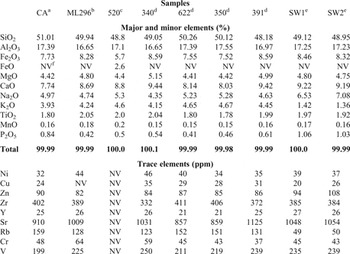
The results, normalised to 100 per cent in the case of major and minor elements, appear in the second column to the right in Table 1. SiO2 forms slightly over half the sample, which is comparatively rich in alkali and alkaline-earth elements. Na2O slightly exceeds K2O and MgO is about half as abundant as CaO. The highest values among the trace elements are shown by strontium and zirconium; vanadium and rubidium are moderately abundant.
Chemical composition of the pompeiian-style mill from silchester compared with rhenish lavas and the mills from 1 poultry (london) and thamesmead (thames estuary)

Notes
a – Silchester mill
b – geological sample, Eifel (Mayen), Williams-Thorpe (1998, table 6)
c – geological sample, Eifel, Duda and Schminke (Reference Duda and Scminke1978, table 11)
d – mills from 1 Poultry (Watson Reference Watson2011, appendix)
e – mills from Thamesmead (Watson Reference Watson2011, appendix)
f – no value reported (only Duda and Schminke express the Fe content in terms of both FeO and Fe2O3)
Of the various rocks used for mills in the Mediterranean region during Roman times, and chemically analysed by Williams-Thorpe,Footnote 89 the Silchester mill most closely resembles the geological sample ML296, considered to be a representive Late Quaternary tephrite from Mayen (Niedermendig) in the eastern Eifel, Germany (Table 1). Except for CaO, which differs by about 12 per cent from the Silchester value, this rock is closely similar in major and minor element composition and element-ratios to the nepheline tephrite under present examination. The two rocks are also closely similar in their trace-element compositions; note, for example, the agreement in the values for vanadium, strontium and zirconium. There is similarly a close agreement in composition with geological sample 520 from Niedermendig (Table 1), analysed by Duda and Schminke,Footnote 90 and quoted for comparison by Williams-Thorpe and Thorpe.Footnote 91
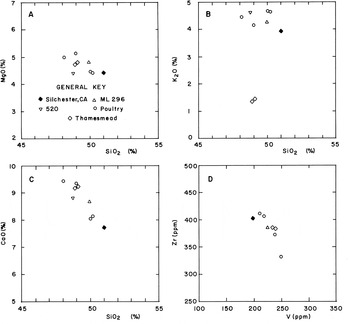
It is worth comparing the Silchester rock with the material used to make the lava hand-mills recovered from 1 Poultry; the fragments interpreted as from Pompeiian-style mills from the site are numbered 137, 144 and 168. This material was also identified petrologically as a nepheline tephrite, and a provenance in the Eifel was suggested.Footnote 92 Mineralogically, the Silchester rock closely resembles these mills, except that neither olivine nor leucite, identified in small amounts at Poultry, were found in the former. Chemical analyses by x-ray fluorescence spectrometry of four Poultry lava mills are reported,Footnote 93 but are not adduced by Williams and Peacock to bolster their petrological interpretation of the provenance, despite Watson's recognition of their close compositional similarity to Eifel rocks. Unfortunately, Watson did not include any of the Pompeiian-style mills among the selection of mills he analysed. Table 1 lists his results (samples 340, 622, 350, 391) and fig. 10 compares the Silchester mill with the Poultry mills and the two Rhenish geological analyses discussed. Although the overall sample is admittedly small, the Silchester mill clearly fits the geochemical trends that are evident, if appearing to lie on their extremities.
Chemical composition of the Silchester mill compared with lavas from the Mayen area of Germany (Duda and Schminke Reference Duda and Scminke1978, rock sample 520; Williams-Thorpe and Thorpe Reference Williams-Thorpe and Thorpe1988, rock sample ML296) and hand-mills from 1 Poultry, London (items 340, 350, 391, 622), and Thamesmead, Thames Estuary (items SW1, SW2) (Watson Reference Watson2011). A – MgO versus SiO2. B – K2O versus SiO2. C – CaO versus SiO2. D – Zr versus V.

Very few mills of any kind from Roman Britain have been chemically analysed. For comparative purposes, WatsonFootnote 94 made two analyses (samples SW1, SW2) of a fragmentary mill(s) excavated from a third-century site on the Thames Estuary at Thamesmead, c. 14 km east of the City of London. The results appear in Table 1 and fig. 10. Chemically, the mill(s) is of an alkali basalt that is clearly different from the Silchester and Poultry rocks; in particular, although the Zr and V values are similar, suggesting some family resemblance, the Na2O/K2O ratios are significantly higher, and another provenance must be sought, perhaps the Miocene lavas of the Eifel, as chemically analysed by Duda and Schminke.Footnote 95
DISCUSSION
The Silchester Pompeiian-style mill, like very many hand-mills from Roman Britain, is made from a nepheline tephrite that falls compositionally within the range of variation of Late Quaternary Rhenish tephrite lavas, exploited in the Mayen area of the Eifel for millstones since antiquity.Footnote 96 Williams and PeacockFootnote 97 are not explicit on the point, but the Pompeiian mills from 1 Poultry in London would seem also to be of this rock. It was previously considered that there was ‘no evidence for its use for British donkey mills’, a conclusion regarded as ‘consistent with the almost total lack of hourglass mill remains in the Mayen area’.Footnote 98
The Pompeiian or similar mills found in Britain at Hamworthy, Corfe Mullen and Princes Street (London) have also been the subject of critical — ideally petrological plus chemical — scientific examination along with a comprehensive range of millstone source rocks.Footnote 99 The rock of the Hamworthy mill, which need not be of Roman date, is a trachyandesite with a likely source area in either Sardinia or Italy. The date of the Corfe Mullen mill is also insecure, but is likely to be Roman on the basis of the archaeological character of the area where it was found. An alkali basalt was used in this case, as also for the third-century mill fragments from Thamesmead (see above). Williams-Thorpe and Thorpe point out that similar rocks are known from many parts of Europe, including the Eifel and the Volvic quarries in the Chaîne des Puys of central France.Footnote 100 The mill found at Princes Street, London, came from a secure Roman context of the late first century a.d. A sample of the rock was identified as an aphyric trachyandesite; it had been previously assigned to Volvic on the basis of its petrography,Footnote 101 a provenance supported by the later chemical analysis. A scientific account of the Clyro mill has yet to be published.
Because the number from Roman Britain is small, and in some cases there is uncertainty over dating, any further commentary on these Pompeiian-style mills must be regarded with caution. What is perhaps needed to strengthen understanding is, on the one hand, a thorough reassessment of collections of millstone fragments from already excavated sites (especially forts and towns) and, on the other, a rigorous scrutiny of even the most fragmentary millstones at sites excavated in the future. The general background is the vigorous trade in millstones from diverse, mainly volcanic sources carried out in the Mediterranean area and North-West Europe in Roman times.Footnote 102 This trade reached early and voluminously into Britain, perhaps on the backs of the military or even as part of the normal equipment of a legion or similar large body of troops, but tapered off somewhat later in the Roman period as the geological potential of the country became better known, and temporarily neglected or forgotten local or regional, indigenous sources were exploited again.Footnote 103 Sources in the Eifel, with access to the navigable Rhine, and perhaps the Mosel and its tributary the Kyll, were the most favourably placed to supply lava millstones to Britain, although Volvic, with its regional links to the wide-reaching samian trade, could also have been important.Footnote 104 Other sources could also be significant, as the reputedly sandstone mill at Clyro suggests.Footnote 105 The latter also clearly introduces the role of the military, in this case pre-Flavian campaigns in the Welsh Borders.Footnote 106 Given the also pre-Flavian date of the oldest context from which fragments were recovered, and the growing evidence for early military activity in the town,Footnote 107 it is not unreasonable to speculate that the Silchester mill may also have been a military introduction. A substantial body of soldiery would have called for a considerable and continuous supply of flour; ‘donkey’ mills rather than hand-mills would have met this need most effectively.
Taken at face value, the very limited sample of Pompeiian-style mills so far known from Roman Britain provokes a number of questions that could with advantage be further researched. Are such mills in Britain all of early Roman (including pre-Flavian) date? To what extent were such mills linked to military activities? Were they introduced as part of the establishment or expansion of early towns? Where were they sourced?
ACKNOWLEDGEMENTS
I am indebted to Professor Michael Fulford (University of Reading) for the invitation to study the Silchester mill and for helpful comments and, with Amanda Clarke, for information on the contexts, and to Franz Street (University of Reading) for the chemical analysis. Jenny Hall and Julian Hill of the Museum of London generously allowed me access to the report on the Poultry excavations prior to its publication. Richard Brewer (Amgueddfa Cymru – National Museum Wales) kindly provided information on the Clyro mill.