Introduction
Since the terrorist attacks of 11 September 2001, emergency department staff across North America have become more aware of the need to be prepared to cope with events involving chemical, biological, radiological, or nuclear (CBRN) contaminants in mass-casualty scenarios or in situations involving smaller numbers of victims. Such an occurrence could be due to a terrorist event or an accidental release of toxic chemicals, radioactive substances, or biological agents unrelated to terrorist activity.
In the last quarter of 2001, a study was performed to review the risks and characteristics of these events and to assess the readiness of Canadian emergency departments to respond.Reference Kollek1 Readiness was assessed using a survey, the analysis of which demonstrated a deficiency in readiness—most notably in the availability of appropriate equipment, antidotal therapy, and decontamination capability. There also were significant deficiencies in the ability to respond to a major biological or nuclear event. This is consistent with studies performed in other countries.Reference Anathallee, Curphey and Beeching2–Reference Green5
Since then, the Canadian Federal and Provincial governments have invested time, money, and efforts to remedy these deficiencies in readiness. In 2007, the Center for Excellence in Emergency Preparedness (CEEP) and the Disaster Committee of the Canadian Association of Emergency Physicians (CAEP) repeated the earlier study to determine if progress has been made. The purpose of this Hospital Emergency Readiness Overview (HERO) study is to assess the readiness of emergency departments in Canada at the organizational and administrative levels. The original questionnaire was modified with input from Federal and Provincial authorities as well as experienced emergency physicians, keeping in mind the limitations of the first study.
Methods
This survey incorporated the questions from the original study,Reference Kollek1 as well as new questions suggested by representatives from the Ministry of Health and Long Term Care of the Ontario Emergency Management Unit, the Public Health Agency of Canada and emergency physicians with experience in disaster management. The questionnaire consisted of multiple-choice questions divided into sections by demographics of the department, risk assessment, general disaster readiness, readiness for bio-events, ability to decontaminate, radiation readiness, and the availability of antidotes.
The CAEP e-mailed the link to an online, web-based survey, as well as a brief introductory letter explaining the purpose of the study to 315 emergency departments across Canada using their e-mail list of Chiefs of Emergency or key contact persons. Two separate, subsequent reminders to complete the survey were sent via the CAEP, and the online survey link was included with each reminder. One additional reminder, including the survey link, was sent using the e-mail list of the North York Emergency Department Administrators Conference.
The emergency department chief or physician designate was asked to complete the survey and was instructed to ask other hospital personnel for assistance with information when needed. Results were pooled for confidentiality so that data element responses could not be ascribed to an individual hospital. Postal code identifiers were used to ensure that no duplicate entries were analyzed and to determine the distribution of responses by province. Results were collected online and analyzed using Survey Monkey© (California, USA) software. The statistical processing included univariate statistical tests as appropriate for the data.
This study was approved by the Research Ethics Board of McMaster University.
Results
Thirty-eight responses were received. Of these, four were duplicate or largely incomplete, leaving 34 (11%) responses for analysis.
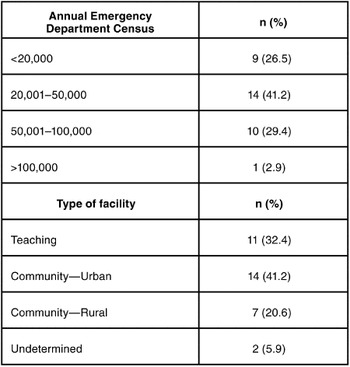
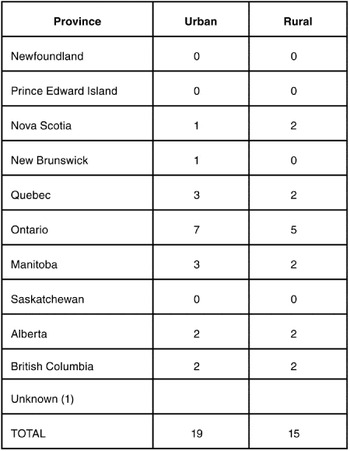
Characteristics of the responding hospitals are in Table 1. The majority had an emergency department census between 20,000 and 100,000 patients/year. All provinces were represented (Table 2) except Newfoundland, Prince Edward Island, and Saskatchewan, and there was a slight majority of urban vs. rural departments.
Characteristics of 34 hospitals that participated in the Hospital Emergency Readiness Overview (HERO) study

Representation of hospitals from across Canada that participated in the Hospital Emergency Readiness Overview (HERO) study

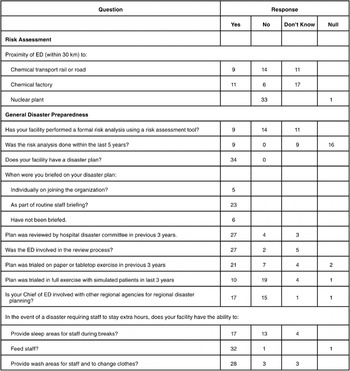
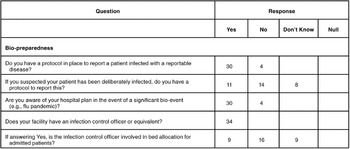
The elements of risk assessment, general disaster preparedness, bio-event preparedness, availability of equipment, and antidote availability in Canadian emergency departments are described in Tables 3–6.
Disaster preparedness in general (ED = emergency department)

Bio-preparedness

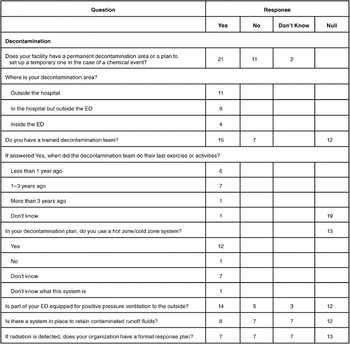
Decontamination preparedness (ED = emergency department)

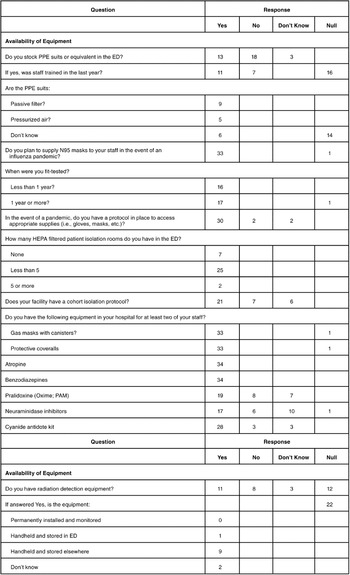
Preparedness of equipment and supplies in case of disaster

All hospitals in this survey and the one performed in 2001 reported that they had a disaster response plan.Reference Kollek1 In the present study, only one-quarter of the hospitals had performed a risk analysis, and of those, more than one-half had not revisited it within the last five years.
The disaster response plan was reviewed within the last three years in 80% of respondents, and 81% in the 2001 study. The emergency department was nearly always involved in the review and, in response to a question not asked in the original survey, only about one-half the responding facilities in this study had coordinated their planning with other organizations. Of respondents to this survey, 17.6% had not been briefed on the disaster response plan for their emergency department.
Sixty-five percent of respondents had performed a tabletop disaster exercise, and 30% a full disaster exercise. The original survey had highlighted that in the past three years, only 40% of hospitals had performed a paper trial (tabletop exercise), and only 4% had performed a full exercise with simulated patients.
Eighty-eight percent of facilities had a reporting protocol for bio-events (increased from 37% in 2001). This marked improvement may reflect Canadian hospitals having experienced the severe acute respiratory syndrome (SARS) crisis. Since establishing such a protocol costs nothing to the individual hospitals, this deficiency is easier to remedy than others.
A new question in this survey asked about the availability of N95 masks, an item that received high profile during the SARS crisis. All of the respondents made these available to their staff, and approximately one-half of the staff had been fit-tested within the past year. A total of 88% had access to supplies in an emergency, and 74% had HEPA-filtered rooms in their respective emergency departments.
Despite the fact that 58% of hospitals recognized that their facility was proximal to a potential chemical spill site, only 38% of the current respondents stocked personal protective equipment (PPE) in the emergency department, and nearly 15% of those who stock the equipment have not trained within the past year. Only 62% have a chemical decontamination capacity or team and of those, only 38% had a system to contain contaminated runoff fluids.
Only 32% of respondents confirmed having radiation detection equipment, and only 21% had a formal response plan for radiation incidents.
Discussion
The results of the HERO survey indicate that there are important deficits in readiness of the emergency departments that responded, and that no national standards for disaster readiness are reflected by the data.
The concerns about the lack of readiness are exacerbated by the lack of coordination and standards across Canada. The diversity of responses denotes a haphazard response pattern with variability between provinces. Some Federal programs, such as the “METER” course for radiation preparedness, only have been offered a few times in select locations, and have been discontinued (hopefully only temporarily). Some provincial programs have been delivered without coordination between provinces, creating a possible obstacle for future mutual aid, as protocols and equipment might not be interoperable. As such, while individual hospitals may have improved their response capability, it is difficult to speak of “national” healthcare disaster readiness with any degree of accuracy or evidence.
There are a limited number of reports in the literature on the preparedness of emergency departments to handle these events. Anathalllee et al recently surveyed 257 hospitals in the United Kingdom to assess readiness to manage patients with infectious diseases, and were able to obtain complete data in 79%.Reference Anathallee, Curphey and Beeching2 Only 24% had isolation facilities in the emergency department, as opposed to 80% in the HERO study. They also determined if the ventilation system for the isolation rooms was independent, and this question should be added to future surveys in Canada.
Keim et al found poor hospital preparedness for chemical terrorism in the United States. There was no significant difference in preparedness detected in surveys conducted in 1996 and 2000 despite investment in resources.Reference Keim, Pesik and Twum-Danso3
Greenberg et al had an 88.5% response rate to a 38-question survey on biological or chemical terrorism preparedness.Reference Greenberg, Jurgens and Gracely4 Deficiencies in physician training, antidote stocking, interagency agreements, and decontamination facilities were reported. Greene reported on a review of 34 trauma centers in the US, that indicated profound deficiencies in surge capacities.Reference Green5
In the 2001 study in Canada, only 6% had decontamination equipment and 18% had a plan, whereas in 2007, 38% had decontamination equipment and 61% had a disaster response plan. With the exception of cyanide, there also was a change in the availability of chemical antidotes located on site or that were promptly available (13–34% in 2001 to 100% today). Only 82% of respondents had a cyanide antidote kit available, but this was increased from 56% in the prior study.
While there presently is no validated tool to assess overall hospital disaster preparedness,Reference Kaji, Langford and Lewis6–Reference Burstein8 the questions posed in this study represent a comprehensive tool to measure emergency preparedness in Canadian emergency departments at an organizational level. This study should be repeated with the resources and authority of a federal agency such as the Public Health Agency of Canada or the Federal Ministry of Health. Additionally, tools should be developed to assess the level of knowledge and preparation of emergency department staff to cope with biological, chemical, and radiation events.
There is no standardized or formal Provincial, Territorial, or Federal assessment of institutional healthcare readiness. Nor has Accreditation Canada applied any rigid standards or assessment tools to review readiness. Periodic reviews of the disaster readiness of emergency departments should be performed, using a standardized tool, such as this survey. Recognizing that emergency-department readiness is meaningless in the context of a hospital that is not prepared, a formal hospital readiness assessment tool should be deployed. Similar to the US process, it should be a regulatory requirement of hospitals and emergency departments to submit their readiness data to a central, federal authority.
Limitations
A limitation of the present study is the low response rate, with only 34 emergency departments across Canada responding. There were 59 responses in the prior study, which was performed shortly after the 11 September terrorist attacks, and disaster preparedness was a topical issue.Reference Kollek1 The lower response rate in this study may reflect: (1) less immediacy to the problem as six years had passed since the 11 September attacks; (2) “survey fatigue” as the use of surveys for studies has grown considerably; or (3) the time constraints of emergency department chiefs, considering that participation in this study was voluntary without remuneration for the time spent in gathering the information. However, considering the importance of disaster readiness and that this is in the domain of expertise in emergency medicine, the low level of engagement, particularly in the larger urban centers, is troubling.
Another limitation is that it is not possible to provide a before and after comparison of specific centers that responded in the first study to those that responded in the second study, because the results in each study were pooled to maintain the confidentiality of data from individual institutions. The small sample size precludes a statistical analysis of before and after data, however, the data points enumerated in the questionnaire and the format of the questionnaire will provide a good basis for future research, and also will help Canadian emergency departments examine their current level of preparedness.
Conclusions
The HERO study demonstrates that, despite improvements, there remained gaps in Canadian healthcare facility readiness for disasters, specifically contamination events. It also highlights the lack of any standardized assessment of healthcare facility CBRN readiness. Healthcare authorities should institute a formal readiness assessment tool incorporating the questions described in the present study that would allow them to identify deficiencies.
Abbreviations:
CAEP = Canadian Association of Emergency Physicians
CBRN = chemical, biological, radiological, or nuclear
HERO = Hospital Emergency Readiness Overview
SARS = severe acute respiratory syndrome