“Hope is an axe you break down doors with in an emergency …
Hope just means another world is possible, not promised, not guaranteed”
(Solnit, Reference Solnit2004, p. 5).INTRODUCTION
Despite difficulties gaining consensus about a definition of hope, it is widely recognized to be an essential aspect of life, and vital to the way people experience and respond to serious illness (Chi, Reference Chi2007; Eliott & Olver, Reference Eliott and Olver2007; Miller, Reference Miller2007; Clayton et al., Reference Clayton, Hancock and Parker2008; McClement & Chochinov, Reference McClement and Chochinov2008; Duggleby et al., Reference Duggleby, Holtslander and Kylma2010; Berendes et al., Reference Berendes, Keefe and Somers2010). Hope is a complex, multi-dimensional, and dynamic phenomenon that is influenced by many factors, including healthcare providers (Chi, Reference Chi2007; Duggleby et al., Reference Duggleby, Holtslander and Kylma2010). Sensitivity to the importance of hope and the ability to influence hope has led to concerns among healthcare providers about communication, particularly the giving of “bad news” (Clayton et al., Reference Clayton, Butow and Arnold2005). One specific concern relates to the possibility of diminishing hope when discussing bad news, such as a diagnosis of incurable cancer, or planning for end-of-life. Worry about disrupting hope has been cited as one reason that such conversations are avoided (Field & Copp, Reference Field and Copp1999; Gordon & Daughtery, Reference Gordon and Daugherty2003; Daughtery, Reference Daugherty2004; Schulman-Green et al., Reference Schulman-Green, McCorkle and Cherlin2005; Clayton et al., Reference Clayton, Hancock and Parker2008; Curtis et al., Reference Curtis, Engelberg and Young2008; McClement & Chochinov, Reference McClement and Chochinov2008). There is agreement, however, that clear, honest communication is both desirable and necessary in supporting a trusting relationship among patient, family, and healthcare professional as well as future planning (Clayton et al., Reference Clayton, Butow and Arnold2005, Reference Clayton, Hancock and Parker2008; Apatira et al., Reference Apatira, Boyd and Malvar2008). Therefore, there can be tension between the idea of supporting hope and communicating honestly about difficult topics such as end-of-life issues (Clayton et al., Reference Clayton, Butow and Arnold2005; Schulman-Green et al., Reference Schulman-Green, McCorkle and Cherlin2005). This can negatively influence practice, for example, by delaying appropriate referral to palliative care (Daugherty, Reference Daugherty2004).
Hope is predominantly viewed as a “good;” something that should be nurtured and supported by healthcare providers in their day-to-day interactions with patients and families. However, especially in the context of palliative care, clinicians may view hope negatively if it does not agree with medical reality (Whitney et al., Reference Whitney, McCullough, Fruge, McGuire and Volk2008). This hope has been called “false,” “unrealistic,” “an illusion,” or “inappropriate” (Sanatani et al., Reference Sanatani, Schreier and Stitt2008; Renz et al., Reference Renz, Koeberle and Cerny2009). False hope is viewed as maladaptive; taking energy that should be placed elsewhere, compromising decision making, and setting the stage for negative emotional responses such as depression (Links & Kramer, Reference Links and Kramer1994; Clayton et al., Reference Clayton, Butow and Arnold2005). It is taken as evidence of denial or unrealistic expectations (Clayton et al., Reference Clayton, Butow and Arnold2005; Zimmermann, Reference Zimmermann2007) and, from the perspective of healthcare providers, must be abandoned as disease progresses (Perakyla, Reference Perakyla1991; Links & Kramer, Reference Links and Kramer1994). The concept of false hope creates worry and anxiety for healthcare providers, as there is a moral imperative within the end-of-life literature to support only adaptive or “genuine” hope that is aligned with what the healthcare provider believes is realistic (Clayton et al., Reference Clayton, Butow and Arnold2005, Reference Clayton, Hancock and Parker2008; Ngo–Metzger et al., Reference Ngo-Metzger, August and Srinivasan2008; Renz et al., Reference Renz, Koeberle and Cerny2009). Finding the balance between communicating with honesty and supporting hope may be difficult (Nekolaichuk & Bruera, Reference Nekolaichuk and Bruera1998; Gordon & Daughtery, Reference Gordon and Daugherty2003). The clinical tensions are exemplified in the following question: “How does one balance concern for nurturing hope, while honestly communicating bad news, and do this in a way that supports only those hopes that are realistically aligned with what the healthcare provider believes is possible, such that false hope is avoided?” Given the complexity of these tensions and the vulnerability inherent in palliative care it is not surprising that relational difficulties arise; however, there is little research available to guide practice.
This article reports on the clinically important theme of hope from a study focused on advance care planning (ACP) in the context of a diagnosis of advanced lung cancer. Facing this traumatic diagnosis, patients and family members described multifaceted hopes and used them to guide their actions and decisions. Within the resulting flurry of intensive life and death decisions, hope emerged as a significant feature of their experience. The nature of hope in relation to a terminal diagnosis will be discussed and the notion of “false” or “unrealistic” hope will be challenged. Although there is much theoretical discussion about the problem of “false” hope, there is little research that explores how such hope actually influences patients and their families. The findings of this study address that gap. Recommendations for practice will be offered.
BACKGROUND AND SELECTED LITERATURE
Of patients who are newly diagnosed with lung cancer, 85% will have advanced disease and require immediate palliative care (Altekruse et al., Reference Altekruse, Kosary and Krapcho2010). Patients with advanced disease at diagnosis often face a rapid decline in health and functional status, an abbreviated time frame for decision making, and early death. Median survival estimates for persons diagnosed with advanced non-small cell lung cancer range from 5.8 to 7.3 months (Breathnach et al., Reference Breathnach, Freidlin and Conley2001). It is a situation that some healthcare professionals might describe as hopeless. What might hope look like for these families who are facing a sudden terminal illness?
Hope in the palliative phase of cancer is complex, multidimensional, dynamic, and central to the experience of meaningful life and dignified death (Benzein et al., Reference Benzein, Norberg and Saveman2001). The lived experience of hope may seem somewhat paradoxical, as widely disparate hopes may be held at the same time (Nekolaichuk & Bruera, Reference Nekolaichuk and Bruera2004). For example, hope for a cure may be held simultaneously with awareness of living with terminal illness (Benzein et al., Reference Benzein, Norberg and Saveman2001; see also Kirk et al., Reference Kirk, Kirk and Kristjanson2004; Clayton et al., Reference Clayton, Hancock and Parker2008). Therefore, hope in this context embraces both life and death, and may transcend medical prognoses (Benzein et al., Reference Benzein, Norberg and Saveman2001; Eliott & Olver, Reference Eliott and Olver2002; Clayton et al., Reference Clayton, Hancock and Parker2008; Sanatani et al., Reference Sanatani, Schreier and Stitt2008). Although it is clear that people can hope for a cure while they are dying, we have little evidence of whether such hope is problematic.
Hope in palliative care is a changing experience of both positive and negative possibilities that are identified within a context of uncertainty and is characterized by resiliency (Eliott & Olver, Reference Eliott and Olver2007; Penson et al., Reference Penson, Gu and Harris2007; Duggleby et al., Reference Duggleby, Holtslander and Kylma2010). While acknowledging uncertainty, hope involves a consistent orientation to the positive or desired future in alignment with one's values, and relies heavily on imagination (Simpson, Reference Simpson2004). Affirming relationships are a key aspect of hope (Benzein et al., Reference Benzein, Norberg and Saveman2001; Chi, Reference Chi2007) and conversations about hope are experienced as a healing counterbalance to suffering (Benzein & Saveman, Reference Benzein and Saveman2008). Even though particular hopes may change over time, the level of hope experienced by cancer patients does not diminish as the disease progresses and is significantly related to coping (Chi, Reference Chi2007; Reynolds, Reference Reynolds2008; Sanatani et al., Reference Sanatani, Schreier and Stitt2008). High hope is associated with enhanced coping and psycho-spiritual well-being (Eliott & Olver, Reference Eliott and Olver2002; Lin & Bauer-Wu, Reference Lin and Bauer-Wu2003; McClement & Chochinov, Reference McClement and Chochinov2008).
Eliott and Olver (Reference Eliott and Olver2007) examined hope and hoping in the talk of dying patients. They found that hope-as-a-noun (i.e., something one holds, as in “there is no hope”) positioned the patient as a relatively powerless recipient of something objective bestowed by another. In contrast, hope-as-a-verb (i.e., hoping) positioned the patient as actively and positively engaged in life. Hope is identified as both a resource and a motivator to action that may be disrupted when there is a demand to talk about end-of-life issues. “Hope functions to value both the desired object, and the one desiring it” (Elliott & Oliver, Reference Eliott and Olver2007, p. 145). It also facilitates interpersonal connection and is nurtured in relationship (see also Penson et al., Reference Penson, Gu and Harris2007; Reynolds, Reference Reynolds2008). In summary, there is consensus that hopes supports both living well and dying well, but concern remains, particularly among healthcare providers, about how to balance respect for hope and respect for truth telling. Although there is discussion about advance care planning having the potential to disrupt hope, the question remains: “How do individuals hold the ideas of cure and terminal illness concurrently and, at the same time, actively plan for death?”
THE STUDY
This article reports on one facet of a study focused on ACP in the context of advanced lung cancer – the theme of hope. The study was designed to explore the process of ACP and to evaluate the usefulness of a promising patient-centered advance care planning tool (PC-ACP Interview) developed by the Respecting Choices® program in Wisconsin (Briggs, Reference Briggs2003; Briggs et al., Reference Briggs, Kirchhoff and Hammes2004). This study was approved by the University Research Ethics Board.
Sample
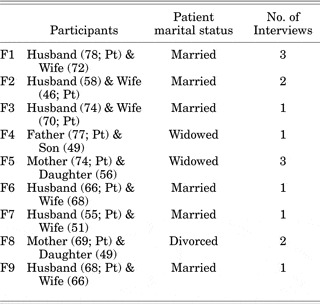
The 18 participants comprised patients diagnosed with advanced lung cancer and their significant other or loved one, recruited from within 1.5 hours' drive of the study site (Table 1). The significant other was defined as someone who was influential in healthcare decision making, such as a partner or a caregiver, and who might act as proxy decision maker. All dyads spoke and read English.
Sample description

Data Collection
The PC-ACP Interview is a structured interview with a consenting patient and a chosen significant other, delivered by a trained facilitator and lasting 1 to 1.5 hours. It is an opportunity for patients and family members to understand and think about the life-sustaining treatment choices the patient would want if he/she became unable to speak for him or herself. The intent of the interview is to explore patients' understanding of their health problem, introduce new information as needed, and promote dialogue. First, participants' experiences and beliefs about the illness, treatment, what made life meaningful, and past family deaths were explored; then they were led through a series of situation-specific scenarios in which preferences for end-of-life care were elicited (see Briggs, Reference Briggs2003, for a more detailed description of the interview components). One dyad chose to stop the interview prior to the discussion of the specific scenarios and discuss this privately, as the patient's wife was feeling overwhelmed. This dyad was at the earliest point in the illness process compared to the others and was waiting for treatment to begin. During the first part of the ACP interview, one of the multiple questions focused on what the hopes were for treatment.
Where possible, follow-up interviews with a different researcher were conducted 3 and then 6 months after the ACP interview, which usually occurred several months after diagnosis. Follow-up did not happen with all families for various reasons, the most common being illness progression. In total, there were 15 interviews (Table 1). All of the interviews were audio-recorded, and transcribed verbatim. Data also included detailed field notes.
Analysis
Constant comparative analysis proceeded concurrently with data collection (Glaser & Strauss, Reference Glaser and Strauss1967). Two researchers with expertise in qualitative research independently read and reread the transcripts, identifying meaning units or themes. The codes evolved through the iterative process of constant comparison within and across transcripts and discussion between the researchers. A coding schema was developed by consensus and NVivoQRS (version 8) was used to manage the data. Constant comparative analysis continued with the codes as data.
FINDINGS: HOPE IN THE CONTEXT OF END-OF-LIFE PLANNING
Hope was Multi-faceted
All of the dyads except one spontaneously identified hope of a cure in relation to their current plan of care; however, there was great variability in how tightly this hope was held and its place in the range of hopes that were expressed. For one family, the hope for a cure was their first and “best hope.” This best hope coexisted with “our second best hope” of more time together offered by treatment that would “give us, who knows how long…months, years, whatever.” A second dyad held the hope for a cure much more tightly and even more prominently. For this couple, it seemed that “complete recovery” was the only possible outcome — hope meant a cure. However, as the interviews progressed, smaller hopes were quietly raised such as the availability of more treatment if necessary.
For other dyads, the hope for a cure was slipped in between other more dominant hopes and was balanced by qualifying statements about the likelihood of this occurring. Hope was about possibilities, not expectations. For example, one participant hoped the treatment would “destroy the tumor” or “reduce its size.” However, she expected that “it [the cancer] will eventually…work its course” since it was an “incurable cancer.”
Only one dyad did not express the hope for cure; instead, this couple emphasized the importance of acceptance and of comfort. This dyad differed from the others because they had completed treatment, which had been unsuccessful in controlling the cancer. The husband in this dyad spoke with an unstated assumption that his wife would be dying soon, saying things such as “you [wife] are bound to get down with having that … You got to leave your mom and your family behind you … It is hard on a person.” Their major hope related to pain management: “The only thing I just hope is that she gets rid of some of this pain … Not all I say, but she has too much pain right now. It is just not good.” Even here there was a balancing of hope with what might be a realistic expectation.
All of the dyads hoped for more good time together and most stated this in a time frame of years. If complete remission or cure were not possible, then treatment might offer “five years normal more.” While most families focused on conventional treatment, one family considered experimental treatments as providing “some good hope” where they could also contribute to “further the research of cancer.”
The emphasis was on hope for a good time rather than simply more time. Each of the ill family members spoke eloquently about their desire to re-engage in simple day-to-day relationships and activities that were taken for granted prior to the cancer. Some of the things they hoped for included: to be well enough to drive one's wife around; to host friends and family at home with a beautiful meal; to “play a round of golf, eight or nine holes with my family;” to contribute to family finances through work; and, to be around to help children grow, get married, and have children of their own. There were no elaborate dreams of activities or accomplishments related to things undone. As one family member said, “we are not very exciting people,” we just want to have a “normal life.” Ill family members hoped that treatment would enable them to live well, yet it was often the rigors of treatment and related side-effects that stood in the way of engaging in life as they desired, not the disease. However, most of the dyads avoided focusing on this paradox and instead minimized current treatment-related difficulties. Hope for a cure acted to reinforce commitment to challenging treatment regimens.
Whereas ill family members hoped to re-engage in the relational intimacies of daily life, their well family members responded by “shoring” them up to soften the suffering of loss. Some examples of this relational work were: in one family where the wife was grieving her inability to garden, her husband repeatedly assured her that it was now his turn to do the gardening as she had done it for so many years. In another family where the husband enjoyed helping his wife with the “heavy” household chores such as vacuuming, his wife reassured him by stating the apartment was so small they only ended up on top of each other when they worked together.
It can be seen that hope was complex and multifaceted. Best and second best hopes coexisted and took center stage in different ways at different times. Particular hopes were held loosely or tightly, reflecting both the importance of the hope and the dyad's commitment to the hope. From the family perspective, a hope was a desired possibility that was more or less likely, and took effort to maintain.
Hope for a Cure was a Well-Considered Possibility
It became evident that each dyad's hopes “made sense” given an understanding of the context in which they were deeply embedded. This context included knowledge of the illness, experience with the illness and treatment, past experience with serious illness, personal beliefs, and family dynamics. Each dyad acknowledged that they had been told the cancer was terminal and/or incurable. However, although not explicitly stated, it became apparent that they did not believe this was an absolute reality for them. Therefore, most dyads hoped for a cure. Some dyads acknowledged the medical perspective, commenting that “others might see things differently” than they did.
The dyad that was most committed to hope for a cure was initially unable to identify any other hopes. This was the dyad for whom healthcare providers might be most concerned about the problematic nature of “false” or “irrational” hope. However, the family was able to clearly articulate how they had arrived at their level of commitment to the hope for cure despite hearing the cancer was not curable. These are the critical elements of their story: the ill family member had been previously cured of a different life-threatening cancer many years earlier; her mother had been diagnosed with terminal cancer and denied treatment because of the advanced disease, yet had lived years longer than expected because of her positive outlook on life; her brother had been diagnosed with the same cancer that she had, but his treatments had been delayed by several months and, as a result, he died. The ill woman experienced cure once, was committed to maintaining a positive attitude, and, with the intervention of her husband, had received treatment quickly; therefore, from their perspective, recovery from this bout with cancer was not only possible but probable.
Hope was Resilient and Persistent
Eight dyads participated in explicit discussion of multiple, specific end-of-life scenarios that had the potential to disrupt hope. One of the scenarios pertained to treatment should their heart or breathing stop. The patients (supported by their family members) chose the option of either “do nothing” or “do nothing unless my doctor thinks there is a reasonable chance of recovery.”
We asked about participants' experience at the end of the ACP interview and in subsequent follow-up interviews. Just as hope was resilient in the face of dire medical prognoses, it was unshaken by the explicit discussion of potential end-of-life experiences. The families told us that this was because the scenarios were approached as hypothetical possibilities in the context of “hoping for the best and planning for the worst.” As one participant commented: “It sort of opened the door for this conversation … First we will see how your treatment goes, then we will see what is happening, then we will start talking about that type of stuff.” The dyads found the ACP interview helpful, important, and, although very emotional, most found it easier than they anticipated. These individuals were able to sustain multiple hopes, including hope for a cure, at the same time as choosing the “do not resuscitate” option should their heart or breathing stop.
Limitations of the Study
Recruitment was challenging for this study, with many potential participants declining to participate. The sample size was small and without ethnic diversity. Follow-up interviews were incomplete.
DISCUSSION
Although the finding that hope for persons with advanced cancer and their family members is multifaceted and may include hope for a cure is not new (Benzein et al., Reference Benzein, Norberg and Saveman2001; Clayton et al., Reference Clayton, Hancock and Parker2008; Sanatani et al., Reference Sanatani, Schreier and Stitt2008), this study contributes to a more nuanced understanding of how individuals maintain hope in the context of ACP. Hope for a cure was well considered and consistent with values, beliefs, and past experiences. This “false” hope was not evidence of denial. It was apparent that the dyads actively chose to hope for a cure despite acknowledging direct, contradictory information from healthcare providers. They were aware that their beliefs differed significantly from the medical perspective and most held the hope for a cure tentatively. Their hope for a cure coexisted with a variety of other hopes and was marked by uncertainty. This differs from Kirk and colleagues (Reference Kirk, Kirk and Kristjanson2004) who found a compartmentalization of hope and a terminal prognosis rather than integrated awareness. As with other hopes, hope for a cure served to keep the dyads actively and positively engaged in life. It did not interfere with planning for end-of-life. This “false” hope did not constrain the dyads from considering the possibility of dying or choosing to forego potentially life-extending treatment such as cardiopulmonary resuscitation. Further, ACP was not problematic for hope. Explicit communication about health problems that were likely to occur at end-of-life did not challenge hope, even hope for a cure. Unlike the findings of Eliott and Olver (Reference Eliott and Olver2007) in which ACP was viewed as potentially disrupting hope, in actuality, hope was not affected by ACP and proved resilient and persistent over time. For these participants, sustaining hope was not in conflict with the provision and discussion of honest but difficult information (see also Garrard & Wrigley, Reference Garrard and Wrigley2009). Ideal timing for ACP is theoretically viewed as later in the illness experience (Barnes et al., Reference Barnes, Jones and Tookman2007), which is difficult to attain in the situation of advanced lung cancer in which life expectancy can be limited. Our findings lend support to the idea that patients and family members need time to adjust to the diagnosis before engaging in explicit discussion of end-of-life.
The findings of this study call into question the clinical utility of “false” hope. This is supported by Kwon (Reference Kwon2002) who found that high hope, regardless of whether it had a “genuine” or “unrealistic” foundation, is consistently associated with positive adjustment. He asserted, “given that the false hope construct portrays individuals pursuing unrealistic goals with negative consequences, the evidence continues to argue against such a construct” (Kwon, Reference Kwon2002 p. 218; see also Snyder et al., Reference Snyder, Rand and King2002). Perhaps there is “no such thing as false hope, there is just hope” (Penson et al., Reference Penson, Gu and Harris2007, p. 1109).
RECOMMENDATIONS FOR PRACTICE
Clinicians have a significant role to play in supporting and nurturing hope as well as assisting families to prepare for death in the context of advanced cancer (Chi, Reference Chi2007; Miller, Reference Miller2007). The findings support the importance of offering clear, honest communication (Clayton et al., Reference Clayton, Butow and Arnold2005, Reference Clayton, Hancock and Parker2008; Apatira et al., Reference Apatira, Boyd and Malvar2008) and show that this can be done without diminishing hope. However, there is considerable controversy in the literature regarding how we should respond to hope when it is out of alignment with what is deemed medically realistic (Clayton et al., Reference Clayton, Hancock and Parker2008). The question remains, should we intervene with the aim of disrupting “false” hope and encouraging more realistic, medically achievable hope as is so often recommended (Perakyla, Reference Perakyla1991; Links & Kramer, Reference Links and Kramer1994; Gordon & Daughtery, Reference Gordon and Daugherty2003; Renz et al., Reference Renz, Koeberle and Cerny2009)? The findings of this small study suggest that it is more important to assess how hope acts than where it comes from (see also Penson et al., Reference Penson, Gu and Harris2007; Clayton et al., Reference Clayton, Hancock and Parker2008). There is no need to disrupt hope if it acts to support the patient and family and does not interfere with important endeavors such as ACP. We are called to listen deeply (Frank, Reference Frank1998), base communication on individualized assessment (Innes & Payne, Reference Innes and Payne2009), follow patient cues and engage in conversations over time (Barnes et al., Reference Barnes, Jones and Tookman2007), temper our honesty with compassion (Clayton et al., Reference Clayton, Hancock and Parker2008), imagine with the patient and family rather than simply offering alternative hopes (Simpson, Reference Simpson2004), and avoid repetitive giving of bad news (Gordon & Daughtery, Reference Gordon and Daugherty2003; McClement & Chochinov, Reference McClement and Chochinov2008). Three specific strategies that worked well in this study were to explicitly “hope for the best and plan for the worst” (Back et al., Reference Back, Arnold and Quill2003), join with the family's hopes, and introduce the discussion of preferences for end-of-life care with a hypothetical question (see also Clayton et al., Reference Clayton, Butow and Arnold2005): “If things do not go as we hope and you experience complications, can you see that it might be a good idea to talk about what you would want to happen?” Hope is life sustaining, and our relationships with patients and families are critical to sustaining hope. This study has shown that the principle of truth telling is not necessarily in conflict with the principle of honoring hope. As Benzein and colleagues (Reference Benzein, Norberg and Saveman2001) suggest, this is the magical element of hope. We do not need to choose between honest communication and supporting hope; we do not need to necessarily disrupt hope that may seem unrealistic or false. We do need to locate our ACP discussions in trusting relationships, where patient and family values and beliefs are understood, and end-of-life scenarios are presented as hypothetical possibilities that can coexist with the possibility of cure.
Hope is of high relevance to patients who are receiving palliative care as is well supported by other studies. The findings of this study suggest that hope for a cure is therapeutic in assisting dyads to manage the enormous reality and threat they are confronted with when a diagnosis of advanced lung cancer is made. Therefore, I argue that whether this hope is illusory or false is of little consequence. Finally, ACP discussions can still occur without interrupting or disturbing hope as an essential source of strength for dyads facing end-stage lung cancer. Thus, providers can be encouraged that they will not create undue stress by discussing end-of-life issues with individuals who are maintaining such hope when the approach acknowledges and respects coexisting hope for a cure.
ACKNOWLEDGMENTS
I thank Bill Nelems, Michael Humer, Terri-Lynn Kent, and Kamilla Bahbahani for their assistance with this study as well as Linda Briggs and the Respecting Choices® program. This project was funded through the British Columbia Medical Services Foundation and the Canadian Nurses Foundation Nursing Care Partnership Program, Grant #BCM04-0018.