Most standard musicological references attribute to Bishop Stephen of Liège (†920) the composition of three Offices: for the Holy Trinity, the feast of Saint Lambert (bishop of Liège in the early eighth century to whom the city's cathedral is dedicated) and the Invention of Saint Stephen the protomartyr, his namesake and patron saint of the cathedral at Metz, where Bishop Stephen received his education.Footnote 1 In the 1920s, Antoine Auda collected the evidence for these attributions and most scholars since have based their findings on his research.Footnote 2 Within the last decade or so, for example, Florence Close, Christopher Page and Catherine Saucier accepted Stephen as the author of one or more of these Offices.Footnote 3 In view of the position scholars have granted Stephen in the early history of the Divine Office, and particularly as part of the wave of new composition that occurred in the late Carolingian and immediate post-Carolingian period, a critical review of the evidence for attributions of his authorship will help to clarify his role in these momentous developments in liturgical and music history. They will also provoke a reassessment of the tenth-century notion of artistic creation.
A good deal of the evidence Auda adduces needs re-evaluation. Anselm of Liège, for example, writing around the middle of the eleventh century, expressed some scepticism about these attributions (see Appendix 2). After reporting that Stephen ‘is said to have brought forth’ responsories for the Invention of Saint Stephen, he continues, ‘Verum ut de incertis taceamus’ (‘but, so that we would remain silent about uncertain things’), and goes on to discuss the bishop's contributions to the biography and Office for Saint Lambert and the Office of the Holy Trinity.Footnote 4 I re-examine Anselm's testimony and the tenth-century evidence on which he bases it, and find that modern scholars would do well to share his doubts ‘de rebus incertis’.
Anselm expresses much of that doubt with his tone. Aside from his candid statement about the general sense of uncertainty he harbours in regard to this topic, he also recounts a story (‘fama’) about the attribution of the Trinity Office to someone (‘nescio quem’) named Hubald, one he happily overturns on the basis of a document whose felicitous discovery and contents he recounts. Where he is least certain, regarding the authorship of the Office for the Invention of Saint Stephen, he uses a verb in the passive voice (‘dicitur’) that simultaneously assigns the authority for the statement to an unnamed witness, and places distance between himself and the opinions he reports. Anselm gives the unmistakable impression that in his generation, a good deal of conflicting information was circulating regarding Stephen and his authorship of these Offices, and Anselm strives to reduce the uncertainty by providing the most reliable data.
The Office for Saint Lambert and the Brussels Codex
I begin with what Anselm might characterise as something less uncertain, namely the life and Office for Saint Lambert, but to commence there requires us to consider another product of Stephen's, a book containing liturgical readings and other texts.Footnote 5 Folcuin, abbot of Lobbes in the second half of the tenth century, to whom I shall return presently for his testimony about the Office for Lambert, provides details about this book that largely concur with Anselm's own description, and it is possible that this book survives in part.Footnote 6 (See Appendix 3.) Codex B-Br 14650-59, a tenth-century manuscript assigned by its editors to the episcopate of Stephen, matches the descriptions given by Folcuin and Anselm.Footnote 7 Both chroniclers indicate that Stephen dedicated the book to Bishop Robert of Metz, but the surviving portion bears no sign of the dedication. Br 14650-59 is clearly the last part of a book because the new foliation starts on fol. 82 of the old. In its original form, the book once provided readings for the entire liturgical year. It was probably part of a two-volume set, and so any dedication would most likely have appeared at the beginning of the now lost first volume.Footnote 8
It is possible, however, that the dedicatory epistle survives. Cunibert Mohlberg printed a letter he found in the context of a liturgical treatise, entitled Liber de officiis ecclesiasticis, in D-KNu GB IV 174, fols. 166rb–167ra.Footnote 9 It is addressed to Robert, the dedicatee of the manuscript described by Folcuin and Anselm, and the type of texts listed in the epistle agrees with those in the manuscript. I retain some scepticism as to whether it ever formed a part of Br 14650-59, however, because of discrepancies between the surviving portion of the manuscript and the list of contents in the epistle. First, the manuscript seems to follow the liturgical year, whereas the contents in the epistle are ranked in order of importance, with only the feasts in the week of Christmas arranged according to the calendar. This organisation of the epistle may not reflect that of the manuscript it introduces, but it does raise questions about the relationship.
Second, the feasts in Br 14650-59 do not accord with those in the epistle (see Table 1).
Feasts in B-Br 14650-59 and the dedicatory epistle in D-KNu GB IV 174

The material concerning Saint Lambert (17 September), the focus of the following discussion, does agree, but it follows texts for Saint Remaclus (3 September) and precedes the feast of Saint Leodegarius (2 October), neither of whom feature in the epistle; missing from the manuscript is any notice of the Nativity of Mary (8 September) and the feast of Saint Michael (29 September) both of which appear in the epistle. So any attempt to identify the epistle as the text of the manuscript's dedication is tenuous at best.
The biography and Office for Saint Lambert in Br 14650-59 follow a prologue that starts: ‘Incipit proemium in uita uel passione atque responsoriis beati Lantberti martyris. Domino patri Herimanno archipraesuli Stephanus humilis tungrorum episcopus’ (‘Here begins the prologue of the life or passion and of the responsories of the blessed martyr Lambert. To the lord father Herimann, archbishop, Stephen, the humble bishop of Tongres’).Footnote 10 Anselm's discussion of the Office for Lambert records the dedication to Herimann. Later in the prologue, Stephen notes that the Office contains new responsories: ‘Exinde musice artis ratione autentica, subnectuntur cum antiphonis responsoria noua’ (‘From this, by the authentic reason of the musical art, new responsories, with antiphons, are subjoined’).Footnote 11 I would attribute the fact that Stephen declines to claim authorship of the Office, or the uita for that matter, to modesty. Folcuin, and even Anselm, may have known this manuscript and derived their claims for the attribution from it.
Their testimony provides one additional detail and confirms Stephen's own statement about the origin of the chants. Both chroniclers indicate that Stephen refined an existing and inelegantly written life of the saint. Folcuin states that he ‘expressed it in a more urbane way’, while Anselm claims that he ‘polished it with the witticisms of urbane speech’. The qualifier urbanus, adverb in Folcuin and adjective in Anselm, links the two passages and suggests that Anselm probably knew Folcuin's text.Footnote 12 Both writers also use the verb compono to describe the bishop's production of the chants, ‘the sweetest harmony of the melody’ in Folcuin's words. Ritva Jacobsson correctly wonders whether we should assign to the verb compono the same meaning we do in modern parlance about music, but because Folcuin and Anselm apply the verb specifically to the musical content of the items, I take it to mean that Stephen created them.Footnote 13 I would, however, countenance two possibilities under the meaning of compono: either he composed them anew, in the modern sense, or he shaped them from existing melodies.
The Office of the Holy Trinity
With the Office of the Trinity, we tread on less firm ground.Footnote 14 Folcuin is silent on the matter and Anselm offers an alternative attribution to Hubald, as I mentioned previously. Bishop Notger of Liège (†1008) taught a student of this name for whose career Anselm himself is the principal source.Footnote 15 We can therefore dismiss him because Anselm qualifies the putative author of the Trinity Office as ‘nescio quem’ (‘I know not who’), and he clearly knew Notger's student well. Orderic Vitalis, writing in the early twelfth century, also attributes an Office for the Trinity to Hubold, but he identifies this person as a student of Gerbert, the future Pope Sylvester II, in Reims.Footnote 16 It is therefore unclear whether he is the same person Anselm named, who studied in Paris and later in Liège. Perhaps the music theorist and composer Hucbald of Saint Amand (†930), however, a contemporary of Stephen, lies behind these two attributions. Scholars name him as the composer of several items, including an Office for Saint Peter.Footnote 17
But Anselm retains doubt regarding Stephen's authorship of the Trinity Office, and he is not alone. Bernold of Constance, writing in the second half of the eleventh century in his Micrologus de ecclesiasticis observationibus, makes this equivocal statement in the chapter on the Trinity: ‘Nam quidam Leodicensis Stephanus idem officium, sicut et historiam de inventione sancti Stephani, composuisse asseritur’ (‘For a certain Stephen of Liège is said to have composed the same Office [of the Holy Trinity], just as he is also said to have composed the Office for the Invention of Saint Stephen’), again placing the verb ‘asseritur’ in the passive voice to provide distance from the assertion.Footnote 18 I return to the scepticism about the attribution of the Office for the Invention of Stephen in the next section.
Anselm goes on to cite a document of Stephen's episcopal successor, Richarius, and even recounts the circumstances of its discovery, ‘within the previous decade, while some documents were being unrolled in the storage chest’. He then quotes it verbatim, ‘so that we would add to the confidence of all who wish to know the truth of this matter’. Richarius, writing in ad 932, makes a definitive statement about Stephen's authorship: ‘the venerable man, namely our predecessor Stephen, took care to establish certain responsories in honour of the Holy Trinity, together with antiphons for the night Office, the day Offices as well as Vespers, and everything for the Office of full and sweetest modulation’.
Modulatio and its less common synonym modulamen are technical terms in rhetoric that quickly acquired similar stature in music, already in the Roman rhetorician Quintilian.Footnote 19 In either sense, it refers to the regulation of the voice, its rises and falls, its cadences, and writers on music use it synonymously with melody. Although Richarius might intend both the rhetorical and the musical senses, it seems most likely that he is referring to the melodies of the responsories and antiphons that comprise the Office, especially with the superlative ‘dulcissime’ (‘sweetest’). In comparison with Anselm's diction, however, Richarius's use of another term, the non-technical stabilio, seems to betray some equivocation. In Classical Latin, where it rarely occurs, it means ‘to strengthen, affirm, establish’ often in a physical sense, and medieval usage concurs.Footnote 20 The metaphorical sense of creating or composing, which we would need in order to understand that Richarius is claiming authorship for Stephen, seems to be more remote from the conventional meanings than one that implies that Stephen refined an existing work, much as Anselm depicts his contribution to the uita of Lambert with the verb expolio, ‘to polish’.
These two documents, Anselm's chronicle and the testament of Richarius he incorporates into it, permit some scepticism over Stephen's authorship of the Trinity Office, particularly in view of Folcuin's silence and in contrast to his and Anselm's treatment of the Office for Lambert. Anselm acknowledges the debate over the attribution and feels compelled to adduce the strongest testimony he can find to make the case. I would maintain, however, that Richarius's testament fails in this regard because he states that Stephen ‘established’ the Office instead of creating it, for which he could have used the verb Folcuin and Anselm use, compono, or even something as simple as facio. In my mind, the matter remains open, incertus.
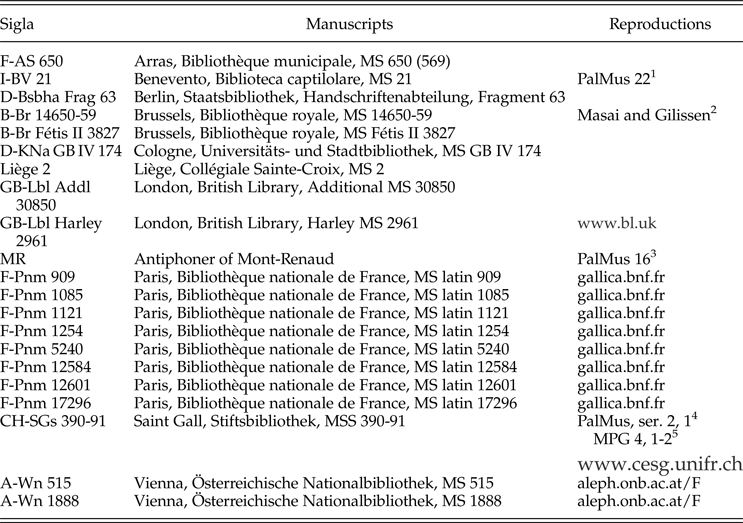
Auda adduces one additional argument in support of Stephen's authorship of the Trinity Office, and that is its stability across a wide variety of sources beginning in the tenth century. I believe the evidence does have some merit and indirectly supports the attribution to Stephen. First, he notes that witnesses from the tenth century (the Hartker antiphoner, CH-SGs 390-91) to the twentieth (the contemporary Roman breviary) exhibit great stability in their versions of this Office, singling out for attention the earliest among those he considers, SGs 390-91 and the eleventh-century collectar of Leofric (GB-Lbl Harley 2961).Footnote 21 To these we could add several other coeval manuscripts, including the Antiphoner of Mont-RenaudFootnote 22 (hereafter MR), A-Wn 1888 and no fewer than five witnesses from Saint Martial in Limoges, beginning with F-Pnm 1085, which I date to the second decade of the eleventh century.Footnote 23Table 2 gives these witnesses along with two other early fragmentary sources.Footnote 24
Early witnesses of the Trinity Office

Unfortunately, Auda undercuts his argument by measuring that stability against a mirage, ‘la tradition liégeoise’, as he puts it. After admitting that no Liégeois witness predates the fourteenth century, he then states that he must depend on witnesses from other places, ‘qui, par le fait de leur identité avec la tradition liégeoise, nous permettent de les tenir comme puisés à la même source’.Footnote 25 If, however, Auda has no control over the Liégeois tradition before the fourteenth century, then we cannot measure the value of tenth- and eleventh-century sources from elsewhere, like SGs 390-91 and Harley 2961, never mind MR, Wn 1888 or Pnm 1085, in relation to what might have been sung in Liège at that time, and so we cannot state unequivocally that they are then ‘descended from the same source’.
One aspect of the form of the Office does support Auda's argument for stability, namely the arrangement of many of the chants in modal order, which he mentions briefly in passing.Footnote 26 In SGs 390-91 and many other witnesses, the antiphons of First Vespers and Lauds, and both the antiphons and responsories of Matins follow modal order.Footnote 27 The five antiphons of the two shorter Offices belong to modes 1–5 in order, and the first eight antiphons and responsories of Matins cycle through the full cursus of the eight ecclesiastical modes.Footnote 28 The ninth antiphon in Matins repeats mode 8, while the ninth responsory belongs to mode 4. The antiphons for the canticles of Vespers and Lauds stand outside the arrangement, as does the invitatory of Matins, and the antiphons of Second Vespers do not follow modal order. The versions of the Office created at Saint Martial share this stability to some degree, although they follow the Benedictine cursus for Matins, of course, with thirteen antiphons and twelve responsories.
Versions of the Trinity Office that evince modal order in some or all of First Vespers, Matins and Lauds may well descend from a tenth-century Liégeois archetype. That archetype may also bear the stamp of Stephen. In his preface to the uita and Office of Saint Lambert, in the passage I adduce previously that suggests his authorship of that Office, he continues by stating that the ‘new responsories’ are arranged in the ‘order of the tones’: ‘Exinde musice artis ratione autentica subnectuntur cum antiphonis responsoria noua, in quibus ordini lectionum series respondet tonorum, quotenus sibi aequando extendi quitur numerus horum’ (‘From this, by the authentic reason of the musical art, new responsories, with antiphons, are subjoined, in which the series of tones responds to the order of the lections, as far as their number is able to be extended by being equal to itself’).Footnote 29 I therefore deduce that the early tenth-century Liégeois Office of the Trinity did follow modal order in the arrangement of the chants in First Vespers, Matins and Lauds, and that that order may have directly resulted from Stephen's revision of the Office.
Consequently, we must weigh the general agreement of the liturgical sources against the equivocation I outlined earlier in the historical accounts of Stephen's authorship. The complexion of the testament of Richarius and Anselm's eleventh-century chronicle reflects the nature of the debate: tenth- and eleventh-century clerics, including Anselm and Bernold, felt uncertain about who really composed the Trinity Office, and Anselm, responsible historian that he is, cannot bring full closure to the debate despite his best intentions because of the odd wording Richarius uses. Anselm would not have gone to these lengths were there no room for controversy, but by attempting to end it, he unfortunately left it unresolved. In combination with the evidence of the liturgical sources, I therefore take the more literal meaning of Richarius's expression ‘stabilire curavit’ to indicate that Stephen took over an existing Office for the Trinity and refined its chants, in regard to both the literary text and the melody.
The Office of the Invention of Saint Stephen
The attribution of the Office for Bishop Stephen's namesake, the Invention of Saint Stephen, raises even more questions. First, no surviving tenth-century evidence supports the attribution: both Richarius and Folcuin, our tenth-century witnesses, maintain a stony silence about it, and the feast does not appear in the list of contents given in the dedicatory epistle printed by Mohlberg from D-KNu GB IV 174. Because of the uncertain provenance of the epistle, as I discussed previously, its silence may hold no relevance concerning Stephen's authorship of this Office.Footnote 30 Second, evidence from the next century does not inspire confidence: Anselm and Bernold relegate the attribution to the passive voice, thus implicitly raising doubts about it.
Moreover, the context in which both authors mention the Office reinforces that doubt to their readers, as I indicated previously. Anselm, after touching on the Office, immediately promises to remain silent regarding matters about which he is uncertain, a statement that allows us to deduce that the attribution of the Office for the Invention of Saint Stephen falls among them.Footnote 31 And Bernold in the Micrologus casually adds a reference to this Office in his very brief discussion of the Trinity Office and its possible authorship by Stephen. The attribution clearly troubles both authors and so they treat it with extreme caution if not outright disdain. The earliest unequivocal statement that supports Bishop Stephen's authorship of the Office occurs in the writings of Sigebert of Gembloux, probably from the early twelfth century, who adopts a distinctly formulaic tone.Footnote 32 (See Appendix 4.)
Further, Auda states that unanimity among early liturgical books in using the Office he attributes to Bishop Stephen for this feast supports his authorship. He cites five manuscripts that range from the eleventh to the eighteenth centuries; Jacobsson adds one more from the tenth; Hesbert three more from the eleventh to the thirteenth centuries; and the CANTUS index provides another two dozen or so, between the eleventh and sixteenth centuries.Footnote 33 Three early antiphoners, however, all of which contain the Trinity Office attributed to Stephen, lack this Office for the Invention of Saint Stephen: MR, SGs 390-91 and Pnm 1085, all hovering within a decade or two of the turn of the eleventh century. The first two do not acknowledge the feast at all; Pnm 1085 does, but its Office reuses most of the chants sung on the principal feast for the saint (26 December), and so exhibits no knowledge of the Office Auda attributes to Bishop Stephen.Footnote 34
The argument from silence always raises problems, but the scribes of Pnm 1085 evinced great enthusiasm for the Office of the Trinity. The original scribe, who normally enters only the incipits of chants, left a full folio blank, currently fol. 70, between the Octave of Pentecost and the feast of Marcellinus and Peter (2 June) for the Trinity Office. When two other scribes came to enter it, they found that a single folio was insufficient because they were writing out its chants in full. Consequently, they added a bifolium, now fols. 71–2, for the entire Office.Footnote 35 If they knew of its attribution to Stephen of Liège (the manuscript bears no evidence of it), they might also have been interested in an Office for the Invention of Saint Stephen that circulated with his name. The fact that they did not adopt that Office for a feast they did celebrate proves nothing about the attribution or their perception of it, but it does undermine Auda's invocation of unanimity among early manuscript sources as evidence for the attribution to Stephen of Liège, as does the absence of any Office for the Invention of Saint Stephen from both MR and SGs 390-91.
Auda also adduces evidence from the melodic tradition of the Trinity Office and that for Saint Stephen to support his attributions.Footnote 36 Unfortunately, these melodies do not provide overwhelming evidence for his authorship. Auda's first example, the antiphons Vidit igitur for the Invention of Saint Stephen and Gloria laudis in the Trinity Office, share their opening with many third-mode chants across several genres, including several antiphons.Footnote 37 The similarity between the two, therefore, may arise as much from the common stock of third-mode melodic material as from the possibility that Stephen composed both. The third example also poses problems because Auda combines two genres, the invitatory Ostendit sanctus Gamaliel for Saint Stephen and the antiphon Te deum patrem from the Trinity Office. Again, the opening occurs frequently in fourth-mode chants, although only a few of the melodies reported by Bryden and Hughes ascend after the initial arch, and of these the only antiphon is Te deum patrem.Footnote 38
Auda's second example, the responsories Vade Luciane and Quis deus magnus, holds more promise. Only a handful of chants among those listed by Bryden and Hughes open in the same manner, but after the first seven pitches – Bryden and Hughes do not report repeated notes on the same pitch – the similarity ends.Footnote 39 Still, the opening resembles that designated Oa for third-mode chants by Walter Howard Frere in his analysis of responsorial melody types.Footnote 40 Like Auda's first example, therefore, the resemblance between these two chants results from their modal identity. Consequently, because most of the parallels he adduces could have arisen from generic and modal formulae instead of the compositional imprint of an individual, the melodic evidence Auda adduces adds little support for Stephen of Liège's authorship of either Office.
So, the accumulated evidence for the attribution of this Office to Bishop Stephen, both documentary and musical, falls well short of certainty. Yet Sigebert of Gembloux, our twelfth-century observer, attributes it to Stephen. He may have reached this conclusion by combining the circulation of this Office with the attributions, of varying degrees of certainty, to Stephen of Offices for Saint Lambert and the Holy Trinity, and as a result, lumped all three Offices together as the output of a single named author of episcopal rank, Stephen of Liège.
Melodic style
I close with a tantalising piece of evidence regarding the melodic language of the two Offices most closely connected with Stephen, for Saint Lambert and the Trinity.Footnote 41 It is difficult to control their musical texts because of the lack of early transcribable witnesses. Br 14650-59 contains full neumation for the Lambert Office, but in unheighted neumes, by several scribes using several notational dialects.Footnote 42 I persevere with Auda's transcriptions from the fourteenth-century antiphoner produced at Sainte-Croix, identified by Close as Liège 2, that he used for much of the music he prints, and I confirmed their contours against the notation in Br 14650-59.Footnote 43 The melodic tradition of the Trinity Office stands on much firmer evidence, and I invoke the earliest known transcribable witness, Pnm 1121 written at Saint Martial ad 1027–8 with musical notation by Adémar de Chabannes, again compared with the versions in Pnm 1085.Footnote 44
Many of the melodies in the Lambert Office employ very angular contours. Typical is the responsory Egregius presul, which Auda prints as the first responsory of the third nocturn of Matins.Footnote 45 (See Ex. 1, transcribed into modern notation from Auda's transcription.)
Responsory Egregius presul.

Alongside the undulating and conjunct motion typical of the genre, as, for example, on the phrase ‘et insit’, it also exhibits many leaps. Twice, at ‘O’ and ‘celestia’, a new phrase opens a fifth higher than the cadence that precedes; and at ‘hos’, the new phrase opens a fifth lower than the preceding cadence, on ‘complens’, but then immediately leaps back up a fifth and then a further third, to compass a seventh in all. Most dramatic is the setting of the exclamation ‘O’, which combines reciprocating leaps A–D–G–D (the last extended up a third to create a compound leap of a seventh, G–D–F), around the reciting tone of the seventh-mode chant, D, with striking conjunct descents, first through a sixth, F to A, and then a seventh, F to G.
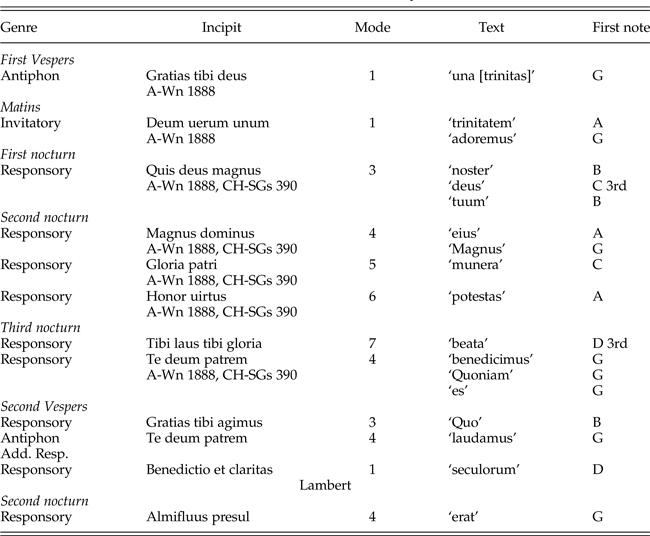
In contrast, conjunct motion dominates in the melodies of the Trinity Office. One gesture in particular occurs in a number of chants, primarily responsories, but also in a couple of antiphons and the invitatory at Matins (see Table 3 and Ex. 2).
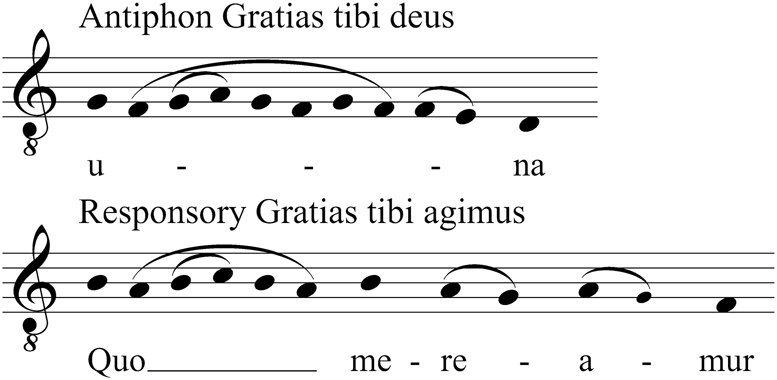
Trinity motive.

Instances of the Trinity motive

To ensure that it did not arise from tinkering with the melodies during their transmission to and within Saint Martial, I consulted Wn 1888 and SGs 390, which both agree in the outline of the motive, as indicated in Table 3. The table also shows the motive's distribution across the genres and modes, and indicates its presence in a responsory from the Lambert Office.Footnote 46 The motive occurs in every mode but 2 and 8, and most often begins a fourth or fifth above the final in the authentic modes and a third above the final in plagal modes. It falls, usually by second (I note in Table 3 instances where the first interval is a third), and then rises through a quilisma before falling again, with conjunct motion predominating. Example 2 gives instances of it from the antiphon Gratias tibi deus, where it leads to a cadence, and the responsory Gratias tibi agimus, where it is used to open the verse.Footnote 47 This gesture, while not particularly distinctive, persists across chant genre and mode in such a way that it may indicate a single compositional hand.
In conclusion, Stephen refined the uita of Saint Lambert and composed the chants for his Office; he modified the chants of an existing Office for the Trinity; and no reliable evidence indicates that he had any part in the composition of the Office for the Invention of Saint Stephen. The chants of the Lambert and Trinity Offices, however, differ markedly in melodic style, as the small sample I present shows. Should we therefore question whether Stephen could have had a hand, as composer or reviser, in both sets of chants? I firmly believe that artists are entirely capable of embracing a variety of stylistic identities in their creative work. Far from doubting that Stephen could have participated in the shaping of these chants, I believe their differences could give us some insight into the workings of one creative mind from the Middle Ages.
Appendix 1 Manuscripts cited, their sigla and reproductions

Appendix 2 Anselm of Liège, Gesta episcoporum Tungrensium, Traiectensium et Leodiensium (MGH, Scriptores 7: 200–1), text and translation
20. De Stephano episcopo et Richario.
Tricesimum nonum habuimus Stephanum, qui eo quod Metensis aecclesiae fuerit canonicus et protomartiris alumnus, de inventione ipsius quae cantantur responsoria edidisse dicitur. Verum ut de incertis taceamus, idem vitam sancti Lamberti simpliciter antiquitus dictatam urbani sermonis expolivit facetiis, et responsoria quae in sollempnitate eius cantamus, composuit; scribens ad domnum Herimannum archiepiscopum, memorati Willeberti successorem. Idem ipse responsoriorum, quae de sancta Trinitate cantantur, auctor fuit, quod nos quidem ignorabamus, credentes, quod fama habebat, nescio quem Hubaldum ipsorum fuisse compositorem. Sed infra hoc fere decennium, dum aliquae in armario revolverentur cartulae, insperato una ex his inventa est a successore praedicti venerabilis Stephani nomine Richario aedita, cuius exemplar, ut fidem astruamus omnibus quicumque huius rei veritatem scire volunt, non ab re credimus huic inserere opusculo; quod in hunc modum continetur:
21. Exemplar testamenti, in quo testatur Richarius Stephanum condidisse responsoria de sancta Trinitate.
Omnibus sanctam Trinitatem confitentibus, Patrem et Filium et Spiritum sanctum, Patrem plenum Deum in se, Filium plenum Deum a Patre genitum, Spiritum sanctum plenum Deum a Patre et Filio procedentem, non tamen tres Deos sed unum Deum, Richarius Tungrensis aecclesiae episcopus, gratia vobis et pax a Deo Patre et Filio eius domino nostro Iesu Christo et Spiritu sancto. Si aliquid utilitatis vel fructificationis in aecclesiasticis rebus nobis commissis ordinare valemus, quantotius accelerare debemus. Idcirco noverit industria fidelium, tam praesentium quamque futurorum, quia venerabilis vir, praecessor videlicet noster Stephanus, in honore sanctae Trinitatis quaedam responsoria cum antiphonis nocturnalibus sive matutinalibus necnon vespertinalibus totumque ad plene officium dulcissime modulationis stabilire curavit, credens sibi suaeque aecclesiae liquido profuturum, si illi debitas laudes speciatim deferret; cui nichil addi vel minui potest, quia semper est quod est, cui proprium est quod sempiternum est, cui idem est vivere et intelligere. Hanc quoque semitam vestigii suprascripti firmiter incedentes, curavimus quoddam oratorium in aecclesia sancti Lamberti, ubi ipse quiescit, struere, atque in eo altare statuentes, quamvis a cunctis fidelibus Deus et Dominus vera et sempiterna unitas in substantia ubique fideliter adoretur, quia una substantia est Pater et Filius et Spiritus sanctus, tamen in honore ipsius sanctae Trinitatis dedicare maturavimus. Sequitur deinceps cuiusdam fundi ad idem altare traditio; unde, ut ibidem continentur, luminaria et reliqua divinae servitutis iugiter adimpleantur sollempnia, quae hic interponere supervacuum extimavi. Actum est hoc Leodii sub die 16. Kalendas Decembris anno Domini 932, indictione 5, regnante Heinrico rege gloriosissimo anno 15. Sed ad propositum redeamus. Idem venerabilis vir Stephanus nonnulla sanctae aecclesiae contulit utilia, ex quibus est libellus ille in quo unicuique tempori congruas per totum anni circulum compegit lectiones cum responsoriis versiculis et orationibus quae collectas vocant, horis rite canonicis recitandas scribens memoratum codicem Roperto Mettensium episcopo.
20. Concerning the Bishop Stephen and Richarius.
We have, as the thirty-ninth, Stephen, who, in that he was a canon of the church of the protomartyr at Metz and a student there, is said to have brought forth responsories that are sung concerning the Invention of Saint Stephen. But so that we would keep silent concerning things about which we are uncertain, the same man polished with the witticisms of urbane speech the life of Saint Lambert that had been written in a simple style a long time ago, and he composed responsories that we sing on his feast, dedicating them to the lord archbishop Herimann, successor of the celebrated Willebert. The same man was the author of the responsories that are sung for the Holy Trinity, which we did not know, believing what rumour held, that someone named Hubald had been their composer. But within the last ten years, while some documents were being unrolled in the storage chest, one of these was found unexpectedly, produced by the successor of the aforesaid venerable Stephen, Richarius by name, a copy of which we feel it not without advantage to insert in this modest work, so that we would add to the confidence of all who wish to know the truth of this matter; and it is comprised in this manner:
21. A copy of the statement in which Richarius attests that Stephen composed the responsories concerning the Holy Trinity.
To all who believe in the Holy Trinity, the Father and Son and Holy Spirit, the Father full God in himself, the Son full God born of the Father, the Holy Spirit full God proceeding from the Father and the Son, not, nevertheless, three Gods but one God, Richarius bishop of the church of Tongres, grace to you and peace from God the Father and His Son our lord Jesus Christ and the Holy Spirit. If we have the power to set in order anything useful or fruitful in the ecclesiastical matters accomplished by us, we should hasten all the more. Therefore, the industry of the faithful, both present and future, knew that the venerable man, namely our predecessor Stephen, took care to establish certain responsories in honour of the Holy Trinity, together with antiphons, whether for Matins or Lauds, as well as Vespers, and also organised everything for the Office of full and sweetest melody, believing that it would clearly be beneficial for himself and his own church if he conferred to it the praises specially owed; and to that nothing should be added or removed, since it always is what it is, to which what is eternal is proper, to which it is the same to live and to understand. We also, who are firmly proceeding along this path of the trace written above, have taken care to build a certain oratory in the church of Saint Lambert, where he [Stephen] rests, and, setting up an altar in it, however much God and the Lord true and eternal unity in substance would be worshipped by all the faithful, since one substance is the Father, the Son and the Holy Spirit, nevertheless, we hastened to dedicate it in honour of the Holy Trinity. Subsequently, the tradition of a certain foundation for this same altar, from which, so that they would be contained in that same place, lamps and the other solemnities of the divine service should be supplied permanently, which things, I have thought to place here even when superfluous. This was done at Liège on the sixteenth day before the Kalends of December [16 November] in the year of the Lord 932, in the fifth indiction, and the fifteenth year of the reign of the most glorious king Henry. But let us return to our purpose. This same venerable man Stephen brought together many beneficial things for the holy church, among which is that little book in which he united the readings that are suitable for each time throughout the entire circuit of the year together with the responsories, verses and prayers that they call collects and that should be recited in the canonical hours, dedicating the renowned codex to Robert, the bishop of Metz.)
Appendix 3 Folcuin of Lobbes, Gesta abbatum Lobiensium (MGH, Scriptores 4: 62), text and translation
Hic passionem beati Lamberti impolito digestam stilo urbanius elucidavit et armoniam ex ea dulcissimam melodiae, quae celebris habetur, composuit. Fecit et libellum quendam ex plurimis divinorum librorum flosculis decerptis, in quo singularum in anno festivitatum capitula cum collectis et versibus utili commento congessit. In cuius libelli praefatione ostendit, se Mediomatricae, quae nunc Mettis dicitur, a puero educatum fuisse. Nam Roberto, eiusdem sedis episcopo, eundem libellum legendum misit et comprobandum.
(This man expressed in a more urbane way the passion of the blessed Lambert, which had been arranged in an unpolished style, and composed the sweetest harmony of the melody from it, which is held to be renowned. He also made a certain small book from a great number of sentences gathered from the divine books, in which he collected with useful invention the chapters of the individual feasts in the year together with the collects and verses. And in the preface of this small book, he stated that he had been educated from his boyhood in the city now called Metz. For to Robert, bishop of that same seat, he sent the same little book to be read and approved.)
Appendix 4 Sigebert of Gembloux, Chronica (MGH, Scriptores 6: 345), text and translation
Francone Leodicensium episcopo mortuo, Stephanus episcopus subrogatur, vir sanctitate et scientia clarus, qui vitam et passionem sancti Lamberti martyris ad Herimannum archiepiscopum urbanius edidit; cantum quoque nocturnum de eodem martyre, cantumque de sancta Trinitate, et de inventione Stephani prothomartyris dulci et regulari modulatione composuit.
(When Franco bishop of Liège died, Stephen was called to be bishop, a man famous for his sanctity and knowledge, who in a suave way brought forth a life and passion of Saint Lambert the martyr for Archbishop Hermimann; he also composed chant in sweet and regular melody even for the nocturnal office concerning the same martyr and chant for the Holy Trinity, and the Invention of Stephen the protomartyr.)