1. Introduction
Evolutionary conceptions of species place distinctive weight on the idea that each species has its own dynamic independence as a unit of evolution. Simpson, for example, defined species as “a lineage (an ancestral-descendant sequence of populations) evolving separately from others and with its own unitary evolutionary role” (Reference Simpson1961, 153). Similarly, Wiley characterized them as “a lineage of ancestral descendant populations which maintains its identity from other such lineages and which has its own evolutionary tendencies and historical fate” (Reference Wiley1978, 18). However, the various notions of a species having its own historical fate, tendency, or role have resisted careful analysis and risk remaining at the level of metaphor. This gap in our theoretical understanding is growing more important as population genomics continues to discover more commonly recognized species that engage in hybridization (Mallet Reference Mallet2008). How can evolutionary species be defined in terms of their independence as units of evolution if they continue to interbreed with each other?
The underlying difficulty is that hybridization muddles our ability to individuate species as precise, mutually exclusive groups of biological individuals. In particular, several traditional assumptions about the logic of individuating species get in the way. (1) Being a species is a categorical (yes/no) property rather than a matter of degree. (2) A biological individual may belong to only one population lineage at the same time. (3) Evolutionary independence is absolute rather than relative. In short, biologists have expected robust genealogical concordance between the histories of species, individuals, and their traits.
However, growing recognition that discordance is ubiquitous has provoked new interest in the idea that evolutionary lineages are dynamical entities composed of processes operating on multiple compositional levels (Haber Reference Haber2012). Most of the attention given to discordance in the context of the species debate has considered its significance only in phylogenetic terms (e.g., Baum Reference Baum2009; Haber Reference Haber2012), and the discovery of incomplete lineage sorting as a source of discordance has led to major innovations in phylogenetic inference (Degnan and Rosenberg Reference Degnan and Rosenberg2009; Knowles Reference Knowles2009). In contrast, my discussion here will pick up on discussions among biologists about the significance of a different cause of discordance, hybridization, which has not received due attention from philosophers (Mayr Reference Mayr2001; Wu Reference Wu2001; Mallet Reference Mallet2008; Harrison and Larson Reference Harrison and Larson2014).
Accommodating discordance in our understanding of lineages opens new possibilities for characterizing evolutionary independence. I argue that the evolutionary independence of species should be understood as relative to the timescale at which reproductive cohesion exists among individuals in the group. This account provides a novel methodological reduction of the macroevolutionary concept of evolutionary independence in terms of the microevolutionary processes constituting population lineages. My argument is based on a new genealogical criterion for individuating population lineages using the statistical rate at which reproductively “insulated” subgroups appear and disappear (Sterner Reference Sterner2017b). An important consequence of this criterion is that biological individuals may participate in multiple population lineages simultaneously. I use this feature to draw a novel distinction between species and subspecies according to what fraction of a group’s heritable traits are dynamically uncoupled from reproductive exchange with other groups.
2. The Speciation Continuum
Genealogical discordance is an increasingly central phenomenon to theoretical, lab, and field research in biological disciplines such as population genomics, systematic biology, and phylogenetics (Degnan and Rosenberg Reference Degnan and Rosenberg2009; Knowles Reference Knowles2009; Seehausen et al. Reference Seehausen2014; Mallet, Besansky, and Hahn Reference Mallet, Besansky and Hahn2016). Most biologists study discordance between gene trees and species trees: the phylogenetic relationships between copies of a gene sequenced from a sample of individuals often differ from the phylogenetic relationships between the species to which those individuals belong. Discordance among the genealogies of biological entities in this way is possible because evolutionary lineages are composed of multiple levels of parts and wholes that possess some degree of dynamical independence from one another. Hybridization is one important source of discordance. For example, some genes in bacteria exhibit very high rates of lateral transfer across highly divergent populations, while others are almost always passed on vertically through cell division. Discordance can also arise through incomplete lineage sorting: when speciation happens rapidly enough that multiple gene lineages exist at the time the population splits and are passed on to each branch in a nonuniform way. While most philosophical work addressing discordance has addressed its implications for phylogenetics, I will focus on the significance of hybridization for our understanding of evolutionary species.
The idea that speciation is an extended process that happens gradually over time is well established, and many authors have recognized that it may be impossible to provide an exact moment when a group became a species (e.g., de Queiroz Reference de Queiroz, Howard and Berlocher1998; Ereshefsky Reference Ereshefsky2014). Today many biologists refer to the “speciation continuum” as “the continuous sequence of genetically-based changes that occur as two lineages diverge from one another on the pathway to reproductive isolation” (Shaw and Mullen Reference Shaw and Mullen2014, 741). Seehausen et al. (Reference Seehausen2014), for example, understand the speciation continuum in a way that accommodates many different pathways to irreversible reproductive isolation. They also describe several species as occupying an approximate interval on an axis between panmictic populations on the one hand and irreversibly isolated species on the other.
Empirical results from population genomics provide further support for speciation existing on a continuum, by showing that many highly diverged groups nonetheless hybridize at nontrivial rates. In addition, many commonly recognized species contain divergent subpopulations despite substantial gene flow (Wu and Ting Reference Wu and Ting2004; Mallet Reference Mallet2008; Mallet et al. Reference Mallet, Besansky and Hahn2016). If species must be strictly reproductively isolated (i.e., exhibit no recurring exchange of genetic material whatsoever), then species will become extremely coarse-grained compared to existing taxonomic classifications. If species may exhibit only partial reproductive isolation, then it becomes difficult to draw a principled line between species and populations that have diverged at some loci under selection while maintaining gene flow with the larger group at the remainder of the genome.
3. Discordance and Evolutionary Species
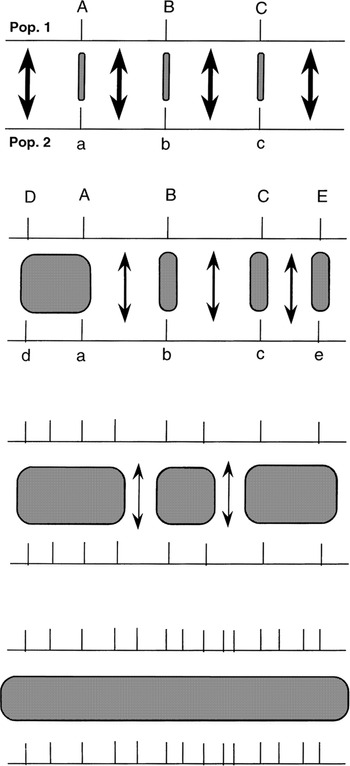
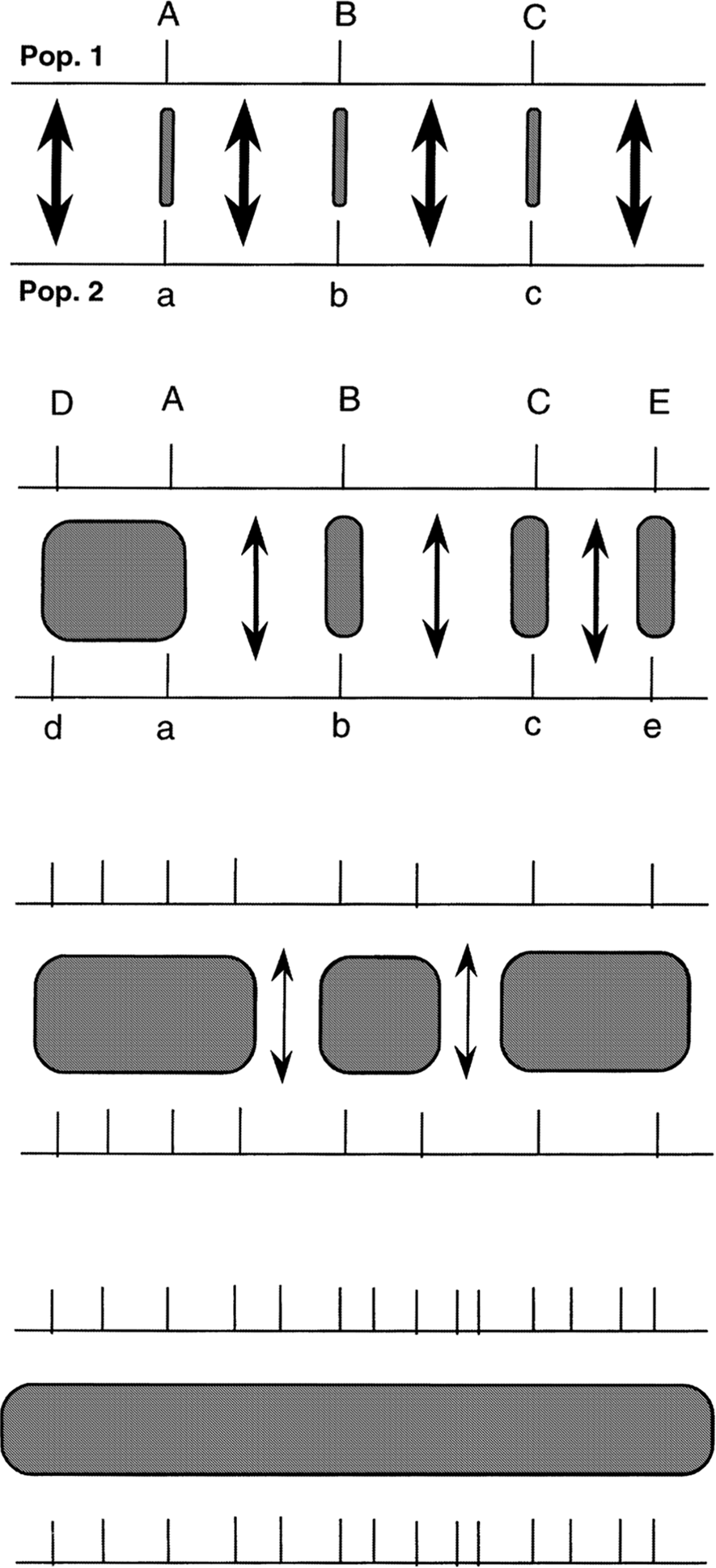
If populations can diverge at just a few loci, do they possess sufficient evolutionary independence to count as species? Evolutionary biologist Chung-I Wu has answered affirmatively: “The essence of any evolution-based species concept should be as follows: speciation is the stage where the populations will not lose their divergence upon contact and, furthermore, will be able to continue to diverge. Thus, the very essence does not have to include [reproductive isolation] in the whole-genome sense” (Reference Wu2001, 854). This view of evolutionary species treats reproductive isolation as a sufficient but unnecessary condition for two populations having distinct evolutionary trajectories. According to Wu, if two populations can continue to diverge in some loci even while undergoing gene flow at other loci, then they should not be treated as sharing the same evolutionary fate and hence should be classified as distinct species. Figure 1 illustrates his view of how species differentiation can occur through differential adaptation.
Reproductive isolation. Theoretical illustration of the speciation process based on increasing differential adaptation at specific loci in the genomes of two populations. Arrows represent net gene flow (with migration overwhelming local selection), which is shown to decrease in magnitude as speciation progresses. Shaded blocks indicate the prevention of gene flow by local selection at and near the loci of differential adaptation. Source: Wu (Reference Wu2001).
Wu supports his view with examples of genes showing adaptive divergence within subpopulations, implying a mosaic pattern of evolution across the genome. Contemporary genome sequencing has amplified the case for common “islands” of divergence evolving across a species (Malinsky et al. Reference Malinsky2015; Rafajlović et al. Reference Rafajlović, Emanuelsson, Johannesson, Butlin and Mehlig2016), although the importance of ecological selection remains contested (Cruickshank and Hahn Reference Cruickshank and Hahn2014; Wolf and Ellegren Reference Wolf and Ellegren2016). Genome sequencing has also shown that some classical cases of biological species, such as Darwin’s finches, do regularly hybridize and fall far short of reproductive isolation (McKay and Zink Reference McKay and Zink2015).
In the background, Wu is challenging two historically popular views in evolutionary biology: moderate gene flow between two populations is sufficient to homogenize them genetically (Barker Reference Barker2007), and the genes of a species are sufficiently coadapted that hybridization generally leads to deleterious epistatic incompatibilities. Wu interprets the genetic evidence as showing that populations maintain significant divergence despite gene flow and that gene flow continues at some loci despite substantial coadaptation among divergent genes in other parts of the genome.
Mayr’s (Reference Mayr2001) response to Wu ultimately misses his key conclusion in this regard. Wu does seem to conflate the biological species concept (BSC) with Mayr’s view that a species’ genes form a coherent coadapted unit. It is not correct that the BSC’s requirement of complete reproductive isolation depends logically “on two strong assumptions about the genetic architecture of speciation, namely the number of genes involved is large and the genetic changes within each species are strongly coadapted, forming a cohesive unit” (Wu Reference Wu2001, 855). So Mayr rightly points out that the BSC accommodates reproductive isolation produced by a few genes that prevent interbreeding.
However, the fundamental issue is not whether mutations at a small number of loci can produce whole-genome reproductive isolation. Instead, Wu’s point is that new evidence shows the BSC’s requirement for total reproductive isolation to be too coarse-grained for the purposes of identifying lineages with distinct evolutionary identities. In contrast, Wu’s species concept privileges a population’s capacity to maintain or increase its divergence over reproductive isolation as the basis for individuating species, resulting in a more fine-grained classification. Nonetheless, the assumption that the BSC and Wu’s genic species concept are mutually exclusive seems unsatisfactory for the purpose of using taxonomic classifications to identify important units of evolution. I will argue for an approach that preserves the evolutionary significance of both concepts while reconciling them taxonomically.
4. The Mixture Account of Population Lineages
In order to handle the implications of discordance, we need a more flexible logical basis for relating species, lineages, subspecies, and individuals. Evolution offers us a cornucopia of natural phenomena that are scientifically valuable to name, define, and study, but these phenomena do not fit within the tidy framework of a logical hierarchy. In a previous paper, I introduced a more flexible framework for individuating population lineages (Sterner Reference Sterner2017b), and I will further develop its implications for the relationship between evolutionary species and population lineages. Because of limited space, I can only provide a brief review; a more thorough introduction is available in Sterner (Reference Sterner, Lidgard and Nyhart2017a, Reference Sterner2017b).
Traditionally, biologists have typically defined population lineages as the units of evolution that emerge when individual chains of parents and offspring are integrated into a cohesive whole that persists over time (Simpson Reference Simpson1961; Hull Reference Hull1980; de Queiroz Reference de Queiroz and Wilson1999). More precisely, biologists usually treat random mating as the defining exemplar of reproductive integration a population lineage should exhibit. In other words, when biologists locate populations on a continuum between random mating and total fragmentation, for example, using Wright’s Fst measure, they take random mating as the paradigm for defining ‘good’ population lineages (Holsinger and Weir Reference Holsinger and Weir2009).
In contrast, I have proposed a way of individuating population lineages on the basis of the turnover rate of internally “insulated” subgroups. According to my account of population lineages, a series of populations over time forms a population lineage for a set of traits if it is closed and mixes over that set of traits. Closure means that the population series never receives new material transferred from or produced by external individuals. Mixture means that any subgroups that are closed to external input (i.e., are “insulated” from the rest of the population) never persist indefinitely or only rarely last longer than a threshold.
A principal novelty of the mixture criterion is the way it characterizes the integrative cohesion of a population lineage in terms of the duration of insulated subgroups. In practice, it is necessary to relate the statistical distribution of insulated subgroup durations to some finite timescale in order to determine whether mixture is occurring. We can define the relevant timescale in terms of microevolutionary processes: compare the genealogical history of an actual series of populations to statistical expectations derived from a neutral model of the population (i.e., where positive and negative selection are absent). The neutral model allows one to calculate the expected distribution of insulated subgroup durations, either analytically or numerically, and to compute a threshold time that marks when the frequency of insulated subgroups lasting at least that long became sufficiently rare. The neutral model therefore serves to specify a concrete timescale for the mixture criterion relative to the features of the target population. Two other relevant features of the mixture account are the facts that it permits a single biological individual to participate in multiple population lineages and that it allows population lineages to maintain their genealogical identity even in the face of substantial hybridization.
We need two further terms from Sterner (Reference Sterner2017b) for the following discussion of evolutionary independence. In order to give their formal definition, we need to introduce some notation first. Let P denote a population series, that is, a temporal sequence of populations at times  , 2, 3 … T. A population in this context is simply a mathematical set of individuals, regardless of their geographic location. Assume that each member of P is individuated by the same demarcator type and has a set of traits E. In the context of Wu’s genic species concept, we can think of E as the set of genetic loci in the genomes of individuals in P.
A population series P is a nested mosaic population lineage over a set of traits E if:
1. It is a population lineage for a subset of types E1 in E.
2. There is another population series Q that contains P as a subset.
3. Q is a population lineage over
 .

In addition, P is an extended population lineage if (1) P contains exactly one insulated subgroup that persists and exhibits mixture, and (2) P is connected. The latter property is defined analogously to mixture in the following way: first, we say a population series P contains a split over E if there exists a series of strict subsets St of Pt for all  to T such that both St and its complement are closed for E; then, we use the distribution of splits to specify when the population series is connected based on criteria analogous to those for mixture.
5. Composite Lineages: Integrative Cohesion with Structured Hybridization
This section describes a novel possible structure for an evolutionary species, in order to articulate a more flexible set of conceptual relationships between species, subspecies, and lineages. The structure is theoretical in nature and unlikely to be realized perfectly by any single biological system; however, it could be approximated by real populations to various degrees. The point is to illustrate how relaxing traditional assumptions about the underlying logic of individuating species opens up new conceptual approaches that are better suited to accommodate challenging empirical results.
Thus far I have left the relationship between evolutionary species and population lineages ambiguous. Generally speaking, biologists accept the claim that species contain at least one population lineage and possibly many. So, the notion of “lineage” invoked by Simpson and Wiley in their definitions above is not generally equivalent to a population lineage as I have defined it. The integrative cohesion provided by closure and mixture for population lineages is hence not universally sufficient to characterize evolutionary species.
Nonetheless, an evolutionary species must exhibit some sort of reproductive integration in order for it to qualify as a lineage. I will define a new, “composite” form of lineage, in order to better resolve the relationship between evolutionary species and population lineages. Composite lineages form integrated wholes by combining two distinct modes of integration available to biological populations: first, integration through exchange of material across chains of parents and offspring and, second, integration through the coexistence of traits within a single biological individual.
These two modes of integration do not necessarily implicate the same sets of individuals across a population, although historically biologists have assumed that the cohesive populations picked out by each trait of each individual are equivalent. Instead, depending on which individual we consider, the individual’s traits may exhibit mixture in different population series. Moreover, the specific population lineages in which an individual participates may differ from one individual to the next. Nonetheless, we will see that abandoning the traditional assumption of equivalence does not mean that integrative cohesion is impossible above the level of population lineages.
Let me now define the term composite lineage. A population series P is a composite lineage if:Footnote 1
1. P is closed over the set of traits E.
2. P contains population lineages P1 … PN, which exhibit mixture on timescales R1 … RN over traits E1 … EN that are strict subsets of E.
3. The union of E1 … EN is equal to E.
4. At least one Pi exists that includes all members of P.
The first property ensures that P exhibits reproductive isolation as a whole, following Mayr’s BSC. The second property requires that P has nontrivial internal genealogical structure, with distinct population lineages exhibiting mixture over different subsets of E. The third property guarantees that every trait type mixes for at least some individuals in the overall population series. The final property guarantees that all members of P are integrated reproductively for at least some traits.
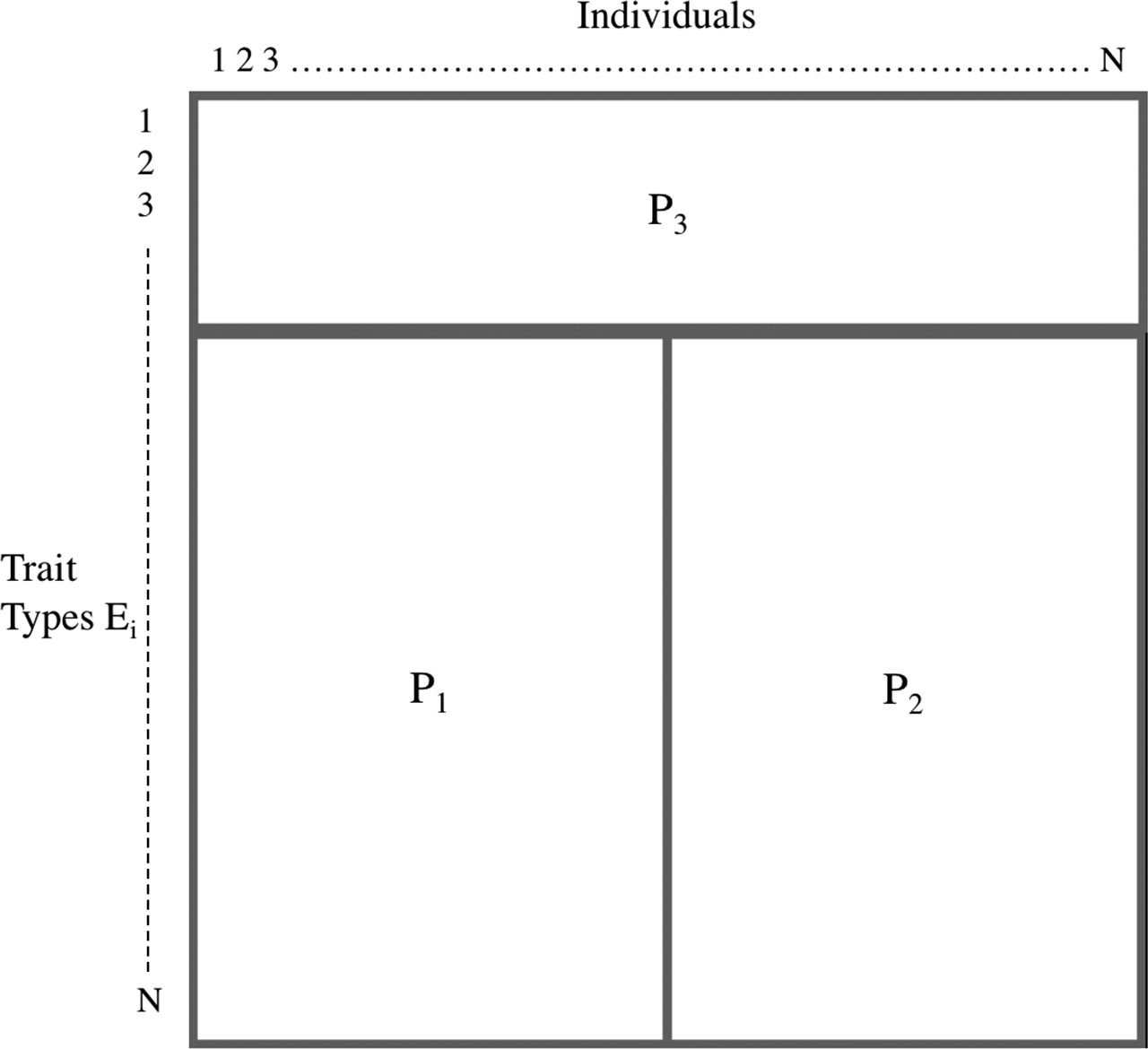
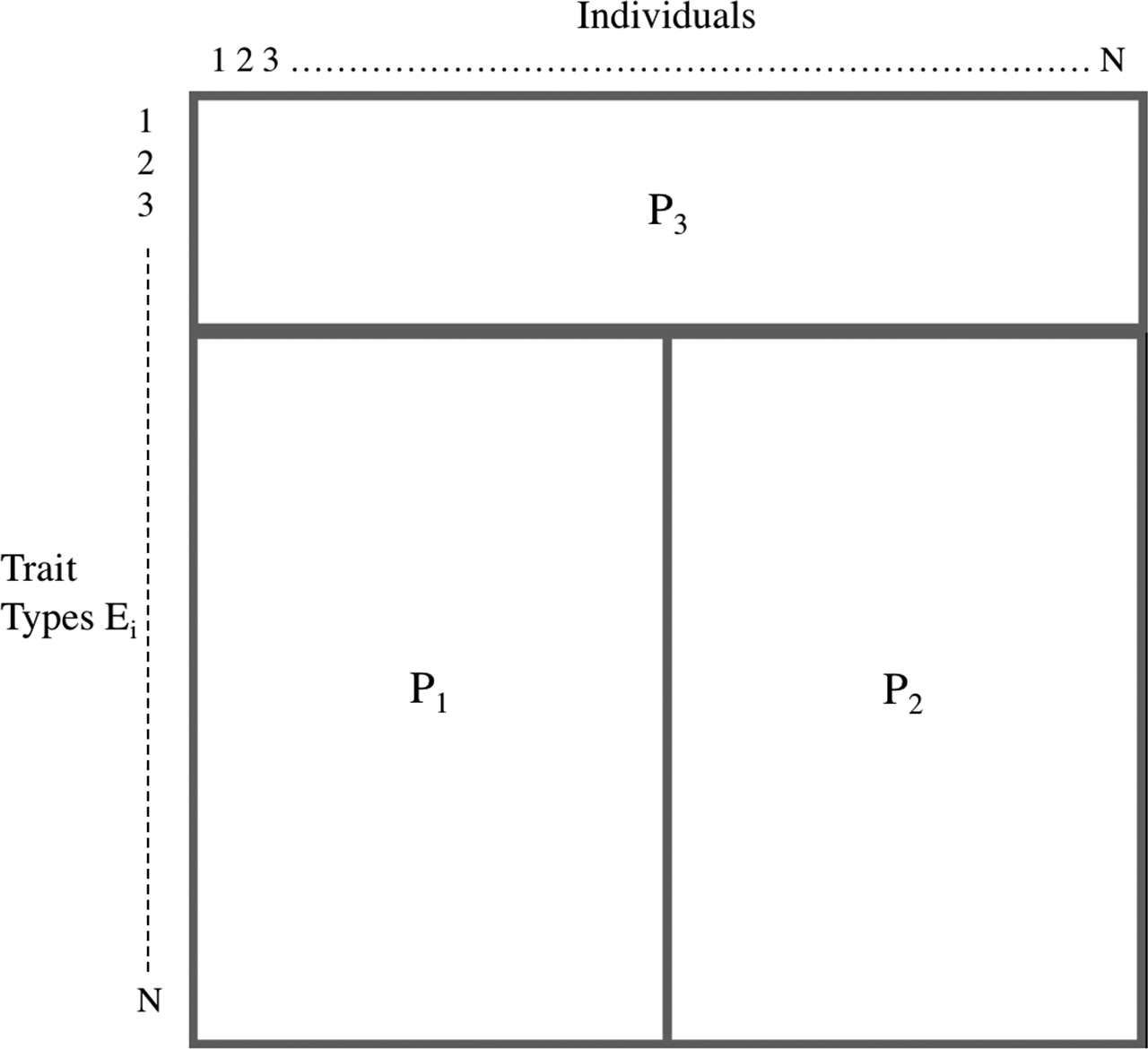
A good example of a composite lineage is a nested hierarchy of mosaic population lineages. For example, P could contain three simple population lineages: P1 and P2, which mix over the same set of trait types ( ) but contain no members in common, and P3, which mixes over
 and contains all members of P1 and P2. Lineages P1 and P2 are therefore nested within P3, satisfying the third requirement. This is illustrated in figure 2. Considered collectively, all three population lineages are closed, meeting the first requirement, and the second requirement is fulfilled by stipulation in this case. A composite lineage is not required to exhibit a perfect nested hierarchy, however, and the definition can also accommodate extensive hybridization between subpopulations in P.
Hypothetical example of a composite lineage P that contains three population lineages: P1, P2, and P3. Vertical axis corresponds to different trait types E1 … EN, such as genetic loci. Horizontal axis corresponds to individuals in the composite lineage. Each box illustrates the traits and individuals over which that population lineage exhibits closure and mixture. Depicted order of both axes is arbitrary and could be shuffled without implications for the underlying biology.
The interest of composite lineages lies in illustrating how populations can maintain distinct evolutionary identities based on reproductive integration for some traits while remaining evolutionarily coupled at others. Potentially all the biological individuals in a composite lineage can themselves be composite wholes in the sense of participating in multiple population lineages simultaneously. In turn, each population lineage combines with others to form the lineage as an integrated whole through interactions among the traits of shared individuals.
The importance of tracking timescales for characterizing the independence of an evolutionary species also emerges naturally from the definition of a composite lineage. Within any composite lineage, evolution is occurring on multiple timescales corresponding to the rate of mixture in each population lineage. If individuals in the composite lineage begin to hybridize with external groups, the composite lineage’s continued independence can be judged by how quickly it is permeated by external genetic material.Footnote 2 If the uptake of external material happens on a much longer timescale than the slowest rate of mixture within the composite lineage, then the composite lineage will still be able to undergo multiple cycles of mutation and fixation. The evolutionary independence of a species can therefore be defined relative to the timescales at which mixture occurs within its population lineages.
6. Conclusion
Characterizing evolutionary independence using the case of composite lineages helps clarify several related problems. As genome data became more common, some evolutionary biologists began to separate their views of species from Mayr’s biological species concept (Mallet Reference Mallet2010; Shaw and Mullen Reference Shaw and Mullen2014). They argued that Mayr treated species as being fundamentally discontinuous from taxa at lower or higher levels, whereas Darwin’s view of species and varieties as being fundamentally continuous is actually a better fit to contemporary knowledge.
Composite lineages show how one can accommodate the evolutionary significance of both the BSC and Wu’s genic species concept taxonomically while maintaining a principled distinction between them. The emergence of evolutionary lineages happens along two dimensions of reproductive integration: individuals related by closure and mixture, and traits related by co-occurrence within individuals. The difference between whether a population series is a composite lineage or a nested population lineage is not closure and mixture per se; rather, the difference is whether the population series is reproductively integrated via all or only some of its traits.
If we identify the nested population lineages within a composite lineage as subspecies, then there is a continuum between being a subspecies and a species according to the proportion of independently evolving traits. To be clear, nothing I have argued for here forces us to assign the species rank to composite lineages versus the nested mosaic population lineages they contain. It does seem reasonable to recognize the distinctive nature of both, however, and the historical usage of the genus rank makes it an uncomfortable fit for composite lineages. In any case, insisting on reproductive isolation as the defining trait of species does not require the denial of a continuum of possible evolutionary independence to populations within that species.