Introduction
Neurological soft signs (NSS) are minor, objective abnormalities that have been tentatively classified into motor coordination, motor sequencing and sensory integration domains (Buchanan & Heinrichs, Reference Buchanan and Heinrichs1989). These signs are recognized as markers of the neurobiological basis of schizophrenia (Heinrichs & Buchanan, Reference Heinrichs and Buchanan1988; Bombin et al. Reference Bombin, Arango and Buchanan2005; Whitty et al. Reference Whitty, Owoeye and Waddington2009) and proposed as candidate endophenotypes for the disease (Chan & Gottesman, Reference Chan and Gottesman2008). Furthermore, NSS may serve as one of the indicators bridging the gap between the aetiopathogenic mechanisms of schizophrenia and the observable clinical manifestations (Heinrichs & Buchanan, Reference Heinrichs and Buchanan1988; Chan & Gottesman, Reference Chan and Gottesman2008).
While a focus of increasing interest, the role of NSS in psychotic disorders remains poorly understood. Well-documented and consistent findings include over-representation of NSS in schizophrenia-spectrum disorders relative to other psychiatric disorders and healthy controls (Cuesta et al. Reference Cuesta, Peralta, Zarzuela, Calvo, García and Serrano2002; Chan & Gottesman, Reference Chan and Gottesman2008), such as association with poor cognitive performance and negative symptoms (Dazzan & Murray, Reference Dazzan and Murray2002; Bombin et al. Reference Bombin, Arango and Buchanan2005; Chan et al. Reference Chan, Xu, Heinrichs, Yu and Wang2009). However, contradictory evidence exists regarding the association of NSS with risk factors for schizophrenia (Dazzan & Murray, Reference Dazzan and Murray2002; Bombin et al. Reference Bombin, Arango and Buchanan2005), pre-morbid functioning (Dazzan & Murray, Reference Dazzan and Murray2002; Whitty et al. Reference Whitty, Owoeye and Waddington2009), domains of psychopathology other than negative symptoms (Dazzan & Murray, Reference Dazzan and Murray2002; Bombin et al. Reference Bombin, Arango and Buchanan2005; Tosato & Dazzan, Reference Tosato and Dazzan2005) and illness course (Chen et al. Reference Chen, Kwok, Au, Chen and Lau2000; Whitty et al. Reference Whitty, Clarke, McTigue, Browne, Gervin, Kamali, Lane, Kinsella, Waddington, Larkin and O'Callaghan2006). The consideration of NSS as a manifestation of a diffuse, generalized brain disorder has been recently questioned and there is increasing evidence that NSS arise from systems-level disturbances in distributed brain networks. However, a consistent pattern of neural correlates of NSS has not yet been found (Keshavan et al. Reference Keshavan, Sanders, Sweeney, Diwadkar, Goldstein, Pettegrew and Schooler2003; Dazzan et al. Reference Dazzan, Morgan, Orr, Hutchinson, Chitnis, Suckling, Fearon, Salvo, McGuire, Mallet, Jones, Leff and Murray2004; Janssen et al. Reference Janssen, Diaz-Caneja, Reig, Bombín, Mayoral, Parellada, Graell, Moreno, Zabala, Vázquez, Desco and Arango2009; Thomann et al. Reference Thomann, Wüstenberg, Dos Santos, Bachman, Essig and Schröder2009).
Lack of consistent evidence regarding NSS correlates may be due to several factors including assessment methodology, sample composition, the effect of illness stage and chronicity, and heterogeneity of neurological signs as evidenced by the lack of an underlying clear factor structure (Goldstein et al. Reference Goldstein, Sanders, Forman, Tarpey, Gurklis, Van Kammen and Keshavan2005; Compton et al. Reference Compton, Bercu, Bollini and Walker2006). A further confounding factor is antipsychotic treatment, which may affect NSS in several ways. While studies comparing NSS levels in treated and untreated patients have resulted in conflicting results (Gupta et al. Reference Gupta, Andreasen, Arndt, Flaum, Schultz, Hubbard and Smith1995; Browne et al. Reference Browne, Clarke, Gervin, Lane, Waddington, Larkin and O'Callaghan2000), most studies using a pre–post treatment design in exacerbated patients have shown that NSS may improve with antipsychotic medication (Whitty et al. Reference Whitty, Clarke, Browne, McTigue, Kamali, Feeney, Lane, Kinsella, Waddington, Larkin and O'Callaghan2003; Bachman et al. Reference Bachman, Bottmer and Schröder2005). Furthermore, a few reports suggest a progression of NSS scores in chronic patients (Madsen et al. Reference Madsen, Vorstrup, Rubin, Larsen and Hemmingsen1999; Chen et al. Reference Chen, Kwok, Au, Chen and Lau2000), which raises the possibility that antipsychotic drugs may worsen NSS in a subgroup of patients (Dazzan & Murray, Reference Dazzan and Murray2002). A good example of the effect of antipsychotic drugs on NSS is provided by the study of Goldstein et al. (Reference Goldstein, Sanders, Forman, Tarpey, Gurklis, Van Kammen and Keshavan2005), which showed that the factor and cluster structure of neurological signs dramatically varied across on- and off-drug conditions. In view of the above-mentioned issues, it has been claimed that only studies of first-episode, never-treated psychotic patients can address the confounding effects of antipsychotic drugs and chronicity on the aetiopathological and clinical underpinnings of NSS (Dazzan & Murray, Reference Dazzan and Murray2002; Whitty et al. Reference Whitty, Owoeye and Waddington2009). Furthermore, previous studies examining the correlates of neurological dysfunction have not examined their unique associations by means of hierarchically controlling for antecedent variables.
In this report we examined NSS by means of the Neurological Evaluation Scale (NES; Buchanan & Heinrichs, Reference Buchanan and Heinrichs1989) in a broad sample of first-episode psychotic patients never treated with antipsychotic drugs and examined their general and unique associations with a number of risk factors and clinical parameters. The specific goals of the study were: (1) to examine the factor structure of the NES items; (2) to examine the relationship of the factor-derived NES scores with illness-related variables; and (3) to examine the comparative validity between the factor-derived NES scores and the original NES subscales regarding the illness-related variables. In addressing goals 2 and 3 we examined a number of illness-related variables relevant to understanding the role of NSS in schizophrenia. These variables included risk factors for schizophrenia (familial liability and obstetric complications), neurodevelopmental disturbances, pre-morbid functioning, psychopathology and spontaneous extrapyramidal signs.
Method
Participants
A total of 177 antipsychotic-naive patients with a Diagnostic and Statistical Manual of Mental Disorders, 4th edition (DSM-IV) diagnosis of schizophrenia-spectrum disorders were recruited via consecutive admissions to the psychiatric ward of the Virgen del Camino Hospital in Pamplona, Spain, between 2002 and 2009. The study was approved by the local ethics committee, and all patients or their legal representatives gave written informed consent to participate. Inclusion criteria were: aged 15–65 years, no previous exposure to antipsychotic drugs as documented by the patient, close relatives and medical records, and available biological mother. The latter requirement ensured the acquisition of reliable retrospective information. Exclusion criteria were: a history of drug dependence, evidence of organic brain disorder, intelligence quotient <70, or meaningful medical illness interfering with the neurological examination.
Assessments
The subjects were administered the Comprehensive Assessment of Symptoms and History (CASH; Andreasen et al. Reference Andreasen, Flaum and Arndt1992), which served to assess demographics, diagnosis, illness-related variables and psychopathology.
The primary dependent measure of interest was the NES (Buchanan & Heinrichs, Reference Buchanan and Heinrichs1989). The NES contains 26 items, 14 of them being assessed bilaterally, and which are functionally grouped into four scales: sensory integration; motor coordination; sequencing of complex motor acts; and other signs. The scale was administered, before starting antipsychotic medication, by E.G.d.J. or M.S.C., who were masked to other clinical variables. Based on the original scoring instructions, items were scored 0 (no abnormality), 1 (mild but definite impairment) or 2 (marked impairment), with the exception of suck and snout reflexes, which were scored 0 (absent) or 2 (present). Bilaterally administered items were collapsed into the higher of the two ratings. This was done because both there were no statistically significant differences between right and left scores and because this has been the most customary procedure in previous studies. Inter-rater reliability was examined in 26 patients and found to be excellent across the four NES subscales (mean intraclass correlation coefficient=0.91, range=0.87–0.96).
The independent measures of interest were grouped according to their temporal proximity with the NSS assessment and included risk factors, pre-morbid characteristics, psychopathology and extrapyramidal syndromes. Risk factors and pre-morbid variables were all assessed through interviews with the patients' mother, which was supplemented by information provided by other close relatives and medical records. Psychopathology was assessed through at least two interviews with the patient plus the information provided by close relatives and clinical records, and rated as its worst during the month previous to hospitalization. Extrapyramidal signs were assessed by means of a structured procedure immediately before the NES administration. Inter-rater reliability for all the rater-administered independent measures was good (mean intraclass correlation coefficient=0.86, range=0.78–0.94).
Risk factors included familial liability to schizophrenia and obstetric complications. Familial liability was assessed in the first-degree relatives of the subjects by computing the familial loading score (Verdoux et al. Reference Verdoux, van Os, Sham, Jones, Gilvarry and Murray1996). The score takes account of family size and age structure and is intended to summarize the extent of psychiatric morbidity in the family by using a continuous measure of liability. Obstetric complications were assessed by means of the McNeil–Sjöström scale (McNeil & Sjöström, Reference McNeil and Sjöström1995). The scale provides a systematic evaluation and weighting of several hundred specific pregnancy, labour–delivery and neonatal factors, which are scored according to a six-point scale reflecting the potential somatic damage in the offspring. In this study we used the type C score, which reflects the highest severity level of any existing obstetric complication and has been shown to be particularly sensitive to neurological damage in schizophrenia (Peralta et al. Reference Peralta, Cuesta and Serrano2006).
Pre-morbid factors included the assessment of developmental milestone attainment, symptoms of attention deficit–hyperactivity disorder and pre-morbid adjustment. Based on Jones et al. (Reference Jones, Rodgers, Murray and Marmot1994), we developed a neurodevelopmental delay score consisting of six specific milestones not attained at the expected age. The score ranges from 0 (all milestones attained) to 6 (none of the milestones attained). Symptoms of attention deficit hyperactivity disorder in childhood were rated according to the 10-item parents' version of the Wender Utah Rating Scale (Ward et al. Reference Ward, Wender and Reimherr1993), which was completed by the mother. The Premorbid Social Adjustment (PSA) scale (Cannon et al. Reference Cannon, Jones, Gilvarry, Rifkin, McKenzie, Foerster and Murray1997) was used to assess five areas of adjustment for childhood (5–11 years) and adolescence (12–16 years): sociability, peer relationships, scholastic performance, adaptation to school and interests, each rated on a seven-point scale ranging from 1 (excellent adaptation) to 7 (extremely poor adaptation). In this study we used the PSA total score as a global measure of pre-morbid functioning, and the change score, which was computed by subtracting the childhood score from the adolescent score, as a global measure of pre-morbid deterioration with age.
We rated six psychopathological syndromes from the CASH representing the most nuclear domains of the psychotic illness: reality distortion, disorganization, negative symptoms, depression, mania, and catatonia (Peralta & Cuesta, Reference Peralta and Cuesta2001). Each domain was scored according to a 0–5 global rating (0=absence, 1=doubtful, 2=mild, 3=moderate, 4=marked, and 5=severe). The assessment of spontaneous extrapyramidal signs included the syndromes of parkinsonism, dyskinesia and akathisia, which were rated, respectively, by means of the Simpson–Angus Rating Scale (SARS; Simpson & Angus, Reference Simpson and Angus1970), the Abnormal Involuntary Movements Scale (AIMS; Guy, Reference Guy1976) and the Barnes Akathisia Rating Scale (Barnes, Reference Barnes1989).
Statistics
Correlational analyses were done by using Pearson correlation coefficients. The 26 NES items were subjected to principal component analysis (PCA), and factors were rotated using the PROMAX procedure as the independence of factors could not be assumed.
A series of hierarchical regression models on the NES factors, original subscales and the total score were used to examine the association of neurological ratings with (1) risk factors, (2) pre-morbid variables, (3) psychopathological syndromes and (4) spontaneous extrapyramidal signs, entered in that order. To control for potential confounders, age, gender and diagnosis (1=schizophrenia, 0=other psychoses) were included in the first step of the hierarchical regression models. All predictors were z-transformed, except for familial loading score for schizophrenia that was log-transformed. Because tremor and glabella tap are included in both the NES and SARS, and in order to eliminate concerns about inflation of the relationship between the two measures, these symptoms were omitted from the SARS.
To examine comparatively the contribution of the NES factors and original subscales in capturing associations with risk factors and clinical variables, separate hierarchical regression analyses were conducted, where each risk factor or clinical variable was entered as the dependent variable and the NES factors or subscales as the independent ones. Age, gender and diagnosis were the covariates and entered first. The relative contribution of the factor scores versus that of subscale scores in explaining illness-related variables was explored by adding subscale scores to each model containing the factor scores, and the reverse, and comparing these by using the R 2 differences. Two-tailed significance tests were used throughout, and α was set at p<0.05.
Results
Subject characteristics
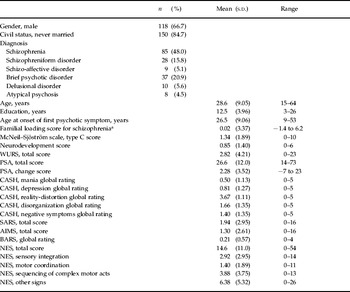
The demographic and clinical characteristics of the patients are reported in Table 1. The group was similar in demographic and clinical characteristics to participants in other first-episode samples of psychotic disorders. More specifically, the quartile distribution of age was 22, 27 and 34 years; the proportion of patients with age under 40 years was 88%, and the proportion of patients lying within ±1 standard deviation of the mean was 74%.
Demographic and clinical characteristics of 177 patients with schizophrenia-spectrum disorders

s.d., Standard deviation; WURS, Wender Utah Rating Scale; PSA, Premorbid Social Adjustment; CASH, Comprehensive Assessment of Symptoms and History; SARS, Simpson–Angus Rating Scale; AIMS, Abnormal Involuntary Movements Scale; BARS, Barnes Akathisia Rating Scale; NES, Neurological Evaluation Scale.
a Log-transformed score.
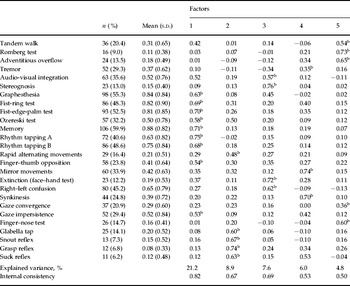
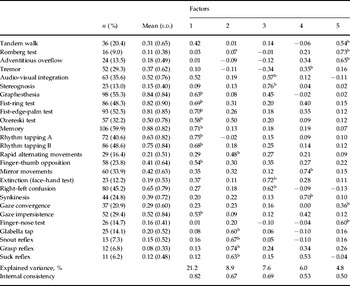
Prevalence rates of particular NES items, scored ⩾1, varied highly across items and ranged from 6.2% (suck reflex) to 59.9% (memory) (Table 2). At least one NSS (defined as one NES item rated 2) was displayed by 78% of patients, with 65% showing at least two NSS (defined as two or more NES items rated 2).
PrevalenceFootnote a, severity and factor structure of Neurological Evaluation Scale items in 177 patients with schizophrenia-spectrum disorders
s.d., Standard deviation.
a Score ⩾1.
b Items most loading on a given factor.
PCA of NES items
To examine how many separable dimensions existed in the NES, we submitted a product–moment correlation matrix to a PCA (see Supplementary Table 1, available online). The Kaiser–Meyer–Olkin of sample adequacy was 0.76, and the Bartlett sphericity test was highly significant [χ2=1263.8, degrees of freedom (df)=325, p<0.001], both suggesting that the correlation matrix was suitable for PCA. The initial PCA yielded eight factors with Eigenvalues >1.0, accounting for 61% of the variance. This solution proved to be highly unsatisfactory as the four last factors were either hardly interpretable or made by only one item. The scree test did not reveal any clear break point in the number of factors to retain. Thus, we examined alternative solutions including two to seven factors. The best solution in terms of parsimony, factor interpretability and explained variance was a five-factor solution, which had a relatively clean factor structure explaining 48.4% of the variance (Table 2).
Factors were defined according to those items most heavily loading on a given factor and named mainly because of their correspondence with the original NES functional grouping. The first factor (sequencing) included the four NES sequencing items – fist-ring test, fist-edge-palm test, Ozeretski test and rhythm tapping test B – plus graphesthesia, memory, rhythm tapping test A, finger–thumb opposition and gaze impersistence. The second factor (release signs) consisted of the four release signs plus rapid alternating movements. The third factor (sensory integration) included all NES sensory integration items excepting graphesthesia. The fourth factor (abnormal movements) consisted of mirror movements, synkinesis and tremor. Last, the fifth factor (coordination) included two of the four NES coordination items – tandem walk and finger–nose test – plus Romberg test, adventitious overflow and gaze convergence.
Bivariate analyses
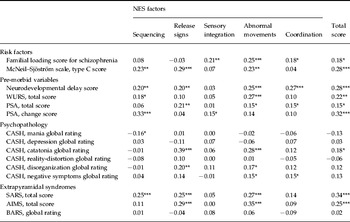
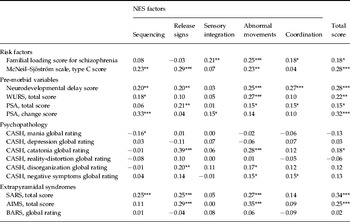
Bivariate analyses of correlations of NES factors and the total score with risk factors, pre-morbid variables, psychopathological domains and spontaneous extrapyramidal syndromes showed a rather complex association pattern (Table 3). Each neurological domain correlated with some variables from the different sets of predictors. Reality-distortion symptoms, depressive symptoms and spontaneous akathisia were all unrelated to any neurological domain.
Bivariate Pearson correlations of NES factors and total score with risk factors, pre-morbid variables, psychopathology and extrapyramidal syndromes in 177 patients with schizophrenia-spectrum disorders
NES, Neurological Evaluation Scale; WURS, Wender Utah Rating Scale; PSA, Premorbid Social Adjustment; CASH, Comprehensive Assessment of Symptoms and History; SARS, Simpson–Angus Rating Scale; AIMS, Abnormal Involuntary Movements Scale; BARS, Barnes Akathisia Rating Scale.
* p<0.05, ** p<0.01, *** p<0.001.
Multivariate analysis
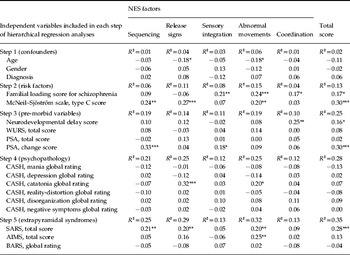
For economy of presentation, only the final step in each sequential model of the hierarchical multiple regression analyses is presented (Table 4). Only those significant associations at the p level <0.01 will be considered here. The confounders explained between 1% and 6% of the variation in the NES factors. The addition of risk factors to confounders increased the explained variance in the NES factors in a range of 4% to 15%. Associations were observed for familial loading of schizophrenia with sensory integration and abnormal movements, and for obstetric complications with sequencing, release signs and abnormal movements. When pre-morbid variables were added to confounders and risk factors, they explained between 10% and 19% of the variation in the NES factors. The neurodevelopmental delay score was related to coordination, and pre-morbid deterioration to sequencing. The addition of domains of psychopathology to confounders, risk factors and pre-morbid variables explained between 12% and 25% of the variation in the NES factors. At this stage, the only association was between catatonia and release signs. Last, the addition of extrapyramidal signs to confounders, risk factors, pre-morbid variables and psychopathological domains explained between 13% and 32% of the model. The parkinsonism score was related to sequencing, release signs and abnormal movements, and the dyskinesia score to abnormal movements.
Multivariate analyses of effects of risk factors, pre-morbid variables, psychopathology and extrapyramidal syndromes on NES factors and total score in 177 patients with schizophrenia-spectrum disordersFootnote a

NES, Neurological Evaluation Scale; WURS, Wender Utah Rating Scale; PSA, Premorbid Social Adjustment; CASH, Comprehensive Assessment of Symptoms and History; SARS, Simpson–Angus Rating Scale; AIMS, Abnormal Involuntary Movements Scale; BARS, Barnes Akathisia Rating Scale.
a Values within the cells are β coefficients.
* p<0.05, ** p<0.01, *** p<0.001.
The NES total score explained 35% of the variance of the independent variables. The total score captured relatively well the associations observed between the individual predictor variables and the NES factors except for the familial loading score, the neurodevelopmental delay score and the catatonia score, which were unrelated (p<0.01) to the NES total score.
The same multivariate analyses procedures reported above were applied to the NES original subscales (see Supplementary Table 2, available online). Subscale scores were significantly related (p<0.01) to the same predictor variables as were the factor scores, except that the neurodevelopmental delay score and the catatonia score were unrelated to any subscale scores.
Comparison between NES factors and original subscales
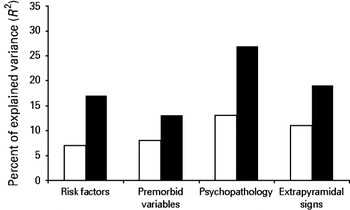
To examine the differential predictive validity of NES factors and subscales regarding illness-related variables, a series of regression analyses was performed in which NES factor scores and subscale scores were entered as independent variables. When the subscale scores were added to the factor scores, there was no statistically significant increase in the amount of variability explained in risk factors or clinical variables. When the factor scores were added to the subscales scores there was a significant increase in the amount of variability explained in the familial loading score for schizophrenia (▵R 2=0.11, F change=4.62, df=5,164, p=0.001), the McNeil–Sjöström scale score (▵R 2=0.05, F change=2.29, df=5,164, p=0.05), the catatonia score (▵R 2=0.14, F change=5.91, df=5,164, p<0.001) and the AIMS score (▵R 2=0.12, F change=5.25, df=5,164, p<0.001). We also examined the overall contribution of NES factors and subscales to each set of predictors in terms of percentage of variance (R 2) explained by the models (Fig. 1). Factor scores explained additional variance over and above that explained by subscale scores across the set of predictors.
Effect of order in hierarchical regression analyses of contributions of Neurological Evaluation Scale factors and subscales to risk factors, pre-morbid variables, dimensions of psychopathology and spontaneous extrapyramidal signs. Risk factors include familial liability to schizophrenia and obstetric complications. Pre-morbid variables include neurodevelopmental delay score, symptoms of attention deficit–hyperactivity disorder, pre-morbid functioning and deterioration of pre-morbid functioning. Dimensions of psychopathology include depression, mania, catatonia, reality distortion, disorganization and negative symptoms. Spontaneous extrapyramidal signs include parkinsonism, dyskinesia and akathisia. □, R 2 after adding subscales to factors; ▪, R 2 after adding factors to subscales.

Discussion
While many previous studies have examined the association of NSS with risk factors, pre-morbid characteristics or clinical variables, most of them have been conducted in chronic or medicated patients. A further limitation of previous studies is that they have generally examined such associations separately, and, thus, they did not address the substantial variance that is shared between risk factors, pre-morbid variables and clinical symptoms. The major advantage of the methods used here is that we simultaneously examined the independent association of NSS with risk factors, pre-morbid characteristics, psychopathology and extrapyramidal signs, as well as their incremental association in sequential regression analysis. To our knowledge this is the first study to report on the independent association of NSS with a set of risk factors, pre-morbid variables and clinical parameters in a large, well-characterized sample of first-episode, drug-naive psychotic patients.
There are three main findings of our study to be considered. First, NSS clustered together into a five-factor structure comprising the domains of sequencing, release signs, sensory integration, abnormal movements, and coordination. Second, neurological domains were independently related to familial liability to schizophrenia, obstetric complications, disordered neurodevelopment, and observable motor disorders such as catatonic and extrapyramidal symptoms. And third, the five-factor structure of NES symptoms was better validated than the original NES subscales across the different sets of predictors.
Our findings add to previous evidence that NSS are seen in the early stages of the psychotic illness, and thus they are not a byproduct of antipsychotic medication or chronicity (Browne et al. Reference Browne, Clarke, Gervin, Lane, Waddington, Larkin and O'Callaghan2000; Dazzan & Murray, Reference Dazzan and Murray2002; Dazzan et al. Reference Dazzan, Lloyd, Morgan, Zanelli, Morgan, Orr, Hutchinson, Fearon, Allin, Rifkin, McGuire, Doody, Holloway, Leff, Harrison, Jones and Murray2008; Whitty et al. Reference Whitty, Owoeye and Waddington2009). In fact, and in line with previous studies (Browne et al. Reference Browne, Clarke, Gervin, Lane, Waddington, Larkin and O'Callaghan2000), we found that a majority of antipsychotic-naive patients displayed evidence of neurological dysfunction. Accordingly, neurological dysfunction in first-episode patients seems to be directly related to the pathogenesis underlying the psychotic illness. The multidimensionality of NSS observed in the present study is consistent with prior research using the NES and other rating scales for assessing NSS, and it indicates substantial heterogeneity within NSS (Krebs et al. Reference Krebs, Gut-Fayand, Bourdel, Dischamp and Olié2000; Goldstein et al. Reference Goldstein, Sanders, Forman, Tarpey, Gurklis, Van Kammen and Keshavan2005; Sanders et al. Reference Sanders, Allen, Forman, Tarpey, Keshavan and Goldstein2005). Previous factor-analytical studies of NSS have reported between two and five factors, with no consistent item composition across factors. Our five-factor structure is not directly comparable with those reported in previous studies using the NES, mainly because studies did not include all NES items. Notwithstanding, our five-factor solution appeared to have face validity and each factor bore some resemblance to those described in one or more previous studies. It should be acknowledged, however, that our failure to obtain a satisfactory solution using the traditional Eigenvalue >1.0 and scree test criteria, along with the lack of a consistent factor structure across previous studies, clearly suggests heterogeneity of NSS that is not fully addressed by factor analysis. Heterogeneity of NSS at the phenomenological level is further confirmed by the differing association pattern of neurological domains with risk factors and clinical parameters found in our and other studies (Griffiths et al. Reference Griffiths, Sigmundsson, Takei, Rowe and Murray1998; Arango et al. Reference Arango, Kirkpatrick and Buchanan2000).
Neurological domains were related to familial liability to schizophrenia, obstetric complications or both, this indicating that the underlying aetiopathogenic mechanisms involved in psychotic disorders are well captured by neurological dysfunction (Picchioni et al. Reference Picchioni, Toulopoulou, Landau, Davies, Ribchester and Murray2006). More specifically, we found that NES factors showed a different association pattern with familial liability to schizophrenia and obstetric complications, which may reflect different aetiopathogenic mechanisms: a genetic one for the sensory integration and coordination factors, an environmental one for the sequencing and release signs factors and a mixed one (both genetic and environmental) for the abnormal movements factor. These findings highlight the need for future studies to disambiguate genetic from environmental factors when investigating the causal mechanisms, and particularly genetic influences, behind NSS. This would help to further delineate the NSS status as an endophenotype candidate for schizophrenia (Chan & Gottesman, Reference Chan and Gottesman2008).
The association of NSS with pre-morbid abnormalities clearly suggests that neurological dysfunction is the expression of a disordered neurodevelopment with genetic, obstetric and developmental-specific underpinnings. These findings are in line with high-risk and birth cohort studies showing a number of developmental and neuromotor deficits in children who later develop schizophrenia (Cannon et al. Reference Cannon, Tarrant, Huttunen, Jones, Murray, Jones, Susser, van Os and Cannon2009). Given the close relationship between pre-morbid dysfunction, and more specifically pre-morbid deterioration, and neurological dysfunction in the early stage of the illness, neurological dysfunction could be considered as a putative candidate for inclusion in the at-risk states criteria for developing schizophrenia.
Univariate analyses showed a complex association pattern between NSS and psychopathological domains, although only catatonia was independently related to some neurological abnormalities. Thus, our study contradicts previous findings relating NSS to negative symptoms. Given that no previous study reporting such an association has controlled for risk factors and pre-morbid function, findings may have been mediated by these intervening variables. Moreover, the association between NSS and negative symptoms in chronic schizophrenia may be explained by underlying factors such as antipsychotic treatment and chronicity-related degenerative processes, factors that were not operating in our patient population. The observed relationship between some neurological domains and catatonic or extrapyramidal signs raises two related hypotheses about the nature of such an association. First, the subtle motor soft signs and the observable motor syndromes are the extreme ends of a continuum of severity in motor dysfunction. Second, motor soft signs, catatonia and extrapyramidal features are all aspects of a more global motor domain. The two hypotheses are compatible with underlying basal ganglia dysfunction, along with distinct cortical–striatal dysconnectivity patterns reflecting the clinical diversity of motor behaviour abnormalities of schizophrenia (Keshavan et al. Reference Keshavan, Sanders, Sweeney, Diwadkar, Goldstein, Pettegrew and Schooler2003; Scheuerecker et al. Reference Scheuerecker, Ufer, Käpernick, Wiesman, Brückmann, Kraft, Seifert, Koutsouleris, Möller and Meisenzahl2008).
To our knowledge, no previous study has examined the comparative validity between empirically derived factors and the original NES subscales. We found that whereas the NES subscales retained important information regarding risk factors and clinical parameters, the empirically derived factors explained additional variance in predictor variables over and above that explained by subscale scores; hence, our results may inform on how to use the NES without substantially modify its original structure. In this way, our findings support the consideration of frontal release signs as an additional subscale (Dazzan & Murray, Reference Dazzan and Murray2002), which deserves to be used on its own in future studies.
Findings from the present study should be viewed in the context of some methodological limitations. First, given that our study sample was made up of in-patients, our results may not apply to the less severe first-episode patients not requiring hospitalization. Second, obstetric complications and pre-morbid variables were retrospectively assessed, which may affect data reliability. We relied, however, on interviews with the patients' mothers, whose information was supplemented by other close relatives and medical records; furthermore, we used highly structured instruments to rate these variables, and inter-rater reliability was of adequate standard, all of which minimizes reliability bias. Third, given the exploratory nature of the study, we decided not to correct for multiple comparisons but to rely on the strength of the associations for interpreting the findings. Notwithstanding, most of the significant associations in the multivariate analyses were in the range of p<0.01, which corresponds to the p value if we had applied the Bonferroni correction method considering the five factor-derived neurological domains as a family of hypotheses (0.05/5). Fourth, our five-factor solution of NES items left unexplained a substantial proportion of the variance to account for correlations among items, and a few items had low loadings on a given factor. Notwithstanding, we argue that the five-factor solution has external validity because of both its distinctive association pattern with predictor variables and its higher predictive value against subscales.
Note
Supplementary material accompanies this paper on the Journal's website (http://journals.cambridge.org/psm).
Acknowledgements
We acknowledge the financial support of the Ministerio de Educación y Ciencia (SAF2008-05674-C03-02) to V.P., and the Departamento de Salud del Gobierno de Navarra (946-2005 and 55-2007) to M.J.C.
Declaration of Interest
None.