Convicted felons at the Old Bailey and on assize in nineteenth-century England had no right of appeal. They had either to submit to their fate or, if they had the means, petition the Crown for a pardon.Footnote 1 The legal avenues for redress were limited. A writ of error would lie to a superior court for legal errors that appeared on the face of the record but by the nineteenth century this was seldom used.Footnote 2 More significantly, it was open for the trial judge to reserve questions of law for the informal and private consideration of all the common law judges. In their illuminating studies of this practice in the eighteenth and early nineteenth centuries, James Oldham and Randall McGowen elucidate the ways in which the judiciary used reserved cases to develop legal doctrine and to shape the operation of criminal justice.Footnote 3 The trend toward increased formalization of procedure that they identify, culminated in 1848, when Parliament created the Court for Crown Cases Reserved (CCCR). The new court adopted the existing method of reserving cases, but was a court of record that sat and gave judgment in public. It became the highest judicial forum for the determination of questions of criminal law until 1908, when it was superseded by the Court of Criminal Appeal.
Although some of its individual decisions are well known, the scope and nature of the CCCR's work have not been the subject of scrutiny. Scholarly attention has been drawn elsewhere in what was a key formative period for English criminal justice. The institutional structure of the system assumed a recognizably modern form in the nineteenth century and the first sustained attempts were made to rationalize the substantive law. Accounts charting these developments emphasize growing uniformity. Historians have traced the emergence of a more impersonal, rule-based, predictable system that was considerably less dependent than previously on the discretion of individual decision makers.Footnote 4 The lack of a fully-fledged court of appeal appears anomalous in this context. As one historian has put it: “The one area in which there was scarcely any progress was that of appeals.”Footnote 5
Judges feature prominently in explanations for this lack of progress. Indeed the judiciary seldom appears in anything other than negative terms in the history of nineteenth-century criminal law. Their opposition to key measures of reform such as the repeal of the capital laws, the establishment of full defense by counsel, and any proposals to codify the criminal law, has established their reputation as stubborn reactionaries. In the area of appeals their arguments were at least effective. They accepted the need for the CCCR, but successfully resisted further attempts to establish a more powerful appeal court. Nonetheless, when set against the rapid pace and scope of criminal justice reforms in the nineteenth century, the judges' arguments are easily dismissed as outmoded, self interested and ultimately futile.
This article argues that they have a wider significance and were informed by a clear and consistent vision of the proper role for a court of review within the criminal justice system. The role envisaged was limited by the judges' desire to preserve the position of the trial at the heart of the criminal justice system. The first part of the article examines the judges' views in the context of the broader political debate on the question of criminal appeals. It identifies the set of beliefs about the criminal law that underpinned the higher judiciary's responses to the frequent attempts to reform appellate procedures that were made throughout the period. The next part of the article examines the extent to which these beliefs found space for expression in the courtroom. It concentrates on cases reserved for the CCCR from the Old Bailey, to investigate how and why decisions to reserve were taken by trial judges. The Old Bailey provides a good focus because the trial reports are detailed and because it is the only court for which all of the results of appeals to the CCCR are available.Footnote 6 The argument then turns to the decisions of the CCCR itself. A full evaluation of the Court's jurisprudence is beyond the scope of the article, but it aims to elucidate judicial attitudes toward the criminal law and the means of its development. It will contend that the judges' restrictive approach to the work of the CCCR is revealing of the limits that were set on the systematizing projects of Victorian law reformers.
I. Judicial Politics and the Movement for a Court of Criminal Appeal
There were numerous attempts in the nineteenth century to establish a court of criminal appeal.Footnote 7 The first efforts were made in the 1830s and were part of a broader movement for criminal law reform that led to the establishment of professional police forces, of full defense by counsel, and to the abolition of England's “bloody code.” In civil law, attempts were also being made to rationalize appeals procedures through the middle decades of the century. New courts were established to hear appeals from Chancery and the Superior Common Law Courts.Footnote 8 Reformers wanted to make the administration of the law more regular and predictable. They argued that a court of criminal appeal would provide a safeguard against wrongful convictions that was formal, legal, and transparent, in contrast to the private process of petitioning the Crown for mercy for which no one could be held accountable. It would also facilitate the development of a principled common law, which could then be applied consistently in trials. One leading proponent of an appeal court, Charles Greaves, argued that it would “have a great tendency to settle the criminal law on a uniform and certain basis; and no law … requires such certainty … as the criminal law.”Footnote 9
The need for a more certain criminal law was keenly felt in certain quarters in mid-nineteenth-century England. The law had been the object of a sustained critique for some decades previously, which focused not just on the bewildering agglomeration of penal statutes but also on the quality of the common law. The Royal Commission on the Criminal Laws in 1833 commented: “It is remarkable that very few principles are stated in the judgments of the Courts upon Criminal Cases.” In 1839, it criticized the “confusion of rules and principles” in the common law and “the inconsistencies and contradictions of its provisions,” which were frequently inapplicable to “the requirements of a civilised nation.”Footnote 10 The Commission sought to replace this confused mass with a criminal law containing well-defined offenses and a clear conception of criminal responsibility.Footnote 11 Its attempts to do so by means of a code failed, but its call for an appeal court in 1845 provided momentum for reformers in Parliament.Footnote 12
Further impetus was provided in the mid 1840s by a number of cases in which the informal process of reserving points seemed inadequate and caused considerable public disquiet. The most prominent example came in the case of the “Brazilian Pirates” who were tried for murder in 1845. The trial judge, Baron Platt, initially refused to reserve a question of jurisdiction on the basis that it was not right to allow the public to suppose that there was any doubt on the subject and his own opinion was “very strong upon the point.”Footnote 13 The prisoners were convicted and sentenced to death. Platt subsequently relented and the case was considered by almost all of the judges six months later. They heard lengthy argument from counsel before eventually deciding by a majority of eleven to two that the convictions were unsafe The report of the case contained no judgment from the majority and only a short note recording the opinions of the two dissenting judges, Baron Platt and Lord Chief Justice Denman.Footnote 14 Following a very high profile trial, conviction, and death sentence, this muted outcome almost six months later seemed very unsatisfactory to many observers. It prompted calls for an appeal court from outside Parliament and triggered discussions among the judiciary and at the Home Office. Denman was particularly unhappy with the result and the process. The Home Secretary, James Graham, investigated and early in 1846 made a promise in Parliament of a government bill on the subject.Footnote 15 This promise was not fulfilled, but the subject did not disappear. In 1847, the Law Times referred to the lack of an appellate remedy on the facts in criminal law as “the disgrace of our jurisprudence and the greatest blot upon the civilisation of our age.”Footnote 16 Examples of injustice, some of which involved mistakes of fact and others mistakes of law, were not hard to find and proponents of an appeal court routinely referred to such cases in parliamentary debates.Footnote 17 In 1848, the lawyer and reformer Fitzroy Kelly was able to refer to a number of instances in which a judge had initially refused to reserve points of law that were subsequently held by the common law judges to be meritorious.Footnote 18
The government took the initiative with the introduction of a bill in the House of Lords by Lord Campbell in 1848.Footnote 19 The result was the establishment of the CCCR.Footnote 20 The Court gained jurisdiction to hear cases reserved from the quarter sessions and adopted a more formal procedure than that which had obtained under the previous system. In the event of a conviction, the trial judge could respite the judgment and then state a written case for the CCCR. Reserved cases would be heard before at least five judges including a Chief Justice or Chief Baron, would take place in public, and would usually, but not always, involve argument from counsel.Footnote 21 Jurisdiction vested in the High Court following the Judicature Acts (1873–75) and, from 1881 onwards, the Lord Chief Justice presided over all sittings.Footnote 22 The Court was meant to deliver its judgments with reasons in open court. This contrasted with previous practice: the twelve judges had met in private and had often not given reasons or, on occasion, any kind of decision. The new Court also had power to quash convictions, whereas previously the judges had only been able to recommend a pardon. From the reformers' point of view, the gains made in terms of transparency were outweighed by the severe limitations that remained. The Court's jurisdiction was confined to points of law and it was contingent upon the willingness of the trial judge to reserve the point. Therefore, the reform did not bestow any right of appeal or supply any means of remedying factual errors made in the trial. It was, as The Times commented, by “some extraordinary perversion of terms” that the Court became known to many contemporaries as the Court of Criminal Appeals.Footnote 23 The Court had no power to order a retrial and no power to alter the sentence.
The establishment of the CCCR did not satisfy the reformers who continued to demand a court of appeal with full powers of review for the remainder of the century in Parliament and in the press. Legal periodicals carried numerous articles putting the case for change. The Law Times and its editor, Serjeant Cox, campaigned persistently for reform.Footnote 24 The issue was regularly debated in other forums including meetings of the National Association for the Promotion of Social Science.Footnote 25 Scandalous criminal cases and the bills before Parliament also ensured that the issue appeared regularly in newspapers in which reformers found fluctuating support. The Times, for example, having initially supported the case for an appeal court in the 1840s, opposed it in 1860.Footnote 26 Bills continued to be brought throughout the century either in the light of some new miscarriage of justice or as part of a wider package of law reform, but they all failed.Footnote 27
The fact that reformers were unable to establish a right to appeal on the facts or to bypass the discretion of the trial judge in 1848, or over the next 60 years, owed much to the resistance of the judiciary. The judges' reasons for blocking attempts to create a court of appeal with full powers of review were expressed with consistency before parliamentary committees and in parliamentary debates on the subject throughout the second half of the nineteenth century. A number of their objections were practical. They asserted that there was insufficient capacity within the judiciary to deal with the increased volume of cases that would result.Footnote 28 The cost of any such system was also cited as an insuperable obstacle. Every convict would appeal if the right was to be at public expense, but any other system would handicap poor prisoners. Furthermore, prosecutors could hardly be expected to bear the additional cost of an appeal, given the difficulty involved in inducing them to prosecute at all.Footnote 29
These types of objection exasperated contemporary reformers and have contributed toward the judges' reputation for being deeply conservative politically and intransigently opposed to change.Footnote 30 Closer examination reveals a more complex picture. The politics of the judiciary were varied. The higher judiciary had diverse party affiliations while many of the puisne judges had no obvious political allegiance, but owed their positions to their technical expertise.Footnote 31 Although they often presented a unified position in response to proposals for reform, judges were not uncritical defenders of the existing criminal law. Chief Justices Denman and Campbell were prominent in their sponsorship of criminal legislation. In the context of appeals, judges regularly expressed concern about the existing processes. In the aftermath of the case of the Brazilian Pirates, Denman was moved to write at length to the Home Secretary, Sir James Graham, setting out the reasons for his dissent and his general view that the process of reviewing criminal cases was unsatisfactory and in need of reform. Denman saw the lack of publicity and a lack of sense of responsibility among the judges as key problems, but his solution was to make the proceedings in reserved cases public and subject to scrutiny. He did not favor allowing a full right of appeal for the prisoner on the facts.Footnote 32 In effect Denman outlined the compromise that was reached a few years later when the CCCR was created.Footnote 33 The fact that the bill had been drafted by Barons Alderson and Parke and was steered through the Lords by Campbell may explain its success.
At various points during the remainder of the century, members of the higher judiciary spoke out in favor of limited revisions of the appellate procedures. Lord Chief Justice Cockburn thought the CCCR should have power to grant a new trial.Footnote 34 In 1879 there was clear judicial support for a measure of reform when a Royal Commission comprising Lord Blackburn, Justice Barry, Lord Justice Lush, and James Fitzjames Stephen proposed a new criminal code that included provision for a court of appeal, albeit with limited powers.Footnote 35 An 1883 government bill that provided for an appeal on the facts in capital cases attracted the support of Lord Chief Justice Coleridge and the Master of the Rolls, Lord Esher.Footnote 36 Stephen, the pre-eminent criminal lawyer of the age as writer and judge, vacillated on the question. In 1863 he favored the establishment of a court of appeal that could hear cases referred to it by the trial judge or Home Secretary.Footnote 37 In 1877 “further experience and reflection” led him to switch his preference to allowing motions for new trials, but shortly thereafter he concurred in the 1879 Royal Commission report.Footnote 38 Finally, in 1890, he declared himself to be opposed to an appeal court and broadly supportive of the existing remedy of securing a pardon from the Home Office.Footnote 39 The Council of Judges passed a resolution in 1892, which was in favor of establishing an appeal court with power to review sentences, but with only a very limited right to review convictions.Footnote 40
If the members of the higher judiciary were not uniformly opposed to reform, most shared a set of beliefs about the criminal law and its administration that could not accommodate a full right of appeal or a fully-empowered appeal court. At the heart of their approach was the desire to retain the primacy of the jury trial as the site for administering criminal law. Denman argued that the “great object ought to be to make the first trial in all respects perfect and final.”Footnote 41 Stephen justified his change of mind in 1877 by observing that “it is more in accordance with all our habits to let the final decision of all questions of fact rest with a jury than to send them before a small number of specially selected judges.”Footnote 42 The drastic reduction in the use of the scaffold in the early part of the century meant that the trial became the focal point of the Victorian criminal justice system. The judges' determination to preserve this state of affairs persisted into the twentieth century. In 1906, Lord Chief Justice Alverstone declared that the “bedrock and foundation” of the criminal justice system was “the recognised duty of the prosecutor to make out his case upon the facts so as to satisfy a jury, and that from the verdict of that jury there is no appeal on questions of fact.”Footnote 43
The judges' emphasis on the role of the jury was multi-faceted. They expressed fears that an appellate mechanism would diminish jurors' sense of responsibility and could even prompt them to convict in doubtful cases, secure in the knowledge that their decision could be reviewed.Footnote 44 They also expressed substantial confidence in the jury and its capacity to reach correct verdicts. Justice Willes was satisfied that juries were “indefatigable in watching the case for the prosecution to see if it be sufficient,” while Baron Martin was convinced that an “English jury will attend to what you tell them, and apply their minds to what you tell them is the question, and they will give an honest verdict upon it.”Footnote 45 These views were shared by most of their brethren who maintained that the danger of a wrongful conviction was very slight. Indeed, few of the judges who gave evidence before parliamentary select committees in 1848 and 1866 could recall any in their long experiences.Footnote 46 This publicly expressed confidence in the jury and their verdicts appears to have been undiminished among the judiciary toward the end of the century. In 1889, Lord Herschell admitted the possibility of wrongful convictions but thought that their occurrence was very “seldom.”Footnote 47 In any event, the royal pardon was available to prevent injustice and judges could be relied upon to highlight such cases to the Home Office.
These expressions of faith in the jury were a convenient means of serving arguments against an appellate court or any further reduction in capital punishment. Judges' confidence in juries had important limitations: they did not trust juries to reach decisions on difficult questions. Indeed they viewed the relative simplicity of the criminal law as a great benefit because it ensured that the questions put to juries were uncomplicated.Footnote 48 This in turn reduced the scope for unwarranted acquittals. Baron Bramwell rejected a proposal to allow English juries to make a finding of extenuating circumstances as was possible in France, on the grounds that it would require considerable explanation, especially for country juries, and “anything which multiplies distinctions and the chances of escape to a criminal is much to be deprecated.”Footnote 49 Having an appeal court raised the prospect of the criminal trial becoming encumbered with fine technical points of law.
Proponents of reform argued that it was unjust for there to be a right of appeal in relatively minor civil cases, but no such right where a prisoner's life was at stake.Footnote 50 Judges responded that one of the great advantages of the criminal law was its clarity and capacity to deliver a clear public message. Baron Parke contrasted the “abundantly clear” criminal law with the more complicated civil law.Footnote 51 The purpose of an appeal in civil law was to give satisfaction to the parties who could bear the cost, but the criminal law had to establish the truth and, crucially, satisfy the public.Footnote 52 The best means of achieving this objective was to ensure that justice was administered speedily and with no room for doubt as to its finality. Baron Platt's refusal to reserve the “Brazilian Pirates” case was explicitly based upon the need to remove any public doubt about the prisoners' guilt.Footnote 53
Deterrence was central to the judges' approach. Denman expressed fears prior to the 1848 Act that judges were too ready to reserve cases and from “this hesitation some want of confidence in the law would be felt by the bystanders and the public; the delay of passing sentence diminished its effect as a lesson and example.”Footnote 54 Lengthy processes of appeal and a court with the power to overturn the jury's verdict would undermine the necessary qualities of speed and finality that characterized the existing system and facilitated its deterrent effects. This was a consistent point of difference between judges and proponents of a court of criminal appeal throughout the nineteenth-century debates on the subject. There was agreement that the criminal law needed to maintain public confidence, but whereas reformers believed that this was best achieved through the certainty and safeguards provided by an appeal court, judges favored combining a “reasonable degree of certainty” with a “great degree of despatch.”Footnote 55 For the remainder of the century the judges remained committed to the view that the sentencing speech in court and the swift execution of the sentence thereafter were the best means of expressing authority and suppressing crime. They continued to pass exemplary, severe sentences for offenses that were prevalent in particular localities. The resulting inconsistency attracted substantial criticism but attempts to address the disparity in sentencing practices came to nothing.Footnote 56
The judges accepted that their approach was unlikely to result in the formulation of a more precise, rule-governed criminal law. Indeed, to the extent that it preserved consonance between the law and the public's understandings of it, they actually welcomed the imprecision. Stephen, who did more than any other Victorian judge to bring clarity to nineteenth-century English criminal law, argued that the jury's verdict supplied “as high a standard of certainty” as was possible in the context of a system that was concerned with practical rather than philosophical inquiry. He emphasized the important role that the jury played in securing wider public support for the administration of justice.Footnote 57 Justice Erle asserted that “there is more practical sense and right feeling in a verdict than in any other known form of expressing a moral opinion.”Footnote 58 The danger that this moral opinion might be obscured by legal form prompted judges to condone juries' mitigating practices in certain circumstances.Footnote 59 The need to accommodate public opinion also explains their unexpected decision to sanction reviews of sentences at their council in 1892 at a time when there was substantial public disquiet surrounding sentencing practices.Footnote 60
A consistent theme in the judges' approach to the question of criminal appeals and indeed the criminal law more generally was the desire to preserve the space for discretion to operate in trials. The judges' vision could accommodate the mediating practices of juries and prosecutors and, most fundamentally, it preserved the judge's position at the core of the trial and the justice system. The few proposals for an appeal court that met judicial approbation usually made the appeal subject to the permission of the trial judge and did not introduce any right of appeal for the prisoner.Footnote 61 Many defended the existing system by arguing that trial judges invariably reserved doubtful points of law and secured a pardon if there was any risk that a miscarriage of justice had occurred. These attitudes were self-interested insofar as they sought to preserve judicial conduct in trials from scrutiny, but the preservation of judicial power could have been achieved in other ways. Indeed, a court of appeal with full powers of review would arguably have been a more effective means for the higher judiciary to exercise a greater degree of control over what passed in trials, particularly those involving quarter session judges or part-time assize judges. Yet judges showed little inclination to support legislation that would have given them greater powers to intervene in the day-to-day workings of criminal justice. Criminal law was best administered locally without fear of central interference and control.
II. The Judicial Approach to Reserving Cases
The common law judges' belief that the scope for review of criminal trials should be very limited is reflected in the small volume of cases heard by the CCCR.Footnote 62 In 1849, the first full year of its operation, it heard twenty-seven cases. This was almost double the number of cases that had been reserved for consideration by the common law judges in 1847, but the rise was attributable to the inclusion of cases from the quarter sessions. In the period from 1849 to 1870, the court heard an average of twenty-six cases per year. Of these, a little more than half were reserved from the quarter sessions. In the period after 1870, the Court's caseload dropped below twenty cases per year. This decline continued in the 1890s and 1900s when the average number of cases fell to single figures.Footnote 63 When it is considered the Court of Criminal Appeal heard 618 cases in its first full year of operation in 1909, the limitations of its predecessor become clearer still.Footnote 64 The 115 cases reserved at the Old Bailey accounted for just over ten percent of the CCCR's entire caseload in the period 1848-1908.Footnote 65 Most fell in the first half of the period and there was a tailing off in the final twenty-year period, mirroring the general pattern for the CCCR.
The small and diminishing caseload of the CCCR was a direct result of the limited extent and quality of legal discussion in trials and the attitudes of the judiciary toward reserving cases. On assize, counsel and judges had limited access to books of authority. This was less of a problem in London, but this by no means guaranteed that the relevant authorities would be cited.Footnote 66 In the ordinary run of trials, counsel had very little, if any, preparation time. If counsel or the judge was unfamiliar with the area of law at issue, it was unlikely that they would pick up on difficult points. Moreover, a high proportion of trials in the nineteenth century took place without defense counsel, in which case the possibility of reserving a case rested solely upon the judge's knowledge or, perhaps more significantly, willingness to doubt it.Footnote 67
Where the question of reserving a point was raised it was usually by the defense counsel. The judge did not feel obliged to accede to a request to reserve a point and often refused.Footnote 68 The reluctance to reserve points was partly a consequence of the fact that the CCCR had no power to order a retrial. Reserving a case ran the risk of having an offender who was obviously blameworthy having his or her conviction quashed. The CCCR quashed just over one quarter of the convictions referred from the Old Bailey.Footnote 69 The risk prompted prosecution counsel to withdraw evidence that the judge had doubts about and was minded to reserve, when it could afford to do so.Footnote 70 On occasion the defendant would take advantage of an offer from the judge not to reserve a point to avoid the delay attendant upon bringing a case before the CCCR.Footnote 71 The CCCR met infrequently, so it could be months before a case was heard and even then there was a risk that it would be adjourned.Footnote 72 If the defendant was unable to find sureties for bail, this prospect of delay would operate as a powerful disincentive to press for a case to be reserved.Footnote 73
Trial judges adopted a very restrictive approach to reserving cases, confident in the knowledge that there was very little chance of censure. The only avenue for redress available to defendants was to seek a royal pardon, in which case any subsequent doubts that the trial judge felt could be communicated to the Home Office privately and a pardon (often only conditional) granted. The judges' limited outlook was also clearly evident in the decisions of the CCCR itself concerning its own jurisdiction. In the first twenty years of its operation, it ruled that it had no jurisdiction where a guilty plea was entered and no power to amend the indictment.Footnote 74
Given the highly discretionary nature of the power, it is unsurprising that at the Old Bailey, trial judges' practice in reserving cases varied considerably. Judges at the Old Bailey included city judges as well as common law judges.Footnote 75 In practice, the majority of serious trials were presided over by one or two of the two common law judges allocated to each session, with the city judges dealing with the remainder. The presence of a number of judges at the Old Bailey allowed for consultations on points of law either before or during the course of the trial.Footnote 76 On assize, where judges usually travelled in pairs with one taking the civil side business and one the crown side business, there was also the opportunity to consult on difficult points. This provided a ready means of resolving issues of law and reduced the need to reserve cases. Judges could meet counsel's objections with confidence if they had the support of one of their brethren.Footnote 77 It was not uncommon in more serious cases for two judges to sit together.Footnote 78
The facility to consult other judges went some way toward obviating the need for reserving points, but it was not a systematic means of raising and debating points of law. There is little evidence of any convention among the judiciary regarding when a question should be reserved or a further opinion sought. This is reflected in the large variations in individual judges' practices at the Old Bailey. Just less than half of the reserved cases from the Old Bailey were tried by the recorder or one of the other city judges.Footnote 79 Some judges, such as Russell Gurney whose service as a city judge at the Old Bailey extended between 1850 and 1877, regularly reserved cases. During his twenty years as recorder of London, he was responsible for one quarter of all Old Bailey reserved cases.Footnote 80 Gurney had a particular interest in the development of the criminal law. He was an active law reformer as a member of Parliament and drafted, with the assistance of his cousin, James Fitzjames Stephen, a homicide bill in 1872.Footnote 81 His detailed knowledge of the criminal law prompted him to use the CCCR to clarify uncertain points.Footnote 82 Gurney was exceptional and held in high regard. Other city judges were less able and much less willing to reserve cases. Commissioner Kerr, a judge of the Sheriff's Court, who sat regularly at the Old Bailey during his forty-year tenure (1859–1901) reserved two cases in his first year, but thereafter averaged one per decade. Others, such as Sir Thomas Hall (1892–1900), and Forrest Fulton (1892–1907), only reserved very infrequently, if at all.Footnote 83 There was also variation in the practice of reserving cases among the common law judges, although it is difficult to make comparisons as they attended the Old Bailey with varying frequency. Some, such as Chief Justice Cockburn, did not reserve any of the cases that they tried at the Old Bailey, whereas others such as Baron Alderson seemed more willing to do so.Footnote 84
In view of the light caseload of the CCCR, fears about overburdening it could scarcely have justified the judges' highly restrictive approach to reserving cases. More pressing would have been a reluctance to subject their reasoning and decisions to scrutiny. The city judges may have felt this concern more acutely, but the CCCR was only marginally more likely to quash convictions in cases tried by city judges than it was in cases reserved by common law judges.Footnote 85 In addition to these concerns, certain types of case were deemed unsuitable for consideration by the CCCR. Judges may have shared the concern expressed by one city judge not “to burden the Court for Crown Cases Reserved with merely fanciful cases that lead to no result.”Footnote 86
Unsuitable cases for the CCCR did not necessarily involve less serious crimes. In the homicide case of R. v. Sattler,Footnote 87 the two judges who tried the case, Baron Martin and Justice Willes, had a basic disagreement as to how the jury should be directed. The defendant had killed the police officer who had arrested him in Hamburg on suspicion of theft in England. The case raised a question of jurisdiction but also a point as to whether the prisoner was in lawful custody and, if he was not, whether the killing was necessarily only manslaughter on grounds of provocation. The defense counsel urged the judges to reserve the point but despite their disagreement and “the great difficulties” involved in the case, Martin and Willes felt unable to formulate a question for the CCCR. Their reasons are not reported, but in view of the uncertainty, they decided it was a question “upon which the Jury must pronounce.”Footnote 88 The case was only reserved when, following another similar case, the Home Secretary made a direct request for Martin to state a case for the CCCR.Footnote 89
Sattler involved two experienced common law judges and a clearly identified point of law in dispute. In cases in which questions of law were mixed with other issues, judges expressed a preference for resolving the case during the trial. This can be illustrated with reference to cases involving members of a religious Sect called the “Peculiar People” who believed that prayer, rather than medical science, was the best means of curing illness. A number of their members were prosecuted for the manslaughter or neglect of their children. The cases prompted considerable contemporary interest and raised difficult religious, medical, and legal questions.Footnote 90 The legal issues focused upon whether parents owed any legal duty to their children to procure medical aid in the event of illness and, if there was such a duty, whether an honest belief that faith healing was a more effective remedy than medicine could afford a defense. A batch of cases at the Old Bailey in the late 1860s and 1870s prompted a range of inconsistent judicial answers to these questions. Justice Willes steered the jury in R. v. Wagstaffe toward an acquittal by stating that it was a case in which “affectionate parents had done what they thought was best for the child.”Footnote 91 In the cases of R. v. Hurry and then R. v. Downes, Justices Byles and Blackburn instructed juries that there was a duty and that they should convict if satisfied that neglect had occurred.Footnote 92 In the intervening case of R. v. Hines Baron Pigott withdrew the case from the jury on the grounds that it was not “a case for a judge to deal with in a Criminal court.”Footnote 93
The judges were reluctant to refer to the CCCR despite the evident divergence of judicial opinion. They preferred to negotiate a solution in the trial than to seek a formal resolution in the CCCR. Byles was dissuaded from reserving the case of Hurry by an assurance from the defendant that he had no wish to break the law and by evidence of his exemplary character. Blackburn reserved the case of Downes, but only after he had suggested during the course of the trial that the prosecution would be satisfied by an assurance from the Peculiar People that they would seek medical aid in future.Footnote 94 The cost of this approach was legal uncertainty. Indeed, the CCCR upheld the conviction of Downes on the basis of a statute, not cited in the trial or in any of the previous cases, which made it a summary offence for parents to neglect to procure medical aid for their children when they were able to do so.Footnote 95 The “discovery” of the statutory basis for the duty is all the more remarkable for the fact that the statutory clause in question appears to have been enacted specifically in response to Wagstaffe's acquittal. The judges' preference for the trial as the forum for addressing the sensitive issues in these cases is also reflected in the CCCR's decision in Downes. The judgments were short, rested entirely on the statute, and did not clarify whether the parents' duty was absolute or whether the standard was one of negligence.Footnote 96
The judges' reticence to reserve cases persisted through the remainder of the century. The fact that the CCCR's caseload diminished as the century progressed suggests that the reticence may have increased.Footnote 97 The variability in practice extended to the mode in which cases were reserved and then stated for the opinion of the CCCR. Rules of court were issued in 1850 that contained instructions as to what should be contained in the statement of case, but some trial judges included much more detail than others.Footnote 98 In some trials the judges asked juries specific questions in order to frame the issue to be discussed before the CCCR.Footnote 99 Other judicial statements of case amounted to little more than a recapitulation of the evidence and a question as to whether the conviction could be supported. It is also clear that some judges did not fully understand their own role or that of the CCCR. In the case of William Tatlock in 1876, Commissioner Kerr confused himself when asking the jury a series of questions before formulating his own for the CCCR. Chief Justice Cockburn was not impressed, but felt powerless to act: “It appears to me plain that there has been a miscarriage in this case. But I scarcely know in what position we are placed as to the decision we can pronounce; … it being to my mind perfectly plain, not only that the right questions have not been put to the jury, but also that their answers to the questions as put are directly contrary to the evidence. The proper remedy would be for a new trial; but that we have no authority to direct.”Footnote 100
III. The Scope of Review
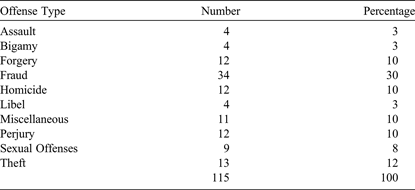
The types of cases that were reserved from the Old Bailey give a clear indication of judicial attitudes (Table 1). A large proportion involved fraud or forgery. These cases were most likely to involve difficult questions of procedure, evidence, or statutory interpretation and often hinged on issues of civil law. This was especially apparent in the disproportionately high number of reserved cases involving bankruptcy. Bankruptcy was not a crime, but bankrupts who had failed to surrender or who sought to defraud creditors could be the subjects of criminal prosecutions. These fraud cases involved the interpretation of the bankruptcy laws, which were very complex. They often turned on the adequacy of the previous summonses or the interpretation of accounting practices in the light of detailed legislation.Footnote 101 Cases involving bankruptcy accounted for just more than 6 percent of the cases reserved but only 0.6 percent of trials at the Old Bailey for the whole period.Footnote 102
Old Bailey Cases Reserved for the CCCR, 1848–1908a
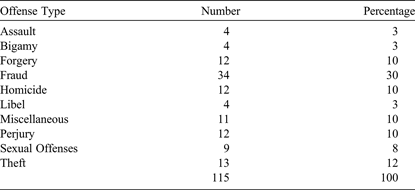
aThese figures are based on the Old Bailey Proceedings Online (http://www.oldbaileyonline.org/), reports of CCCR cases in the English Reports, Cox's Criminal Cases and the Law Reports and the records of outcomes in the National Archives, Crim 12. Fraud includes offenses involving deception such as obtaining by false pretenses, embezzlement, and offenses relating to bankruptcy. The category of miscellaneous includes arson, malicious damage to property, deserting a child, keeping a betting house, kidnapping, perverting the course of justice, public nuisance, selling bodies for dissection, and unlawful assembly.
The technical nature of some of these cases reflects continuity with the previous era of the “Bloody Code” when the volume and scope of capital statutes encouraged judges to adopt very narrow interpretations of legislation and to insist upon strict procedural regularity. This theme persisted in the CCCR's jurisprudence despite the fact that the “Bloody Code” had been substantially repealed. The CCCR heard a steady stream of cases from the Old Bailey, which concerned the adequacy of the indictment. There were legislative attempts to minimize the scope for acquittals based upon technical faults with the indictment, but problems remained.Footnote 103 It was still common for the indictment to contain a large number of counts, each describing events slightly differently to avoid a variance between the indictment and the evidence. This generated numerous reserved cases from the Old Bailey. For example in R. v. Amos, the defendant was charged with arson. The building that had been set alight was described variously in twelve counts in an attempt to ensure that one of the descriptions matched the evidence and fell within the statute. The CCCR judges delivered a series of short judgments all of which asserted that the building in question could be described as a shed.Footnote 104 This type of case resulted from penal legislation that, despite attempts at rationalisation, continued to be drafted in very specific terms. As the period progressed, the highly pedantic, formalistic style of judicial reasoning became less prominent and some judges expressed a dislike of “fine distinctions.”Footnote 105 Nonetheless, very specific, technical cases were a staple of the CCCR's workload, prompting one suggestion for its name as the “the court for refined distinctions.”Footnote 106
The cases reserved from the Old Bailey that generated substantial debate in the CCCR tended to concern property offenses and involved discussion of civil law concepts. This is clearly evident from the cases reserved that prompted a hearing in front of the full CCCR. This procedure, triggered when the initial panel of five judges could not agree or thought a question particularly important, was only invoked once or twice a year.Footnote 107 The full court was constituted of all of the common law judges, or at least as many as could attend. Six of the nine cases reserved from the Old Bailey for the full CCCR concerned offenses that involved issues of civil law. Three concerned fraud or forgery. The judges were asked to examine complex bankruptcy proceedings, to determine the scope of the privileged relationship between solicitor and client in a conspiracy to defraud case, and to decide whether a novel attempt to gain credit through use of a forged receipt fell within the ambit of a statute.Footnote 108 Three additional cases turned on questions of public nuisance, property and contract.Footnote 109 These were significant and complex cases, but the decisions had limited implications for the day-to-day operation of criminal trials at the Old Bailey. The other cases from the Old Bailey reserved for the full court focused upon issues that arose from particularly unusual or novel facts. These included the high profile cases of R. v. Keyn and R. v. Clarence, but neither addressed issues of criminal law that were likely to arise in trials on a regular basis.Footnote 110
The Court's preoccupation with questions that had a civil law dimension reflected the judges' expertise. Many had limited experience of practicing in criminal courts and few showed much interest in criminal jurisprudence.Footnote 111 Lord Campbell, for example, had a very active dislike of criminal work on circuit: “[M]y spirit almost dies away when I think that I am to pass the remainder of my days in hearing witnesses swear that the house was all secure when they went to bed, and next morning they discovered that the window had been broken and their bacon gone.” He did not relish going to the Old Bailey, while “the horrors of the gaol in Liverpool” at one assize in 1852 gave him nightmares.Footnote 112 Judges who did not share Campbell's distaste saw little intellectual challenge in administering the criminal law. Baron Parke's assessment in 1866 was that: “There are very seldom any questions of real doubt in administering the criminal law; all the questions of doubt are those connected with property and contracts.”Footnote 113 This view of criminal law restricted the scope of the CCCR's jurisprudence. The judges' belief that questions of criminal law were straightforward and ought to remain so, made them less likely to consider basic questions about criminal responsibility.
IV. Judgment in the CCCR
Judgments in the CCCR were brief. The cases that were heard before the full court generated substantial argument and usually, although not always, prompted a number of judges to express opinions in some detail. In the majority of reserved cases however, only one substantial judgment was delivered by the senior judge. The judgments were often unreserved and in some cases, especially those in the first half of the period, they are barely distinguishable from the legal argument in the report and appear, in effect, as the judge bringing the argument to a conclusion.Footnote 114 The convention that a full court had to be convened if the five judges could not agree must have deterred judges from expressing dissenting opinions and inhibited full discussion of the issues.Footnote 115 Indeed, despite the fact that the Court was supposed to give reasons for its decisions, judges often only paid lip service to this requirement and in some instances no reasons are reported at all.Footnote 116 In one case the Court failed even to reach a decision.Footnote 117
The brevity of the judgments reflected the judges' desire to confine their decision to as narrow a ground as possible. This was a feature of judicial reasoning of the period, but seems to have been carried to an unusual extent in the CCCR where judges consistently refused to stray beyond the specific facts of the case reserved to articulate anything approaching a general principle. The CCCR judges failed to set out guidance or to take meaningful steps toward controlling or structuring the approach taken in the trial. The judges may have been deterred by the difficulty involved in establishing workable tests of general applicability but they sought to avoid rather than address this problem. This cannot simply be dismissed as an evasion of professional responsibility however, it seems clear that the judges did not see it as a critical part of their role. There was a conviction among judges that the CCCR was there as a safety net to correct errors of law retrospectively, but not to issue guidance, even implicitly, as to the future conduct of trials. This may have been a legacy of the previous informal system of reserving cases in which the judges were concerned to advise the Crown as to the safety of a conviction in law. Nonetheless the same judges were taking the initiative in developing doctrine in civil cases. They viewed criminal law in different terms.
Even in cases in which an obvious solution presented itself, the CCCR was loath to circumscribe the discretion of trial participants. This is clearly manifest in the law of evidence, an area in which the judges could have taken effective measures to shape the conduct of the trial and structure the way in which the jury reached its verdict. In 1855, the chairman of the Durham quarter sessions directed a jury that it could convict on the basis of unsupported accomplice evidence. He then requested guidance from the CCCR as to whether his direction was correct.Footnote 118 It was perfectly clear that the judges in the CCCR did not agree with his direction and that they viewed it as completely contrary to established practice. Baron Parke indicated that it had been his uniform practice for twenty-five years to advise the jury not to find the prisoner guilty unless the evidence of the accomplice was confirmed. Nonetheless, the judges declined to intervene because, in the words of Justice Wightman, the issue was “one of discretion and not of strict law.”Footnote 119 This remained the position for the remainder of the century. The result was to give the trial judge complete control over the issue.Footnote 120
This approach was not confined to accomplice evidence, but extended to other aspects of evidence law where there was a conspicuous failure to develop an exclusionary rule-based system, which stands in marked contrast to civil procedure where such a system was developed.Footnote 121 The leading study of the law of evidence in the Victorian period attributes this difference to the lack of an effective appellate remedy on the criminal side.Footnote 122 Yet there was no formal bar to the development of these rules by the CCCR. The issues were clearly within its jurisdiction and it had opportunities to develop the law, which it did not take. The judges were responsible for the lack of development and it was only following the establishment of the Court of Criminal Appeal in 1908 that rules of practice hardened into rules of law.
The approach in criminal law contrasts with that taken in civil law where questions of fact were increasingly turned into questions of law by judges. This had the effect of circumscribing the role of the jury in determining outcomes.Footnote 123 There is little evidence of any concerted attempt by the CCCR to produce similar outcomes through the development of the substantive criminal law. This is not to say that trial judges did not seek to reduce the scope of jury discretion in particular contexts.Footnote 124 In reserved cases the judges seemed content to allow such developments to take place in trials. The judges in the CCCR did not consider it their duty to elucidate the meaning of key fault terms such as intention and malice, to set out the scope of defenses or to establish the effect that intoxication should have on criminal liability. These issues arose but critics at the time and legal historians since have struggled to discern any coherent framework emerging from the decisions.Footnote 125
The judicial treatment of the term “malice,” a key ingredient of numerous felonies, provides a good example. The obscurity of this term, its ubiquity and the failure of the legislature or judiciary to ascribe to it any consistent legal meaning was the source of much criticism from those concerned to clarify the criminal law.Footnote 126 The CCCR had a few opportunities to address the issue, but when they arose it failed to act decisively. In R. v. Ward, a full court of fifteen judges had to consider a case in which a man had shot and wounded the prosecutor, having intended only to fire a warning.Footnote 127 He was convicted of unlawful wounding at the Suffolk assizes, but Chief Justice Cockburn reserved the question as to whether malice was an ingredient of the statutory offense and, if it was, whether it was present in circumstances in which the prisoner had acted “without any actual malice or intention of offering violence to the prosecutor.” The judges unanimously held that malice was part of the offense and, by a majority of twelve to three, held that it was present and that the conviction was therefore proper. Cockburn delivered the only brief judgment, but offered no reasons for the decision and no indication as to who the dissenting judges were or as to their reasons. Some insight can be gained from the reported argument in which the judges expressed a variety of views on the meaning of malice. These included an “improper motive” (Justice Lush), “want of all proper care” (Baron Martin) and “a wicked and perverse disposition” (Justice Mellor).Footnote 128 Justice Blackburn was more specific, suggesting that “a man acts maliciously when he wilfully does that which he knows will injure another person or property.”Footnote 129 In light of these diverse views and the fact that the issue was obviously deemed sufficiently important to warrant a hearing before a full court, a more detailed judgment might have been expected. Yet Cockburn felt no such obligation, something which prompted critical surprise in the Law Magazine.Footnote 130
Soon after R. v. Ward the CCCR had another opportunity to address the question in the case of R. v. Welch.Footnote 131 The defendant was charged at the Old Bailey with maliciously wounding a horse. He was actuated by a sexual motive rather than from any desire to injure the horse. At the Old Bailey, Justice Lindley instructed the jury to convict if satisfied that the prisoner committed the act “knowing that it might kill or wound the mare and not caring whether it did or not.”Footnote 132 The conviction was affirmed in the CCCR, but Lord Coleridge stopped counsel from presenting arguments to deliver an exceptionally brief judgment: “We are all of the opinion that there was malice sufficient to sustain this conviction.” He expressed no view of the adequacy of Lindley's direction, which in its terms refined the meaning of malice at least as it applied to malicious damage. As a result the CCCR did nothing to clarify the law. On the basis of Lindley's direction, the case entered the law books as one of the very earliest authorities to support fault based upon what lawyers would now call “subjective recklessness,” but it does not appear to have been cited again at the Old Bailey in a malicious damage case for the remainder of the century.Footnote 133
The issue recurred in the case of R. v. Martin in 1881 when Justice Stephen, following Blackburn in Ward, suggested that a man acted maliciously when he “wilfully … does an act which he knows will injure another.” In the same case, the Lord Chief Justice, Lord Coleridge, preferred to use a much vaguer definition of doing an “unlawful act calculated to injure.”Footnote 134 These cases became established as leading cases and legal historians have pointed to them as the antecedents of modern ideas about subjective criminal fault. It has to be recognized, however, that the majority of judges were uninterested in such conceptual distinctions and did not envisage their own role in terms of establishing a framework for their development.
The judicial approach cannot be attributed to the lack of contemporary discussion of these issues. Smith has pointed out that the presence from the 1830s of a growing body of literature on criminal law meant that judges inclined to engage in “structured, more comprehensive conceptual developments would not have lacked the supporting background intellectual wherewithal.”Footnote 135 While it was available, it certainly did not feature in many lawyers' or judges' outlook. This is reflected in professional literature. Criminal law books continued to be structured around particular offenses and contained very limited analysis of what has become known as the general part of the criminal law. As Lacey points out, the significance of this fact has been underestimated by those concerned to trace the origins of the modern principles of criminal law and responsibility.Footnote 136 But it is certainly reflected in the CCCR's practice, which demonstrates that judges continued to view the criminal law in highly specific terms. Few principles transcended the offense categories.
Contemporaries criticized judges for this approach, attributing it to their narrow professional outlook. Yet while the reluctance and disinclination to conceptualize or generalize may have reflected a conservative disposition, it also fit well with judicial view of the function and purpose of the criminal law. It was unnecessary to elaborate the meaning of criminal laws because they were clear and well understood by trial participants.Footnote 137 Such a process would also be undesirable because the trial was the best place in which to raise and to resolve questions of criminal law. In view of the prevailing judicial approach, it is not surprising that contemporaries bemoaned the lack of conceptual clarity in the meaning of key terms in the criminal law.Footnote 138
V. Conclusion
Many of the problems that were identified in the 1830s and 1840s in relation to the quality and extent of legal reasoning in criminal cases, were still present at the beginning of the twentieth century. It was only following two particularly scandalous miscarriages of justice involving Adolf Beck and George Edalji, that Parliament was eventually moved to create a Court of Criminal Appeal in 1907.Footnote 139 In the twentieth century the criminal appeal court came to occupy a central position in the criminal justice system and to be viewed as an indispensable safeguard against injustice.Footnote 140 That nineteenth-century judges did not see it in those terms has significant implications for our understanding of the Victorian criminal law.
Judges retained a strikingly individualistic notion of justice, which informed their resistance to attempts to fetter the discretion of the trial judge and jury. They believed that the criminal law should be free of complexity, flexible enough to accommodate individual circumstances, and capable of delivering a clear public message in the trial. These were deemed essential preconditions if the law was to remain an effective and efficient means of suppressing crime. The trial was central to the judges’ vision and as a result, the scope and influence of the CCCR as a lawmaking body was restricted. The content of directions to juries was, to a very large extent, deemed to be within the discretion of the trial judge. Consistency was not the primary consideration but would be safeguarded by the judges' common understanding of criminal law. They felt no compunction to articulate this understanding in the CCCR. Indeed in the cases that were reserved, it was often the trial judge's direction rather than the CCCR's judgment, that provided the more detailed consideration of the legal principles at stake.
This suggests that the trial remained a critically important site of legal development through the century. In the absence of a superior court willing to shape trial practice actively, judges and juries retained substantial powers to shape the contours of criminal responsibility. This mode of legal development did not accord with the nineteenth-century reformers' vision of a centrally formulated and consistently applied criminal law. It is clear, from the judges' resistance to the proposed reforms and their subsequent conduct in trials and reserved cases, that they did not share this vision. They held and acted upon a coherent, alternative understanding of the criminal law.