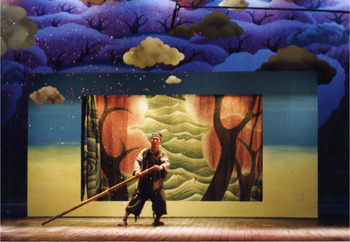
Ago, A Dream Like a Dream, and Secret Love in Peach Blossom Land
In December 2019, renowned theatre director and playwright Stan Lai (Lai Sheng-Chuan; b. 1954) premiered his latest play Cengjing rushi (Ago) in his company’s own theatre venue in Shanghai, Shang juchang (Theatre Above). In a staging reminiscent of Lai’s much-acclaimed epic play that premiered nearly 20 years ago, Rumeng zhimeng (A Dream Like a Dream; 2000), a “marathon” performance of “theatre-in-the-surround” (Sun Reference Sun2006:162), the more than five-hour-long Ago stages the entangled life journeys of a group of people punctuated by two deathly disasters: a great earthquake that forces the surviving characters to leave their village in the mountains of Yunnan Province in China; and the 9/11 attacks in New York City where they all end up 10 years after the earthquake. The poster for Ago, designed by Huang Hai, features the tops of the Empire State Building and Mount Kangchenjunga piercing through a sea of clouds, one upwards and one downwards, like mirror reflections. Across the two disasters, aspects of the characters’ lives repeat, as if a déjà vu, as stories of encounter and separation, abandonment and longing, the search for “truth,” and the quest for utopia—the “Pure Land” whose portal is believed to be located on the world’s third-highest mountain, Kangchenjunga—unfold in front of the audience’s eyes.
The Chinese title, Cengjing rushi, literally means “as it used to be.” On a metatheatrical level, within the formal and structural self-referentiality of the “past,” motifs that have recurred in Lai’s plays reappear, at once mirror-like and evolving, as if moving along their own circular course of repetition with a difference. One of the earliest plays that Lai is known for, Anlian taohua yuan (Secret Love in Peach Blossom Land; 1986), features the search for and the loss of the utopic taohua yuan (Peach Blossom Spring)Footnote 1 in a farcical reinterpretation of the classic text by the ancient Chinese poet Tao Qian (ca. 365– 427 CE). As to themes of encounter, separation, abandonment, and longing, they are central to many of Lai’s plays, which often concern life as a “journey”—from a slice of Jiang Bingliu’s journey across his nearly 40 years of life between Shanghai and Taipei in Secret Love, to a grand cyclical journey joining the protagonist’s reincarnated lives across Taipei, France, and Shanghai in A Dream. The expansive geographical scope also figures in Ago, with the characters moving through Yunnan, Shenzhen, New York, and Sikkim; but Ago comes with the subtitle “A Journey through the Illusory World,” echoing in part the notion that “life is like a dream,” as uttered in A Dream and further elevating “life as a journey” to philosophical consideration.
Lai’s more than 35 years of creation in the theatre and beyond is enormously rich and eclectic. As Yu Qiuyu characterized in 1999, Lai’s theatre uniquely engages “high art and popular culture, the tragic and the comic, the ancient and the contemporary, the Chinese and the for-eign” (in Tao and Hou Reference Tao and Hou2003:9). I would argue that Ago, which took 10 years to develop, continues the epic scale and the formal staging of A Dream, affirming that the artist’s matured philosophical and aesthetic vision had coalesced in this original total artwork.
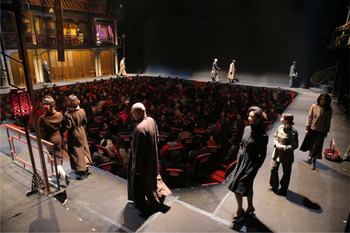
Storytelling, ritual, journey, dream, illusion, mirror, utopia, and compassion are essentially interconnected in Lai’s plays. In fact, Lai embeds references to his own plays: the prelude of Ago makes reference to the motif of the “dream,” the story-within-a-story structure, and the act of storytelling in A Dream; the prologue of A Dream subtly recalls Tao Qian’s Daoist-influenced “Peach Blossom Spring,” Tao Qian’s own fictional utopia in which he wishes to insert himself in order to flee from politics. Lai’s interest in exploring the deeper meanings behind the encounters and separations that constitute the stories—and journeys—of people’s lives should also be considered in light of his lifelong study of Vajrayana Buddhism. A Dream was the first play in which Lai explicitly included Buddhist notions of karma and reincarnation. Ago borrows from the Buddhist lore the idea of a “Pure Land,” which the highly spiritual character Dorje sings of and is supposed to lead people to find. Dorje’s lyrics beckon listeners to let go of desires and attachments, and to “wake up” from “the grand dream” that is life (Lai Reference Lai and Renaud2021c: act 4, scene 5).Footnote 2 The wraparound stage, what I call the “surrounding” stage, is where the stories unfold. At the opening, the actors perform a ritualistic walk, circling the audience seated in the middle—designated as the “lotus pond” by Lai—inspired by the Buddhist practice of circumambulating the stupa. If theatre is an art of illusion-making and life is like a dream, Lai turns theatre-going into a ritual of self-encounter and self-reflection, where an illusion mirrors a dream. As it captivates its audiences with theatrical storytelling, Lai’s theatre aspires to cleansing and blessing them through an event that is a mirror of life.
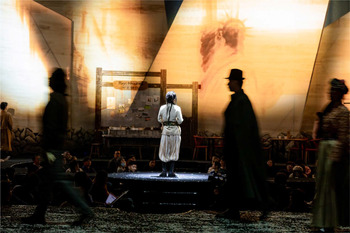
Dorje in Ago, performed by Jason Zhang, Theatre Above, Shanghai, 5 December 2019. (Photo by Wang Kai; courtesy of Theatre Above)

Eclecticism and Cross-Cultural Journeys
Stan Lai primarily works in theatre but also makes film, television, opera, and live events. He has directed 54 plays, most of which he also authored, often in conjunction with a devising process based on improvisation, a signature of his directorial style. Born and raised in Washington, DC, to a diplomat father while his mother worked in clerical and then secretarial jobs, he moved back with his parents to Taiwan in 1966 when he was 12. Lai experienced cross-cultural schisms growing up, but he also developed a sensibility for contemplating culture from shifting perspectives. As Lai notes:
My mother was a housewife, raising us two kids until they found they couldn’t make ends meet on my father’s salary. ROC was very poor at the time and diplomats made very little. She went to night school to learn how to type and take shorthand, and found a clerical job at a Savings and Loan in DC, then worked at the Smithsonian Institute as a secretary. These were the skills she used to support us as a single mother in Taipei after my father passed in 1969. (Lai Reference Lai2020b )
In 1983, Lai went back to the US to earn a doctorate in Dramatic Arts from the University of California, Berkeley, then returned to Taiwan to join the faculty at the National Institute of the Arts (now Taipei National University of the Arts [TNUA]). With Guo-Hsiu Li and Li-Chun Lee, he cofounded the Performance Workshop (PW) in 1984.
Taiwan in the mid-1980s was undergoing political liberalization and economic growth, but with little infrastructure for theatre. Lai began by developing original plays with his students using methods of improvisation adapted from Shireen Strooker of Amsterdam Werkteater who guest-taught at Berkeley during Lai’s time there.Footnote 3 The first work of PW, Na yi ye, women shuo xiangsheng (That Evening, We Performed Crosstalk; 1985), was an instant success, adapting the traditional Chinese folk performance xiangsheng (crosstalk, a kind of stand-up comedy performed by one to three comedians) to modern Western theatre. It fostered a unique sensibility of the tragicomic from a contemporary, culturally informed perspective that at once eulogizes and revives a dying tradition of joke-telling. Six of these “xiangsheng plays” were made between 1985 and 2011 and remain popular in PW’s repertoire today. The interplay between the tragic and the comic also figures in one of Lai’s most well-known plays, Secret Love in Peach Blossom Land, whose film adaptation The Peach Blossom Land (1992), also directed by Lai, was selected by several international film festivals.Footnote 4 Secret Love remains Lai’s most popular and continually staged play.
Wang Meng (left) and Yang Zhen in Secret Love in Peach Blossom Land, Theatre Above exclusive version. Theatre Above, Shanghai, 10 March 2017. (Photo by Qin Zhong; courtesy of Theatre Above)

Lai also translated into Chinese Western dramas ranging from Chekhov, Beckett, and Pinter to Tony Kushner and Alan Ayckbourn. Also notable are his translations of plays by Carlo Goldoni (1707–1793) and Dario Fo (1926–2016). Most of Lai’s translations resulted in productions with his company directed by him or guest directors, and incorporated local issues. With Goldoni’s and Fo’s plays, they also involve the embodiment of an aesthetic of comedy as first seen in Secret Love in Peach Blossom Land, in which the “Peach Blossom Land” as a play within the play was inspired by the comical farce created through improvisatory methods in the spirit of commedia dell’arte.Footnote 5 Lai also directed two original operas and three by Mozart, as well as TV shows and large-scale live events.Footnote 6 Lai pioneered an improv-based serial sitcom on television that commented on daily breaking news and world events, with a total of 303 hour-long episodes that he scripted, in 1995–97 and 2004. In 2009, he was invited to direct the Opening Ceremony of the Deaflympics in Taipei, a large-scale live broadcasted international event. He also hosted a pioneering radio show on jazz in Taiwan. In addition, he has translated books about Buddhism and written one about creativity inspired by Buddhist philosophy, Lai Shengchuan de chuangyixue (Stan Lai on Creativity; Reference Lai2006).
Lai’s most original and moving plays are tied to the rapid changes in Taiwanese society as it underwent economic development, urbanization, and globalization. The changes led to shifting attitudes and confusion for Taiwanese people regarding cultural traditions, family, romance and other interpersonal relationships, and individuals’ choices amid rampant materialism—Lai’s core themes. It turned out that many such themes are also relatable to mainland Chinese people, as they too have been coping with similar impacts of rapid development. In 1998, Lai began touring his works in mainland China and in 2015, cofounded Theatre Above in Shanghai, a venue he codesigned primarily to premiere and restage his works. Since 2013, Lai has also influenced theatre culture in China as the cofounder and director of the Wuzhen Theatre Festival, an annual international event in the scenic ancient town of Wuzhen, about a two hours’ drive west of Shanghai. Besides cutting-edge international programs, the festival’s categories of “Outdoor Carnival” and “Emerging Theatre Artists Competition” are popular with young Chinese and international artists.Footnote 7
As Lai’s work became known internationally, he broadened the geographic settings of his plays and featured cosmopolitical concerns. Lai was an artist-in-residence at UC Berkeley (2000 and 2019), Stanford University (2006/2007), and California Institute of the Arts (2016), where he taught master classes and incubated plays with multicultural and multidisciplinary students. The two epics, A Dream and Ago, were first developed at UC Berkeley with workshop presentations on campus.Footnote 8 Commenting on the Berkeley showing of Ago, Shannon Jackson wrote that Lai’s theatre allows its audience to “experience their interconnectedness at the deepest level” and is “a new kind of theatre […] equipped to respond to the pressures of the 21st century” ( Jackson Reference Jackson2019).
Stan Lai’s Storytelling
Ago opens with the actors walking and then running clockwise on the surrounding stage as if trying to escape a disaster. They fall and scream, foreshadowing the two disasters at the center of the play. Then they rise and stand still speaking directly to the audience. In a meta-commentary on the act of storytelling, with a reference to A Dream, the actors start, “Thus have I heard”—a common opening in Buddhist scriptures, marking here wisdom originally transmitted orally. The actors take turns recounting different dreams representing different forms of desire—food, clothing, social life, and even the pursuit of knowledge. Also infused throughout their dreams are “Time” and “Chance,” two abstractions that are personified and woven into the play. The actors then ponder how many kinds of stories there are in the world—36, 7, or 6, according to different “wise men”—and how an anonymous someone said that “Humankind has only one story to tell: Repeated triumph and failure, victory and folly, in the name of desire.” They end the prelude by declaring, “Thus I have heard, in a dream a long time ago” (Lai 2021c: prologue).
Storytelling is fundamental to Lai’s theatre, and we can trace the ways he tells stories through his past creations. However, it is in A Dream that storytelling is made explicit as a motif, the linchpin, the driving momentum of the play. It is also in A Dream that storytelling is intricately crafted into a distinctive theatrical presentation, in ways of staging both the narrative event and the narrated event, with the characters encountering themselves by telling stories of themselves. The theatrical storytelling imbricated within the concept of the “lotus pond” stage configuration further elaborates its ritualistic meaning.
A Dream features storytelling ingeniously structured like Chinese nesting boxes: “in a story someone tells of a dream in which someone tells a story,” according to the program of A Dream (Sun Reference Sun2006:161). The play opens when a young doctor encountering four consecutive deaths during the first day of her internship at the hospital realizes that the knowledge of medical science from school has not sufficiently prepared her to face real death. Distressed, she resorts to alternative methods of spiritual healing by asking the dying Patient #5 to tell her the stories of his life. She has been told that deep wisdom and healing can emerge from the stories a person tells in the final stage in life, and one can practice a method called tonglen, a Tibetan Buddhist meditation practice for healing, to help alleviate their pain.Footnote 9 Patient #5 tells stories of his love and exile from Taipei to France and then about tracking down an old woman, Koo Hsiang-lan, in Shanghai and hearing her story of cross-continental love and exile that took place in the first half of the 20th century. In the end, we realize that Patient #5 is the reincarnation of the French diplomat assigned to colonial Shanghai in the 1920s and 1930s who fell in love with but eventually abandoned Koo. The life journey of Patient #5 is propelled by a mysterious force in search of his past-life lover.
William Huizhu Sun points out the unusual narrative-oriented dramaturgy in A Dream, which—unlike most other plays, including other notable marathon-length plays—does not feature dramatic conflicts. It simply tells stories of encounter, abandonment, longing, and issues dealing with “the search for something lost, instead of with fighting” (2006:161). If we take Lai’s Buddhist influence into account, the larger arc of A Dream’s narrative could be understood as driven by a lengthy and mysterious process—involving extensive physical journeys and encounters across lifetimes—for Patient #5 to come to terms with his karma, with its deep causes and effects. In fact, this narrative orientation has been apparent throughout Lai’s creative trajectory, from which we can extrapolate several features that pave the way for and continue to resound after A Dream. Women doushi zheyang zhangda de (We All Grew Up This Way; 1984) features 10 stories distilled from 15 student-actors’ personal life stories. Zhai xing (Plucking Stars; 1984) is a collage of 16 scenes based on field observations of the lives of mentally challenged children. Yuanhuan wuyu (Circle Story; 1987) opens with a prologue that has actors recount the 200-year history of the once famed yunhuan (circle) area of food stalls in Taipei, connected to the play, though not directly, through a series of overlapping romances in the contemporary city. Taiwan guaitan (Strange Tales from Taiwan; 1995) is a solo performance that spins off of PW’s own brand of xiangsheng theatre, adding multimedia and a dark tone to compose a social satire with fantastical tales. Baodao yicun (The Village; 2008), made after A Dream, also highlights stories within stories, with an opening flashback narration followed by characters doubling as narrators to perform the telling of their own stories. These plays embody and accumulate elements characterizing Lai’s storytelling: stories connected to real life, the staging of storytelling as an act of narration, and different ways of casting or double-casting the performer as the narrator.
A Dream brings to the fore a more profound purpose for storytelling—to resolve the greater mystery of life as one is nearing the end of it. The very story of a doctor looking for alternative methods to treat a dying patient by asking him to tell his own stories derives from The Tibetan Book of the Dead, a well-read book for Lai, who carried it with him on his trip to Bodhgaya for a Buddhism study camp in the late fall of 1999, during which he also put together the entire outline of A Dream. It was also during this trip that Lai practiced the daily ritual of walking around the Buddhist stupa and came up with the idea of letting the stories unfold in a literal circular pattern surrounding the audience, who are sacredly honored in the center like the position of the stupa (Lai Reference Lai2006:65–68). For Lai personally, key elements of dramaturgy came together in this extraordinary moment.
The Storyteller
The storyteller, the agent of the narrative, is central to understanding the essence of storytelling. Walter Benjamin pointed out the difference between novels that are written and read in isolation and storytelling with its oral and communal dimensions ([1936] 1969:87–89). Benjamin focuses on the craftsmanship of the storyteller, who takes “his own [experience] or that reported by others” as material, and whose personal, corporeal presence remains in the story: “traces of the storyteller cling to the story the way the handprints of the potter cling to the clay vessel” (92). Moreover, and highly relevant to theatre, it is not the stories alone, nor the voices alone, that are at the heart of the storyteller’s craft, but a holistic coordination of “the soul, the eye, and the hand” (108). Most importantly, the essence of storytelling lies in wisdom, the “counsel woven into the fabric of real life” (86). Benjamin notes that at the moment of death, the storyteller crys-talizes and transmits his “real life,” just like Patient #5 does in A Dream:
It is, however, characteristic that not only a man’s knowledge or wisdom, but above all his real life—and this is the stuff that stories are made of—first assumes transmissible form at the moment of his death. […] Death is the sanction of everything that the storyteller can tell. He has borrowed his authority from death. In other words, it is natural history to which his stories refer back. (94)
With Ago Lai is fully conscious of himself as a storyteller and the power of storytelling to transmit wisdom in an enticing and open way. In its prelude Lai offers a reflection on storytelling itself. Onstage, multiple threads of the different characters’ encounters and journeys are revealed and interwoven bit by bit in front of the audience’s eyes, with each bit staged on a different spot of the surrounding stage, following a clockwise order that altogether forms a sense of the cyclical flow of events. The audience discovers “what happens next” to each character or incident, until in some instances the characters merge (such as in the big wedding, during the earthquake, or on a group expedition in search of the Pure Land on Mount Kangchenjunga), while at other moments, and eventually, they separate. Ago features a character, Tashi, who can speak with animals and thus includes a lot of “animal characters” onstage, interacting and dia-loguing among themselves and with Tashi. This adds a fantastical, otherworldly appeal and perspective to the stories of the human characters conceived as contemporaries of us in the audience. Although harboring the intention of instilling Buddhist wisdom via his theatre, Lai knows all too well that the last thing he wants to come across as is “preachy” (Lai Reference Lai2020b). The lyrics of the songs that the highly spiritual character Dorje sings in Ago are embedded with Buddhist messages in subtle, poetic ways (discussed further below), which is probably the most “direct” means of relaying them in the play. What Lai hopes to achieve is “to illuminate the [Buddhist] teachings through stories, which serve as metaphors”; “we can make allusions to the subject, and the audience can find themselves suddenly able to appreciate certain aspects of the larger debate” (Lai Reference Lai2020c).
In fact, imparting wisdom through storytelling has always been part of the Buddhist tradition. In the lead-up to Ago, Lai thought about drawing inspiration from Buddhist folklore, especially The Prince and the Zombie, which also features an ingenious story-within-a-story structure, in a logic similar to One Thousand and One Nights wherein a larger framework of storytelling may contain infinite stories (Lai Reference Lai2020a).Footnote 10 Lai had even come up with a complex outline based on this folk story, but eventually realized that it would not work: “It was a judgment call. I just didn’t feel that I had found the correct ingredients for the sprawling structure. It’s like having the run-on structure of Arabian Nights but feeling that the actual contents do not do the structure justice” (Lai Reference Lai2020c).
Discarding the idea of adapting an actual Buddhist story and its fascinating structure, Lai returned to the unrealized play of healing he conceived in 2014 for the postearthquake community in Yushu, Qinghai Province (Lai Reference Lai2019). The Yushu play was about events before and after the devastating earthquake of 2010 that killed almost 3,000 people and leveled the town. Lai was invited to conceive a work to help heal the collective trauma of the area. Titled Yushu chuntian (Yushu/Spring), the production features the surrounding stage, the circle walk, and many elements of the first movement of Ago, including characters or prototypes of the Ago characters: the two Tibetan brothers who are given supernatural powers of singing and talking with animals, the narrator who is a history major from Beijing in search of life’s meaning, vignettes of the different villagers’ lives filled with various woes and aspirations, the big earthquake that destroys everything, and songs whose lyrics convey Buddhist philosophical messages of the illusory and dreamlike nature of life (Lai Reference Lai2020e; Lai Reference Lai2014). Many of the stories and characters in Yushu chuntian came from real people or anecdotes that Lai encountered or heard about when in Yushu working on the play (Lai Reference Lai2020a). For complicated reasons regarding venue and funding, Yushu/Spring was never performed, though it was rehearsed by the Yushu Song and Dance Troupe in 2014. When Lai conceived a new play for the UC Berkeley residence, this unperformed play was the catalyst.
For Lai the storyteller, the story to be told is as important as how it is told. The content, the narrative structure, and the staging (when it comes to theatrical presentation) are equally important and closely interlocked. Reflecting on the connection between storytelling and what it reveals about certain people, Lai notes both the form and content:
Storytelling is an amazing art. From the earliest examples of humanity telling stories, we see that the stories themselves are essential to the narrative of a people, to the essence of what that people or civilization stands for, and what they choose to remember. How stories are told is also incredibly diverse, and the diversity in storytelling strategies also reveals the character and depth of a culture. (Lai Reference Lai2020c )
Lai cites Homer’s Iliad and Odyssey as two examples of radically different approaches to storytelling. The Iliad is a tightly structured narrative about the final two months of the Trojan war, while the Odyssey uses the end of the war as the start of a loosely structured account of Odysseus’s adventures as he tries to return home to Ithaca, a journey comprising as many episodes as the storyteller wanted. “In fact, these two strategies suggest most of the storytelling strategies that will follow” in history, Lai observes (Lai Reference Lai2020c). As a theatre director, he dedicates himself to the ancient art of storytelling as it manifests in our times, regardless of changing aesthetic fashions:
So, what are the stories of our times, and how do we tell them? In the theatre, […] many directors are not that interested in storytelling, or at least they do not see storytelling to be their central job. This of course is a reflection on the times. […] I for one know that humanity still loves stories and depends on stories to keep itself going.
More and more, what makes a good story, or makes a story work within a certain context, is as much a question about the content of the story as it is the form one chooses to tell it. To me, these two elements are locked together, and no matter how brilliant or mundane the content may be, it may find its voice in the correct contextual form. And vice versa: it may not be able to find its correct expression if placed in the wrong structure.
One thing that is certain about our times: we are jaded. And we have seen and heard so many stories, every day, more and more, that we demand not only to see a story that we have never seen before but it must be told in a way that has never been expressed before. That seems to be the challenge for storytellers today. (Lai Reference Lai2020c )
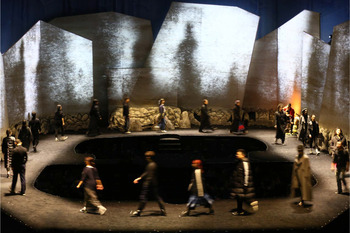
Ago, Theatre Above, Shanghai, 5 December 2019. (Photo by Wang Kai; courtesy of Theatre Above)

The search for the right fit of form and content is the first challenge for a storyteller like Lai. It might be smooth or jagged, but is rarely a simple, straightforward process. The idea of a story-within-a-story structure in A Dream was first inspired by a painting of Jan Brueghel the Elder, The Allegory of Sight and Smell (1620), which Lai saw in the Museo del Prado in 1990 (Lai Reference Lai2006). The painting features paintings-within-the-painting—paintings of all sizes line the hallway and walls surrounding the figures depicted. The conception of Ago was more convoluted. Besides the long-harbored intention of sharing wisdom through storytelling, the keywords “luminosity” and “compassion” were also among Lai’s concerns (Lai Reference Lai2019). Ago as it turned out is filled with devastating disasters—but perhaps light can best be seen through darkness, through showing how people cope with the darkness of their lives.
Beyond storytelling and its strategies, the most profound question Lai asks is, “What is life?” A Dream began Lai’s inquiry into the nature of life, as well as theatre. This quest continues and deepens in Ago. In the Prologue of A Dream, a fable-like story is told of Zhuang Rumeng, an ancient poet (whose name and deeds are reminiscent of the Daoist sage Zhuangzi) who escapes the political persecution of Emperor Qin (259–210 BC) by abandoning his physical life and retreating into his dreams.Footnote 11 “Rumeng” means, literally, in Chinese, “like a dream.” It is said that when he was caught by the emperor and put in prison, while waiting to be buried alive with a thousand other scholars, Zhuang used his skill of dream control to construct an alternate world while he slept more and more each day. That alternate dream world of Zhuang’s is “as elaborate and intricate as the waking world, filled with the most minute details of mountains, rivers, villages, cities, and people” (Lai Reference Lai and Renaud2021b: prologue). The night before his immolation, Zhuang “made his grand escape, disappearing into the world that he had created in his dreams, a place finally free from persecution” (Lai Reference Lai and Renaud2021b: prologue). Only a few lines of Zhuang’s poetry survived: “This floating life is a dream. But is a dream really dream-like? If not, what then, is this floating life? A dream like a dream” (Lai Reference Lai and Renaud2021b: prologue).
A Dream Like a Dream (2013). (Photo by Guo Yan-bing; courtesy of Theatre Above)

In telling this fable, which is seemingly irrelevant to the story of A Dream, Lai instills the message “life is like a dream.” By way of Zhuang’s story, Lai provokes his audience to consider the power of imagination—and, I suggest, Lai’s developing vision of his approach to theatre. After finishing the story of Zhuang Rumeng, there is a pause. Then an actor addresses the audience with the following lines:
But imagination has no actual substance, one will surely protest, and so there was nowhere for Zhuang to go! But given the illusory—and many say, dream-like—quality of life, who can say with any certainty what imagination can’t do? (Lai Reference Lai and Renaud2021b: prologue)
In addressing the likely doubts of the audience about the “truthfulness” of the fantastic story of Zhuang, Lai is implicitly making an important if brief statement—framed as an internal debate—about life and about theatre. Theatre has long been taken, even undermined, as “illu-sion” or “make-believe,” not as real as “real life.” But if life is illusory and dream-like, and imagination more substantial than we think, perhaps the illusion that is theatre is actually more real than life.
The Craft
Theatre-making and theatre-going are far from illusory or insubstantial. In Lai’s theatrical storytelling, “the soul, the eye, and the hand” of the storyteller are manifest onstage as layers of the reflexive doubling of the narration and enactment of the characters’ life stories, which inspire metaphysical debates about “reality” and life. These stories are framed ritualistically in the circling walk around the audience, whose presence fosters a special kind of connection distinct from everyday life. Although many of Lai’s well-known theatre works have featured stylized staging drawn from different traditions such as xiangsheng, commedia dell’arte, xiqu (Chinese opera), and Western absurdist drama, the staging of A Dream and Ago relies primarily on the use of the wraparound stage even as the acting style is generally realistic. The stories (from dreams to past lives), the characters (from common people to animals, “Time,” and “Chance”), and the narrative structures (stories-within-the-story) go beyond the conventions of theatrical realism.
The outermost framing of both plays is imbued with ritualistic meaning and intellectual provocation. As mentioned earlier, the surrounding stage and the “lotus pond” is inspired by the Buddhist practice of circumambulating the stupa. The Buddhist ritual is performed in a clockwise direction, as are the circling walks and the placement of scenes on Lai’s stage. In Ago, the seating area is in the shape of a Tibetan ritual dorje, creating a “double lotus pond” with a center island (Lai Reference Lai and Renaud2021c). Both A Dream and Ago open with circling walks, and when up to more than 30 actors do it, they look like everyday pedestrians on (metaphoric) individual and collective journeys. An actor rings a handbell, and the rest of the actors—all dressed as but not performing as their characters—take turns telling a “collective story” directly to the audience. In A Dream, Lai makes up a fable he then attributes to Zhuang Rumeng; in Ago, Lai creates accounts of different dreams, including aphorisms and foreshadowing of what is to come in the play. Here are some examples:
In my dream, I wanted to find out if my life was predestined, or if everything occurred by chance. I met a wanderer who told me everything was predestined. AND everything occurred by chance.
In my dream, my house had been destroyed. I was forced to abandon my home. A line of refugees moved slowly through a terrain of rubble and destruction, with no destination, for all eternity. From out of the desolation, I heard a man say softly, “The one thing that makes us human is hope.” To that, another replied, “But we must forsake all hope to stay alive.”
Thus have I heard in a dream. (Lai Reference Lai and Renaud2021c: prologue)
In both plays, the opening transports the audience into a liminal experience of communitas. This experience is paradoxically extended and condensed in time as the audience is offered multiple stories spanning lifetimes, taking eight hours in A Dream and more than five hours in Ago — all packed onto a confined stage. These mundane and fantastical stories unfold in a continuous circular motion, giving a sense of time’s endless cycles.
Over the duration of the performances, the audience experiences the interplay of emotional engagement and detachment. This interplay is accomplished not only by the staging, the continuous circular movement, but also through the storytelling as narratives and enactments double back on each other, jumping between the everyday and the extraordinary. In Ago there are dialogues with animals and even with “Time” and “Chance,” fable-like tales, and philosophy. In A Dream, six characters, including the Doctor and Patient #5, are played by two actors, while Koo Hsiang-lan is played by three (one as the old woman, and two as her younger self). Each episode of the story-within-the-story unfolds with the doubled characters, one narrating what happens (multiple characters take turns doubling as narrator) while the other enacts the scene being narrated. This makes visible for the audience both the intimate perspective of the character’s experience and an objective view as if in past-tense, as having already happened. This technique illustrates Benjamin’s conclusion to his essay: “The storyteller is the figure in which the righteous man encounters himself” (Benjamin Reference Benjamin, Arendt and Zohn1969:109).
Lai’s characters are all relatable ordinary people, each with their own flaws and emotional attachments. The staging in A Dream vividly presents each character’s encounter with themselves in the moment of being the storyteller. In Ago, the narrator is played by just one of the characters, JJ, a history major at Beijing University whose self-exile after heartbreak brings her to a remote village in Yunnan province where she becomes entangled with the villagers. She experiences the devastating earthquake with the villagers and, 10 years later, finds herself still friends with some of them as they all turn out to have relocated to New York City. Here they experience another disaster—the 9/11 attacks—which vividly recalls the trauma of 10 years prior. Following the second disaster that befalls them, they are drawn to follow the highly spiritual character Dorje in the search of the Pure Land. They travel to Sikkim and make a collective expedition up Mount Kangchenjunga, which ends yet again with another disaster—an avalanche that kills most of the characters. Only JJ and another villager, Pema, survive and go back to New York to carry on with their lives.
Ago is conceived like a symphony in four movements. At the opening of each movement and at key moments during the play, JJ, the narrator, recounts and reflects on what happens to her and to others from a personal, omniscient perspective. She either opens a scene speaking directly to the audience before inserting herself into the actions onstage, becoming part of the story she tells; or she comes in as a certain scene is drawing to a close to describe to the audience what eventually happens to the characters. While doubling narrators and characters in A Dream emphatically performs the many “self-encounters” onstage, making the storyteller a compassionate, reflexive character who majored in history, Ago implies, symbolically, a greater sense of “self-encounter” with the history of humanity.
This symbolic implication of having JJ the history major as the storyteller is already dis-cernable in her opening monologue. Directed at the audience, her speech is imparted with Lai’s own observations of human history, thus adding an additional layer of symbolic meaning for the circular actions on the surrounding stage beyond the reference to a Buddhist ritual. JJ recounts her personal life and stretches toward semi-philosophical observations of human history couched in the sentiments of a rebellious youth:
JJ: I was always good at school. Textbooks, exams were never a problem for me. So I got into Beijing University to study History. There, I fell in love, hard. And love ended. My whole perspective on life seemed then to go down a wormhole, and I started seeing everything as if I were looking into a funhouse mirror. I watched as everyone around me seemed to be progressing toward fulfillment in life, but just like me, everything they were doing seemed to guarantee that this fulfillment would not, could not possibly be fulfilled.
As you know, there’s a cyclical theory about history. History repeats itself, supposedly. I believe that. But what do we repeat? We repeat defeating ourselves. We repeat killing ourselves, disrespecting ourselves. We repeat not learning from our follies to commit even more extravagant and absurd follies. SOON WE WILL COME TO THE SIXTH EXTINCTION OF THE PLANET BECAUSE OF OUR OWN STUPIDITY AND GREED AND PRIDE AND SELFISHNESS!! So what have we learned from history? Nothing. (Lai Reference Lai and Renaud2021c: act 1, scene 1)
The surrounding stage, the circle walk, and the staging of each scene at various points on the surrounding stage follow a generally clockwise direction. Thus they form a circular, cyclical pattern of happenings onstage—taking on further symbolic meanings beyond the reference to the circular walk around the sacred Buddhist stupa. Regarding JJ’s opening monologue, Lai remarked that “What exactly is being recycled? Falling. We never learn, that’s why everything is ‘as it used to be.’ This is the world as I see it” (Lai Reference Lai2020a). This sober and somewhat pessimistic observation is counter to our mainstream modernist ideology of progress, which Lai also criticizes in light of his Buddhist views on life:
If the cyclical theory of history stands, we should be able to perceive that mankind is really not going forward, despite technological achievements. The state of the human mind has remained the same, if not deteriorated, over time. And that is precisely because of the way we define progress. Human history is all about who wins and who loses, not who gains enlightenment, or wakes up to see the reality of where human desire continues to lead us. (Lai Reference Lai2020c)
For Lai, setting the direction along which the stories on the surrounding stage unfold becomes “a basis for [his] creation of an aesthetics of staging” (Lai Reference Lai2020c). In principle, the scenes happen clockwise onstage “because that is the way we humans regard the motion of time (I always felt track races are in a wrong direction)”:
This is a direction being determined when staging A Dream. It was also out of practical concerns. When inventing such a “lotus pond” staging, I could have gone wild and made scene changes at my free will and let the audience look for where the next scene is in confusion. But at that time, I decided to limit myself, to make the play travel along one direction as much as possible, and reverse the path when necessary. (Lai Reference Lai2020d)
The reversal of the path happens a few times in Ago. Before each disaster, certain main characters or pedestrians travel counterclockwise, or two consecutive scenes onstage likewise occur in counterclockwise order. During the avalanche at Kangchenjunga, JJ and Pema have to turn back from the search for the Pure Land and go downhill instead, thus making an obvious counterclockwise move on the surrounding stage to enact the difficult downhill journey in the snowstorm.
In addition to the doubling of narration and enactment and the deepened implications behind the pattern of travels and actions in a circular motion onstage, Ago introduces new cognitive planes of “reality” woven into JJ’s story that allude to other archetypes of storytelling and unsettle any singular, fixed perspective on reality. Tashi’s special power of speaking with animals brings to the lifeworld of Ago everything from dogs, wolves, and the mythical Snow Lion in the Yunnan mountains (a character in the play) to rats, pigeons, and ants in New York City. On top of this, Time and Chance also appear occasionally, conversing with Tashi and the animals, or they silently circle the audience as other actions transpire. Anthropomorphized animals abound in Lai’s stories, which resemble European medieval and renaissance allegories (Blackham Reference Blackham1985; Tambling Reference Tambling2010; Rourke Reference Rourke2011) except that instead of didactic moral lessons, the interspecies and metaphysical interactions on Lai’s stage often depend on witty repartee. For example:
TIME: Sometimes people think they see me. But actually, at the moment you see me, I’m already gone.
TASHI: Well Time, it’s 9:37. Is that you?
TIME: That’s just a manmade way of defining in an abstract sense a moment that does not exist.
TASHI: Why does 9:37 not exist?
TIME: Because when you actually reach that moment, it’s already gone.
PIGEON: So you’re a thief.
TASHI: Time’s a thief!
(TASHI and the PIGEON laugh heartily.)
TIME: I’m not a thief. I don’t steal. Because there’s nothing I can take from you that you haven’t forfeited yourself already.
TASHI: What?
TIME: Look at you now. You’re searching for your mother, right? These are all thoughts from the past, and your hopes of finding her are in the future. So you’re not here.
TASHI: So where am I?
TIME: You’re in a limbo called nowhere.
[…]
TASHI: Hold on a second.
TIME: There is no second. I’m time.
TASHI: So?
TIME: I go on. Enjoy your evening in nowhere. Bye.
(TIME exits.)
PIGEON: Time waits for no one!
TASHI: Well, we had a good time together…
(PIGEON and TASHI share a hearty laugh, but stop and reflect.) (Lai Reference Lai and Renaud2021c: act 2, scene 10)
The Pigeon (Zong Juntao, left) with Tashi (Yang Yuguang) in Ago. Theatre Above, Shanghai, 5 December 2019. (Photo by Wang Kai; courtesy of Theatre Above)

And from a scene a bit later in the second act:
CHANCE: You suddenly arrive at a place that you didn’t intend to come to. New scenery. New horizons. That’s because of me.
TASHI: What?
EMMA: Who’s this guy?
CHANCE: You intended to turn left, but you turned right. That’s also because of me.
SQUIRREL: Excuse me?
[…]
TASHI: Well, Chance, we’ll be going along our way.
CHANCE: If I allow you to.
TASHI: If YOU allow us to?
[…]
SQUIRREL: Whoa, that’s talking pretty big, Mr. Chance.
CHANCE: Perhaps. Perchance.
TASHI: Perchance? Who’s that?
CHANCE: My cousin. Her brother is “Perhaps.”
SQUIRREL: OK Chance, what exactly do you do?
CHANCE: I don’t do. I am.
TASHI: Chance.
CHANCE: You bet.
TASHI: I wouldn’t chance it.
(They laugh.)
CHANCE: Actually, to be truthful, I don’t have authority over anything until everything that is supposed to happen, happens.
EMMA: Everything that was supposed to happen…?
SQUIRREL: What does that mean? So you’re saying what I do today is all because of what I did yesterday? You mean I have no free will?
CHANCE: You have all free will, and everything is Chance. I take my leave.
SQUIRREL: There goes our Chance! (Stifling a laugh.)
TASHI: By Chance, he’s gone! (Stifling a laugh.)
CHANCE: You never know when your Chance has gone, and what I have taken away.
TASHI: Well…
SQUIRREL: (Weakly) Catch you later.
CHANCE: If I allow it.
(CHANCE exits.) (Lai Reference Lai and Renaud2021c: act 2, scene 21)
These intersecting planes of reality, accessible only to Tashi, are made visible on the physical plane of the stage. The spectators see the limitations of human-centric consciousness; they hear commentary on the folly of humans who often forget they are not alone on earth; that greater and inexplicable workings of time and chance are also at play in daily life.
By staging stories that elaborate shifts of perspectives and planes of reality, Lai captivates audiences even as he challenges them to think about themselves and about life. While the story-within-a-story structure of A Dream envelops one man’s journey in his search for a past-life lover, the four movements of Ago generate conceptual echoes and contrasting notes. The first two movements mirror each other, each ending with a massive disaster. The third movement rises to a climax as the collective embarks on the search for the Pure Land but ends in another disaster when an avalanche kills most of the characters. The extremely brief fourth movement ends with the perpetually good-hearted Pema reuniting in New York with her missing husband, who she takes home to care for in his final days. Ago concludes with Dorje (performed in the original production by pop singer Jason Zhang) singing an epimythium to the fable-like play: “In this grand dream, when do we wake? Dreaming here, dreaming there; where from, where to? Happiness and suffering are the same trickster, deceiving us into not waking up” (Lai Reference Lai and Renaud2021c: act 4, scene 5). Whether or not anyone immediately grasps the wisdom of awakening, Dorje—who has reached the Pure Land—attempts to embrace everyone in the theatre with his enchanted singing as this grand processional of illusion concludes.
Utopic Imaginary and Mirrors of Illusion and Reality
The utopic imaginary appears across Lai’s plays and is echoed in the prologue of A Dream. In it, the ancient thinker who is about to retreat into his dream spends weeks in preparation. In his prison cell every day, he works to “construct an alternate world in his dreams—a world as elaborate and intricate as the waking world, filled to the most minute detail with mountains, rivers, villages, cities, and people” (Lai Reference Lai and Renaud2021b: prologue). Not directly related to any stories within the play, the prologue subtly recalls the poem “Peach Blossom Spring” which Lai famously adapted in his 1986 play Secret Love in Peach Blossom Land. “Peach Blossom Spring” describes the eponymous place that has become an archetypal utopia in the Chinese cultural imaginary informed by Tao Qian’s own neo-Daoist sensibility. Such an otherworldly, idealistic realm differentiated from the present reality appears once again in Ago as the Pure Land. Whereas Tashi is endowed with the ability to speak with animals, his elder brother Dorje is granted the ability to channel messages by spontaneously singing about the Pure Land that he is supposed to help people find. The Pure Land is where one achieves the ultimate goal of transcending the sufferings of life. This recurring utopia motif in Lai’s plays illuminates his evolving aesthetic and philosophical visions.
Utopia is a paradox expressed in the word’s etymology. The word comes from two Greek words: eutopia (“good place”) and outopia (“no place”) (Rüsen, Fehr, and Rieger Reference Rüsen, Fehr and Rieger2005). However, what utopia points to in Lai’s work are the alternate realms of the Peach Blossom Spring and the Pure Land where the line between illusion and reality is blurred. In the prologue of A Dream, the ancient thinker retreats into and lives on in his own dream. Ago stages a debate about what is “illusion” and what is “reality”; the play is subtitled “A Journey through the Illusory World”—the “journey” being our life experiences. The broader implications of utopia can also be approached through Dorothy Ko’s observation of the significance of the body in the Chinese utopic imaginary and Daoist and Buddhist meditation practices. Utopia is not abstract or imaginary; it rests on corporeal, sensual, and sentient experience, as well as on the transformation and cultivation of the self as an embodied, mindful being. Rather than an ideal society, Ko contends, utopia articulates the “body in utopia” and the “body as utopia” (Ko Reference Ko, Rüsen, Fehr and Rieger2005). This is reflected in Lai’s staging of his plays and the way they work as allegories and their Daoist and Buddhist underpinnings.
Peach Blossom Land: Idealist Escape and Sentimental Longing
In his two-part prose narrative and in a poem, Tao Qian wrote about the elusively beautiful Peach Blossom Spring. After serving in the imperial court, disheartened by politics, Tao retreated to a reclusive life of farming in middle age. He tells the story of a fisherman during the Taiyuan reign (376–396 CE) who, paddling his boat up a creek one day, comes across Peach Blossom Spring, where a utopic agrarian community resides, their houses, fields, and plants neat and varied; chickens and dogs, men and women, the elderly and the children are all content and happy. The residents tell the fisherman that their ancestors settled here to flee the tyranny of Qin times, and they are not aware that several dynasties have already passed in the outside world. The fisherman leaves after a few days, warned not to disclose the place to outsiders. He disregards the warning. He marks his route along the way so he can show others what he has found. But when he attempts to return with an official, he gets lost. Another high-minded intellectual, Liu Ziji from Nanyang, also tries in vain to find this utopia, and eventually dies trying. Afterwards, no one inquires about it again (Kwong Reference Kwong1995:51).
Tao Qian’s narrative paints the imaginary as realistic—replete with historical details—but ultimately unreachable because it is a mystery. The story ends with no one able to find the Peach Blossom Spring, perhaps suggesting a general loss of interest in seeking the ideal but also a secret wish to keep the utopian village from being discovered (and thus risking destruction). Nevertheless, Tao Qian expresses his true yearning in the poem when he inserts himself into his own fiction (recall the story of the ancient thinker who retreats completely into the dream he constructs): “May I ask you who wander within the realm, can you fathom what lies beyond the dust and noise? I would like to tread the light breeze, and fly high to seek my fellows” (in Kwong Reference Kwong1995:52–53).
Secret Love in Peach Blossom Land parodies this well-known tale from China’s literary canon. Lai’s play creates a Peach Blossom Land that is a distorted mirror reflecting inner fears projected onto an ideal realm of peace and beauty. It is also a comic foil to a melancholic play about Jiang Binliu, an old man who secretly yearns for his past lover of nearly 40 years ago—they fell in love in wartime Shanghai in the late 1940s but were separated when Jiang ended up in Taiwan after 1949. In a metatheatrical framework of two plays-within-a-play, Secret Love in Peach Blossom Land dramatizes two theatre troupes forced to share a stage for rehearsal because the venue has been double-booked. One troupe rehearses a sad, serious drama, Secret Love, while the other rehearses a stylized farce, Peach Blossom Land. In Peach, the fisherman becomes distressed by both fishing and his home life. When he accidentally stumbles upon Peach Blossom Land, he is welcomed by a pleasant couple who look exactly like his wife and her boyfriend. After staying happily with them (staged with much comic irony), the fisherman misses his real wife and decides to go back, only to see her chaotic home life. Disillusioned, the fisherman tries to return to Peach Blossom Land but loses his way (Lai et al. Reference Lai and Chen2010). Onstage, the couple in Peach Blossom Land, played by the same actors performing the fisherman’s wife and her boyfriend, wear long flowing white gowns and speak and act in an extremely calm, pleasant, ethereal manner that is almost too good to be true. But things aren’t as they seem. In one scene, the couple are seen in shadow silhouettes performing exaggerated physical movements as if they are having sexual intercourse. But when the bed cloth on which the shadows have been projected is lifted, the audience and the fisherman see that the couple is working together wringing dry a thick piece of laundry. The implication is that reality does not live up to what we imagine. The audience laughs when they realize the difference between what they thought they were seeing and what was actually happening. For the fisherman, the reveal is his worst nightmare, his total disillusionment.
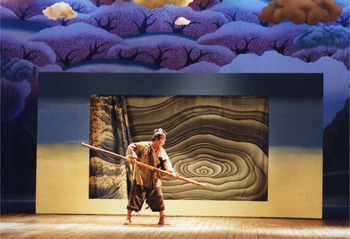
Li-Chun Lee in Secret Love in Peach Blossom Land (1992). Keelung Cultural Center, Taiwan ( for the film Secret Love in Peach Blossom Land). (Photo by Tsai Jentai; courtesy of Theatre Above)

For Tao Qian, the Peach Blossom Spring is conjured as an idealist escape from reality. In Lai’s Secret Love in Peach Blossom Land, this “utopia” is first mocked by displacing the fisherman’s worst nightmare in a poetic realm, turning it into an allegorical space that enacts sentiments surrounding leaving and return, separation and reunion, and longing for the past and being in the present. As the two plays with their respective tragic and comic moods shift, clash, undercut, and infiltrate each other, their mutual disruption inadvertently yields mutual illumination. Interrupting Secret Love with Peach Blossom Land undercuts the sentimentality that consumes Secret Love, accentuating the stage artifice of Jiang being transported back to his memories of playing with a swing, pushing it back and forth with his lover. During one of the inter-troupe quarrels, the actor-director of Peach Blossom Land scoffs at the director of Secret Love:
ACTOR PLAYING MASTER YUAN: Fine, since YOU brought it up, let me say that your tragedy is absolutely laughable!
DIRECTOR: What?
ACTOR PLAYING MASTER YUAN: A dying patient climbs out of bed, hums a song, and goes to play with a swing! If that’s not enough, tell me how to portray a white camellia. Play a white camellia for me! Come on! You can do it! (Lai et al. Reference Lai and Chen2010 :1007–08)
Another high point is when the two troupes decide to divide the stage into two halves and rehearse simultaneously. On the side of Peach, the fisherman is contemplating a return back home; on the side of Secret, the nurse is discussing with Jiang the ad he put in a newspaper to search for his past lover. The lines spoken on one side often seem to respond to those on the other side. This accentuates the shift in moods, making serious what might be comic in its own context. For example, when Tao the fisherman expresses in Peach Blossom Land that he misses home and his wife:
TAO: I’m thinking of home.
NURSE (to JIANG BINLIU, on the other side of the stage): You can’t just keep thinking of that one thing.
WOMAN IN WHITE (to TAO): You’ve been here so long, why go back?
NURSE: Look, from the day you put out the ad it’s been…
(She counts on her fingers.)
TAO: How long?
NURSE: …five days.
WOMAN IN WHITE: So long.
(The NURSE and WOMAN IN WHITE glance at each other.)
NURSE: And you’re still waiting for her? Forget it!
TAO: She might be waiting for me. I want to see if she’s willing to come with me.
WOMAN IN WHITE: She may not want to come.
NURSE: The first day Miss Yun didn’t come, I knew for sure she wouldn’t come.
TAO: She’ll come.
(The NURSE and TAO glance at each other.)
WOMAN IN WHITE: She may have forgotten all about you.
(TAO grimaces and shakes his head at the thought.)
NURSE: Plus, you don’t even know if she’s alive or not—why get all worked up like this?
TAO: How could you say such a thing?
NURSE and WOMAN IN WHITE (coincidentally in unison): Sorry! That’s not what I meant! (Lai et al. Reference Lai and Chen2010 :1010–11)
There is more. In a metatheatrical reference to the ancient poet’s ignorance of utopia’s whereabouts, the last scene of Peach—when the fisherman loses his way—is not rehearsed (in the play within the play) because the overbooked venue is closing. Also withheld from representation is the tragedy underlying Jiang Binliu’s laughably pathetic secret love: the great forces of war and politics that led to displacement, separation, and longing. Lai channels postmodernist sensibility and classical Chinese prose and poetry, making his audience laugh hard and lament at the same time.
In terms of performance, Ko’s note on the corporeal and sentient experience inherent in “Peach Blossom Spring” is highlighted in Tao Qian’s text, whose key sentences the fisherman recites to play up the disjuncture between classical and contemporary languages in the spirit of parody. The performance also employs techniques and aesthetics from Asian theatre traditions. For example, the fisherman’s upstream journey to the Peach Blossom Spring requires physical effort, a momentary disorientation—“a trading of mind for body” (Ko Reference Ko, Rüsen, Fehr and Rieger2005:95)—before coming to a place where “fragrant flowers were fresh and beautiful” and “fallen petals lay in rich profusion” (in Kwong Reference Kwong1995:51). The upstream journey features a special walking technique where the actor moves sideways symbolizing boat-rowing in Chinese opera, accompanied by changing painted scrolls upstage depicting different kinds of waves and swirls, reminiscent of Hokusai’s famous ukiyo-e print, The Great Wave (ca. 1829). The stylization breaks the theatrical illusion of Secret Love’s realism.
Li-Chun Lee in Secret Love in Peach Blossom Land (1992). Keelung Cultural Center, Taiwan (for the film Secret Love in Peach Blossom Land). (Photo by Tsai Jentai; courtesy of Theatre Above)

Pure Land: The Grand Journey to Awakening
Ago shares several motifs with Secret Love in Peach Blossom Land—a utopian place, disruption, displacement, and migration. Whereas Secret Love frames these motifs by synchronically presenting two plays on a shared proscenium stage, Ago enfolds them in a diachronic marathon of storytelling on Lai’s lotus pond stage. Ago is a grand journey that may or may not lead to the Pure Land—it seems that only Dorje (perhaps with his mother) eventually reaches it, while the rest of the characters, except for Pema and the narrator JJ, die in an avalanche. Like the Peach Blossom Spring, the Pure Land is described by Dorje in his songs as blissful: “A rainbow waterfall marks the gate. Sweet nectar flows. A sip of it clears your mind in the Pure Land” (Lai Reference Lai and Renaud2021b: act 2, scene 8). However, unlike Tao Qian’s self-governed small society, the Pure Land vaguely articulates an ideal state of well-being: “Where my worn-out soul will be cleansed. Where everything and everyone becomes one in beautiful harmony” (act III, scene 1). If we recall Ko’s “body as utopia” as found in Daoist and Buddhist meditation practices, Dorje may represent such a being with his calm presence and infectious singing, while the Pure Land, unlike the Peach Blossom Land, is not represented at all onstage. What is represented is the “journey”—the stories of the entangled lives of the characters. This grand metaphorical “jour-ney through the illusory world” of the subtitle is also symbolized in the opening collective circular walks, which evolve into running, pushing, falling down, and getting back up—always moving. This tumultuous activity performs the cycles of humankind’s folly and suffering.
Self-Denial as Dystopic Disillusionment
Within the journey, with all the characters except Dorje failing to reach the Pure Land, Tashi’s story offers the most poignant contrast: a reverse-mirror of dystopic disillusionment that also contains debate about illusion and reality, the key underlying theme of Ago. Dorje and Tashi, the two brothers with supernatural powers, already stand out from the other characters. While Dorje remains steady in his unwavering belief in the Pure Land, Tashi takes a diverging path of self-denial. Tashi’s ability to speak with animals, Time, and Chance introduces other planes of reality to the world of the play. Before each of the two great disasters, Tashi learns of the danger from the animals and tries to warn the humans, but no one believes him. The drastic change in Tashi appears in the third movement when he goes on a live TV talk show with Professor Emma Woods upon publication of her book based on the study of Tashi, Talking with Animals, in which she insists that Tashi’s ability is not scientifically proven. Surprisingly, Tashi admits that he is a fake: “I have been living a self-fulfilling prophecy wherein I have willingly deluded myself into believing something that is not objectively true” (Lai Reference Lai and Renaud2021b: act 3, scene 6). The change is corporeally manifested in Tashi’s thick glasses and scholarly blazer identifying him as a PhD candidate in cultural anthropology, in sharp contrast to his previously laid-back, bohemian look and affect.
The scene is staged satirically. Exposing the behind-the-camera operations of the TV sound-stage, the scene shows an assistant raising prompt cards instructing spectators to “applaud” or “laugh” at the host’s often cheap, vulgar jokes. When the host jokes about Tashi’s “delusion,” Tashi launches a tirade on the artificiality of television:
This television program is what’s truly delusional […] Every night, you try to put on something you think is interesting, but what are you really offering people? Whatever works that draws people AWAY […] from the boredom of their lives, including silly little jokes that actually have zero meaning. (Lai Reference Lai and Renaud2021c: act 3, scene 6)
In criticizing the TV show’s manipulations as “delusional,” Tashi is changing. He denies the multiple dimensions of life, which his character used to embody with his ability to talk with animals, even Time and Chance, far beyond any “scientifically proven reality”: “[…] we don’t need to be distracted from our boredom! We should in fact be led to face truthfully the empty space of our lives and focus on it,” Tashi asserts (Lai Reference Lai and Renaud2021b: act 3, scene 6). As he says this, Tashi is becoming ordinary, like everyone else.
Tashi’s transformation is illuminated in a later scene during the expedition, when he meets his childhood friend from the mountains, the Snow Lion:
SNOW LION: Tashi, we meet again. But something has happened to you. You no longer believe. In me. In yourself.
[…]
I am sorry to be creating confusion for you today. But please examine this. See what it is that is causing you not to believe, to become like everyone else, only believing in the thin slice of reality that is known as reason. Only…
TASHI: ENOUGH!!
(Tashi exits. The SNOW LION is sad.) (Lai Reference Lai and Renaud2021b: act 3, scene 13)
In their first conversation, the Snow Lion tells Tashi: “You must be determined in your mission to spread our message of natural harmony to the world” (act I, scene 7). But as the journey continues, Tashi sadly chooses to deny himself, his ability, his friend the Snow Lion, and his mission. Unlike Dorje, who persists in the search for the Pure Land despite other people’s doubts, Tashi is beaten down by tragedies and by being deeply distrusted by his fellow human beings. (It is suggested that he may be mistreated by the police who suspect him as a terrorist because he knows of a coming attack.) The dystopic disillusionment embodied in Tashi’s eventual self-denial belies the greater tragedy of humanity.
Tashi and the Snow Lion in Ago. (From left) Gu Xuewei, Song Yumin, Feng Li, Yang Yuguang, Wang Meng. Theatre Above, Shanghai, 5 December 2019. (Photo by Wang Kai; courtesy of Theatre Above)

Compassion and Longing between This World and the Other World
Lai’s theatricalization of the Peach Blossom Spring and the Pure Land share gross common-alities and fine differences. Grounded in Daoist and Buddhist traditions, the two lands both prefigure the “body in utopia” and the “body as utopia,” but they also differ in that the Peach Blossom Spring includes the Daoist spirit of freedom and flight from structural limitations, while the Pure Land shows the Buddhist spiritual cultivation of the self. The fisherman accidentally stumbles upon Tao Qian’s Peach Blossom Spring but it remains forever hidden as a mystery, which Lai adapts as a metaphor for one’s inner fears and longings, which are exacerbated by war and displacement. The Pure Land, by contrast, requires a prolonged life journey, a conscious pursuit of spiritual awakening that leads to transcendence of the sufferings of life once and for all. Only Dorje ever reaches it. Ago puts onstage the disasters that ruthlessly destroy lives; the most disheartening tragedy is Tashi’s denial of who he once was—as is our own denial of our true selves.
These echoing and disparate conceptions of the ideal, a utopia versus this world, reflect themes Lai has been exploring for decades. Most strikingly, despite an otherworldly utopia the characters long for, they are attached to and linger in the imperfect real world. While Secret Love in Peach Blossom Land explores this tension, Ago’s stories of so many lives across gender, class, ethnicity, and even species in the face of the nonrepresented Pure Land communicates a more profound sense of compassion, of undifferentiated care, a notion significant in Buddhist philosophy. While “luminosity” and “compassion” were keywords for Lai in conceiving Ago, he also reveals a longing for “this world” as reflected in the final movement of Ago. Dorje, already in the Pure Land, asks an old couple to order noodles from Pema. In Pema’s noodles they can “taste” what they miss so much about life in this world: “Happiness and pain, hopes and fears […] fulfilment and disappointment, life and death” (Lai Reference Lai and Renaud2021b: act 4, scene 2).
Worldly Engagement and Evolution of the Creative Process
Developing original works in Taiwan with few resources or preceding models, Lai combined local traditions with the Western theatre technique of improvisation he adapted from his teacher, Shireen Strooker. Lai’s improvisatory work is based on clearly defined situations and goals rather than limitless freedom. He and his actors spent many hours discussing the characters, rather than dramatic situations (which Lai designates), and none on action (Lai Reference Lai1994:35). Secret Love in Peach Blossom Land embodies the skillful use of this devising/rehearsal process to craft a piece that merges the comic and the tragic, the realistic and the expressionist, Asian aesthetics and postmodern sensibilities. Secret Love in Peach Blossom Land dramatizes poignant sentiments against the backdrop of 20th- and 21st-century political turmoil and migration in the Chinese world.
Lai’s works won popular acclaim from the beginning—audio recordings of the xiangsheng plays were listened to like pop albums by young people in Taiwan who had never gone to theatre (including me in my childhood). His many plays that reflect on contemporary Taiwanese society, often mixing humor and satire, at once engaging and provoking, continue to be welcomed by audiences, which is perhaps the key to Lai’s ability to straddle high art and popular culture. It also allowed his Performance Workshop to survive, with ticket sales covering the bulk of the costs at first, assisted by government and corporate sponsorship by the early 1990s (Lai Reference Lai1994:37). Meanwhile, Lai also conducted more avantgarde experiments for special commissions, school productions, and festival invitations, including the opera Xi you ji ( Journey to the West; 1987), Luo jiao sheng—gucu zhong de beikete (Footfalls: Beckett in the Ancient Chinese Garden; 1988), and Pusa zhi sanshiqi zhong xiuxing zhi lier wang (Lear and the Thirty-seven-fold Path of a Bodhisattva; 2000).
The complex form, structure, and content of A Dream and Ago, two epic plays 20 years apart, mark Lai’s maturity, his original aesthetic vision, highly sophisticated playwriting, and profound concerns for life. Reviewing Lai’s oeuvre, Tao Qingmei points out the tendency towards “seeing self” marked by the creation of A Dream after the millennium versus the relatively direct social engagement, “seeing society,” before (Tao Reference Tao and Renaud2021). These differences are of course not clear-cut and linear, and interestingly, the internal movement towards “seeing self” that undergirds Lai’s later plays is accompanied by a more expanded engagement with a wider world. His rehearsal process also continued to evolve, often with his own preparation of a much more detailed outline including characters, story, structure, and scene descriptions before assembling a cast for rehearsal. Then, with him as the main “improviser” in the studio, the group composed actual scenes (Lai Reference Lai and Renaud2021a). This goes along with his own increased clarity and efficiency over the years, as well as the constraints of shorter rehearsal schedules. Whereas for Plucking Stars (1984) Lai could work with actors for seven months, today he and the actors (who also work on film and TV projects) must compress the creative process. For That Evening the ratio of material created through improv compared to material actually used was 8:1; for A Dream it was 1.1:1, and for Ago it was 0.3:1—less material from improv than Lai’s own writing (Lai Reference Lai and Renaud2021a).
Playwrighting for Lai, however, is never approached as separate from the organic process of theatre-making. Tracing the historical spelling of the word “playwright” and the meaning of “wright” as “a person who makes or build things,” Lai considers the word to more accurately reflect the way he creates theatrical works; he has been “wrighting” plays with the performers and designers in the rehearsal studio “using the same ecology as the actual performance” rather than pen and paper, both in the early years when the use of improvisation was more prominent, and later on when more of the outline and structure are conceived beforehand (Lai Reference Lai and Renaud2021a). Ismene Ting, an actress who has worked with Lai since Plucking Stars and is now a theatre director associated with PW, says that Lai’s improv-based rehearsal and direction is like “building a house,” with Lai himself carefully shaping the structure:
[Lai] would say now the structure is such and such, and then slowly everyone proceeds to create the “interior” based on this given structure, until finally when this house is fully built, and I would eventually see what the house actually looks like. […] I think what’s unique about Lai is that not only is his story itself appealing to the audience, but that he has a way of telling the story that is always very special. His storytelling is about a framework that structures and presents the story […] so that when the audience finishes watching the play, they feel that they had to devote further thoughts on certain things. (Ting Reference Ting2020)
Fan Rui-Chun, who played Dorje and Tashi’s mother in Ago and has also acted in many revivals of PW’s plays, compares Lai’s style of directing to a symphony conductor. She sees his attention to rhythm and tempo in directing as relevant to his performance experience as a singer-musician:
I often feel that Lai’s directing is like conducting a full orchestra, that he has his own sense of the musical development and its rhythm. He tells you that “at this point, it has to be the climax of the music,” or how the actors need to work together in rapport, or how an individual actor pushes towards a climax, he gives a lot of room for that. […] Lai personally knows very well about performing, because he is a singer himself, plays music and understands performance, so he can combine performance and directing [in rehearsal]; he can capture the essence for performance very quickly and help actors. […] [In rehearsing the revival of The Village, for example,] Lai only needs to remind everyone that “the tempo has gotten a bit slower,” and everyone adjusts by themselves. He says “The Village has gotten longer for five, or ten minutes, and everyone should pay attention to tighten it up,” and then everyone makes their own adjustments. He always has a way to smartly give notes to actors. (Fan Reference Rui-Chun2020)
As an amateur singer-musician in his youth and a connoisseur of jazz, Lai also likens his theatre rehearsal to jazz jamming where he “flies” along with the actors in the heat of structured improvisation:
When I work with accomplished professionals who know the process, it is not unlike competent jazz musicians jamming. The difference is, these actors are not improvising for an audience-en-masse, but for one solitary “audience” member, me, and they fly to the heights of improvisation riffs while being tethered to the parameters of character and scene, anchored together in a common purpose. I, in turn, attempt to “live” in the same moment as they, flying with them, occupying the different characters in turn, and I will shout out directives to them on the spot that change the path of that present moment even as they improvise. (Lai Reference Lai and Renaud2021a)
The evolution of Lai’s method is due partly to his “simply getting better at improvisation”; Lai’s intimate understanding of working this way allows him to “quickly see the truths of any given moment (setting up the structure of a scene), or the truth of the character in that moment (what the character will say or do)” at a much faster pace than in his earlier years as a director (Lai Reference Lai and Renaud2021a). Lai’s increased efficiency at working this way meets the demands of operating commercial theatre with no government subsidies. He directs PW in Taiwan and Theatre Above in Shanghai, which has its own house staff, crew, and actors. Since the opening of Theatre Above in 2015, on average about 200 performances per year including domestic tours sustain the operation, in addition to some corporate sponsorships (Ding Reference Ding2020).Footnote 12
Lai’s theatrical and philosophical concerns have evolved with his expanded international engagements. In merging cross-cultural aesthetics and sensibilities with Daoism and, more profoundly, Buddhism, Lai stages his vision of life. He poses a question to his students that he asks of himself: “Are you giving your audience a gift, or dumping your trash?” (Lai Reference Lai2006:209). He bestows on his audience gifts of wisdom through humor and storytelling. In creating an illusion that mirrors a dream, Lai’s theatre performs ritualistic moments for contemporary urban Chinese and international audiences—moments of self-encounter and reflexivity.