This paper examines the recent history of the “Kurapaty”Footnote 1 mass shootings in Belarus (1937–41) and asks several questions: what are the current estimates of the number of victims? How do scholars view the event today? It outlines and discusses public events linked to the memorial site that have raised tensions to a high level, particularly in the period 2017–18. Why is contemporary Belarus so reluctant to address the Stalin Purges and their impact on Belarusian politics and society? Is Kurapaty a new symbol of Belarusian national identity? And lastly, why has there been such limited and reluctant official recognition of Kurapaty as a Stalinist massacre? After almost three decades of its independence we are somewhat closer to resolving some of these key questions.
Belarus and the Stalin Purges
In 1937–41, the Belarusian (Belorussian) Soviet Socialist Republic (BSSR) was a small republic on the western borderland of the USSR with a population of around five million. Its ethnic composition included the majority Belarusians (about 80%), mainly in rural areas, and significant numbers of Poles and Jews—mostly urban-based—as well as sizeable enclaves of Latvians and Lithuanians. The BSSR was subjected to the program of indigenization, launched by the Bolsheviks in the early 1920s, the results of which were reportedly quite spectacular. Belarusians took over leading positions in the Communist Party, government, and society, and the Belarusian language was given high priority.Footnote 2 The situation was reversed rapidly in the early 1930s, however, and the BSSR suffered particularly harshly from the Purges because of several factors: its heavily rural population (mainly Belarusians) was subjected to Stalin's campaign to “liquidate the kulaks as a class” in 1929–31, the authorities’ distrust of the rural population, fears of national and cultural development of the Belarusian language and literature, acute suspicion of its large Polish population in the western borderlands resulting in deportations and a “Polish Operation,” and—in 1937–38—a “Latvian Operation” linked to a suspicion of Latvians in the USSR and the removal of real and imagined enemies that also permeated the BSSR. Although there were similar operations in all republics, the BSSR's location on the western border with Poland rendered it an important security concern at a time when the USSR feared encirclement and a new war with capitalist powers.
One can speculate on why Belarus has been so reticent in investigating its Stalinist past. In the Soviet period, the trauma of ‘the Great Patriotic War’ superseded all other events and defined the future narratives. Though there was a partial thaw in 1956–64 when Nikita Khrushchev denounced Stalin at the Communist Party Central Committee Twentieth Party Congress, and in 1987–91 when Mikhail Gorbachev deepened de-Stalinization, the era of independence brought no further inquiries from the Belarusian leadership. Traditionally both the BSSR and independent Belarus have glorified war heroes, especially partisans, and the obvious link with their exploits and the wartime Soviet leader, Stalin, rendered such inquiries unlikely. The war victory is the official-defining point of national Belarusian identity. Thus, through a referendum in 1995, Aliaksandr Lukašenka (Aleksandr Lukashenko), president of Belarus since July 1994, changed the national Independence Day from July 27—the date sovereignty was declared in 1990—to July 3—the date of the liberation of Minsk from occupation in 1944.
Competing against the war-based narrative and focusing instead on Stalinist-era crimes, the nationalist perspective derives mainly from political parties on the right, particularly the Conservative Christian Party of the Belarusian Popular Front (hereafter CCP-BPF), the Young Front, Belarus Memorial Society, and the unregistered Christian Democratic Party (CDP).Footnote 3 None of the above had any representation in the government or Parliament after the 2019 elections, and the CCP-BPF leader, Zianon Paźniak, remains outside the country. Within Belarus, scope for their actions and publications is very limited. Nonetheless, as shown below, these groups mounted effective protests and defended the site from intrusions over a number of years at Kurapaty. The struggle to “own” Kurapaty has forced the state to acknowledge crimes there without treating them as a defining event for the current republic.
Paźniak's Findings
Kurapaty is a large tract of forested land in the northern suburbs of Minsk, Belarus, easily visible from the ring road in the southern sector, which was built in 1957. It has become well known as the major site of Stalinist era mass killings in Belarus, but one that until 2018 received no recognition from the national government. On June 3, 1988, during the mid-point of Gorbachev's leadership of the Soviet Union, Zianon Paźniak and Jauhien Šmyhalioŭ, an archaeologist and an engineer respectively, published an article in the Belarusian literary newspaper Litaratura i Mastactva that caused a sensation.Footnote 4 It provided eyewitness testimony to mass killings in the forest—the current forest consists of trees planted after the war—the methods of the NKVD who carried out the shootings, and some of the items found in the mass graves that pointed conclusively to the identity of the victims as Soviet citizens.
In the article, which consists of a series of interviews, Paźniak recalls the existence of the village Zialiony Luh in the early 1970s on the northern edge of Minsk. Elderly residents there had informed him that two kilometers to the north there were shootings in the forest “between the Ring Road and the Zaslaŭje Road from 1937 to 1941. A fence over three meters high, made of wooden planks and flanked with barbed wire and guard dogs, encircled an area of about 10–15 hectares. A road made from gravel stretched from the Lahojski highway to Zaslaŭje and was known locally as “The Road of Death.” Paźniak had been able to question residents of Zialiony Luh and the villages Cna-Jodkava and Drazdova about the shootings behind the fence but had been unable to divulge his findings at that time.Footnote 5
In 1987–88, by which time the settlement of Zialiony Luh no longer existed, Paźniak and Šmyhalioŭ interviewed some of its former residents along with eyewitnesses in nearby villages and recorded the responses. They established that the executions started in 1937 and took place three times per day. Later in the year the authorities closed off the site and carried out further executions that began in the afternoon but once again took place three times daily. The executioners wore NKVD uniforms and fired into the side of the victims’ heads so that each bullet killed two people.Footnote 6 One eyewitness, Mikola Karpovič (born 1919), was able to see for himself the contents of an open grave, having been alerted by a guard from Malinaŭka some four kilometers away. Another witness confirmed that the victims were gagged before they were shot. All confirmed that the shootings continued daily until the outbreak of war on June 22, 1941. The NKVD appeared to be arresting people from all villages in the area. Another interviewee, Maryja Paciarsuk, stated that there were shootings at other sites too, at Ždanovičy, near Drazdova, and at the back of Čaliuskincaŭ Park (today the largest park in Minsk).Footnote 7
The geography of Kurapaty changed with time. The original forest site of the killings was removed during the war for firewood, starting with the wooden perimeter, and then the forest itself. The forest that exists today is relatively new as the trees were all planted in the postwar period, after 1948. The name Kurapaty was changed to Brod. In 1957 a ring road was built that according to Paźniak and Šmyhalioŭ involved the digging up of skulls and bones, reducing the number of corpses remaining. Because the grave pits differed in size it was not possible to determine exactly how many victims were killed altogether. By the late 1980s, the Zialiony Luh development had advanced close to the forest and become a recreation area where children played.Footnote 8
When searching the area, Paźniak and Šmyhalioŭ first found a grave that had been cleared of its contents. Subsequently, some youths alerted them to a grave that still contained corpses. The youths had started to remove items such as ceramic mugs, a purse containing Soviet kopecks (the oldest dated 1936), a tooth brush produced by a factory in Viciebsk, broken eyeglasses, galoshes, men's leather boots, and women's footwear. These were enough for the authors of the article to conclude that the grave in question was filled to capacity in 1937–38 and that the victims were unaware that they were about to be shot, having brought items that might be used for a journey.Footnote 9 Another grave was discovered during the installation of a gas main along the ridge that runs through the Kurapaty Forest, and revealed women's footwear, galoshes made in 1939 (one made in Riga, indicating that the victim was Latvian as there was no trade between Latvia and BSSR before Latvia's annexation into the Soviet Union in 1940).Footnote 10 The discovery broadened the mass shootings beyond the peak period of the Purges and into the period 1939–41, which included the Soviet annexation of the eastern areas of Poland at the start of the Second World War as well as the Baltic States annexed by the Soviet Union in 1940.
The revelations of the Paźniak-Šmyhalioŭ article, despite its partial censorship, resulted in the formation the following month of a Government Commission led by Nina Mazaj, Deputy Chairman of the Belarusian Council of Ministers, to investigate the findings. The article itself was heavily censored, however, on the orders of the Communist Party of Belarus to omit the estimated number of victims and the important fact that the massacres took place between 1937 and 1941. The Government Commission's conclusions were that at least 30,000 civilians were killed in the period between 1937 and summer 1941—no military victims were identified. These findings, it is fair to say, caused considerable resentment in government circles, as well as among those in the communist hierarchy, and there were immediate calls for more studies of Kurapaty.
In 1991 and 1994, two further investigations pioneered by a “civil commission” and a so-called “public commission on the investigation of crimes at Kurapaty” both concluded that the Nazis were responsible for the shootings of European Jews here, even though none of the eyewitnesses reported seeing German troops in the area and some of the items gathered, as noted above, were clearly those of Catholics.Footnote 11 Historian Ihar Kuzniaсoŭ (Igor Kuznetsov in Russian, we will discuss him more fully later) notes that one of the participants of the initial investigation in 1988, Maria Osipava, “suddenly remembered four years later that during the war in the direction of Zelionyi Lug (Zialiony Luh), the Germans were chasing civilians to shoot them.”Footnote 12 A fourth investigation, including the further exhumation of bodies in May 1998, produced conclusions closer to the 1988 Commission.Footnote 13
As noted above, Lukašenka initially ignored the issue and refused to visit the burial ground. In spring 2017, however, while visiting the agricultural enterprise 1000 Arvibelagro in Lida, he declared that Kurapaty should not be exploited for political ends and that there was no need “to trample on the bones.” He would authorize a small memorial, “possibly like a small chapel,” and certainly not on the scale of the Brest Hero Fortress.Footnote 14 Ironically, protests at the site in 2017–18 had the precise goal of not permitting any trampling of bones through the incursions of commercial enterprises (discussed below). Moreover, Lukašenka's promise carefully circumvented the question of guilt for the massacres and left the question open. But if the ostensible goal was to close the Kurapaty issue, it did not succeed.
Debates Over Number and Identity of Victims
The question of the number of victims should not detract from the enormity of the atrocities committed. Nonetheless, it is a pertinent one in terms of the sheer scale of the NKVD operation. Paźniak's original estimate was that between 30,000 and 250,000 people were buried at Kurapaty.Footnote 15 The lower figure was based on extrapolation: he and Šmyhalioŭ had located 510 burial sites with an assumed fifty to sixty corpses in each. Eyewitnesses had declared that they were packed tightly, though likely some bodies were later removed. By the end of 1990s the number of studied graves with corpses was eighteen; some of the excavations did not uncover any corpses.Footnote 16 Paźniak himself, however, did not believe the lower figure was credible. In the summer of 2018, in a public statement, he declared that archaeologists had located “around 600 graves” with Kurapaty victims’ remains and that the NKVD executions took place between 1937 and June 23, 1941, the day after the German invasion of the Soviet Union.Footnote 17 Interestingly, Paźniak's fellow archaeologist Mikola Kryvalcevič estimates that the number of victims at Kurapaty was 60,000.Footnote 18 Kuzniaсoŭ insists the real number of victims is between 30,000 and 60,000, which he also justifies by the historical documents and research he has conducted on those repressed on Belarusian territories.Footnote 19
Aleksandr Dyukov, the 40-year old general director of the Moscow-based “Fund of Historical Memory,” who has made a career out of downplaying Soviet atrocities and uses sources very selectively (he worked most notably in Estonia, before turning his hand to Belarus), provides a more conservative estimate.Footnote 20 Dyukov, according to his sources, has access to the FSB archives in Moscow. By contrast, as the KGB archives in Minsk remain closed, none of the scholars researching Kurapaty have analogous access. Writing in the journal International Affairs, he reassesses figures he considers to be inflated without denying that massacres took place.Footnote 21 Dyukov cites the Memorial Society as declaring that NKVD sources are accurate. If there are errors in the totals, “they are not serious ones.” He lists also the work of the head of the BSSR Council of Ministers Archives Committee, V. I. Adamuška,Footnote 22 to conclude that over 35,000 people had been executed for counter-revolutionary crimes in the period 1935–40, a figure later refined to 35,868.Footnote 23 As the Minsk files make up 27% of all cases, about 7,500 people must have been sentenced to death in the city in 1937–38.Footnote 24
Dyukov only looks at the years 1937–38 (undoubtedly the peak years), but Paźniak and Šmyhalioŭ’s original article specifically cites fifty-five eyewitnesses as stating that the shootings went on daily, several times per day, from 1937 until the summer of 1941. Thus, we need to account for killings after 1938 and particularly between September 1939 and June 1941, the years when the western Belarusian regions were annexed from Poland and incorporated into the USSR. These additional numbers then need to be added to the total of 7,500, and would include detained Polish citizens as well as Belarusians, Latvians, and Jews. Another study that is generally sympathetic to the work of Adamuška points out that the latter was unaware at the time he wrote his book (it was published in 1994) of mass shootings by the NKVD in the prisons of western Belarus, which likely added 10–15,000 people to the number of those executed in Belarus in 1918–1953, some of whom may have died at Kurapaty.Footnote 25
Historian Ihar Kuzniaсoŭ also refers to the lost “track of 3,000 Polish officers sent to Minsk in March-April 1940.”Footnote 26 Kuzniaсoŭ’s findings indicate a Polish and Latvian trace, which is also an indicator that former citizens of Poland, either residents of the USSR in 1937–38 or else added to the Soviet Union after September 1939, are also buried in the forest. Finally, Dyukov's statistics relate to judicial cases, but administrative measures accounted for a significant proportion of the Soviet repressions. Paźniak, writing in June 2018, claims that in the early 1980s when the authorities built a gas line in the area, they destroyed a significant number of graves, thus prompting him to expedite the dig. He also believes that the top layers of bodies were removed, making it more unlikely that investigators or the public would discover those in the lower seams. He estimates that the correct number of corpses must be three to four times the number actually found in each grave, giving a total in the area of 100,000–120,000.Footnote 27 But this is far-fetched and based on guesswork. It does not correspond with mortalities in other republics (see below).
In early 2018, a team from the Polish Institute of National Remembrance visited Kurapaty to demand some answers to questions about the missing officers, and the IPN report stated that there were “probably almost 4,000 Poles buried” at Kurapaty, apparently with reference to the post-September 1939 operations in former eastern Poland.Footnote 28 Kuzniaсoŭ, on the other hand, has protested the political motives behind Polish demands for further exhumations of graves at Kurapaty and the fact that he and other researchers were to be prevented from participating. He added that 90% of the burial sites consisted of corpses of Belarusians buried in 1937–38, thus bringing him closer to Paźniak's views.Footnote 29 The first Government Commission, we recall, had also commented that all the corpses exhumed at Kurapaty were those of civilians rather than military officers, who would be easily identifiable. The Belarusian Ministry of Foreign Affairs, in its responses to the Polish inquiry, has maintained consistently that there was no “Katyń List” at Kurapaty, but such statements do not negate the possibility of other Polish victims there.Footnote 30
The Polish question is made more complex by a number of factors. Simon Lewis has pointed out that among the belongings of victims exhumed at Kurapaty are boots made in Poland, a comb with Polish writing etched on it, and medallions “bearing images of Our Lady of Częstochowa, a national symbol of Polish Catholicism.” He acknowledges, on the other hand, the lack of military artifacts or personal documents, which executed officers would be certain to have had, along with uniforms.Footnote 31 Seven grave excavations were undertaken altogether, and one grave contained the bodies of people from western regions of the Soviet Union, likely from western Belarus and the Baltic States.Footnote 32 The lack of military artifacts was confirmed in the 2018 interviews by both Mikola Kryvalcevič and Zianon Paźniak, who carried out the initial excavations.Footnote 33 One can assume that there were significant numbers of Poles, Latvians, and other nationalities executed at Kurapaty.
Publicist and CCP-BPF Secretary Valery Bujval, writing in 2011, argues that the “absolute majority” of victims in this period were Belarusians, though the local Jewish community “was affected.” He insists that “no one” was brought to Belarus from other regions or countries “for detention in camps or destruction.” Those arrested in Belarus were either executed or sent to Gulag camps, and all attempts to equate Kurapaty with the Holocaust in Belarus have no foundation. “The death machine worked especially intensively in 1937–41.”Footnote 34 The problem with this statement is that the borders changed. Those arrested would not necessarily have needed to be brought to Belarus since the eastern regions of Poland, including what the Soviets termed “Western Belarus,” were annexed by Stalin in September 1939 and detentions of prominent residents followed immediately. When the NKVD retreated in late June 1941, they massacred many of the prisoners, including at one of the best-known execution sites in Belarus: Ula, near Polack. Of the 800–1,000 dead, the “overwhelming majority” were Poles, along with about 200 Jews, and some Lithuanians.Footnote 35 It is very evident that Poles comprised a significant portion of the victims of 1939–41, which would also have been the case at Kurapaty.
Another critical factor is the so-called Polish Operation or Order No. 00485 (August 9, 1937) conducted by the NKVD in 1937–38 but initiated earlier in March 1930 with the Politburo resolution to deport kulak families—first and foremost those who were ethnic Poles—from the border regions of Belarus and Ukraine. The campaign to deport kulaks was completed in 1935, but it was the forerunner to the much more comprehensive campaign, as part of the Great Terror of 1937–38, led by NKVD chief Nikolai Ezhov. Although the victims included many other nationalities, the main target was the 782,000 Poles living in the Soviet Union, 73% of which lived in Belarus or Ukraine. It resulted in a decline of the Polish population of the BSSR from 119,881 to 58,380 between 1937 and 1939.Footnote 36 James Morris points out that the NKVD did not list victims according to ethnicity, although regional troikas, which took over operations toward the end of the campaign did so, with only 54% of victims described as ethnic Poles.Footnote 37 It seems very plausible that the Polish “trace” at Kurapaty included victims of both the Polish Operation and the annexation of western Belarus, with the proviso that the former encompassed non-Poles as well.
The Findings of Ihar Kuzniaсoŭ
As for Kuzniaсoŭ himself, he has continued consistently to draw attention to the crimes committed at Kurapaty and other sites in Belarus in the 1930s and has taken an active role in opposition-led commemorations at the forest. Kuzniaсoŭ is an Associate Professor of the Department of Diplomatic and Consular Service, in the Faculty of International Relations of Belarusian State University, a position that has aroused some suspicion within the circles of the Belarusian Popular Front because it appears only distantly related to his area of research. In 1992 he defended his doctoral thesis in history on the “Mass Repressions in the 1930s and Rehabilitation of Terror Victims” at Tomsk State University in Russia. Interestingly, his brief biography on the website of Belarusian State University does not include any of his writings on Kurapaty among his major publications, nor does he teach courses in history, perhaps because of the controversial nature of some of his findings.Footnote 38
Concerning his voluminous output on Kurapaty, our focus here will be on the most recent period. In 2008, in his article in the Belarusian newspaper BelGazeta, Kuzniaсoŭ discusses the original 1988 article by Paźniak and Šmyhalioŭ, noting without further comment that “at least 30,000 citizens rest on the tract of Kurapaty” but it is not possible to determine their identities with certainty. Five years later, at a briefing of the Belarusian branch of “Memorial” Society, he commented that about 600,000 people were subject to repressions in Belarus, 250,000 from judicial and non-judicial organs, and 350,000 “administratively.” He added that “at least 377,000 people were shot on the territory of Belarus,” mostly in Minsk and its environs, and 28,000 in the city itself.Footnote 39 These data cover the period of the 1930s and 1940s. In January 2017, Kuzniaсoŭ added more comments, claiming that shootings took place in “at least 48 localities” in Minsk and other centers. About 370,000 people may have been shot during the period 1917–53, which is more than ten times higher than official figures. Among those executed, 57% (not 90% as earlier claimed) were Belarusians, 25% were Poles, and 7% Jews.Footnote 40
In January 2017, at a meeting of the organizing committee of “The Return of Memory,” Kuzniaсoŭ presented further information. He stated that Belarus (the BSSR) had suffered especially from the repressions because it is a border region believed to be harboring spies, and in order to “break the backbone of the national intelligentsia.” According to official data, 600,000 people were “repressed,” of whom 200,000 have been rehabilitated. “Where are the 400,000?” he asked. In terms of gender, 90% of the victims were males and 8% were women (2% were minors). Most were aged 18–50 years. By nationality, 65.3% (up from his earlier 57%) were Belarusians and 20% Poles. By social stratum, 78% were peasants and 8.4% workers. Most of the repressed were illiterate or had a basic primary education. Though sentences were often hidden in official reports, official investigators acknowledged that among those repressed, 44% were executed.Footnote 41
Kuzniaсoŭ comments that the official number of repressed in Belarus between 1917 and 1952 is over 600,000 people, but his own totals are much higher, at 1.5 million. From the official total, only 250,000 cases were registered in the courts and other organs, hence a further 350,000 were based on “administrative order” and the cases may not have been recorded.Footnote 42 Thus, Kuzniaсoŭ more than doubled his earlier total based on supposition that there were unrecorded cases. After the peak years of 1937–38, Kuzniaсoŭ points out, there were further repressions in 1939 with the annexation of western Belarus. Deportations from the region took place from October 1940 until June 20, 1941, when 1.7 million were uprooted from their homes.Footnote 43
Although his output is prolific, Kuzniaсoŭ has lacked official support either from the government or from the opposition. From the perspective of historical accuracy, his work is deeply flawed. The variations of figures on victims, repressed and killed, appear to be random and not based on in-depth research. Yulij Karalioŭ (2014) dissects these studies meticulously, noting that current estimates of the number of “repressed” vary as follows: Memorial, 1.1 million in the USSR; Adamuška, 35,000 in the BSSR, and Kuzniaсoŭ (2013) 377,000 in the BSSR.Footnote 44 Thus, if one accepts the accuracy of Memorial's figures, Kuzniaсoŭ is claiming that about one-third of all Terror victims were in Belarus, which had a population of about 5.2 million. Whereas Memorial's total comprises 0.68% of the 162-million people in the USSR and Adamuška's 0.67% of the population of Belarus, Kuzniaсoŭ’s constitute 7.2% of the Belarusian population.Footnote 45 Karalioŭ notes further that Adamuška's work was written before the KGB archives in Minsk were closed and that they are the most accurate to date concerning the number of victims during the period of repression.Footnote 46
The other disturbing question to arise from Kuzniaсoŭ’s findings is this: if the majority of massacre victims were poorly-educated peasants, then how could they have had such a devastating impact on the national intelligentsia? The logical answer to this question is that, as Rudling has demonstrated, the destruction of the Belarusian national intelligentsia took place earlier, in 1929–31, mostly as a result of the “War Scare” of 1927 and Józef Piłsudski's coup and rise to power in Poland.Footnote 47 The shootings in 1937–38 did include over 100 cultural leaders and the party elite, but ostensibly most victims were part of the NKVD Order number 00447 directed against kulaks, with division of detainees between those to be executed and those sent to labor camps, as well as the Polish Operation cited above.Footnote 48 Goujon notes that in Belarus (BSSR), there were 2,000 Belarusian kulaks in the first category and 10,000 in the second, or 12,000 “anti-Soviet elements.”Footnote 49 Mass arrests took place in June 1937 of members of the fabricated “United Anti-Soviet Underground,” which designated as “enemies of the people” leaders of the Communist Party and Komsomol of the BSSR, as well as all sectors of the Soviet apparatus.Footnote 50
The Issue of National Identity
One of the problems in discussing Kurapaty is its association with national identity. Both Paźniak and Kuzniaсoŭ, in taking the lead on assessments of the killings, emphasize Belarus in Stalinist persecutions. Indeed, Belarusian activists often use the word genocide to describe the events of the 1930s. As a result, the number of victims has acquired political as well as historical significance. In the Belarusian Diaspora, as Alexandra Goujon points out, the first publication concerning the “Genocide of the Belarusian nation” came out in 1950 under the title “I Accuse the Kremlin of Genocide of my Nation” written by M. Abramčyk, the president of the Rada (Council) of the former Belarusian People's Republic in 1947, a continuation of the original Rada formed in 1917. A second book in 1958 by N. Deker and A. Lebed went further, aiming to show how from its inception the Soviet regime consistently conducted genocide against “the Belarusian people.”Footnote 51 The term has also been used regularly by Paźniak to describe not only Kurapaty, but also the Chernobyl disaster of 1986 and its impact on Belarus.Footnote 52
Two recent studies put the issue of Belarusian national identity in perspective. Lizavieta Kasmač examines the entangled histories of nation building of Belarus, Lithuania, and Poland in the period of the First World War. She notes that the geographical location of Belarus between different empires forced the small but nationally-conscious group of Belarusian activists constantly to reach compromises with other, more powerful ethnic communities. It was Soviet rule, however, which determined the path of national development in the twentieth century; the Belarusian Soviet Socialist Republic, with its communist values, proved to be a more important factor than the Belarusian National Republic founded in 1918.Footnote 53 Rudling, cited above, places emphasis on the destruction of the national elite in the late 1920s with Stalin's concern that the indigenization program initiated in the BSSR in the 1920s had fueled Polish plans for an invasion of the USSR with the backing of the western Powers.Footnote 54
Sociologist Nelly Bekus maintains that the key issue of Belarusian national identity is the fact that there are two “conflicting concepts of Belarus, to which the Belarusian regime and political opposition appeal.”Footnote 55 Supporters of the Lukašenka administration adhere to the first and the “nationalists” to the second. The former is based on links to the Soviet past as a natural progression of Soviet rule, whereas the 1990s movement perceived “an alternative Belarusianness,” which in the case of the party led by Paźniak—the CCP-BPF (the main defender of the Kurapaty site)—accuses the authorities of the “ethnocide and elimination of the Belarusian nation.”Footnote 56 The CCP-BPF thus does not recognize any Belarusians among those who support the authorities and believes that the nation “has nothing in common with the existing state.”Footnote 57 This analysis perhaps most accurately explains the reason why Kurapaty has become such a divisive issue in that there is no middle ground between the authorities and those who protect the site: the former is not regarded as legitimate representatives of the Belarusian nation.
Commemoration of Kurapaty
Alongside official and nonofficial investigations into the massacres at Kurapaty there took place a number of public activities over a thirty-year period. Usually sparked and catalyzed by official moves to interfere with the burial grounds, they culminated in the Spring and Fall of 2018. All involved the participation of the Belarusian opposition movement. Here they are presented in outline to provide an illustration of the sensitivity of the Kurapaty question and the interplay between government and popular activity around the site, particularly in the twenty-first century. In addition to protecting the area, the protests also put some pressure on the Belarusian government to reach a resolution on the question of a monument and recognition of what took place in 1937–41.
Since 1987, a traditional rally and march to Kurapaty has been an annual commemoration at the end of October or the beginning of November, organized by the anti-communist opposition headed by the Belarusian Popular Front and its chief, Zianon Paźniak. This took place until 1999, when the party divided into two branches under Paźniak (by now living in exile) and Vincuk Viačorka (who remained in Minsk). The first commemoration of Kurapaty victims—the Dziady march in 1987—was named by many Belarusian political activists as an awakening of the Belarusian nation from Soviet times.Footnote 58 The Dziady commemoration march of 1988 had subsequently grown into a large rally and was brutally suppressed by the BSSR militia and internal troops, who used tear gas to disperse peaceful protesters.Footnote 59 The response was typical for the time, and the Founding Congress of the Belarusian Popular Front, which was later to form a major part in preserving the Kurapaty site, was held in Vilnius rather than Minsk as a result of official pressure. The Kurapaty site was deliberately chosen by an emerging anti-communist opposition to demonize the communist regime in the BSSR and to point out the crimes committed against the Belarusian nation during the major wave of Stalinist purges in the 1930s and 1940s. Anti-communist opposition led by the Belarusian Popular Front, established simultaneously with the Popular Fronts in the Baltic States, attempted to apply in Belarus the national anti-communist narratives popular in Estonia, Latvia, and Lithuania (Sajudis) where Stalinist repressions of the 1940s are crucial elements in their national-historic memory.
From when Belarus gained its independence in 1991 until the first presidential elections in the summer of 1994, Dziady and the memory about Kurapaty remained an important cornerstone of the young republic's national construction. Those elections eventually pushed the BPF into the role of an opposition party bitterly at odds with the official leadership of the country. In his interview with Radio Free Europe/Radio Liberty on November 2, 2001 during the protests against the construction of a beltway there, the late, renowned Belarusian writer Vasil Bykaŭ named Kurapaty “a common sacred symbol” for the historical memory of Belarusians.Footnote 60 Every year during the Dziady rally and the march towards Kurapaty its participants bring new crosses to set up in Kurapaty and usually carry Christian symbols on their banners, such as crosses and icons, to stress the spiritual role of the place as a symbol of national martyrdom.
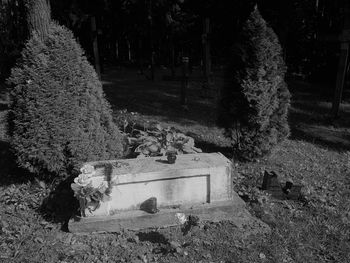
In January 1994, during his visit to Belarus, US president Bill Clinton donated a concrete bench for the Kurapaty site as a sign of sympathy and respect from the American people to Belarusians for the repressions they had experienced (See Figure 1).Footnote 61 The memorial has encountered frequent acts of desecration ever since. The first time the bench was destroyed was in summer 2001; it was rebuilt in 2002. It was vandalized again in 2003 and 2012.Footnote 62 The “Clinton bench” was the only monument given to Belarus during the first and to date the last visit of a US president since Belarus’ independence. It was also the only memorial erected on behalf of a different state for twenty-four years. Thus, the bench took on a symbolism that was perhaps unexpected at the time it was installed.
The Clinton Bench at Kurapaty donated to the Belarusian people on behalf of the US government in 1994.

A protest camp against the construction of a new passage of the Minsk beltway emerged on September 26, 2001, attracting people from various political parties and movements such as Malady Front, Zubr, the Belarusian Party of Liberty, the Party of the Belarusian Popular Front (led by Vincuk Viačorka), and the Conservative Christian Party-Belarusian Popular Front. Often, local people and those whose relatives had been repressed by the Stalinist regime also paid visits and sometimes joined the protest camp. Simultaneously the Institute of Archaeology of the Belarusian Academy of Sciences started excavations to determine whether there were any remains of the bodies in the area where the construction works would take place. At the end of the process the Senior Researcher, Aleh Ioŭ, stated that such remains had not been discovered.Footnote 63
The camp encountered a series of provocative acts, including visits of drunken men to the camp, arson, helicopters flying above the protester-occupied tents, and monitoring by unknown persons in cars with no signs.Footnote 64 In addition, on October 18, 2001 a column of military vehicles approached the tent camp of the protesters and stopped there with their lights on. The arson was organized on the night after the Dziady commemoration day on November 2, 2001.Footnote 65 The Dziady march of October 28, 2001 gathered 1,000 people representing oppositional political parties, youth protesters against the construction of the beltway, and people whose relatives had been repressed during the communist period in Belarus.Footnote 66 In early November 2001, about 100 Belarusian militia, without insignia, launched an operation to destroy the protester tent camp and newly-erected crosses as well as remove the protesters from the construction site. Later they evicted people from the tent camp. They also physically attacked several defenders of the site, as well as other politicians, and several journalists.Footnote 67 People formed a human chain, but the militia applied gas and removed the remaining protesters and their supporters, who had responded to the news about attacks by the militia.Footnote 68 Thus, the forty-six days around-the-clock duty at Kurapaty construction site came to a halt, but its demise proved to be temporary.
The Belarusian authorities attempted to distort the discourse with the initiative by Lukašenka's adviser Siarhiej Posachaŭ, who appealed to the Committee of Conservation of Historical and Cultural Heritage to erect a monument to the victims of Nazi repressions in Kurapaty.Footnote 69 In mid-November 2001, a group of archaeologists expressed their concern that the authorities had started to seek a “German trace” in Kurapaty instead of revealing the results of the additional state investigation.Footnote 70 A month later, the Prosecutor General's office confirmed that Kurapaty contained “the remains of the political repressions’ victims,” thus rejecting any suggestion of a “German trace” there. At the same time, the office refused to reveal the results of the 1997–99 investigation, which they maintained “could be abused by the various political forces” for their own purposes.Footnote 71 The same day, the Belarusian Parliament's lower chamber—the House of Representatives—refused to include financing of the future Kurapaty memorial from the 2002 budget.Footnote 72 Consequently, the Belarusian art community Pahonia decided to donate all the money earned on the works of its members to a new memorial in Kurapaty.Footnote 73 It also organized a charity exhibition and sale of their works in one of the Minsk art galleries. On November 15 of this same year, the Belarusian president visited one of the reconstructed passages of the Minsk beltway, but opted not to visit the Kurapaty area.Footnote 74
The protesters’ camp came to a halt on June 3, 2002 when they decided to dismantle the site but continue to pay visits to and monitor the condition of the Kurapaty burial grounds.Footnote 75 During a period of almost nine months, protesters did not manage to stop the construction of the beltway, but succeeded in drawing society's attention to Kurapaty. They also erected several crosses, tidied up the area, and demonstrated to the authorities that the memorialization of Kurapaty was crucial for some Belarusians. Simultaneously, around thirty organizations united in the civic initiative, “Experts defending Kurapaty,” which was still extant at the time of writing. The initiative organized an exhibition, “The Truth about Kurapaty: Facts, documents, testimonies” in February 2017.Footnote 76 The world-renowned Polish film director Krzysztof Zanussi visited and stressed the importance of Kurapaty, which “should be as crucial for Belarusians as Katyń for Poles.”Footnote 77 The exhibition coincided with another big protest connected with the Kurapaty site. The 24-hour tent camp emerged on a construction site near Kurapaty and was organized by the “Young Front” leader Zmicier Daškievič and his followers, with the active participation of Paval Sieviaryniec, a leader of the Belarusian Christian Democratic Party. The protest started on February 16, 2017 and lasted until the end of March, when both leaders received criminal charges and were imprisoned for several days for holding an unsanctioned mass event.Footnote 78
The protesters spent many days preventing construction workers from completing any work on the site. The company that initiated the construction had intended to build an office center there, but was forced off the site after several physical clashes with the protesters. In the aftermath of the public interest in the protest, the editor-in-chief of the major presidential newspaper SB-Belarus Today, Pavel Jakubovič, initiated a roundtable discussion about the conflict over Kurapaty and invited various actors to take part.Footnote 79 Jakubovič asked the Belarusian Nobel Prize for literature winner writer Sviatlana Alieksijevič (Svetlana Aleksievich) to head the commission on Kurapaty memorialization. Alieksijevič declined the offer, however, suggesting that Paźniak be appointed instead.Footnote 80 The choice of Paźniak was impractical for two main reasons: first, he had left Belarus in 1996; secondly, he would not have cooperated with the authorities even if they approached him. Subsequently, the commission disappeared from the public eye and only re-emerged when the Ministry of Culture announced a competition for the future Kurapaty memorial.
The Present
The lengthy saga of Kurapaty featured again in the Belarusian media and social media during 2018 because of the demonstrations at the site against the restaurant “Let's Go and Eat!” Earlier, in 2014, a restaurant was constructed under the name Bulbaš Hall (bulbaš is a derogatory term often used by Russians and other Belarusian neighbors to describe Belarusians).Footnote 81 The debates over the legal grounds to build a restaurant near Kurapaty started in 2011 and were followed by numerous protests of various political parties, independent activists, and people whose relatives had been repressed during the Soviet period.Footnote 82
Belarusian journalist Dzianis Ivašyn revealed corrupt practices during the building of the “Let's Go and Eat!” restaurant on the same site in Novy Čas.Footnote 83 Later Ivašyn had to face accusations of libel in court and was accused by Arkadź Izrailievič, one of the defenders and friends of the restaurant owners, of antisemitism. The journalist had discovered that the owners of the restaurant comprised several legal entities and were citizens of Belarus and Israel. The court, however, did not bring any charges against either the newspaper or the journalist.Footnote 84 Another scandal erupted in November 2018, when journalists revealed that some political activists had started negotiations with the owners of the restaurant and had taken money from them for maintenance of the memorial site.Footnote 85
In 2018, from its first day of operation, the most frequent protesters picketing the newly-opened restaurant were Hanna Šapućka (“Initiative to defend Kurapaty”), Daškievič (“Young Front”), and Sieviaryniec (Belarusian Christian Democratic Party). Both Daškievič and Sieviaryniec have defended the Kurapaty site since 2001. The other main participant in earlier protests, Paźniak's own CCP-BPF, criticized the more recent protesters for distracting public attention from the main zone of Kurapaty. Members of the CCP-BPF were concerned that gradually the “people's memorial in Kurapaty,” that is, the crosses and monuments erected thanks to civic initiatives and money, would be destroyed over time, enabling the authorities to expropriate the monopoly on Kurapaty memorialization from the opposition.Footnote 86 The new monument to some extent has begun this process.
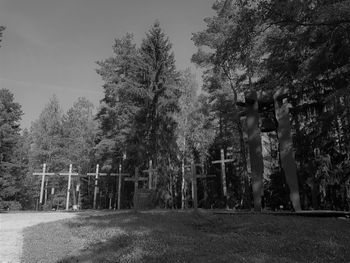
In the meantime, as described above, the Belarusian government, despite its earlier reticence, finally erected a memorial to Kurapaty victims (see Figure 2). Despite the protests against the project itself and debates over the site of the monument's erection, the monument was placed on “Golgotha” on November 6, 2018, at the top of the Kurapaty hill next to the monuments founded on crosses and stones.Footnote 87 At the installation ceremony, the authorities were represented only by the members of state-funded trade union organization. No other officials visited the memorial, which is simple in form with four columns carrying a bell. It explicitly states that it commemorates the victims of the political repressions of the twentieth centuryFootnote 88 and provides inscriptions in four languages of pre-1936 Soviet Belarus—Belarusian, Russian, Polish, and Yiddish—thus underlining the multinational character of the victims killed there.Footnote 89
The official government memorial at Kurapaty, installed in November 2018.

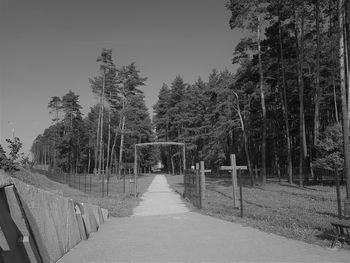
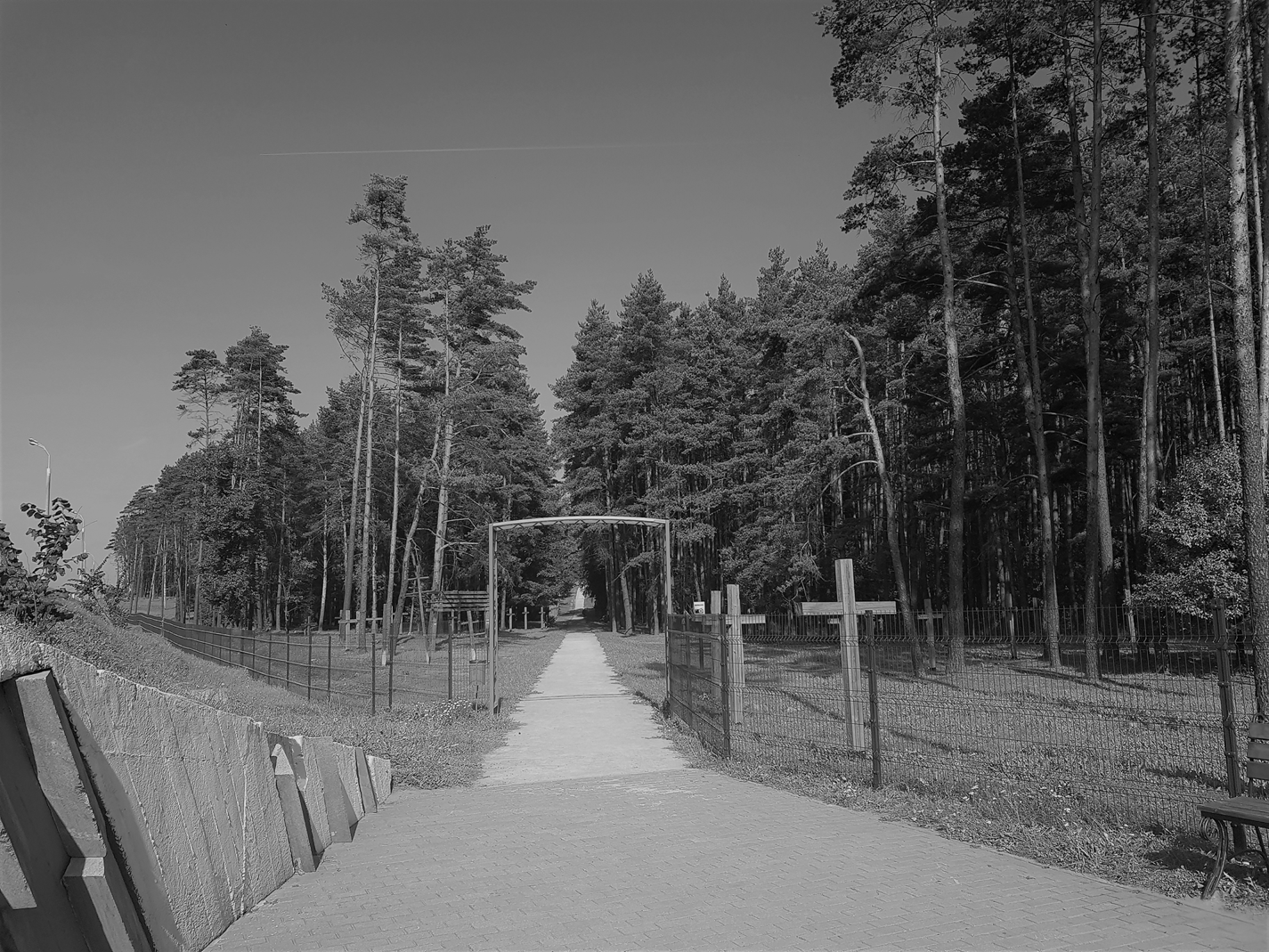
The appearance of the monument was followed by a number of acts of vandalism, including anti-Semitic ones.Footnote 90 The Clinton bench and the crosses erected by the public were targeted several times after November 2018.Footnote 91 The removal of crosses on the perimeter of Kurapaty in early April 2019 by bulldozers, during the weeks before both the Catholic and Eastern Orthodox Easter, and the erection of a fence surrounding the entire site on government orders shocked many (see Figure 3).Footnote 92 Lukašenka announced plans to “clean up” the area and decorate the fence with flowers. He rejected the outcomes of earlier investigations: “We don't even know whether there were victims of Stalinist purges only, whether people were buried and reburied there later, whether Nazis executed people there.” Lukašenka emphasized that the identity of the victims was unknown and should remain so: “Dead people should rest in peace.”Footnote 93
Government fence around Kurapaty site, installed in April 2019.
Analysis of Findings
Accurate information about Kurapaty has been difficult to ascertain, although certain facts are apparent. The first target was the remaining Belarusian cultural and political elite, starting in 1937 during the height of the Stalinist Purges, from which it never fully recovered. The years 1937–38 account for most of the corpses buried at Kurapaty and during those years we can assume that the majority of the victims were ethnic Belarusians and Poles, as well as Jews, Latvians, and Russians living in Belarus. After 1939 until the beginning of the war, there were also victims of other nationalities after the incorporation of the western regions into BSSR in 1939. In terms of the number of victims at Kurapaty, the most likely estimate is about 30,000, based on earlier archaeological excavations and conclusions, the work of scholars, and pre-1994 research carried out in Moscow archives. Our own view is that the figure of 30,000 appears realistic.
More precise information would benefit from access to KGB archives, although we have Adamuška's conclusions from 1994, which are reasonably comprehensive for the years 1937–38. Since 2005, victory in the Second World War has been used as the defining point of the modern nation, and historically inaccurate—even wildly inaccurate—depictions of those events have prevailed to the detriment not only of Stalinist victims, but also those of the Jewish Holocaust in Belarus, which was largely ignored by both the Soviet and post-Soviet regimes. Although some minor steps have been taken to address these issues, they have never threatened the official rhetoric of the war and its commemoration at the highest level.
Concerning Kurapaty, only the resilience of its latter-day defenders has preserved the site to the present. In addition, these actors continue to debate the right way to memorialize the Kurapaty massacres and the monopoly over arguably the major anti-Soviet memorial in Belarus. Today, the government constitutes a new and important actor that has finally addressed the Kurapaty issue, but which has also distanced itself from opposition initiatives and shown little interest in investigating Kurapaty further. Its involvement has been essentially low key. The government also made several attempts to reduce, modify, and even destroy the memorial site, and failed to prevent what can only be described as a provocative eyesore restaurant at its entrance. That emotions among its defenders run high is to be expected because Kurapaty has become a Belarusian national shrine for some of the political opposition and other sectors of Belarusian society.
Was Belarus exceptionally or uniquely affected by the Stalin Purges and executions? The answer is no, since specialist studies of the Purges, such as those by Robert Thurston and Arch Getty, have shown that all parts of the Soviet Union were affected, with losses of life in Belarus somewhere around the Soviet average. We have argued, however, that their impact here was greater than in most other republics because of earlier campaigns against and arrests of its small intelligentsia, its strategically-important geographic location close to the Polish border, and its multi-national population with high numbers of Poles, Jews, Russians, and people of Baltic origin in 1937–41. The failure of the authorities to pursue the subject of repressions arguably limited national and cultural development after independence. Only the war victory has remained as a national commemorative event.
The Kurapaty question has been made more complicated by its political nature, with the government and its perpetuation of war myths on one side and the rightist opposition on the other. The latter tends to adopt an ethnic approach that perceives Belarusians as the main—and often only—victims. The arguments over the number of victims are compounded by inaccurate and conjectural estimates, a lack of context, and a lack of knowledge about the identities of many of those who were killed. But the investigations of Kurapaty, and the more recently-discovered mass grave sites at Chajsy (near Viciebsk) and Kabyliaki (near Orša)—the former on a scale comparable to that of Kurapaty—allows the conclusion that all parts of Soviet Belarus were encompassed by arrests, trials, and mass executions of the population throughout the period 1937–41.Footnote 94 Moreover, there are almost certainly more sites waiting to be discovered, just as there were in Ukraine and many parts of Russia in 1988–91.Footnote 95
Ultimately, the analyst is faced with destruction of humanity on a mass scale. The Purges ran into the beginning of the war and some of its most violent battles, as well as Partisan activities and the Holocaust. Thus, to separate completely the Stalinist violence of 1937–41 from what followed is extremely difficult; indeed, the killing grounds were often the same, though Kurapaty was not a Nazi execution site. The struggles of Belarus today to define its national identity and its division into competing narratives owe much to this period and the Russification with which it was accompanied from the 1930s to the 1980s.