Introduction
Cardiac implantable electronic devices (CIEDs) are among the main technological advances in Cardiology. Reference Zaremba, Jakobsen, Søgaard, Thøgersen and Riahi1 The prevalence of implanted cardioverter defibrillators (ICDs) is on the rise in the overall population due to longer life expectancy. External beam radiotherapy (EBR) can affect the electronic components of the ICDs and induce permanent damage. This could be related either to the ionizing effect of the rays or to the interaction of electromagnetic radiations. Reference Brouillard, Chamula, Lavoie, Varfalvy and Archambault2 Since then, several learned societies have published their guidelines based mainly on the direct dose of radiation, the level of CIED dependency and exposure to neutron-producing radiation. Reference Huertas, Thuillot and Bibault3
We report herein the case of a patient with ICD treated with EBR for breast carcinoma.
Case Presentation
A 76-year-old patient presented with a long history of ischemic cardiomyopathy since 2007 with coronary bypass grafting and then a left anterior descending coronary artery percutaneous coronary intervention with drug-eluting stent in 2013. The patient had severe systolic left ventricular dysfunction and therefore had an ICD as primary prevention of sudden cardiac death. In September 2017, the patient presented with left breast carcinoma and had a partial mastectomy, leaving in place the mammary gland surrounding the defibrillator and lymph nodes because of intraoperative hypoxemia. So that, adjuvant radiotherapy was indicated.
The oncologist defined the treatment field and referred the patient to us, given the risk of electromagnetic interference with the ICD.
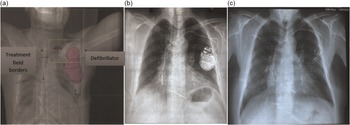
As the pulse generator was on the same side as the irradiation field (Figure 1A), we removed it and kept the leads in place, with closer follow-up. Figure 1 shows the chest X-ray before (Figure 1B) and after (Figure 1C) the extraction of the device. Currently, the patient is receiving hormonotherapy. He is stable on antiarrhythmic treatment with no cardiac events.
(a): Field arrangement for radiotherapy treating supraclavicular lymph node, chest wall and left breast. (b): Chest X-ray showing the ICD generator in the upper left chest and the ICD leads in the right atrium and ventricle of the heart. (c): Chest X-ray after the extraction of the ICD generator with the leads in place. ICD, implanted cardioverter defibrillators.

Discussion
An increasing number of patients with CIEDs are receiving radiotherapy. Reference Huertas, Thuillot and Bibault3 EBR may interfere with electric components of ICDs. Reference Menard, Campana and Kirov4 Electromagnetic interference can generate a signal detected as a normal or pathological heart rhythm, leading to pacing inhibition, or inappropriate shock. Reference Lambert, Da Costa and Marcy5 The system reset may occur. The CIED reprogramming resolves this issue. However, irreversible and permanent device damage may occur. Reference Dobson and Wright6
The risk of ICD malfunction increases with the increasing dose of radiotherapy (RT). There is no specific ‘safe’ dose to a device, as a dose as little as 0·15 Gy may cause ICD malfunction. Dobson R et al. reported that most significant malfunctions occurred above a dose of 20 Gy. Reference Dobson and Wright6 The small number of patients included in the trials may explain this discrepancy. ICDs are known to be more vulnerable to malfunction issues than pacemakers. Reference Dobson and Wright6
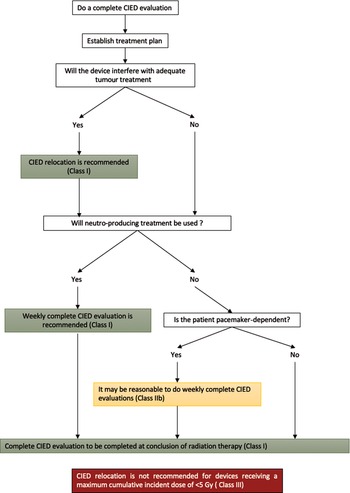
This problem was studied and described in vitro and in vivo since the 1980s, leading the American Association of Physicists in Medicine (AAPM) to propose the first guidelines for these cases management in 1994· Reference Huertas, Thuillot and Bibault3 Since then, several have been published. Heart Rhythm Society (HRS) published the latest guidelines in 2017 (Figure 2). Reference Indik, Gimbel and Abe7,Reference Sharifzadehgan, Laurans and Thuillot8
Management of patients with implantable cardiac devices treated with radiation, according to the 2017 consensus of the Heart Rhythm Society.
Class of recommendations: Class I (strong): recommended or indicated with high level of benefit; IIa (moderate): reasonable, can be useful; Class IIb (weak): may be reasonable, low level of benefit recommendation; Class III: not recommended, can be harmful, high level of risk recommendation. Level of evidence (LOE: level of evidence): A-NB: high-quality evidence based on meta-analyses; B-NR: Level B, based on observational studies (non-randomised); C-EO: Level C, expert consensus. CIED, cardiac implantable electronic device.

AAPM, according to the 80s data, proposed a threshold of 2 Gy of a total dose beyond which there would be a high risk of malfunction. With the technological evolution of ICDs, some experts currently suggest a threshold of 5 Gy. Reference Huertas, Thuillot and Bibault3
We referred to the recommendations of the French Society of Radiation Oncology Therapy (SFRO) published in 2016 to manage our patient. These are derived from the National Agency for the Safety of Medicines and Health Products (ANSM) report of 2005. The main elements of these recommendations are Reference Huertas, Thuillot and Bibault3
-
– Move the CIED if it is in the field or at the edge of the treatment field;
-
– Before treatment, check that the device is working correctly and specify the dependency level;
-
– Limit the maximum dose to 5 Gy;
-
– During treatment:
-
Perform an electrocardiogram before and after each session;
-
Place a magnet on the ICD to deactivate it during the session;
-
Check the parameters of the ICD at mid-treatment and the end of treatment;
-
-
– After treatment, a close follow-up is mandatory.
Further device interrogation should occur at 1, 3 and 6 months after the end of RT, as a device failure may occur several months after the end of the irradiation. Reference Yeung, Chacko and Glover9,Reference Barillot, Mazeron, Mornex and Giraud10
In our case, the defibrillator in the irradiation field was removed, with a regular follow-up, respecting the basic rules.
Pre- or post-session electrocardiogram and the use of magnets on ICD are not recommended in the latest guidelines of 2017. Only the threshold of 5 Gy was maintained, which simplifies the management of the patient on a radiotherapy protocol. Reference Huertas, Thuillot and Bibault3
Conclusion
With rising CIED implantation rates, radiation oncology departments will be treating an increasing number of patients with CIEDs. A structured multidisciplinary approach, involving ongoing collaboration between cardiologists, radiation oncologists and RT technicians, is imperative to ensure safe and efficient RT delivery. And lastly, we highlight the need to develop evidence-based guidelines on this topic.
Acknowledgements
None.
Financial Support
This research received no specific grant from any funding agency, commercial or not-for-profit sectors.
Conflict of Interest
The authors declare none.