Cavopulmonary shunt was initially developed in the 1950–60s by many groups worldwide. Reference Konstantinov and Alexi-Meskishvili1 It had provided successful long-term palliation to provide an additional source for pulmonary blood flow in severely hypoxic patients with a wide range of congenitally malformed hearts until the 1970s, when the classic Fontan operation replaced the procedure. Reference Freedom, Nykanen and Benson2 Ironically, the cavopulmonary anastomosis procedure was reintroduced in the 1990s as an interim stage procedure for high-risk Fontan patients. Reference Bridges, Jonas and Mayer3 It has been shown to improve systemic arterial oxygen saturation by increasing the effective pulmonary blood flow and enhancing the systemic ventricle volume unloading Reference Pridjian, Mendelsohn and Lupinetti4–Reference Donofrio, Jacobs, Norwood and Rychik6 and led to lower mortality and morbidity in children undergoing single-ventricle palliation. Reference Alejos, Williams and Jarmakani7,Reference Jacobs, Rychik and Rome8 In the current era, bidirectional cavopulmonary anastomosis has become the standard second-stage procedure in children with a functionally univentricular heart. Despite the high survival after bidirectional cavopulmonary anastomosis, a considerable number of patients undergo heart transplantation or suffer significant post-operative morbidities related to prolonged length of hospital stay. Reference Jaquiss, Ghanayem and Hoffman9,Reference Hansen, Uebing and Furck10 Identifying risk factors for poor outcomes after bidirectional cavopulmonary anastomosis might help in early referral to a heart transplant and early post-operative reinterventions. Reference Meza, Hickey and McCrindle11 The previously reported risk factors for early mortality and prolonged length of stay after bidirectional cavopulmonary anastomosis have been inconsistent. Reference Hansen, Uebing and Furck10,Reference Alphonso, Baghai, Sundar, Tulloh, Austin and Anderson12–Reference Tran, Sullivan, Cleveland, Kumar and Takao26
The objectives of our study were to describe outcomes of bidirectional cavopulmonary anastomosis and identify pre-operative risk factors associated with prolonged length of stay at our institution.
Materials and method
Study design and definitions
Following exemption from Nicklaus Children’s Hospital Research Institute institutional review board (exempt study# NCRI-EX-252), we retrospectively reviewed all available medical records, operative reports, cardiac catheterisation data, and echocardiographic data for all consecutive patients with functionally single ventricle who underwent first-time bidirectional cavopulmonary anastomosis operation from 1 January, 2006 to 31 December, 2019, at Nicklaus Children’s Hospital. Patients who underwent prior surgical interventions at an outside institution were excluded. Prematurity was defined as gestation age less than 37 weeks; low birth weight was defined as less than 2.5 kg, the genetic syndrome was defined as any anomaly identified by chromosomal karyotype or microarray, and weight-for-age Z-score at the time of bidirectional cavopulmonary anastomosis was calculated using the 2006 World Health Organization child growth standards. Interstage catheterizations were classified as elective and unplanned based on the documented indication in the catheterisation report. Catheterization data obtained from elective interstage catheterisation included systemic ventricle end-diastolic pressure, mean pulmonary artery pressure, pulmonary vein wedge pressure, and superior vena cava oxygen saturation. In the scenario where multiple samples were obtained for oxygen saturations, an average was used. If direct measurement of the mean pulmonary artery pressure was not obtained, the mean pulmonary vein wedge pressures were used as a surrogate, and if mean pressures between the left and right pulmonary artery were discrepant, an average of the two values was used. Although used in previous reports, pulmonary vascular resistance and cardiac index were excluded from our analysis due to multiple potential sources of errors related to assumed oxygen consumption and differences in pressures, flows, and sources of pulmonary blood flow. As graded by the expert imaging cardiologist who finalised the echocardiogram report, pre-operative assessments of atrioventricular valve function and ventricular function were determined based on the last complete echocardiogram performed prior to bidirectional cavopulmonary anastomosis. The severity of systemic atrioventricular valve regurgitation was dichotomised into two categories; 1) trivial to mild and 2) more than mild. Similarly, systemic ventricle function was dichotomised into two categories: 1) normal to mild dysfunction and 2) greater than mild dysfunction for the purpose of simple logistic regression. In order to assess the relationship between outcomes and increasing severity of systemic atrioventricular valve regurgitation and/or systemic ventricle dysfunction and accordingly generate effect plots, the pre-operative ventricular function was categorised into normal-fair function, mild, moderate, and severe dysfunction, and the systemic atrioventricular valve regurgitation was categorised into trivial, mild, moderate, and severe regurgitation.
The anatomical diagnosis was classified as:
-
1. Classic hypoplastic left heart syndrome.
-
2. Hypoplastic left heart syndrome variant: double-outlet right ventricle with mitral atresia and right ventricle dominant unbalanced complete atrioventricular canal defect.
-
3. Single left ventricle with normally related great arteries: tricuspid atresia with normally related great arteries, severe Ebstein’s anomaly, pulmonary atresia with intact ventricular septum, and left ventricle dominant unbalanced complete atrioventricular canal defect.
-
4. Single left ventricle with malposed/transposed great arteries: tricuspid atresia with transposed great arteries, double-inlet left ventricle with malposed great arteries, and double-outlet left ventricle with malposed great arteries.
-
5. Heterotaxy.
-
6. Biventricular CHD with good size ventricles which could not be septated.
We restricted our analysis to inpatient hospital outcomes; operative mortality was defined based on the Society of Thoracic Surgeons Congenital Heart Surgery Database criteria. Post-operative length of stay was measured from the day of surgery until discharge or death, and prolonged length of stay was defined as hospital stay greater than the 75th percentile for our cohort.
Statistical analysis
All data processing and analyses were performed using the statistical programming language R. 27 Data were described using means and standard deviations or medians and interquartile for continuous variables, counts, and percentages for categorical variables. To determine associations between pre-operative and intraoperative variables and the outcomes of interest, we performed simple logistic regression using tools from the R package DHARMa. Reference Hartig28 Covariates with a p-value less than 0.1 on univariate analysis were included for multivariate logistic regression. The variance inflation factor of the fitted models was checked using the R package car, Reference Fox29 and since variance inflation factor >5 indicates excessive collinearity, Reference Yoo, Mayberry and Bae30 the variables with the highest variance inflation factor were successively removed until all variables were displayed variance inflation factor less than or equal to 5. The resulting model was checked for diagnostic issues using tools from the R package DHARMa. Reference Hartig28 To evaluate the relationship between the increasing severity of pre-operative echocardiographic variables and outcomes of interest, estimated marginal means and contrasts were calculated using the R package Emmeans, Reference Lenth, Singmann and Love31 and effects plots for composite failure and prolonged post-operative length of stay with pre-operative ventricular function and the systemic atrioventricular valve regurgitation were generated from logistic regression using the R package effects. Reference Fox29
Results
Demographics and outcomes
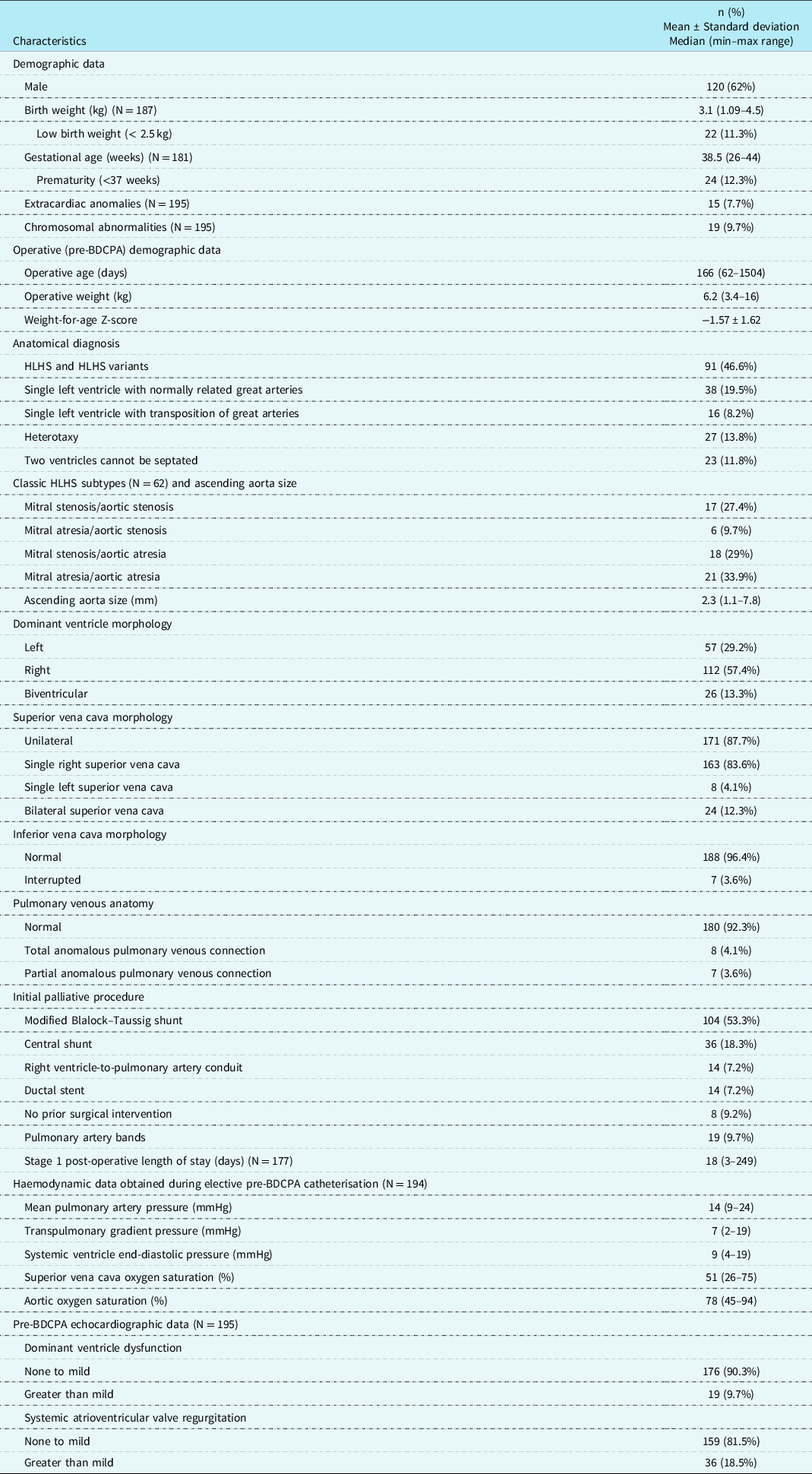
A total of 203 patients who underwent first-time bidirectional cavopulmonary anastomosis were identified from our institution’s surgical database. Of 195 patients who met inclusion criteria, 62% were males, and the median operative weight and age at the time of bidirectional cavopulmonary anastomosis were 6.2 kg (minimum-maximum range 3.4–16 kg) and 166 days (minimum-maximum range 62–1504 days), respectively. The most common anatomic subtype was classic hypoplastic left heart syndrome in 62 patients (31.8%). The source of pulmonary blood flow after the first-stage palliation included a modified Blalock–Taussig shunt in 104 patients (53.3%), central shunt in 36 patients (18.3%), right ventricle-to-pulmonary artery conduit (Sano modification) in 14 patients (7.2%), and ductal stent in 14 patients (7.2%) with median post-operative length of stay after the initial palliative procedure of 18 days. Eighteen patients (9.2%) underwent primary bidirectional cavopulmonary anastomosis without any previous surgical intervention. Atrioventricular valve regurgitation was greater than mild in 36 patients (18.5%), and systemic ventricle dysfunction was greater than mild in 19 patients (9.7%). Out of the 36 patients who had more than mild systemic atrioventricular valve regurgitation, the anatomical diagnosis with classic hypoplastic left heart syndrome was most common in 29 patients followed by atrioventricular canal in 6 patients and double-outlet right ventricle with remote ventricular septal defect in 1 patient. Pre-operative characteristics are summarised in Table 1.
Pre-operative patient characteristics

BDCPA = bidirectional cavopulmonary anastomosis; HLHS = hypoplastic left heart syndrome.
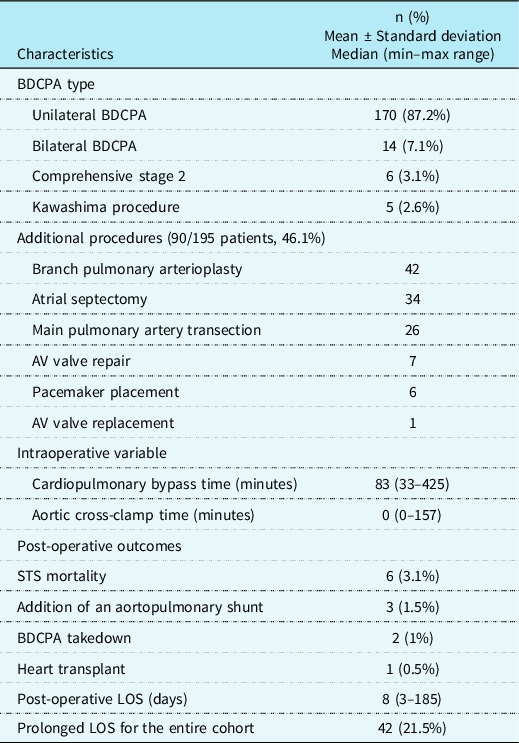
Our institution’s preference is to perform bidirectional cavopulmonary anastomosis under cardiopulmonary bypass. Unilateral bidirectional cavopulmonary anastomosis was performed in 170 patients (87.2%), bilateral bidirectional cavopulmonary anastomosis in 14 patients (7.1%), comprehensive stage 2 palliation in 6 patients (3.1%), and Kawashima procedure in 5 patients (2.6%). Excluding takedown of the previously created source of the pulmonary blood flow, 90/195 patients (46.1%) underwent a concomitant procedure. Table 2 summarises operative characteristics, bidirectional cavopulmonary anastomosis type, the additional procedures performed at the time of bidirectional cavopulmonary anastomosis, and post-operative outcomes. Median post-operative length of stay was 8 days (minimum-maximum range, 3–185 days and interquartile range, 4–15 days), and 42 patients (21.5%) met the criteria for prolonged post-operative length of stay (>15 days).
Bidirectional cavopulmonary anastomosis type, additional procedures, intraoperative variables, and post-operative outcomes

AV = atrioventricular; BDCPA = bidirectional cavopulmonary anastomosis; LOS = length of stay; STS = Society of Thoracic Surgeons.
Risk factors analysis for prolonged length of stay
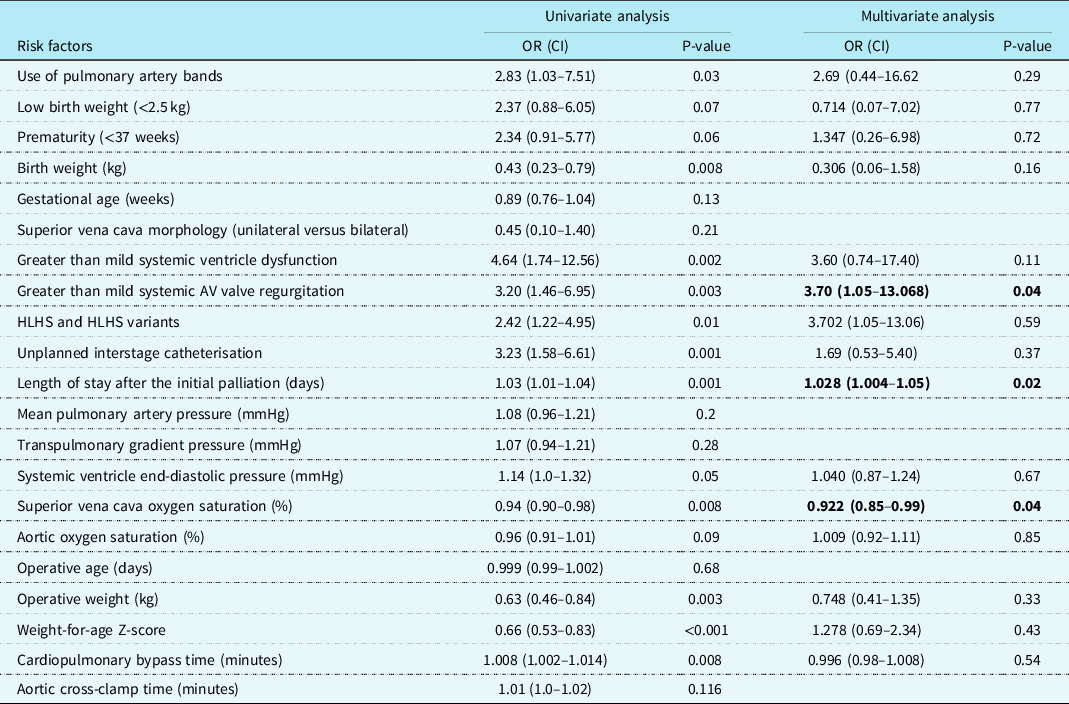
The 75th percentile for post-operative length of stay in our cohort was 15 days. Prolonged length of stay was defined as greater than 15 days. By univariate analysis, the use of pulmonary artery banding, greater than mild systemic ventricular dysfunction, greater than mild systemic atrioventricular valve regurgitation, hypoplastic left heart syndrome and its variants, unplanned cardiac catheterisation in the interstage period, longer length of stay after the initial palliation, and longer cardiopulmonary bypass time were associated with increased risk of prolonged post-operative length of stay, while higher birth weight, higher superior vena cava oxygen saturation, higher operative weight, and higher weight-for-age Z-score were associated with reduced risk of prolonged length of stay. In multivariate analysis, greater than mild systemic atrioventricular valve regurgitation (odds ratio 3.7, 95% confidence interval 1.05–13.068, p = 0.04), longer length of stay after the initial palliative procedure (odds ratio 1.028, 95% confidence interval 1.004–1.05, p = 0.02), and higher superior vena cava oxygen saturation (odds ratio 0.922, 95% confidence interval 0.85–0.99, p = 0.04) maintained statistical significance as independent risk or protective factors (Table 3).
Pre-operative and intraoperative risk factors for prolonged length of stay

AV = atrioventricular; CI = confidence interval; HLHS = hypoplastic left heart syndrome; OR = odds ratio.
Effect plots generated for prolonged post-operative length of stay (Supplementary Figures A-D) demonstrated a linear relationship between the severity of pre-operative systemic ventricular dysfunction and systemic atrioventricular valve regurgitation with the odds of prolonged post-operative length of stay. Each one-level increase in the severity of pre-operative systemic ventricular dysfunction was associated with a multiplicative change in the odds ratio of prolonged post-operative length of stay of 7.35 (p-value 0.012), as demonstrated in Figure A. This linear relationship was maintained after adjusting for the severity of systemic atrioventricular valve regurgitation, with a multiplicative change in the odds ratio of prolonged post-operative length of stay of 6.12 (p-value 0.028), as demonstrated in Figure B. A one-level increase in the severity of pre-operative systemic atrioventricular valve regurgitation was associated with a multiplicative change in the odds ratio of prolonged post-operative length of stay of 3.5 (p-value 0.012), as demonstrated in Figure C and the linear relationship was maintained independent of the severity of systemic ventricular dysfunction, with a multiplicative change in the odds ratio of prolonged post-operative length of stay of 5.45 (p-value 0.005), as demonstrated in Figure D.
Discussion
In our single-center series spanning over 13 years, we found that pre-operative findings of greater than mild systemic atrioventricular valve regurgitation and longer length of stay after the initial palliative procedure were risk factors, and higher superior vena cava oxygen saturation was a protective factor associated with prolonged post-operative length of stay (>15 days) in multivariate analysis. These findings may help clinicians stratify this complex patient population into risk groups, provide data for post-operative management strategies for those at high risk, and provide more accurate family counselling.
Our median post-operative length of hospital stay (8 days) was comparable to previous studies. Reference Schwartz, Lu and Ohye22,Reference Barron, Haq and Crucean25,Reference Baker-Smith, Goldberg and Rosenthal32 Our study showed that longer length of stay after the initial surgical palliation was one of the independent risk factors for prolonged length of stay after bidirectional cavopulmonary anastomosis. It was similarly reported in the single-ventricle reconstruction trial. Reference Schwartz, Lu and Ohye22 We highlight that this subgroup of patients had several morbidities and complications before and after their initial palliation. They carried long-term consequences such as significant ventricular dysfunction, significant atrioventricular valve regurgitation, additional interventions, and poor somatic growth with lower operative weight and weight-for-age Z-score. All mentioned variables were significantly associated with prolonged length of stay after bidirectional cavopulmonary anastomosis in the univariate but not the multivariate analysis. Our study is unique in that we found higher superior vena cava oxygen saturation was an independent protective factor associated with prolonged length of stay out of many haemodynamic variables. We did not examine pulmonary vascular resistance as we believed many assumptions were made to calculate pulmonary vascular resistance.
Multiple recent studies suggested a significant association between the severity of pre-operative systemic atrioventricular valve regurgitation and poor outcomes after bidirectional cavopulmonary anastomosis. Reference Hansen, Uebing and Furck10,Reference Scheurer, Hill and Vasuki13,Reference Tanoue, Kado and Boku14,Reference Friedman, Salvin and Wypij17,Reference Carlo, Carberry and Heinle18,Reference Lee, Aiyagari, Hirsch, Ohye, Bove and Devaney21,Reference Schwartz, Lu and Ohye22,Reference Barron, Haq and Crucean25 In our study, greater than mild systemic atrioventricular valve regurgitation was an independent risk factor for prolonged post-operative length of stay. In addition, effect plots demonstrated a linear relationship between the increase in the severity of systemic atrioventricular valve regurgitation and prolonged length of stay independent of the severity of systemic ventricle dysfunction.
A few studies have shown systemic ventricular dysfunction was a risk factor for death or heart transplant after bidirectional cavopulmonary anastomosis. Reference Meza, Hickey and McCrindle11,Reference Friedman, Salvin and Wypij17,Reference Lee, Aiyagari, Hirsch, Ohye, Bove and Devaney21,Reference Barron, Haq and Crucean25 In our study, effect plots demonstrated a clear linear relationship between the increasing severity of systemic ventricle dysfunction and the risk for prolonged post-operative length of stay, independent of the severity of systemic atrioventricular valve regurgitation. However, multivariate analysis did not reach statistical significance for the association.
Elevated pulmonary vascular resistance and/or elevated pulmonary artery pressure were most consistently reported as pre-operative risk factors for mortality in the 1990s, with median age at the time of bidirectional cavopulmonary anastomosis older than 1 year of age. Reference Bridges, Jonas and Mayer3,Reference Pridjian, Mendelsohn and Lupinetti4,Reference Alejos, Williams and Jarmakani7 The timing of bidirectional cavopulmonary anastomosis has shifted to a younger age based on poor outcomes at an older age. Most recent studies, including our study, did not find higher pulmonary artery pressure as a risk factor for mortality, probably because pulmonary artery pressure remained overall low at a younger age. Several recent studies examined the association between pre-bidirectional cavopulmonary anastomosis cardiac catheterisation and worse outcomes. Elevated central venous pressure, mean pulmonary artery pressure, transpulmonary gradient pressure, and pulmonary artery stenosis were associated with in-hospital complications and subsequent longer hospital stay. Reference Kogon, Plattner, Leong, Simsic, Kirshbom and Kanter16,Reference Schwartz, Lu and Ohye22,Reference Tran, Sullivan, Cleveland, Kumar and Takao26 We identified that higher superior vena cava oxygen saturation was an independent protective factor associated with prolonged length of stay.
Limitation
This is a retrospective study limited to an inpatient cohort at a single institution with a single programmatic approach to the treatment and the palliation of univentricular heart disease, which has evolved over time. Many centres perform pre-operative cardiac magnetic resonance instead of cardiac catheterisation in patients undergoing bidirectional cavopulmonary anastomosis. Reference Brown, Gauvreau and Powell33 In addition, the majority of our cohort underwent stage I palliation with a modified Blalock–Taussig shunt or central shunt and was not representative of the modern cohort with right ventricular to pulmonary artery conduit. Therefore, the results of this study may not be generalisable to different programmatic philosophies at other institutions. As with all retrospective studies, significant unknown variables may have been unavailable through chart review and the bedside physician’s judgment dictated the clinical decisions, which was not established as a protocol. Therefore, many of the measured outcomes have some degree of inter-practitioner variability. Many of our outcome measures may indeed be co-linked variables rather than direct causes of prolonged length of stay.
Supplementary material
To view supplementary material for this article, please visit https://doi.org/10.1017/S1047951122002694
Acknowledgements
None.
Financial support
This research received no specific grant from any funding agency, commercial or not-for-profit sectors.
Conflicts of interest
None.
Ethical standards
The authors assert that all activities contributing to this work comply with the ethical standards of the US Good Clinical Practice Guidelines and the 2008 revised version of the Helsinki Declaration of 1975 and have been approved by the institutional review boards of Nicklaus Children’s Hospital.