


We are pleased and honored to publish in this issue the first of a two-part Special Section assessing the current state of archaeology in the Basin of Mexico, based on a conference organized in 2007 by Ian G. Robertson and Larry J. Gorenflo, who in turn have coordinated the current contributions. As students and close research associates of George L. Cowgill and the late William T. Sanders, respectively, Robertson and Gorenflo have dealt with Basin of Mexico archaeology for many years. As they discuss in their own remarks below, they felt that the time had come to gather together the principal specialists who had contributed to Basin of Mexico settlement archaeology during the final four decades of the twentieth century to appraise their efforts and results.
Building on the pioneering research of Jorge R. Acosta, Pedro Armillas, Leopoldo Batres, James A. Bennyhoff, Alfonso Caso, José Luis Franco, Manuel Gamio, James B. Griffin, Antonieta Espejo, Robert F. Heizer, Sigvald Linné, Ángel Palerm, Eduardo Noguera, Paul Tolstoy, and George C. Vaillant, archaeological research at Teotihuacan during the 1960s developed in two different directions. One direction involved extensive excavation and restoration of monumental architecture, “palaces,” and residential compounds with murals. The other favored systematic survey accompanied by small-scale excavations to address specific questions that emerged in the surveys. In 1962–1964, Ignacio Bernal directed a large project for the Mexican Instituto Nacional de Antropología e Historia (INAH) in the plaza of the Moon Pyramid and other structures in the northern sector of the civic-ceremonial center. Young professionals participating with Bernal on the INAH project included, most notably, Rubén Cabrera Castro, Eduardo Matos Moctezuma, and Alba Guadalupe Mastache Flores. At about the same time, Laurette Séjourné and Juan Vidarte de Linares were beginning to excavate residential compounds at Tetitla and in the La Ventilla district (Moragas Segura and Sarabia González Reference Moragas Segura and González2007).
The other direction was taken by a small number of U.S. and Canadian archaeologists who began in 1960 to plan and conduct systematic, “full coverage” archaeological survey of the entire Basin of Mexico accompanied by intensive, problem-oriented excavations. The short list of the original principals who planned, directed, and conducted this research in separate but related projects includes Richard E. Blanton, Thomas Charlton, René Millon, Jeffrey R. Parsons, and William T. Sanders. For the sake of simplicity, I mention only these five names with the implied understanding that scores of other associates, colleagues, and students of the principals contributed toward this massive effort. The audacity and scope of their collective enterprise was not fully appreciated at the time of its inception. In fact, only now, decades later, are we coming to understand and appreciate the gargantuan workloads and the immense accomplishments of their projects.
Due to the collective results of this work begun in the 1960s, most Mesoamericanists are aware of the general outline of pre-Columbian cultural development in the Basin of Mexico. In view of some recent changes in interpretations, a brief summary based on published research of the past 50 years, intended to pay homage to the projects and research featured in this Special Section, may not seem entirely unwarranted. Much of the story revolves around the great urban center of Teotihuacan. The following sketch relies primarily on a recent paper and a delightful new book by Cowgill (Reference Cowgill2013, Reference Cowgill2015) on Teotihuacan for interpretation of chronology, events, processes, and population estimates. For a good textbook treatment, one should consult Evans (Reference Evans2013).
After a poorly understood Archaic period, the initial sedentary, agricultural occupation of the basin began at about 1600 b.c., with the early ascendance of Cuicuilco in the fertile, moist, southwestern part of the basin as the most significant polity during the Middle Formative period leading up to about 400 b.c. Specialists have often speculated that the destruction of Cuicuilco by the massive eruption of the Xitle volcano may have been a major factor in the rapid population growth at Teotihuacan in the cooler, more arid Teotihuacan Valley, in the northeastern part of the basin, during the Late Formative from about 300 to 100 b.c. Cowgill (Reference Cowgill2015:48) points out, however, that Cuicuilco continued to be occupied during this time, and thus a cataclysmic Cuicuilco exodus is not likely to have contributed to the initial population growth at Teotihuacan. A more likely source of population influx seems to have come from the Valley of Puebla where the Popocatepetl volcano was actively erupting during the first two centuries b.c. In any event, by 100–1 b.c. Teotihuacan had a population ranging from 20,000 to 40,000 people living in a large city with the earliest civic-ceremonial constructions, streets, and residences covering an area of about 8 km2.
By a.d. 100 the population of the city had grown to approximately 60,000–80,000 people inhabiting a dense urban area of 20 km2, three to four times the size of the population of a century earlier. Much of the increase probably continued to be the result of in-migration. It was thought by Sanders, Parsons, and Santley (Reference Sanders, Parsons and Santley1979:105–108) that virtually all inhabitants of the Basin of Mexico lived in Teotihuacan at this time as the result of attraction, persuasion, or coercion. It now appears, however, that the northern and western portions of the basin may have had a considerable population that could have contributed to the agricultural support of Teotihuacan, while other parts of the basin, notably the southern portion, may have been only sparsely occupied during the Early Classic period (Cowgill Reference Cowgill2015:76; see also Clayton Reference Clayton2013).
Though Teotihuacan was a majestic city fit for the gods, the bulk of its population consisted of peasant farmers who worked the surrounding wetlands and canal-irrigated fields (Millon Reference Millon1973:59). Population in the city continued to expand until it peaked at a maximum of about 85,000 at around a.d. 200. Cowgill (Reference Cowgill2015:144) notes that a maximum of 125,000, as advocated by Millon (Reference Millon, Bricker and Sabloff1981:208), is possible but that a minimum of about 80,000 is also possible. This was the period of the beginning of Teotihuacan's power and splendor as an imperial capital, probably based on military effectiveness, commercial success, and religious appeal, and this ascendance is reflected in the increase in the monumental civic-ceremonial building program of almost indescribable scale and grandeur, including the Moon Pyramid (the first stage of which had been constructed as early as a.d. 100) (Sugiyama and Cabrera Castro Reference Sugiyama and Castro2007; Sugiyama and López Luján Reference Sugiyama and Luján2007), the Sun Pyramid, the Feathered Serpent Pyramid with its sacrificial burials (Cabrera Castro et al. Reference Castro, Rubén and Cowgill1991; Sugiyama Reference Sugiyama2005), the Ciudadela complex, and the Great Compound (Millon Reference Millon1973:18–20). As Cowgill (Reference Cowgill2015:61) observes, “the scale of the great pyramids suggests powerful and centralized authority.”
In Cowgill's synthesis (Reference Cowgill2015:141), from about a.d. 200 until about a.d. 550, the city experienced a long demographic plateau with no sharp peaks and few changes to its spatial boundaries, but Robertson in his paper presented here points out that more current and probably much improved ceramic analyses suggest a quite different growth curve—one characterized by relatively steady growth until a Xolalpan peak—and therefore, significantly, continued growth after the adoption of apartment compounds. Teotihuacan was at its apogee of growth and power, both within and beyond the Basin of Mexico, during a period between a.d. 300 and 500. With population increasing steadily and authority consolidated, a project of urban renewal was undertaken. During this time about 2,300 residential compounds were constructed to house the majority of the population. Single-story, discrete, bounded units surrounded by windowless walls, somewhat standardized in general spatial layout but highly variable in size, the compounds range in size from 15 × 20 m to 50 × 150 m. Cowgill (Reference Cowgill2015:142) states that more than three-quarters are smaller than 60 × 60 m which is believed to be a common size. The extreme degree of variation in internal layout indicates that the compounds were not built by a central authority but, rather, by the social groups that resided in them. Nevertheless, the standardized orientations imply that their construction must have been mandated by a strong central authority (Cowgill Reference Cowgill2015:157). The reason for this interest may have lay in the advantages of the residential compounds as ideal units for administration, taxation, labor recruitment, and social control. The social composition of the compounds was probably based on a complex combination of kinship ties and patron-client relationships (Millon Reference Millon, Bricker and Sabloff1981:208–209; Widmer and Storey Reference Widmer, Storey, Santley and Hirth1993).
The beginning of the construction of the residential compounds coincided in time with a great expansion of craft production within the city and inter-polity expansion of the influence and presence of the Teotihuacan state beyond the Basin of Mexico, suggesting that these three trends were integrated in some way. Millon (Reference Millon, Bricker and Sabloff1981:209) sees them as indicative of a “powerful state apparatus, capable of making bold, long-range plans and carrying them out.” In Cowgill's (Reference Cowgill2015:236) estimation, “materially tangible innovation” on the part of the Teotihuacan state bureaucracy ceased after the widespread construction of the residential compounds.
Although the compounds offered advantages for urban growth and management, they probably also led to increased stress and conflict (Millon Reference Millon and Wolf1976:224). Other clues also suggest social conflict near the beginning of this period of apparent stability. The time of the inception of the urban renewal project also coincided with the desacralization of the Feathered Serpent Pyramid as signaled by evidence of massive burning at the base of the pyramid and the construction of a platform, known as the Plataforma Adosada in Spanish, which Cowgill (Reference Cowgill2015:144–148) refers to as the “fore-platform,” covering most of the pyramid's stairway and the elaborate iconography of the western façade. The new stepped platform was built in the talud-tablero style that had now become standard Teotihuacan architectural style. Cowgill (Reference Cowgill, Demarest and Conrad1992:109) interprets the new fore-platform as a reaction against the things the Feathered Serpent Pyramid symbolized, perhaps a rejection of the persons or ideology responsible for the pyramid and its sacrifices, or the institutionalization of restraint on despotic power. Whatever the exact nature of the significance of these acts, they represented the proclamation of a new state ideology which appears to have been a major turning point in Teotihuacan's social and political history (Sugiyama Reference Sugiyama2005:224).
Another turning point occurred at about a.d. 550 or a bit earlier when the population began to decline and parts of the city on its margins were apparently abandoned; the decline was on the order of one-third to half of its earlier peak, dropping to as low as perhaps 40,000 people (Cowgill Reference Cowgill2015:233). A number of early warning signs of decline and impending collapse have been identified archaeologically. The city appears to have experienced economic difficulties in its final decades. No longer able to afford imported Thin Orange ceramics in the quantities once enjoyed, some Teotihuacanos resorted to inferior local imitations. The city was suffering from health and sanitation problems with garbage accumulating in the streets. Endemic and parasitic disease associated with poor sanitation, especially diarrheal infection, and malnutrition were probably important factors in the decline, as hypothesized by Paddock (Reference Paddock1973:22) many years ago and supported by Storey's data and interpretations (Reference Storey1991, Reference Storey1992) from her research at the Tlajinga 33 residential compound (see especially, Storey Reference Storey1992:254–255, 257–258). Personal security may also have become an issue. In the La Ventilla district, at least one street had been blocked by makeshift gates, and improvised guard booths had been constructed at street intersections (Cabrera Castro and Gómez Chávez Reference Cabrera Castro, Chávez, Mastache, Cobean, Cook and Hirth2008:45, 75), but other possible explanations exist for these modifications. In addition, deforestation caused by centuries of wood cutting on mountain slopes could have caused permanent springs to dry up, resulting in a scarcity of clean water, although Cowgill (Reference Cowgill2015:234–235), based on data from McClung de Tapia (Reference McClung de Tapia2009), expresses skepticism about the possible impact of environmental degradation.
Cowgill (Reference Cowgill2015:234–239) discusses a number of internal economic and sociopolitical problems as well as external actions that could have contributed to a decline of the city and ultimately to the collapse of the Teotihuacan state. Among major internal problems, he considers increased factionalism among ruling elites, growing disparities in wealth and class conflict, bureaucratic proliferation, ideological rigidity, and the growing power of “intermediate” elites to have been likely causes of problems. To these scenarios, we might add the historically based hypothesis proposed by Matos (Reference Matos Moctezuma, Mastache, Parsons, Santley and Puche1996) that the Teotihuacan state was toppled by a coalition of tributary communities in the hinterland that perceived the state's weak, fragile condition and seized the opportunity to throw off the yoke.
With regard to external factors, it seems likely that Xochicalco in Morelos, Cacaxtla-Xochitecatl in Tlaxcala, and Tula Chico in Hidalgo may have emerged as competitors during Teotihuacan's last years as an effective power. But it is difficult to judge on the basis of current chronologies, Cowgill (Reference Cowgill2015:237) reasons, whether these emerging Epiclassic states contributed through economic and political competition or even military action to Teotihuacan's decline, or if they simply took advantage of a decline that had already set in on its own. In contrast, Cowgill (Reference Cowgill1996:330; Reference Cowgill2013:140–142; Reference Cowgill2015:238–239) argues with firm conviction that the collapse of the Teotihuacan state was hastened or followed by a successful invasion by a large, coordinated group of Nahua speakers (perhaps a coalition of several small polities) from west Mexico who brought the Coyotlatelco ceramic tradition into Teotihuacan and the Basin of Mexico (see also Beekman and Christensen Reference Beekman and Christensen2003; Cobean and Mastache Reference Cobean, Mastache and Healan1989; Mastache and Cobean Reference Mastache, Cobean, Diehl and Berlo1989; Rattray Reference Rattray, Mastache, Parsons, Santley and Puche1996).
The collapse of the Teotihuacan state came when, at some moment between a.d. 600 and 650, virtually all temples, pyramids, and public buildings along the Avenue of the Dead in the civic-ceremonial core were systematically burned in a coordinated series of planned acts of ritual desanctification. A popular misconception, dating to before the time of Millon's Teotihuacan Mapping Project, is that the entire city was “put to the torch by a hostile army, for the ruins show widespread evidence of destruction by fire” (Armillas Reference Armillas, Jennings and Norbeck1964:311). In fact, the conflagration was mostly confined to monumental architecture, but burning also occurred in some parts of the city outside the civic-ceremonial core. The extent, intensity, and deliberateness of destruction indicate a mindful, political purpose in the ancient Mesoamerican tradition, not a wanton sacking and pillaging. Millon (Reference Millon, Bricker and Sabloff1981:236) thinks that “the state itself must have been in a paralyzed condition of internal crisis before those who destroyed it came into the city's center.” The identity of those who wrought the destruction, whether invaders, disaffected Teotihuacano masses, or both, is not known.
Teotihuacan continued as a significant population center during the Epiclassic period, a.d. 650–850, although now it wielded comparatively little political power. The spatial extent of Epiclassic settlement in the former city covers about 17–18 km2, not much smaller than the maximum of 20 km2 at about a.d. 400 (Cowgill Reference Cowgill2013:142). Cowgill (Reference Cowgill2015:240) states that multiple high-density zones of concentration of Coyotlatelco ceramics within the city indicate a lack of political centralization. Coyotlatelco peoples in Teotihuacan lived on top of the rubble of abandoned ruins of residential compounds. Others lived in dispersed settlements in Oxtotipac and Xometla, both located just outside of the old city (Rattray Reference Rattray, Mastache, Parsons, Santley and Puche1996:215). The political landscape in the basin was now characterized by a number of neighboring city-states operating as peer polities (Crider Reference Crider2013:107–109; Crider et al. Reference Crider, Nichols, Neff and Glascock2007:127–129). Other major Epiclassic city-state centers in the basin include Cerro Portezuelo in the southeast; Xico and Chalco in the south; Azcapotzalco and Tenayuca in the west; and Zumpango in the north (Parsons Reference Parsons and Wolf1976:92; Sanders et al. Reference Sanders, Parsons and Santley1979:131–132; Rattray Reference Rattray, Mastache, Parsons, Santley and Puche1996:220–224). Another major region of important Epiclassic Coyotlatelco settlement was in the vicinity of Tula, Hidalgo, adjacent and to the northwest of the basin (Cobean and Mastache Reference Cobean, Mastache and Healan1989; Mastache and Cobean Reference Mastache, Cobean, Diehl and Berlo1989; Rattray Reference Rattray, Mastache, Parsons, Santley and Puche1996:228–229). Cowgill (Reference Cowgill2013:145; Reference Cowgill2015:239–240) offers some intriguing thoughts and speculations on the impact of migrants in the Basin of Mexico during the two centuries or so after the demise of Teotihuacan and their interactions with pre-existing societies in the basin. It will behoove us to follow the leads that he offers with regard to continuities versus discontinuities in Teotihuacan and post-Teotihuacan material culture and the maintenance or change of cultural identity by Teotihuacan survivors.
Moving into the Early Postclassic or “Toltec” period (a.d. 850–1150), the dominant city of this period was Tula, Hidalgo, a major metropolis that covered an area of about 16 km2 and center of a powerful regional state (Mastache et al. Reference Mastache, Cobean and Healan2002:82; Sanders et al. Reference Sanders, Parsons and Santley1979:137–149). Following Crider (Reference Crider2013), Cowgill (Reference Cowgill2015:241) points out that Toltec influence was strong in the northern Basin of Mexico (contra Smith and Montiel [Reference Smith and Montiel2001] who underestimate Toltec influence not only in the Basin of Mexico but throughout Mesoamerica). A Middle Postclassic period (a.d. 1150–1400), beginning after the collapse of Tula, encompasses the time span of “Early Aztec” (Aztec I and II) ceramics, while the Late Postclassic (a.d. 1400–1521) is distinguished by “Late Aztec” (Aztec III) ceramics (Sanders et al. Reference Sanders, Parsons and Santley1979:149–181; Parsons et al. Reference Parsons, Brumfiel and Hodge1996). The former period saw the rise of the Tepanec empire at Azcapotzalco, while the latter saw the genesis in 1428 of the expansionist Triple Alliance empire with its major city-state centers of Tenochtitlan-Tlatelolco, Tetzcoco, and Tlacopan (Berdan et al. Reference Berdan, Blanton, Boone, Hodge, Smith and Umberger1996; Hodge Reference Hodge1984).
The authors of the first five papers in this Special Section recount much of the history and offer appraisals of some of the fundamental research and subsequent analyses that have made summaries like this one possible. We turn now to some prefatory remarks by the organizers.
ASSESSING THE STATE OF BASIN OF MEXICO ARCHAEOLOGY IN 2007
In September 2007, we convened a five-day seminar at San Miguel Ometusco, a former hacienda pulquera in the upper Teotihuacan Valley, Mexico, to discuss the current state of Basin of Mexico archaeology (Robertson and Gorenflo Reference Robertson and Gorenflo2008). Two earlier meetings, organized by Eric Wolf, helped define an integrated strategy for anthropological research in the region (in 1960) and provided an early synthesis of results of that research (in 1972; see also Wolf Reference Wolf1976). And the seminal volume by William T. Sanders, Jeffrey R. Parsons, and Robert S. Santley (Reference Sanders, Parsons and Santley1979) summarized our understanding of Basin of Mexico prehistory after two decades of intensive investigations that included René Millon's Teotihuacan Mapping Project (TMP), Sanders’ Cultural Ecology of the Teotihuacan Valley Project, and settlement pattern surveys directed by Sanders, Parsons, and Richard Blanton. But major advances in Basin of Mexico archaeology over the final two decades of the twentieth century, carried out amid ever-growing threats to remaining archaeological resources in the basin from modern development (Parsons Reference Parsons1989; Sanders Reference Sanders1996), called for a new assessment of archaeological research in this important region. Papers presented in this and the following issue of Ancient Mesoamerica emerged from discussions of Basin of Mexico archaeology at the Omestusco Seminar.
We defined seminar topics strategically, both to summarize important advances in Basin of Mexico archaeology and to address key subjects that needed updating. Seminar structure included research at or in the near vicinity of urban Teotihuacan and research elsewhere in the basin. The chief goals of the Ometusco Seminar were two. The first was to assess the current state of archaeological research in the basin, particularly concerning investigations focused on the emergence of complex societies. The second aim of the seminar involved charting future archaeological investigations in the basin. The second goal was dependent on the first—identifying useful directions for future research required first assessing the current state of knowledge, including major lacunae. The need to be strategic about defining future archaeological research in the basin seemed paramount. Home to nearly 19 million people in 2000 (based on an analysis of data from the 2000 decennial census of population and housing), and with population growth and associated impacts continuing through the first decade of this millennium, the basin had lost thousands of archaeological sites to modern development since the mid-twentieth century. In the wake of continued urban expansion and increasingly destructive agricultural techniques, it was essential to identify and address shortcomings in our understanding of Basin of Mexico prehistory while there was still (arguably) time to do something about them.
Deciding whom to invite to the seminar at Ometusco was an enormous challenge, given the large number of gifted, productive scholars who work in and around the basin. Our plan from the beginning was to convene individuals with long track records in Basin of Mexico archaeology (ideally including some participants from the historic 1960 meeting), as well as those closer to the beginning of their professional careers. Constraints on time and funding meant that this group would need to be relatively small; to maximize coverage of key themes, we decided to invite individuals possessing relatively broad ranges of expertise and experience. Inevitably, we were unable to extend invitations to many who we very much would have liked to have present. We acknowledge that, because of these limitations, there are important gaps in topics that were directly covered by presentations—including discussions on relationships with adjacent regions, pre-Formative occupation, iconography, ceramic and other craft production, and the role of obsidian in local and regional economies.
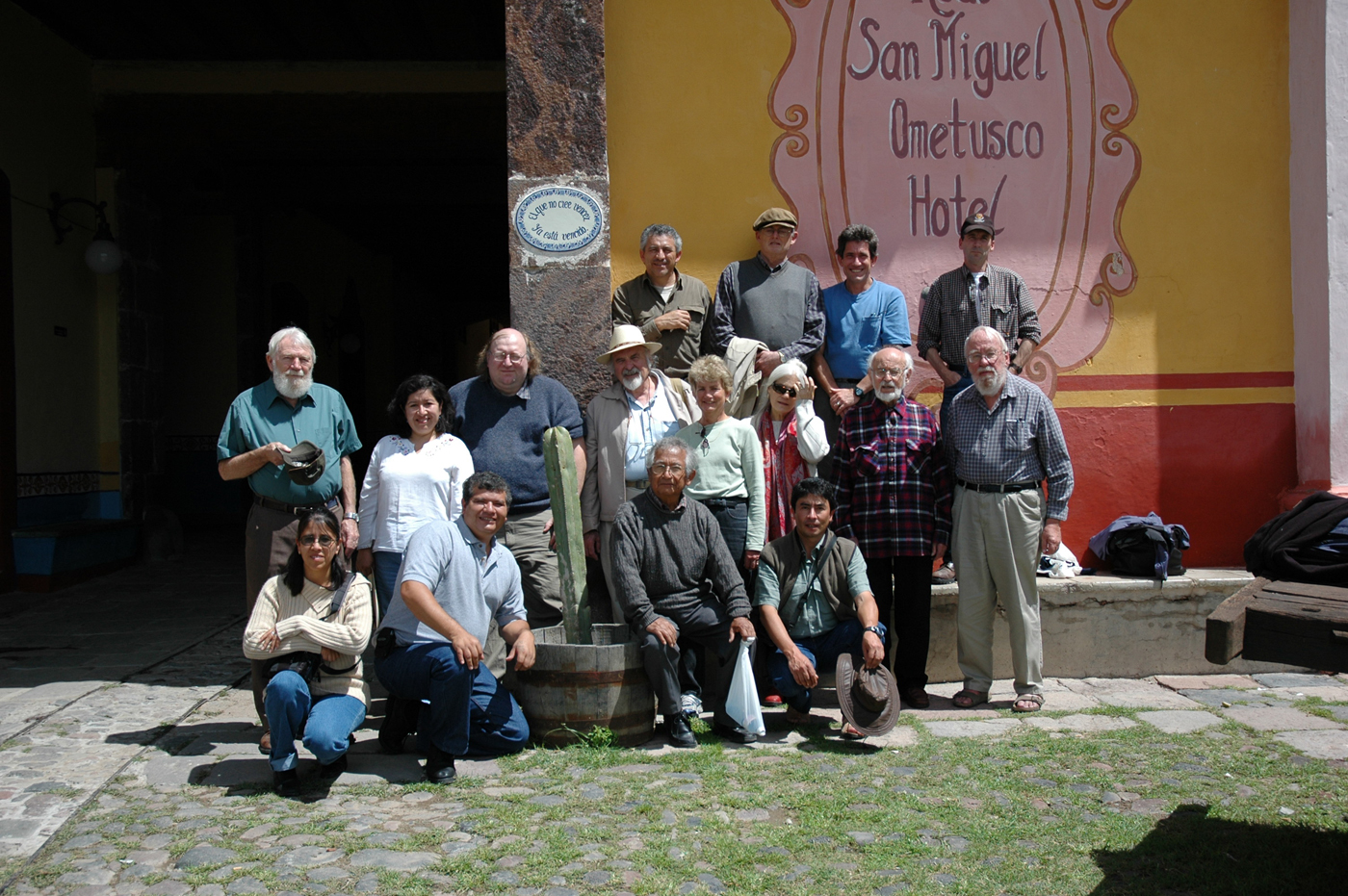
Ometusco Seminar participants (Figure 1) consisted of the following individuals, listed with their general contributions: Martin F. Biskowski, regional pre-Columbian economic development; Rubén Cabrera Castro, La Ventilla and barrio organization of Teotihuacan; Thomas H. Charlton, historical archaeology; George L. Cowgill, organization of and data generation in the TMP; Luis Manuel Gamboa Cabezas and Nadia Vélez Saldaña, Late Postclassic and colonial occupations; Raul García Chávez, Teotihuacan's rural hinterland in the Basin of Mexico; Sergio Gómez Chávez, management and conservation of Teotihuacan in light of modern institutions and society; Larry Gorenflo, regional settlement analysis; Emily McClung de Tapia, paleoenvironment and paleoecology of the basin; René Millon, design and development of the TMP; Deborah L. Nichols, relationship between agricultural development and emerging complex societies in the Basin of Mexico; Jeffrey R. Parsons, reflections on settlement pattern surveys; Ian G. Robertson, structure and analysis of TMP data; and William T. Sanders, regional cultural ecology in the Basin of Mexico, past and present. (We also invited Elizabeth M. Brumfiel to address regional organization, economy, and ethnicity, as viewed from Huexotla and Xaltocan, but unfortunately she had to withdraw from the meeting shortly before we convened at Ometusco.)
Group photo of seminar participants, September 6, 2007, at the former hacienda pulquera, San Miguel Ometusco, Teotihuacan Valley. Back row (left to right): Raúl E. García Chávez, Jeffrey R. Parsons, Larry J. Gorenflo, and Ian G. Robertson. Middle row (left to right): William T. Sanders, M. Oralia Cabrera Cortés, Martin F. Biskowski, Thomas H. Charlton, Deborah L. Nichols, Emily McClung de Tapia, René Millon, and George L. Cowgill. Front row (left to right): Nadia Vélez Saldaña, Luis M. Gamboa Cabezas, Rubén Cabrera Castro, and Sergio Gómez Chávez.
We would highlight in particular the contributions of four senior scholars with decades of experience in Basin of Mexico archaeology: George Cowgill, René Millon, Jeff Parsons, and Bill Sanders. Although all had retired from university appointments at the time of the seminar, each was still active in the analysis and interpretation of data generated over long and highly productive careers. Beyond their individual presentations, these individuals contributed unparalleled knowledge on the evolution of anthropological research in the region during discussions that dominated most waking hours over the five-day seminar. (See Robertson and Gorenflo [2008] for further detail on seminar activities, including two archaeologically themed field trips.)
Finally, we would like to acknowledge the important contribution made by Oralia Cabrera Cortés to this meeting. Oralia assisted in many aspects of planning and preparation, and, as well as participating in seminar discussions, provided near-simultaneous translation of almost all of the presentations. Funding for the seminar was generously provided by the Center for Latin American Studies at Stanford University and the Foundation for Advancement of Mesoamerican Studies, Inc. (FAMSI).
ORGANIZATION OF PAPERS IN THIS TWO-PART SPECIAL SECTION
We present the first half of results of the seminar on Basin of Mexico Archaeology at San Miguel Ometusco in the remaining pages of this issue of Ancient Mesoamerica, with the second half of this special section to appear in the following issue (vol. 26, no. 2) under its own introduction. Prior commitments prevented several participants (Rubén Cabrera Castro, Luis Gamboa Cabezas, and Nadia Vélez Saldaña) from submitting papers on their seminar presentations, giving us a total of 11 papers for publication across these two issues. As with presentations at the seminar, we have tried to group papers thematically, putting those with similar themes into the same issue.
In the first paper, René Millon and Jeffrey Altschul offer an earnest, first-hand account of the early days of the TMP. They discuss both the successes and the shortcomings of the TMP. One of the most important points they make is that “a big project needs a big problem to solve.” In this case, the big problem was the origin of the city. Of course, a wide number of other problems, large and small, also became subjects of investigation and continue to receive attention. Discussion of the TMP continues in the second paper in which George L. Cowgill reflects on experiences and lessons learned in creating electronic data files derived from Mapping Project field records and collections. He addresses questions about the city and state of Teotihuacan that he considers especially compelling. Finally, Cowgill suggests some specific field projects at Teotihuacan that he believes should be given high priority in the future, as well as research opportunities with curated materials, records, and electronic files.
In the third paper Ian G. Robertson provides an update on his work with the electronic databases created from the TMP results and observations made from the descriptive records and artifact collections of the systematic surface survey conducted in the 1960s and 1970s, particularly with regard to ceramic collections. As he notes, the architectural and locational data captured by the map are much more meaningful when combined with the contextual surface data, and vice versa. He presents several case studies that illustrate the value of these data in the investigation of various aspects of ancient life at Teotihuacan, from demographic estimates to ceramic production and maguey cultivation, the verification of the existence of “insubstantial structures” (probably low-status residential units originally inferred on the basis of TMP surface data), the existence of barrios and other socio-spatial units, and shifts in neighborhood diversity through time. Robertson concludes with the sobering prediction that the TMP surface collections and electronic files will increase in importance in the future as destruction of ancient Teotihuacan outside the perimeter of the protected Zona Arqueológica (roughly 12–15% of the ancient city) continues at an alarming rate.
In the fourth paper, Jeffrey R. Parsons discusses regional surveys undertaken in the Basin of Mexico from 1960 to 1975. He points to how resulting survey data and surface collections have provided the foundations for subsequent research on a variety of specific problems, sites, and locales, and how complementary historical and ethnographic studies have contributed to interpretations of pre-Columbian settlement patterns. Parsons suggests that off-site survey has the potential to complement the more extensive regional surveys that have been conducted in the past. He also suggests lines of productive future investigation that could be undertaken to extend the significance of previous results, evaluate questions and hypotheses defined by the surveys, and help conserve archaeological sites and collections for future study.
In the final paper Larry J. Gorenflo provides a regional perspective on pre-Columbian settlement in the Basin of Mexico based on data from surface surveys from more than 3,900 separate archaeological sites in eight survey regions aggregated into a single GIS database. This procedure makes it possible to introduce geographic space as a measurable variable in the study of the development of regional demographic patterns and sociocultural systems in the basin. Gorenflo discusses a number of problems and shortcomings in the data and potential solutions. Like others, he concludes on a somber note with comments on the massive wave of destruction of archaeological remains due to urban sprawl and landscape (com)modification.
A COMMENT ON LOST COLLEAGUES: TOM CHARLTON AND BILL SANDERS
As most readers will be aware, two participants in the Ometusco Seminar passed away since that meeting. William T. Sanders died about eight months after the seminar, and Thomas H. Charlton about two years after that. Fortunately, Tom had developed a solid draft of his presentation before his untimely death, which was very capably revised and completed for inclusion here by co-authors Patricia Fournier and Cynthia L. Otis Charlton. Bill never had a chance to complete a written version of his presentation which, as discussed below, focused on a different topic than we hoped he would address. Because of their enormous contributions to Basin of Mexico archaeology, we wanted to close this introduction with a comment on each of them.
Tom Charlton worked in the Basin of Mexico for more than 40 years, beginning with the Teotihuacan Valley archaeological survey directed by Sanders in 1963 (Kolb Reference Kolb2010). When we discussed potential participants in the Ometusco Seminar, there was no doubt that we would invite Tom; the only problem was deciding what we would suggest that he speak on, given the unusual depth and breadth of his knowledge and experience. We decided to ask him to address historical archaeology in the basin, a long-neglected topic that he explored for decades. The cost of this decision was diverting his attention from Otumba and the upper Teotihuacan Valley—an area where Tom (often in close collaboration with Cynthia Otis Charlton) focused his research since the mid-1960s, making it one of the best archaeologically known parts of the basin. Of course, the range of Tom's knowledge was fully apparent in the important contributions he made to discussions throughout the week. His specific assessments of historical archaeology in the Basin of Mexico appear in his paper with Fournier and Otis Charlton. A most capable paper in written form, it nevertheless fails to replicate the wonderful experience of hearing Tom speak in person, to hear, first-hand, his shared insights on a region in which he worked so long and knew so well.
To one degree or another, Bill Sanders influenced every participant in the Ometusco Seminar. He was, as one participant put it after his passing, larger than life, a powerful intellectual force in Basin of Mexico anthropology for nearly six decades beginning in the early 1950s when he first visited the region with his graduate school friend, David H. Kelley, prior to beginning research in the region for his Ph.D. dissertation (Sanders Reference Sanders1957). Because Bill's words are absent from these two issues, we want to spend a moment reflecting on his contribution.
When planning the seminar, we asked Bill to give a talk on how he did it—that is, how he assembled ideas from early efforts in settlement survey, cultural ecology, cultural geography, and peasant studies to design the Teotihuacan Valley settlement survey in the early 1960s. It seemed to us a fascinating account (heard by very few in its entirety) that led to a series of projects headed by himself and colleagues, work that would change Basin of Mexico archaeology and in important ways influence the entire discipline (obituaries for Sanders by Parsons [Reference Parsons2009], and Webster and Evans [Reference Webster and Evans2008], relate parts of this story). Bill, however, thought otherwise, instead giving a passionate talk on the loss of the archaeological record in the basin, something that had become an increasing concern of his. A man of strong opinions, he contributed to all discussions during the seminar, during breaks, and in the evening over libations. Bit by bit, pieces of how his ideas evolved emerged informally. During a few hours of free time after the seminar had ended, but before everyone had left, four of us (Sanders, Gorenflo, Parsons, and Robertson) drove to Nexquipayac to visit the site of Parsons' remarkable ethnoarchaeological study of salt makers (Parsons Reference Parsons2001). On the trip, Bill remarked on the strong interest that seminar participants had shown in how his ideas about regional settlement surveys, ethnohistory, cultural ecology, and modern campesino behavior had informed his early work in the basin. He concluded that his decision not to speak on that topic at the meeting—which still seemed to him somewhat self-serving—might have been, well, somewhat hasty. So much for best laid plans….
We spoke to Bill during the months following the Ometusco Seminar about revisiting our original idea as the theme for his written contribution to the current publication, the summary of seminar activities. He agreed to do so—and then he passed away, unexpectedly, and too early. We discussed the possibility of trying to recreate his story, based on conversations with friends and colleagues of many years, such as Jeff Parsons, Susan Evans, David Webster, and others. In the end, it just seemed too difficult to do justice to the intricacies of Bill Sanders’ intellectual development in the context of Basin of Mexico research, and we decided against it. Bill's words and thoughts are nonetheless present in many ways in the papers that follow in this issue and the next—the broad influence by a scholar whose passion for Basin of Mexico archaeology inspired a Mexican colleague, at a reception for Bill's homenaje at the National Museum of Anthropology in Mexico City in 1996, to remark “Usted es más mexicano que nosotros.”


