

Introduction
Invasion of the laryngotracheal airway is infrequent in well differentiated thyroid cancer.Reference Batsakis1–Reference Shelton, Skolnik, Berlinger and Arab6 However, when such invasion does occur, it is a cause of significant morbidity and mortality. Currently, complete surgical resection is the primary treatment for patients with locally aggressive thyroid carcinoma.Reference Batsakis1–Reference Shelton, Skolnik, Berlinger and Arab6 In patients with a severely compromised airway, airway management prior to anaesthesia and surgery can be difficult. In this situation, a trial of intubation can be risky, and may result in complete obstruction of the airway due to oedema.
In those cases in which the surgeons plan to remove the involved trachea and to reconstruct the airway by end-to-end anastomosis, a tracheotomy prior to anaesthesia is undesirable. This is because the tracheotomy might inadvertently damage the trachea, necessitating resection of a larger tracheal segment. In addition, a tracheotomy might compromise the vascular supply to the tracheal segment between the tracheotomy site and the resected tracheal margin.Reference Pinsonneault, Fortier and Donati7, Reference Wright, Grillo, Wain, Wong, Donahue and Gaissert8 In such cases, an alternative method of securing the airway is intubation using a rigid bronchoscope.Reference Chao, Liu, Hsieh, Wu, Liu and Wang9, Reference Nekhendzy and Simmonds10 However, this approach may result in dissemination of the intraluminal tumour to the distal airway. Moreover, if the patient is obese and has a short neck and limited neck extension, intubation via a rigid bronchoscope may be impossible.
We present a safe, alternative option for airway management in patients with papillary thyroid carcinoma invading the trachea. In the case described, we successfully accomplished curative surgery using cardiopulmonary bypass with venovenous extracorporeal membrane oxygenation. This case report may assist decision-making regarding airway management in patients with locally aggressive thyroid carcinoma.
Case report
Our patient was a 68-year-old woman with a one-year history of dyspnoea. In addition, she complained of voice change, cough and intermittent haemoptysis. The dyspnoea had worsened two months prior to presentation, and the patient was referred to our clinic. The medical history was otherwise unremarkable.
Physical examination revealed a short, obese neck. There were no chest retractions during inspiration.
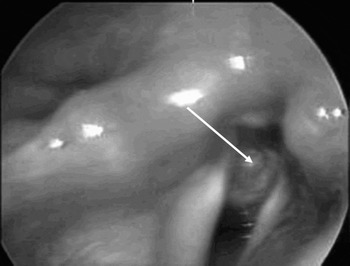
Laryngoscopic examination revealed a subglottic mass obstructing the airway lumen, and impaired mobility of the right vocal fold (Figure 1).
Laryngoscopic view showing a large mass in the subglottic area (arrow) obstructing most of the airway lumen.

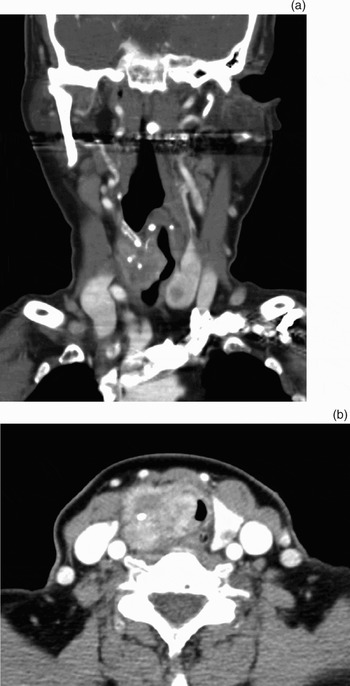
Computed tomography showed a 3 × 4 cm mass in the right lobe of the thyroid gland, displacing the trachea to the left. The mass had invaded the trachea and the cricoid cartilage and was protruding into the tracheal lumen. Necrotic changes and calcification were observed within the mass (Figure 2). Cytological analysis of a fine needle aspiration sample of the mass was consistent with papillary thyroid carcinoma. Thyroid function test results were normal.
(a) Coronal and (b) axial computed tomography images showing a large mass with heterogeneous enhancement replacing the right lobe of the thyroid gland. The mass invades and protrudes into the subglottis and trachea. The lumen of the airway from the subglottis to the upper trachea is severely distorted due to the mass.

Because the tracheal lumen was almost completely occluded and distorted, it was felt that intubation could be dangerous and may result in complete airway obstruction or spasm. In addition, due to the patient's short, obese neck, the use of a rigid bronchoscope or a pre-anaesthesia tracheotomy would be a risky approach to securing the airway. Therefore, we sought a safer method of managing the airway.
Under local anaesthesia, venovenous bypass catheters were placed for cardiopulmonary bypass, using the femoral veins bilaterally. The bypass system achieved greater than 90 per cent arterial oxygen saturation.
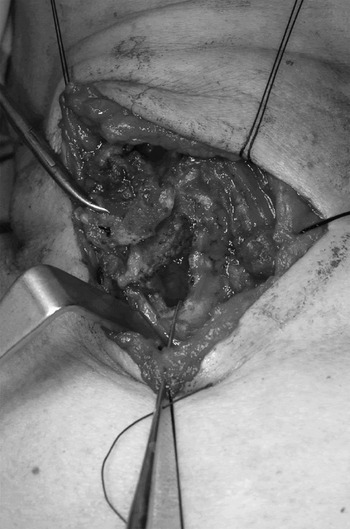
Under general anaesthesia, assisted by cardiopulmonary bypass oxygenation, we performed curative surgery for the aggressive thyroid mass. The mass had invaded the airway on the right posterolateral wall of the cricoid cartilage to the second tracheal ring. The right recurrent laryngeal nerve adhered tightly to the mass and was impossible to separate. Therefore, we performed an en bloc resection of the mass along with the right recurrent laryngeal nerve. The oesophagus was easily separated from the mass; however, it was necessary to resect a portion of the cricoid and the first and second rings of the trachea along with the mass (Figure 3). Then, we intubated the patient through the opened trachea, changing the pathway of oxygenation from the cardiopulmonary bypass machine to inhalation of oxygen by tracheal intubation. Finally, we performed a central lymph node dissection and reconstructed the airway by a thyrotracheal anastomosis with a tracheotomy.
Intra-operative view showing the thyroid mass invading the airway on the right posterolateral wall from the cricoid cartilage to the second tracheal ring, and almost completely occluding the lumen. The mass was resected along with a portion of the cricoid and the first to second tracheal rings, while general anaesthesia was maintained with cardiopulmonary bypass assistance.

Histopathological analysis of the 4 × 3.5 × 3.5 cm mass confirmed the diagnosis of papillary thyroid carcinoma invading the cricoid and tracheal cartilage and mucosa. All resection margins were negative for malignant cells, and there were no metastatic lymph nodes in the resected specimen.
Post-operatively, the tracheal lumen was patent without any stenosis. Ten days after surgery, the tracheal cannula was removed, and the patient was discharged home without symptoms of dyspnoea or aspiration.
Discussion
Thyroid cancer involving the laryngotracheal airway is an uncommon but serious clinical problem. The incidence has been reported to be 0.5–2.2 per cent of all thyroid cancers.Reference Batsakis1, Reference Britto, Shah, Parikh and Rao2, Reference McCaffrey, Bergstralh and Hay4–Reference Shelton, Skolnik, Berlinger and Arab6 When the tumour invades the trachea or the larynx and occupies the airway lumen, dyspnoea and stridor can occur, mimicking asthma. In such cases, enbloc resection of the trachea and/or cricoid cartilage with the mass is the treatment of choice.Reference Batsakis1–Reference McCaffrey, Bergstralh and Hay4
In the case presented here, a trial of intubation may have been dangerous, as it would have irritated the airway, possibly causing spasm, and would have risked dissemination of tumour cells into the distal airway. A pre-anaesthesia tracheotomy is an alternative option to secure the airway in patients with a compromised airway. However, this would have been technically difficult as the trachea was compressed and displaced. Moreover, there was a large, haemorrhagic tumour in the anterior neck; thus, identification of the trachea would be difficult, the procedure would be prolonged and significant bleeding from the mass would be likely. In addition, the extensive neck manipulation required during tracheotomy would probably compromise the airway.
In contrast, cardiopulmonary bypass could provide sufficient oxygenation to the patient with relative ease. Traditionally, cardiopulmonary bypass has been used for cardiothoracic surgery. In the field of upper airway pathology, its use has been described in tracheal repair cases.Reference Angel, Murillo, Zwischenberger, Swischuk, Graves and Chernin11–Reference Hines and Hansell15 In cases of tracheal stenosis or tracheal tumour, cardiopulmonary bypass can be used intra-operatively to supply oxygen and post-operatively to stabilise the airway. Therefore, we surmised that cardiopulmonary bypass offered an alternative for surgery on a thyroid mass compromising the airway.
A few case reports have described the use of cardiopulmonary bypass in the management of thyroid mass. In most reports of cases similar to our own, cardiopulmonary bypass was used to support the airway during tracheotomy. Rosa et al. used cardiopulmonary bypass in a patient with a large cervical thyroid mass, while performing tracheotomy.Reference Rosa, Johnson and Barcia16 Belmont et al. reported its use in a patient with a thyroid lymphoma compressing the airway.Reference Belmont, Wax and DeSouza17 Onozawa et al. reported airway management with cardiopulmonary bypass during surgery for thyroid cancer compressing the trachea.Reference Onozawa, Tanaka, Takinami, Kagaya and Tanifuji13
• In cases of massive tracheal invasion by thyroid carcinoma, peri-operative management of the severely compromised airway is difficult but critical
• When tracheal resection and reconstruction are planned, a pre-operative tracheotomy may penetrate the tumour and cause additional problems, e.g. a more extended tracheal resection
• Cardiopulmonary bypass oxygenation is a safe and effective alternative option for airway management in patients with locally aggressive thyroid cancer
In most previously reported cases, cardiopulmonary bypass was removed after securing the airway. Cardiopulmonary bypass has the potential complications of intracranial haemorrhage, gastrointestinal haemorrhage and deoxygenation due to mechanical circuit failure.Reference Kolla, Awad, Rich, Schreiner, Hirschl and Bartlett18, Reference Mols, Loop, Geiger, Farthmann and Benzing19 However, transient use of bypass oxygenation, as in our patient, carries a low risk of serious complications.
Conclusion
In our patient, cardiopulmonary bypass using venovenous catheters was a safe and effective method of securing a compromised airway during surgery for locally aggressive thyroid cancer.