Urinary tract infections (UTI) are the fourth most common healthcare-associated infection (HAI), accounting for 12.9% of HAIs in acute care hospitals.Reference Magill, Edwards and Bamberg 1 , Reference Weber, Sickbert-Bennett and Gould 2 Almost all healthcare-associated UTIs occur in patients with an indwelling urinary catheter or instrumentation of the urinary tract.Reference Weber, Sickbert-Bennett and Gould 2 Catheter-associated urinary tract infection (CAUTI) is associated with increased morbidity, mortality, length of stay, and hospital cost.Reference Kennedy, Greene and Saint 3 , Reference Sutherland, Beloff, McGrath and Liu 4
In 2015, 2 important modifications were made to the 2013 National Healthcare Safety Network (NHSN) surveillance definition of CAUTI, with the aim of producing a meaningful comparative and objective metric that could guide CAUTI prevention practices.Reference Allen-Bridson, Pollock and Gould 5 The new definition of symptomatic CAUTI excludes funguria and nonbacterial organisms as uropathogens and sets the threshold of organisms to≥105 CFU/mL.Reference Allen-Bridson, Pollock and Gould 5 However, the requirement to report a CAUTI with fever as the sole symptom, even if another source of fever is identified remains unchanged.Reference Allen-Bridson, Pollock and Gould 5 The impact of the change in definition on rates of reported CAUTI remains to be determined. The requirement to report a CAUTI even if an alternate cause of fever is identified may overestimate the true rates of CAUTI, especially in the intensive care unit (ICU) population, in which fever is a common symptom with multiple etiologies.
The goal of this study was to estimate the impact of the 2015 CAUTI criteria on 2013 and 2014 CAUTI rates. We also evaluated the proportion of CAUTIs with fever as the sole symptom and another concurrent microbiologically confirmed infection.
METHODS
A retrospective analysis was performed of CAUTI surveillance data of ICU patients hospitalized at Henry Ford Hospital, an 800-bed teaching hospital with 140 ICU beds, in urban Detroit. CAUTI rates were calculated per 1,000 urinary catheter days. In January 2015, CAUTIs from 2013 to 2014 identified through the routine infection control and prevention (ICP) surveillance for NHSN reporting were reviewed. The new 2015 criteria were retrospectively applied to estimate the impact of the new definition on CAUTI rates. These estimates were validated by comparing them to the actual CAUTI rate for 2015. The medical records of all 237 patients with CAUTIs from 2013 to 2015 defined using 2015 criteria were reviewed to identify any concurrent (±1 day) NHSN-defined and microbiologically confirmed (ie, positive culture of a sterile site specimen) infection.
When applying the 2015 NHSN CAUTI definition, 2 changes in the 2013 NHSN CAUTI definition were considered: (1) the removal of yeasts and other rarely reported nonbacterial pathogens from the UTI criteria, and (2) limit the threshold for the UTI surveillance definitions to≥100,000 CFU/mL.Reference Allen-Bridson, Pollock and Gould 5
RESULTS
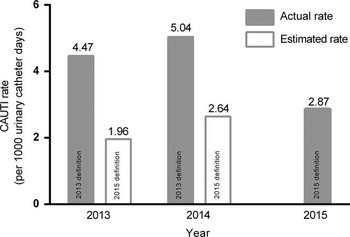
Application of the 2013 NHSN CAUTI criteria identified, as part of the routine ICP surveillance for NHSN reporting, 318 ICU patients with CAUTI, 173 in 2013 and 145 in 2014. After application of the 2015 NHSN criteria, only 152 of 318 patients (47.8%) met the NHSN definition of CAUTI; 76 met the definition in 2013, and 76 in 2014. Application of the 2015 criteria resulted in exclusion of 166 CAUTIs (52.2%); 131 (41%) were excluded because of candiduria; 66 (21%) were excluded because of low colony-forming unit (CFU) count; and 31 were excluded with both candiduria and low CFU count. Actual and estimated CAUTI rates are shown in Figure 1. Denominators for CAUTI rates were 38,716 urinary catheter days in 2013, 28,746 urinary catheter days in 2014, and 29,559 urinary catheter days in 2015.
Actual and estimated catheter-associated urinary tract infection (CAUTI) rates based on 2013 and 2015 National Health and Safety Network (NHSN) criteria.

Of the 237 cases defined using 2015 NHSN criteria over 3 years, 22 patients (9.3%) had concurrent NHSN-defined infections confirmed by positive cultures from sterile sites. Of these, 15 were bloodstream infections (BSIs): 6 were central line-associated BSIs, 1 was pneumonia, 2 were intraabdominal infections, and 6 were primary BSIs. The remaining infections included 4 cases of nosocomial meningitis, 1 case of empyema, and 2 intraabdominal infections with peritonitis.
DISCUSSION
In our hospital, application of the new 2015 NHSN CAUTI definition markedly reduced the rates of CAUTI, slightly more than 50%. The CAUTI rates estimated after retrospective application of the 2015 NHSN criteria to CAUTIs reported in 2013 and 2014 were comparable to the prospectively collected CAUTI surveillance rate of 2.87 in 2015. A CAUTI rate reduction of 41.2% was estimated based solely on excluding cases with candiduria. This reduction in CAUTI rate is greater than the 25% reduction that resulted from the exclusion of the funguria criterion reported in the multihospital study by Dicks et al.Reference Dicks, Baker and Durkin 6 The significant decrease in CAUTIs observed in our hospital may be applicable only to institutions with high rates of candiduria in catheterized patients.
The significant impact on CAUTI rates resulting from the change in NHSN definition must be considered carefully when evaluating the effectiveness of various measures for CAUTI prevention. In our institution, a decrease of the 2013 and 2014 CAUTI rates of>50% would be required to demonstrate a favorable impact of our CAUTI prevention initiatives.
Despite the use of the more specific 2015 criteria, ~9% of our ICU patients with CAUTI and fever as the sole symptom had a concurrent NHSN-defined infection confirmed by positive cultures from a sterile site. In the ICU population, fever is prevalent and is often multifactorial in etiology. Prior studies have reported that patients in the ICU with CAUTI often have alternative diagnoses to explain the fever.Reference Tedja, Wentink, O’Horo, Thompson and Sampathkumar 7 , Reference Neelakanta, Sharma and Kesani 8 In a study of 105 CAUTIs in ICU patients, 51% had another infection (primarily pneumonia), and 18% had noninfectious conditions as alternative explanations for fever.Reference Tedja, Wentink, O’Horo, Thompson and Sampathkumar 7 The lower rate of 9% of CAUTIs with concurrent infection as a possible cause of fever in our study is likely because of the more stringent criteria used, namely infections confirmed by positive cultures from a sterile site. The exclusion of microbiologically confirmed infections may improve the specificity of the new CAUTI definition. Electronic surveillance for CAUTI has been proposed as a feasible and sustainable tool for improving reliability and reducing the resource burden of surveillance.Reference Wald, Bandle, Richard, Min and Capezuti 9 , Reference Hsu, Shenoy and Kelbaugh 10 Electronic surveillance could also be utilized for rapidly identifying and excluding patients with CAUTI who have microbiologically confirmed concurrent infections. However, if electronic surveillance is utilized to exclude CAUTI in patients with other NHSN infections, the current NHSN definition would need to change again, which would further complicate comparisons of CAUTI surveillance outcomes over time.
Our study has the limitations of a retrospective, single-center study with a relative short study period of 3 years. Our observations of significant reduction in CAUTI as a consequence of exclusion of patients with candiduria may not be applicable to institutions with low rates of candiduria. The 2015 CAUTI definition also included changes in the time frame for infections and the date of first infection element during the infection window. It is unclear whether these variables could also have an impact on our 2015 CAUTI rates.
The new 2015 NHSN CAUTI definition changes resulted in a significant reduction in CAUTI rates at our institution. It would be important for other institutions to estimate the potential impact of the 2015 NHSN definition on their CAUTI rates to set appropriate internal benchmarks for evaluating CAUTI prevention programs.
ACKNOWLEDGMENTS
Financial support: No financial support was provided relevant to this article.
Potential conflicts of interest: K.R. has received research grant from Cubist, Merck and Theravance. M. Z. has received research grants from Pfizer, Cerexa, Cubist, Merck, Tetraphase, Cempra, Melinta, Paratek and Rempex. G.A. has received research grants from Cubist/Merck. All other authors report no conflict of interest relevant to this article.