Introduction
Chicken meat is an important segment of the consumption structure of various meat types. Changes in nutritional habits have resulted in the growth of consumption of chicken. In the current study, several different survey methods were used, including methods of analysis and comparisons, which helped to fully analyse the nutritional trends in the chicken meat market. These comparisons enabled us to understand purchasing trends by consumers of poultry and the importance of meat origin in their purchase-decision-making process (Vukasovič, Reference VUKASOVIČ2010).
Based on the results of the analyses and trends in meat processing industry, it was determined that the chicken meat and associated product sectors represent a very dynamic and fast-growing market. Chicken meat is one of the most favourite meat types. Not only it is described as tasty, it is also a food that corresponds to the requirements of modern and balanced nutrition. In addition, it is quick and easy to prepare, healthy, safe and nourishing (Vukasovič, Reference VUKASOVIČ2009a; Strašek, Reference STRAŠEK2010).
In other international surveys, origin of a product has proved to be one of the more important factors in selection by consumers. Investigation of the impact that country of origin has on consumer behaviour in the buying decision-making process has become especially topical in the second half of the twentieth century (Bilkey and Nes, Reference BILKEY and NES1982; Han and Terpstra, Reference HAN and TERPSTRA1988; Papadopoulos and Heslop, Reference PAPADOPOULOS and HESLOP1989; Kaynak et al., Reference KAYNAK, KUCUKEMIROGLU and HYDER2000; Balabanis et. al., 2002; Vukasovič, Reference VUKASOVIČ2010; Strašek, Reference STRAŠEK2010). The latest survey findings in market factors acting on the global market are reflected in consumer behaviour, buying habits and decisions. The rise in international market communications, knowledge transfer to other countries, formation of multi- and trans-national companies, parallel processes of global horizontal concentrations and the increased power of retail chains have had an impact on the importance of country-of-origin in the product evaluation process and final buying decision. The increased global market complexity is reflected in the importance of country-of-origin (Roth and Romeo, Reference ROTH and ROMEO1992). Some surveys (Jaffe and Nebenzahl, Reference JAFFE and NEBENZAHL2001; Parameswaran and Pisharodi, Reference PARAMESWARAN and PISHARODI1994) claim that country-of-origin, together with the increasing consciousness of a consumer's own national and cultural identity, is the fifth component of this marketing mix. If country-of-origin is indeed important in its influence of consumer acceptance of a domestic or foreign product, marketing experts should give this factor the same amount of attention as design and development of new products, marketing planning, communications and pricing. Based upon opinions and published papers of the studies carried out so far, a country-of-origin became, to a certain extent, an element of the marketing mix.
Research design and data collection
State-of-the-art market research guidelines that emphasise the use of the methods for determining key variables, the use of multi-item measurement scales and the use of various research plans were used for analysing the research results. Details of these research methods can be found in Gacula and Singh (Reference GACULA and SINGH1984), Malhotra et al. (1999), Žižmond and Novak (Reference ŽIŽMOND and NOVAK2006) and Vukasovič (Reference VUKASOVIČ2009b; Reference VUKASOVIČ2010).
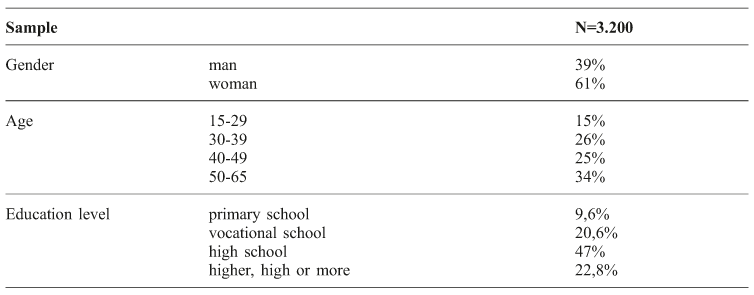
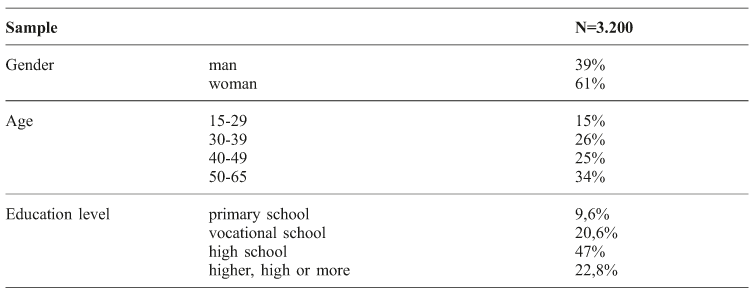
In order to investigate the purchasing habits of fresh chicken meat consumers, the perception of this meat, and the importance of origin in the purchase-decision-making process, a quantitative research on the sample of N=3.200 fresh chicken meat consumers was carried out in a group of selected countries of Central and South-eastern Europe (Slovenia, Croatia, Bosnia and Herzegovina and Serbia). The research sample was representative for age (15 and 65 years), gender, region, and the population settlement type in a selected country. Personal interviews were used based on a structured questionnaire. Table 1 shows the socio-demographic properties of the sample of respondents who were collaborating in the research of selected countries.
Structure of the sample.
Questionnaire
A questionnaire was devised for this survey that was written to ensure that respondents could progress quickly through it. All questionnaires carried a stamped number in order to be able to identify individuals and correspond to their personal data.
The questionnaire was divided into the following areas:
lifestyle,
purchase and consumer habits regarding fresh chicken meat,
perception and attitude toward fresh chicken meat,
the importance of fresh chicken meat origin in a purchase-decision-making process,
demographic data at the end of the questionnaire.
Purchasing habits and the use of fresh chicken meat in the selected countries
The analysis of purchasing habits and the perception of fresh chicken meat with consumers in selected countries of Central and South-eastern Europe is presented below. The research process began with questions related to the purchasing habits and the use of fresh chicken meat. This provided links between the effect of fresh chicken meat origin and its perception of consumers in the selected countries of Central and South-eastern Europe.
The results showed that fresh chicken meat is very popular among consumers in Slovenia, Croatia, Bosnia and Herzegovina, and Serbia. Comparisons between the countries showed the trends illustrated in Figure 1. The largest number of fresh chicken meat purchasers among the common population was seen in Slovenia (99%), followed by Croatia and Bosnia and Herzegovina (98%), whereas the smallest share was recorded in Serbia (91%). Users who bought fresh chicken meat once a week were prevailing in Slovenia (43%), whereas the lowest portion again was seen in Bosnia and Herzegovina (29%).
The frequency of buying fresh chicken meat in Central and South-Eastern European countries (in %).
Source: own calculations 2010

Consumer perceptions of fresh chicken meat
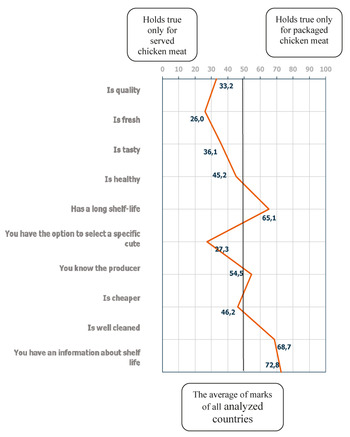
In the following discussion, the attitude of the consumers towards packaged and served fresh chicken meat is examined and analysed for possible differences. On the basis of the results in the selected countries of Central and South-eastern Europe, the average of data of all analysed countries was calculated (Figure 2). Statements which mostly held true for the packaged fresh chicken meat were categorised according to their significance and included shelf life, cleanliness and hygiene information and the location and background of producer.
The statements which mostly held true for the served fresh chicken meat (according to their significance) included freshness, specific cuts and their availability, quality level, taste perception, healthiness of the meat and cost.
Perception of served and packaged fresh chicken meat.
Source: own calculations 2010

The research in this region showed that consumers perceived fresh chicken meat as a tasty and healthy meat. Since it is easy to prepare and is suitable for several ways of cooking and presentation, it also represents a very flexible food type.
Attitude toward the origin of meat
Chicken meat is typically a generic product where a trade mark has no special importance when deciding whether to buy it or not. The importance of a trade mark depends on the consumer's attitude: the image of the trade mark, its familiarity, perception of quality, fidelity, marketing associations and other benefits (Aaker Reference AAKER1991; Keller, Reference KELLER1998).
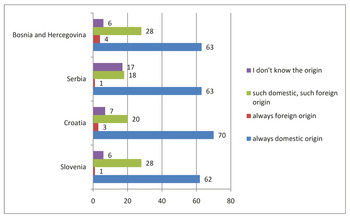
A very important segment of the survey was the determining the importance of fresh meat origin in the purchase-decision-making process. The results showed that, in all four countries (Slovenia, Croatia, Bosnia and Herzegovina, and Serbia), the attitude towards the origin of fresh chicken meat was very similar – the majority of persons interviewed preferred to buy from domestic sources (Figure 3). In Croatia, 70% of interviewees expressed this opinion, with 63% in Bosnia and Herzegovina and Serbia and 62% in Slovenia The percentage of interviewees who bought meat of domestic and foreign origin was highest in Slovenia and Bosnia and Herzegovina (28%) and slightly lower in Croatia (20%) and Serbia (18%). This confirmed that in these three countries there was a significant tendency towards purchasing fresh chicken meat of domestic origin.
The attitude towards fresh chicken meat origin in the analyzed countries of Central and South-Eastern Europe (%).
Source: own calculations 2010

Conclusions
In a highly competitive market, companies are increasingly aware of the importance of understanding the behaviour of consumers, their motives for the purchase of certain product and their standpoints on traded objects. Companies devote considerable attention to market and consumer surveys which can be a factor that determine the success on the market.
In the recent years, developments on the global chicken meat market, which were the result of the occurrence of avian influenza (H5N1), did not always indicate a change in the average view of market development and chicken meat production, which remains positive due to the competitive pricing of chicken in comparison with other types of meat, and a strong liking for chicken meat, mainly because of its perceived advantages over other types of meat. This contributes to its consumption by human populations.
The trends in chicken meat consumption which were found during as previous survey of the European chicken meat market (Vukasovič, Reference VUKASOVIČ2009a) were confirmed with the current quantitative research in Central and South-Eastern Europe. In conclusion, the positive perception of fresh chicken meat is clear in all analysed markets. Known chicken meat origin plays a key role in the purchase-decision-making process.