Introduction
The purpose of this short article is to propose a conceptual structure for “neurolaw” modeled loosely on the common division of the sister field of neuroethics into the “ethics of neuroscience” and the “neuroscience of ethics.”Footnote 1 Neuroethics is more firmly established as a field than neurolaw. Neuroethics, unlike neurolaw, is supported by dedicated journals, degree programs, and scholarly societies. It is not clear that neurolaw has achieved or will achieve the status of a legal field, but this is not an essential question or problem. There is still value in creating a label for an area of inquiry like “neurolaw” around which those interested in a common set of issues can coalesce and can find the relevant scholarship. There is also value in describing the shape or scope of the area of inquiry. A sense of the issues being considered, their relationships to one another, and the methods adopted is useful for identifying gaps and weaknesses. The article closes by considering some of the critiques levelled against neurolaw, which parallel those levelled against neuroethics. The continued utility of these fascinating areas of inquiry requires that these cautionary notes be considered carefully.
Emergence of Neurolaw
The term “neurolaw” was coined by J. Sherrod Taylor in the early 1990s to capture the set of issues involved in civil litigation involving brain injury, including the neuropsychological expertise needed.Footnote 2,Footnote 3 Of course, legal interest in the brain and brain science (and pseudoscience) was older and broader than this. For example, the law has engaged with emerging technological and clinical developments such as the emergence of electroencephalography (EEG) and psychosurgery in the mid-twentieth century.Footnote 4 Another important piece of twentieth century neurolaw was the adoption of the legal concept of brain death. Earlier, now discredited, theories such as phrenology were also discussed in the nineteenth century in the context of the criminal justice system.Footnote 5,Footnote 6 This was also the era of Lombrosian biological criminology, which sought to understand crime in neurobiological and other physiological terms.Footnote 7
The current and broader use of the term “neurolaw” developed in line with the recent explosion in the use of the “neuro” prefix, including terms such as “neuroethics,” “neuroaesthetics,” “neurotheology,” “neuropolitics,” and “neuroeconomics,” to name only a few.Footnote 8 This lexical creativity reflects the increased societal attention to neuroscience, driven in part by technological advances such as functional MRI (fMRI) and by rapidly expanding research and publication in the field.Footnote 9
An important effort to develop the field of neurolaw was conducted through the MacArthur Foundation Law and Neuroscience Project, launched in 2007.Footnote 10,Footnote 11 The Project’s “Law and Neuroscience Bibliography” reveals a rapid and increasing growth since 2000 in the publication of articles focusing on how neuroscientific research might be relevant to the law.Footnote 12,Footnote 13,Footnote 14
Is Neurolaw a Field of Law?
The recognition of new academic fields is a recurrent and reliable source of disagreement, and the law is no exception. The dispute over “cyberlaw,” another field organized around technoscientific change, offers a useful precedent for neurolaw. A debate well known to law and science enthusiasts was launched by Judge Frank Easterbrook in his article criticizing cyberlaw as a kind of “law of the horse.”Footnote 15 “[T]he best way to learn the law applicable to specialized endeavors is to study general rules. Lots of cases deal with the sale of horses; others deal with people kicked by horses; still more deal with the licensing and racing of horses, or with the care veterinarians give to horses, or with prizes at horse shows. Any effort to collect these strands into a course on “the law of the horse” is doomed to be shallow and to miss unifying principles.”Footnote 16
Many responses can and have been made to this argument. Larry Lessig responded to Easterbrook by pointing out that the focus on cyberspace allows us to reach insights about the nature of the law and regulation that apply well beyond cyberspace.Footnote 17 For example, he pointed out how the technological architecture of cyberspace—the software and hardware with which it is built—constitutes a system of law in itself, containing embedded values and constraints on behavior. The study of cyberlaw thus focuses attention on deeper theoretical issues such as the nature of law and regulation, the source and legitimacy of legal rules, as well as cross-cutting theoretical and practical problems posed by conflicting systems of behavioral regulation. In other words, attention to certain specialized fields may offer insights of broader application in the law. Whether or not there is such a thing as a practicing “cyberlawyer” is not the essential point.
Ultimately, legal taxonomy is always somewhat arbitrary. The objective of the taxonomic exercise may vary, but the idea is to identify significant patterns in the law that serve the objective.Footnote 18 A label like neurolaw or “law and neuroscience” is justified if and while it is useful. For now at least, it seems likely that neurolaw, like cyberlaw, will serve a useful nucleating function at the social and intellectual levels. It offers a label around which people interested in a similar set of questions and issues that cut across multiple classical domains of the law can organize themselves. At the intellectual level, the types of theoretical insights offered by cyberlaw are also likely to occur with neurolaw. Not only are legal questions organized differently and in association with other disciplines (i.e., the brain sciences), but neurolaw also encourages the type of self-reflexive focus described by Lessig.Footnote 19 Neurolaw encourages the law to examine its own fundamental concepts and procedures in a potentially productive way.
A Proposed Structure for Neurolaw
The question remains how best to organize the burgeoning field of neurolaw. Leaders in the field have proposed several helpful conceptual structures.Footnote 20,Footnote 21,Footnote 22,Footnote 23,Footnote 24 These structures together highlight a number of features: novel legal problems related to brain research and interventions, novel ways to solve existing legal problems such as detecting mental states or improving forensic risk assessment, the potential reevaluation of fundamental legal concepts, and the study of the neurobiology of moral and legal decisionmaking.
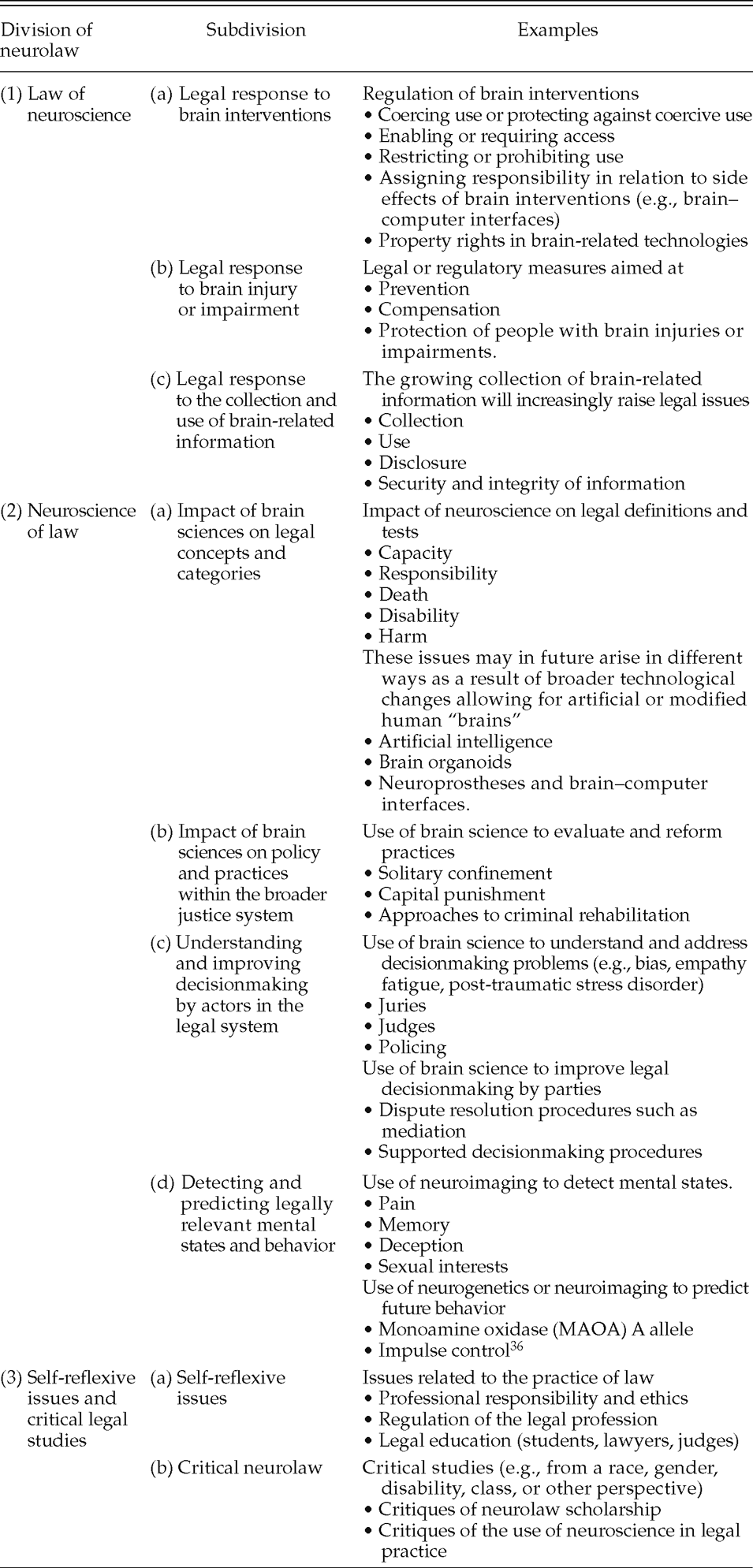
The structure proposed here builds on these ideas, translating the bipartite structure that Roskies proposed early on for the developing field of neuroethics, namely the “ethics of neuroscience” and the “neuroscience of ethics” into the “law of neuroscience” and the “neuroscience of law.”Footnote 25 This remains an appealing organizational structure, and is reflected in the organization of major recent anthologies in the field.Footnote 26 One of the reasons it is appealing is that it brings together two domains of inquiry that might otherwise remain separate, and invites one to look for feedback links or possible interactions between the two. One interesting possibility is that scientific understanding of moral or legal reasoning might lead to calls to modify moral or legal reasoning (“moral bioenhancement”) to make people more willing to sacrifice individual liberties for the common good. If these modifications were to be adopted widely, we might change the general character of moral or legal reasoning in ways that would make society more receptive to further changes of this type.
In neuroethics, there are some supplementary topics that could perhaps be placed within the bipartite division, but they may cut across it or they may be sufficiently important to justify independent identification as subdivisions. For example, Eric Racine identifies “public and cultural neuroethics,” which addresses policy issues such as resource allocation, public understanding and engagement with neuroscience, and cultural representations of mental illness.Footnote 27 Liana Buniak and colleagues identify a subdivision that they call “neuroethics and society/international neuroethics,” which includes among other things multicultural issues and perspectives in neuroethics, as well as certain cross-cutting issues such as neuroethics education.Footnote 28,Footnote 29 In addition, the project of “critical neuroscience” focuses on the bidirectional relationship between society and the behavioral and brain sciences.Footnote 30 However, critical neuroscience is distinguished from neuroethics, as it includes neuroethics as an object of study and critique as a social and cultural phenomenon.Footnote 31
In the legal context, similar cross-cutting issues or independently important topics or approaches exist. There are flourishing schools of legal sociology and critical legal studies, and scholars are already offering critical examinations of neurolaw itself or are taking critical (e.g., feminist or disability) perspectives on the use of neuroscience in the law.Footnote 32,Footnote 33,Footnote 34,Footnote 35
Proposed Structure for Neurolaw

These categories are meant to be broad and to cut across classic divisions of law such as criminal, tort, employment, human rights, or evidence law. This does not mean that they are not prominent features of neurolaw. For example, even though the admissibility of neuroscientific evidence is widely discussed in neurolaw, the law of evidence is not explicitly mentioned here. Rather, it will likely have an important role in many of the areas of neurolaw discussed here. The categorization is also provisional, and will need to adapt as the neuroscience and technology changes, and also as moral and legal concepts evolve (e.g., Francis Shen predicts a neuroscience-driven shift in the legal response to animal rightsFootnote 37).
Critiques of Neurolaw
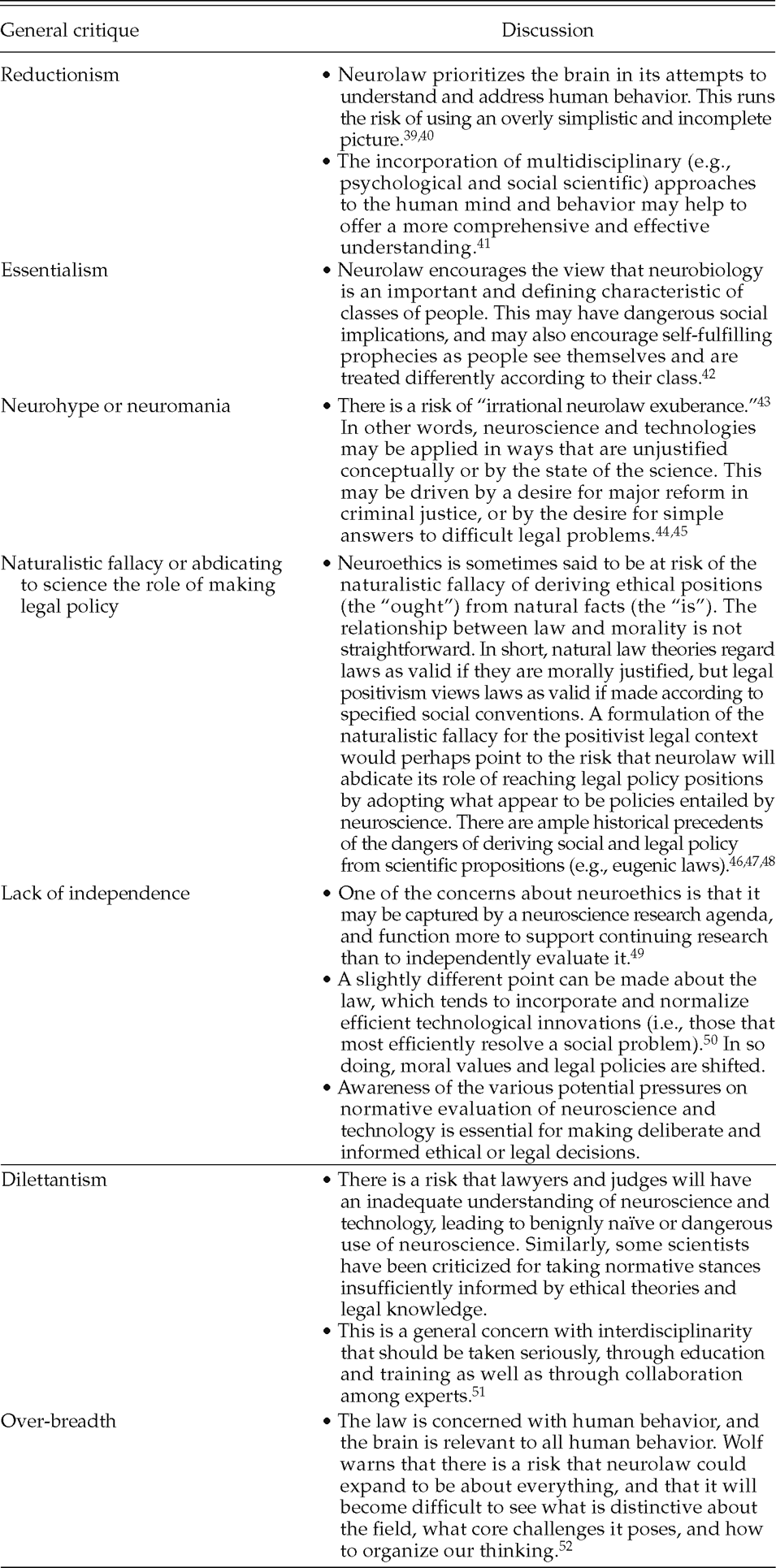
Healthy neurolaw scholarship will depend on careful engagement with the lines of critique that have been made about neurolaw, as well as those made about neuroethics, to the extent that they translate to neurolaw.Footnote 38 A partial list of critiques of neurolaw is presented in Table 2.
Possible Critiques of Neurolaw

Conclusion
Neurolaw is a young but very promising field of inquiry. It is most unlikely that there will be such a thing as a practicing “neurolawyer,” just as there are no lawyers specifically practicing in many other well-established fields of law, such as contract law or evidence law. However, this does not detract from the value of examining the law and legal system from the perspective of how they might intersect with the brain sciences. The law has in the past had to respond to new information and theories about the brain and behavior, as well as to techniques to intervene in the brain, and will probably have to grapple with these at an increasing rate in the future. Of particular interest in neurolaw will be the impact of brain sciences on legal concepts. Whether or not brain sciences should affect attributions of criminal responsibility, there will be a question of whether and how they do affect these judgments. At the same time, there are risks associated with the use of brain sciences in the law, as past episodes of enthusiasm for using science in social and legal policy have demonstrated. A self-critical perspective will, therefore, be an important part of the field.