Introduction
More than a thousand insect species are used as human food; some of the more important groups include grasshoppers, caterpillars, beetles, winged termites, bees, wasps and a variety of aquatic insects. In Africa, beetles, termites, caterpillars, grasshoppers, crickets, bees, maggots and butterflies are significant sources of food, with varying levels of proteins, fat, minerals and vitamins (Womeni et al., Reference Womeni, Linder, Tiencheu, Mbiapo, Villeneuve, Fanni and Parmentier2009). Larvae of the African palm weevil Rhynchophorus phoenicis (F.) (Coleoptera: Curculionidae) are fried and eaten in several parts of western Nigeria; they are also marketed. Caterpillars of Gonimbrasia belina (Westwood) (Lepidoptera: Saturniidae), known as the mopane worm, are a popular food in Botswana, northern South Africa, Zimbabwe and Namibia (Banjo et al., Reference Banjo, Lawall and Songonuga2006).
During the past few years, there has been a new upsurge of interest in insects as food. One factor that may be responsible is an increasing awareness in the western world that insects are traditionally and nutritionally important foods for many non-western cultures (Foliart, Reference Foliart1992). It has been postulated that insects could be an important source of proteins of good quality and high digestibility (Ramos-Elorduy et al., Reference Ramos-Elorduy, Moreno, Prado, Perez, Otero and de Guevara1997; Zhou and Han, Reference Zhou and Han2006). Banjo et al. (Reference Banjo, Lawall and Songonuga2006) analysed 17 species of edible insects representing nine families for their nutrient composition. These insect species constitute a significant component of diet among the people of southwestern Nigeria. They found high crude protein contents (27–30%). In Thailand, over 50 species of insects are edible and can be consumed throughout the year; these include silkworm pupae, bamboo caterpillars, locusts, beetles and crickets (Yhoung-Aree et al., Reference Yhoung-Aree, Puwastien and Attig1997). Oil extracted from the melon bug Aspongopus viduatus F. and the sorghum bug Agonoscelis pubescens (Thunberg) (both Hemiptera: Pentatomidae) is used as famine food in the western parts of Sudan and has traditional medicinal uses (Mariod et al., Reference Mariod, Matthaus and Eichner2004). In a study to determine the antibacterial activities of melon bug crude oil, silicic acid column purified oil and phenolic compounds-free oil by agar diffusion assay against seven bacterial isolates, Mustafa et al. (Reference Mustafa, Mariod and Matthäus2008) reported that the crude oil and the phenolic compounds-free oil showed high antibacterial activities against some test species, while the silicic acid column purified oil showed no antibacterial activity. Ramos-Elorduy et al. (Reference Ramos-Elorduy, Moreno, Prado, Perez, Otero and de Guevara1997), analysing the nutrient composition of 78 Mexican edible insect species, reported protein content ranging from 15 to 81%, fat content from 4.2 to 77.2%, with carbohydrates up to 77.7% on a dry-matter basis. Their protein chemical score ranged from 46 to 96%; in a few cases, there were deficiencies of tryptophan and lysine protein digestibility (the amount of protein absorbed into the body relative to the amount that was consumed), and varied between 76 and 98% for the species analysed. Eaten daily in some regions, the insects are roasted, fried or incorporated into a ragout dish, generally in the immature stage. In Sudan, many edible insects are consumed and the desert locust is considered most popular in many parts of the country beside sorghum and melon bugs (Mariod et al., Reference Mariod, Matthaus and Eichner2004, Reference Mariod, Matthaus, Eichner and Hussein2006a), and grasshopper (van Huis, Reference van Huis2003).
The melon bug is mainly distributed in the western states (Kordofan and Darfour) of Sudan where it is known as ‘um-buga’. The oil is extracted from the bugs by hot water and used in cooking and some medicinal applications, e.g. skin lesion remedy (Mariod et al., Reference Mariod, Matthaus and Eichner2004). Melon bugs are considered to be edible in Namibia, where the last nymph stage is called ‘nakapunda’. In this soft stage, the bug is cooked and eaten (http://www.science.mcmaster.ca (retrieved 25 April 2009)). Many Namibians collect the adults and use them as a relish or as a spice in a ground form for cooking meals (http://www.natmus.cul.na (retrieved 14 May 2009)). The bug has a 45% oil content containing 46.5, 3.4 and 44.2% oleic, linoleic and palmitic (if referring to the hexadecanoic acid) acids, respectively, with low amount of tocopherol 0.3 mg/100 g and high oxidative stability of 38 h under Rancimat test (Mariod et al., Reference Mariod, Matthaus and Eichner2004).
Agonoscelis pubescens is considered as the main pest of sorghum (durra) in both rainfed and irrigated areas in Sudan where it is known as ‘dura andat’. In western Sudan, the adult bugs are collected and eaten after frying, while in some other areas of Sudan the collected oil is extracted from the bugs and used for cooking and as medicine. In the Botana area of central Sudan, nomads use tar obtained from highly heated bugs for their camels against dermatological infections. Sorghum bug oil content was 60% with 40.9, 34.5 and 12.1% of oleic, linoleic and palmitic acids, respectively; the oil also contains 34 mg/100 g tocopherols (Mariod et al., Reference Mariod, Matthaus and Eichner2004).
Published works on melon and sorghum bugs as edible insects include: Mariod et al. (Reference Mariod, Matthaus and Eichner2004) on the fatty acid, tocopherols, sterols and oxidative stability of edible oils from melon and sorghum bugs; Mariod et al. (Reference Mariod, Matthaus, Eichner and Hussein2006b) on the effects of different processing steps on the quality and stability of edible oils from melon and sorghum bugs; and Mariod et al. (Reference Mariod, Matthaus, Eichner and Hussein2006a) on the frying quality and oxidative stability of sorghum bug oil. In addition, Tauscher et al. (Reference Tauscher, Muller and Schildknecht1981) reported that in remote areas of Sudan, oil from melon bug is used as sweet-oil, and no poisonous effect of this oil was found. The bug-oil corresponds in its fatty acid composition with most of the other animal-derived oils.
Melon and sorghum bugs are commonly eaten in some Sudanese communities as a source of lipid and protein. However, data on their approximate analyses and nutritive value are scarce. The present study was designed to evaluate their amino acid, fatty acid and mineral compositions.
Materials and methods
Sample solvents and reagents
All solvents used were of analytical grade. n-Hexane, methanol, chloroform and petroleum-ether were obtained from Prime Ltd (Khartoum, Sudan), whereas HCl, NaOH, and HNO3 and H2O2 suprapure grade were from Merck Ltd (Darmstadt, Germany).
Agonoscelis viduatus and A. pubescens bugs were collected in the Ghibaish province and from the Rahad Agricultural scheme area in Sudan, respectively. The collected bugs were stored in tight polyethylene bags, killed by hot water treatment and then sun-dried. Before representative samples were taken for chemical analysis, they were ground to obtain homogeneous samples. For determination of the oven-dry weight, samples were dried at 105 °C for 24 h.
Proximate chemical analysis
Moisture, protein, lipid, ash and carbohydrate contents were determined following the standard methods of the Association of Official Analytical Chemists (AOAC, 1995). Insect samples' organic nitrogen content was quantified by the Kjeldahl method and an estimate of the crude protein content was calculated by multiplication of the organic nitrogen content by a factor of 6.25. The different insect samples were analysed in triplicate. Total carbohydrate content was calculated from the difference.
Minerals by atomic absorption spectrophotometer
Ashes were dissolved in nitric acid (analytical grade; Merck) and passed through an ash-free, acid-washed filter paper (Albet no. 242, 9 cm diameter). Major mineral elements (Na, K, P, Ca and Mg) were determined in a novAA® 300 flame atomic absorption spectrophotometer (Analytik Jena, Wembley, UK), equipped with an automatic 6-lamp hollow cathode lamp for each element and an air-acetylene burner. Standards of mineral elements for flame atomic absorption spectrophotometry were obtained from Analytik Jena (Wembley, UK).
Minerals by variable-pressure scanning electron microscope (VP-SEM) equipped with energy dispersive X-ray (EDX) microanalyser
EDX microanalysis has been applied before to determine which elements are present in samples. Following the method of Abbdewahab et al. (Reference Abbdewahab, Ain, Abdul, Taha and Ibrahim2009a), samples were cut into 1 × 1 mm and mounted on aluminium stub specimen holders and viewed under a VP-SEM model LEO 1455 with an Oxford INCA EDX 300 attachment. Samples were examined at an accelerating voltage of 20 kV. For such analysis, three spectra from each sample were acquired for 120 s with process number 5. This experiment was conducted at the Microscopy Unit, Institute of Bioscience (IBS), University Putra Malaysia (UPM), Malaysia.
Fatty acids composition by gas–liquid chromatography (GLC)
The fatty acid composition of the insects was determined by GLC. The insect oils were converted to their corresponding methyl esters according to the American Oil Chemists' Society Official Methods (AOCS, Reference Firestone1998). BF3–methanol was used for methylation. Fatty acid methyl esters (FAME) analysis was performed using a Hewlett-Packard HP-5890 Series II gas chromatograph equipped with an Ultra 2 (25 m × 0.32 mm × 0.5 μm film thickness) of 5% biphenyl and 95% dimethyl polysiloxane (Hewlett-Packard, Waldron, Germany) capillary column, a split injector (split ratio 88:1) and a flame ionization detector (FID). The column temperature program was 5 min at 150 °C, 10 °C/min to 275 °C, and 10 min at 275 °C. The injector and detector temperatures were 250 and 280 °C, respectively. The carrier gas was nitrogen at a flow rate of 1.6 ml/min. Air and hydrogen flow rates were 460 and 33 ml/min, respectively. The peaks of fatty acids were identified by comparing the retention times with those of a mixture of standard FAME (Sigma Chemicals Co., Deisenhofen, Germany). Each fatty acid methyl ester sample was analysed in duplicate.
Amino acid composition by amino acid analyser
Preparation of hydrolysate sample
The content of dry matter and total nitrogen were determined according to procedures described by the AOAC (1995) method. The content of amino acids (except for tryptophan) in defatted insects was determined using an Amino Acid Analyzer model L-8900 (Hitachi High-Technologies Corporation, Tokyo, Japan) under the experimental conditions recommended for protein hydrolysates. Samples containing 5.0 mg of protein were acid hydrolysed with 1.0 ml of 6N HCl in vacuum-sealed hydrolysis vials at 110 °C for 22 h. Ninhydrine was added to the HCl as an internal standard. Tryptophan, cystine and cysteine are completely lost by acid hydrolysis, and methionine can be destroyed to varying degrees by this procedure. Hydrolysates were suitable for analysis of all other amino acids. The tubes were cooled after hydrolysis, opened, and placed in a desiccator containing NaOH pellets under vacuum until dry (5–6 days). The residue was then dissolved in a suitable volume of a sample dilution Na–S buffer, pH 2.2 (Beckman Instruments, Inc., Fullerton, CA, USA), filtered through a millipore membrane (0.22 μm pore size) and analysed for amino acids by ion-exchange chromatography in a Beckman (model 7300) instrument, equipped with an automatic integrator. Nitrogen in amino acids was determined by multiplying the concentration of individual amino acids by corresponding factors calculated from the percentage nitrogen of each amino acid (Sosulski and Imafidon, Reference Sosulski and Imafidon1990). The ammonia content was included in the calculation of protein nitrogen retrieval, as it comes from the degradation of some amino acids during acid hydrolysis (Mosse, Reference Mosse1990; Yeoh and Truong, Reference Yeoh and Truong1996). The ammonia–nitrogen content was calculated by the multiplication of ammonia by 0.824 (NH3 = 82.4% of N).
Expression of results
The composition of amino acids was expressed as milligrams per gram of nitrogen to estimate the quality of the protein in insect samples using amino acid score pattern where amino acid ratios = (mg of an essential amino acid (EAA) in 1.0 g of test protein/mg of the same amino acid in 1.0 g of reference protein × 100) for nine EAAs calculated by using the FAO/WHO (1991) method.
SEM analysis
The morphology of the fine ground insect samples (defatted and undefatted) was examined by VP-SEM/EDX microanalysis. Following the method of Abbdewahab et al. (Reference Abbdewahab, Ain, Abdul, Taha and Ibrahim2009a), samples were cut into 1 × 1 mm and mounted on aluminium stub specimen holders and viewed under a variable-pressure model LEO 1455 with an Oxford INCA EDX 300 attachment. Samples were examined at an accelerating voltage of 20 kV. For such analysis, three spectra from each sample were acquired for 120 s with process time number 5. This experiment was conducted at the microscopy unit of IBS, UPM, Malaysia.
Statistical analysis
The analyses were performed with three replicates. The mean values and standard deviation (mean ± SD) were calculated and tested using the Student's t-test (P < 0.05). Analysis of variance was performed on all values using Statgrafics® Statistical Graphics System version 4.0 (Statgraphics®, 1985–1989).
Results and discussion
The proximate composition
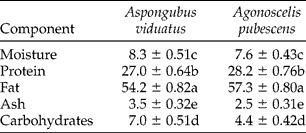
The values obtained for moisture, crude protein, fat, ash and carbohydrate content from the present study for A. viduatus were 8.3, 27.0, 54.2, 3.5 and 7.0%, while for A. pubescens they were 7.6, 28.2, 57.3, 2.5 and 4.4%, respectively (Table 1). Agonoscelis pubescens contained higher levels of protein and fat than A. viduatus. The two constituents (crude protein and fat) are high (85.5 and 80.2%) on a dry-matter basis, which makes the two insects a good source of protein and oil, which can be a supplement to fat and protein foods. The oil content was 54.2 and 57.3%, in A. viduatus and A. pubescens, respectively, which was different from the values reported by Mariod et al. (Reference Mariod, Matthäus, Eichner and Hussein2008), i.e. 45% for A. viduatus and 60% for A. pubescens. Ramos-Elorduy et al. (Reference Ramos-Elorduy, Moreno, Prado, Perez, Otero and de Guevara1997) reported protein and fat content that ranged from 33 to 65% and 19 to 54%, respectively, for other hemipteran bugs.
Approximate chemical analysis (mean±SD) of two Sudanese edible insects (g/100 g dry weight)*
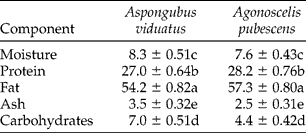
Values followed by different letters within a column indicate significant difference at P>0.05.
* Values are means ( ± SD) of three (n = 3) measurements. Values are on a dry-matter basis.
Minerals
Mineral analysis by atomic absorption spectrophotometer
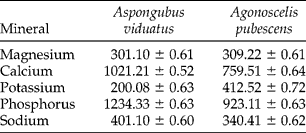
Concentrations of major elements such as Mg, Ca, K, P and Na in A. viduatus (301.10, 1021.21, 200.08, 1234.33 and 401.10 mg/100 g) were significantly (P < 0.05) higher (except for Mg and K) than in A. pubescens (309.22, 759.51, 412.52, 923.11 and 340.41 mg/100 g for Mg, Ca, K, P and Na, respectively) (Table 2). Calcium, a mineral that is essential to bone structure and function in A. pubescens was about 74% of that in A. viduatus. Potassium plays an important role in the human body and sufficient amounts from it in the diet protect against heart disease, hypoglycaemia, diabetes, obesity and kidney disease. The content of potassium in A. pubescens was twice the amount found in A. viduatus.
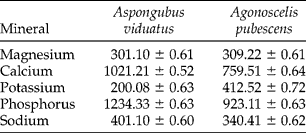
The calcium, sodium, phosphorus and potassium contents in the two insects are higher than that of four types of fish (Martínez-Valverde et al., Reference Martínez-Valverde, Periago, Santaella and Ros2000), which were 351.0–476.0, 64.89–160.0, 421.0–1047.0 and 104.0–446.0 mg/100 g, respectively. In the same manner, calcium, sodium, phosphorus and potassium contents were higher in the two insects than that of snails (Ozogul et al., Reference Ozogul, Ozogul and Olgunoglu2005), which were 726.3, 90.5, 104.5 and 82.2 mg/100 g, respectively.
Mineral analysis by EDX combined with VP-SEM microanalysis
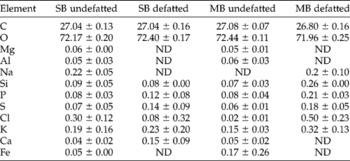
Mineral analyses by SEM seem to be a very quick method, but it is a quantitative rather than a qualitative method, and many authors use this method to analyse different samples, e.g. medicinal plants (Abbdewahab et al., Reference Abbdewahab, Ain, Abdul, Taha and Ibrahim2009a, Reference Abbdewahab, Ain, Abdul, Taha and Ibrahimb). Apart from carbon and oxygen, both insects contain most of the elements. Defatted, dried and ground insects contained fewer minerals than the undefatted ones; and magnesium, aluminium, sodium and ferrous contents were not detected in the defatted insects (Table 3).
Mineral contents (weight %)* of the defatted and undefatted sorghum bug (SB) and melon bug (MB)

* Values are means ( ± SD) of three (n = 3) measurements.
Fatty acid analysis
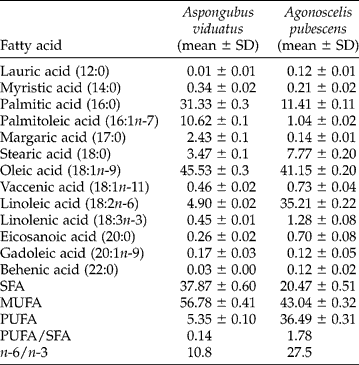
According to data in Table 1, A. viduatus and A. pubescens contain high concentrations of lipids (54.2 and 57.3%, respectively) and analyses were made to investigate the fatty acid profile. The fatty acid composition determined by gas chromatography in A. viduatus and A. pubescens oils is oleic (45.53 and 41.15%), linoleic (4.90 and 35.21%) and palmitic (31.33 and 11.41%) acid, respectively. Mariod et al. (Reference Mariod, Matthaus and Eichner2004) reported similar values, i.e. 46.6 and 40.9% for oleic, 3.9 and 34.5% for linoleic and 30.9 and 12.2% for palmitic acids in A. viduatus and A. pubescens oils, respectively. Aspongubus viduatus and A. pubescens have 37.9 and 20.5% of saturated fatty acids (SFA), 56.8 and 43.0% of monounsaturated fatty acids and 5.3 and 36.5% of polyunsaturated fatty acids (PUFA), respectively (Table 4).
Fatty acid composition (%)* of Aspongubus viduatus and Agonoscelis pubescens oils
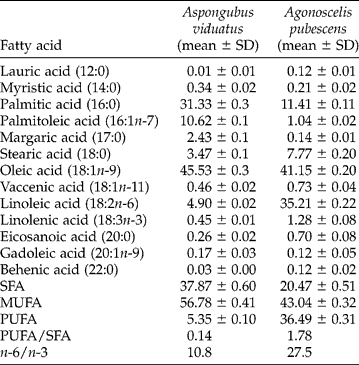
MUFA, monounsaturated fatty acids.
* All determinations were carried out in triplicate and mean values ( ± SD) reported.
The balanced ingestion of foods containing PUFAs reduces cardiovascular disorders. The PUFA:SFA ratio in the oil of A. viduatus is relatively lower (about 0.14), while it is relatively high (about 1.78) in the case of A. pubescens (Table 4). This ratio is recommended to be 0.45 for a healthy diet; so A. viduatus oil seems to be healthier than that of A. pubescens. In addition, the two insect oils have a n-6/n-3 fatty acids ratio (10.8 and 27.5 for A. viduatus and A. pubescens, respectively) that should be smaller than 4.0 as suggested by the UK Department of Health (1994).
Protein and amino acid analysis
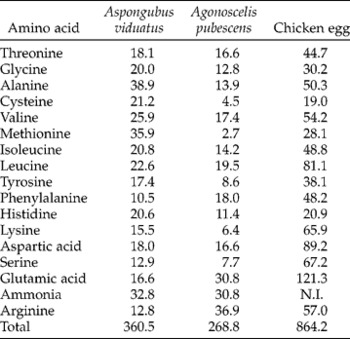
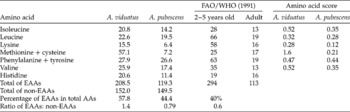
Aspongubus viduatus and A. pubescens contain high concentrations of protein (27.0 and 28.2%, respectively, on a dry-matter basis) and analyses were made to investigate the amino acid profile (Table 5). The total amino acids were 360.5 and 268.8 mg/g crude protein in A. viduatus and A. pubescens, respectively, which was less than the 864.2 mg/g crude protein in chicken egg that is considered as a main protein source in the human diet (Table 5). The percentage of sulphur-containing amino acid (methionine and cysteine) in A. viduatus was 57.1 mg/g crude protein, while in A. pubescens it was 7.2% mg/g crude protein, which can be considered a reasonable amount for their important function in the cell processes in the oxidation and reduction system (cysteine) and its role as a methyl donor (methionine) in metabolism (Heimann, Reference Heimann1980). The total amount of the EAAs found in A. viduatus and A. pubescens was 208.5 and 119.3 mg/g crude protein, respectively, which were higher than the values recommended by FAO/WHO (1991) (113 g protein for adults). The EAA profile of A. viduatus and A. pubescens protein (Table 6) revealed that the levels of EAAs were comparable with those of the FAO/WHO amino acid reference (FAO/WHO, 1991) established for human adults. According to the amino acid scores, the first limiting amino acid of the melon bug protein was lysine and the second was leucine followed by phenylalanine+tyrosine, while in the sorghum bug protein the first limiting amino acid was lysine and the second was methionine+cysteine followed by leucine.
Amino acid composition of Agonoscelis pubescens and Aspongubus viduatus (mg/g crude protein)*

* All determinations were carried out in triplicate and mean values ( ± SD) reported. N.I., not identified.
EAA composition of two Sudanese edible insects compared with the FAO/WHO pattern (mg/g crude protein)*

* All determinations were carried out in triplicate and mean values ( ± SD) reported.
SEM
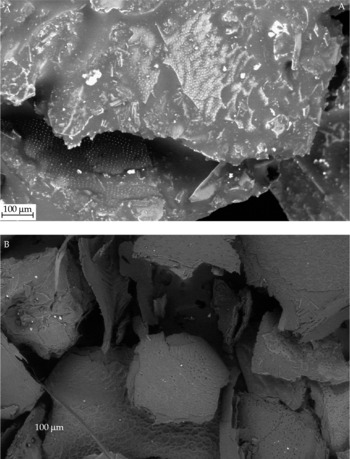
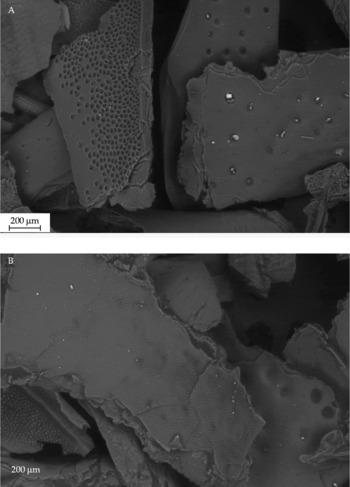
SEM, widely applied in insect morphology (Korchi et al., Reference Korchi, Farine and Brossut1998; Tellam et al., Reference Tellam, Wijffels and Willadsen1999; Hopkins et al., Reference Hopkins, Krchma, Ahmad and Kramer2000), was used to study the surface structures of the two bugs' particles (Figs 1 and 2). When the dried bugs were ground mechanically, oil and other cellular contents were exposed and oil drops were very clear in full-fat samples (Figs 1A and 2A). When the dried bugs were ground, cell walls were disrupted, exposing more lipid bodies; this exposure greatly improved the rate of extraction and oil yield. Clear changes were observed in the appearance of the defatted bugs (Figs 1B and 2B). When the oil was removed from the ground and dried bugs by solvent extraction, the insect structure under the SEM seemed to be clear of oil when compared with the full-fatted samples.
Scanning electron micrographs of (A) full-fat melon bug and (B) defatted melon bug

Scanning electron micrographs of (A) full-fat sorghum bug and (B) defatted sorghum bug

Conclusions
Insects are traditional foods in Sudanese cultures, mainly in the western (Kordofan and Darfur) and Blue Nile states where they play an important role in human nutrition, providing important nutrients. This study revealed that the melon bug A. viduatus and the sorghum bug A. pubescens, pests for watermelon and sorghum, also have high nutritional qualities and are indeed a good source of protein, fatty acids and other nutrients (minerals) that are often in short supply in parts of Sudan. The consumption of these insects, therefore, should be encouraged and it would be ideal if these species were not only collected but also cultivated.
Acknowledgements
The first author would like to thank M. B. Mahmoud and A. H. Abd-Elrahman for their technical assistance during the practical work of this study.