Supraventricular tachyarrhythmias affect all age groups and cause significant morbidity.Reference Orejarena, Vidaillet and DeStefano1, Reference Waldo and Wit2 Their incidence has been reported to be around 36/100,000 person-years, with a prevalence of 2.29/1000 persons.Reference Orejarena, Vidaillet and DeStefano1 Extrapolating the results to the entire United States population, it is estimated that close to 570,000 individuals have supraventricular tachyarrhythmias, with about 89,000 new cases each year.Reference Orejarena, Vidaillet and DeStefano1
Supraventricular tachyarrhythmias are frequently encountered in otherwise healthy individuals without structural heart disease, in whom disabling symptoms most frequently start at a relatively young age.Reference Rodriguez, de Chillou and Schläpfer3, Reference Goyal, Zivin and Souza4
Radiofrequency catheter ablation has been consistently demonstrated as a safe and highly effective treatment strategy to achieve a definite cure of supraventricular tachyarrhythmias,Reference Blomström-Lundqvist, Scheinman and Aliot5 with a reported single-procedure efficacy higher than 95% and an overall risk of adverse events lower than 1%.Reference Blomström-Lundqvist, Scheinman and Aliot5, Reference Spector, Reynolds and Calkins6 On the other hand, conventional radiofrequency catheter ablation approaches for supraventricular tachyarrhythmias are associated with substantial exposure to ionising radiation, owing to the use of fluoroscopy to navigate and position catheters within the heart chambers.Reference Blomström-Lundqvist, Scheinman and Aliot5 To date, the health hazards associated with ionising radiation exposure in the setting of supraventricular tachyarrhythmia catheter ablation have not been adequately addressed.Reference Hirshfeld, Balter and Brinker7 The clinical relevance of this topic is straightforward, considering that patients with supraventricular tachyarrhythmias undergoing catheter ablation are relatively young,Reference Rodriguez, de Chillou and Schläpfer3, Reference Goyal, Zivin and Souza4 and that ionising radiation exposure in such patients is associated with a significant long-term risk of cancer based on the latest risk estimates.8–10 Moreover, recent epidemiological evidenceReference Kleinerman11, Reference Estner, Deisenhofer and Luik12 corroborates the assumption by all major organisations8–10 that even low doses can cause harm, and no completely safe dose exists.10 In recent years, there have been significant technical innovations in radiofrequency catheter ablation, such as the development of non-fluoroscopic three-dimensional mapping systems, for example EnSite NavX™, which combine the rapid generation of three-dimensional cardiac geometry with real-time visualisation of any standard electrophysiology catheter to assist ablation.Reference Estner, Deisenhofer and Luik12–Reference Sporton, Earley, Nathan and Schilling14 It has been recently reported that radiofrequency catheter ablation through a minimally fluoroscopic approach by the EnSite NavX™ mapping system is feasible and safe for the successful ablation of a wide range of supraventricular tachyarrhythmias.Reference Alvarez, Tercedor and Almansa15–Reference Casella, Pelargonio and Dello Russo17 On the other hand, it remains unclear whether such an approach results in a clinically significant reduction in exposure to ionising radiation for the patient and operator, and whether the long-term benefits associated with such reduction outweigh the increased procedural costs owing to the requirement of dedicated equipment.
To address appropriately these issues, the NO-PARTY trial was designed to compare a non-fluoroscopic catheter ablation guided by the EnSite NavX™ mapping system with conventional catheter ablation for supraventricular tachyarrhythmias in terms of ionising radiation exposure for both the patient and the operator, and estimate life-term risks associated with such exposure for the patient.
Owing to the fact that DNA damage mediates many of the harmful effects of ionising radiation, an evaluation of the radiobiological effectiveness of dose reduction by the non-fluoroscopic EnSite NavX™ approach is carried out by assessing chromosomal DNA damage in peripheral blood lymphocytes of a subset of patients.
Moreover, a cost-effectiveness analysis will be performed to weigh the additional costs associated with the non-fluoroscopic EnSite NavX™-guided radiofrequency catheter ablation against the estimable benefits associated with reduced fluoroscopy use.
Materials and methods
Study objective
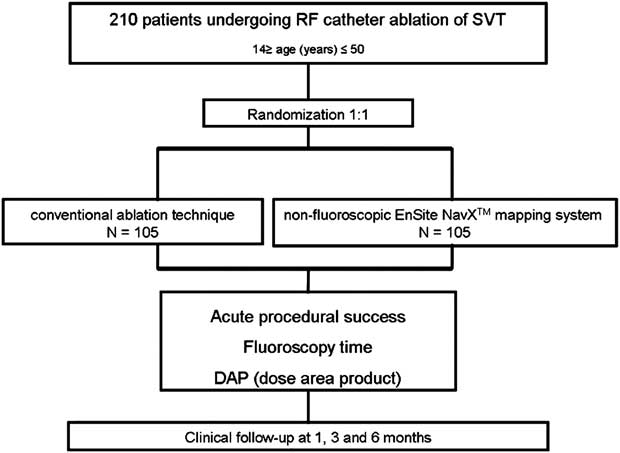
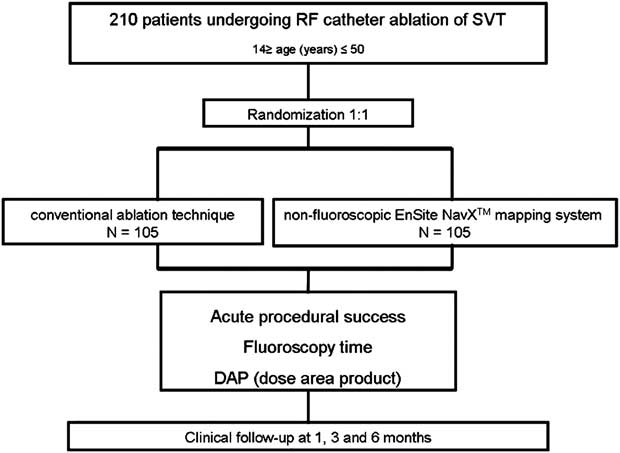
NO-PARTY (www.clinicaltrials.gov identifier NCT01132274) is an investigator-initiated, multi-centre, randomised controlled study in 210 patients undergoing radiofrequency catheter ablation of supraventricular tachyarrhythmias. In each participating centre, the study was fully approved by the responsible Institutional Review Board or Ethics Committee. The primary objective of the study is to evaluate the reduction in patient exposure to ionising radiation, as assessed by dose–area product, obtained by the use of a non-fluoroscopic EnSite NavX™ mapping system approach to guide radiofrequency catheter ablation of supraventricular tachyarrhythmias. Pre-specified secondary end-points to be analysed include procedural success, reduction in operator exposure to ionising radiation, and reduction in fluoroscopy time during the procedure (Fig 1). Moreover, a cost-effectiveness analysis will be performed, taking into account the additional costs associated with the use of the EnSite NavX™ mapping system, and the estimable life-term benefits associated with the reduction of exposure to ionising radiations.
Study design of No-Party Trial.
Study population
The NO-PARTY study will enrol male and female patients between 14 and 50 years of age who have received an indication to catheter ablation of supraventricular tachyarrhythmias according to current guidelines.Reference Blomström-Lundqvist, Scheinman and Aliot5 With the exception of atrial fibrillation and non-isthmus-dependent atrial flutter, all supraventricular tachyarrhythmias will be considered eligible for randomisation. Exclusion criteria include pregnancy, haematological contraindications to ionising radiation exposure, presence of complex congenital heart disease, and cardiac surgery within 1 month of enrolment.
Patients who meet all inclusion criteria and no exclusion criterion and who are willing to provide informed consent will be randomly assigned in a 1:1 manner to radiofrequency catheter ablation with either a non-fluoroscopic EnSite NavX™ system approach or a conventional approach.
Study procedures
Patients assigned to the control group will undergo radiofrequency catheter ablation using a conventional fluoroscopy-guided approach. On the other hand, in patients assigned to the EnSite NavX™ system (St. Jude Medical, St. Paul, Minnesota, United States of America), seven skin patches will be applied to guide the non-fluoroscopic navigation system. Vascular access will be obtained through the femoral vein and, if necessary, through the right internal jugular vein or left subclavian vein.
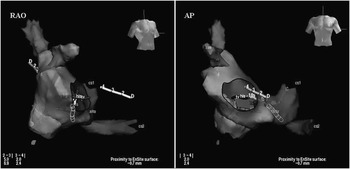
The EnSite NavX™ system will be used to navigate within the femoral vein, using a skin patch as a positional reference, and to reconstruct the cardiac anatomy as previously reported (Fig 2).Reference Alvarez, Tercedor and Almansa15–Reference Casella, Pelargonio and Dello Russo17 Briefly, once the right atrium will be reached, the catheter will be advanced and pulled back to mark the inferior and superior caval veins. Then, a provisional right atrial geometry will be created in the attempt to reconstruct the interatrial septum and to localise the ostium of the coronary sinus, where a diagnostic catheter will be positioned as an anatomical reference point for the remainder of the procedure. The other diagnostic and ablation catheters will be advanced and positioned with the same technique. After performing impedance calibration and compensation for respiratory movements, one of the catheters will be used as a roving catheter and swept through the cardiac chambers, in order to define endocardial boundaries and to obtain a more accurate geometry of the right atrium. If necessary, a separate geometry will be acquired in a similar manner for the right ventricle and its outflow tract. From this point on, the electrophysiological study and subsequent catheter ablation will be carried out using standard protocols and procedures. In procedures randomised to the NavX™-guided arm, the use of minimum-possible fluoroscopy will be allowed whenever the operator will consider it absolutely necessary for the effective and/or safe continuation of the procedure; this may include trans-septal puncture for left-sided procedures if the operator finds trans-septal puncture necessary or preferable to a retrograde approach. The statistical power of the study has been calculated with the estimate in mind that about 20% of procedures randomised to the EnSite NavX™ arm may require minimal fluoroscopy.Reference Casella, Pelargonio and Dello Russo17 Radiofrequency catheter ablation guided by the EnSite NavX™ system will be performed only by operators who have already performed at least five procedures using a minimally fluoroscopic approach, so as to minimise the possible confounding effect of the learning curve.
Non-fluoroscopic three-view reconstruction of the right atrium (grey) with the coronary sinus (dark grey) and the superior and inferior caval veins. AP = antero-posterior projection; RAO = right anterior oblique projection.

Data collection
For all patients, we will keep track of the total procedural time, which is defined as the interval from the initial placement of the first venous sheath to its ultimate removal, the time necessary to position catheters, that is, from venous insertion to their definite position in the heart, the time necessary to complete the electrophysiological study, that is, from the beginning of the study to the diagnosis, and the cumulative time ablation energy will be turned on. We will keep track of the number of pulses and the maximum power of radiofrequency delivery for each procedure. For patients randomised to a catheter ablation guided by the EnSite NavX™ system, we will also keep track of the total geometry time, that is, the time interval from the insertion of the first catheter to the beginning of the electrophysiological study.
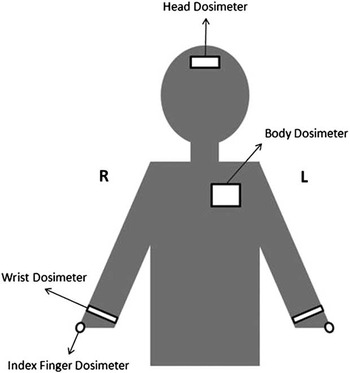
Ionising radiation use and exposure will be analysed in terms of total fluoroscopy time, of patient radiation exposure – as assessed by the dose–area product – and of operator radiation exposure. The latter will be analysed by providing all operators with a series of radiation dosimeters to be carried at the head, chest, right and left wrists, and hands (Fig 3). Radiation data from each of these dosimeters will be collected every month.
Scheme of radiation dosimeters provided to operators during the procedures. The dosimeters will be carried at the head, chest, right and left wrists, and hands.

Evaluation of chromosomal DNA damage
Chromosomal analysis will be performed using micronucleus cytokinesis block assay in peripheral blood lymphocytes as a biomarker of chromosomal damage and intermediate end-points in carcinogenesis.Reference Ferguson, Helms and Mangrum16, Reference Andreassi, Ait-Ali, Botto, Manfredi, Mottola and Picano18, Reference Andreassi, Cioppa, Manfredi, Palmieri, Botto and Picano19 The micronucleus cytokinesis block assay will be performed on a randomly selected subset of 30 patients undergoing radiofrequency catheter ablation with a non-fluoroscopic EnSite NavX™ system approach and 30 patients undergoing radiofrequency catheter ablation with a conventional approach. Venous blood samples will be analysed before and after catheter ablation. From each sample, two separate cultures will be set up by mixing 3.3 millilitres of whole blood with 4.7 millilitres of RPMI-1640 medium; cultures will be incubated at 37°C for 72 hours. Cytochalasin B (6 micrograms per millilitre) will be added 44 hours after culture initiation. Cells will be harvested and fixed according to the standard method used in our laboratory.Reference Andreassi, Ait-Ali, Botto, Manfredi, Mottola and Picano18–Reference Ait-Ali, Andreassi, Foffa, Spadoni, Vano and Picano20 For micronuclei analysis, 1000 binucleated cells will be scored using an optical microscope (final magnification ×400) following the standard criteria.
Procedural success and complications
The definition of procedural success will depend on the specific supraventricular tachyarrhythmias. Ablation of atrioventricular nodal reentrant tachycardia and atrioventricular reentrant tachycardia will be considered successful if no supraventricular tachyarrhythmia can be induced for at least 30 minutes after the last ablation pulse, neither under basal conditions nor with intravenous isoprenaline. Ablation of accessory pathways with manifest pre-excitation but no recorded reciprocating tachycardia will be considered successful if pre-excitation will disappear and atrioventricular and ventriculo-atrial block will be induced by intravenous adenosine. Ablation of typical atrial flutter will be deemed successful if bidirectional isthmus conduction block will be achieved. Finally, ablation of atrial tachycardia will be considered successful if no tachycardia will be induced for at least 30 minutes after the last ablation pulse, neither under basal conditions nor with intravenous isoprenaline.
With regard to the collection of data on procedural complications, all patients will undergo a post-procedural echocardiogram to exclude pericardial effusion or other acute complications. Any other complication that occurs during the procedure or before discharge will be recorded. When 50% and 70% of total patients will be enrolled, the principal investigators from the coordinating centre will conduct an interim analysis of efficacy and safety.
Follow-up
A follow-up outpatient visit will be scheduled for each patient at 1, 3, and 6 months to take an updated history, perform physical examination, obtain a 12-lead ECG, and monitor post-procedural adverse events.
Statistical considerations
Assumptions include a projected reduction in total radiation exposure for the patient, that is, dose–area product, from a mean of 10 plus or minus 5 milligray per square metre for the conventional radiofrequency catheter ablation approach to a mean of 5 plus or minus 5 milligray per square metre for the EnSite NavX™ system-guided catheter ablation approach, and the life-term benefits associated with such reduction will be assessed according to the radiological risk tables provided in the BEIR VII phase 2 document10. Based on these assumptions, a two-sided alpha lower than 0.05, the trial will have 99% power with sample size of 210 patients, and including 20% of patients that it is estimable will be lost at follow-up.
On the basis of previous data,Reference Andreassi, Cioppa, Manfredi, Palmieri, Botto and Picano19, Reference Ait-Ali, Andreassi, Foffa, Spadoni, Vano and Picano20 a total sample size of 60 patients – 30 in each group – will allow to detect an increase of 15% in micronucleus assay in patients undergoing conventional radiofrequency catheter ablation approach with a power greater than 80% and type 1 error of alpha equal to 0.05.
Descriptive statistics will be reported as mean plus or minus standard deviation (or median and range for skewed distributions) for continuous variables and as absolute frequencies and percentages for categorical variables. Between-group comparisons will be performed with the unpaired Student t test, the Mann–Whitney U test, or Fisher's exact test as appropriate. All tests will be two sided, and a value of p lower than 0.05 will be considered statistically significant. Interim analysis for efficacy will be performed when 50% and 70% of total patients will be enrolled. After either analysis, the coordinating centre may recommend the interruption of the trial if a significant benefit for the EnSite NavX™ system approach will be demonstrated for all the end-points of interest at p lower than 0.001. The STATA 10.0 (Stata Corporation, College Station, Texas, United States of America) statistical package will be used for statistical analyses.
Current status
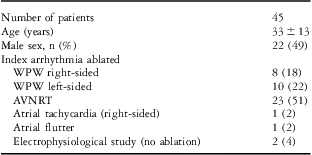
Recruitment began in January, 2010 and is expected to be completed in January, 2012. Baseline characteristics of the patients enrolled are shown in Table 1. Analyses and reporting are expected to be completed by June 2012.
Clinical characteristics of currently enrolled patients.
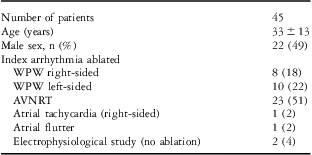
WPW = Wolff–Parkinson–White syndrome; AVNRT = atrioventricular node reentrant tachycardia.
Values expressed as mean ± standard deviation or n (%).
Discussion
The NO-PARTY trial was designed to test the hypothesis that a non-fluoroscopic radiofrequency catheter ablation guided by the EnSite NavX™ system can significantly reduce the exposure to ionising radiation for both patient and operator, and that the estimable life-term benefits derived from such an approach outweigh the additional costs compared with a conventional radiofrequency catheter ablation procedure. To this aim, NO-PARTY will enrol a large cohort of patients undergoing catheter ablation of a wide range of supraventricular tachyarrhythmias, because such arrhythmias are frequently encountered in young and otherwise healthy individuals,Reference Orejarena, Vidaillet and DeStefano1, Reference Waldo and Wit2, Reference Hirshfeld, Balter and Brinker7 in whom a reduction in ionising radiation exposure is more likely to result in a life-term clinical benefit.8–10, Reference Andreassi, Cioppa, Manfredi, Palmieri, Botto and Picano19–Reference Beels, Bacher, De Wolf, Werbrouck and Thierens22 Moreover, the results of the cost-effectiveness analysis will also provide important information regarding the appropriateness of increased procedural costs associated with the use of the EnSite NavX™ mapping system.
It is currently well established that catheter ablation can achieve a definite cure in a wide range of arrhythmias, with supraventricular tachyarrhythmias being among those most commonly referred for ablation.Reference Waldo and Wit2, Reference Blomström-Lundqvist, Scheinman and Aliot5, Reference Spector, Reynolds and Calkins6, Reference Cappato and Kuck23 Unlike other diagnostic or interventional procedures, catheter ablation requires a continuous use of fluoroscopy to navigate and position catheters within the heart chambers and patients may not always have been properly informed of radiation risks. Indeed, the clinical significance of radiation exposure during radiofrequency catheter ablation procedures has been largely underestimated in previous studies. Although the long-term effects of exposure to ionising radiation are well known, particularly with regard to an increased incidence of cancer, statistical limitations make them difficult to evaluate at low doses. The BEIR VII document of the United States National Academies, the major authority in this field, concludes that current evidence supports a “linear-no-threshold” model, in which a simple linear relation exists between cancer risk and radiation dose.10 According to this model, there is no threshold dose below which radiation carries no risks.
In addition to long-term risks, an acute effect of ionising radiation exposure has been recently described in the form of chromosomal DNA damage in circulating lymphocytes of children undergoing cardiac catheterisation. A pivotal point in risk stratification is that radiation risks are not distributed homogeneously among the population: women and younger individuals are at a relatively higher risk, because of both a greater vulnerability to radiation effects and a longer life expectancy.Reference Andreassi, Ait-Ali, Botto, Manfredi, Mottola and Picano18–Reference Beels, Bacher, De Wolf, Werbrouck and Thierens22 In this regard, we should remark that effort has been undertaken to minimise radiation exposure in the paediatric population during interventional cardiology, whereas this issue has only recently come to the attention of electrophysiologists treating adults. In fact, to date, interventional cardiologists remain largely untrained in radiation effects and safety.
Another aspect pertaining to the use of ionising radiation in electrophysiology is the chronic low-dose exposure of operators. Venneri et alReference Venneri, Rossi and Botto24 recently reported that cumulative occupational radiation exposure is associated with a non-negligible lifetime attributable risk of cancer for most heavily exposed staff in a contemporary cardiac catheterisation laboratory. In that paper, data from the Tuscany regional dosimetric data bank showed that cardiac electrophysiologists received a cumulative exposure of 4.3 millisieverts per year with a range from 3.5 to 6.1 millisieverts per year, as calculated from personal thermoluminescent dosimeters carried under the apron at the waist or chest. In terms of occupational risk, this means that the lifetime extra risk for fatal or non-fatal cancer after 20 years of professional activity is in the range of 1 in 100. In addition, it is important to underline that radiation exposure may be a significant concern for other organs as well, which are usually not protected from direct or scattered X-rays, such as the hands, arms, eyes, and rest of the head.
Using adequate equipment and checking the correct positioning of the arch of fluoroscopy can yield significant reduction in radiation doses to patients, and therefore to staff, without compromising the procedure and its clinical outcome.Reference Germano, Day and Gregorious25–Reference Rogers, England and Lozhkin27 The large variation in operator doses observed for the same type of procedure suggests that optimising procedure protocols and implementing a wider use of most effective types of protective devices and shields may reduce radiation doses to operators, while the lack of a good radioprotection policy could increase occupational doses, and risk of cancer, by a factor of 10.Reference Picano, Santoro and Vano28 In high-volume centres, the large number of procedures per operator is hopefully counterbalanced by the presence of more recent and efficient radiographic/fluoroscopic units and newer three-dimensional mapping systems, and by the greater availability of protective devices, such as personal glasses, radiation protection cabin, radiation protection shields to absorb scatter radiation. The same facilities may not be available at low- or medium-volume centres, where, on the contrary, the effective dose to operators could be higher in proportion to the number of procedures performed.
Finally, we must take into account the additional costs associated with the use of a three-dimensional mapping system to guide catheter ablation of supraventricular tachyarrhythmia compared with a standard fluoroscopic approach. To the best of our knowledge, the only study comparing the costs of a non-fluoroscopic approach – both with CARTO and NavX™ system – with those of the standard fluoroscopic approach was the paper by Earley et al.Reference Earley, Showkathali and Alzetani29 The authors concluded that among a wide range of supraventricular tachyarrhythmia, CARTO and NavX were cost neutral only in the ablation of typical atrial flutter, because their additional cost is balanced by sparing the use of a duodecapolar catheter. We must observe that cost analyses are usually invalidated by the difficulty in weighing the cost of the three-dimensional mapping system, which is easily recorded in a hospital budget, against the benefits of its use – the near-total absence of radiation exposure for the patient, operator, and auxiliary staff, elimination of all radiation protection equipment and possibly of the vertebral strain they impose on operators, and so on. These benefits can only be assessed meaningfully in a long-term, “lifetime” perspective, and although they do carry additional costs they may be significant enough for the community and catheter laboratory staff. In this regard, we decided to perform the electrophysiological procedures with all the catheters the operator requires and to compare only the additional cost of the mapping system with the life-term benefits according to the radiological risk tables provided in the BEIR VII phase 2 document.10
Conclusions
We believe this multi-centre randomised study will provide definitive data on the safety and effectiveness of a non-fluoroscopic approach for radiofrequency catheter ablation of supraventricular tachyarrhythmias guided by the EnSite NavX™ system, and will answer key questions on its cost/effectiveness. This may redefine the role of such an approach in clinical practice, particularly in younger patients at a relatively higher risk from radiation exposure, such as those who typically undergo radiofrequency catheter ablation of supraventricular tachyarrhythmias.
Appendix A: NO-PARTY Investigators
Centro Cardiologico Monzino: Stefano Bartoletti, Corrado Carbucicchio, Michela Casella, Daniele Colombo, Pasquale De Iuliis, Antonio Dello Russo, Gaetano Fassini, Francesco Giraldi, Benedetta Majocchi, Massimo Moltrasio, Stefania Riva, Claudio Tondo, Fabrizio Tundo, Martina Zucchetti.
Catholic University of the Sacred Heart: Ghaliah Al-Mohani, Fulvio Bellocci, Gianluigi Bencardino, Fabrizio Cichocki, Francesca Di Clemente, Laura Gargiulo, Andrea Morasca, Maria Lucia Narducci, Gemma Pelargonio, Francesco Perna, Pasquale Santangeli, Antonio Scarà, Paolo Zecchi.
Santa Chiara Hospital, Hospital University of Pisa: Maria Grazia Bongiorni, Andrea Di Cori, Luca Paperini, Luca Segreti, Ezio Soldati, Stefano Viani, Giulio Zucchelli.
Santa Chiara Hospital, Trento: Alessio Coser, Maurizio Del Greco, Lucia Magagna, Massimiliano Marini.
CNR, Institute of Clinical Physiology: Maria Grazia Andreassi, Luca Panchetti, Marcello Piacenti, Eugenio Picano, Andrea Rossi, Umberto Startari.