INTRODUCTION
Kraepelin’s (Reference Kraepelin1919) division of “dementia praecox” and “manic-depressive” disease (e.g., bipolar disorder) into separate neuropsychiatric disorders has been a fundamental nosological distinction for more than 100 years. However, there is growing evidence identifying common as well as distinct neurobiological features (Mayer, Zobel, & Wagner, Reference Mayer, Zobel and Wagner2007), including genetic liability (Berretini, Reference Berrettini2000; Craddock, O’Donovan, & Owen, Reference Craddock, O’Donovan and Owen2006; Cross-Disorder Group of the Psychiatric GWAS Consortium, 2013), brain structural abnormalities (Ivleva et al., Reference Ivleva, Bidesi, Keshavan, Pearlson, Meda, Dodig and Tamminga2013; McIntosh et al., Reference McIntosh, Job, Moorhead, Harrison, Whalley, Johnstone and Lawrie2006), and neurocognitive deficits (Hill et al., Reference Hill, Reilly, Keefe, Gold, Bishop, Gershon and Sweeney2013; Lewandowski, Cohen, & Ongur, Reference Lewandowski, Cohen and Ongur2011; Seidman et al., Reference Seidman, Kremen, Koren, Faraone, Goldstein and Tsuang2002). Compared to affective psychoses, neurocognitive dysfunction is currently better established as a robust component of schizophrenia at all phases of the illness including chronic phases (Heinrichs & Zakzanis, Reference Heinrichs and Zakzanis1998), first episode (Mesholam-Gately, Giuliano, Faraone, Goff, & Seidman, Reference Mesholam-Gately, Giuliano, Faraone, Goff and Seidman2009), prodromal (Fusar-Poli et al., Reference Fusar-Poli, Deste, Smieskova, Barlati, Yung, Howes and Borgwardt2012; Giuliano, Mesholam-Gately, Sorenson, Woodberry, & Seidman, Reference Giuliano, Li, Mesholam-Gately, Sorenson, Woodberry and Seidman2012), and premorbidly (Agnew-Blais et al., Reference Agnew-Blais, Buka, Fitzmaurice, Smoller, Goldstein and Seidman2015; Reichenberg et al., Reference Reichenberg, Caspi, Harrington, Houts, Keefe, Murray and Moffitt2010; Seidman et al., Reference Seidman, Cherkerzian, Goldstein, Agnew-Blais, Tsuang and Buka2013; Woodberry, Giuliano, & Seidman, Reference Woodberry, Giuliano and Seidman2008).
Nevertheless, in the past two decades, the presence of neuropsychological dysfunctions in affective disorders has also become well established (Bora, Yücel, & Pantelis, Reference Bora, Yücel and Pantelis2009; Lewandowski et al., Reference Lewandowski, Cohen and Ongur2011). Many studies report the presence of neuropsychological impairments in bipolar disorder, regardless of the phase of the illness (Bearden, Hoffman, & Cannon, Reference Bearden, Hoffman and Cannon2001; Burdick et al., Reference Burdick, Goldberg, Cornblatt, Keefe, Gopin, DeRosse and Malhotra2011; Ferrier, Stanton, Kelly, & Scott, Reference Ferrier, Stanton, Kelly and Scott1999; Gitlin, Swendson, Heller, & Hammen, Reference Gitlin, Swendsen, Heller and Hammen1995; Pousada-Casal, Reference Pousada-Casal2010; Sánchez-Morla et al., Reference Sánchez-Morla, Barabash, Martínez-Vizcaíno, Tabarés-Seisdedos, Balanzá-Martínez, Cabranes-Díaz and Gómez2009; Tohen et al., Reference Tohen, Hennen, Zarate, Baldessarini, Strakowski, Stoll and Cohen2000; Van Gorp, Altshuler, Theberge, Wilkins, & Dixon, 1998), as well as in unipolar major depressive disorder (Baune et al., Reference Baune, Miller, McAfoose, Johnson, Quirk and Mitchell2010; Maalouf et al., 2010; Murrough, Iacoviello, Neumeister, Charney, & Iosifescu, Reference Murrough, Iacoviello, Neumeister, Charney and Iosifescu2011; Reichenberg et al., Reference Reichenberg, Harvey, Bowie, Mojtabai, Rabinowitz, Heaton and Bromet2009).
Several studies of early onset bipolar disorder revealed neuropsychological deficits in pediatric and adolescent patients (Cahill, Green, Jairam, & Malhi, Reference Cahill, Green, Jairam and Malhi2007; Dickstein et al., Reference Dickstein, Treland, Snow, McClure, Mehta, Towbin and Leibenluft2004; Doyle et al., Reference Doyle, Wilens, Kwon, Seidman, Faraone, Fried and Biederman2005; Gruber, Rosso, & Yurgelun-Todd, Reference Gruber, Rosso and Yurgelun-Todd2008; Schouws, Zoetman, Comjis, Stek, & Beekman, Reference Schouws, Zoeteman, Comijs, Stek and Beekman2007). The presence of psychotic features appears to be associated with greater neurocognitive impairment in both bipolar diorder (Bora, Yücel, & Pantelis, Reference Bora, Yücel and Pantelis2010; Glahn et al., Reference Glahn, Bearden, Barguil, Barrett, Reichenberg, Bowden and Velligan2007) and major depressive disorder (Belanoff, Kalehzan, Sund, Fleming Ficek, & Schatzberg, Reference Belanoff, Kalehzan, Sund, Fleming Ficek and Schatzberg2001; Fleming, Blasey, & Schatzberg, Reference Fleming, Blasey and Schatzberg2004; Schatzberg et al., Reference Schatzberg, Posener, DeBattista, Kalehzan, Rothschild and Shear2000). While the literature is relatively limited, direct comparisons of individuals with schizophrenia spectrum disorders and affective psychotic disorders indicate that neurocognitive impairment is more pronounced in schizophrenia (Hill et al., Reference Hill, Reilly, Keefe, Gold, Bishop, Gershon and Sweeney2013; Lewandowski et al., Reference Lewandowski, Cohen and Ongur2011; Seidman et al., Reference Seidman, Kremen, Koren, Faraone, Goldstein and Tsuang2002; Sperry et al., Reference Sperry, O’Connor, Ongur, Cohen, Keshavan and Lewandowski2015).
An important question is whether neuropsychological impairments differ in persons at risk for these illnesses, such as in offspring or siblings of probands with a psychotic disorder. Genetic/family high-risk (FHR) studies allow a defined selection process for ascertaining nonpsychotic subjects at any age to test the hypothesis that they carry genetic liability for the illness, expressed across a range of phenotypes reflecting the underlying disorders (“endophenotypes”). Studying nonpsychotic relatives, who are typically unmedicated allows a comparison of individuals who express disorder-associated phenotypes without confounds (i.e., medications) that can obscure potentially distinctive cognitive features of the disorders.
There are several meta-analyses and reviews of this literature in first-degree relatives of people with schizophrenia (Bora et al., Reference Bora, Lin, Wood, Yung, McGorry and Pantelis2014; Gur et al., Reference Gur, Calkins, Gur, Horan, Nuechterlein, Seidman and Stone2007; Sitskoorn, Aleman, Ebisch, Appels, & Kahn, Reference Sitskoorn, Aleman, Ebisch, Appels and Kahn2004; Snitz, Macdonald, & Carter, Reference Snitz, Macdonald and Carter2006; Trandafir, Meary, Schurhoff, Leboyer, & Szoke, Reference Trandafir, Meary, Schurhoff, Leboyer and Szoke2006) and a recent comprehensive review restricted to young relatives up to age 30 (Agnew-Blais & Seidman, Reference Agnew-Blais and Seidman2013). These reviews provide clear evidence that, as a group, the relatives are impaired on a variety of measures of general intellectual ability, sustained attention or vigilance, working memory, and declarative memory. In the affective psychoses, there is a smaller literature on unaffected relatives, but meta-analytic evidence (Bora et al., Reference Bora, Yücel and Pantelis2009; Burdick, Goldberg, Harrow, Faull, & Malhotra, Reference Burdick, Goldberg, Harrow, Faull and Malhotra2006) indicates that relatives of individuals with bipolar disorder with psychosis are impaired in several cognitive domains proposed as potential endophenotypes, including response inhibition, set shifting, verbal memory, and sustained attention.
A few previous FHR studies of young (age <30 years), first-degree relatives of probands with schizophrenia (FHR-SCZ) or affective psychoses (FHR-AFF) have investigated the degree of overlap in neuropsychological deficits in those at familial risk for these disorders (Diwadkar et al., Reference Diwadkar, Goradia, Hosanagar, Mermon, Montrose, Birmaher and Keshavan2011; Erlenmeyer-Kimling et al., Reference Erlenmeyer-Kimling, Rock, Roberts, Janal, Kestenbaum, Cornblatt and Gottesman2000; Schubert & McNeil, Reference Schubert and McNeil2005, Reference Schubert and McNeil2007; Seidman et al., Reference Seidman, Giuliano, Smith, Stone, Glatt, Meyer and Cornblatt2006). Significant differences in perceptual-motor speed were found between FHR-SCZ and FHR-AFF groups, where FHR-SCZ showed more deficits on both the Wechsler Intelligence Scale for Children, Third Edition (WISC-III) Digit Symbol subtest (Seidman et al., Reference Seidman, Giuliano, Smith, Stone, Glatt, Meyer and Cornblatt2006) and the Trail Making Test-B (Schubert & McNeil, Reference Schubert and McNeil2007). Likewise, differences were observed in working memory tasks, such as on short-term memory (Erlenmeyer-Kimling et al., Reference Erlenmeyer-Kimling, Rock, Roberts, Janal, Kestenbaum, Cornblatt and Gottesman2000) and the Spatial Memory paradigm, where FHR-SCZ showed significantly more impairments than the FHR-AFF group (Diwadkar et al., Reference Diwadkar, Goradia, Hosanagar, Mermon, Montrose, Birmaher and Keshavan2011).
Measures of attention yielded less consistent results: on the Selective Attention test, the FHR-SCZ group performed significantly worse than the FHR-AFF group on measures of compound hits (Schubert & McNeil, Reference Schubert and McNeil2005) and correct hits (Schubert & McNeil, Reference Schubert and McNeil2007), whereas on a sustained attention task [the Continuous Performance Test, Identical Pairs (CPT-IP); Cornblatt, Risch, Faris, Friedman, & Erlenmeyer-Kimling, Reference Cornblatt, Risch, Faris, Friedman and Erlenmeyer-Kimling1988], both groups showed reduced sensitivity, but only offspring of bipolar probands significantly differed from controls (Diwadkar et al., Reference Diwadkar, Goradia, Hosanagar, Mermon, Montrose, Birmaher and Keshavan2011). However, Erlenmeyer-Kimling et al. (Reference Erlenmeyer-Kimling, Rock, Roberts, Janal, Kestenbaum, Cornblatt and Gottesman2000) showed FHR-SCZ to be more impaired than FHR-AFF on the CPT-IP.
Taken together, these results indicate that those at risk for schizophrenia-spectrum disorders display more consistent neuropsychological deficits in perceptual-motor speed and working memory tasks, and general cognitive ability (Burdick, Gunawardane, Woodberry, & Malhorta, Reference Burdick, Gunawardane, Woodberry and Malhotra2009) than those at risk for affective psychoses and that attention difficulties are found in both high-risk groups. Moreover, a recent review of working memory that compares schizophrenia and affective disorders, and includes relatives as well as patients, provides strong support for working memory as an endophenotype specifically for schizophrenia (Park & Gooding, Reference Park and Gooding2014). The neurocognitive results are largely consistent with the hypothesis by Murray et al. (Reference Murray, Sham, van Os, Zanelli, Cannon and McDonald2004) that “on a background of shared genetic predisposition to psychosis, schizophrenia, but not bipolar disorder, is subject to additional genes or early insults, which impair neurodevelopment” (p. 405). Presumably, more impaired neurodevelopment is reflected in a greater compromise in neurocognition in FHR-SCZ, particularly working memory.
There is also an ample literature documenting greater psychopathology associated with familial risk for psychotic disorders including social behavior (Glatt, Stone, Fraone, Seidman, Tsuang, Reference Glatt, Stone, Faraone, Seidman and Tsuang2006), various forms of psychopathology (Dean et al., Reference Dean, Stevens, Mortensen, Murray, Walsh and Pedersen2010; Erlenmeyer-Kimling, et al., Reference Erlenmeyer-Kimling, Rock, Roberts, Janal, Kestenbaum, Cornblatt and Gottesman2000; Rasic, Hajek, Alda, & Uher, Reference Rasic, Hajek, Alda and Uher2014), schizotypal traits (Ettinger et al., Reference Ettinger, Mohr, Gooding, Cohen, Rapp, Haenschel and Park2015) and psychiatric disorders (Goldstein, Buka, Seidman, & Tsuang, Reference Goldstein, Buka, Seidman and Tsuang2010: Rasic et al., Reference Rasic, Hajek, Alda and Uher2014). Given the covariation of schizotypal traits with a range of characteristics (Ettinger et al., Reference Ettinger, Mohr, Gooding, Cohen, Rapp, Haenschel and Park2015), including cognition, and the association of various manifestations of current psychopathology with cognition (e.g., depression), an important question is whether any cognitive impairments observed in at-risk youth can be explained by personality traits or current psychopathology.
In previous work evaluating FHR-SCZ, we examined attention and working memory performance using a battery of auditory tests (Seidman et al., Reference Seidman, Meyer, Giuliano, Breiter, Goldstein, Kremen and Faraone2012). We found that the FHR-SCZ participants were impaired on the working memory tasks and maximally on the high load working memory task with interference. In this study, we compare FHR-AFF with that sample of FHR-SCZ, drawn from the same study, with identical instruments, as we have done with verbal and visual-spatial memory tasks (Scala et al., Reference Scala, Pousada, Stone, Thermenos, Manschreck, Tsuang and Seidman2013). We had three hypotheses: (1) Both FHR-AFF and FHR-SCZ participants would be significantly impaired in auditory vigilance compared to healthy controls. (2) The FHR-SCZ participants would be significantly more impaired in working memory compared to the FHR-AFF participants and to the healthy controls. (3) Measures of physical anhedonia or current psychopathology would not fully explain the cognitive deficits. The latter hypothesis is designed to incorporate findings from our previous work with these samples (Glatt et al., Reference Glatt, Stone, Faraone, Seidman and Tsuang2006; Rosso et al., Reference Rosso, Makris, Thermenos, Hodge, Brown, Kennedy and Seidman2010) and from the field of FHR-SCZ studies demonstrating that physical anhedonia is a common phenotypic finding (Phillips & Seidman, Reference Phillips and Seidman2008).
METHODS AND MATERIALS
Participants
The data were collected as part of the Harvard Adolescent Family High Risk Study between 1998 and 2007. This sample and its ascertainment procedures were described previously (Scala et al., Reference Scala, Pousada, Stone, Thermenos, Manschreck, Tsuang and Seidman2013; Seidman et al., Reference Seidman, Giuliano, Smith, Stone, Glatt, Meyer and Cornblatt2006, Reference Seidman, Meyer, Giuliano, Breiter, Goldstein, Kremen and Faraone2012), and these Auditory Continuous Performance Test (ACPT) data have been previously published comparing FHR-SCZ to healthy volunteers (Seidman et al., Reference Seidman, Meyer, Giuliano, Breiter, Goldstein, Kremen and Faraone2012). However, the FHR-AFF data have not been previously published. In brief, participants for this study constituted three groups: the biological children and siblings of schizophrenia probands, the biological children and siblings of affective psychosis probands, and biological children of community control probands. All participants were between the ages of 13 and 25 at the time of their ACPT assessment.
The FHR-SCZ group was composed of 41 children and siblings of adult probands (at least 18 years of age) who were diagnosed according to DSM-IV diagnostic criteria (APA, 1994) with either schizophrenia or schizoaffective disorder, depressed type, using the Diagnostic Interview for Genetic Studies (DIGS; Nurnberger et al., 1994) and the Family Interview for Genetic Studies (FIGS; Maxwell, Reference Maxwell1996). This diagnostic clustering had considerable support when the study began (Goldstein et al., Reference Goldstein, Buka, Seidman and Tsuang2010). The FHR-AFF group consisted of 24 children and siblings of adult probands with Diagnostic and Statistical Manual of Mental Disorders, 4th Edition (DSM-IV) diagnoses of bipolar disorder with psychosis (n=18) or major depressive disorder with psychotic features (n=6). The control group consisted of 54 children of parents diagnosed according to DSM-IV criteria with no mental illness (n=25), major depressive disorder (n=8), mood disorder due to a general medical condition (n=1), or cannabis abuse (n=1) using the DIGS and FIGS (one parent had two diagnoses). The adult control probands were drawn from respondents to local newspaper advertisements and announcements posted in the sites from which FHR probands were recruited (e.g., local hospital and clinics).
Exclusion Criteria
Participants were excluded if they had any lifetime diagnosis of psychotic illness, substance dependence, or neurological disease, a history of head injury or medical illness with documented cognitive sequelae, sensory impairments, current psychotropic medication use, or a full-scale IQ estimate of less than 70 based on eight sub-tests of the WISC-III (Wechsler, Reference Wechsler1991) or Wechsler Adult Intelligence Scale, Third Edition (WAIS-III) (Wechsler, Reference Wechsler1997). Participants in the control group were screened with the same criteria, with an additional exclusion criterion of any first- or second-degree biological relatives with lifetime history of a psychotic disorder.
Offspring and siblings of case and control probands were screened for presence of psychosis with the Washington University Kiddie SADS (WASH-U-KSADS; Geller, Zimmerman, Williams & Frazier, Reference Geller, Zimmerman, Williams and Frazier1994). The Psychosis, Substance Abuse and Mood Disorders modules of the WASH-U-KSADS were administered along with a Neurodevelopmental Questionnaire (Faraone et al., Reference Faraone, Seidman, Kremen, Pepple, Lyons and Tsuang1995) to establish other inclusion and exclusion criteria. The reading subtest of the Wide Range Achievement Test – Third Edition (WRAT-3; Wilkinson, Reference Wilkinson1993) was used as an estimate of potential intellectual ability. Social economic status (SES) of the parents was measured by the Hollingshead (Reference Hollingshead1975) four factor scale.
Participant’s age 18 and older gave informed consent, while subjects younger than 18 years of age gave assent in conjunction with informed consent provided by a parent. Subjects received an honorarium for participating. The study was approved by the human research committees of the Massachusetts Mental Health Center, Massachusetts General Hospital, and the Harvard Medical School.
MEASURES AND PROCEDURES
Auditory Continuous Performance Tests
Three ACPT task conditions were used: vigilance (“QA”), working memory (“Q3A-MEM”), and working memory with interference (“Q3A-INT”). These tasks were described in considerable detail previously (Seidman et al., Reference Seidman, Breiter, Goodman, Goldstein, Woodruff, O’Craven and Rosen1998, Reference Seidman, Meyer, Giuliano, Breiter, Goldstein, Kremen and Faraone2012) and thus will only be described briefly here. Each task consisted of a baseline and target condition presented in an A-B-A-B format (see Figure 1a, Seidman et al., Reference Seidman, Meyer, Giuliano, Breiter, Goldstein, Kremen and Faraone2012). In each condition, letters of the alphabet were presented monaurally at a rate of one per second for four blocks of 90 s. Subjects were required to respond to all target stimuli by lifting their index finger.
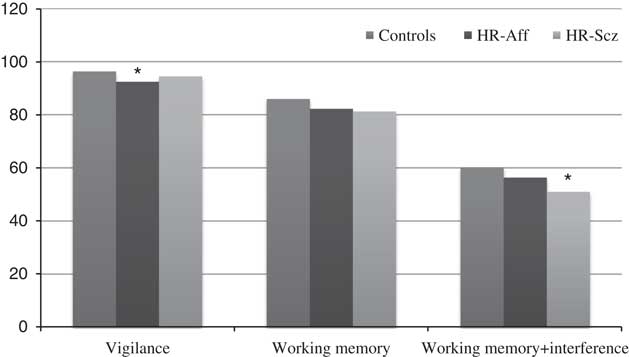
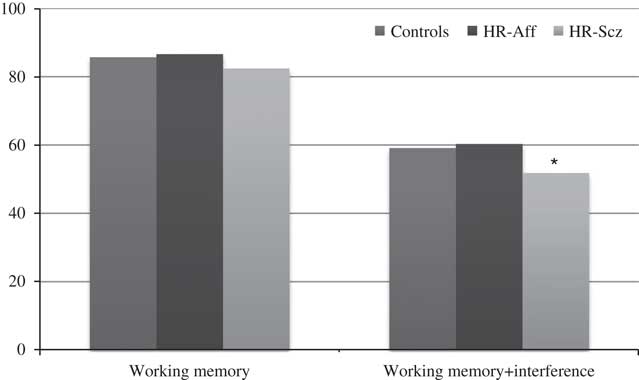
Percent of correct scores on the Auditory Continuous Performance Test in the three groups adjusted for intrafamilial correlation and age.

The vigilance condition required subjects to respond to each A only if immediately preceded by a Q (i.e., QA), a typical successive discrimination AX CPT (Cohen, Barch, Carter, & Servan-Schreiber, Reference Cohen, Barch, Carter and Servan-Schreiber1999; Rosvold, Mirsky, Sarason, Bransome, & Beck, Reference Rosvold, Mirsky, Sarason, Bransome and Beck1956). There were two versions of the increased memory load CPT in which the warning (Q) and target (A) stimuli were separated by three letters (“Q3A-MEM” and “Q3A-INT”). In the target condition for the “Q3A-MEM” task, subjects responded to each A when preceded by a Q separated by three letters (e.g., Q R C T A), and there were never Qs or As between the Q (warning) and A (target) (i.e., no “interference”). In “Q3A-INT,” like Q3A-MEM, randomly selected letters of the alphabet were interspersed throughout the block, including freestanding Qs and As alone. To make the task more difficult, combinations of the letters, Q, A, or QA were periodically embedded in between the Q and the target A. For example, some of the embedded stimuli strings were like the following: “QQcqAAbr.” In this example, capital Qs and As are cues and targets, respectively, whereas the lower case “q” is a distracter.
Trials with interspersed Qs and interleaved series were designed to produce distraction, divide attention, and prevent counting because the subject was episodically required to maintain two separate tracks simultaneously (e.g., constant updating of identification of stimuli from memory). These working memory tasks have been shown to activate the classical frontal-parietal network in two separate functional neuroimaging studies (Huang, Seidman, Rossi, & Ahveninen, Reference Huang, Seidman, Rossi and Ahveninen2013; Seidman et al., Reference Seidman, Breiter, Goodman, Goldstein, Woodruff, O’Craven and Rosen1998).
Measures of Psychosis Proneness
Individuals at risk for psychosis have frequently demonstrated significant differences from healthy volunteers on measures of psychosis proneness such as the Chapman scales. We used three of these scales. The Revised Physical Anhedonia Scale (RPAS) assesses reduced capacity to experience physical and sensory pleasures (e.g., “The beauty of sunsets is greatly overrated”, keyed “true”) (Chapman, Chapman, & Raulin, Reference Chapman, Chapman and Raulin1976). The Perceptual Aberration Scale (PAS) (Chapman, Chapman, & Raulin, Reference Chapman, Chapman and Raulin1978) taps perceptual distortions that do not reach the severity of hallucinations (e.g., “Parts of my body occasionally seem dead or unreal”, keyed “true”). The Magical Ideation Scale (MIS) (Eckblad & Chapman, Reference Eckblad and Chapman1983) enquires about ideas of reference and odd beliefs (e.g., “Good luck charms don’t work”, keyed “false”). In previous work using the FHR-SCZ sample compared to healthy controls (Glatt et al., Reference Glatt, Stone, Faraone, Seidman and Tsuang2006; Rosso et al., Reference Rosso, Makris, Thermenos, Hodge, Brown, Kennedy and Seidman2010), we demonstrated that FHR-SZ were significantly impaired on revised physical anhedonia but not on PAS or MIS. The results of the FHR-AFF group were not reported in those papers.
Measures of current psychopathology
The Symptom Checklist 90-Revised (SCL-90-R; Derogatis, Reference Derogatis1993), is a self-report questionnaire of 90 items, clustered into nine specific and three total subscales, often given in outpatient settings. Participants are asked, “how much that problem has bothered you during the past 7 days including today”; thus, it is a measure of current symptomatology. In a previous report on this sample (Scala et al., Reference Scala, Pousada, Stone, Thermenos, Manschreck, Tsuang and Seidman2013; Table 3), we reported that three SCL-90-R dimensions were significantly worse in the high-risk groups than in controls, Obsessive-Compulsive (FHR-AFF>controls), Phobic Anxiety (FHR-AFF>controls), and Psychoticism (FHR-SZ>controls), while none of the clinical scales significantly distinguished the two high-risk groups from each other. In this study, we tested the effects of these three variables as well as Depression on cognition, as depression is often associated with cognitive impairment.
Data Analysis
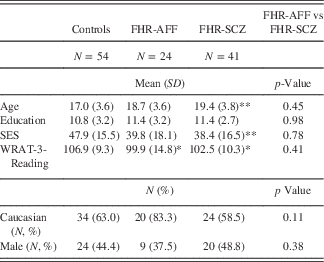
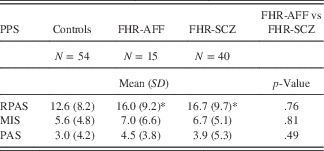
Means and standard deviations for continuous demographic variables (age, education, SES, and WRAT-R reading) and Ns and percentages for sex and ethnicity were calculated for controls, FHR-AFF, and FHR-SCZ groups and are reported in Table 1. Means and standard deviations were also calculated for subscales of the Psychosis Proneness Scales (PPS) and are reported in Table 2, and for four SCL-90-R subscales (Obsessive-Compulsive, Phobic Anxiety, Psychoticism, Depression); statistical comparisons between groups on demographic variables and the PPS were conducted using the PROC MIXED procedure in SAS. For tests of the neurocognitive hypotheses, the dependent measure was hit rate. Because there were age differences between the groups, we adjusted for age in all ACPT analyses as in Seidman et al. (Reference Seidman, Meyer, Giuliano, Breiter, Goldstein, Kremen and Faraone2012).
Demographics of youth at familial risk for schizophrenia or affective psychoses and community controls

Note. All p values from mixed models adjusted for intrafamilial correlation compared to controls. N for WRAT-3 reading among controls=53, FHR-SCZ=40; N for SES among FHR-AFF=19, FHR-SCZ=38.
*p<.05.
**p<.01.
***p<.001.
FHR-AFF=familial high-risk for affective psychosis; FHR-SCZ=familial high-risk for schizophrenia;
Psychosis Proneness Scales (PPS) of youth at familial risk for schizophrenia or affective psychoses and community controls

Note. All p values from mixed models adjusted for intrafamilial correlation.
*p<.05.
**p<.01.
***p<.001.
FHR-AFF=high risk for affective psychosis; FHR-SCZ: high risk for schizophrenia; RPAS: Revised Physical Anhedonia Scale; MIS: Magical Ideation Scale; PAS: Perceptual Aberration Scale; N for FHR-SCZ on the PAS=39.
To determine if putative working memory deficits were accounted by impairments in vigilance, psychosis proneness, or current psychopathology, we adjusted for age and vigilance performance; age and psychosis proneness (as measured by the physical anhedonia scale of the PPS); and age, vigilance, physical anhedonia, and each of the four psychopathology scales. To determine if the cognitive deficit remained after statistical control for a measure of general cognitive ability, we chose the WRAT Reading test, a commonly used estimate of potential IQ (Kremen et al., Reference Kremen, Seidman, Faraone, Pepple, Lyons and Tsuang1995). Adjusted least squares means and associated standard errors of the hit rates are presented by study group. We adjusted for intrafamilial correlation in all analyses.
RESULTS
Demographic Characteristics
FHR-SCZ subjects were significantly older and had a lower SES in comparison with controls. The WRAT-3 Reading score of the FHR-AFF and FHR-SCZ were significantly lower than that of the controls. The FHR-SCZ group had a non-significant trend to a larger proportion of non-white participants than FHR-AFF group. There were no other significant differences in education, ethnicity, or sex.
Psychosis Proneness
Comparisons among the three groups were significant for physical anhedonia (Table 2). FHR-SCZ and FHR-AFF had significantly more physical anhedonia than controls. As in prior comparisons between controls and FHR-SCZ, there were no significant differences on PAS or MIS for the FHR-AFF group.
There were no significant correlations between ACPT performance and MIS or PAS (all rs<.07). However, physical anhedonia was significantly correlated with vigilance (r=−.277; p<.004), working memory (r=−.211; p<.028), and working memory + interference (r=−.201; p<.037).
Psychopathology
As noted in Scala et al. (Reference Scala, Pousada, Stone, Thermenos, Manschreck, Tsuang and Seidman2013), three SCL-90-R dimensions were significantly worse in the high-risk groups than in controls, Obsessive-Compulsive (FHR-AFF>controls), Phobic Anxiety (FHR-AFF>controls), and Psychoticism (FHR-SZ>controls), and none of the clinical scales distinguished the two high-risk groups from each other. There were no significant differences between high-risk groups and controls or between high-risk groups on the Depression scale.
ACPT Performance
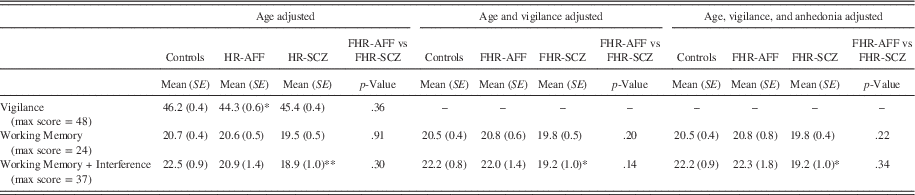
For vigilance, the FHR-AFF group was significantly worse than controls but not than FHR-SCZ when controlling for age (see Table 3). The significant differences were eliminated when controlling for physical anhedonia and when controlling for any of the four psychopathology scales. The FHR-SCZ group was not different than controls on vigilance (see Figures 1, 2, and 3).
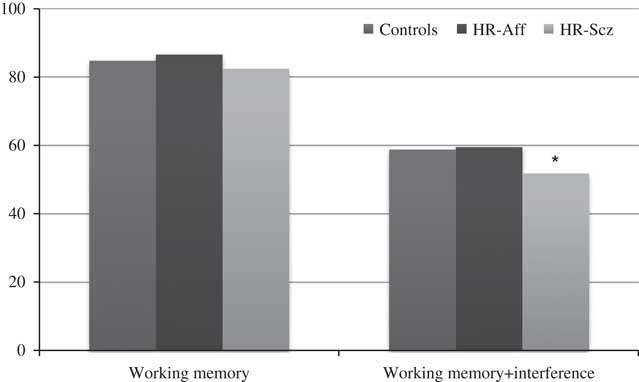
For working memory without interference (“Q3A-MEM”), there were subtle performance decrements in both FHR groups compared to controls but none were significant. For working memory + interference (“Q3A-INT”), the FHR-SCZ group was significantly impaired compared to controls and this effect remained significant after adjusting for vigilance and physical anhedonia. We adjusted each symptom individually (Obsessive-Compulsive, Phobic Anxiety, Psychoticism, Depression) with age and also simultaneously with age, vigilance, and anhedonia. In all eight of these models, Q3A-INT remained statistically significant (p<.05) for the FHR-SCZ versus control comparison.
To determine if the working memory deficit remained after statistical control for a measure of general cognitive ability, we added WRAT Reading to the regression analyses. In the analysis with age and WRAT Reading, the working memory effect became a marginal trend (p=.053) and with the more stringent correction with age, vigilance, anhedonia, and WRAT Reading, the effect was p=.065.
DISCUSSION
Because attention and working memory have been proposed as potential endophenotypes for each of the major psychoses, we evaluated auditory vigilance and two levels of auditory working memory in samples of young people at FHR-AFF, FHR-SCZ, and controls. Compared to controls, the FHR-AFF sample was significantly more impaired in auditory vigilance, while the FHR-SCZ sample was significantly worse in the high load working memory task with interference. The FHR-SCZ and FHR-AFF samples showed significantly higher levels of physical anhedonia than the control group. Statistically adjusting for physical anhedonia eliminated the FHR-AFF vigilance effects but not the working memory deficits in FHR-SCZ. The FHR-SCZ working memory deficits were not explained by auditory vigilance. Moreover, the working memory impairments stayed robust after statistical adjustment using symptom dimensions of current psychopathology that were elevated in the high-risk groups. Thus, the high load working memory deficit in FHR-SCZ was a robust neurocognitive deficit and not explained by vigilance, current psychopathology or negative schizotypal traits (i.e., anhedonia).
Our results are largely consistent with trends in the literature found in the few other direct comparisons in FHR studies of young people at familial risk for psychosis. Notably, Diwadkar et al. (Reference Diwadkar, Goradia, Hosanagar, Mermon, Montrose, Birmaher and Keshavan2011) showed a very similar pattern in a somewhat younger (mean age 15) group of FHR children on two visual tasks: working memory was assessed using a delayed spatial memory paradigm with two levels of delay (2 s and 12 s), which was impaired in FHR-SCZ, whereas sustained attention processing was assessed using the shapes version of the visual CPT-IP, which was impaired in FHR-Bipolar (BP) participants. Also important was the fact that the visual working memory deficit was observed only at the longer delay period (12 s) after interference was interposed during the delay period, and only on the interference version of the auditory working memory task in our study. We cannot be certain whether the observed effect is simply due to the added difficulty of the longer delay/interference conditions or whether it is specific to the vulnerability of interference, an effect proposed originally by Spring (Reference Spring1985). One must use tasks matched for degree of difficulty to clarify this effect (Chapman & Chapman, Reference Chapman and Chapman1978) and neither study did so.
The working memory deficit first observed in relatives of people with schizophrenia in a spatial working memory deficit paradigm (Park, Holzman, & Goldman-Rakic, Reference Park, Holzman and Goldman-Rakic1995), received support as a true cognitive deficit in FHR-SCZ, as it remained significant after adjusting for the simpler vigilance task within the same paradigm and for physical anhedonia, and current psychopathology. It is notable that the results in our study are consistent with Erlenmeyer-Kimling et al. (Reference Erlenmeyer-Kimling, Cornblatt, Rock, Roberts, Bell and West1993). In their study, the New York High-Risk Project, they found that, in children at risk for psychosis, attentional dysfunction was related to anhedonia. Also important is that these studies demonstrated that both visual and auditory working memory are affected in FHR-SCZ, hypothesized to be a defect in the central executive (Baddeley & Hitch, Reference Baddeley and Hitch1974), and associated with prefrontal cortical dysfunction (Goldman-Rakic, Reference Goldman-Rakic1991).
The auditory CPT + interference task clearly activates prefrontal cortex in healthy volunteers (Huang et al., Reference Huang, Seidman, Rossi and Ahveninen2013; Seidman et al., Reference Seidman, Breiter, Goodman, Goldstein, Woodruff, O’Craven and Rosen1998) and has been shown to be associated with increased prefrontal activation (Thermenos et al., Reference Thermenos, Seidman, Breiter, Goldstein, Goodman, Poldrack and Tsuang2004) and increased thalamic activation (projecting to prefrontal cortex) in two independent samples of adult relatives of individuals with schizophrenia, compared to healthy volunteers (Seidman et al., Reference Seidman, Thermenos, Koch, Ward, Breiter, Goldstein and Tsuang2007). Our results are consistent with the conclusions derived from an extensive literature review carried out by Park and Gooding (Reference Park and Gooding2014), indicating that working memory is an endophenotype for schizophrenia, and in a meta-analysis of functional imaging studies showing that working memory tasks yield abnormal patterns of activation suggesting a dysfunctional prefrontal cortex in FHR-SCZ (Zhang, Picchioni, Allen, & Toulpoulou, Reference Zhang, Picchioni, Allen and Toulopoulou2016).
A related question is whether our results, or results in the literature, support a “differential deficit” (vigilance impairment in FHR-AFF, working memory impairment in FHR-SCZ) or a continuum of liability observed in many studies comparing schizophrenia and affective psychosis patient samples (Hill et al., Reference Hill, Reilly, Keefe, Gold, Bishop, Gershon and Sweeney2013; Keshavan et al., 2011). While tempting to consider that this study and the study by Diwadkar et al. (Reference Diwadkar, Goradia, Hosanagar, Mermon, Montrose, Birmaher and Keshavan2011) provide support for a differential deficit, neither study used matched tasks on degree of difficulty and the samples were relatively small.
Furthermore, the vigilance impairment in FHR-AFF observed here was not robust when adjusting for physical anhedonia or for all four of the current psychopathology measures, suggesting vigilance deficits in FHR-AFF may be influenced by psychiatric symptoms. Moreover, the small sample size of HR-AFF leaves the subtle findings vulnerable to loss of power with statistical adjustment. Nevertheless, the results do not rule out the hypothesis of differential cognitive deficits, which could be pursued with larger samples and matched tasks. On the other hand, these results certainly support the idea that both groups of relatives are impaired on some attention and working memory functions, and that the FHR-SCZ group has the more robust cognitive (e.g., working memory) deficit, at least with respect to these tasks.
Other studies of relatives, with other tasks, shed some light on the “specificity” versus “severity” of neurocognitive deficits. Performance on the Grammatical Reasoning Test, a declarative memory task measuring speed and accuracy when evaluating logical statements, was worse for the FHR-SCZ group when compared to the FHR-AFF and healthy control group, both in percent correct hits/rejections (Schubert & McNeil, Reference Schubert and McNeil2005) and percent errors (Schubert & McNeil, Reference Schubert and McNeil2007). Similar results were found on measurements of verbal and linguistic abilities, specifically on the Word-Pair Test, where the FHR-SCZ group performed worse than the FHR-AFF group in immediate recall and 1-hr delayed recall (Schubert & McNeil, Reference Schubert and McNeil2005, Reference Schubert and McNeil2007). However, in a study of verbal and visual memory using the identical sample as reported here, Scala et al. (Reference Scala, Pousada, Stone, Thermenos, Manschreck, Tsuang and Seidman2013) reported no significant differences in verbal or spatial memory performance between the two groups of relatives. In Eastern Quebec Multigenerational Families, Maziade et al. (Reference Maziade, Rouleau, Gingras, Boutin, Paradis, Jomphe and Roy2009) found that both relatives of schizophrenia and bipolar probands shared cognitive impairments in memory and executive functions. Taken together, the aforementioned results suggest that a continuum of liability model fits best (Keshavan et al., Reference Keshavan, Morris, Sweeney, Pearlson, Thaker, Seidman and Tamminga2011), and that perhaps the most distinctive deficits to date are those in working memory and processing speed in FHR-SCZ.
One final issue is whether general cognitive ability affected the findings. This is raised in part because there was a small, but significant impairment in the WRAT Reading score in both HR-SCZ and HR-AFF groups, which like other single word reading tests is a commonly used index of premorbid or potential intellectual ability. Moreover, after we statistically adjusted for WRAT Reading, the significant difference for FHR-SCZ shifted marginally to a trend level (p=.053), suggesting that indeed, these cognitive measures are related.
There are many conceptual issues involved in whether to control for general cognitive ability when evaluating other, presumably more specific cognitive functions, and this has been addressed extensively in the literature (Dennis et al., Reference Dennis, Francis, Cirino, Schachar, Barnes and Fletcher2009; Kremen et al., Reference Kremen, Seidman, Faraone, Pepple, Lyons and Tsuang1995; Meehl, Reference Meehl1970; Snitz et al., Reference Snitz, Macdonald and Carter2006). By and large, many researchers consider this “mismatching” (Meehl, Reference Meehl1970; Snitz et al., Reference Snitz, Macdonald and Carter2006) because groups may be “overmatched” on a related variable that is not independent of the illness. Kremen et al. (Reference Kremen, Seidman, Faraone, Pepple, Lyons and Tsuang1995) have argued that, if schizophrenia is a neurodevelopmental disorder (and hence the relatives suffer from some of the same aspects of neurodevelopmental dysmaturation), then matching relatives and controls on an IQ estimate may cause mismatching of theoretically expected cognitive ability.
This argument has also been favored in developmental neuropsychology. For example, Dennis et al. (Reference Dennis, Francis, Cirino, Schachar, Barnes and Fletcher2009) say “we propose that it is misguided and generally unjustified to attempt to control for IQ differences by matching procedures or, more commonly, by using IQ scores as covariates.” They go on to provide several examples from three neurodevelopmental disorders that matching for IQ “over-corrects.” In this study, the working memory deficit is clearly not explained by psychiatric traits or current symptoms, and recent neuroimaging research supports the idea that working memory is indeed a fundamental deficit in the familial risk for schizophrenia (Park & Gooding, Reference Park and Gooding2014; Zhang et al., Reference Zhang, Picchioni, Allen and Toulopoulou2016). The impact of statistically adjusting for an estimate of general cognitive ability is complex and does not negate the working memory findings.
LIMITATIONS OF THE STUDY
The main limitation of this study is the relatively modest power to detect differences in individual diagnostic groups, particularly in the FHR-AFF group, which is smaller than the other groups. An additional limitation concerns the diagnostic heterogeneity of the FHR-AFF sample, which comprises individuals at high risk for bipolar psychotic disorder (n=18) and for major depressive disorder (n=6). We chose to combine these groups, considering them as different expressions of the same vulnerability, based on literature indicating a positive history of affective illness was associated with BP disorder and vice-versa (Bearden et al., Reference Bearden, Glahn, Monkul, Barrett, Najt, Villarreal and Soares2006).
Nevertheless, we cannot be certain that they have identical cognitive risk profiles, and moreover, the small number of subjects at risk for major depressive disorder limits evaluating this issue in the current study. Finally, it is possible that the findings might have been different if we had sorted the relatives from families with schizoaffective disorder, depressed type, with the HR-AFF group instead of with the schizophrenia group. However, studies that have looked at all of these subgroups in patient samples observe that the “schizoaffective” groups share more similarity in phenotypes with schizophrenia, than with affective psychoses (Keshavan et al., Reference Keshavan, Morris, Sweeney, Pearlson, Thaker, Seidman and Tamminga2011), even though there is considerable genetic overlap between bipolar disorder and schizophrenia, roughly 15% (Cross-Disorder Group of the Psychiatric GWAS Consortium, 2013). It is yet to be determined if schizophrenia related disorders suffer from additional risk genes affecting cognition or whether these results are consistent with the hypothesis of Murray et al. (Reference Murray, Sham, van Os, Zanelli, Cannon and McDonald2004) that other environmental impacts on brain are more impairing in the developmental risk for schizophrenia than in affective psychosis.
Our results are relevant to adolescent and young offspring and siblings of probands with adult onset psychotic disorder, but they may not generalize to all relatives. For example, Doyle et al. (Reference Doyle, Wozniak, Wilens, Henin, Seidman, Petty and Biederman2009) showed more significant impairments, including on the auditory CPT battery used here, in a pediatric sample, in siblings of early onset bipolar disorder. In their meta-analysis, Bora et al. (Reference Bora, Yücel and Pantelis2009) showed that results were weaker with older age in relatives of people with bipolar disorder. This illustrates the likelihood that there are nested subgroups of especially impaired or less impaired subjects in these studies (Burdick et al., Reference Burdick, Russo, Frangou, Mahon, Braga, Shanahan and Malhotra2014; Kremen, Seidman, Faraone, Toomey, & Tsuang, Reference Kremen, Seidman, Faraone, Toomey and Tsuang2000, Reference Kremen, Seidman, Faraone, Toomey and Tsuang2004). Finally, while our assessment battery was quite extensive, it would have been useful to have also assessed social anhedonia, which is emerging as an important risk factor for schizophrenia (Gooding, Matts, & Rollmann, Reference Gooding, Matts and Rollmann2006). However, this was not known at the time this study began in 1997.
CONCLUSIONS AND FUTURE DIRECTIONS
In one of the few well-controlled studies directly comparing youth at familial risk for either schizophrenia or affective psychosis, our findings largely supported our hypotheses. Vigilance dysfunction was more associated with FHR-AFF, whereas working memory impairment was more associated with FHR-SCZ. The auditory CPT battery was sensitive to different impairments in the two groups and, thus, shows promise as a vulnerability indicator. The working memory deficit was the more robust of the two findings when associated psychopathological features were statistically controlled. Examination of larger samples of people at familial risk for different psychoses is necessary to confirm these findings.
Another future direction is using neuropsychological tasks to help with prediction of functional outcome or transition from a “clinical high risk” (also called “ultra high risk” or “at-risk mental state”) or prodromal stage based on attenuated positive psychotic symptoms, to a full psychotic disorder (Fusar-Poli et al., Reference Fusar-Poli, Deste, Smieskova, Barlati, Yung, Howes and Borgwardt2012; Giuliano et al., Reference Giuliano, Li, Mesholam-Gately, Sorenson, Woodberry and Seidman2012). Thus far, the data suggest that the neuropsychological impairments in the clinical high-risk stage are more severe in those who eventually transition to psychotic disorder than those who do not, and substantially more impaired than healthy controls (Seidman et al., Reference Seidman, Giuliano, Meyer, Addington, Cadenhead, Cannon and Cornblatt2010). Given the largest effect size impairments (Cohen’s d=~.80), it is unlikely that neuropsychological tasks will be able to be used alone for prediction of psychosis in those at clinical high risk (Giuliano et al., Reference Giuliano, Li, Mesholam-Gately, Sorenson, Woodberry and Seidman2012).
However, using them in combination with other clinical and psychobiological measures may enhance prediction of psychosis or functional outcome. For example, some investigators have found that verbal declarative memory and processing speed tasks added modest but significant independent predictive power above the clinical, symptomatic measures in several studies (Keefe et al., Reference Keefe, Perkins, Gu, Zipursky, Christensen and Lieberman2006; Michel, Ruhrmann, Schimmelmann, Klosterkotter, & Schulze-Lutter, Reference Michel, Ruhrmann, Schimmelmann, Klosterkotter and Schulze-Lutter2014; Riecher-Rossler et al., Reference Riecher-Rossler, Pflueger, Aston, Borgwardt, Brewer, Gschwandtner and Stieglitz2009). Future studies could test whether the auditory CPT measures used in this FHR study may be helpful in predicting psychotic disorders such as schizophrenia.
Percent of correct scores on the Auditory Continuous Performance Test in the three groups controlling for intrafamilial correlation, age, and vigilance.

Percent of correct scores on the Auditory Continuous Performance Test in the three groups adjusted for intrafamilial correlation, age, vigilance, and physical anhedonia.

Auditory Continuous Performance Test (CPT) performance of youth at familial risk for schizophrenia or affective psychoses and community controls

Note. All p values from mixed models adjusted for intrafamilial correlation.
*p<.05.
**p<.01.
***p<.001.
FHR-SCZ=familial high-risk for schizophrenia; FHR-AFF: familial high-risk for affective psychosis.
ACKNOWLEDGMENTS
Stanley Medical Research Institute (L.J.S.); National Association for Research on Schizophrenia and Depression (NARSAD; L.J.S., M.T.T.); MH 43518 (M.T.T., L.J.S.); The Commonwealth Research Center of the Massachusetts Department of Mental Health, SCDMH82101008006 (L.J.S.); Real Colegio Complutense at Harvard University (AP); CooperInt Program – 2010 edition- University of Verona (S.S.). We thank the patients with schizophrenia or affective psychosis and their family members, control families, and project staff for their generous contributions to the study. Staff included Mimi Braude, Joanne Donatelli, Lisa Gabel, Anthony J. Giuliano, Stephen Glatt, Jennifer Koch, Marc Korczykowski, Erica Lee, Virna Merino, Elon Mesholam, Raquelle Mesholam-Gately, Caroline Patterson, Nicole Peace, Maryan Picard, Keri Teknos, Lynda Tucker, and Sharon White. Conflicts of Interest: None