


The influence of family has long been a defining feature of the political science literature when it comes to explaining how children grow up to view the political world (Beck and Jennings Reference Beck and Jennings1991; Greenstein Reference Greenstein1965; Jennings and Niemi Reference Jennings and Niemi1968; Reference Jennings and Niemi1981; Jennings, Stoker, and Bowers Reference Jennings, Stoker and Bowers2009; Niemi and Jennings Reference Niemi and Jennings1991). Explanations explicitly focused on political participation have also examined the role of family during adolescence. Research detailing the effects of family on political participation has largely fallen under the auspices of resource-based theories. The core claim of the resource-based theory literature is that parental determinates, such as a parent’s level of education and income, place children in an environment where they can learn the skills necessary to overcome the costs associated with political involvement (Hess and Torney Reference Hess and Torney1967; Nie, Junn, and Stehlik-Barry Reference Nie, Junn and Stehlik-Barry1996; Plutzer Reference Plutzer2002; Schlozman, Verba, and Brady Reference Schlozman, Verba and Brady2012; Verba, Burns, and Schlozman Reference Verba, Burns and Schlozman2003; Verba, Schlozman, and Brady Reference Verba, Schlozman and Brady1995).
Notwithstanding the resource-based model’s dominant role in the literature, scholars have pointed to its limitations in explaining political participation in the U.S. in a variety of contexts. Specifically, resource-based theories have struggled to rationalize the paradox between low voter turnout numbers and increased income and education levels (Brody Reference Brody and King1978; Teixeira Reference Teixeira1992). Relatedly, even with increased access to education and a push by policy makers to increase the amount of civic education, youth participation among both the well-resourced and those lacking access to resources continues to lag significantly behind that of older Americans (Holbein and Hillygus Reference Holbein and Hillygus2020; Niemi and Junn Reference Niemi and Junn2005; Rouse and Ross Reference Rouse and Ross2018). Access to resources is also not always enough to overcome the unexpected disruptions of parenthood, unemployment, divorce or even geographic constraints when it comes to participation (Gimpel and Schuknecht Reference Gimpel and Schuknecht2003; Ojeda, Michener, and Haselswerdt Reference Ojeda, Michener and Haselswerdt2020; Pacheco and Plutzer Reference Pacheco and Plutzer2007). However, one of the major limitations of the resource-based literature is its inability to explain how racial, class, and gender differences do not always comport with resource-based models (Barreto Reference Barreto2007; Bedolla Reference Bedolla2005; Brown Reference Brown2014; Cho, Gimpel, and Dyck Reference Cho, Gimpel and Dyck2006; Dawson Reference Dawson2001; Holman Reference Holman, Brown and Gershon2016; Junn Reference Junn1999; Leighley and Vedlitz Reference Leighley and Vedlitz1999; Masuoka, Ramanathan, and Junn Reference Masuoka, Ramanathan and Junn2019; Wong et al. Reference Wong, Ramakrishnan, Lee, Junn and Wong2011).
Yet, even with the increased attention given to the resource-based model’s limitations, there is a dearth of research regarding the political outcomes of children who lack access to parental resources considered essential for participation because of ethnic and class differences. This is particularly true when it comes to examining the effects of economic inequalities among Latinx children in immigrant households. Research often converges on adults while ignoring the position of children, despite the fact that resource-based models focus on the outcomes of economic inequalities that cover both parents and children. Therefore, we must investigate whether the children of Latinx immigrants who often lack access to parental resources are doomed to be relegated to a life of political inequality. Specifically, are there other factors that challenge our understanding of the role that social class and immigration status play on participation?
I offer an alternative explanation of how the children of Latinx immigrants develop the noncognitive skills that enable them to overcome the lack of resources deemed vital for political participation. I posit that the children of Latinx immigrants develop the noncognitive skills associated with higher rates of participation when they are tasked with taking on “adult” responsibilities on behalf of their households. I define adult responsibilities as the types of support children provide their households when they perform work, not characteristically linked to children in the United States. Children of immigrants often take on adult roles because either or both of their parents work long hours outside the home, or their parents’ immigrant status, especially as it relates to language deficiencies, requires these children to help their parents.
Claims about the role noncognitive skills play in facilitating political participation have received increasing attention. Noncognitive skills describe the abilities and attitudes often developed during adolescence that allow individuals to navigate life’s challenges more successfully (Bandura Reference Bandura and Ramachaudran1994; Heckman and Kautz Reference Heckman and Kautz2013). Noncognitive skills like general self-efficacy (Condon and Holleque Reference Condon and Holleque2013), even-temperedness, hard work (Denny and Doyle Reference Denny and Doyle2008), patience (Fowler and Kam Reference Fowler and Kam2006), altruism (Fowler and Kam Reference Fowler and Kam2007), and follow-through (Holbein and Hillygus Reference Holbein and Hillygus2020) are all positively associated with voter turnout.
However, beyond targeted interventions (Holbein Reference Holbein2017; Holbein and Hillygus Reference Holbein and Hillygus2020), little has been said about the type of environment that leads to the development of these noncognitive skills during childhood. Of those studies that have examined what contributes to increased participation during adolescence, outside of parental resources or specially designed curriculum, consideration has been given to salient political environments. Salient political environments, such as those connected to the issue of civil rights, concerns over policing, or debates around immigration, have been shown to be catalysts for increased youth participation (Bloemraad and Trost Reference Bloemraad and Trost2008; Cohen Reference Cohen2010; Sears and Valentino Reference Sears and Valentino1997; Street, Jones-Correa, and Zepeda-Millán Reference Zepeda-Millán2017; Verba, Schlozman, and Burns Reference Verba, Schlozman, Burns and Zuckerman2005).Footnote 1
Building on the scholarship concerning the development of noncognitive skills and environment, I hypothesize that mundane experiences that require the children of Latinx immigrants to take on adult responsibilities on behalf of their households equip these children with the noncognitive skills that assist in lowering the costs associated with political participation. I label these experiences mundane, not because they are superfluous or unworthy of study. Instead, I label them mundane because while these experiences are undoubtedly a testament to the type of contributions these children make to their households, they are also commonplace for many children in the U.S., particularly for those in Latinx immigrant homes (Orellana Reference Orellana2003).
Children of Latinx Immigrants
I test this hypothesis using two original cross-sectional surveys and a 10-year longitudinal study. The first survey examined is a survey of Latinx college students conducted in March of 2016. The second survey, the GenForward Survey, is a representative survey of adults between the ages of 18 to 30 conducted after the 2016 election. Both surveys include questions concerning a respondent’s parents’ place of birth and questions about translation and interpretation responsibilities they may have performed for their parents during childhood. The inclusion of the responsibility measure in both surveys provides the ability to test the claim that taking on adult responsibilities during childhood equips the children of Latinx immigrants with the noncognitive skills needed to participate politically. The inclusion of the longitudinal study, the Educational Longitudinal Study of 2002 (ELS; Institute of Education Sciences 2002), offers strong support for the overall theory, as it relates to the effect of household responsibilities on participation and the likelihood of a causal relationship between the assignment of household responsibilities during adolescence and political participation in adulthood.
The children of Latinx immigrants, often referred to as second-generation Latinxs, make for a strong test case when evaluating the effect of adult responsibilities for a multitude of reasons. However, before expanding on the appropriateness of focusing on second-generation Latinxs, some clarity on generational status is necessary. The second generation consists of native-born individuals whose parents were both born outside the U.S. and its territories (Rumbaut Reference Rumbaut2004). In other words, the second generation refers to the children of immigrants, and the first generation comprises the immigrants themselves. Those persons born with at least one U.S.-born parent belong to the third generation or higher. The distinction is important because generational status plays a significant role in the way people experience the political world (e.g., Abrajano and Alvarez Reference Abrajano and Alvarez2010; Alvarez and Bedolla Reference Alvarez and Bedolla2003; Cain, Kiewiet, and Uhlaner Reference Cain, Kiewiet and Uhlaner1991; Carlos Reference Carlos2018; Hajnal and Lee Reference Hajnal and Lee2011).
Second-generation Latinxs make a strong test case for examining the effects of adult responsibilities on participation because the second generation is less likely to have access to the parental resources considered essential for participation by resource-based theories (Brown and Bean Reference Brown and Bean2016; Fraga Reference Fraga2018; Fraga et al. Reference Fraga, Garcia, Hero, Jones-Correa, Martinez-Ebers and Segura2011; Hajnal and Lee Reference Hajnal and Lee2011; Sears, Danbold, and Zavala Reference Sears, Danbold and Zavala2016; Wong Reference Wong2000). Research also shows that immigrants with limited English proficiency struggle with social and political integration, in addition to earning less on average than do other immigrants (Andersen Reference Andersen2010; Bleakley and Chin Reference Bleakley and Chin2004; Reference Bleakley and Chin2010; Cain, Kiewiet, and Uhlaner Reference Cain, Kiewiet and Uhlaner1991; Rosenstone and Hansen Reference Rosenstone and Hansen1993). Furthermore, limited English proficiency among immigrants negatively affects their children’s educational attainment (Bleakley and Chin Reference Bleakley and Chin2008). The limitations around language are amplified in the Latinx community, where only an estimated 34% of Latinx immigrants speak English proficiently (Krogstad, Lopez, and Rohal Reference Krogstad, Lopez and Rohal2015). Taken together, we should not expect the children of Latinx immigrants to have readily available access to the resources seen as necessary to overcome the high costs associated with political participation.
Additionally, second-generation Latinxs make for an excellent test case because research has demonstrated that the children of immigrants provide household support to their parents during adolescence by taking on responsibilities that are not typically associated with children living in the U.S. (Katz Reference Katz2014; Orellana Reference Orellana2001; Reference Orellana2003; Orellana, Dorner, and Pulido Reference Orellana, Dorner and Pulido2003; Park Reference Park2001; Reference Park2005; Valenzuela Reference Valenzuela1999).Footnote 2 This line of research runs counter to claims about the role Americans envision for their children. Sociologist Viviana Zelizer contends that a shift in the American zeitgeist occurred surrounding the treatment of children in the twentieth century, where the expectation became that “properly loved children, regardless of social class, belonged in domesticated, nonproductive world lessons, games, and token money” (Zelizer Reference Zelizer1994, 11). However, the view that children should be sheltered from the responsibilities of adulthood and avoid making critical household contributions is not equally held among everyone in the U.S., particularly among parents with varying economic and social needs such as those in immigrant communities.
Roadmap
In what follows, I demonstrate that the children of Latinx immigrants tasked with adult responsibilities during adolescence, in this case, “language-brokering” responsibilities, are significantly more likely to participate in politics despite lacking the traditional resources said to play a role in political engagement. Language brokering is the act of having a child mediate communication through translation or interpretation for their immigrant families in public and private exchanges (McQuillan and Tse Reference McQuillan and Tse1995; Tse Reference Tse1995). Specifically, I reveal that those who language broker exhibit higher levels of political activity than those who do not.
Additionally, I demonstrate that those who take on adult responsibilities have a greater sense of political utility. The analysis reveals that the children of Latinx immigrants who language broker on behalf of their families are also more likely to introduce politics into their household. In other words, language brokers are also likely to act as what I label “political brokers.”Footnote 3 Finally, I will analyze the ELS to highlight the likelihood of a causal relationship between household responsibilities and participation by demonstrating that the assignment of frequent household chores during an individual’s youth is predictive of their political participation.
The Importance of Environment in Overcoming the Resource Gap
Based on the prior scholarship, the picture is bleak when it comes to the prospects of adolescents whose parents lack the resources considered essential in overcoming the resource gap. This concern rings particularly true when it comes to second-generation Latinxs. The children of Latinx immigrants are significantly more likely to live below the poverty line, have lower household incomes, and deal with concerns about food and housing insecurities, and they also have higher dropout rates than children of U.S.-born parents (Capps, Fix, and Reardon-Anderson Reference Capps, Fix and Reardon-Anderson2003; Woods and Hanson Reference Woods and Hanson2016).
Resource-based theories also do not paint a particularly bright picture of the overall health of American democracy. The children of immigrants from all ethnic backgrounds are not only more likely to have parents that lack access to resources associated with political participation; they are also the fastest-growing demographic in the United States. The second generation is projected to make up 20% of the U.S. population by 2050 (Taylor et al. Reference Taylor, Cohn, Livingston, Funk and Morin2013). The notion that we could have an exploding population of denizens not opting into the political process is not far-fetched. These projections say nothing about those children who lack these resources because of other structural inequalities directly related to race and class (e.g., Cohen Reference Cohen2010).
However, what often gets overlooked in discussions about the children of Latinx immigrants and their lack of political incorporation is that young people in the United States, regardless of their parents’ resource availability, citizenship status or their own educational attainment, still participate at lower rates than do older Americans (Holbein and Hillygus Reference Holbein and Hillygus2020; Rouse and Ross Reference Rouse and Ross2018). It appears that many of the narratives about the unwillingness or inability of immigrants and their offspring to incorporate into the political process (e.g., Huntington Reference Huntington and Torr2005) lack an understanding on how the incorporation process plays out for many in immigrant households. Therefore, it is worth exploring whether the children of Latinx immigrants who grow up with limited resources are destined to exhibit low levels of political participation or whether they can be activated to participate through other means.
I add to the scholarship in answering this question by expanding on the role of environment found in the work of Verba, Schlozman, and Burns (Reference Verba, Schlozman, Burns and Zuckerman2005) and Street, Jones-Correa, and Zepeda-Millán (Reference Street, Jones-Correa and Zepeda-Millán2017). These scholars demonstrate that we can make sense of what appears to be uncharacteristic political behavior, in this case high levels of political activity among populations expected to have low levels of engagement, by looking to the environment these populations interact with daily. By contextualizing the situation, we can better understand how the cycle of political inequality can be broken even when social class and immigration status dictate that this should not be the case according to resource-based theories of participation.Footnote 4
Verba, Schlozman, and Burns (Reference Verba, Schlozman, Burns and Zuckerman2005) show that despite expectations grounded in the resource-based literature, young African Americans during the Civil Rights era outpaced their white and Latinx cohorts in political engagement by significant margins. The authors contend that salient political stimulation through Civil-Rights-era politics functioned to overcome the lack of resources. By understanding the everyday realities African Americans directly confronted when dealing with state-sanctioned policies of white supremacy, we are better equipped to explain the increase in their political activity that the resource-based literature could not rationalize.
Street, Jones-Correa, and Zepeda-Millán (Reference Zepeda-Millán2017) similarly argue that the everyday political realities of immigration enforcement policies mobilized the children of the undocumented. Using theories of social activism and political threat, they argue that the U.S.-born children of undocumented parents are motivated to use the rights attached to their citizenship to protest on behalf of their parents. They find that children of the undocumented were more likely to protest immigration issues, and they were more likely to believe they could influence the political climate despite being poorer and less educated.
A Hypothesis of Childhood Responsibilities
I build on the research surrounding the role of environment, which up until now has connected higher than expected levels of political engagement to salient high threat environments. I argue that the environment in households where the children of Latinx immigrants are assigned adult responsibilities provides a space for them to acquire the skills needed to overcome the costs associated with political action. Specifically, I posit that the children of Latinx immigrants who are assigned adult responsibilities are significantly more likely to be politically engaged than those children who are not, ceteris paribus.
Due to either social class, immigrant status, or both, the type of support the children of Latinx immigrants often provide can include working long hours to help run a family-owned business; acting as de facto full-time babysitters to younger siblings; or laboring alongside their parents as street vendors, overnight office cleaners, construction workers, farmworkers, or landscapers. However, one of the primary forms of support second-generation Latinxs provide their parents is language brokering (Katz Reference Katz2014; McQuillan and Tse Reference McQuillan and Tse1995; Morales and Hanson Reference Morales and Hanson2005; Tse Reference Tse1995; Valenzuela Reference Valenzuela1999). I use language brokering as a measure of adult responsibility to examine those who reported language brokering growing up and compare them with those who did not.
Language Brokering and Noncognitive Skills
The second generation frequently takes on household tasks that require them to act with a level of agency and autonomy that is not typically associated with children (Katz Reference Katz2014; McQuillan and Tse Reference McQuillan and Tse1995; Morales and Hanson Reference Morales and Hanson2005; Tse Reference Tse1995; Valenzuela Reference Valenzuela1999). Language brokering is one such undertaking that empowers children in ways that I argue lead them to develop the noncognitive skills considered necessary to overcoming life’s challenges. Noncognitive skills give a person the belief that they can be successful in overcoming challenges across multiple domains because they have done so in the past. According to Bandura (Reference Bandura and Ramachaudran1994; Reference Bandura1997), as individuals develop successes in domain-specific experiences in the aggregate, they foster a belief that they can be successful in domains not related to their success by relying on the skills they formed while mastering domain-specific tasks.Footnote 5
The idea that noncognitive skills translate to political activity among individuals from disadvantaged backgrounds is not new. Condon and Holleque (Reference Condon and Holleque2013) reveal that people from disadvantaged backgrounds rely on noncognitive skills when turning out to vote. The work done by Condon and Holleque is critical because it emphasizes that a person’s decision to participate is distinct and requires more examination than typical turnout models provide.
Yet, Condon and Holleque (Reference Condon and Holleque2013) offer no explicit theory as to why we should expect those from disadvantaged backgrounds to develop these noncognitive skills. Moreover, their focus is strictly on turnout, which cannot shed any light on other forms of participation. This concern is especially valid when examining immigrant communities that may be unable to vote but still participate in different ways (e.g., Barreto et al. Reference Barreto, Manzano, Ramirez and Rim2009; Hero and Campbell Reference Hero and Campbell1996; Jones-Correa and Leal Reference Jones-Correa and Leal2001; Stoll and Wong Reference Stoll and Wong2007; Wong et al. Reference Wong, Ramakrishnan, Lee, Junn and Wong2011).
I argue that language brokering imparts children with the skills that lead them to believe that they can also master the domain of political participation. Children who take on responsibilities customarily perceived to be the domain of adults are forced to think on their feet with a level of autonomy that is not usually thought to be afforded to children. When relying on their children to act as language brokers, immigrants are often forced to depend on their children to help them traverse the American landscape as competently as possible. This reliance often necessitates having children start as translators and interpreters as young as the age of seven. As these children grow older, their workload intensifies, as does the autonomy and responsibility parents give them because parents see them becoming more efficient in this role (Kuziemko Reference Kuziemko2014). From commonplace exchanges on behalf of parents such as a trip to a convenience store or supermarket to adult-centered contexts such as emergency room visits, employment issues, exchanges with banks and creditors, and legal counsel, children who act as language brokers are constantly learning the skills needed to be successful in a variety of real-world settings.
Latinx College Students, Language Brokering, and Political Engagement
To assess whether the children of Latinx immigrants who report acting as language brokers are significantly more likely to exhibit higher levels of political activity, I first turn to the survey of Latinx college students. The survey is comprised of juniors and seniors at public universities in Los Angeles, Chicago, San Antonio, and Atlanta. The survey was conducted in March of 2016 among self-identified Latino/as. Using Spanish surnames to identify Latinx respondents, 10,000 students were contacted via email and asked to take the survey online. The final number of respondents to the survey totaled 1,458.Footnote 6
While one concern may be that the survey is not a random sample of either Latinxs or college students, it nevertheless provides an opportunity to test the effects of language brokering on political activity. The advantage lies in the ability to question students about their household experiences growing up, where many of these students still live at home or are just a few years removed. Recall should be more reliable when it comes to answering questions about their interactions growing up with their parents (Klein, Graesch, and Izquierdo Reference Klein, Graesch and Izquierdo2009). Another possible concern with the college sample is that research already tells us that education has a substantial effect on political engagement (Schlozman, Verba, and Brady Reference Schlozman, Verba and Brady2012; Verba, Schlozman, and Brady Reference Verba, Schlozman and Brady1995). It then comes as no surprise that those in the survey report high levels of political activity. Even still, the sample also allows us to test the effect that language brokering has on political engagement even when compared with others in the sample who are already likely to be politically engaged.
A series of logit regression models are analyzed to determine whether language brokers engage in political activity at rates significantly higher than that of the average person in the sample. Logit regression is used because the dependent variables related to political activity are dichotomous. The dependent variables being analyzed include asking respondents whether they ever voted, attended a political rally, participated in a political meeting, or signed a petition. Additional ordered probit and logit models are also analyzed to estimate the effect language brokering has on how often respondents report talking politics with their parents, whether they ever suggested a political candidate or party to their parents, and how much they think their parents would listen if they ever did suggest a political party or candidate.
As to the primary independent variable of interest, language brokering, a scale was constructed using a series of questions related to any interpretation and translation the students reported doing on behalf of their parents. The interpretation index was created by asking which, if any, of the 12 interpretation tasks the students had performed. The translation index was composed analogously to the interpretation index.Footnote 7 Principal component analysis was used to construct the language brokering scale (Acock Reference Acock2018).Footnote 8
The college sample includes predictor variables that account for possible alternative explanations associated with political activity. The demographic covariates include the respondent’s gender, income, age, citizenship status (undocumented or not), and whether they or both of their parents are foreign-born. Controls also detail how much interest the respondent has in politics and whether either the respondent or their parents are Non-identifiers. Non-identifiers are individuals who do not report belonging to a political party (Hajnal and Lee Reference Hajnal and Lee2011). The introduction of the Non-identifiers variable accounts for the uniqueness of the political socialization process for those connected to immigrant communities, as Non-identifiers make up the plurality of those in Latinx and Asian communities (Carlos Reference Carlos2018; Hajnal and Lee Reference Hajnal and Lee2011). Finally, two variables regarding whether respondents think they can trust others and whether they believe Latinos can get ahead in the United States are included. The addition of these two variables attempt to account for the alternative explanation of “positive affect group attachment.” Positive affect group attachment is theorized to positively influence Latinos and their likelihood of participating in the political process (Bedolla Reference Bedolla2005).Footnote 9
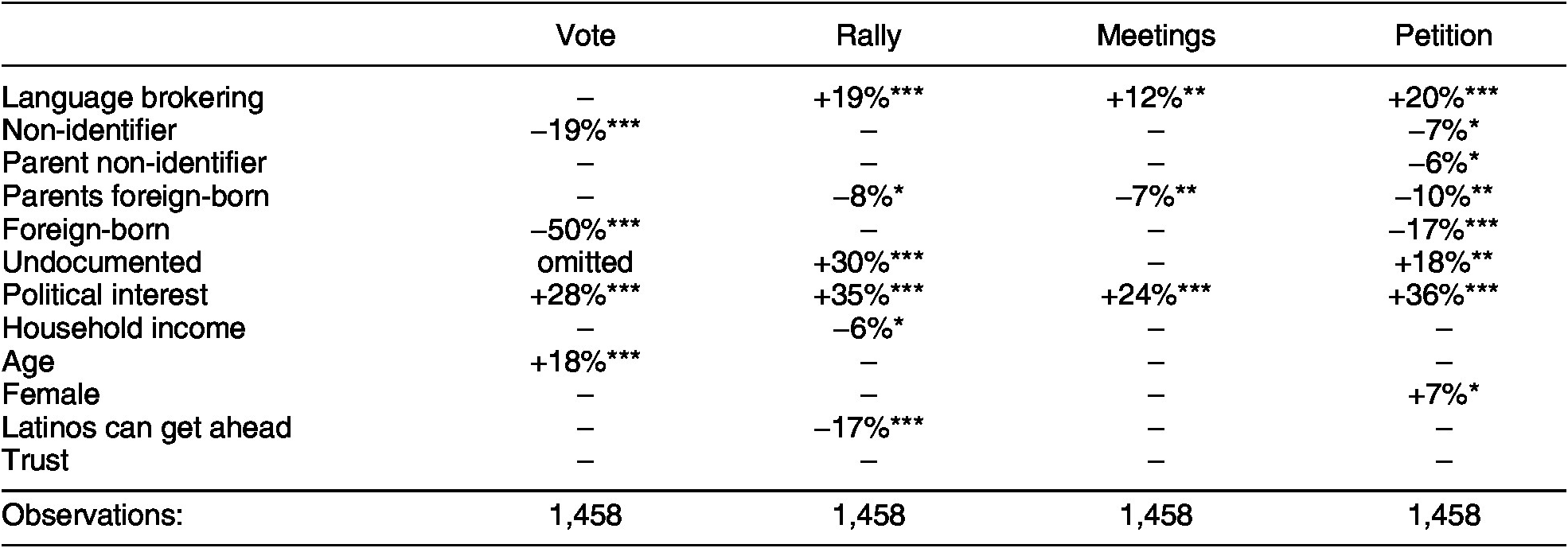
Since it is difficult to interpret what the size of each estimate translates to in a logit model, the results presented in Table 1 report the size of the effects of the covariates using first differences.Footnote 10 In a logit model, probabilities are conditional on the values of the other variables. Therefore, to be able to demonstrate the size of the effect of each dichotomous variable in predicting the probability of a respondent’s likelihood of being politically active, first differences allow us to compare the difference between two set values of the independent variable of interest, in this case, language brokering versus non-language brokering by enabling us to compare the difference while holding all the other variables in the model at their means (King Reference King1989). Concerning the effect of nondichotomous variables in predicting the probability of a respondent being politically active, those variables of interest are compared at their “maximum” and “minimum” values while holding all the other variables in the model at their means.
Latinx College Sample First Difference Estimates on Effects of Political Activity

Note: The blank cells indicate the coefficients are nonsignificant. City fixed effects are included in the model, but estimates are not reported because of the difficulty in parsing out what is occurring within each city (see Appendix Table 6 for coefficients and standard errors). The undocumented variable is omitted because the undocumented are unable to vote. *p ≤ 0.05, **p ≤ 0.01, ***p ≤ 0.001.
As Table 1 shows, students who take on language brokering are no more or less likely than non-language brokers to report voting. The lack of difference highlights the issues associated with only focusing on turnout as a metric to gauge political activity, particularly among those from immigrant communities. The problem is that many children of immigrants may be unable to vote because of a host of constraints associated with their own or with their parents’ citizenship status.
When looking at the results that focus on political activity beyond turnout, three things stand out. First, we see that high levels of political interest play a decisive role in a person’s decision to engage in politics. Those very interested in politics are anywhere from 24 to 36 percentage points more likely to engage in political activity than someone who has no political interest. Second, concerning the effect of household responsibilities, what stands out is the size of the effect of language brokering on a person’s decision to participate. Third, we continue to see evidence that undocumented status, although with mixed results, is a mobilizing factor in determining whether young people participate (e.g., Chávez, Monforti, and Michelson Reference Chávez, Monforti and Michelson2015; Marrow Reference Marrow2005; Wong, García, and Valdivia Reference Wong, García and Valdivia2019).
Respondents on the high end of the language brokering scale are substantially more likely to report political activity when compared with those on the low end of the scale. Language brokers are 19 percentage points more likely to rally, 12 percentage points more likely to attend political meetings, and 20 percentage points more likely to sign petitions compared with the average college student in the sample who does not language broker. The size of the effect related to language brokering demonstrates that respondents providing this household responsibility participate politically at levels neighboring near those who express a high level of interest in politics.
As mentioned above, the effect of being undocumented offers a mixed picture. While the undocumented are unable to vote, the results do reveal that undocumented students are 30 percentage points more likely to rally and 18 percentage points more likely to sign petitions when compared with those who have some form of protected status. However, the undocumented were not any more or less likely to attend political meetings than those with protected status.
Latinx College Students and Political Activity at Home
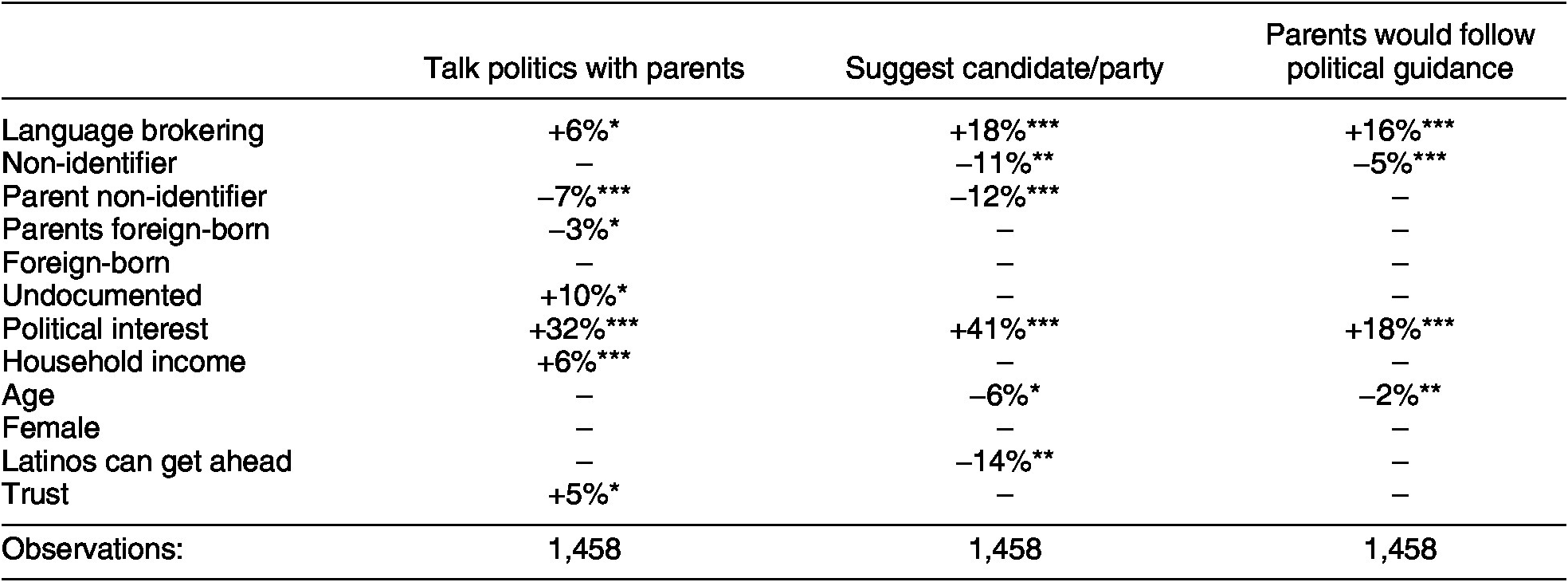
The college sample also provides an opportunity to investigate political activity within the household. To explore this further, this paper shifts its attention to how often those in the sample talk politics with their parents, whether they have ever suggested a political party or candidate to their parents, and whether they believe their parents would follow their advice if they ever suggested a political party or candidate. As the results in Table 2 demonstrate, language brokering substantively increases the likelihood of political communication occurring at home.
Latinx College Sample First Difference Estimates on Effects of Political Activity

Note: The blank cells indicate that the coefficients are nonsignificant. The estimate for Talk Politics with Parents is taken from the fourth cut point, which shifts from occasionally to regularly. The estimate for the Believed Parents would follow Political Guidance is taken from the fourth cut point, which shifts from somewhat consider to very much consider. City fixed effects are included in the model, but estimates are not reported here because of the difficulty in parsing out what is occurring within each city (see Appendix Table 7 for coefficients and standard errors). *p ≤ 0.05, **p ≤ 0.01, ***p ≤ 0.001.
When it comes to political activity in the home, political interest and language brokering continue to have the largest effects.Footnote 11 Those who report being very interested in politics are 32 percentage points more likely to have a political conversation with their parents than those in the sample who are not interested in politics. Language brokers are predicted to be 6 percentage points more likely to talk politics with their parents, all things being equal, compared with nonbrokers. The results also reveal that undocumented college students are 10 percentage points more likely to talk politics with their parents when compared with those who have protected status. However, the evidence of the effect surrounding unprotected status continues to be mixed because the effect disappears for the undocumented when other political activity in the home is explored.
The results also reveal that language brokers are acting as “political brokers.” I define political brokers as children who seek to provide influential political information to their parents when it comes to partisan politics. The idea that the children of immigrants are seen as agents in helping to facilitate the political assimilation process is not new (e.g., Foner and Dreby Reference Foner and Dreby2011; García-Castañon Reference García-Castañon2013; Morales and Hanson Reference Morales and Hanson2005; Portes and Rumbaut Reference Portes and Rumbaut2006; Wong and Tseng Reference Wong and Tseng2008). What is new is a focus on the practice of children actively suggesting political candidates or political parties to their parents. Again, close to those who express high levels of political interest, those who take on language brokering are 18 percentage points more likely to suggest a political party or candidate to their parents when compared with those who do not broker for their parents. The result suggests that language brokers feel confident enough to believe they can influence political outcomes in ways children are typically not expected to. There is no significant effect found for undocumented students.
I also find that language brokers are 16 percentage points more likely to believe they can influence their parents’ politics when compared with nonbrokers. This effect is on par with those who express high levels of interest. I find no effect for undocumented students when it comes to thinking they can influence their parents’ politics. Of course, asking respondents to gauge the amount of influence they have over someone else should be interpreted with caution. Even still, the results point to the sense of efficacy language brokers display when they become political brokers. Whether or not their parents listen to these political suggestions is not essential for our purposes; what is critical is that language brokers have the confidence to believe they can influence their parents. However, what remains unanswered is whether language brokers in this college sample differ from language brokers we may find in a general survey when it comes to introducing politics into the household.Footnote 12
GenForward Survey and Political Brokering at Home
Before answering whether or not respondents who act as language brokers are significantly more likely to act as political brokers in the home, a brief description of the GenForward data is needed. The GenForward survey, which consists of a representative sample of 1,823 respondents between the ages of 18 to 30, was fielded just after the 2016 presidential election. The sample lets us examine the effect of language brokering in and beyond the Latinx community to include other ethnic groups.
The GenForward survey consists of 33% of respondents who are second-generation Americans. This translates to 44% Latinx respondents, 86% Asian respondents, and 19% Black respondents reporting that both of their parents are immigrants. Of those 33% with immigrant parents, more than half (59%) report having language brokered for their parents. To examine the effect of operating as a language broker on political brokering on this diverse sample, logit regression is again employed because the dependent variables related to political activity are also dichotomous. The dependent variables examined are voter turnout, whether respondents talk politics with their parents, and whether respondents have ever suggested a political party or candidate to their parents.
The predictor variables included in the model to account for political brokering incorporate the primary variable of interest, language brokering. In the GenForward Survey, the language brokering variable is dichotomous, either respondents report acting as a language broker or not. Other dichotomous variables include gender and race, whether the respondents are Non-Identifiers or college graduates, and whether the respondents have foreign-born parents. Respondents were also asked about their income, age, how much they trust the political system, as well as their political ideology (ordered from liberal to conservative). Finally, respondents were asked about whether they were concerned about newly elected President Trump dividing the country. Footnote 13 The Trump variable is included to explain whether or not Trump’s candidacy with its strong anti-immigration rhetoric may have activated those with close ties to the immigrant community to take political action.
Variables that are noticeably absent from the analysis are political interest and citizenship status. Unfortunately, the GenForward Survey did not ask these questions. I attempt to get a sense of political interest by including the voted in 2016 variable in additional analyses (see Appendix Table 13 for analysis and an explanation on why this remains problematic). Despite the lack of political interest and citizenship status in the survey, the additional variables provide considerable leverage in assessing the effect of language brokering on political activity by disentangling the effect of education, race, political ideology, and Trump’s candidacy and subsequent election.
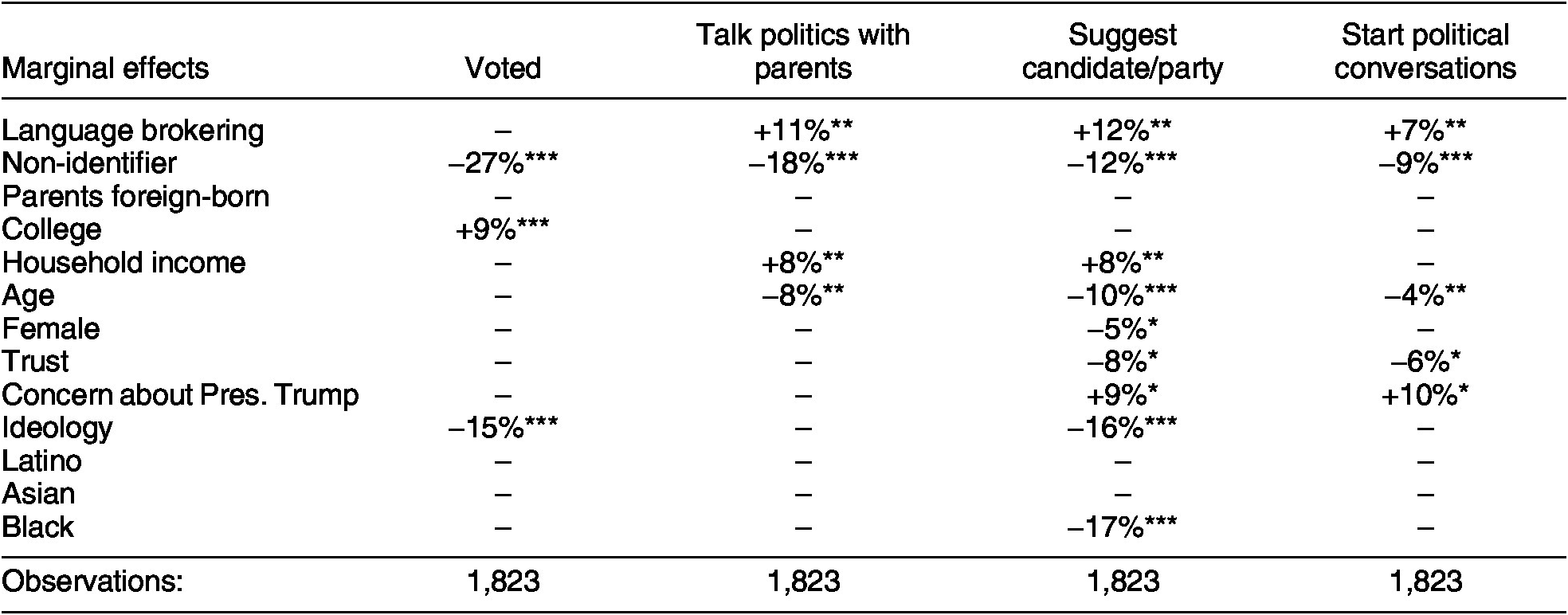
As shown in Table 3, the size of the effects found in relation to the likelihood of voting in 2016 are consistent with those found in the college sample.Footnote 14 The GenForward data similarly reveal that focusing on voter turnout as a metric of political participation makes it challenging to get a clear understanding of the political behavior of immigrant communities.Footnote 15 Similar to the Latinx college sample, the results show that those who report taking on language brokering are not statistically different from those who do not when it comes to voting.
GenForward First Difference Estimates on Effects of Political Activity

Note: The blank cells indicate the coefficients are nonsignificant. White is the race baseline variable for the racial categories. Finally, only the category for “I start the political conversation at home” is displayed in the Starts Political Conversation at Home estimates. *p ≤ 0.05, **p ≤ 0.01, ***p ≤ 0.001.
It is worth noting that acquiring a college degree does increase one’s likelihood of voting by 9 percentage points when compared with those who do not have a degree. The research has long established this with respect to voting, but it is mentioned here because the exclusively Latinx college sample was unable to highlight this effect because of its student composition. Additionally, the effect of being a Non-identifier appears more pronounced among those sampled in this general survey. Non-identifiers are anywhere from 9 to 27 percentage points less likely to participate politically than those who identify with a political party.
The effect sizes for examining the likelihood that respondents talk politics with their parents or are suggesting a political party or candidate to their parents mirror those for language brokering that were found in the Latinx college sample. Here the results denote that language brokers are 11 percentage points more likely to talk politics with their parents when compared with nonbrokers.
Additionally, respondents who report acting as language brokers are also 12 percentage points more likely to suggest a political party or candidate to their parents compared with nonbrokers. The size of these effects for language brokers are more pronounced and consistent than traditional covariates used in participation models including college education, income, and ideology.
While levels of concern about the divisive nature of the Trump presidency did not register any significant difference on a person’s likelihood to vote or on their probability of talking politics with their parents, it does appear to account for political movement at home. The belief among respondents that the Trump presidency could lead to more division has a significant effect on their political dialogue with their parents. Those who were extremely concerned that the Trump presidency would divide the country were 9 percentage points more likely to suggest a political party or candidate to their parents than to those who expressed no such concern.
The primary claim in this paper is that the adult responsibility of language brokering empowers the children of immigrants with the noncognitive skills that translate to political outcomes. Yet, until now, there has been no way to know whether the conversations these respondents report having with their parents are related to the noncognitive skills developed as language brokers or whether the parents are driving the conversations that language brokers are having. The GenForward Survey provides an opportunity to shed some light on this question by asking respondents, “Who in the household starts political conversations?” Respondents were able to choose from the options of “no one,” “my parents,” or “me” when answering the question. Since any movement from one of the three choices to another corresponds to examining whether the independent variables account for who starts a political conversation at home from one categorical choice to another, multinomial logistic regression is employed.Footnote 16
Consistent with the expectations laid out, language brokers were 7 percentage points more likely to start political conversations at home with their parents when compared with nonbrokers. The effect size is on par with other variables related to political activity in the model. Nonetheless, it is clear that Trump’s candidacy accounted for a host of political conversations started at home by children. Those extremely concerned about Trump’s presidency were 10 percentage points more likely to start political conversations at home with their parents compared with those who express no such concerns. While the context of politics in the face of threat or excitement can push people towards political engagement, it is also clear that even in the midst of Trump’s candidacy and subsequent election, mundane yet critical familial responsibilities continue to empower individuals to take on political action for those in the Latinx community and beyond.Footnote 17
Longitudinal Evidence of the Effect of Household Responsibilities on Participation
The analysis presented thus far points to the effect taking on adult responsibilities as a child has on political participation; however, this is still likely to leave the reader with questions. One question may be whether the development of noncognitive skills through household responsibilities that translate to participation is limited to distinct tasks like language brokering. Others may wonder about causality, as the cross-sectional data are ill-suited for making causal claims.
To address these concerns, I turn to the ELS (Institute of Education Sciences 2002). The ELS is a longitudinal study of high school sophomores conducted in 2002. Students in the study were asked about the frequency of household responsibilities they took on. The question asked, “How often do your parents require you to do work or chores?” The expectation is that children who are assigned chores frequently are significantly more likely to participate politically than are those assigned less frequently because of the skill acquisition that occurs when performing these tasks.
There is considerable evidence that taking on chores leads to positive outcomes for children as it relates to their personal and professional successes (Goodnow Reference Goodnow1988; Klein and Goodwin Reference Klein, Goodwin, Ochs and Kremer-Sadlik2013; Rende Reference Rende2015; Riggio, Valenzuela, and Weiser Reference Riggio, Valenzuela and Weiser2010). Of course, not all household tasks assigned to children are created equal, and equating language brokering and the frequency of household chores may be a false equivalence. To add to the concern, the ELS makes no mention of the type of chores these children assume. It could be that some took on traditional childhood chores, such as making their bed or taking out the trash, whereas others cooked, cleaned, and looked after siblings for extended periods.
Yet, even with the lack of specificity in the ELS about which chores are being performed, it is a mistake to dismiss the idea that children acquire noncognitive skills through chores. Research shows that children learn valuable skills that translate to self-efficacy and relationship building in nonpolitical domains by taking on chores (Goodnow Reference Goodnow1988; Riggio, Valenzuela, and Weiser Reference Riggio, Valenzuela and Weiser2010). Regarding frequency, children are often used as a labor source to substitute whenever structural constraints related to economic inequality prevent parents from filling these roles (Blair Reference Blair1992). When parents are prevented from doing household labor because they have to spend more time working outside the home, the burden shifts to their children. Studies have consistently demonstrated that low-income families depend on their children at the highest rate to provide household labor, whereas the wealthiest families rely on their children the least (Blair Reference Blair1992; Klein and Goodwin Reference Klein, Goodwin, Ochs and Kremer-Sadlik2013; Orellana Reference Orellana2003; Rende Reference Rende2015).
As Rende points out, “middle-class families have painted a picture of youth who are disengaged from household responsibilities” (Rende Reference Rende2015, 7). This suggests that while frequency of chore assignment is not a perfect measure, it can still shed considerable light on the outcomes of those children who carry a heavier burden. While perhaps not on the scale as those who rely on their children to language broker, this type of reliance still requires children to step up to help their parents, particularly along ethnic and social class cleavages. To highlight the relationship between class and race, the analysis below will examine the effect of chore frequency on the complete ELS, followed by an analysis of racial and class differences.
An additional advantage of the ELS is that it provides a robust test of the effect of chore assignment on participation. This is because the effect of household chore frequency on participation will be estimated with controls that have historically accounted for participation. The controls include gender, race, parental income, parental education, family newspaper access, college enrollment status, and the student’s high school composite test scores for math and reading. Footnote 18 When age-appropriate, additional controls accounting for income as an adult, having a college degree, and whether or not the respondent has children are included in the analysis.
The outcome variables measuring participation include whether the respondent voted in the 2004 and the 2008 presidential elections. Furthermore, a question asking about turnout in either any local, state, or midterm election in 2009, 2010, or 2011 is included. As noted above, voter turnout questions alone are not an ideal measure of participation; however, the ELS, with its primary focus on educational outcomes, limited the political items it asked. Other limitations related to the ELS are that it does not provide any insight into the respondent’s citizenship status or levels of political interest.
Regarding causality, the ELS data support the proposed theory concerning the effect of household responsibilities during childhood on political participation. The ELS allows us to test whether the frequency of household chores assigned during childhood influences participation as an adult by looking at individual-level change as these high school sophomores transition into adulthood, first, four years later in 2006 and then another six years later in 2012. Although the ELS longitudinal data cannot address every alternative explanation, analyzing the data with controls derived from the participation literature during these critical years leave it well-suited to test how household responsibilities during youth influence political participation in adulthood. Further, if the findings on the effect of childhood language brokering on political participation in adulthood are spurious or operate via a channel other than the posited noncognitive skill development, then we are unlikely to find support in an analysis of independent data on children who assumed other responsibilities in their households. Estimating similar effects for language brokering and household chores can increase confidence in the findings from the other two surveys.
The Education Longitudinal Survey Results
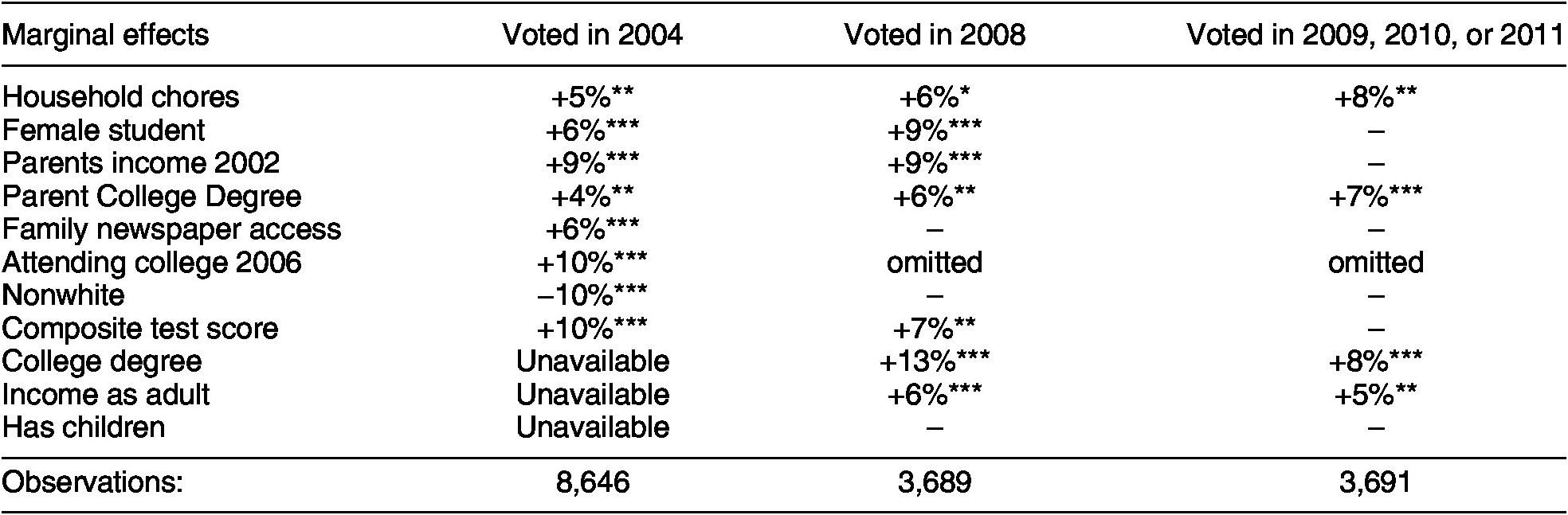
To examine the effects of the assignment of household responsibilities on participation via frequency of chore assignment, logit regression and first differences are once again appropriate because the dependent variables related to political activity are dichotomous.Footnote 19 Turning to Table 4, we find that the magnitude of effect for household chore assignment is on par with traditional predictors long thought to influence voter turnout, including education, parental socioeconomic status, and testing ability. Specifically, the data reveal that those children who were assigned household chores often were 5 to 6 percentage points more likely to vote in the 2004 and 2008 presidential elections than those children who did not take on any chores.
ELS First Difference Estimates on Effects of Political Activity

Note: The blank cells indicate the coefficients are nonsignificant. *p ≤ 0.05, **p ≤ 0.01, ***p ≤ 0.001.
However, where the effect of the skills acquired by doing household chores stands out is in off-year elections. Children assigned to do chores often by their parents were 8 percentage points more likely to vote in local and midterm elections than those who never did any chores. Predictor variables, long used to explain turnout, do not help overcome the obstacles and inconveniences typically associated with voting in off-year elections. Gender, parental income, and composite test scores had no significant effect on turnout in off-year elections. Taken together, we see that assignment of chores, not typically thought of as affecting political participation, appear to tap into a skill set that is learned and deployed to make other demanding activities, like voting in off-year elections, more manageable to overcome.Footnote 20
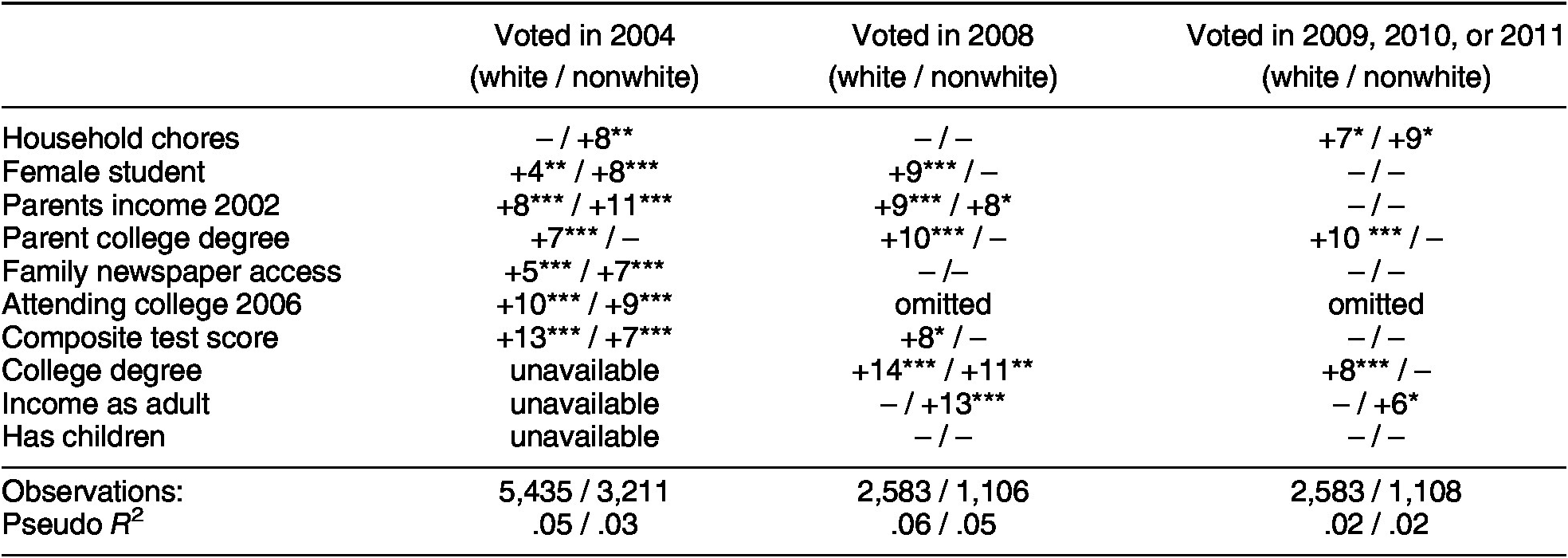
As stated, the literature on the effect of household chore assignment suggests that it is likely weighted along racial and social class lines because children of color and children in low socioeconomic environments are more likely to find themselves in the position to have to step up to help parents. To get some insight into possible racial differences related to the influence of household chore assignment on participation, I compare white and nonwhite students. The analysis in Table 5 provides a mixed picture of the effect that chores have on participation as it relates to race.
ELS Logit Regression Estimates of Political Activity Comparing White and Nonwhite Students

Note: The blank cells indicate the coefficients are nonsignificant. *p ≤ 0.05, **p ≤ 0.01, ***p ≤ 0.001.
For nonwhite students, household chore assignment is influential in two out of three elections. Nonwhite students frequently assigned household chores were 8 percentage points more likely to vote in the 2004 presidential election and 9 percentage points more likely to vote in off-year elections compared with other nonwhite students who did not take on any chores. The results mirror those of the complete ELS sample regarding the effect being on par with traditional participation variables such as education, parental socioeconomic status, and testing ability. However, there are no significant differences between the frequencies of chore assignment in the 2008 presidential election. Additionally, white respondents who frequently took on chore assignments were also more likely to vote in off-year elections than were white respondents who did not take on any chores.Footnote 21
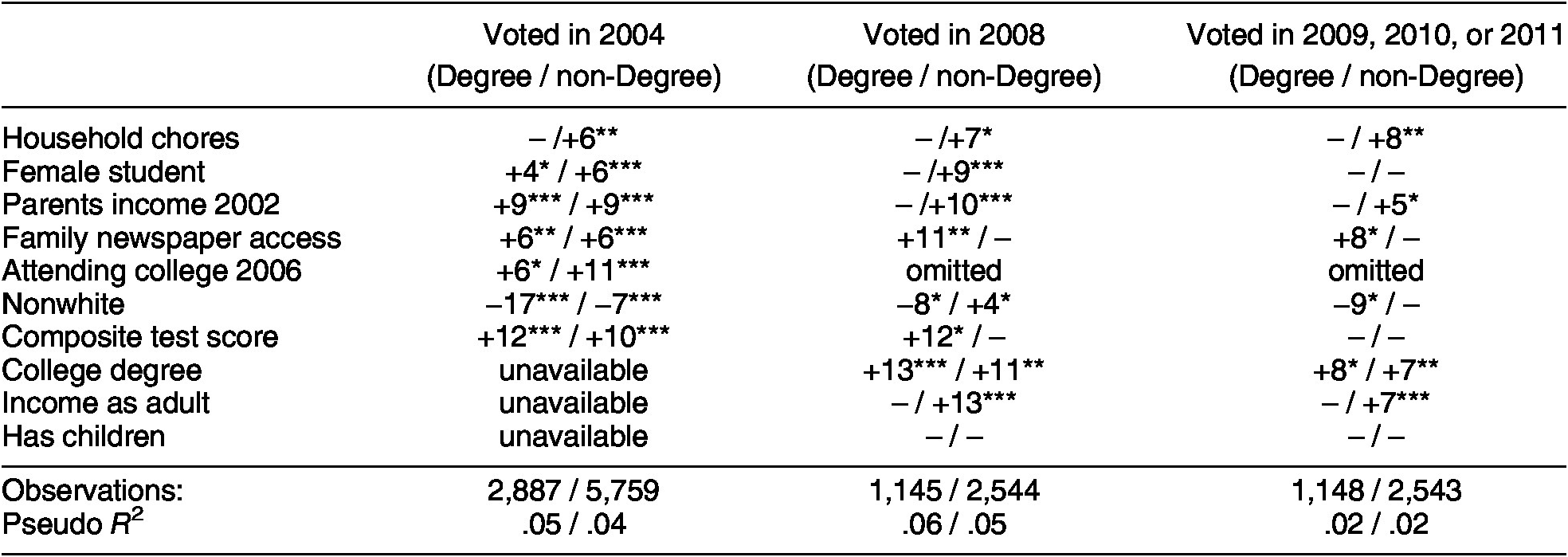
The largest differences exist when it comes to household chore assignment’s effect on class differences. Class differences are examined by focusing on the role of parental education. The analysis in Table 6 compares those who have at least one parent with a college degree with those who do not. The effect of household chore assignment has no influence on those who have parents with a college degree. Consistent with the argument made about the role of class, those who frequently take on household chores are 6 to 8 percentage points more likely to vote in all three elections than are those who do not take on any chores. Similar to much of the analysis of the ELS, household chore assignment is as influential as is indicated by traditional measures with respect to leading to political engagement for those whose parents lack a college education. These results, in combination with the cross-sectional data focusing primarily on second-generation Latinxs, point to the importance of challenging our understanding of the role that social class and immigrant status play in political participation.Footnote 22
ELS Logit Regression Estimates of Political Activity Comparing Students with Parents with and without a College Degree

Note: The blank cells indicate the coefficients are nonsignificant. *p ≤ 0.05, **p ≤ 0.01, ***p ≤ 0.001.
Discussion
In summary, this article has built on the knowledge surrounding environment and participation in meaningful ways. First, I demonstrate that the cycle of political inequality associated with resource scarcity can be broken in ways that have not been previously accounted for by scholars. Mundane functions of everyday life performed by children in Latinx communities can lead to political engagement. Specifically, when children assume adult responsibilities, they appear more likely to engage in a range of political behaviors that are not restricted to voting. While these results are encouraging, future work should examine whether the magnitude of such responsibilities can overwhelm children and have countervailing effects.
Second, the development of noncognitive skills during childhood because of life circumstances related to class or immigrant status can shed new light on previous findings. Resource scarcity does not make children more likely to rely on noncognitive skills to get ahead or more likely to be self-efficacious. However, skills developed as a result help explain surprising levels of political engagement. The children of immigrants who act as language brokers get an early education in asserting themselves in adult situations by taking on adult responsibilities. This informal education gives many of these children the training needed to make political participation less daunting.
Third, I show that Latinx children who act as language brokers operate with a sense of political agency that we typically do not think children have. More work needs to be done to determine whether these children are using this agency to influence parents politically in ways yet to be discussed. If we do not understand the agency related to being a child who takes on adult tasks and its consequences, we will continue to struggle to understand what is on the horizon as immigrant populations in the United States continue to become a larger part of the political landscape.
Finally, the results reveal a strong association between other responsibilities and political participation. That association supports the effect of language brokering on political participation. The influence of assigned household chores on political participation also suggests that scholars should explore other tasks that children in marginalized communities assume. If we want to understand why some of those whose circumstances discourage political activity exceed expectations, we need to reexamine the role of family and home life.
Supplementary Materials
To view supplementary material for this article, please visit http://dx.doi.org/10.1017/S0003055421000204.
DATA AVAILABILITY STATEMENT
Research documentation and replication files are available at the American Political Science Review Dataverse: https://doi.org/10.7910/DVN/4P2JA3.
ACKNOWLEDGMENTS
I am extremely grateful to John Brehm, Cathy Cohen, and John Mark Hansen for their valuable comments and suggestions. I would also like to thank Hajer Al-Faham, Elise Blasingame, Christina Boyd, Chinbo Chong, Jaime Dominquez, Micah Gell-Redman, Daniel Gillion, Daniel Hopkins, Michael Jones-Correa, David Leal, Neil Malhotra, Michele Margolis, Geoffrey Sheagley, Walter Wilson, Tamar Zeilberger, and the 2018 APSA New Insights on Latin@ Politics panel. Finally, I would like to thank the editors and the three anonymous reviewers for their grace and guidance in helping to improve the paper significantly.
FUNDING STATEMENT
The research conducted was made possible by funding from the Division of Social Sciences at the University of Chicago, the Center for the Study of Ethnicity, Race, and Immigration at the University of Pennsylvania, and the University of Georgia.
CONFLICTS OF INTEREST
The author declares no ethical issues or conflicts of interest in this research.
ETHICAL STANDARDS
The author declares that the human subject research in this article was reviewed and approved by the University of Chicago and affirms that this article adheres to the APSA’s Principles and Guidance on Human Subject Research.




Comments
No Comments have been published for this article.