

Introduction
Agriculture is a significant contributor to Australia’s economy. In 2013–14 the value of farm production was A$51 billion (ABARE 2015) contributing two percent of gross domestic product (GDP) and 15% of total Australian merchandise exports (ABARE 2014). Agriculture underpins Australia’s food and beverage manufacturing industries, which add $25 billion to the economy or 25% of GDP (ABARE 2015). Approximately 50% of Australia’s land mass is owned by farmers and graziers (ABS 2013–14). The climatic conditions in which production occurs, range from the temperate southern areas to the tropical north. Irrespective of location Australian farmers have to contend with ancient soils of inherently low fertility; in most locations, water is the primary factor limiting production.
Australia has been well known for its wool, sheep meat and beef production, and while these remain important in some regions, the past 20 years has seen considerable developments in grain (wheat, barley, canola, sorghum, oats, cotton seed, lupins, chickpeas, lentils and rice) grape, tree crop and horticultural production.
Australian agricultural producers have been renowned for their ability to remain competitive in an unsupported market place. Part of this ability is driven by their innovation and adoption of improved technologies and management practices and willingness to collaborate and question.
Australian PA innovations include reflectance activated spot weed spraying (1983), the ‘Beeline Navigator’, a GPS and inertial guidance system (1997), yield monitors for winegrape, tomato and potato producers (mid 1990s – mid 2010s), a grain protein sensor (2003) and GPS livestock tracking (2013). Details of many of these developments are available via the SPAA website (www.spaa.com.au) and in Cook and Bramley, Reference Cook and Bramley1998; Felton and McCloy, Reference Felton and McCloy1992; McBratney A, Whelan B, Ancev T and Bouma J, Reference McBratney, Whelan, Ancev and Bouma2005; and Whelan, Reference Whelan2011. While innovations in farming technology are not new, achieving adoption of precision farming ‘systems’ (e.g. implementing technology, processes and practices on-farm) is an area where farmers and indeed the broader PA value chain require additional support.
Since its inception in 2002, the Society of Precision Agriculture Australia (SPAA) has worked to support farmers and the wider cropping, horticultural, viticultural and livestock industries in the adoption of PA (Bramley and Trengove, Reference Bramley and Trengove2013). Through traditional and evolving platforms, SPAA helps to disseminate PA research, demonstration and application while promoting the economic, environmental and social benefits of PA adoption to Australian agricultural industries at a regional and national level. Collaboration across industry sectors and between farmers, industry specialists and researchers is central to its success and values.
SPAA
SPAA is a national non-profit, independent membership organisation. It aims to promote the development and adoption of precision technologies by farmers as means of enhancing the profitability of crop and animal production systems. The organisation has an Australia-wide focus, achieved by partnering with other organisations and by involvement with national and industry alliances. In addition to promoting the profitability and productivity gains due to the adoption of PA, environmental sustainability benefits are also a key focus.
SPAA has five key aims. These are to:
-
1. Encourage adoption of PA technology in the Australian agricultural industry.
-
2. Provide the latest information on PA research and proven PA technologies.
-
3. Enhance and exchange the sharing of ideas and information amongst growers, researchers and manufacturers of PA equipment.
-
4. Form partnerships with research and new technology providers to increase information sharing.
-
5. Increase the skills of, and collaboration amongst, the PA support industry.
SPAA was initiated in 2002 by a group of farmers, researchers and advisers from the grains and winegrape industries in South Australia. Issues of equipment incompatibility between manufacturers and a basic lack of on-farm skills were key drivers for its formation. In its start-up phase, it focused primarily on extension workshops and meetings for southern Australian grain growers. These events brought together farmers, industry specialists and researchers to share their knowledge and experience of using PA technologies. This successful model is now replicated across Australia with a number of agricultural sectors including dairy, wine, sugarcane, and fruit and vegetable horticulture engaged. The SPAA model has also been replicated in New Zealand (https://precisionagriculture.org.nz/).
A committee of farmers, researchers and industry specialists continue to run SPAA. This brings independence and collaboration across all areas and is a key element of the success of the organisation. The committee is supported by a small regionally located part-time management team and sub-contracted roles.
In addition to the modest membership fee of $150 AUD, SPAA receives sponsorship from major industry players including John Deere, CASE IH Agriculture, Topcon, and financial support from the Australian Federal Government. Funding from the latter is predominantly channeled through the either the Rural Research and Development Corporations and/or regionally based Natural Resouce Management (NRM) Boards. The funds support a broad mix of precison orientated Research, Development and Extension (RD&E) activities.
As the ‘umbrella organisation’ for the adoption of PA in a diverse number of industry sectors, SPAA is frequently sought as the ‘voice of the farmer’ by researchers and policy developers. It has a close working relationship with universities, research institutes and companies leading the development of PA in Australia.
SPAA runs events, produces publications and uses social media to generate networks and connections across Australia. These support the adoption of PA across a diverse range of industry sectors. Increasing the knowledge and skills of farmers and those in the PA support industry is considered pivotal to increasing adoption of PA. As the PA industry continues to mature, SPAA’s aims remain relevant but their implementation is regularly reviewed to respond to industry developments; for example, the emergence of ‘Big Data’ and associated demand for the collection, collation and analysis of data up and down the value chain.
Extension
Extension and outreach are central to SPAA’s operations with events, publications and the use of social media all key platforms in the SPAA extension strategy. Development of farmer case studies through on-farm R&D are a key element of these.
Events
Workshops, field visits, conferences and training activites are all event formats used by SPAA to help engage farmers with PA. The objective of all events is to build confidence in the use of PA technologies which, over time, will lead to practice change. Audience size can range from a room of 15 farmers to a conference venue of 150 or more. Irrespective of event style, all SPAA extension events bring together practitioners (e.g. leading farmers, machinery and industry specialists, researchers and commercial agronomists) with experience in the practical application of PA tools on-farm or in research. Farmers are often brought from interstate or different industry sectors to counter issues associated with of being a ‘prophet in your own land’. SPAA regularly engages returning Nuffield scholars and international speakers to provide a global perspective on PA developments.
SPAA extension events always provide high level sponsors with the opportunity to present. Over the years, sponsors have evolved these presentations from tedious sales pitches to more practical descriptions of the equipment or support services they provide. At most events, including the annual PA Symposium which is run in collaboration with the University of Sydney, there is the opportunity for trade displays. The stucture and content of all SPAA extension events is designed so that participants have plenty of time for questions and to network with speakers and other delegates. The feedback which is gathered from all events always rates this networking opportunity highly. Creating a simple but welcoming environment to help delegates feel like they are part of a family connected by a common interest is an important element of these events. Smaller, local or industry-specific events, often based on a half day of presentations follwed by an optional on-farm tour or hands on hardware/software training, has proved a popular structure with delegates and funders.
While SPAA has been actively engaging and educating current farmers and industry participants it is increasingly seeing the need for greater understanding and use of PA technology in secondary and tertiary education. Discounts are provided to assist students with membership and in attending events
Publications
SPAA produces both electronic and hard copy publications to keep members and the wider industry informed of PA developments, user experience and SPAA events. All publications can be viewed on SPAA’s website (www.spaa.com.au).
‘Precision Ag News’ is a magazine-format newsletter that is circulated three times a year to members. It is the only independent, cross-industry magazine dedicated to the adoption of PA in Australia . In addition to general PA news, each issue contains ‘case studies’ describing farmer and advisor use of PA, and articles provided by researchers. Broader emerging issues such as data ownership and cloud storage are also covered.
‘PA in Practice’ - editions I and II (Southern Precision Agriculture Association, 2008; SPAA Precision Agriculture Australia Inc, 2012) were produced by SPAA with support from the Grains Research and Development Corporation, comprising farmer case studies, ‘to do’ checklists and tips, as well as articles from researchers and industry specialists on implementing PA in grain production. Recent fact sheets have covered topics such as Controlled Traffic Farming, Precision Viticulture, Weed sensing and Airborne imagery. These are designed to provide readers with a quick ‘go to’ source of basic information. Over 2000 copies of this publication have been distributed to farmers plus downloads from internet. It is now course material for two Universities in Australia.
SPAA circulates its ‘e-news’ to over 1500 members and non-members at least six times per year.
Social media as a brand enhancer
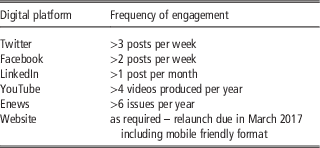
Casual analysis has shown that many Australian farmers are using social media platforms such as Twitter®™ as a method of sharing technical information or posing technical questions. Accordingly, social media is becoming a popular method by which SPAA converses with members and attracts new members and supporters. SPAA has over 1500 followers on two Twitter accounts and is regularly active on Twitter®, Facebook®, YouTube® and LinkedIn® (Table 1). It has been found that since using these digital platforms a greater number of young, enthusiastic people are being attracted to positively engage with agriculture.
Frequency of SPAA’s digital engagement

In recognition of the power of social media, SPAA has instigated a structured social media policy, supported by staff training, to help foster brand loyalty by providing powerful, emotive, compelling and technical content. Loyalty to SPAA is also fostered by being responsive to inquiries and issues raised on social platforms. As a farming group, SPAA uses social media to build a lasting connection with members, stakeholders and followers; increase brand awareness; burnish SPAA’s reputation; interact with its target market informally; gain insights about PA developments and trends; advertise events, publications and membership benefits; and network with others with similar interests/objectives. Analytics are used to identify the effectiveness of engagement.
Enhanced adoption of PA
It’s well understood that formal and informal farmer groups play an important role in improving knowledge exchange between researchers, advisors and farmers, though achieving practice adoption typically requires more than attending events. Abadi Ghadim and Pannell (Reference Abadi Ghadim and Pannell1999) describe adoption as a process of learning that has two distinct steps, firstly this involves the collection, integration of new information. The other step required in an adoption process is improvement in the landholder’s skills in applying the innovation to their own situation (Abadi Ghadim and Pannell Reference Abadi Ghadim and Pannell1999). SPAA is unique in that it has developed a broad mix of learning and experiential opportunities for the entire PA value chain; that cater for the critical aspects as described by Abadi Ghadim and Pannell (Reference Abadi Ghadim and Pannell1999) and Pannell et al. (Reference Pannell, Marshall, Barr, Curtis, Vanclay and Wilkinson2006). Through a range of structured extension and outreach activities and experiences SPAA has increased PA adoption. Through undertaking a feedback process for each of the events it holds PA technologies have now been adopted, to at least some extent, in many industry sectors; guidance, autosteer and variable application of inputs are the technologies most widely adopted in the grains sector.
For example, surveys of grain growers carried out at both the start (2009) and end (2012) of a SPAA extension project (SPAA Precision Agriculture Australia Inc, 2012) revealed that in 2012, 90% used guidance, 81% had a yield monitor and 74% gathered yield data. At the start of the project, 44% used variable rate inputs, by project end, 64% were using such technology. This survey engaged over 400 farmer responses. Australian grain growers have reported that they used guidance and autosteer to reduce overlap, varying the rate of nitrogen, lime and gypsum and for automated spot spraying of summer weeds generated the greatest increase in profit (SPAA Precision Agriculture Australia Inc, 2012).
These feedback forms also provided an opportunity for delegates to nominate the topics they would like to hear/ learn more about at future events, further enhancing the success of SPAA. Together with event ratings (of activity and presenter), SPAA poses the question of “practice change”. As each event holds a tailored and varied program, it is difficult to determine the exact adoption rates the intention to change is noted by 80% of delegates at each event. The single biggest “change” intended is the use of technology if the equipment has the capabilities and utilising contacts and networks made. This contributes to increasing knowledge and adoption.
Case study
SPAA relies heavily on farmer and industry professional case studies to get across messages to its farmer members. A brief example follows.
As 19 year olds, Jessica Koch and her (now husband) Joe began attending SPAA Expo’s and Symposiums. Jessica found these events gave them the opportunity to meet progressive farmers and to collect new ideas to take back to the farm. Ten years on, these are the same reasons for continuing to attend SPAA events and become actively involved in the SPAA committee. Jessica is SPAA’s incoming president. When Jessica is not farming, she is working as a PA advisor for John Deere. She sees that SPAA links retailers, researchers and farmers, which is why she values the organisation.
“SPAA events allow not only its key audience, the farmer to learn, but also help to keep resellers and service providers abreast of new products that come to market, and learn what is being researched and trialled. Customers expect our sales and service teams to be knowledgeable in this area, with this knowledge they can provide the best service to our customers.”
From Jessica’s experience the benefits of PA are being achieved on-farm through the optimization of production efficiency and crop quality, the minimization of detrimental environmental impacts and minimization of business risk. She considers SPAA to have been instrumental in assisting farmers in achieving this through cross-industry understanding and collaboration.
Conclusion
For the past 15 years, SPAA has been advocating and supporting the adoption of precision agriculture, through learning, sharing, connecting and inspiring producers in the adoption process.
Much of this work has been by delivering technical and practical information to help farmers and the broader PA value chain gain confidence in the application and use of PA software and hardware. This has been achieved through extension events, publications and the use of social media. Through its cross-industry, multi-faceted, but farmer-focussed membership SPAA has developed a broad ‘community of practice’ in PA systems; this community is not only vital to improving the adoption of PA but is important for the development of more sustainable and resilient farming systems and landscapes.
This will require thinking, research and linkages not only across multidisciplinary themes, but throughout the value chain. SPAA seeks to facilitate the application of the PA philosophy across Australian agriculture leading to more commercially and environmentally sustainable agricultural systems.
Acknowledgements
SPAA thanks its members and stakeholders for assisting in putting this paper together. The assistance and input of Dr Rob Bramley (CSIRO) and Mr Ian Layden (Queensland Government; Department of Agriculture and Fisheries & SPAA-Society of Precision Agriculture Australia) in editing this paper has been much appreciated.