In Australia, like elsewhere, decisions to use a particular technology are often driven by medical practitioners (1). For example, when laparoscopic cholecystectomy was introduced in the United States, Hatlie suggested that the influence for its widespread use could have involved “surgeons’ desires to expand their markets,” and “manufacturers’ desires for equipment sales” (Reference Hatlie2). Surgeons not only play an important role in the adoption and diffusion of new technologies but can also serve as innovators, practitioners and patient advocates (Reference Stafinski, Topfer, Zakariasen and Menon3). Furthermore, as noted by Riskin et al. “ . . . surgical innovation is fundamental to surgical progress and has significant health policy implications” (Reference Riskin, Longaker, Gertner and Krummel4). New surgical technology may come in the form of a technique, a procedure, or a process of care. Some of the contextual factors that can influence the adoption of a new technologies described by Wilson (Reference Wilson5) include: (a) patient's demand for the technology; (b) low cost to surgeon of learning and using the procedure, (c) manufacturer's aggressive promotion of technology, and (d) the magnitude of benefit perceived by each stakeholder.
One of the goals of health technology assessment (HTA) is to provide information that clinicians can use to guide healthcare system change and clinical decision making (Reference Rashiq, Barton, Harstall, Schopflocher and Taenzer6). However, as described by several authors there is insufficient contact between producers of HTAs and those who use them (i.e., policy makers, clinicians) (Reference McGregor and Brophy7;Reference Wild and Langer8).
In Australia, the state, territory, and federal governments have shared responsibilities for the funding and provision of health care. Australia's HTA activities seem to parallel those main governance structures. Australia's federal government has primary funding responsibility over pharmaceuticals, out-of-hospital care, and inpatient care provided to privately insured patients. Private hospitals undertake around 50 percent of all elective surgeries in Australia (9). In line with their responsibilities, the federal government uses HTA extensively in the decision to fund new pharmaceuticals under the Pharmaceutical Benefits Scheme (PBS) as well as new diagnostic and procedural technologies through the Medicare Benefits Schedule (MBS). The Medical Services Advisory Committee (MSAC) is a national body which advises the Minister for Health and Ageing on evidence relating to the safety, effectiveness and cost-effectiveness of new medical technologies and procedures (10). MSAC's reach is restricted to the Medicare Benefits Schedule (MBS), covering medical services provided to patients who are privately admitted or being treated out-of-hospital. However, MSAC's advice (and the evidence on which that advice is based) have long been publicly available and can be used by decision makers in other parts of the healthcare system (e.g., public hospitals) to aid resource allocation decisions. In the 2010 and 2011 calendar years, it completed thirteen assessments and made ten recommendations on technologies such as K-RAS mutation testing for Cetuximab and artificial intervertebral lumbar disc replacement.
Australia's six state and two territory governments are responsible for the provision of public hospital care. Historically, state governments have funded around 60 percent of public hospital expenditure and the federal government provides around 40 percent through block grants to the states. However, there is a significant gap in HTA activity for public hospitals, although recent efforts to introduce HTA programs in the states of Queensland and Victoria have aimed to redress this imbalance.
Whereas a lot has been written about the functioning of Australia's HTA activities in the area of pharmaceuticals, less is known about Australia's national HTA efforts in areas such as surgery. The Australian HTA situation for surgical procedures provides an interesting case study for many other countries. There is a systematic, albeit small, HTA program that supports the evidence base and is used to inform funding decisions that primarily affect services provided in private hospitals. This same HTA effort can inform providers in public hospitals, although there are virtually no funding implications that arise from the HTA report.
This study reports on the results of a pilot study aimed at filling gaps in knowledge regarding the influence of HTA bodies, and the perceptions and attitudes of clinicians toward the introduction and uptake of new technologies. This pilot study aims to explore the understanding of surgeons of an HTA process for new medical technologies and procedures and explore the factors that influence uptake and diffusion of new health technologies in Australia. In particular, it aims to examine the impact of HTA on provider knowledge and attitudes when its role is not just to provide information but is also coupled with funding.
METHODS
Questionnaire Development
The questionnaire for the online survey was developed from key themes identified from a qualitative study (Reference Gallego, Casey, Norman and Goodall11). The pilot questionnaire was reviewed and pretested by two surgeons and an emergency physician with wording of some questions slightly modified. The questionnaire was divided into three main sections:
Section 1: Adoption of surgical and medical procedures (Qs1–5). Participants were asked about their experience and motivation regarding the uptake and diffusion of new health technologies. Participants were then asked to indicate their level of agreement with statements about the “ideal” health technology process, using a five point Likert scale (1 = strongly disagree to 5 = strongly agree). They were also asked to rate the influence that certain criteria have in the introduction and approval, using a five point Likert scale (1 = strongly disagree to 5 = strongly agree).
Section 2: The HTA process (Qs 6–10). Participants were asked how familiar and how often they used recommendations from different HTA bodies. They were then asked to indicate their level of agreement with statements about the current MSAC process using a five point Likert scale (1 = strongly disagree to 5 = strongly agree). An open-ended question was also included to allow participants to comment on adoption and financing of health technology in Australia.
Section 3: Information about participants (Qs11–16. This section sought details such as gender, age, surgical specialty, work place of respondent, responsibility for managing a budget and involvement in decisions about the adoption or financing of health technology at their institution and their attitudes toward the adoption of new technologies.
Data Collection and Analysis
Eight hundred prepacked envelopes with a cover letter explaining the objectives of the survey and a flyer with the link to the online survey were sent to the Royal Australasian College of Surgeons’ (RACS) to be posted to its members (mainly general surgeons) between October and November 2009. However, due to RACS policy surrounding unsolicited mail outs and correspondence, we were unable to determine how many envelopes were posted and received by its members. The link to the online survey was available for 6 weeks after the mail-out until the 30th of November 2009. Respondents were offered an incentive for their participation, a $50 e-voucher for a bookstore. Responses were collated and analyzed using SAS (Version 9.13, Cary, NC, USA). Descriptive statistics summarize the data, frequencies and proportions were calculated with their 95 percent confidence intervals. Open-ended responses were analyzed using a modified thematic analysis which involved an open coding technique (Reference Charmaz12).
Ethics
This study was approved by the University of Technology Sydney (UTS) Human Research Ethics Committee (HREC) and the Royal Australasian College of Surgeons Ethics Committee.
Results
Of the sixty-two survey respondents, 79 percent were males, 32 percent were aged between 36 and 45, 55 percent reported their primary work place as a public hospital, and 52 percent were involved in making decisions about the adoption of health technologies or treatments at their institution.
Sixty percent of respondents considered that surgical procedures are most likely to be introduced in public hospitals. Seventy-three percent regarded that once new medical technologies (devices/equipment) have regulatory approval, they are most likely to be introduced in private hospitals. More than half of the respondents noted that the main influence for them to uptake a new medical technology is their desire for better patient outcomes (61 percent) and the availability of evidence-based supporting data (31 percent). Only a small percentage of respondents are influenced by uptake by peers (3 percent) or patient demand (3 percent). When asked to describe their approach to new technologies one-third (34 percent) described themselves as early adopters.
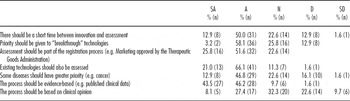
When participants were given statements about the “ideal” health technology process, 87 percent of participants agreed/strongly agreed that existing technologies should also be assessed and priority should be given to “breakthrough” technologies (66 percent). The majority agreed/strongly agreed that assessment should be part of the registration process (77 percent) and it should be evidence-based (89 percent) (see Table 1). Safety, effectiveness, and cost-effectiveness were listed as the most important criteria in reaching decisions about the adoption and financing of health technologies. Political considerations, patient preferences, and workforce capacity were listed as the least important criteria.
Perceptions of health technology process

Likert scale (SA = strongly agree, A = agree, N = Neither agree nor disagree, D = disagree, SD = strongly disagree).
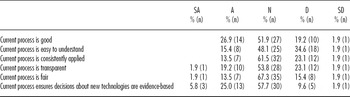
Twenty-four percent of the participants had never heard of MSAC, 23 percent had heard of it but did not really understand it, 32 percent were somehow familiar, and only 21 percent were familiar with it. Those who had heard of MSAC reported that the Commonwealth Government and committee members have a high impact on the MSAC decision-making process. The general public, medical companies, and the media had low impact. Respondents were generally neutral about the characteristics of the MSAC decision-making process (see Table 2). The percentage of respondents who had knowledge of the Federal Government's Pharmaceutical Benefits Advisory Committee (40 percent) was similar to those who had an awareness of MSAC, with 53 percent reporting they would like to have access to more information about the PBAC decisions. Almost all respondents (94 percent) were aware of the Australian Safety and Efficacy Register of New interventional Procedures (ASERNIP-S), and 73 percent reported using the results of the ASERNIP-S assessment data.
Perceptions of the current MSAC process (N = 52)

Likert scale (SA = strongly agree, A = agree, N = Neither agree nor disagree, D = disagree, SD = strongly disagree).
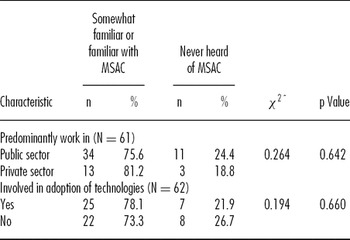
Table 3 provides further information about awareness of MSAC processes broken down by surgeons who predominantly work in the public and private sectors and those who are and are not involved in the decisions about the adoption of health technologies or treatments at their institution. The results show that a slightly greater proportion of surgeons working predominantly in the private sector have some familiarity of MSAC processes. This provides some indication of the additional awareness that MSAC exerts through its ability to recommend funding for new technologies. Nevertheless, the differences in awareness between the public and private sectors are small and not statistically significant. This may be related to the small sample size, but it does show that the informational role of MSAC raises considerable awareness among surgeons, even when it is not coupled with funding. Similarly, surgeons involved in decision making do have a greater awareness of MSAC, but again the difference with those not involved in decision making is small and not statistically significant.
Association between surgeons’ characteristics and awareness of current MSAC process

^ df = 1; p < 0.05.
Thirty-five percent of the participants (n = 22) provided further comments about the adoption and financing of health technologies in Australia. Two distinctive views emerged about the level at which decisions about the adoption and funding of new technologies should take place. While some support the idea that guidelines should be developed at the national level, decisions about the adoption and financing should happen at the State, Area Health Service (AHS) or public hospital level. As noted by one of the participants “Lower level than Governmental to avoid red tape however general guidelines for adoption need to be generated at a higher level and applied locally”.
This group of participants also commented that if decisions are taken at the state level mechanisms should be in place to make these decisions equitable. In the words of one of the participants “. . . .there should be state/national review to ensure that geographical dissemination of the technology is equitable.” The second view expressed was that “All major health decisions should be made at a national level.”
One of the concerns expressed by participants is the “lack of adequate funding” for new technologies. “New technologies generally require sponsorship, donation or a generous public hospital budget.” Some participants articulated the need to raise public awareness. “I would strongly support measures to increase public awareness of determinations by independent bodies such as those named here. At present their sole sources of information are clinicians with potential or actual bias, and a sometimes manipulated commercial media.”
DISCUSSION
This pilot survey represents the first attempt to explore surgeons’ views of HTA in Australia. As stated by the Calgary health region, “the more clinicians and decision makers are aware of a systematic but simple process to evaluate the impact of new technologies, the more efficiently HTA will be undertaken and the greater the likelihood that it will be embedded within clinical practice” (13). Furthermore, as noted by Reeves almost a decade ago one of the greatest challenges to HTA in surgery is finding ways of encouraging surgeons to be less “susceptible to the lure of new and expensive technology that has not been fully evaluated” (Reference Reeves14).
This survey provides some evidence that even though surgeons are only somewhat familiar of the MSAC process, but still value evidence-based information. The situation is not unique to Australia; Stanfiski and colleagues’ in Canada found that surgeons viewed the current government HTA process as a “black box” (Reference Stafinski, Topfer, Zakariasen and Menon3). Indeed, numerous countries are searching for the most effective and efficient way to incorporate evidence (including economic evidence) into resource allocation decisions (15).
In Australia, at least, there is good general awareness among surgeons of the types of HTA being undertaken in this country. In a survey of fellows of the RACS, 65 percent were aware and used the systematic reviews produced by ASERNIP-S (Reference Maddern16). The percentage in this survey is even higher with 94 percent being aware and 73 percent using the results.
The problem seems to lie at the decision-making stage, where there is a general lack of awareness of national HTA decision-making bodies. It is interesting to note that the percentage of respondents who had knowledge of PBAC was similar to those who had an awareness of MSAC. This is somewhat surprising given that MSAC's responsibilities cover the same type of technologies that surgeons typically use. This situation presents a missed opportunity of integrating high-quality evidence into resource allocation decisions at other levels of the healthcare system (such as public hospitals). This is not to say that public hospitals should necessarily follow MSAC recommendations but they may, at the very least, wish to consider it in their own deliberations. This situation is not unique to Australia; there are hospital based HTA initiatives in Canada, Spain, and Italy (17). This is a reflection that decisions taken at the national HTA level are not necessarily used or implemented at the regional (institutional) level.
The lack of integration of HTA activities in Australia will become more prominent under the national hospitals reforms currently being implemented. These reforms will change the way the federal government funds public hospitals. Instead of block grants to the state and territory governments, the federal government will from 2014 to 2015 onward fund 45 percent of the efficient price of hospital activities. From 2018, this percentage will rise to 50 percent. At the same time, local hospital networks will be charged with greater responsibilities to manage their hospitals effectively and efficiently. For these reforms to work, decision makers need better access to information on the effectiveness and efficiency of new technologies. This presents a unique opportunity to deliver HTA in an integrated and systematic way in the Australian hospital system.
As noted by Lehoux et al., medical specialists are key to medical innovation and often due to their role in clinical research, contribute to the evidence base that triggers innovations in their field (Reference Lehoux, Denis, Rock, Hivon and Tailliez18). Some initiatives have been established by HTA agencies in Canada, Sweden, and the United Kingdom to educate surgeons and other clinicians regarding the concept of HTA, and improve the awareness of the process and the use of HTA reports. For example the Swedish Council on Technology Assessment in Health Care (SBU) established the Ambassador program in 1996. Clinicians who are also opinion leaders are “ambassadors.” Their role is to promote and disseminate the findings of SBU reports to influence practice and clinical policy at the regional and local levels (19). The Alberta ambassador program was based on the Swedish strategy and uses ambassadors who act as content experts and facilitators in interactive education sessions to decision makers and clinicians (20). The National Institute for Health and Clinical Excellence (NICE) in England and Wales also has a clinical fellow program (21). These initiatives highlight the importance of engaging and raising awareness of the HTA process and results among clinicians.
Limitations
Studies such as these have several limitations. First, the wording of questions and the way they are presented influences responses. Second, the sample is not representative of all surgeons and is likely to be over representative of those with an interest in the research topic. Furthermore, because the mail out was done by the College it is unknown how many members actually received the letter hence we were unable to determine the response rate. Notwithstanding this, the results of the survey could allow hypothesizing that surgeons have a low perception of the existing processes for new medical technologies and procedures conducted by MSAC.
CONCLUSION
The results of this study suggest that knowledge and understanding of the MSAC decision-making process is limited among surgeons. Public hospitals are still perceived as the entry point for the introduction of new surgical procedures. The influence that MSAC decisions have on clinical practice, especially in areas beyond MSAC's scope, appears to be limited. Better integration of evidence and decision making at national and local levels is needed. Further research could explore avenues to engage surgeons and raise awareness of the HTA process in both public and private hospitals.
CONTACT INFORMATION
Dr. Gisselle Gallego, BPharm, PhD, Research Fellow Centre for Health Research, School of Medicine, University of Western Sydney, Campbelltown, New South Wales, Australia; Faculty of Health Sciences, The University of Sydney, Lidcombe, New South Wales, Australia
Dr. Kees van Gool, BEc, BA, MEc, PhD, Senior Lecturer
Dr. Robert Casey, BA, MD, Visiting Scholar, Centre for Health Economics Research and Evaluation (CHERE), University Technology Sydney, Ultimo, New South Wales, Australia; Assistant Clinical Professor of Medicine, University of California, Los Angeles. Los Angeles, California, USA.
Professor Guy Maddern, MBBS, PhD, MS, MD, FRACS Surgical Director, Australian Safety and Efficacy Register of New Interventional Procedures–Surgical, Royal Australasian College of Surgeons, Adelaide, South Australia
RP Jepson, Professor of Surgery; Head of Discipline, Discipline of Surgery, University of Adelaide, The Queen Elizabeth Hospital, Adelaide, South Australia
CONFLICTS OF INTEREST
Gisselle Gallego and Kees Gool report a grant to their institution from University of Technology Sydney (UTS) - Early Career Research Grant. The other authors report they have no potential conflicts of interest.