

1 Introduction
Many countries operate public pension systems. In light of increasing life expectancy and falling fertility rates, the recent decade has seen several reforms and reform proposals for these systems. Some of these reforms imposed parametric adjustments to the existing pay-as-you-go (PAYG) system. Others were more fundamental. Some proposals boiled down to replacing the public PAYG system by a fully-funded one. The question arises which of these reforms dominates from a welfare perspective. In particular, can aggregate efficiency be improved without simultaneously causing welfare losses for individuals with low earnings capacity and higher welfare inequality?
This paper addresses this research question by comparing the effects of moving to a fully-funded private pension system with the effects of different reforms of the earnings-related linkage in a PAYG system. We argue that a fully-funded system falls short of achieving the objective, mainly because there is no policy option inherent in the system to address the distributional aspects. Moreover, while moving to a fully-funded system is most beneficial for employment, it is not for human capital formation and labor productivity. We therefore investigate whether a ‘smart’ design of the earnings-related linkage in the PAYG system can achieve the objective.
To approach the question, we build a four period overlapping generations model (OLG) for an open economy that also incorporates heterogeneity in innate ability. We have three active generations (the young, the middle aged and the older) and one generation of retired. The model explains hours worked by the active generations, (tertiary) education by the young, the retirement decision of older workers, aggregate output and income, and welfare, within one coherent framework. Within each generation we distinguish individuals with high, medium or low ability. Individuals with higher ability enter the model with more human capital. They are also more productive in building additional human capital when they allocate time to education. The public pension system in our model is of the PAYG type. Our specification allows an analysis of a wide range of parametric reforms. The government in the model can impose a strong, a weak or no linkage between the pension benefit and past individual labor earnings. When there is a linkage, it can impose different weights in the pension assessment base to labor income earned when young, middle aged or older. If the government prefers no direct link to individual earnings, it can adopt a basic pension system for all individuals, or guarantee a minimum pension to those who would otherwise run the risk of old age poverty. For both earnings-related and basic pension systems, the government can choose the level of the replacement rate. It can also choose the level of the minimum pension. As the most drastic change, the government in the model may decide to move from a public PAYG system to a fully-funded private one.
Our main findings are as follows. Our simulation results prefer a PAYG pension system above a fully-funded private system. Aggregate productivity, output and welfare benefit the most from a PAYG system that conditions pension benefits on past individual labor income, with a high weight on labor income earned when older and a low weight on labor income earned when young. Uncorrected, however, such a system implies welfare losses for individuals with low ability, and rising inequality. Complementing or replacing this system by a minimum pension component does promote the welfare of current and future low-ability generations, but it is inferior or even negative for aggregate employment, output and welfare. Introducing a basic pension system would also avoid old-age poverty, but it would reduce almost everyone's lifetime utility, including most current and all future generations of low-ability individuals. Much better is to maintain the tight link between past individual labor income and the pension also for low-ability individuals, but to strongly raise their replacement rate. An additional correction improving the welfare of low-ability individuals would be to maintain for these individuals equal weights on past labor income.
The intuition for our findings is as follows. A PAYG system that conditions benefits on past individual labor income, with a high weight on labor income earned when older and a low weight on labor income earned when young, raises the marginal gain from work at older age and reduces the marginal gain from work when young. In that way, it includes strong incentives for individuals – at least those of high and medium ability – to study when young and to work more and longer when old. Increased accumulation of human capital by the young promotes productivity and per capita income. It also brings higher wages at older age, which provides another reason for older individuals to work more and to postpone retirement. For individuals with low innate ability, however, this system brings welfare losses. They cannot study. They can only work more with low human capital and at low wages. Old-age poverty among these individuals and intragenerational welfare inequality will rise. Introducing minimum pensions to avoid this is inefficient. The main reason is that labor supply and employment among low-ability individuals would fall sharply. Eligibility to a pension above the level that these individuals can ever collect from their own labor kills an important incentive to work. Together with a rise in public pension expenditures, these negative employment effects undermine the public budget, and force the government to raise taxes. The alternative of introducing a basic or flat pension for all citizens has even worse effects. Flat pensions imply a reduction in the return to working for all individuals and to education for individuals with higher and medium ability. Overall negative effects on employment, human capital and productivity would in the end make everyone worse off in absolute terms, including the individuals with low ability. The only positive effect may be that inequality declines. A much more efficient response to the distributional challenge, because it preserves labor supply incentives, is to maintain the tight link between individual labor income and the pension also for low-ability individuals, but to significantly raise their replacement rate. Moreover, since these individuals cannot study at the tertiary level, it makes much less sense for them to reduce (raise) the weight attached to labor income earned as a young (older) worker to compute the pension base.
Our paper relates to a large existing literature. Foremost, it complements our own recent work in Buyse et al. (Reference Buyse, Heylen and Van de Kerckhove2013). That paper already demonstrated the aggregate efficiency of a PAYG system that conditions pension benefits on past individual labor income, with a high (low) weight on labor income earned when older (young) to compute the pension assessment base. However, it neglected heterogeneity in individuals’ innate ability and therefore completely ignored the important distributional issue. Both our earlier work and this paper have benefited from a rapidly expanding literature on pension economics. Many studies have documented how the pension system may affect the incentives of individuals of different ages to work (e.g., Sheshinski, Reference Sheshinski1978; Auerbach et al., Reference Auerbach, Kotlikoff, Hagemann and Nicoletti1989; Gruber and Wise, Reference Gruber and Wise2002; Lindbeck and Persson, Reference Lindbeck and Persson2003; Sommacal, Reference Sommacal2006; Cigno, Reference Cigno2008; Fisher and Keuschnigg, Reference Fisher and Keuschnigg2010; Jaag et al., Reference Jaag, Keuschnigg and Keuschnigg2010; de la Croix et al., Reference de la Croix, Pierrard and Sneessens2013; Fehr et al., Reference Fehr, Kallweit and Kindermann2013). Others have investigated the relationship between the pension system and investment in human capital, as a major determinant of productivity and growth (e.g., Zhang, Reference Zhang1995; Kemnitz and Wigger, Reference Kemnitz and Wigger2000; Docquier and Paddison, Reference Docquier and Paddison2003; Zhang and Zhang, Reference Zhang and Zhang2003; Le Garrec, Reference Le Garrec2012). Most recently, Ludwig et al. (Reference Ludwig, Schelkle and Vogel2012), Buyse et al. (Reference Buyse, Heylen and Van de Kerckhove2013) and Kindermann (Reference Kindermann2015) made progress by studying pension reform in OLG models where both employment by age and human capital are endogenous.
Many researchers have introduced heterogeneous abilities in OLG models before. Some have done this to study the effects of the pension system on inequality, as one of the dependent variables. However, the way in which heterogeneity is introduced differs. Some authors model individuals with different human capital (or skill) levels when they enter the model (e.g., Sommacal, Reference Sommacal2006; Fehr et al., Reference Fehr, Kallweit and Kindermann2013). Others introduce individuals with the same initial human capital, but different learning abilities (e.g., Docquier and Paddison, Reference Docquier and Paddison2003; Kindermann, Reference Kindermann2015). Another assumption to make is whether or not human capital and productivity are subject to idiosyncratic shocks during life, as for example in Fehr et al. (Reference Fehr, Kallweit and Kindermann2013). In our model in this paper, individuals with higher ability will have both higher initial human capital and be more productive in building additional human capital when they allocate time to (tertiary) education. Individuals with low ability will enter the model with low human capital and have zero productivity to study and build additional human capital. We abstain, however, from shocks to individual human capital and productivity during individuals’ life. This set of assumptions may offer the best match to recent findings by Huggett et al. (Reference Huggett, Ventura and Yaron2006, Reference Huggett, Ventura and Yaron2011) and Keane and Wolpin (Reference Keane and Wolpin1997) that heterogeneity in human capital endowment at young age and learning abilities, rather than shocks to human capital, account for most of the variation in lifetime utility. Our approach also matches findings that innate learning ability and human capital at the age of 23 are strongly positively correlated (Huggett et al., Reference Huggett, Ventura and Yaron2011). A final important element is the relationship between the human capital of subsequent generations. In this paper, we follow Ludwig et al. (Reference Ludwig, Schelkle and Vogel2012) and Kindermann (Reference Kindermann2015), among others, and assume that human capital is predetermined and generation-invariant. Growth will then be exogenous. In a companion paper (Buyse et al., Reference Buyse, Heylen and Van de Kerckhove2014) we add a short robustness section where we assume that when people enter the model, they inherit a fraction of the human capital of the previous generation, as in Azariadis and Drazen (Reference Azariadis and Drazen1990). Individuals with higher ability inherit a larger fraction. Different generations then start with different (ability-specific) human capital, and growth becomes endogenous. We observe that under these alternative assumptions the conclusions that we draw in this paper only get stronger.
The structure of this paper is as follows. Section 2 sets out our model. In Section 3 we calibrate the model on actual data. Section 4 gives more insight into the reality behind the key pension policy parameters in our model. We report data for 13 Organization for Economic Co-operation and Development (OECD) countries. Section 5 includes the results of a range of model simulations. We investigate the steady state employment, education, output and welfare effects of various reforms of the pension system. We study effects per generation and per ability group. Section 6 concludes the paper.
2 The model
Our analytical framework borrows heavily from Buyse et al. (Reference Buyse, Heylen and Van de Kerckhove2013). It consists of a computable four-period OLG-model for a small open economy with endogenous employment and human capital. New in this paper is that we realistically take into account differences in individuals’ innate abilities.
2.1 Basic setup and demographics
We consider three active adult generations, the young, the middle aged and the older, and one generation of retired agents. Individuals enter the model at age 20. Each period of life is modeled to last 15 years. Within each generation we assume three types of individuals with different ability: a group H with high ability, a group M with medium ability and a group L with low ability. We normalize each ability group to 1, so that the size of a generation is 3, and total population is 12, and constant. Differences in ability are reflected both in the amount of human capital with which individuals enter the model and in their productivity of schooling (at the tertiary level) when young. Low-ability individuals enter with the lowest human capital and will never go into tertiary education. They only work or have ‘leisure’ (including other non-market activities). High- and medium-ability young people enter the model with more human and will also invest a fraction of their time in tertiary education. Middle aged and older individuals do not study anymore. Whatever their innate ability, they only work or have ‘leisure’. The statutory old-age retirement age in our model is 65. Individuals may however optimally choose to leave the labor force sooner in a regime of early retirement.
Output is produced by domestic firms acting on competitive markets. These firms employ physical capital together with existing technology and effective labor provided by the three active generations. In the spirit of Buiter and Kletzer (Reference Buiter and Kletzer1993), physical capital is internationally mobile, whereas labor and human capital are immobile.
In what follows, we concentrate on the core elements of the model: the optimizing behavior of individuals, the formation of human capital, the behavior of domestic firms and the determination of aggregate output, capital and wages.
2.2 Individuals: preferences and time allocation
An individual with ability a (a = H, M, L) reaching age 20 in period t maximizes an intertemporal utility function of the form:
 $$U_a^t = \sum \limits_{\,j = 1}^4 {\beta ^{\,j - 1}}\left( {\ln c_{\,ja}^t + \displaystyle{{\,\gamma_j} \over {1 - \theta}} {{(\ell _{\,ja}^t )}^{1 - \theta}}} \right)\; \quad \forall a = H,M,L,$$
with 0 <β < 1, γ
j
> 0, θ > 0 (θ ≠ 1). Superscript t indicates the period of youth, when the individual comes into the model. Subscript j refers to the jth period of life and a refers to ability. Lifetime utility depends on consumption
 $(c_{ja}^t )$
and enjoyed leisure
 $(\ell _{ja}^t )$
in each period of life. The parameters β, γ and θ define the discount factor, the relative value of leisure versus consumption, and the inverse of the intertemporal elasticity to substitute leisure. These parameters are common across ability types. The preference parameter γ may, however, be different in each period of life. Except for the latter assumption, our specification of the instantaneous utility function is quite common in the macro literature (e.g., Rogerson, Reference Rogerson2007; Erosa et al., Reference Erosa, Fuster and Kambourov2012).
Figure 1 shows the individuals’ time allocation over the life-cycle. Equations (2)–(5) describe how this is reflected in enjoyed leisure
 $\ell _{ja}^t $
. Time endowment in each period is normalized to 1.
 $$\ell _{1a}^t = 1 - n_{1a}^t - e_{1a}^t \; \quad {\rm with}\quad e_{1L}^t = 0,$$
 $$\ell _{2a}^t = 1 - n_{2a}^t, $$
 $$\ell _{3a}^t = \Gamma {\left( {\mu {{(R_a^t (1 - \tilde n_{3a}^t ))}^{1 - \displaystyle{1 \over \zeta}}} + (1 - \mu ){{(1 - R_a^t )}^{1 - \displaystyle{1 \over \zeta}}}} \right)^{\displaystyle{\zeta \over {\zeta - 1}}}},$$
 $$\ell _{4a}^t = 1.$$
Life-cycle of an individual of generation t and ability a.

In the first period of active life (Equation (2)), leisure falls in labor supply
 $(n_{1a}^t )$
and in education time
 $(e_{1a}^t )$
. Only the low-ability individuals do not study
 $(e_{1L}^t = 0)$
. In the second and third period, no one studies. Individuals only work or have leisure (Equations (3) and (4)). Following the approach in Buyse et al. (Reference Buyse, Heylen and Van de Kerckhove2013), part of the individuals’ optimal choice of leisure in the third period of their life concerns the determination of early retirement. Individuals choose
 $R_a^t $
which relates to the optimal effective retirement age and which is defined as the fraction of time between age 50 and 65 that the individual participates in the labor market;
 $(1 - R_{a\;} ^t )$
is the fraction of time in early retirement. Assuming that labor market exit is irreversible and post-retirement employment is not allowed, the relationship between the fraction of time devoted to work between 50 and 65 (
 $n_{3a}^t $
) and the fraction of time devoted to work before early retirement but after 50 (
 $\tilde n_{3a}^t $
), is as follows:
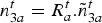 $n_{3a}^t = R_a^t. \tilde n_{3a}^t $
. Leisure time in the third period therefore consists of two parts: non-employment time before the effective retirement age
 $R_a^t (1 - \tilde n_{3a}^t )$
, and time in early retirement after it
 $(1 - R_{a\;} ^t )$
. Equation (4) then describes composite enjoyed leisure of an older worker as a constant elasticity of substitution (CES) function of both parts. Like Buyse et al. (Reference Buyse, Heylen and Van de Kerckhove2013), we assume imperfect substitutability between the two leisure types. The idea is that leisure time after and between periods of work is not the same as leisure time in periods when individuals are not economically active anymore.Footnote
1
Equation (4) expresses that individuals prefer to have a balanced combination of both rather than an extreme amount of one of them (and very little of the other). In this equation ζ is the constant elasticity of substitution, μ is a usual share parameter and Γ is added as a normalization constant such that the magnitude of
 $\ell _{3a}^t $
corresponds to the magnitude of total leisure time
 $(1 - n_{3a}^t )$
. The latter assumption allows us to interpret γ
3 as the relative value of leisure versus consumption in the third period, comparable with γ
1 and γ
2. The main results in this paper are not in any way influenced by the magnitude of μ, Γ or ζ.
2.3. Individuals: budget constraints
Equations (6)–(10) describe the budget constraints that individuals are subject to. We briefly explain these constraints, paying particular attention to the determinants of the old-age pension benefit that individuals receive, and its relationship to employment and human capital in earlier periods.
 $$\hskip -23pt (1 + {\tau _c})c_{1a}^t + \; {\rm \Omega} _{1a}^t = {w_{a,t}}h_{1a}^t n_{1a}^t (1 - {\tau _w}) + b{w_{a,t}}h_{1a}^t (1 - {\tau _w})(1 - n_{1a}^t - e_{1a}^t ),$$
 $$ \hskip -34pt \eqalign{(1 + {\tau _c})c_{2a}^t + \; {\rm \Omega} _{2a}^t & = {w_{a,t + 1}}{h_{2a}^t} {n_{2a}^t} (1 - {\tau _w}) + b{w_{a,t + 1}}{h_{2a}^t} (1 - {\tau _w})(1 - n_{2a}^t ) \cr & \quad + (1 + {r_{t + 1}}){\rm \Omega} _{1a}^{t},} $$
 $$\eqalign{(1 + {\tau _c})c_{3a}^t + \; {\rm \Omega} _{3a}^t & = {w_{a,t + 2}}h_{3a}^t R_a^t \tilde n_{3a}^t (1 - {\tau _w}) + b{w_{a,t + 2}}h_{3a}^t (1 - {\tau _w})R_a^t (1 - \tilde n_{3a}^t ) \cr & \quad + {b_{er}}{w_{a,t + 2}}h_{3a}^t (1 - {\tau _w})(1 - R_a^t ) + (1 + {r_{t + 2}}){\rm \Omega} _{2a}^t,} $$
 $$(1 + {\tau _c})c_{4a}^t = (1 + {r_{t + 3}}){\rm \Omega} _{3a}^t + pp_a^t, $$
 $$\hskip 28pt \eqalign{\,pp_a^t & = {\rho _{wa}}\mathop \sum \limits_{\,j = 1}^3 \left( {{\,p_j}{w_{a,t + j - 1}}h_{\,ja}^t n_{\,ja}^t (1 - {\tau _w}){{(1 + x)}^{4 - j}}} \right)\; \; \cr & \quad + {\rho _{\,fa}}\left( {\displaystyle{1 \over 9}} \right)\mathop \sum \limits_{\,j = 1}^3 \mathop \sum \limits_{a = H,M,L} \left( {{w_{a,t + 3}}h_{\,ja}^{t + 4 - j} n_{\,ja}^{t + 4 - j} (1 - {\tau _w})} \right),} $$
with: 0 ≤ p j ≤ 1
 $$\hskip -186pt\mathop \sum \limits_{\,j = 1}^3 {\,p_j} = 1$$
 $$\hskip -176pt n_{3a}^t = R_a^t {\tilde n}_{3a}^t. $$
The left hand side (LHS) of Equations (6)–(9) shows that individuals allocate their disposable income to consumption (including consumption taxes, τ
c
) and to the accumulation of non-human wealth. We denote by
 ${\rm \Omega} _{ja}^t $
the stock of wealth held by a type a individual of generation t at the end of the jth period of the individual's life. Individuals start adult life with zero assets. As is clear from Equation (9), they also finish life with zero assets. During the three periods of active life, disposable income at the right hand side (RHS) includes after-tax labor income and non-employment benefits. From the second to the fourth period, it may also include interest income. We denote by w
a,k
the real wage per unit of effective labor supplied at time k by an individual with ability a and by r
k
the exogenous (world) real interest rate at time k.
Effective labor of an individual with ability a depends on hours worked
 $(n_{ja}^t )$
and human capital
 $(h_{ja}^t )$
. Given the tax rate on labor income τ
w
, young individuals earn an after-tax real wage equal to
 ${w_{a,t}}h_{1a}^t n_{1a}^t (1 - {\tau _w})$
. After-tax labor income of middle aged and older workers in Equations (7) and (8) is determined similarly. For the fraction of time that young, middle aged and older individuals are inactive, they receive a non-employment benefit from the government. Older individuals may be eligible to two kinds of benefits: standard non-employment benefits (analogous to what young and middle aged workers receive) as long as they are on the labor market, and early retirement benefits after having withdrawn from the labor market. All benefits are defined as a proportion of the after-tax wage of a full-time worker. The net replacement rate for standard non-employment benefits is b, for early retirement benefits it is b
er
Footnote
2
.
After the statutory retirement age (65) individuals have no labor income and no non-employment benefits anymore. They earn interest income from accumulated non-human wealth, and they receive an old-age pension benefit
 $(pp_a^t )$
. We assume a public PAYG pension system in which pensions in period k are basically financed by contributions from the active generations in that period k (see below). As described by Equation (10), individual net pension benefits consist of two components. A first one is related to the individual's earlier net labor income. It is a fraction of the individual's so-called pension base, i.e. a weighted average of revalued net labor income in each of the three active periods of life. The net replacement rate is ρ
wa
. The parameters p
1, p
2 and p
3 represent the weights attached to each period. This part of the pension rises in the individual's hours of work
 $n_{ja}^t$
and the individual's human capital
 $h_{ja}^t $
. It will be lower when the individual retires early (lower
 $R_a^t $
). Thanks to revaluation, this part of the net pension is adjusted to increases in the overall standard of living between the time that workers build their pension entitlements and the time that they receive the pension. We assume that past earnings are revalued in line with economy-wide wage growth x and hence follow practice in many OECD countries (OECD, 2005)Footnote
3
. The second component of the pension is a flat-rate or basic pension. Every retiree receives the same amount related to average net labor income in the economy at the time of retirement. This assumption assures that also basic pensions rise in line with productivity. Here, the net replacement rate is ρ
fa
.
Note that we allow ability-specific pension replacement rates ρ wa and ρ fa . This specification is in line with the data in many countries. The importance of own-income related versus flat components may be very different depending on people's earned income, and therefore ability (see Section 4 and Table 2 below). For other policy variables like labor tax rates such differences are much smaller (Heylen and Van de Kerckhove, Reference Heylen and Van de Kerckhove2013). The introduction of ability-specific pension replacement rates also allows a richer policy analysis.
2.4. Individuals: human capital formation
Individuals enter our model at the age of 20 with a predetermined level of human capital. This level is generation-invariant, but it rises in innate ability. The latter reflects for example that higher innate ability makes it easier for individuals to learn and accumulate knowledge at primary and secondary school. In Equation (11) we normalize the human capital of a young individual with high ability to h 0 . A young individual with medium ability enters the model with only a fraction ε M of this. A young worker with low ability enters with an even lower fraction ε L . These fractions will be calibrated.
 $$h_{1a}^t = {\varepsilon _a}{h_0}\quad \forall \; a = H,M,L$$
with 0 < ε L < ε M < ε H = 1.
During youth, individuals with high and medium ability will invest a fraction of their time to expand their human capital, making them more productive in the second and third period. We adopt in Equation (12.a) a human capital production function similar to Lucas (Reference Lucas1990), Glomm and Ravikumar (Reference Glomm and Ravikumar1998), Bouzahzah et al. (Reference Bouzahzah, de la Croix and Docquier2002) and Docquier and Paddison (Reference Docquier and Paddison2003). The production of new human capital by these individuals rises in the amount of time they allocate to education
 $(e_{1a}^t )$
and in their initial human capital
 $(h_{1a}^t )$
. We assume a common elasticity of time input (σ) and a common efficiency parameter (φ) for both ability types. Individuals with low innate ability do not study. In Equation (12.b) their human capital remains constant. Finally, we assume in Equation (13) that the human capital of all individuals remains unchanged between the second and the third period. We have in mind that learning by doing in work may counteract depreciation. The same assumption explains the lack of depreciation in Equation (12). In no way does this assumption affect our main results in this paper.
 $$h_{2a}^t = h_{1a}^t (1 + \varphi {(e_{1a}^t )^\sigma} )\quad \forall a = H,M,$$
 $$ \hskip -111pt h_{2L}^t = h_{1L}^t, $$
 $$\hskip -38pt h_{3a}^t = h_{2a}^t, \; \quad \forall a = H,M,L$$
with 0 < σ ≤ 1, φ > 0.
2.5. Individuals: optimization and the role of the pension system
Low-ability individuals will choose consumption, labor supply in each period of active life, and their effective retirement age to maximize Equation (1), subject to Equations (2)–(13). Individuals of medium and high ability will also choose the fraction of time they spend in education when young. For details on the optimality conditions, we refer to our more extensive companion working paper (Buyse et al., Reference Buyse, Heylen and Van de Kerckhove2014). Here we restrict the discussion to the role of the pension system.
The pension system in our model is of the PAYG type as we see it in most OECD countries. Expenditures are basically financed by contributions from workers (labor taxes). However, since we do not define a strictly separate budget for the pension system, the government may also support it using other resources from its general budget (see Section 2.7). It will be obvious from our discussion of Equation (10) that for a given way of financing the specific organization of pension benefits may have strong effects on behavior in earlier periods of life. Both income and substitution effects occur:
-
- A higher replacement rate ρ wa raises the return to working (n, for all ability groups) and to building human capital (e, h, for high- and medium-ability individuals) in earlier periods. It will encourage individuals to work and to invest in education.
-
- Changes in the particular weights of the periods that constitute the pension assessment base to which ρ wa applies may modify these incentive effects. The return to working in a particular period rises in the weight attached to that period. A shift in weight from p 1 to p 3 brings strong incentives to work less when young, and to work more and longer when old. This shift also includes a strong incentive to invest in human capital. The net return to education rises in p 2 and p 3, but falls in p 1.
-
- Pension systems that encourage individuals to work more when middle aged or older, also stimulate them to study when young (at least when they have medium or high innate ability). The reason is that an increase in n 2 or n 3 raises the return to education. Conversely, individuals who invest more in human capital when young will also prefer to work more and longer at higher age. The reason here is that a higher level of human capital raises wages and the return to working.
-
- Higher replacement rates ρ wa do not only bring about substitution effects, however. Raising individuals’ consumption possibilities, they also cause adverse income effects on labor supply.
-
- The story is different when old-age benefits are of the basic pension type (ρ fa ). These cause no substitution effects, and thus no incentive effects to work or study. They only affect employment (negatively) via the income effect. Since lower employment in later periods affects the return to education, a basic pension system would also discourage investment in education. Shifting from an earnings-related to a basic pension system is bad for efficiency.
Obviously, for a proper assessment of the effects of pension systems and reforms, one cannot disregard the issue of financing. In this respect, it has been shown in the literature that if an increase of the replacement rate ρ wa and the future pension benefit is associated with an increase in the tax rate on labor, the positive effect on labor supply disappears. In most cases, i.e. when the present discounted value of benefits is lower than the value of the contributions, the effect may turn negative (see e.g., also Cigno, Reference Cigno2008; Fisher and Keuschnigg, Reference Fisher and Keuschnigg2010). The positive effect on education will not disappear, however. A pension system with earnings-related benefits will always encourage individuals to invest in education when young. The reason is that when the present value of future benefits is lower than the value of the contributions, an implicit tax structure results that has high tax rates on labor income in the first period of active life and lower tax rates towards the end. This subsidizes human capital formation (see also Kindermann, Reference Kindermann2015). Raising individuals’ future wages, a higher level of human capital will then recreate positive incentive effects for individuals to work when middle aged and older. All these interactions between endogenous labor and endogenous human capital, supplied by individuals of different generations and ability, clearly highlight the need for a larger scale numerical analysis of pension reform. We carry out this analysis in Section 5.
2.6. Domestic firms, output and factor prices
Firms act competitively on output and input markets and maximize profits. All firms are identical. Total domestic output (Y t ) is given by the production function (14). Production exhibits constant returns to scale in aggregate physical capital (K t ) and labor in efficiency units (A t Ht ), so that profits are zero in equilibrium. Technology A t is growing at an exogenous and constant rate x: A t+1 = A t (1 + x). Equation (15) defines total effective labor as a CES aggregate of effective labor supplied by the three ability groups. In this equation s is the elasticity of substitution between the different ability types of labor and η H , ηM and η L are the input shares. We will impose that η H = 1 − η M − η L .
 $${Y_t} = K_t^\alpha {({A_t}{H_t})^{1 - \alpha}}, $$
 $${H_t} = {\left( {{\eta _H}H_{H,t}^{1 - \displaystyle{\scriptstyle{1} \over s}} + {\eta _M}H_{M,t}^{1 - \displaystyle{\scriptstyle{1} \over s}} + {\eta _L}H_{L,t}^{1 - \displaystyle{\scriptstyle{1} \over s}}} \right)^{\displaystyle{s \over {s - \scriptstyle{1}}}}}. $$
Equation (16) specifies effective labor per ability group. Within each ability group we assume perfect substitutability of labor supplied by the different age groups.
 $${H_{a,t}} = n_{1a}^t h_{1a}^t + n_{2a}^{t - 1} h_{2a}^{t - 1} + n_{3a}^{t - 2} h_{3a}^{t - 2}. $$
Competitive behavior implies in Equation (17) that firms carry physical capital to the point where its after-tax marginal product net of depreciation equals the world real interest rate. Physical capital depreciates at rate δ k . Capital taxes are source-based: the tax rate τ k applies to the country in which the capital is used, regardless of who owns it. The (world) real interest rate being given, firms will install more capital when the amount of labor in efficiency units increases or the capital tax rate falls. In that case the net return to investment in the home country rises above the world interest rate, and capital flows in. Furthermore, perfect competition implies equality between the real wage and the marginal product of effective labor for each ability type (Equation (18)). Workers of a particular ability type will earn a higher real wage when their supply is relatively scarce, when the level of technology is higher, and when physical capital per unit of aggregate effective labor is higher.
 $$\left[ {\alpha {{\left( {\displaystyle{{{A_t}{H_t}} \over {{K_t}}}} \right)}^{1 - \alpha}} - {\delta _k}} \right](1 - {\tau _k}) = {r_t}, $$
 $$(1 - \alpha )A_t^{1 - \alpha} {\left( {\displaystyle{{{K_t}} \over {{H_t}}}} \right)^\alpha} {\eta _a}{\left( {\displaystyle{{{H_t}} \over {{H_{a,t}}}}} \right)^{\displaystyle{\scriptstyle{1} \over s}}} = {w_{a,t}}\quad \forall a = H,M,L.$$
Our assumptions of constant population and of individuals entering the model with a predetermined and generation-invariant level of human capital imply that in steady state effective labor will be constant. Physical capital, output and real wages by contrast will all grow at the exogenous technology growth rate x.
2.7. Government
Equation (19) describes the government's budget constraint. Demand for goods G t , benefits related to non-employment B t (including early retirement benefits), old-age pension benefits PP t , and interest payments r t Dt are financed by taxes on labor T nt , taxes on capital T kt , and taxes on consumption T ct and/or by new debt ΔD t+1. We define D t as outstanding public debt at the beginning of period t.
 $${\rm \Delta} {D_{t + 1}} = {D_{t + 1}} - {D_t} = {G_t} + {B_t} + P{P_t} + {r_t}{D_t} - {T_{nt}} - {T_{kt}} - {T_{ct}},$$
with: G t = gY t
 $$\eqalign{{B_t} & = \sum\limits_{a = H,M,L} {\left( {(1 - n_{1a}^t - e_{1a}^t )b{w_{a,t}}h_{1a}^t (1 - {\tau _w}) + (1 - n_{2a}^{t - 1} )b{w_{a,t}}h_{2a}^{t - 1} (1 - {\tau _w})} \right.} \cr & \quad \left. { + R_a^{t - 2} (1 - \tilde n_{3a}^{t - 2} )b{w_{a,t}}h_{3a}^{t - 2} (1 - {\tau _w}) + (1 - R_a^{t - 2} ){b_{er}}{w_{a,t}}h_{3a}^{t - 2} (1 - {\tau _w})} \right)} $$
 $$\hskip -53pt \eqalign{P{P_t} & = \mathop \sum \limits_{a = H,M,L} \left( {{\rho _{wa}}\sum\limits_{j = 1}^3 {\left( {{p_j}{w_{a,t + j - 4}}h_{ja}^{t - 3} n_{ja}^{t - 3} (1 - {\tau _w}){{(1 + x)}^{4 - j}}} \right)} } \right. \cr & \quad + \left. {{\rho _{fa}}\left( {\displaystyle{1 \over 9}} \right)\sum\limits_{j = 1}^{3} {\sum\limits_{a = H,M,L} {\left( {{w_{a,t}}h_{ja}^{t + 1 - j} n_{ja}^{t + 1 - j} (1 - {\tau _w})} \right)} } } \right)} $$
 $$\hskip -145pt {T_{n,t}} = {\tau _w}\sum\limits_{a = H,M,L} {\left( {\sum\limits_{\,j = 1}^3 {n_{\,ja}^{t + 1 - j} {w_{a,t}}h_{\,ja}^{t + 1 - j}}} \right)} $$
 $$ \hskip -224.5pt {T_{kt}} = {\tau _k}(\alpha {Y_t} - {\delta _k}{K_t})$$
 $$\hskip -151pt {T_{ct}} = \; {\tau _c}\mathop \sum \limits_{\,j = 1}^4 \left( {c_{\,jH}^{t + 1 - j} + c_{\,jM}^{t + 1 - j} + c_{\,jL}^{t + 1 - j}} \right).$$
Note our assumption that the government claims a given fraction g of output. Goods bought by the government have no effect on private sector productivity, nor do they directly affect individuals’ utility. Non-employment benefits (B t ) are an unconditional source of income support related to inactivity (leisure) and non-market household activities as in Rogerson (Reference Rogerson2007) and Dhont and Heylen (Reference Dhont and Heylen2009). Although it may seem strange to have such transfers in a model without involuntary unemployment, there is clear practical relevance. Unconditional or quasi unconditional benefits to structurally non-employed people are a fact of life in many European countries. Note also our assumption that the pension system is fully integrated into government accounts. We do not impose a specific financing of the PAYG pension plan. The government can use resources from the general budget to finance pensions.
2.8. Aggregate equilibrium and the current account
Optimal behavior by firms and households and government spending underlie aggregate domestic demand for goods in the economy. Our assumption that the economy is open implies that aggregate domestic demand may differ from supply and income, which generates international capital flows and imbalance on the current account. Equation (20) describes aggregate equilibrium as it can be derived from the model's equations. The LHS of (20) represents national income. It is the sum of domestic output Y t and net factor income from abroad r t Ft , with F t being net foreign assets at the beginning of t. The aggregate stock of wealth Z t accumulates wealth held by individuals who entered the model in t−1, t−2 and t−3. At the RHS of (20) CA t stands for the current account in period t.
 $${Y_t} + {r_t}{F_t} = {C_t} + {I_t} + {G_t} + C{A_t}, $$
with: F t = Z t − K t − D t
 $$\hskip -129pt C{A_t} = {F_{t + 1}} - {F_t} = {\rm \Delta} {Z_{t + 1}} - {\rm \Delta} {K_{t + 1}} - {\rm \Delta} {D_{t + 1}}$$
 $$\hskip -232pt {I_t} = {\rm \Delta} {K_{t + 1}} + {\delta _k}{K_t}.$$
3. Parameterization
The economic environment described above allows us to simulate the effects on employment, education, output and welfare of various changes in the pension system. Our main contribution in this paper is that we model and assess differential effects for individuals with different ability. This simulation exercise requires us first to parameterize and solve the model. Table 1 contains an overview of all parameters. Many have been set in line with the existing literature. Others have been calibrated to match key data.
Parameterization and benchmark equilibrium

Notes: 1 Values for Belgium. For a detailed description of these policy parameters, see Buyse et al. (Reference Buyse, Heylen and Van de Kerckhove2014). For a description of the pension policy parameters, see also Section 4 in this paper.
2 Values for Belgium. For a detailed description, see Table 1 and Appendix A in Buyse et al. (Reference Buyse, Heylen and Van de Kerckhove2014). Employment rates (n j ) are computed as actual annual per capita hours worked divided by 2080 in the respective age groups (20–34, 35–49, 50–64). The employment rate would be 100% if all people in the age group worked 2080 h per year (52 weeks, 40 h per week). Education (e) is our proxy for the fraction of time spent studying by the average person of age 20–34. It is computed as the total number of students in full-time equivalents, divided by total population in this age group. R (in years) is the average age of all persons older than 40 withdrawing from the labor force. The data for n j and e are averages over 1995–2007. The value for R is an average over 1995–2006.
3 As a proxy for the relative wage of low-ability (medium-ability) young workers, we use available data on earnings of workers of age 25–34 with below upper secondary education (with secondary education) in the USA relative to earnings of workers with a tertiary degree. The data concern 2007.
Data source: OECD Education at a Glance, 2009, Table A7.1a.
We set the rate of time preference at 1.5% per year, the (exogenous and constant) world real interest rate at 4.5% per year and the physical capital depreciation rate at 8% per year. Considering that periods in our model last 15 years, this choice implies a discount factor β = 0.8, an interest rate r = 0.935 and physical capital depreciation δ k = 0.714. In the production function for goods we assume a capital share coefficient α equal to 0.3. The elasticity of substitution s between the different ability types of effective labor is set equal to 1.5. Our values for the rate of time preference, the capital share and capital depreciation are well within the range of values imposed in the literature (e.g., Altig et al., Reference Altig, Auerbach, Kotlikoff, Smetters and Walliser2001; Heijdra and Romp, Reference Heijdra and Romp2009; Ludwig et al., Reference Ludwig, Schelkle and Vogel2012). So is the value for s. The empirical labor literature consistently documents values between 1 and 2 (see Caselli and Coleman, Reference Caselli and Coleman2006). For the value of the intertemporal elasticity of substitution in leisure (1/θ) we follow Rogerson (Reference Rogerson2007, p. 12). He puts forward a reasonable range for θ from 1 to 3. In line with this, we impose θ to be equal to 2. This choice implies an elasticity of labor supply which is much higher than the very low elasticities typically found in micro studies. Given our macro focus, however, these micro studies may not be the most relevant ones (see Rogerson and Wallenius, Reference Rogerson and Wallenius2009; Fiorito and Zanella, Reference Fiorito and Zanella2012).
Four parameters relate to human capital production. For the elasticity with respect to education time (σ) we choose a conservative value of 0.3. This value is within the range considered by Bouzahzah et al. (Reference Bouzahzah, de la Croix and Docquier2002) and Docquier and Paddison (Reference Docquier and Paddison2003), but much lower than the elasticity of 0.80 that we see in Lucas (Reference Lucas1990) or Glomm and Ravikumar (Reference Glomm and Ravikumar1998). The choice of a conservative value for σ excludes that our main findings in the next sections might be due to an overestimation of the returns to educationFootnote 4 . The literature provides much less guidance for the calibration of the relative initial human capital of medium- and low-ability individuals (relative to the initial human capital of high-ability individuals, ε M and ε L ). To determine these parameters we rely on Programme for International Study Assessment (PISA) science scores. These scores leave no doubt. In about all OECD countries the science test score of students at the 17th percentile varies between 65% and 69% of the test score of students at the 83th percentile, while the science test score of students at the 50th percentile varies between 82.5% and 85.5% of the test score of students at the 83th percentileFootnote 5 . The differences across countries in these relative scores are extremely small. We can take them as objective indicators of the relative cognitive capacity of low- and medium-ability individuals, and will correspondingly set ε L equal to 0.67 and ε M equal to 0.84. Last but not least, the efficiency parameter φ in the human capital production function has been determined by a calibration procedure that we discuss now.
We determined eight parameters by calibration. Next to the efficiency parameter in human capital production (φ), these are the exogenous technology growth rate (x), two share parameters in aggregate effective labor (η M and η L , where η H follows as 1 − η L − η M ), three taste for leisure parameters (γ 1, γ 2, γ 3) and the elasticity of substitution (ζ) in the composite leisure function in Equation (4). The calibration target values are reported at the bottom of Table 1. Six of them concern Belgium: three employment rates, the effective retirement age, aggregate participation in tertiary education and growth. We choose Belgium since it is a small open economy (and therefore matches key assumptions of our model) and since in Belgium public pension benefits are calculated exactly as we model themFootnote 6 . The other two target values are the relative wages of young workers with below upper secondary education and young workers with upper secondary education in the USA compared with workers with tertiary education. Although in practice a whole system of simultaneous equations is solved in which each target value is important for each parameter to be calibrated, it may be useful for our exposition here to bring some more structure. Certain parameters are clearly more than others linked to certain target values. The calibrated growth rate of technology (x) reflects total per capita output growth over a period of 15 years, annual growth in Belgium being 1.77%. The leisure parameters, including the elasticity of substitution in the composite leisure function (4), are basically determined so that with observed levels of the policy variables in Belgium (tax rates, non-employment benefit replacement rates, pension replacement rates, etc.), the model correctly predicts Belgium's employment rates by age (n 1, n 2, n 3) and effective early retirement age (R). By the same approach the efficiency parameter in human capital production (φ) is mainly determined to correctly predict participation in education (e). We find that the taste for leisure rises with age (γ 1 = 0.074, γ 2 = 0.147, γ 3 = 0.258) and observe a stronger degree of substitutability than in the Cobb–Douglas case between the two types of leisure for older workers (ζ = 1.54). The efficiency parameter φ turns out to be 1.21. Finally, calibration of the share parameters η M and η L is mainly driven by the values for relative wages of young workers in the USA. They are determined so that with observed levels of the policy variables in the USA, and given the whole set of other parameters, the model correctly predicts these relative wages. As shown by Equation (18), the share parameters are important determinants of the relative productivity of labor. Actual wages are informative if a close link can be assumed between wages and productivity. This condition is much more likely fulfilled in the USA than in Europe, which explains the introduction here of US relative wages rather than Belgian ones. We provide more detail on our calibration procedure to obtain η L and η M in our companion paper (Buyse et al., Reference Buyse, Heylen and Van de Kerckhove2014, Appendix B). The results imply η L = 0.19, η M = 0.33 and η H = 0.48.
Finally, we had no ex ante indication on the remaining parameters in the composite leisure function in Equation (4). We impose equal weight for both leisure types (μ = 0.5). The normalization parameter Γ equals 2. The size of this parameter has no impact at all on our results.
4. Pension policy in 13 OECD countries
We report and describe the fiscal and pension policy data that underlie our numerical work extensively in our companion paper (Buyse et al., Reference Buyse, Heylen and Van de Kerckhove2014). The data concern 13 OECD countries. Here, in Table 2, we limit ourselves to the pension policy parameters ρ wa and ρ fa , and to how they may be different for people with low, medium and high earnings potential. In this way we give more insight into the reality behind the key pension policy parameters in our model. The data have been taken or computed from OECD (2005). They include only (quasi-)mandatory pension programsFootnote 7 . In line with our specification in Equation (10), ρ wa is expressed as a percentage of an individual's average lifetime net labor income, while ρ fa is expressed as a percentage of average economy-wide net labor income at the time of retirement. We consider individuals at 50% of mean earnings as representative for the low-ability group, individuals with mean earnings as representative for the medium-ability group and individuals at twice the mean earnings as representative for the high-ability group. In the majority of countries individuals with mean or higher earnings only receive earnings-related pensions (ρ wa > 0, ρ fa = 0 for a = M, H). Among these countries, Austria and Italy pay the highest net replacement rates (ρ wM > 85%), Belgium and the USA the lowest (ρ wM < 65%)Footnote 8 . Five countries also pay basic pensions to individuals with mean or higher earnings: the Netherlands, Denmark, Norway, the UK and Canada. For individuals with low earnings, the situation is somewhat the opposite. Their pension includes a significant basic (or similar) component in most countries. Unsurprisingly, the Netherlands, Denmark and the UK pay the highest ‘basic’ amountsFootnote 9 .
Net pension replacement rates

Notes: Pension replacement rates have been taken or computed from OECD (2005, p. 52 and part II). The data concern 2002. For more details, see Appendix A in Buyse et al. (Reference Buyse, Heylen and Van de Kerckhove2014).
5. Public pension reform
In this section we study the effects of various reforms of the pension system on employment, education (human capital), income and welfare. We report steady state aggregate effects and effects per generation and per ability group. To solve our model and to perform our policy simulations, we choose an algorithm that preserves the non-linear nature of the model. We follow the methodology basically proposed by Boucekkine (Reference Boucekkine1995) and implemented by Juillard (Reference Juillard1996) in the program Dynare. We use Dynare 4.4. Throughout all our policy simulations we assume that the government maintains a constant debt to gross domestic product (GDP) ratio in each period. To reach this goal, it adjusts the consumption tax rate. For a proper understanding of timing, it will be our assumption that the economy is in steady state at time t = −1. Reform is announced at time t = 0 and implemented with a delay of 1 period, i.e., at time t = 1. Hence, reforms apply to everyone except the generation of retirees at t = 0, since they are no longer able to adapt their behaviorFootnote 10 . In Section 5.1 we discuss our main findings. Section 5.2 summarizes the results of some additional simulations investigating robustness and underlying mechanisms.
5.1. Main findings
We report our results in Tables 3 and 4 and Figure 2. We focus on seven (permanent) reforms in key features of the pension system. Table 3 shows the steady state effects on employment rates by age (j = 1, 2, 3) and by ability (a = H, M, L), aggregate employment, the effective retirement age of older workers, average participation in education and per capita output. Following Buyse et al. (Reference Buyse, Heylen and Van de Kerckhove2013), the benchmark from which we start, and against which all policy shocks are evaluated, is the average of six core euro area countries. The parameters describing the benchmark pension system are indicated in the upper left corner of the table and in the first note below the table. Individual earnings-related replacement rates vary in the benchmark between 59% (ρ wL ) and 71% (ρ wM ). They are applied to a pension base where each active period has equal weight (p ja = 1/3). Basic pensions take values between 6% (ρ fH ) and 14.6% (ρ fL ) of aggregate average net labor income. There is no particular minimum pension (MP = 0). The percentage point change in the consumption tax rate to maintain a constant debt to GDP ratio is indicated at the bottom of the table.
Welfare effects for individuals belonging to current and future generations after pension reform. Note: The vertical axis indicates the welfare effect for individuals belonging to the generation born k periods after the announcement of permanent pension reform. The horizontal axis indicates k. Negative numbers for k point at generations born before the (announcement of the) reform.

Steady state effects of pension reform – Effects for a benchmark of 6 core euro area countries (Austria, Belgium, France, Germany, Italy and the Netherlands)

Notes: Initial policy values: ρ
wL
= 59.4%, ρ
wM
= 70.6%, ρ
wH
= 66.1%, ρ
fL
= 14.6%, ρ
fM
= 7.0%, ρ
fH
= 6.0%. Initial steady state (benchmark):
 ${n_1} = 55.1\% $
,
 ${n_2} = 61.3\% $
,
 ${n_3} = 39.9\% $
, R = 59.4,
 $e = 13.7{\rm \%} $
,
 $n = 53.0\% $
,
 ${n_H} = 52.1\% $
,
 ${n_M} = 52.2\% $
,
 ${n_L} = 54.7\% $
,
 ${\tau _c} = 13.6\% $
. For details, see Buyse et al. (Reference Buyse, Heylen and Van de Kerckhove2014).
1 Difference in percentage points between the new steady state and the benchmark, except for total hours worked, per capita output and R.
2 Change in optimal effective retirement age, in years.
3 Change in (weighted) aggregate employment rate in hours, change in percentage points.
4 Difference in percent between new steady state and the benchmark.
5 Change in consumption tax rate in percentage points to keep the ratio of debt to GDP constant.
Net welfare effect after compensating welfare transfers (expressed as % of initial GDP)

Note: for a description of the computation of these data, see main text.
Figure 2 shows the welfare effects of these policy changes for high-ability and low-ability individuals of current and future generations. The results for medium-ability individuals are in general close to those for the high-ability group. We report on the vertical axis the welfare effect on individuals of the generation born k periods after the announcement of the policy reform, where k is indicated on the horizontal axis. So, the data at k = 0 for example concern the young in the period of the policy announcement. The data at k = −3 concern the retirees in that periodFootnote 11 . Our welfare measure is the (constant) percentage change in benchmark consumption in each period of remaining life that individuals should get to attain the same lifetime utility as after the policy shock (see also King and Rebelo, Reference King and Rebelo1990). To compute this percentage change we keep employment rates at the benchmark. For example, policy 1 implies a welfare gain for the current high-ability young (k = 0) equal to 2.4% of benchmark consumption. It implies a welfare loss for the current older low-ability individuals (k = −2) equal to 3% of their benchmark consumption.
In Table 4 we integrate the welfare effects induced by each policy reform into a single aggregate summary measure. For each individual we first compute the present discounted value of the total consumption change over life that is required in the benchmark to make him equally well off as under the policy reform. The basis of our computation is the data that we report in Figure 2. But now we also take into account differences in the length of remaining life. For young individuals the data in Figure 2 apply to four periods, whereas for retired individuals they only apply to one remaining period. Next, we impose that all those who lose under the new policy are compensated by the winners. Our summary measure is the present discounted value of the net aggregate consumption gain of all winners after having compensated the losers, in percent of initial GDP. The first row in Table 4 includes only those generations of all three ability types that live at the moment the reform is announced. The second row includes all current and four future generations into the computation.
The starting point of our discussion is policy 1, which introduces for all individuals an increase in p 3, and a fall in p 1, along the lines preferred by Buyse et al. (Reference Buyse, Heylen and Van de Kerckhove2013). To compute the pension base, the weight of labor income earned as an older worker rises to 2/3, the weight of labor income earned when young falls to 0. Our results confirm the important positive effects of such a reform for aggregate hours worked, for hours worked by older workers, for human capital formation by the young and for per capita output. The higher (lower) marginal utility from work when older (young) makes it interesting to shift work from the first period of active life to the third, and to postpone effective retirement (n 3 and R rise, n 1 falls). The positive effect that we observe on R and n 3 is fully in line with earlier arguments by Sheshinski (Reference Sheshinski1978) and Gruber and Wise (Reference Gruber and Wise2002), among others. Jaag et al. (Reference Jaag, Keuschnigg and Keuschnigg2010) also predict a shift from n 1 to n 3 when p 1 falls and p 3 rises. Unlike in Jaag et al., however, the role of endogenous education in our model strongly qualifies the fall in young workers’ labor supply. As is clear from Table 3, participation in tertiary education (e) increases. Young individuals – at least those of high and medium ability – are encouraged to study because the lifetime rate of return to building human capital rises. This follows first from the reduction of the opportunity cost of studying when young, second from the perspective of working longer and third from the greater importance of effective human capital when old in the calculation of the pension. Extra schooling reinforces incentives to work at older age. Individuals of low innate ability do not have the option to study and to enjoy higher human capital. These individuals can only respond to the new policy by working more and longer (Δn L = 1.75). In the end they are the only ones to work more over their lifetime. The individuals with medium or high ability do not (Δn H , Δn M ≈ 0). As a final positive effect of policy 1 we observe a significant improvement in the overall government budget. The bottom row of Table 3 reveals that the government will be able to maintain a constant public debt to GDP ratio with a reduced consumption tax rate (−2.71%-points).
A quick comparison with the other policies in Table 3, to be discussed immediately, reveals that most of these policies are less effective than policy 1 when it comes to promoting employment of older workers, investment in human capital and per capita output. A major disadvantage of policy 1, however, is the welfare loss that it imposes on the current generations of low-ability individuals (Figure 2, upper panel, RHS). These individuals work more, but can hardly consume more. Even if policy 1 may be part of the solution to the overall challenge of employment and productivity in today's economies, and in that sense contribute to safeguard the welfare state in the future, it may also worsen conditions for many lower-ability individuals. Moreover, it may offer no solution to the problem of old-age poverty faced by many. Figure 3 shows an important fall of about 7% relative to the benchmark in the pension level of all generations of low ability individuals to come. These observations make it also politically difficult to impose such a policy.
Pension level (relative to the benchmark) of low-ability retirees at time t (where t = 0 is when the policy reform is announced, and t = 1 when it is implemented). Note: Policy 7 is not included. This policy implies a gradual reduction of public pensions to zero.

Policies 2 and 3 tackle the problem of low pensions and welfare for low-ability individuals. Policy 2 maintains all benchmark replacement rates, but also introduces a minimum pension. Individuals are sure of a pension equal to at least 60% of the average net labor income per worker in the economy. In practice the latter implies a strong increase in the pension level for the low-ability group (see also Figure 3), but no ex-ante change for the other two groups. Their optimal behavior, given their human capital endowment and all policy variables, implies a pension that is above 60% of the average net wage from the beginning. We remind that none of the policy reforms that we discuss apply to the retired at the moment of the announcement of the reform, so they are not eligible to the minimum pension. As shown by Figure 2, all low-ability individuals experience welfare increases up to about 5% under policy 2. For the welfare of all other individuals, however, these policies have negative effects. A key element is the drastic drop in the employment rate among low-ability individuals. The perspective of a minimum pension weakens the incentives for them to work. In Table 3 we observe a drop in n L of about 4.8%-points. The implied fall in aggregate employment and its negative effects on the government's budget, force the latter to raise consumption tax rates for all. Furthermore, medium- and higher-ability individuals can also expect a fall in their wage per unit of effective labor due to the reduction of low-ability labor supplyFootnote 12 .
Policy 3 imposes a shift from earnings-related pensions to ‘basic’ pensions on all individuals. Every retiree gets a basic pension equal to 75% of average net labor income per worker in the economy. In our model ρ w goes to zero for all ability groups, ρ f becomes 0.75. This policy basically goes one step further than policy 2. It breaks the relationship between the pension and an individual's human capital and labor supply also for the high- and medium-ability groups. The fall in the return to studying and to working also for these groups is at the basis of an overall and strong fall in employment, education time and per capita output (see also Sommacal, Reference Sommacal2006). Figure 2 reveals negative welfare effects almost across the board, especially for higher-ability individuals and all future generations. Only current older low-ability individuals gain. They benefit most from higher pensions. However, due to the falling per capita output, this gain will not persist for the future low-ability generations. As a result, policy 3 shows among the worst net aggregate welfare effects in Table 4.
Policies 4, 5 and 6 are alternative attempts to combine the efficiency of policy 1 with the objective to raise everyone's welfare and to reduce the risk of old-age poverty for low-ability individuals. Policy 4 extends policy 1 with a minimum pension equal to 60% of the average net wage, like in policy 2. This policy is the most beneficial for the welfare of all current young and future low-ability individuals (Figure 2). They enjoy both an immediate increase in their pension, for which they have to work less, and the benefits from increased human capital formation by the high- and medium-ability groups. The latter immediately contributes to higher wages per person, also for the lower-ability individuals. Like policy 2, however, policy 4 also imposes welfare losses on the current generations of high- (and medium-ability) individuals, which reduces its chances politically. Net aggregate effects in Table 4 are still slightly negative for those generations alive when the policy change is announced.
Policy 5 tackles the problem of welfare losses and low income at old-age for the low-ability group by significantly raising their individual earnings-related pension replacement rate to 85% (Δρ wL = 25.6%-points). This policy combines the efficiency gains from policy 1 with strong incentives for the low-ability group to work more and longer. In contrast to the disincentives induced by basic or minimum pensions, policy 5 raises the return to work since it yields more future pension. Among all the reforms that we discuss in Table 3 and that maintain the PAYG system, not one has more favorable effects on the aggregate employment rate (Δn = 0.97), on the employment rate of low-ability individuals (Δn L = 3.07) and on the employment rate of older workers (Δn 3 = 8.66) than policy 5. Higher pensions can as a result be paid without the need for the government to raise consumption taxes. Given the strong rise in output and employment, τ c can even be reduced by 2.25%-points. Compared with policy 1, welfare effects are better for all low-ability generations alive at the time of announcement of the policy reform, without hurting the medium- and high-ability groups. Policy 5 induces the best net aggregate welfare effects in Table 4.
Policy 6 reconsiders the basic choice made in policy 1 to raise the weight of labor income earned as an older worker in the computation of the pension assessment base, and to reduce the weight of labor income earned when young. One of the main advantages of this choice is that it promotes education and human capital formation. Given that low-ability individuals will never continue education at the tertiary level, however, one may question this change in weights for them. Policy 6 therefore maintains the much higher individual earnings-related replacement rate for the low-ability group (ρ wL = 85%), but combines this with equal weights p j = 1/3 for this group. The shift to p 1 = 0, p 2 = 1/3 and p 3 = 2/3 only applies to medium- and high-ability individuals. The employment and output effects of policy 6 are a little less good than those of policy 1. So are the welfare effects for the individuals with high and medium ability. However, for the low-ability individuals, who work the highest fraction of their time while they are young, maintaining p 1 at 1/3 in policy 6 implies a further increase in their pension benefit and in their welfare compared with policy 5. All in all, the welfare effects from policy 6 are among the best for the low-ability individuals, with only small cost imposed on the others. In Table 4 net aggregate welfare effects from policy 6 are comparable with those from policy 1 and only a little lower than those from policy 5. Policy makers with no aversion to inequality may therefore prefer policy 5. As soon as one attaches greater weight to the evolution of the welfare of low-ability (low-income) groups, however, policy 6 may come out as preferable.
Policy 7 is a gradual shift from the PAYG system in the benchmark to a system with full private capital funding. This policy completely abolishes old-age pension benefits (ρ wa , ρfa ). For the government it implies a drastic cut in pension expenditures. We assume that this drop in expenditures feeds through into lower social security contributions for all workers such that, ex ante, the decline in total labor tax receipts in % of GDP is exactly the same as the drop in pension expenditures.Footnote 13 We observe in Table 3 that this transition to a fully-funded private pension scheme is most beneficial for employment. The new steady state shows higher hours worked among all ability groups and all age groups. The aggregate employment rate n rises by about 2.8%-points. The rise in employment is the strongest among young workers and among individuals with lower innate ability. Aggregate per capita output also rises strongly (+ almost 4%) and the overall government balance improves. To maintain a constant debt to GDP ratio, the government can reduce the consumption tax rate by 5.75%-points. Considering existing literature (e.g., Fisher and Keuschnigg, Reference Fisher and Keuschnigg2010; Ludwig et al., Reference Ludwig, Schelkle and Vogel2012), these positive effects come as no surprise. The same holds, however, for a number of negative effects from moving to a fully-funded private system. First of all, the steady state time allocated to education falls, confirming the theoretical expectations of Kemnitz and Wigger (Reference Kemnitz and Wigger2000), Buyse et al. (Reference Buyse, Heylen and Van de Kerckhove2013) and Kindermann (Reference Kindermann2015), among others. Next, Figure 2 reveals a strong intertemporal trade-off in the welfare effects from moving to a fully-funded system. Future generations gain, but current, transitional generations experience large welfare lossesFootnote 14 . This result is also well-known in the literature. It applies to all three ability groups. Individuals with low ability in the transitional generations are hit the hardest though. The very substantial welfare gains for future generations that movement to a fully-funded system may bring about, also when compared with the future gains from e.g., policies 1 or 6, cannot wipe out these welfare losses in the shorter run. In Table 4, when we take into account welfare effects on all current and four future generations, a slight negative net result remains.
5.2. Robustness and underlying mechanisms
Policies 5 and 6 emerged as most preferable from the simulations that we reported in the previous section. In this section we summarize the results of some additional series of simulations.
The first series was inspired by the fact that governments cannot observe individuals’ ability. The question that follows is obvious. Low-ability individuals receive very high pension replacement rates in policies 5 and 6. Could this not inspire an individual with high or medium ability to pretend that he has low ability and to mimic the behavior of a lower-ability agent? Our simulations make very clear that this behavior would not be optimal. The individual with high or medium ability would then choose not to study during youth. He would work more, at a much lower wage per hour of work. Our simulations reveal utility losses of more than 14% (policy 6), respectively, 18% (policy 5) compared with what individuals with high or medium ability can attain when they optimally exploit their skills.
In a second series of additional simulations we investigated the importance of our assumptions of endogenous employment and endogenous human capital for the effects that we obtained in the previous section. Would our conclusions change if we assumed labor supply or education to be exogenous? The answer is basically no. Table 5 shows the results for policies 1, 5 and 7Footnote 15 . The relative performance for employment and output of the different policies can obviously change, compared with Table 3, as we impose that employment, respectively, education, are exogenous. However, when we consider relative welfare effects at the bottom of the Table, the ranking of policies does not change. Policies 5 (and 6) still emerge as preferable. In further details, our main findings are as follows. First, it is clear that most of the action after pension reform is induced by adjustment on the labor market. If individuals cannot change their labor supply, not much happens. The left part of Table 5 shows only very limited changes of output and welfare. Also, education effects become much smaller than in Table 3 as the incapacity to rearrange hours worked over time, greatly diminishes the incentive to study when young. Second, imposing exogenous education in the right part of Table 5 affects the results that we reported in Table 3 much less. The main thing that changes is that young individuals of high or medium ability shift their optimal adjustment from education to work, as education is now constant. Low-ability individuals are not directly affected. This behavior explains the much smaller drop in n 1 under policies 1 and 5 and the much smaller rise in n 1 under policy 7, compared with Table 3. The bonus – compared with other reforms – that moving to a fully funded system brings for aggregate employment will correspondingly be smaller. By contrast, moving to a fully funded system now generates the largest output gain, larger than policies 1 or 5. The reason is that the latter policies no longer benefit from labor productivity gains once education is assumed to be exogenous. A final interesting observation is that when young high- and medium-ability individuals cannot change education time, this also affects the distribution of welfare effects by ability and by generation. For example, if young high- and medium-ability individuals respond to policy 5 by working more rather than studying, aggregate output will rise directly. So will the wages of low-ability individuals. The government budget will also improve. All this implies very positive welfare effects in a transitional period for all low-ability individuals and for older high- and medium-ability individuals. Over time, these positive effects will not persist as higher employment and lower education become the new equilibrium.
Decomposition: policy effects when employment or education is exogenous

Notes: see Table 3. All reported effects are steady state effects, except the welfare effects. These concern the four generations alive when policy reform is imposed, and the first four future generations.
A third series of additional simulations checked the robustness of our conclusions to a change in our assumptions about the growth process. Instead of exogenous growth driven by technological progress, we alternatively modeled growth to be endogenous and driven by education. Empirical research has shown that education is indeed one of the most important determinants of economic growth in the long run (see e.g., Hanushek and Woessmann, Reference Hanushek and Woessmann2012). More specifically, to get endogenous growth, we introduced the assumption that education generates a positive externality in the sense of Azariadis and Drazen (Reference Azariadis and Drazen1990). We assumed that each young generation inherits a fraction of the average level of human capital of the middle aged generation. The higher an individual's ability, the larger the fraction an individual inherits. As a complement, in this alternative approach, we assumed technology A to be constant. None of our conclusions changed. Quite on the contrary, when growth is endogenous and driven by human capital accumulation, they only get stronger, especially for the welfare of future generations. For details about our modeling of endogenous growth, and these results, we refer to Buyse et al. (Reference Buyse, Heylen and Van de Kerckhove2014).
6. Conclusion
Growing concern for the long-run financial viability of public pension systems has put pension reform high on the agenda of policy makers and researchers. To face the challenge, there now seems to be general agreement on the need for higher employment, especially among older individuals, and higher productivity and growth. Another concern is to provide adequate retirement benefits for everyone, so as to avoid old-age poverty.
In this paper we study the effects of pension reform in a four-period OLG model for an open economy where hours worked by young, middle aged and older individuals, education and human capital, the retirement decision of older workers, per capita output and welfare are all endogenous. As our main contribution we distinguish within each generation individuals with high, medium or low ability. Differences in ability show up in both a different initial level of human capital and a different learning ability. The extension allows us to investigate also the effects of pension reform on the income and welfare levels of different ability groups. Our specification of pension benefits includes both earnings-related and flat-rate or basic components. The weight of each component may differ for individuals with different abilities.
Our simulation results prefer a PAYG system with a particular earnings-related linkage above a fully-funded private system. This PAYG system conditions pension benefits on past individual labor income, with a high weight on labor income earned when older and a low weight on labor income earned when young. It generates the best effects on human capital, productivity and the overall welfare of current and future generations. It also has positive effects on the government budget. Recognizing realistic differences in initial human capital and learning ability across people, however, we find that uncorrected this PAYG system also implies significant welfare losses for current low-ability generations and rising inequality. Low-ability individuals cannot accumulate more human capital when young. Moreover, if the weight in the pension base of earned labor income when young falls, these individuals will see their future pension fall. The incentives for them are then to work more and longer, at low wages.
Analyzing alternative responses to tackle the problem of rising inequality and welfare losses for low-ability individuals, while maintaining the aggregate efficiency gains of our PAYG system, we can conclude as follows. Complementing or replacing the PAYG system by basic and/or minimum pension components would reduce inequality, but it would also be negative for aggregate employment and aggregate welfare. Strong and direct negative effects on labor supply of low-ability individuals and higher pension expenditures would induce the government to raise taxes. Much better is to maintain the tight link between individual labor income and the pension also for low-ability individuals, but to strongly raise their replacement rate. An additional correction improving the welfare of low-ability individuals would be to maintain for these individuals equal weights on past labor income in the pension assessment base.
Acknowledgements
We thank David de la Croix, André Decoster, Alexander Ludwig, Dirk Van de gaer, Glenn Rayp, Grégory Ponthière and two anonymous referees for most valuable suggestions and comments. We also benefited from discussions during seminars at the Université catholique de Louvain (IRES, March 2011) and the University of Cologne (May 2012), and from comments at the Netspar International Pension Workshop (Paris, June 2012), the 11th Journées Louis-André Gérard-Varet – Conference in Public Economics (Marseille, June 2012), and the 2012 Annual Conference of the European Society for Population Economics (Bern, June 2012). We acknowledge support from the Flemish government (Steunpunt Fiscaliteit en Begroting – Vlaanderen). Tim Buyse acknowledges financial support from the Research Foundation – Flanders (FWO) and from the National Bank of Belgium. Any remaining errors are ours.



