Hurricanes can have detrimental health implications for youth. Reference Carroll and Frakt1 Although natural disasters do not discriminate, families with few resources are less likely to be able to recover than families with greater resources. 2 This observation is explained by the Social Vulnerability Perspective which describes individuals’ risk of exposure to, and their ability to cope with a natural disaster. Reference Cutter, Boruff and Shirley3 According to the social vulnerability perspective; youth and the elderly, individuals of a minority race/ethnicity, individuals experiencing poverty, and those with low educational attainment are highly vulnerable to natural disaster exposure and are unlikely to be able to prepare for, respond to, and recover from the disaster. Reference Masozera, Bailey and Kerchner4 Consequently, this population is also at increased risk for impaired health following a natural disaster. For children, growth (changes in weight relative to height) is an extremely important indicator of health. Reference Yap, Lee and Aw5 Poverty is associated with both the developmental issues that can arise from being underweight, Reference Homan6 as well as the cardiovascular and diabetic consequences of obesity. Reference Ogden, Carroll and Fakhouri7,Reference Benjamin, Virani and Callaway8 Little is known, however, about the growth patterns of low-income, ethnic minority youths following a hurricane in the United States.
Hurricane Harvey was declared a natural disaster on August 25, 2017. Most school districts in Houston, Texas were closed for 3 to 4 weeks following the hurricane. While the interruption in daily routine experienced during summer or winter vacation is fundamentally different from that experienced during a hurricane, Reference Baranowski, O’Connor and Johnston9-Reference Smith, Bartee, Dorozynski and Carr12 increases in body mass index (BMI) have been consistently seen when school is not in session. Although the rate of BMI increase typically stabilizes once school resumes, many students do not compensate during the school year for the weight gained during the summer. Without intervention, the disproportionate amount of weight gained relative to height is maintained. Reference Moreno, Johnston and Woehler13 Thus, short-term shifts in weight following a hurricane could impact students’ growth trajectories in the long term.
Energy balance behaviors are likely to be altered in response to a hurricane. During a natural disaster, the food supply is interrupted. School meals can no longer be relied on, food aid typically has poor nutritional quality, Reference Kirizuka, Nishizaki and Kohriyama14 and outdoor physical activity is limited. Furthermore, physical activity and eating behaviors often change with elevated stress. Reference Stults-Kolehmainen and Sinha15-Reference Michaud, Kahn, Musse, Burlet, Nicolas and Mejean18 Stress could also lead to weight changes via a disruption in endocrine, immune, and central nervous systems functioning. Reference Glaser and Kiecolt-Glaser19 These changes in behavior affecting energy intake and expenditure are critical during adolescent growth and development. Reference Sawyer, Afifi and Bearinger20,Reference Chulani and Gordon21
The majority of knowledge regarding the impact a natural disaster has on pediatric growth in developed nations comes from analysis of the impact of the 2011 Great East Japan Earthquake and the subsequent Fukushimia Nuclear Power Plant disaster. Reference Kikuya, Matsubara and Ishikuro22-Reference Nomura, Blangiardo, Tsubokura, Ochi and Hodgson26 Increases in BMI following these disasters were more pronounced in children with personal disaster experience (e.g, house collapsed). Reference Zheng, Yokomichi and Matsubara24 Differences in BMI between children most exposed to the disasters and those in the comparison group became greater over time, and the prevalence of overweight and obesity remained higher years after. Reference Yokomichi, Zheng and Matsubara23-Reference Yamamura25 Fewer studies have analyzed the impact the disaster had on the growth of older (11-17 years of age) youth. Studies among older youth have only looked at long-term shifts in growth (1 or more years post-disaster). In contrast to the younger children, these studies found no significant changes or small decreases in BMI during the years following the disaster. Reference Yamamura25,Reference Nomura, Blangiardo, Tsubokura, Ochi and Hodgson26
The primary aim of this study was to prospectively compare changes in standardized body mass index (zBMI) among low income, ethnic minority middle and high school students by the degree to which they were impacted by the hurricane. A greater change in zBMI was hypothesized among students highly impacted by the hurricane compared to students less impacted. A secondary aim was to compare changes in dietary intake, physical activity, and perceived stress over the course of the semester by the degree to which students were impacted by the hurricane. It was hypothesized that changes in dietary intake, physical activity, and percieved stress would be greater among those more highly impacted by the hurricane. Lastly, this study aimed to test dietary intake, physical activity, and stress variables found to differ between hurricane impact groups in the secondary study objective as possible mediators for potential zBMI changes found in the primary study aim.
METHODS
Sample
Prior to the hurricane, youth (n = 213) from a public charter school district in Houston, Texas were recruited to participate in a study evaluating the effectiveness of a healthy lifestyles program during the students’ physical education class. While the healthy lifestyles program was not implemented because of the hurricane, initial baseline data collected prior to the hurricane enabled the present study to occur. The Institutional Review Board approved the study protocol. Students with a baseline BMI percentile <5th percentile (n = 17), who had incomplete hurricane impact data (n=1), or who had incomplete anthropometric data (n = 20) were omitted from analysis. Students who were underweight were excluded because the interpretation of weight change among this group is inherently different from individuals at or greater than the 5th BMI percentile (i.e., weight gain is a goal for minority youth with underweight status; whereas minority youth with obesity, overweight or normal weight status are encouraged to maintain or decrease zBMI). This resulted in a total analytic sample of 175 students for the primary aim. As a result of missing questionnaire data, the analytic sample for secondary and tertiary aims was further reduced to 159 students. Specifically, students who were missing only junk food data (n = 1), only health food data (n = 1), only perceived stress data (n = 1), only MVPA data (n = 1), or had incomplete data for multiple of these variables (n = 12).
Measures
Height and weight measurements, demographic, dietary, and physical activity questionnaires were taken 2 days prior to the hurricane hitting Houston (baseline). Weight measurements, dietary intake, and physical activity were assessed again when schools reopened (3 weeks post-hurricane). At this time, students also completed questionnaires which assessed how they were impacted by the hurricane and their perceived stress. Weight measurements, dietary intake, physical activity, and perceived stress questionnaires were taken again at the end of the quarter (8 weeks post-hurricane). Height measurements, in addition to the assessments taken at the end of the quarter, were repeated at the end of the semester (15 weeks post-hurricane).
Demographics
At baseline, students reported their ethnicity (Hispanic, African American, Asian, Caucasian), age, and gender (male or female). Student eligibility for free/reduced school meals was obtained from the school as a proxy for poverty. School meal eligibility was analyzed as a dichotomous variable (free/reduced school meals or paid full price).
Anthropometric
Trained research staff measured height at baseline and at 15 weeks post-hurricane. Weight was measured at all 4 assessment points. Height and weight were measured to the nearest tenth of a centimeter and kilogram respectively, without shoes and in light clothing (SECA stadiometer; Tanita DC-430U Dual Frequency Total Body Composition Analyzer). BMI, BMI percentile, and zBMI were calculated. Baseline height was used in the calculations for baseline, 3 weeks post-hurricane, and 8 weeks post hurricane. Weight status groups were determined according to CDC guidelines with healthy weight being classified at a BMI percentile ≥5th and <85th percentile; overweight as ≥85th and <95th percentile, and obesity as ≥95th percentile. Reference Kuczmarski, Ogden and Guo27 Students with a BMI percentile <5th percentile (underweight) were excluded from analysis (n = 17).
Diet and Physical Activity
At all time points, health and junk food consumption, as well as the frequency of Moderate-Vigorous Physical Activity (MVPA) and Light Physical Activity (LPA) were assessed using the School Physical Activity and Nutrition (SPAN) questionnaire. Reference Hoelscher, Day, Kelder and Ward28 SPAN is widely used with adolescents in school settings and its validity is consistent with, or better than, other self-reported dietary assessments for youth with correlations for each item ranging from 0.32 to 0.68 and reliability correlations for each item ranging from 0.66–0.97. Reference Hoelscher, Day, Kelder and Ward28-Reference Larsen, McArdle, Robertson and Dunton32 Dietary questions were modified in order to assess what students consumed during a specified time period. For example, “When school was closed during the hurricane how often did you eat vegetables?” The response scale ranged from 0 to 3 or more times a day. Consistent with prior studies, Reference Ranjit, Evans, Byrd-Williams, Evans and Hoelscher30,Reference Larsen, McArdle, Robertson and Dunton32 composite variables were created for health and junk food. Health food was a summed score of the questions regarding fruit, vegetable, 100% fruit juice, and milk intake. Reference Larsen, McArdle, Robertson and Dunton32 Junk food was a summation of the questions regarding intake of chips, fried potatoes, chocolate candy, frozen dessert, desserts (sweet rolls, doughnuts, cookies, brownies, pies, or cake), and fried meats. Reference Ranjit, Evans, Byrd-Williams, Evans and Hoelscher30 Health and junk food scores ranged from having consumed the food 0 to 3 or more times per day. Among this sample, reliability correlations for health and junk food scores ranged from 0.37 to 0.82.
The SPAN questionnaire asked students to recall their MVPA by asking how many days during the last week they participated in activity for 30 minutes that made their heart beat fast. LPA was queried as at least 30 minutes of physical activity that didn’t make students’ heart beat fast and did not make them breathe hard. Response options for both physical activity questions ranged from 0 to 7 days per week.
Hurricane Impact
How students were impacted by the hurricane was assessed when students returned to school using questions from the Survey of Hurricane Katrina Evacuees, Reference Brodie, Weltzien, Altman, Blendon and Benson33 and the National Child Traumatic Stress Network Hurricane and Assessment Referral Tool. Reference Hansel, Osofsky and Osofsky34,35 Specifically, affirmative responses to house damage, boat or helicopter rescue, displacement, or going without food, water, or medicine were summed to create an impact score. Impact was analyzed as a dichotomous variable with a score of 1 or more indicating high impact and a score of 0 indicating low impact. Having experienced at least 1 of these events (i.e., an impact score of 1) was used as the cut off between high and low impact because experiencing any of these events may be considered a life stressor.
Perceived Stress
Although not measured pre-hurricane, students’ perceived stress was assessed at all post-hurricane assessment points. Perceived stress was assessed with the 4-item Perceived Stress Scale, Reference Cohen, Kamarck and Mermelstein36 which is frequently used among adolescents in health research. Reference van Jaarsveld, Fidler, Steptoe, Boniface and Wardle37,Reference Cartwright, Wardle, Steggles, Simon, Croker and Jarvis38 The validity of PSS is well established, with high correlations (0.65–0.76) to depressive and physical symptomatology. Reference Cohen, Kamarck and Mermelstein36 Each item asked students to identify how often (never, almost never, sometimes, fairly often, or very often) they felt stressed or able to handle a stressor. Positively stated items were reverse scored such that higher scores indicated higher levels of perceived stress. Each item was scored from 0 to 4 and items were summed to create a total perceived stress score.
Statistical Analysis
All statistical analysis was conducted with SPSS software (version 25.0, Chicago, IL). Potential differences in baseline characteristics between hurricane impact groups were assessed using chi square and independent sample T-tests. Repeated measures ANCOVA evaluated zBMI over time (baseline, 3 weeks, 8 weeks, and 15 weeks post-hurricane) by Hurricane Impact (low impact and high impact). BMI percentile and free/reduced school meal eligibility were included in the model as co-variates because prior studies have shown changes in weight outcomes to be associated with baseline weight status, Reference Moreno, Johnston and Woehler13 and poverty. Reference Ogden, Carroll and Fakhouri7,Reference Plachta-Danielzik, Landsberg, Lange, Seiberl and Muller39 Post-hoc tests, which were conducted based on changes in zBMI between time points, aimed to determine when such differences occurred. Changes in zBMI between 2 time points were calculated as zBMI at the later of the 2 time points minus zBMI at the earlier of the 2 time points.
To examine potential explanations for differences between hurricane impact groups, subsequent repeated measures ANCOVA models were conducted using MVPA, LPA, health food intake, junk food intake, and perceived stress as the dependent variables. Variables found to differ by hurricane impact were tested as mediators of the relationship between impact and zBMI change. Mediation was tested through the development of regression models and a bootstrapping procedure to estimate the indirect association. Mediation was assessed using bootstrapping methods as outlined by Preacher and Hayes with 5000 resamples. Reference Preacher and Hayes40 Regression models included free/reduced school meal eligibility as a co-variate.
RESULTS
Demographic characteristics, baseline anthropometric data, baseline energy balance behavior, and perceived stress at 3 weeks post-hurricane are provided in Table 1. Most of the participants were female (51%), Hispanic (79%), were eligible to receive free/reduced school meals (89%), and had overweight or obesity (55%). Results of chi square and independent sample T-tests revealed no differences in demographic or anthropometric characteristics or energy balance behavior between hurricane impact groups at baseline. Perceived stress at 3 weeks post-hurricane was found to be significantly higher among those more severely impacted by the hurricane compared to those in the low hurricane impact group (t = −3.65, p < 0.001; low impact M = 5.17, SD = 2.83, high impact M = 6.72, SD = 2.66).
Pre-hurricane demographic and anthropometric characteristics, energy balance behaviors, and stress of adolescents in the overall sample and by hurricane impact group [Mean (SD) or N (%)]

a Assessed for the first time when students returned to school three weeks post-hurricane.
***Independent samples t-test indicated significant difference between hurricane impact groups at p < 0.001.
Analysis of zBMI Over the Semester by Hurricane Impact
Adjusting for poverty (free/reduced school meal eligibility) and pre-hurricane BMI percentile, the repeated measures ANCOVA revealed a significant time by hurricane impact interaction (F(1171) = 2.85, p < 0.05). Post-hoc testing revealed a significantly greater zBMI decrease among students highly impacted by the hurricane compared to those less impacted from when students returned to school (3 weeks post-hurricane) and the end of the quarter (8 weeks post-hurricane) (95% CI 0.001 to 0.06, p < 0.05), and from baseline to the end of the semester (15 weeks post-hurricane) (95% CI 0.02 to 0.25, p < 0.05). A greater zBMI decrease among students highly impacted by the hurricane compared to those less impacted approached significance from baseline to the end of the quarter (95% CI -0.01 to 0.19, p = 0.08), and from when students returned to school to the end of the semester (95% CI -0.003 to 0.14, p = 0.06). These changes are visually depicted in Figure 1.
Percent change in low income, ethnic minority adolescents’ zBMI from baseline over the course of the semester by hurricane impact group (n=175).
aChange in zBMI from baseline to 15 weeks post-hurricane is significantly different between hurricane impact groups at p<0.05.
b Change in zBMI from three to eight weeks post hurricane is significantly different between hurricane impact groups at p<0.05.

Analysis of Dietary Consumption, Physical Activity, and Stress Over the Semester by Hurricane Impact
Repeated measures ANCOVA models indicated no significant time by hurricane impact interaction for any dietary, physical activity, or stress variable. No main effects for the hurricane impact group were found for any of the dietary or physical activity variables. However, a main effect for hurricane impact group was indicated for perceived stress (F(1155)=14.462, p < 0.001) with those highly impacted having higher perceived stress than those less impacted.
Mediation Analysis of Stress on zBMI
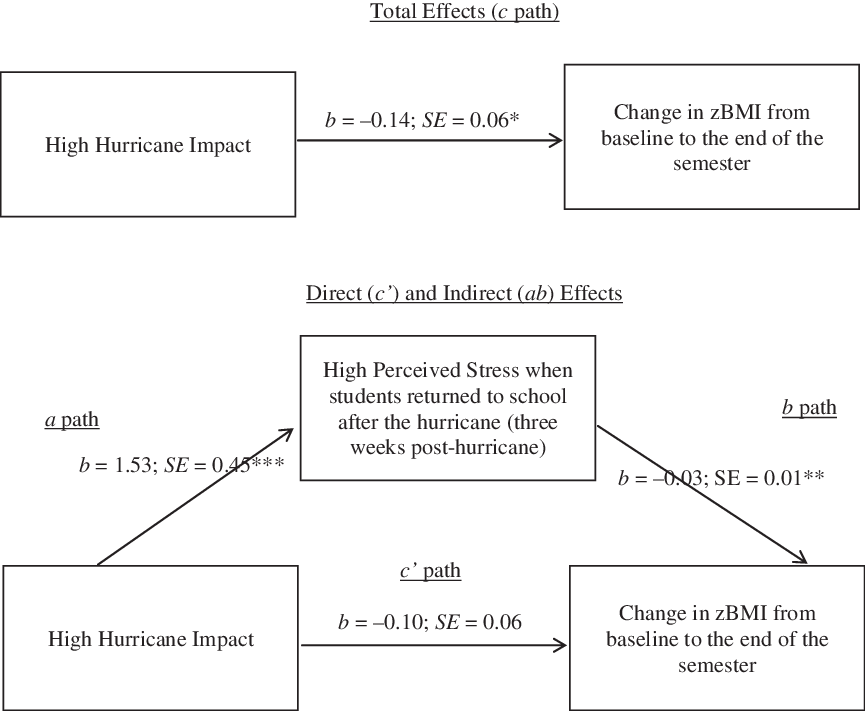
Since perceived stress differed by hurricane impact in the secondary aim of the study, mediation analyses were conducted using perceived stress from when students returned to school (3 weeks post-hurricane), the end of the quarter (8 weeks post-hurricane), and the end of the semester (15 weeks post-hurricane). For all 3 models, the change in zBMI from baseline to the end of the semester was chosen as the dependent variable of interest because a significant hurricane impact group by time interaction was found from baseline to the end of the semester in the primary aim (F(1171)=2.85, p < 0.05). In addition, the end of the semester is the most long-term time point of the study. Neither perceived stress at the end of the quarter or at the end of the semester mediated the relationship between hurricane impact and changes in zBMI. However, the bootstrap test of indirect effects indicated perceived stress from when students returned to school mediated the association between hurricane impact and changes in zBMI (β = −0.05 [−0.14, −0.004]). The total effect between hurricane impact and changes in zBMI (c path: β −0.14, p < 0.05) was reduced and was no longer significant when perceived stress was included in the model (c’ path: β =−0.10, p = 0.13) (Figure 2).
Covariate-adjusted (free/reduced school meal eligibility) model of the indirect effect (ab) of hurricane impact on change in zBMI from baseline to the end of the semester through perceived stress when adolescents returned to school. ***p<0.001, **p<0.01, *p<0.05

DISCUSSION
This study prospectively examined the impact of Hurricane Harvey on the growth of low income, ethnic-minority adolescents. While the zBMI of students less severely impacted by the hurricane had stabilized by the end of the semester, the zBMI of students severely impacted by the hurricane continued to decrease. Furthermore, the difference between impact groups grew larger over the course of the semester.
Unintentional weight loss among youth is an important indicator of many medical conditions including cancer and many gastrointestinal disorders. Reference Wong41 Students highly impacted by the hurricane had a mean decrease in zBMI of 0.09 over the course of a school semester. While this unintentional zBMI decrease is not near the magnitude at which growth velocity becomes a concern, 42 it approaches the average intentional 0.13 zBMI decrease achieved in obesity interventions. Reference Al-Khudairy, Loveman and Colquitt43 This rate of unintentional zBMI decrease is especially concerning because it occurred during adolescence, when rapid growth and development is expected. Reference Sawyer, Afifi and Bearinger20,Reference Chulani and Gordon21
While there are many reasons for an adolescent to not maintain an appropriate growth pattern, psychosocial factors such as poverty often play a role. Reference Homan6 From a social vulnerabilty perspective, economic disadvantage likely increases individuals’ risk of exposure to a natural disaster and decreases individuals’ ability to prepare for, respond to, and recover from the disaster. Reference Cutter, Boruff and Shirley3 Shifts in weight over the semester could be reflective of this phenomenon. The economic disadvantage experienced by the majority of this sample prior to the hurricane may have been particularly exacerbated for those severly impacted by the hurricane. Although no differences in poverty were observed between groups prior to the hurricane, the use of free/reduced school meal eligibility as a proxy for poverty may not be sensitive enough to capture financial differences between impact groups.
The perceived stress of students highly impacted by the hurricane remained significantly higher than that of students less impacted throughout the semester. This finding provides support for the way students were classified into low and high hurricane impact groups, as it would be expected that highly impacted students would have higher perceived stress. The sustained elevated stress level may indicate that those highly impacted had greater difficulty recovering from the hurricane, which is consistent with this group’s decrease in zBMI. However, because perceived stress was only assessed following the hurricane, no comparisons can be made to stress levels prior to the hurricane. This limits the extent to which the higher level of perceived stress among those highly impacted can be directly attributed to this group’s hurricane experience.
In order to test the impact of perceived stress on changes in zBMI more directly, we conducted a mediation analysis. This analysis provided clear evidence that the higher level of perceived stress immediately following the hurricane was a more direct predictor of decreases in zBMI than experiencing 1 or more stressful events during the hurricane. Although specific causes of students’ stress are not known, it is likely that the stress reported when students returned to school was related to the hurricane. The lack of statistical change in perceived stress over time does not necessarily indicate that the stressors did not change over the semester (stress from exams, teenage dating drama, etc is likely to fluctuate). The types of stress experienced at the end of the semester were not predictive of changes in zBMI; whereas, the types of stress experienced immediately following the hurricane led to unintentional weight loss that persisted at the end of the semester. It is imperative that health professionals recognize that stress experienced immediately following a hurricane can impact students’ health months later.
Although not statistically significant, by the time students had returned to school there was a clear distinction in zBMI trajectory based on the degree to which students were impacted by the hurricane. As the decrease in zBMI experienced by those highly impacted persisted throughout the semester, a student’s change in zBMI after returning to school may be an important screening metric for schools to identify students at risk for poor health. Health screening in schools is especially important for the predominately low income, minority sample in this study as this population may be particularly vulnerable following a hurricane, 2 and is unlikely to seek medical care. Reference Mullins, Blatt, Gbarayor, Yang and Baquet44
Long-term results are needed to better understand the implications which the findings of this study have on health. If the differences found at the end of the semester persists, the unintentional weight loss experienced by those in the highly impacted group could reach a magnitude warranting intervention. Conversely, it is possible that a weight rebound will occur in which individuals regain weight in excess of what was lost. This type of weight regain is typical with rapid weight loss and restrictive dieting, Reference Drenick and Johnson45-Reference Paisey, Frost and Harvey47 and has been associated with an accumulation of visceral adipose tissue, Reference Banasik, Walker, Randall, Netjes and Foutz48 which may increase an individual’s risk for developing type 2 diabetes and cardiovascular disease. Reference Liu, Fox and Hickson49,Reference Wang, Rimm, Stampfer, Willett and Hu50 Lastly, it is possible that weight shifts among those highly impacted by the hurricane will stabilize just as those of the less impacted had by the end of the semester. This would be consistent with an epidemiological study following older youths (13–15 years old) after the Great East Japan Earthquake which found no significant difference in weight status 4 years post-disaster. Reference Nomura, Blangiardo, Tsubokura, Ochi and Hodgson26
Understanding the impact of the hurricane on the health of this high-risk population is crucial for preventing health issues in the future were another disaster to hit. However, the results of this study may not be generalizable to other populations. Results may not apply to students who did not take PE classes, and caution should be taken when comparing these results to that of disasters in other geographic regions. This study’s prospective design increases the likelihood that zBMI changes can be attributed to the immediate hurricane period. However, the lack of a comparison group of students who did not experience the hurricane limits the understanding of the hurricane impact and zBMI relationship. Similarly, due to the relatively homogenous study population and sample size, differences in hurricane impact across income levels or ethnicities are not able to be adequately assessed.
There are many ways to assess the impact of a hurricane. The assessment in this study focused on physical impacts rather than mental health impacts. Future work is therefore needed to understand the relationship between mental health, stress, and growth trajectory following hurricanes. The measure used to assess energy balance behaviors did not permit the calculation of energy and may not be sensitive enough to detect changes in diet and physical activity that likely occurred to cause zBMI changes. Differences in zBMI due to changes in height (rather than weight) at 3 and 8 weeks post-hurricane could not be observed because height was assessed only at baseline and at the end of the semester. However, there were no differences in height between groups at baseline and it was expected that each group would grow in height similarly. Also, even at peak growth velocity, increases in height are expected to be relatively small over an 8 week period (< 1.5 centimeters). Reference Chulani and Gordon21 It is also possible that unobserved baseline differences between those more severely impacted and those less impacted by the hurricane could have contributed to the zBMI differences seen in this study.
CONCLUSION
To the authors’ knowledge, this is the first study to prospectively analyze youth growth following a hurricane and offer some of the only evidence from which disaster response policies can be generated. The continued unintentional decrease in zBMI at the end of the semester among highly impacted students indicates a clear need to continue a long term monitoring of students’ growth. Health professionals and school staff should be aware that stress experienced immediately following the hurricane continued to impact growth 15 weeks post-hurricane. Unintentional changes in weight can be indicative of stress and may be a sign that the children need assistance. Objective measures, such as the assessment of zBMI changes, are important among pediatric populations as children may not express their needs verbally. Schools can play an important role in monitoring and screening student health needs following a natural disaster.
Abbreviations
- BMI
-
Body Mass Index
- zBMI
-
Standardized Body Mass Index
- PE
-
Physical Education
- MVPA
-
Moderate-Vigorous Physical Activity
- LPA
-
Light Physical Activity
- SPAN
-
School Physical Activity and Nutrition Questionnaire
Author Contributions
Katherine R Arlinghaus and Craig A Johnston conceptualized and designed the study. Katherine R Arlinghaus collected the data. Katherine R Arlinghaus and Stacey L Gorniak conducted statistical analysis. Katherine R Arlinghaus wrote the first draft with contributions from Stacey L Gorniak, Daphne C Hernandez, and Craig A Johnston. All authors reviewed and commented on subsequent drafts.
Funding Information
This work was funded in part by the Sugar Association via the Academy of Nutrition and Dietetics Research Dietetic Practice Group, and the Department of Health and Human Performance at the University of Houston.
Conflict of Interest
The authors declare that there is no conflict of interest.