Introduction
Attention deficit hyperactivity disorder (ADHD) is a neurodevelopmental disorder that is characterized by inattention, impulsivity, and hyperactivity (Biederman & Faraone, Reference Biederman and Faraone2005). With an estimated heritability of approximately 76%, ADHD is generally considered to have a genetic basis (Faraone et al. Reference Faraone, Perlis, Doyle, Smoller, Goralnick, Holmgren and Sklar2005). The heritability estimates account not only for the main effects of genetic factors but also for gene–environment interactions. Thus, the entire heritability of the disease may be attributable to the presence or absence of a necessary environmental co-factor. From the epigenetic perspective, environmental factors can modulate gene expression without causing alterations in the DNA sequence and without affecting protein function in the brain (Elia et al. Reference Elia, Laracy, Allen, Nissley-Tsiopinis and Borgmann-Winter2012). DNA can be methylated via DNA methyltransferases; methylation typically occurs at cytosine-guanine dinucleotides (CpG) and represses gene activity (Bird, Reference Bird1986; Goll & Bestor, Reference Goll and Bestor2005). DNA methylation of cytosines in CpG sites is thought to be the most representative of the broader epigenetic modification of a given locus (Hochberg et al. Reference Hochberg, Feil, Constancia, Fraga, Junien, Carel, Boileau, Le Bouc, Deal, Lillycrop, Scharfmann, Sheppard, Skinner, Szyf, Waterland, Waxman, Whitelaw, Ong and Albertsson-Wikland2011).
It has been reported that environmental stress, such as perinatal stress, social environment, environmental toxins, drugs, or childhood adversities produced persistent changes in methylation patterns of the promoters of several genes (Rampon et al. Reference Rampon, Jiang, Dong, Tang, Lockhart, Schultz, Tsien and Hu2000; Bollati et al. Reference Bollati, Baccarelli, Hou, Bonzini, Fustinoni, Cavallo, Byun, Jiang, Marinelli, Pesatori, Bertazzi and Yang2007; Cheng et al. Reference Cheng, Liao, Hsiung, Chen, Liao and Chen2008; Roth et al. Reference Roth, Lubin, Funk and Sweatt2009; Devlin et al. Reference Devlin, Brain, Austin and Oberlander2010; Kang et al. Reference Kang, Kim, Stewart, Kim, Bae, Kim, Shin, Shin and Yoon2013; Szyf, Reference Szyf2013). This environmental stress (e.g. perinatal stress, childhood adversities) is known to be a risk factor for ADHD (Merry & Andrews, Reference Merry and Andrews1994; Ben Amor et al. Reference Ben Amor, Grizenko, Schwartz, Lageix, Baron, Ter-Stepanian, Zappitelli, Mbekou and Joober2005; Grizenko et al. Reference Grizenko, Shayan, Polotskaia, Ter-Stepanian and Joober2008; Ouyang et al. Reference Ouyang, Fang, Mercy, Perou and Grosse2008). Additionally, it has been reported that certain types of environmental stress contribute to the specific ADHD phenotype. For example, Grizenko et al. (Reference Grizenko, Shayan, Polotskaia, Ter-Stepanian and Joober2008) reported that children with the ADHD combined subtype are exposed to more stress in utero than are children with the ADHD inattentive subtype. Another study found that children with the inattentive subtype were less likely to have received regular prenatal check-ups and were more likely to have experienced postnatal medical illness compared to children who had the combined subtype (Park et al. Reference Park, Cho, Kim, Shin, Yoo, Min Oh, Hyun Han, Hoon Cheong and Kim2014).
Recently, van Mil et al. (Reference van Mil, Steegers-Theunissen, Bouwland-Both, Verbiest, Rijlaarsdam, Hofman, Steegers, Heijmans, Jaddoe, Verhulst, Stolk, Eilers, Uitterlinden and Tiemeier2014) found that lower DNA methylation levels of the dopamine receptor D4 gene and the serotonin transporter gene (SLC6A4 or 5-HTT), which were assessed at birth using cord blood samples, were associated with the child having more ADHD symptoms at 6 years. The DNA methylation status of neuronal genes at birth may reflect prenatal exposure to adverse environmental factors, such as maternal smoking (Langley et al. Reference Langley, Rice, van den Bree and Thapar2005) or stress (Grizenko et al. Reference Grizenko, Shayan, Polotskaia, Ter-Stepanian and Joober2008), which are risk factors of ADHD. However, DNA methylation status at birth cannot reflect the epigenetic effect of postnatal factors on the risk of exhibiting ADHD symptoms. By contrast, the postnatal methylation status may represent both antenatal and postnatal risk factors. In addition, the precise manner in which DNA methylation affects the neural system, leading to ADHD symptoms, has yet to be established.
In this study, we measured DNA methylation patterns by using the peripheral blood of children. These patterns may reflect exposure to postnatal as well as prenatal exposure to an adverse environment. Additionally, we investigated whether the DNA methylation patterns of SLC6A4 were associated with clinical characteristics and brain cortical thicknesses (CT) of children with ADHD. The SLC6A4 promoter region was selected because the SLC6A4 gene has a critical role in the association between childhood adversities and increased susceptibility to a lifetime risk for many psychiatric disorders, such as depression (Jans et al. Reference Jans, Riedel, Markus and Blokland2007) and alcohol dependence (Laucht et al. Reference Laucht, Treutlein, Schmid, Blomeyer, Becker, Buchmann, Schmidt, Esser, Jennen-Steinmetz, Rietschel, Zimmermann and Banaschewski2009). Additionally, this region is one of the two regions in which DNA methylation levels were associated with ADHD symptoms in the previous study by van Mil et al. (Reference van Mil, Steegers-Theunissen, Bouwland-Both, Verbiest, Rijlaarsdam, Hofman, Steegers, Heijmans, Jaddoe, Verhulst, Stolk, Eilers, Uitterlinden and Tiemeier2014). We hypothesized that the DNA methylation status of SLC6A4 would be associated with worse inattentive and/or hyperactive-impulsive symptoms and decreased regional CT values in children with ADHD.
Materials and method
Participants
A total of 102 children with ADHD (aged 6–15 years) were recruited from Seoul National University Hospital in Seoul, Korea, between May 2012 and April 2014. ADHD patients with an intelligence quotient (IQ) <70; a past or an ongoing history of tic disorder, obsessive compulsive disorder, language disorder, learning disorder, convulsive disorder, pervasive developmental disorder, schizophrenia, bipolar disorder, or brain damage; or a recent history of taking stimulants or atomoxetine over the past 4 weeks were excluded from the study. The study protocol was approved by the institutional review board for human subjects at Seoul National University Hospital. Detailed information about the study was given to parents and children, and written informed consent was obtained from both parents and children prior to study entry.
Diagnostic and clinical evaluations
We assessed the presence of ADHD and other psychiatric disorders by using a semi-structured diagnostic interview, the Kiddie-Schedule for Affective Disorders and Schizophrenia – Present and Lifetime version (K-SADS-PL). The validity and reliability of the original and Korean versions of the K-SADS-PL have been established previously (Kaufman et al. Reference Kaufman, Birmaher, Brent, Rao, Flynn, Moreci, Williamson and Ryan1997; Kim et al. Reference Kim, Cheon, Kim, Chang, Yoo, Kim, Cho, Seo, Bae, So, Noh, Koh, McBurnett and Leventhal2004). The parents completed the Korean version of the ADHD Rating Scale-IV (ARS; So et al. Reference So, Noh, Kim, Ko and Koh2002), and the children participated in a computerized continuous performance test (CPT) that measured their levels of attention and response inhibition (Greenberg & Waldman, Reference Greenberg and Waldman1993). The CPT was standardized for age among Korean children and adolescents (Shin et al. Reference Shin, Cho, Chun and Hong2000), and four variables were measured: omission errors (a measure of inattention), commission errors (a measure of impulsivity), response time (a measure of information processing speed), and response time variability (a measure of the consistency of attention). Higher T scores indicate worse performance.
Quantitative DNA methylation analysis
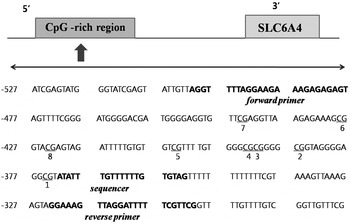
Quantitative DNA methylation analysis was performed as described previously (Kang et al. Reference Kang, Kim, Stewart, Kim, Bae, Kim, Shin, Shin and Yoon2013), with slight modification. In brief, genomic DNA was extracted from whole blood using an Intron_G-DEX™ IIb Genomic DNA Extraction kit (Intron, Korea). DNA was bisulfite-treated using an EX DNA Methylation-Lighting kit (Zymo Research, USA). A 185 bp fragment of the SLC6A4 promoter was amplified by PCR from bisulfite-treated DNA using the primers listed in Fig. 1. The following thermal profile was applied using a PTC-220 DYAD™ thermal cycler (Bio-Rad, USA): 10 min at 95 °C for initial denaturation, followed by 45 cycles of 95 °C for 30 s, 54 °C for 30 s, and 72 °C for 30 s, with a final extension at 72 °C for 5 min. PCR products were sequenced using the PyroMark ID Pyrosequencing system (Qiagen, USA) according to the manufacturer's protocol with the two types of sequencing primers listed in Fig. 1. The methylation percentage at each CpG region was quantified by using Pyro Q-CpG software (Qiagen).
The schema of serotonin transporter gene (SLC6A4) promoter region for DNA methylation analyses. The CpGs are underlined and numbered. Forward and backward primers and sequencer appear in bold.

SLC6A4 genotype
Serotonin-transporter-linked polymorphic region (5-HTTLPR) in SLC6A4 was amplified by using a PCR method described previously (Heils et al. Reference Heils, Teufel, Petri, Stober, Riederer, Bengel and Lesch1996). The 484-bp fragment was designated as an S allele, and the 528 bp fragment was designated as an L allele. Frequency distributions conformed to Hardy–Weinberg equilibrium.
Image acquisition and processing
Whole-brain structural MRI was acquired with a T1-weighted magnetization-prepared rapid acquisition gradient echo (MPRAGE) scan on a 3T Siemens scanner (Siemens Magnetom Trio Tim Syngo MR B17, Germany). Images were acquired with the following parameters: TR = 1900 ms, TE = 3.13 ms, inversion time 900 ms, flip angle = 9°, voxel size 0.9 mm3, FOV = 230 mm, slices 176.
T1-weighted images were registered in the ICBM 152 average template using linear transformation and corrected for intensity non-uniformity artifacts. The images were then classified into white matter (WM), grey matter (GM), cerebrospinal fluid (CSF) and background using an advanced neural net classifier. Hemispheric cortical surfaces were automatically extracted from each T1-weighted image using the Constrained Laplacian-based Automated Segmentation with Proximities (CLASP) algorithm, which reconstructed the inner cortical surface by deforming a spherical mesh onto the WM/GM boundary and then expanding the deformable model to the GM/CSF boundary (MacDonald et al. Reference MacDonald, Kabani, Avis and Evans2000; Kim et al. Reference Kim, Singh, Lee, Lerch, Ad-Dab'bagh, MacDonald, Lee, Kim and Evans2005). The reconstructed hemispheric cortical surfaces consisted of 40 962 vertices, each forming high-resolution meshes. The inner and outer cortical surfaces had the same number of vertices, and there was a close correspondence between the counterpart vertices of the inner and outer cortical surfaces. CT was defined using the t-link method, which captures the Euclidean distance between these linked vertices (MacDonald et al. Reference MacDonald, Kabani, Avis and Evans2000; Kim et al. Reference Kim, Singh, Lee, Lerch, Ad-Dab'bagh, MacDonald, Lee, Kim and Evans2005). For group analysis, each individual thickness map was transformed to a surface group template using a 2-dimensional (2D) surface-based registration that aligns variable sulcal folding patterns through sphere-to-sphere warping (MacDonald et al. Reference MacDonald, Kabani, Avis and Evans2000; Lerch et al. Reference Lerch, Pruessner, Zijdenbos, Hampel, Teipel and Evans2005)
Statistical analysis
First, we explored whether individual genetic variants may underlie variation in DNA methylation levels. The methylation percentages at each CpG site were compared according to the SLC6A4 genotype (SS v. SL v. LL) by using analysis of variance (ANOVA).
Second, we investigated the associations between SLC6A4 promoter methylation percentages and clinical and neuropsychological characteristics of ADHD. Multiple linear regression models were constructed with the methylation percentages at each CpG site (continuous variable) as the predictive variables and the subscores on the ARS or CPT (continuous variable) as the dependent variables, after adjusting for age, sex, and IQ.
SPSS version 21.0 (SPSS Inc., USA) was used to perform all the statistical analyses, and a p value <0.01 was considered significant, which provided some control for type I errors.
To investigate the correlation between SLC64 methylation percentages and brain CT, multiple regression analyses were performed with SLC64 methylation percentages, age, sex, IQ, and intracranial volume as independent variables, and each vertex of CT was used as a dependent variable. All 81 924 of the vertices were used in the statistical analysis. We utilized SurfStat (by K. Worsley; http://www.math.mcgill.ca/keith/surfstat/), which is a MATLAB toolbox (MathWorks Inc., USA) for the statistical analysis of multivariate surface data using linear mixed-effects models. We employed thresholding in our resulting statistical maps (uncorrected p < 0.001).
Results
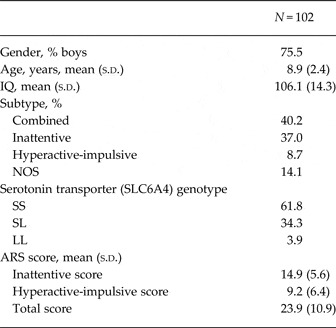
A total of 102 children with ADHD (77 males, 25 females, mean age 8.9 ± 2.4 years) participated in this study. The characteristics of the participants are presented in Table 1.
Characteristics of the study participants

NOS, Not otherwise specified; ARS, ADHD Rating Scale.
There were no significant differences between the methylation percentages at each CpG site and their average values according to the SLC6A4 allele type (Supplementary Table S1).
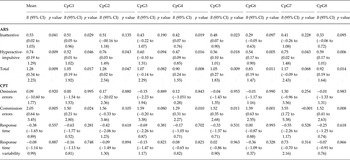
We examined the existence of an association between SLC6A4 promoter methylation levels and clinical characteristics and regional CT of ADHD. After adjusting for age, sex, and IQ, higher methylation status in the CpG6 and CpG8 regions was significantly associated with higher hyperactive-impulsive scores; higher methylation status in the CpG4 and CpG5 regions was significantly associated with higher total ARS scores; higher methylation status in the CpG6, CpG7, and CpG8 regions was significantly associated with more commission errors; and higher mean SLC6A4 promoter methylation levels were associated with higher hyperactive-impulsive scores, higher total ARS scores, and higher commission error scores (Table 2).
Associations between serotonin transporter (SLC6A4) promoter methylation percentages and clinical and neuropsychological characteristics of ADHD (N = 102)

ADHD, Attention deficit hyperactivity disorder; CI, confidence interval; ARS, ADHD rating scale; CPT, continuous performance test.
B (unstandardized regression coefficients) represents the change in the ARS or CPT scores for every 1-unit increase in methylation percentages.
Multiple regression analyses are adjusted for age, sex, and IQ.
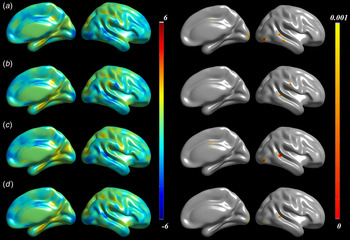
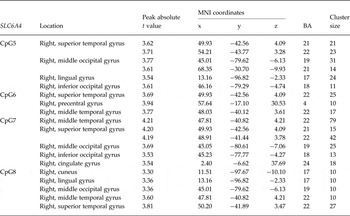
Additionally, a negative correlation was observed between methylation levels in the CpG5, CpG6, CpG7, and CpG8 regions and CT values in the right occipito-temporal regions (Fig. 2, Table 3).
Correlational analysis between cortical thickness values and SLC6A4 promotor methylation levels in the CpG5 (a), CpG6 (b), CpG7 (c), and CpG8 (d) in children with attention deficit hyperactivity disorder, controlling for age, sex, IQ , and intracranial volume. Statistical t maps with t value ranges of −6.0 to 6.0. Negative correlations are shown in blue and positive correlations are shown in red (left). Negative correlations were observed at an uncorrected p < 0.001 (right).

Areas of negative correlation of cortical thickness values and SLC6A4 promoter methylation levels in children with ADHD [p < 0.001 (uncorrected)]

MNI, Montreal Neurological Institute; BA, Brodmann area .
Clusters whose sizes are <10 are eliminated.
Note that all MNI coordinates of maximum t values are selected in the significant regions.
Discussion
The principal findings from this study of patients with ADHD were that a higher SLC6A4 promoter methylation status was significantly associated with worse clinical symptoms (more hyperactive-impulsive symptoms and more commission errors) and decreased regional CT. Hypermethylation of the gene promoter is recognized as reducing respective gene expression (Philibert et al. Reference Philibert, Madan, Andersen, Cadoret, Packer and Sandhu2007). A study by Wang et al. (Reference Wang, Szyf, Benkelfat, Provencal, Turecki, Caramaschi, Cote, Vitaro, Tremblay and Booij2012) reported that increased methylation levels of the SLC6A4 promoter in blood cells were associated with decreased levels of SLC6A4 RNA and brain serotonin synthesis. The cited study suggests that peripheral DNA methylation of the serotonin transporter may be a marker of central serotonin transporter function (Wang et al. Reference Wang, Szyf, Benkelfat, Provencal, Turecki, Caramaschi, Cote, Vitaro, Tremblay and Booij2012). In reports describing epigenetic studies of patients with psychiatric disorders (e.g. depressive disorder, alcohol dependence, schizophrenia), patients were more likely to have hypermethylated neuronal candidate genes, including SLC6A4, than non-patients (Jans et al. Reference Jans, Riedel, Markus and Blokland2007; Laucht et al. Reference Laucht, Treutlein, Schmid, Blomeyer, Becker, Buchmann, Schmidt, Esser, Jennen-Steinmetz, Rietschel, Zimmermann and Banaschewski2009; Ikegame et al. Reference Ikegame, Bundo, Sunaga, Asai, Nishimura, Yoshikawa, Kawamura, Hibino, Tochigi, Kakiuchi, Sasaki, Kato, Kasai and Iwamoto2013). This is consistent with our study, where we found a positive association between SLC6A4 promoter methylation levels and more severe symptoms of ADHD.
In particular, commission errors are indicators of a deficit in response inhibition, which is clinically presented as hyperactivity, poor impulse control, and behavioural disinhibition (Barkley, Reference Barkley1997; Aron & Poldrack, Reference Aron and Poldrack2005). Therefore, we suggest that hypermethylation of the SLC6A4 promoter reduces brain serotonin synthesis, which may affect behavioural disinhibition and present as more hyperactive-impulsive symptoms and more commission errors in children with ADHD. This suggestion is plausible because central serotonin function is an important component of normal behavioural inhibition that controls impulsive responding (Evenden, Reference Evenden1999; Winstanley et al. Reference Winstanley, Eagle and Robbins2006). For example, premature response control on the rat 5-choice serial reaction-time task and human CPT is influenced by 5-HT receptor manipulations and central 5-HT depletion (Carli et al. Reference Carli, Baviera, Invernizzi and Balducci2006; Dougherty et al. Reference Dougherty, Marsh, Mathias, Dawes, Bradley, Morgan and Badawy2007; Walderhaug et al. Reference Walderhaug, Landro and Magnusson2008). Furthermore, 5-HT depletion also impaired go/no-go inhibition in rats and led to hostile aggression in children with ADHD (Harrison et al. Reference Harrison, Everitt and Robbins1997; Zepf et al. Reference Zepf, Holtmann, Stadler, Demisch, Schmitt, Wockel and Poustka2008). However, it should be noted that we could not determine whether the relationship with symptom severity holds across the full range or only in more severe cases due to the lack of a population sample with a broad range of ADHD symptoms.
Our results showed negative correlations between SLC6A4 promoter methylation levels and CT values in the right temporal gyri and suggest that hypermethylation of the SLC6A4 promoter may play an additional role in developmental delays or abnormal development in these brain regions. The right temporal region is a cortical region that is closely related to disruptive behaviour disorders and poor impulse control (Wahlund & Kristiansson, Reference Wahlund and Kristiansson2009; Fahim et al. Reference Fahim, He, Yoon, Chen, Evans and Perusse2011). Therefore, our results suggest that hypermethylation of the SLC6A4 promoter may have a negative impact on temporal maturation, possibly increasing the risk and the severity of ADHD. However, we could not determine whether the relationship with CT values is general or specific to ADHD due to the lack of a control group in this study.
Contrary to our results, van Mil et al. (Reference van Mil, Steegers-Theunissen, Bouwland-Both, Verbiest, Rijlaarsdam, Hofman, Steegers, Heijmans, Jaddoe, Verhulst, Stolk, Eilers, Uitterlinden and Tiemeier2014) reported that DNA methylation levels of SLC6A4 using cord blood samples were negatively associated with ADHD symptom scores of children at age 6 years. These differences may be accounted for by methodological differences in the sampling period (at birth v. childhood), sample characteristics (population-based birth cohort v. ADHD sample), and measures (child behavior checklist (CBCL) v. ARS). The biggest difference between the previous study and present study is that we used peripheral blood samples of children, while the previous study used cord blood samples of newborn babies. Unlike DNA methylation status determined with cord blood samples at birth, the DNA methylation status determined with peripheral blood samples in childhood may be influenced by a variety of postnatal factors, including childhood adversities, as well as antenatal factors (Rampon et al. Reference Rampon, Jiang, Dong, Tang, Lockhart, Schultz, Tsien and Hu2000; Kang et al. Reference Kang, Kim, Stewart, Kim, Bae, Kim, Shin, Shin and Yoon2013; Szyf, Reference Szyf2013). Therefore, the previous study suggests that prenatal SLC6A4 hypomethylation related to prenatal stress increases the risk of ADHD, whereas the present study suggests that childhood SLC6A4 hypermethylation related to the prenatal and postnatal adverse environment is associated with certain phenotypes of ADHD (behavioural disinhibition and poor impulse control).
Our study has some limitations that should be noted. First, the cross-sectional nature of our design did not allow for causal associations to be tested robustly. Second, there was no control group. To determine whether the influence of SLC6A4 promoter methylation on clinical symptoms and CT is specific to ADHD patients, we should have obtained data from healthy controls. Third, the sample size of the present study was relatively small; thus, the results should be interpreted with caution. Finally, due to resource constraints, methylation status could only be investigated for one CpG island of the SLC6A4 gene. Methylation status that was measured for this single island can only act as a proxy for the methylation status of the whole gene.
Conclusions
Our preliminary findings suggest that SLC6A4 methylation status may be associated with the severity of hyperactive-impulsive symptoms and related brain changes in children with ADHD. Future studies that use a larger sample size and a control group and examine multiple CpG islands of the SLC6A4 gene are required to corroborate these results.
Supplementary material
For supplementary material accompanying this paper visit http://dx.doi.org/10.1017/S003329171500094X.
Declaration of Interest
None
Acknowledgements
This work was supported by the Basic Science Programme and the Brain Research Programme through the National Research Foundation of Korea (NRF) grant funded by the Korean Govrnment (MSIP) (NRF-2013R1A1A3008158 and NRF-2014M3C7A1046050) and by a grant from the Korean Health Technology R&D Project, Ministry of Health & Welfare, Republic of Korea (No. A120013).